A PowerPoint presentation on
SELECTIVE LASER MELTING (SLM)
IN ADDITIVE MANUFACTURING.
BY:
N.Sashi Kumar (III B.Tech )-13121A03A3
N.V.Rohith (III B.Tech)-13121A03A2
Dept. of Mechanical Engineering,SVEC.
Contents
 Introduction
 Process
 Printing methods
 Why SLM?
 SLM parameters
 Polymer properties for SLM
 Applications
 Conclusion
Introduction
 3-D Printing.
 Type of Industrial Robot.
 Encompasses process like Extrusion, Sintering.
 Process refers to sequential deposit of material on to powder bed
using computer control.
Process
 3-D Modelling.
 Slicing.
 Printing (depositing material).
 Inspection.
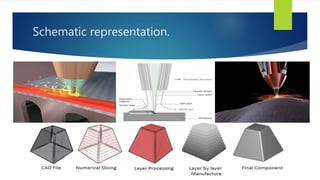
Schematic representation.
Printing Methods
 SELECTIVE LASER MELTING (SLM).
 SELECTIVE LASER SINTERING.
 FUSED FILAMEN FABRICATION.
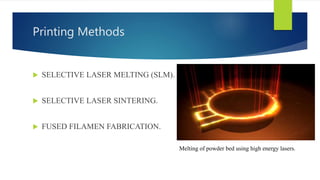
Melting of powder bed using high energy lasers.
What is SLM?
 The additive manufacturing technology.
 SLM make it possibility to metal components layer by layer according to a 3D-
CAD models.
 Complex geometrics with out need of pre-production costs.
 Melts the material on the powder bed layer by layer.
Why SLM?
 Alloys of Titanium, cobalt chrome, aluminum can be fabricated.
 No compromise in accuracy.
 No need of any auxiliary holding devices – Melting on powder bed.
 Completely melts the powder instead of fusing granules.
 Obtains mechanical properties similar to conventional manufacturing.
Parameters that effect the SLM
 Atmosphere
 Temperature
 Powder
 Laser power & thickness
 -ve effect on mechanical properties
 oxygen is responsible for pores
 SLM atmosphere must equipped with N, Ar, He.
Laser Power & Thickness
 Laser intensity is different for different types of materials
 Laser thick ness is associated with granularity and type of
material
Atmosphere
Temperature
The temperature is set between 220c and 3000c.
It is easier to melt powder layer with laser
Powder
Layer thickness 20µm to 100µm and Spherical
Building speed, density of parts produced
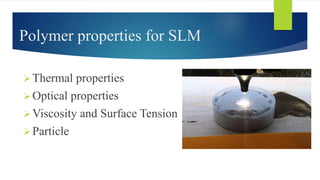
Polymer properties for SLM
Thermal properties
Optical properties
Viscosity and Surface Tension
Particle
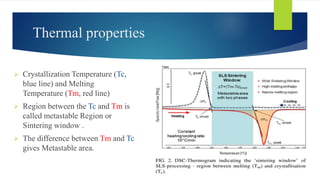
Thermal properties
 Crystallization Temperature (Tc,
blue line) and Melting
Temperature (Tm, red line)
 Region between the Tc and Tm is
called metastable Region or
Sintering window .
 The difference between Tm and Tc
gives Metastable area.
Optical properties
The powder should be capable of absorbing the
energy of wavelength emitted from laser
Viscosity And Surface tension
Zero viscosity and low surface tension are
essential for successful SLM processing
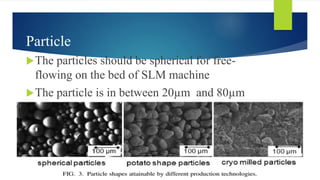
Particle
The particles should be spherical for free-
flowing on the bed of SLM machine
The particle is in between 20µm and 80µm
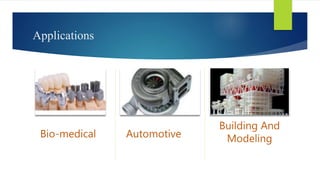
Applications
Bio-medical Automotive
Building And
Modeling
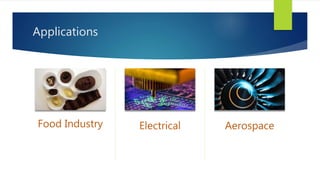
Applications
Food Industry Electrical Aerospace
Conclusion
SLM offers a great potential to solve the
challenges of serving individual customer requirements,
on the one hand, and high quality as well as low cost
products
selective laser machining in additive manufacturing

selective laser machining in additive manufacturing

  • 1.
    A PowerPoint presentationon SELECTIVE LASER MELTING (SLM) IN ADDITIVE MANUFACTURING. BY: N.Sashi Kumar (III B.Tech )-13121A03A3 N.V.Rohith (III B.Tech)-13121A03A2 Dept. of Mechanical Engineering,SVEC.
  • 2.
    Contents  Introduction  Process Printing methods  Why SLM?  SLM parameters  Polymer properties for SLM  Applications  Conclusion
  • 3.
    Introduction  3-D Printing. Type of Industrial Robot.  Encompasses process like Extrusion, Sintering.  Process refers to sequential deposit of material on to powder bed using computer control.
  • 4.
    Process  3-D Modelling. Slicing.  Printing (depositing material).  Inspection.
  • 5.
  • 6.
    Printing Methods  SELECTIVELASER MELTING (SLM).  SELECTIVE LASER SINTERING.  FUSED FILAMEN FABRICATION. Melting of powder bed using high energy lasers.
  • 7.
    What is SLM? The additive manufacturing technology.  SLM make it possibility to metal components layer by layer according to a 3D- CAD models.  Complex geometrics with out need of pre-production costs.  Melts the material on the powder bed layer by layer.
  • 8.
    Why SLM?  Alloysof Titanium, cobalt chrome, aluminum can be fabricated.  No compromise in accuracy.  No need of any auxiliary holding devices – Melting on powder bed.  Completely melts the powder instead of fusing granules.  Obtains mechanical properties similar to conventional manufacturing.
  • 9.
    Parameters that effectthe SLM  Atmosphere  Temperature  Powder  Laser power & thickness
  • 10.
     -ve effecton mechanical properties  oxygen is responsible for pores  SLM atmosphere must equipped with N, Ar, He. Laser Power & Thickness  Laser intensity is different for different types of materials  Laser thick ness is associated with granularity and type of material Atmosphere
  • 11.
    Temperature The temperature isset between 220c and 3000c. It is easier to melt powder layer with laser Powder Layer thickness 20µm to 100µm and Spherical Building speed, density of parts produced
  • 12.
    Polymer properties forSLM Thermal properties Optical properties Viscosity and Surface Tension Particle
  • 13.
    Thermal properties  CrystallizationTemperature (Tc, blue line) and Melting Temperature (Tm, red line)  Region between the Tc and Tm is called metastable Region or Sintering window .  The difference between Tm and Tc gives Metastable area.
  • 14.
    Optical properties The powdershould be capable of absorbing the energy of wavelength emitted from laser Viscosity And Surface tension Zero viscosity and low surface tension are essential for successful SLM processing
  • 15.
    Particle The particles shouldbe spherical for free- flowing on the bed of SLM machine The particle is in between 20µm and 80µm
  • 16.
  • 17.
  • 18.
    Conclusion SLM offers agreat potential to solve the challenges of serving individual customer requirements, on the one hand, and high quality as well as low cost products