

3D Printing
MANUFACTURING METHOD OF THE FUTURE
A. Introduction
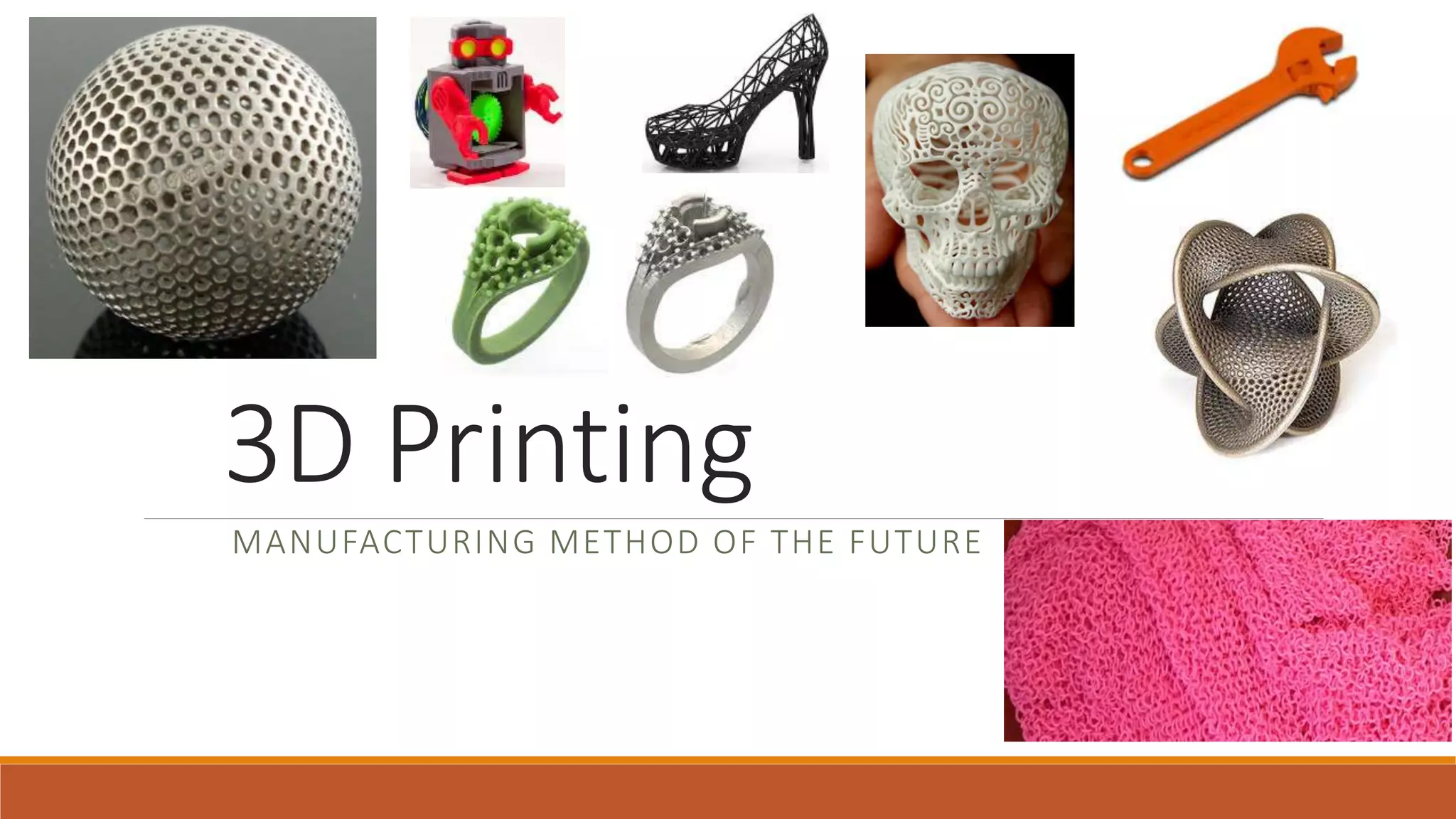
 3D Printing, often referred as Additive Manufacturing, is a new way of making three
dimensional objects by laying down successive layers of materials.
 Like an office printer that puts 2D digital files on a piece of paper, a 3D Printer creates
components by depositing thin layers of material one after another – only where required –
using a digital blue print unit the exact component has been created.
 Can be used as prototype, create replacement parts.
3D Printer can use Metals, Polymers, Composites or other powders to print components.
A. Introduction Cont..
 Additive process can reduce waste and save energy when compared to todays ‘subtractive’
manufacturing process and reduce material costs.
 Potentially benefit to defence, aerospace, automotive, biomedical, consumer products and
metals manufacturing.
 It can make physical models of objects either designed with a CAD program or scanned with a
3D Scanner.
B. Main Technologies
 Fused Deposition Modelling (FDM)
 Selective Laser Sintering (SLS)
 Stereo Lithography (SLA)
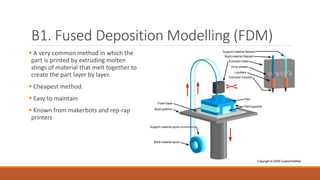
B1. Fused Deposition Modelling (FDM)
 A very common method in which the
part is printed by extruding molten
stings of material that melt together to
create the part layer by layer.
 Cheapest method.
 Easy to maintain
 Known from makerbots and rep-rap
printers
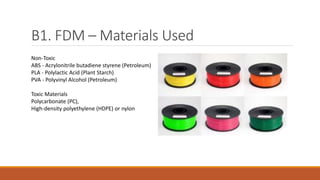
B1. FDM – Materials Used
Non-Toxic
ABS - Acrylonitrile butadiene styrene (Petroleum)
PLA - Polylactic Acid (Plant Starch)
PVA - Polyvinyl Alcohol (Petroleum)
Toxic Materials
Polycarbonate (PC),
High-density polyethylene (HDPE) or nylon
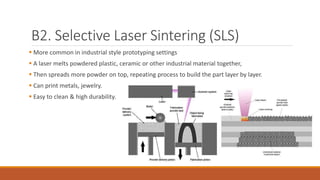
B2. Selective Laser Sintering (SLS)
 More common in industrial style prototyping settings
 A laser melts powdered plastic, ceramic or other industrial material together,
 Then spreads more powder on top, repeating process to build the part layer by layer.
 Can print metals, jewelry.
 Easy to clean & high durability.
B2. SLS – Materials Used
Polymers such as nylon (neat, glass-filled, or with other fillers) or polystyrene, metals including steel,
titanium, alloy mixtures, and composites and green sand..
Nylon 12 PA
Nylon 12 AF(Aluminium)
Nylon 12 GF(Glass)
NyTek 1200 CF (Carbon filled Nylon 12)
NyTek 1100 (White Nylon 11)
FR106 Fire Retardant Nylon 11
http://www.solidconcepts.com/materials/sls-materials/
B3. Stereo Lithography (SLA)
 This method employs a vat of liquid ultraviolet curable
photopolymer "resin" and an ultraviolet laser to build parts'
layers one at a time.
 For each layer, the laser beam traces a cross-section of the
part pattern on the surface of the liquid resin. Exposure to the
ultraviolet laser light cures and solidifies the pattern traced on
the resin and joins it to the layer below.
 Crystal clear printing is possible.
 Using fluid that hardens under light.
 Difficult to maintain, due to resin liquid.
 Expensive Photo curable resin.
 Machine costs from $100000 to $500000
C. Software behind 3D Printing
 By using 3D scanner, object is scanned part by part and create a X3 key file. Put the key file in a
SD card and print it in Makerbot 3d printers.
 Using designer software’s like
 Google sketch up
 Autodesk Inventor
 Solid works
D. Limitations & Applications
 Imagination is the limitation
Questions
Thank you

3d printing

  • 1.
  • 2.
    A. Introduction  3DPrinting, often referred as Additive Manufacturing, is a new way of making three dimensional objects by laying down successive layers of materials.  Like an office printer that puts 2D digital files on a piece of paper, a 3D Printer creates components by depositing thin layers of material one after another – only where required – using a digital blue print unit the exact component has been created.  Can be used as prototype, create replacement parts. 3D Printer can use Metals, Polymers, Composites or other powders to print components.
  • 3.
    A. Introduction Cont.. Additive process can reduce waste and save energy when compared to todays ‘subtractive’ manufacturing process and reduce material costs.  Potentially benefit to defence, aerospace, automotive, biomedical, consumer products and metals manufacturing.  It can make physical models of objects either designed with a CAD program or scanned with a 3D Scanner.
  • 4.
    B. Main Technologies Fused Deposition Modelling (FDM)  Selective Laser Sintering (SLS)  Stereo Lithography (SLA)
  • 5.
    B1. Fused DepositionModelling (FDM)  A very common method in which the part is printed by extruding molten stings of material that melt together to create the part layer by layer.  Cheapest method.  Easy to maintain  Known from makerbots and rep-rap printers
  • 6.
    B1. FDM –Materials Used Non-Toxic ABS - Acrylonitrile butadiene styrene (Petroleum) PLA - Polylactic Acid (Plant Starch) PVA - Polyvinyl Alcohol (Petroleum) Toxic Materials Polycarbonate (PC), High-density polyethylene (HDPE) or nylon
  • 7.
    B2. Selective LaserSintering (SLS)  More common in industrial style prototyping settings  A laser melts powdered plastic, ceramic or other industrial material together,  Then spreads more powder on top, repeating process to build the part layer by layer.  Can print metals, jewelry.  Easy to clean & high durability.
  • 8.
    B2. SLS –Materials Used Polymers such as nylon (neat, glass-filled, or with other fillers) or polystyrene, metals including steel, titanium, alloy mixtures, and composites and green sand.. Nylon 12 PA Nylon 12 AF(Aluminium) Nylon 12 GF(Glass) NyTek 1200 CF (Carbon filled Nylon 12) NyTek 1100 (White Nylon 11) FR106 Fire Retardant Nylon 11 http://www.solidconcepts.com/materials/sls-materials/
  • 9.
    B3. Stereo Lithography(SLA)  This method employs a vat of liquid ultraviolet curable photopolymer "resin" and an ultraviolet laser to build parts' layers one at a time.  For each layer, the laser beam traces a cross-section of the part pattern on the surface of the liquid resin. Exposure to the ultraviolet laser light cures and solidifies the pattern traced on the resin and joins it to the layer below.  Crystal clear printing is possible.  Using fluid that hardens under light.  Difficult to maintain, due to resin liquid.  Expensive Photo curable resin.  Machine costs from $100000 to $500000
  • 10.
    C. Software behind3D Printing  By using 3D scanner, object is scanned part by part and create a X3 key file. Put the key file in a SD card and print it in Makerbot 3d printers.  Using designer software’s like  Google sketch up  Autodesk Inventor  Solid works
  • 11.
    D. Limitations &Applications  Imagination is the limitation
  • 12.
  • 13.