Seismic wave propagation
Er. Ramprasad Kumawat
(M.Tech)
DEPARTMENT OF
CIVIL ENGINEERING
• Seismic waves are waves of energy that travel
through the Earth's layers, and are a result
of earthquakes, volcanic eruptions, magma
movement, large landslides and large man-
made explosions that give out low-frequency
acoustic energy.
• Seismic waves are studied
by geophysicists called seismologists. Seismic
wave fields are recorded by
a seismometer, hydrophone (in water),
or accelerometer.
• The propagation velocity of the waves depends
on density and elasticity of the medium.
Velocity tends to increase with depth and
ranges from approximately 2 to 8 km/s in the
Earth's crust, up to 13 km/s in the deep mantle.
Types
1. Body waves
• 1.1Primary waves
• 1.2Secondary waves
2. Surface waves
• 2.1Rayleigh waves
• 2.2Love waves
• 2.3Stoneley waves
3. P and S waves in Earth's mantle and core
1. Body waves
• Body waves travel through the interior of the
Earth along paths controlled by the material
properties in terms
of density and modulus (stiffness). The density
and modulus, in turn, vary according to
temperature, composition, and material phase.
This effect resembles the refraction of light
waves.
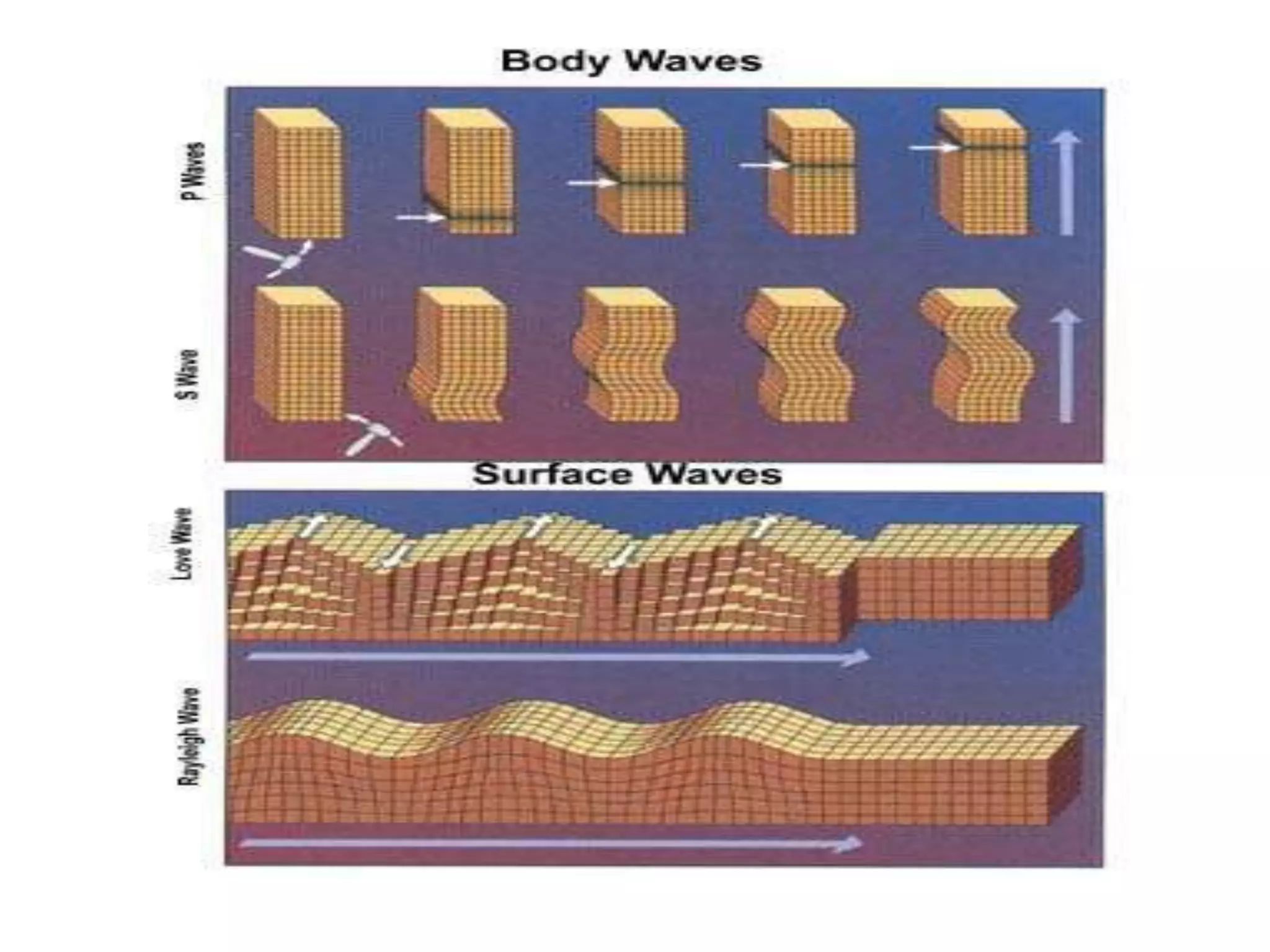
• Two types of particle motion result in two
types of body waves:
a. Primary and
b. Secondary waves.
a. Primary waves
• Primary waves (P-waves) are compression
waves that are longitudinal in nature.
• P waves are pressure waves that travel faster
than other waves through the earth to arrive at
seismograph stations first, hence the name
"Primary".
• These waves can travel through any type of
material, including fluids, and can travel at
nearly 1.7 times faster then the S waves.
• In air, they take the form of sound waves,
hence they travel at the speed of sound.
• Typical speeds are 330 m/s in air, 1450 m/s in
water and about 5000 m/s in granite.
b. Secondary waves
• Secondary waves (S-waves) are shear waves
that are transverse in nature.
• Following an earthquake event, S-waves arrive
at seismograph stations after the faster-moving
P-waves and displace the ground perpendicular
to the direction of propagation.
• Depending on the propagation direction, the
wave can take on different surface
characteristics;
• For example, in the case of horizontally
polarized S waves, the ground moves
alternately to one side and then the other. S-
waves can travel only through solids, as fluids
(liquids and gases) do not support shear
stresses.
• S-waves are slower than P-waves, and speeds
are typically around 60% of that of P-waves in
any given material.
2. Surface waves
• Seismic surface waves travel along the Earth's
surface.
• They can be classified as a form of mechanical
surface waves. They are called surface waves,
as they diminish as they get further from the
surface.
• They travel more slowly than seismic body
waves (P and S). In large earthquakes, surface
waves can have an amplitude of several
centimeters.
2.1 Rayleigh waves
• Rayleigh waves, also called ground roll, are
surface waves that travel as ripples with
motions that are similar to those of waves on
the surface of water (note, however, that the
associated particle motion at shallow depths is
retrograde, and that the restoring force in
Rayleigh and in other seismic waves is elastic,
not gravitational as for water waves).
• The existence of these waves was predicted by
John William Strut, Lord Rayleigh, in 1885.
They are slower than body waves, roughly
90% of the velocity of S waves for typical
homogeneous elastic media. In the layered
medium (like the crust and upper mantle) the
velocity of the Rayleigh waves depends on
their frequency and wavelength.
2.2 Love waves
• Love waves are horizontally polarized shear
waves (SH waves), existing only in the presence
of a semi-infinite medium overlain by an upper
layer of finite thickness.
• They are named after A.E.H. Love, a British
mathematician who created a mathematical model
of the waves in 1911. They usually travel slightly
faster than Rayleigh waves, about 90% of the S
wave velocity, and have the largest amplitude.
2.3 Stoneley waves
• A Stoneley wave is a type of boundary wave
(or interface wave) that propagates along a
solid-fluid boundary or, under specific
conditions, also along a solid-solid boundary.
• Amplitudes of Stoneley waves have their
maximum values at the boundary between the
two contacting media and decay exponentially
towards the depth of each of them.
• These waves can be generated along the walls
of a fluid-filled borehole, being an important
source of coherent noise in VSPs and making
up the low frequency component of the source
in sonic logging. The equation for Stoneley
waves was first given by Dr. Robert Stoneley
(1894–1976), Emeritus Professor of
Seismology, Cambridge.
3. P and S waves in Earth's mantle
and core
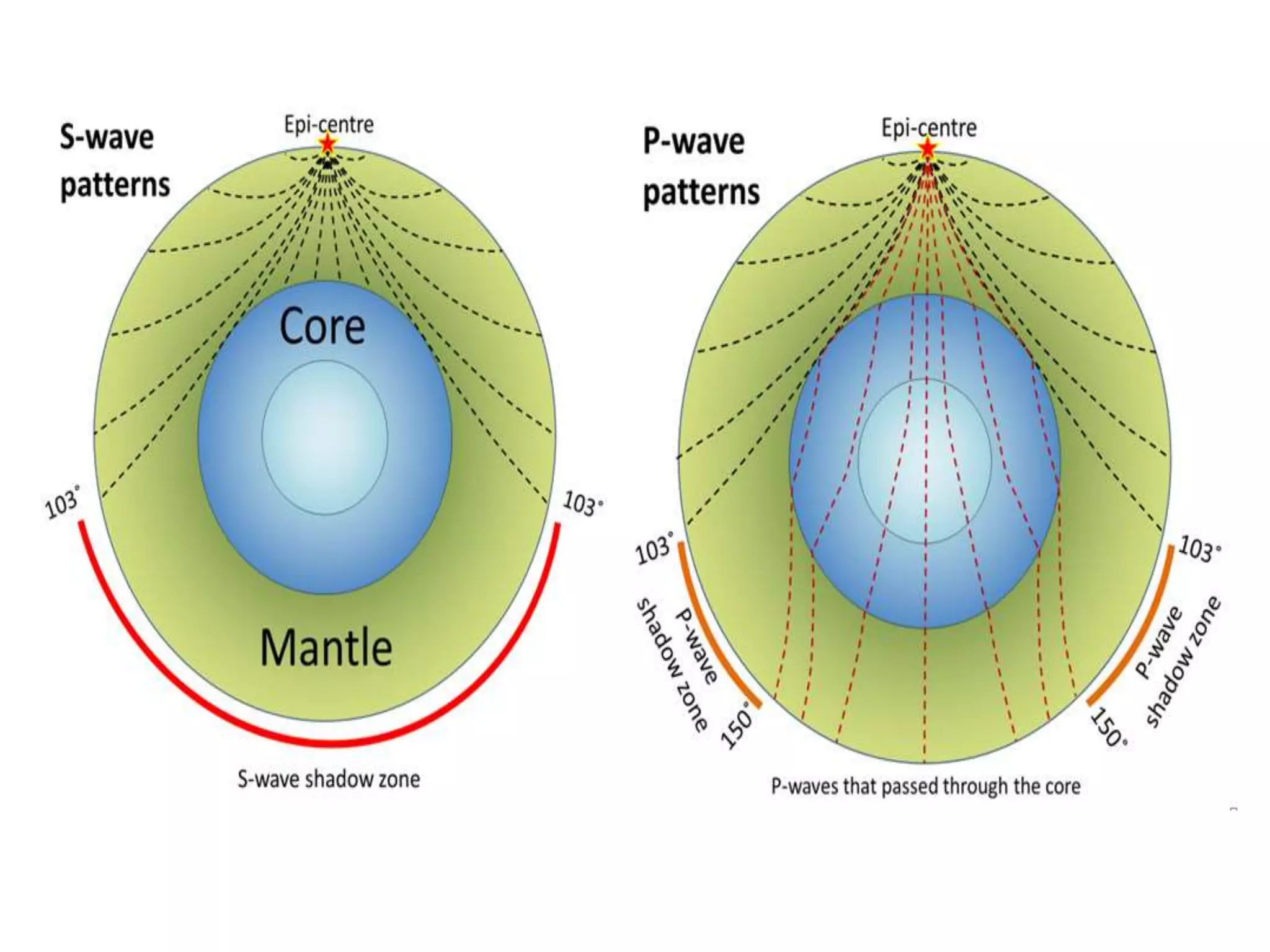
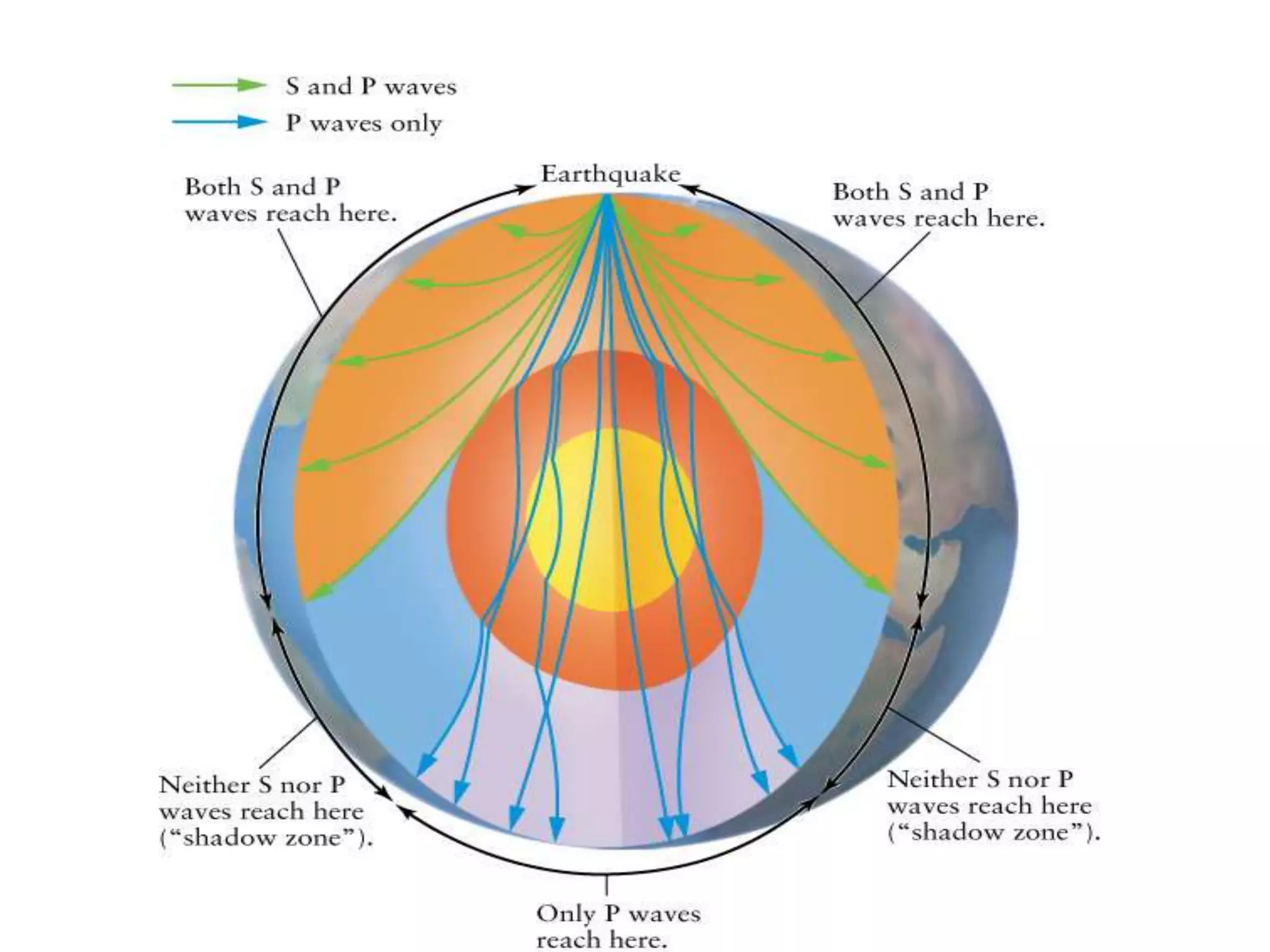
• When an earthquake occurs, seismographs near
the epicenter are able to record both P and S
waves, but those at a greater distance no longer
detect the high frequencies of the first S wave.
• Since shear waves cannot pass through liquids,
this phenomenon was original evidence for the
now well-established observation that the Earth
has a liquid outer core, as demonstrated
by Richard Dixon Oldham.
• Email : ramkumawat001@gmail.com
THANKS!

Seismic wave propagation

  • 1.
    Seismic wave propagation Er.Ramprasad Kumawat (M.Tech) DEPARTMENT OF CIVIL ENGINEERING
  • 2.
    • Seismic wavesare waves of energy that travel through the Earth's layers, and are a result of earthquakes, volcanic eruptions, magma movement, large landslides and large man- made explosions that give out low-frequency acoustic energy. • Seismic waves are studied by geophysicists called seismologists. Seismic wave fields are recorded by a seismometer, hydrophone (in water), or accelerometer.
  • 3.
    • The propagationvelocity of the waves depends on density and elasticity of the medium. Velocity tends to increase with depth and ranges from approximately 2 to 8 km/s in the Earth's crust, up to 13 km/s in the deep mantle.
  • 4.
    Types 1. Body waves •1.1Primary waves • 1.2Secondary waves 2. Surface waves • 2.1Rayleigh waves • 2.2Love waves • 2.3Stoneley waves 3. P and S waves in Earth's mantle and core
  • 5.
    1. Body waves •Body waves travel through the interior of the Earth along paths controlled by the material properties in terms of density and modulus (stiffness). The density and modulus, in turn, vary according to temperature, composition, and material phase. This effect resembles the refraction of light waves.
  • 6.
    • Two typesof particle motion result in two types of body waves: a. Primary and b. Secondary waves.
  • 7.
    a. Primary waves •Primary waves (P-waves) are compression waves that are longitudinal in nature. • P waves are pressure waves that travel faster than other waves through the earth to arrive at seismograph stations first, hence the name "Primary".
  • 8.
    • These wavescan travel through any type of material, including fluids, and can travel at nearly 1.7 times faster then the S waves. • In air, they take the form of sound waves, hence they travel at the speed of sound. • Typical speeds are 330 m/s in air, 1450 m/s in water and about 5000 m/s in granite.
  • 9.
    b. Secondary waves •Secondary waves (S-waves) are shear waves that are transverse in nature. • Following an earthquake event, S-waves arrive at seismograph stations after the faster-moving P-waves and displace the ground perpendicular to the direction of propagation. • Depending on the propagation direction, the wave can take on different surface characteristics;
  • 10.
    • For example,in the case of horizontally polarized S waves, the ground moves alternately to one side and then the other. S- waves can travel only through solids, as fluids (liquids and gases) do not support shear stresses. • S-waves are slower than P-waves, and speeds are typically around 60% of that of P-waves in any given material.
  • 12.
    2. Surface waves •Seismic surface waves travel along the Earth's surface. • They can be classified as a form of mechanical surface waves. They are called surface waves, as they diminish as they get further from the surface. • They travel more slowly than seismic body waves (P and S). In large earthquakes, surface waves can have an amplitude of several centimeters.
  • 13.
    2.1 Rayleigh waves •Rayleigh waves, also called ground roll, are surface waves that travel as ripples with motions that are similar to those of waves on the surface of water (note, however, that the associated particle motion at shallow depths is retrograde, and that the restoring force in Rayleigh and in other seismic waves is elastic, not gravitational as for water waves).
  • 14.
    • The existenceof these waves was predicted by John William Strut, Lord Rayleigh, in 1885. They are slower than body waves, roughly 90% of the velocity of S waves for typical homogeneous elastic media. In the layered medium (like the crust and upper mantle) the velocity of the Rayleigh waves depends on their frequency and wavelength.
  • 15.
    2.2 Love waves •Love waves are horizontally polarized shear waves (SH waves), existing only in the presence of a semi-infinite medium overlain by an upper layer of finite thickness. • They are named after A.E.H. Love, a British mathematician who created a mathematical model of the waves in 1911. They usually travel slightly faster than Rayleigh waves, about 90% of the S wave velocity, and have the largest amplitude.
  • 16.
    2.3 Stoneley waves •A Stoneley wave is a type of boundary wave (or interface wave) that propagates along a solid-fluid boundary or, under specific conditions, also along a solid-solid boundary. • Amplitudes of Stoneley waves have their maximum values at the boundary between the two contacting media and decay exponentially towards the depth of each of them.
  • 17.
    • These wavescan be generated along the walls of a fluid-filled borehole, being an important source of coherent noise in VSPs and making up the low frequency component of the source in sonic logging. The equation for Stoneley waves was first given by Dr. Robert Stoneley (1894–1976), Emeritus Professor of Seismology, Cambridge.
  • 19.
    3. P andS waves in Earth's mantle and core • When an earthquake occurs, seismographs near the epicenter are able to record both P and S waves, but those at a greater distance no longer detect the high frequencies of the first S wave. • Since shear waves cannot pass through liquids, this phenomenon was original evidence for the now well-established observation that the Earth has a liquid outer core, as demonstrated by Richard Dixon Oldham.
  • 21.
    • Email :ramkumawat001@gmail.com THANKS!