Market segmentation targeting and
positioning
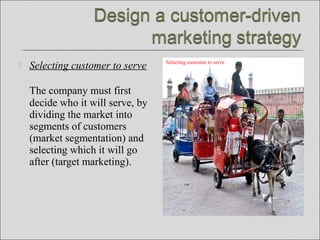
 Selecting customer to serve
The company must first
decide who it will serve, by
dividing the market into
segments of customers
(market segmentation) and
selecting which it will go
after (target marketing).
Selecting customer to serve
Dividing a market into
smaller group with
similar needs,
characteristics, or
behaviors who might
require separate
products or marketing
mixes.
Market segmentation
1-4
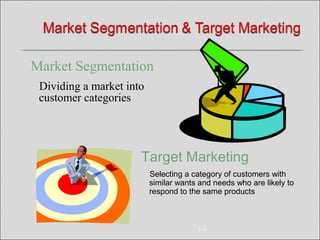
Market Segmentation
Dividing a market into
customer categories
Target Marketing
Selecting a category of customers with
similar wants and needs who are likely to
respond to the same products
1-5
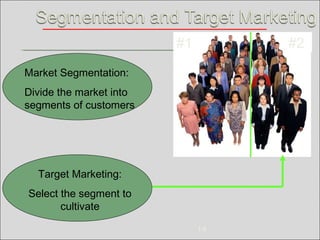
Market Segmentation:
Divide the market into
segments of customers
Target Marketing:
Select the segment to
cultivate
#1 #2
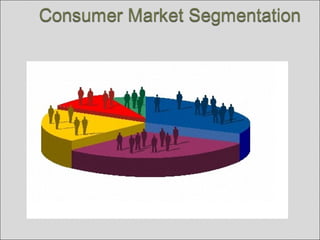
1)Consumer Market Segmentation
2)Business Market Segmentation
3)International Market Segmentation
 There is no single way to segment a market. A
marketer has to try different segmentation variables,
alone and in combination to find the best way to view
the market structure.
Consumer market can be segmented through the
following variables
A. Geographic segmentation
B. Demographic segmentation
C. Psychographic segmentation
D. Behavioral segmentation
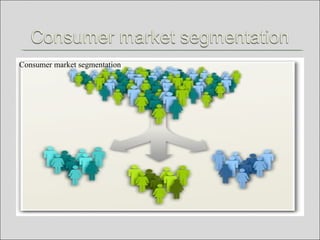
Consumer market segmentation
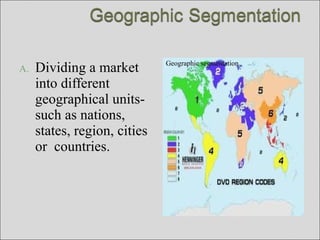
A. Dividing a market
into different
geographical units-
such as nations,
states, region, cities
or countries.
Geographic segmentation
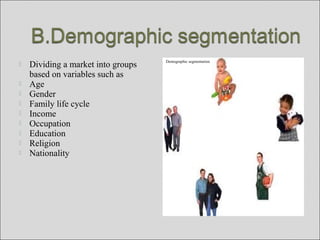
 Dividing a market into groups
based on variables such as
 Age
 Gender
 Family life cycle
 Income
 Occupation
 Education
 Religion
 Nationality
Demographic segmentation
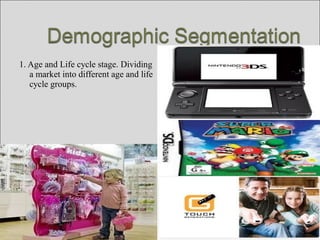
1. Age and Life cycle stage. Dividing
a market into different age and life
cycle groups.
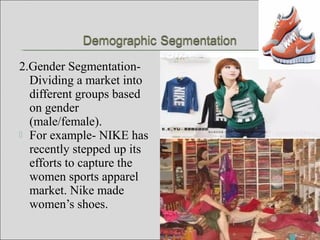
2.Gender Segmentation-
Dividing a market into
different groups based
on gender
(male/female).
 For example- NIKE has
recently stepped up its
efforts to capture the
women sports apparel
market. Nike made
women’s shoes.
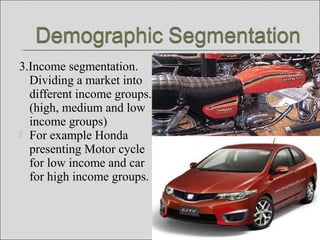
3.Income segmentation.
Dividing a market into
different income groups.
(high, medium and low
income groups)
 For example Honda
presenting Motor cycle
for low income and car
for high income groups.
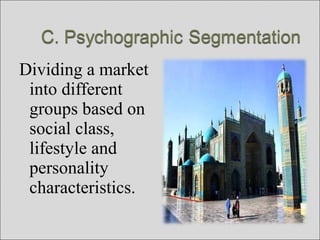
Dividing a market
into different
groups based on
social class,
lifestyle and
personality
characteristics.
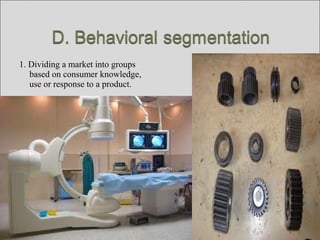
1. Dividing a market into groups
based on consumer knowledge,
use or response to a product.
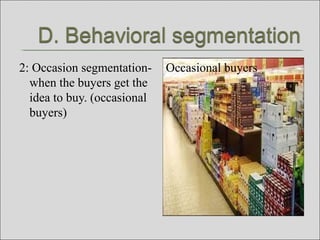
2: Occasion segmentation-
when the buyers get the
idea to buy. (occasional
buyers)
Occasional buyers
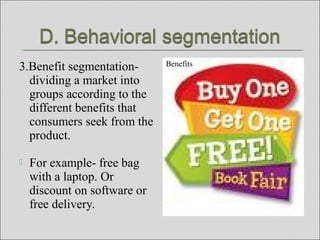
3.Benefit segmentation-
dividing a market into
groups according to the
different benefits that
consumers seek from the
product.
 For example- free bag
with a laptop. Or
discount on software or
free delivery.
Benefits
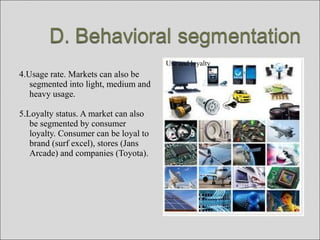
4.Usage rate. Markets can also be
segmented into light, medium and
heavy usage.
5.Loyalty status. A market can also
be segmented by consumer
loyalty. Consumer can be loyal to
brand (surf excel), stores (Jans
Arcade) and companies (Toyota).
Use and loyalty
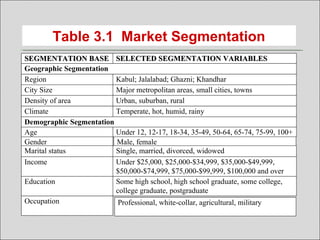
Table 3.1 Market Segmentation
Occupation
SEGMENTATION BASESEGMENTATION BASE SELECTED SEGMENTATION VARIABLESSELECTED SEGMENTATION VARIABLES
Geographic Segmentation
Climate
Density of area
City Size
Region Kabul; Jalalabad; Ghazni; Khandhar
Major metropolitan areas, small cities, towns
Urban, suburban, rural
Temperate, hot, humid, rainy
Demographic Segmentation
Income
Marital status
Gender
Age Under 12, 12-17, 18-34, 35-49, 50-64, 65-74, 75-99, 100+
Male, female
Single, married, divorced, widowed
Under $25,000, $25,000-$34,999, $35,000-$49,999,
$50,000-$74,999, $75,000-$99,999, $100,000 and over
Education Some high school, high school graduate, some college,
college graduate, postgraduate
Professional, white-collar, agricultural, military
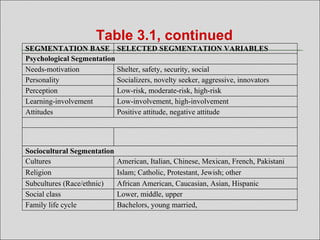
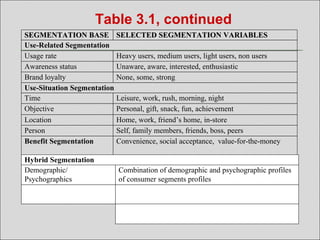
Table 3.1, continued
SEGMENTATION BASESEGMENTATION BASE SELECTED SEGMENTATION VARIABLESSELECTED SEGMENTATION VARIABLES
Psychological Segmentation
Learning-involvement
Perception
Personality
Needs-motivation Shelter, safety, security, social
Socializers, novelty seeker, aggressive, innovators
Low-risk, moderate-risk, high-risk
Low-involvement, high-involvement
Subcultures (Race/ethnic)
Religion
Cultures American, Italian, Chinese, Mexican, French, Pakistani
Islam; Catholic, Protestant, Jewish; other
African American, Caucasian, Asian, Hispanic
Family life cycle
Social class Lower, middle, upper
Bachelors, young married,
Attitudes Positive attitude, negative attitude
Sociocultural Segmentation
SEGMENTATION BASESEGMENTATION BASE SELECTED SEGMENTATION VARIABLESSELECTED SEGMENTATION VARIABLES
Use-Related Segmentation
Brand loyalty
Awareness status
Usage rate Heavy users, medium users, light users, non users
Unaware, aware, interested, enthusiastic
None, some, strong
Use-Situation Segmentation
Location
Objective
Time Leisure, work, rush, morning, night
Personal, gift, snack, fun, achievement
Home, work, friend’s home, in-store
Person Self, family members, friends, boss, peers
Benefit Segmentation Convenience, social acceptance, value-for-the-money
Demographic/
Psychographics
Combination of demographic and psychographic profiles
of consumer segments profiles
Hybrid Segmentation
Table 3.1, continued
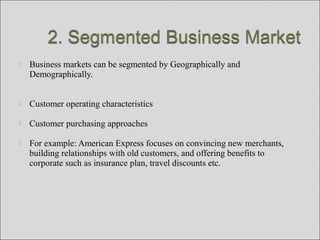
 Business markets can be segmented by Geographically and
Demographically.
 Customer operating characteristics
 Customer purchasing approaches
 For example: American Express focuses on convincing new merchants,
building relationships with old customers, and offering benefits to
corporate such as insurance plan, travel discounts etc.
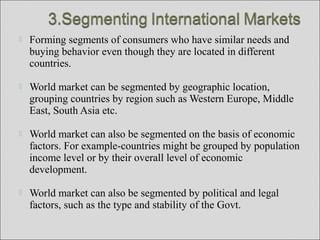
 Forming segments of consumers who have similar needs and
buying behavior even though they are located in different
countries.
 World market can be segmented by geographic location,
grouping countries by region such as Western Europe, Middle
East, South Asia etc.
 World market can also be segmented on the basis of economic
factors. For example-countries might be grouped by population
income level or by their overall level of economic
development.
 World market can also be segmented by political and legal
factors, such as the type and stability of the Govt.
 Target market: A set of buyers sharing common needs or characteristics that
the company decides to serve.
 After successfully segmented the market the firm now must evaluate the
various segments and decide how many and which segment it can serve
best.
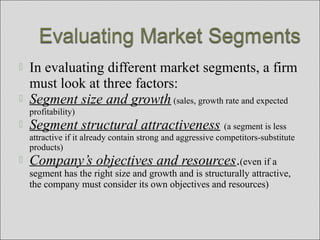
 In evaluating different market segments, a firm
must look at three factors:
 Segment size and growth (sales, growth rate and expected
profitability)
 Segment structural attractiveness (a segment is less
attractive if it already contain strong and aggressive competitors-substitute
products)
 Company’s objectives and resources.(even if a
segment has the right size and growth and is structurally attractive,
the company must consider its own objectives and resources)
 After evaluating different segments, the company must decide which and
how many segments it will target.
 A target market consists of a set of buyers who share common needs or
characteristics that the company decides to serve.
 Buyers have unique needs and wants, a seller could potentially view each
buyer as a separate target market. Then a seller might design a separate
marketing program for each buyer.
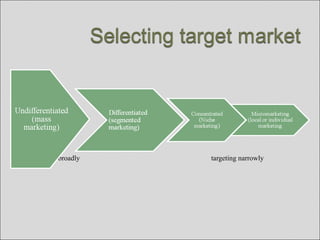
 Companies can target very broadly , very narrowly or some where in
between.
 Targeting broadly targeting narrowly
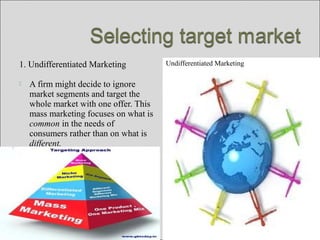
1. Undifferentiated Marketing
 A firm might decide to ignore
market segments and target the
whole market with one offer. This
mass marketing focuses on what is
common in the needs of
consumers rather than on what is
different.
Undifferentiated Marketing
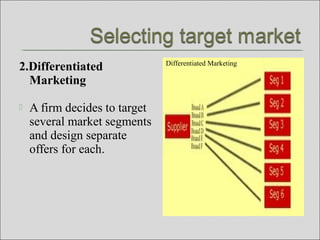
2.Differentiated
Marketing
 A firm decides to target
several market segments
and design separate
offers for each.
Differentiated Marketing
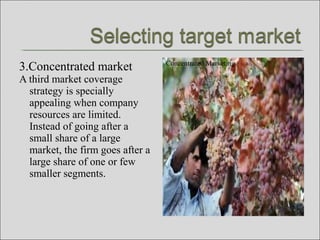
3.Concentrated market
A third market coverage
strategy is specially
appealing when company
resources are limited.
Instead of going after a
small share of a large
market, the firm goes after a
large share of one or few
smaller segments.
Concentrated Marketing
4.Micromarketing
 The practice of tailoring products
and marketing program to the
needs and wants of specific
individuals.
5.Individual marketing- has also
labeled one to one marketing. For
example. Dell is doing individual
marketing, by taking the order of
every individual and prepare the
computer accordingly.
Micro & Individual Marketing

Chapter 3 segmentation

  • 1.
  • 2.
     Selecting customerto serve The company must first decide who it will serve, by dividing the market into segments of customers (market segmentation) and selecting which it will go after (target marketing). Selecting customer to serve
  • 3.
    Dividing a marketinto smaller group with similar needs, characteristics, or behaviors who might require separate products or marketing mixes. Market segmentation
  • 4.
    1-4 Market Segmentation Dividing amarket into customer categories Target Marketing Selecting a category of customers with similar wants and needs who are likely to respond to the same products
  • 5.
    1-5 Market Segmentation: Divide themarket into segments of customers Target Marketing: Select the segment to cultivate #1 #2
  • 6.
    1)Consumer Market Segmentation 2)BusinessMarket Segmentation 3)International Market Segmentation
  • 8.
     There isno single way to segment a market. A marketer has to try different segmentation variables, alone and in combination to find the best way to view the market structure. Consumer market can be segmented through the following variables A. Geographic segmentation B. Demographic segmentation C. Psychographic segmentation D. Behavioral segmentation
  • 9.
  • 10.
    A. Dividing amarket into different geographical units- such as nations, states, region, cities or countries. Geographic segmentation
  • 11.
     Dividing amarket into groups based on variables such as  Age  Gender  Family life cycle  Income  Occupation  Education  Religion  Nationality Demographic segmentation
  • 12.
    1. Age andLife cycle stage. Dividing a market into different age and life cycle groups.
  • 13.
    2.Gender Segmentation- Dividing amarket into different groups based on gender (male/female).  For example- NIKE has recently stepped up its efforts to capture the women sports apparel market. Nike made women’s shoes.
  • 14.
    3.Income segmentation. Dividing amarket into different income groups. (high, medium and low income groups)  For example Honda presenting Motor cycle for low income and car for high income groups.
  • 15.
    Dividing a market intodifferent groups based on social class, lifestyle and personality characteristics.
  • 16.
    1. Dividing amarket into groups based on consumer knowledge, use or response to a product.
  • 17.
    2: Occasion segmentation- whenthe buyers get the idea to buy. (occasional buyers) Occasional buyers
  • 18.
    3.Benefit segmentation- dividing amarket into groups according to the different benefits that consumers seek from the product.  For example- free bag with a laptop. Or discount on software or free delivery. Benefits
  • 19.
    4.Usage rate. Marketscan also be segmented into light, medium and heavy usage. 5.Loyalty status. A market can also be segmented by consumer loyalty. Consumer can be loyal to brand (surf excel), stores (Jans Arcade) and companies (Toyota). Use and loyalty
  • 20.
    Table 3.1 MarketSegmentation Occupation SEGMENTATION BASESEGMENTATION BASE SELECTED SEGMENTATION VARIABLESSELECTED SEGMENTATION VARIABLES Geographic Segmentation Climate Density of area City Size Region Kabul; Jalalabad; Ghazni; Khandhar Major metropolitan areas, small cities, towns Urban, suburban, rural Temperate, hot, humid, rainy Demographic Segmentation Income Marital status Gender Age Under 12, 12-17, 18-34, 35-49, 50-64, 65-74, 75-99, 100+ Male, female Single, married, divorced, widowed Under $25,000, $25,000-$34,999, $35,000-$49,999, $50,000-$74,999, $75,000-$99,999, $100,000 and over Education Some high school, high school graduate, some college, college graduate, postgraduate Professional, white-collar, agricultural, military
  • 21.
    Table 3.1, continued SEGMENTATIONBASESEGMENTATION BASE SELECTED SEGMENTATION VARIABLESSELECTED SEGMENTATION VARIABLES Psychological Segmentation Learning-involvement Perception Personality Needs-motivation Shelter, safety, security, social Socializers, novelty seeker, aggressive, innovators Low-risk, moderate-risk, high-risk Low-involvement, high-involvement Subcultures (Race/ethnic) Religion Cultures American, Italian, Chinese, Mexican, French, Pakistani Islam; Catholic, Protestant, Jewish; other African American, Caucasian, Asian, Hispanic Family life cycle Social class Lower, middle, upper Bachelors, young married, Attitudes Positive attitude, negative attitude Sociocultural Segmentation
  • 22.
    SEGMENTATION BASESEGMENTATION BASESELECTED SEGMENTATION VARIABLESSELECTED SEGMENTATION VARIABLES Use-Related Segmentation Brand loyalty Awareness status Usage rate Heavy users, medium users, light users, non users Unaware, aware, interested, enthusiastic None, some, strong Use-Situation Segmentation Location Objective Time Leisure, work, rush, morning, night Personal, gift, snack, fun, achievement Home, work, friend’s home, in-store Person Self, family members, friends, boss, peers Benefit Segmentation Convenience, social acceptance, value-for-the-money Demographic/ Psychographics Combination of demographic and psychographic profiles of consumer segments profiles Hybrid Segmentation Table 3.1, continued
  • 23.
     Business marketscan be segmented by Geographically and Demographically.  Customer operating characteristics  Customer purchasing approaches  For example: American Express focuses on convincing new merchants, building relationships with old customers, and offering benefits to corporate such as insurance plan, travel discounts etc.
  • 24.
     Forming segmentsof consumers who have similar needs and buying behavior even though they are located in different countries.  World market can be segmented by geographic location, grouping countries by region such as Western Europe, Middle East, South Asia etc.  World market can also be segmented on the basis of economic factors. For example-countries might be grouped by population income level or by their overall level of economic development.  World market can also be segmented by political and legal factors, such as the type and stability of the Govt.
  • 25.
     Target market:A set of buyers sharing common needs or characteristics that the company decides to serve.  After successfully segmented the market the firm now must evaluate the various segments and decide how many and which segment it can serve best.
  • 26.
     In evaluatingdifferent market segments, a firm must look at three factors:  Segment size and growth (sales, growth rate and expected profitability)  Segment structural attractiveness (a segment is less attractive if it already contain strong and aggressive competitors-substitute products)  Company’s objectives and resources.(even if a segment has the right size and growth and is structurally attractive, the company must consider its own objectives and resources)
  • 27.
     After evaluatingdifferent segments, the company must decide which and how many segments it will target.  A target market consists of a set of buyers who share common needs or characteristics that the company decides to serve.  Buyers have unique needs and wants, a seller could potentially view each buyer as a separate target market. Then a seller might design a separate marketing program for each buyer.  Companies can target very broadly , very narrowly or some where in between.
  • 28.
     Targeting broadlytargeting narrowly
  • 29.
    1. Undifferentiated Marketing A firm might decide to ignore market segments and target the whole market with one offer. This mass marketing focuses on what is common in the needs of consumers rather than on what is different. Undifferentiated Marketing
  • 30.
    2.Differentiated Marketing  A firmdecides to target several market segments and design separate offers for each. Differentiated Marketing
  • 31.
    3.Concentrated market A thirdmarket coverage strategy is specially appealing when company resources are limited. Instead of going after a small share of a large market, the firm goes after a large share of one or few smaller segments. Concentrated Marketing
  • 32.
    4.Micromarketing  The practiceof tailoring products and marketing program to the needs and wants of specific individuals. 5.Individual marketing- has also labeled one to one marketing. For example. Dell is doing individual marketing, by taking the order of every individual and prepare the computer accordingly. Micro & Individual Marketing