Prepared by:
Kiran Pata
Kinjal Patel
Parag Chitroda
Jugal Shah
Bhavesh Vaghamshi
CONCEPT AND DEFINITION
 The concept of market segment is based on the
fact that the market of commodities are not
homogeneous but they are heterogeneous. Market
represent a group of customer having common
characteristics but two customer are never common
in their nature, habits, hobbies income and
purchasing techniques.
 Market Segmentation is a method of “dividing a
market (Large) into smaller groupings of consumers
or organizations in which each segment has a
common characteristic such as needs or behavior.”
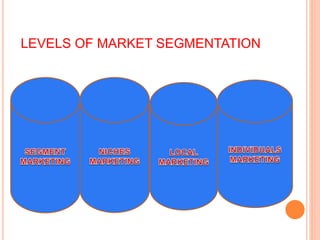
LEVELS OF MARKET SEGMENTATION
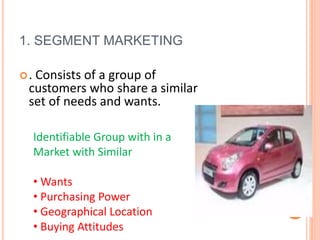
1. SEGMENT MARKETING
. Consists of a group of
customers who share a similar
set of needs and wants.
Identifiable Group with in a
Market with Similar
• Wants
• Purchasing Power
• Geographical Location
• Buying Attitudes
BASIS FOR MARKET SEGMENTATION
 Following are the main basis for market
segmentation.
1. Geographical segmentation
2. Demographic segmentation
3. Psychographic segmentation
4. Behavioural segmentation
GEOGRAPHIC SEGMENTATION
 Divide the market into different group based on :
• Region :
• South India , North , Western Region, East
• City :
• Metro cities, cities with population more than 1 million.
 Rural and semi-urban areas:
 Rural villages with a population of over 10,000; semi-urban
areas ; small towns with a population between 20,000 and
50,000.
 Examples:
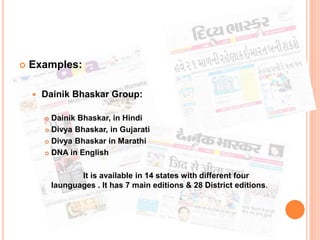
 Dainik Bhaskar Group:
 Dainik Bhaskar, in Hindi
 Divya Bhaskar, in Gujarati
 Divya Bhaskar in Marathi
 DNA in English
It is available in 14 states with different four
launguages . It has 7 main editions & 28 District editions.
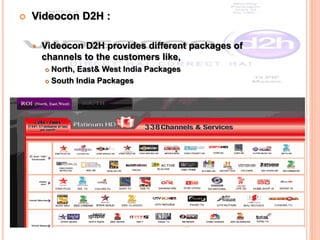
 Videocon D2H :
 Videocon D2H provides different packages of
channels to the customers like,
 North, East& West India Packages
 South India Packages
DEMOGRAPHIC SEGMENTATION
 Age:
 It is essentially a case of age based segment of market.
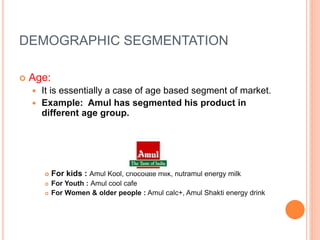
 Example: Amul has segmented his product in
different age group.
 For kids : Amul Kool, chocolate milk, nutramul energy milk
 For Youth : Amul cool cafe
 For Women & older people : Amul calc+, Amul Shakti energy drink
 Family size:
 Young , single; young , married, no children ; young ,
married , youngest child under 6; young , married
,youngest child under 6 or over ; older ,married , with
children ; older , married , no children under 18 ; older ,
single ; other.
 Gender:
 Male , Female
 Example:
 HUL provides Fair & lovely for women & men
 Red Chief target men in India.
 Income:
 Segmenting the market by keeping in mind the customer’s
income level.
 Example:
 Nokia
 Nokia 2600 price RS 2750
 Nokia 5130 price RS 5300
 Nokia N73 price RS 12500
 NokiaN95 price RS 22500
 Occupation:
 Unskilled worker , skilled worker , petty traders , shop owners
, bussinessman/indusrialist , self-employed ( professionals ,
clerical/salespersons , supervisory levals , officers/junior
exectives. Middle / senior executies .
 Example : Raymond suits
 Education :
 Literate , school up to 4 years , school between 5 and 9
years , SSC/HSC , nongraduate ,
graduate/postgraduate ( general) ,
graduate/postgraduate (professional).
 Example:
 Navneet Publication offers guides & study material for
schools as well as colleges. They olso publish reference
books for competitive exams.
PSYCHOGRAPHIC SEGMENTATION
 Psychographic segmentation divides buyers into
different groups based on lifestyle, personality
characteristics, or social class.
 To better meet the psychological needs of people,
marketers often segment their markets by consumer
personalities and lifestyles.
 Example:
 Thums Up is marketed as a drink for tougher, action-oriented men
whereas Pepsi is marketed predominantly as a youth drink.
 CCD choose life style oriented, urban customers as target with
youth.
BEHAVIOURAL SEGMENTATION
 In Behavioural Segmentation, buyers are divided into groups
on the basis of their knowledge of, attitude towards, use of, or
respond to a product.
 Variables of buyer behaviour are:
 Benefit sought: - Quality/economy/service/look etc of the
product.
 Example- Nestle has found a separate atta noodles as
distinct from maida noodles
 User status : Heavy user/ moderate user/ light user
 Usage Rate : Regular/ potential/ first time user/ irregular/
 Loyalty Status : Hard core loyal/ split loyal/ shifting/ switches
 Occassion:
 Cadbury’s advertisement to promote the product on the
basis of various occasion.
 On navratri, there will be a great demand for traditional
clothes.
 On Diwali occassion, people may purchase jewellary
items so we’ll find more advertisement of jewellers like
TBZ, Kalyan Jewellers . The same is true in marriage
season.
2. NICHE MARKETING
 Group of customers seeking a distinctive mix of benefits who
are ready to pay extra premium.
 Niche = segment sub – segments
e.g Washing detergents hard & gentle washes . Surf excel
for tough stains ( hard on clothes) & Ezee from Godrej for
delicate clothes.
- Astha , Sanskar , Q TV – focus on religion & spiritualism.
 DISTINCT NEEDS
 PAY PREMIUM
 SPECIALIZATION
 LESS COMPETITION
 POTENTIAL
 Example:
 Harley Davidson bikes
 Star channel provides various channels for different
customer groups:
 i.e for entertainment star plus
 For youth - MTV
 For hindi movies – Star Gold
 For English movies – Star Movies
 Also there are 4 different sports channel of star group
Here they provide product/service to a
specific customer group that’s why it can be
considered as niche marketing.
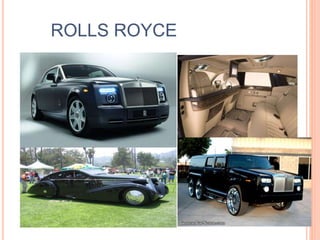
ROLLS ROYCE
3. LOCAL MARKETING
 Marketing programs tailored to the needs & wants of
local customer groups in trading areas, neighborhoods ,
etc.
 This trend is called grass roots marketing.
Example:
- Shiva Bakery in porbandar surves bakery products
only for limited area.
- Induben Khakharawala in ahmedabad can also be
considered as local marketing.
- Mumbai’s Dabbawala also considered as local
marketing.
4. INDIVIDUAL MARKETING
 Ultimate segmentation – segments of 1 or
customized marketing or one to one marketing.
 Customerization – empower the consumers to
design the product or service offering of their
choice.
 Example:
 Airtel launched MYPLAN in which an individual person can
know about data usages, balance information, n all activated
plan.
 SBI has also developed a mobile app “ SBI FREEDOM” which
facilitates all banking facilities in mobile to an individual.
TARGET MARKET
Target market selection is the process of
fixing the target market for one particular
product. Target marketing contrasts with
mass marketing, which offers a single
product to the entire market.
Market segmentation involves
dividing customers into groups (market
segments) with common characteristics.
STRATEGIES OF MARKET TARGETING
1. Single-segment concentration
2. Selective specialization
3. Product specialization
4. Market specialization
5. Total market coverage
SINGLE-SEGMENT CONCENTRATION
 Business is focused on any one segment of the
market .
 example For cricket balls, cricket bats and related
sporting gear, cricket clothing, etc. the business
objectives could be to become the largest supplier
of cricket accessories in a particular geographic
market.
SELECTIVE SPECIALIZATION
 The business focuses on a number of segments in
the market.
 There may not necessarily be any relationship
between the segments; however each segment has
a high degree of value for the business objectives
and resources.
 Since, the segments can stand alone, the risk of
failure is reduced by the diversification - the
assumption is that at least one, or more, of the
segments will be successful at any one time.
PRODUCT SPECIALIZATION:
 The business focuses on one product and it sells to
a number of segments.
 For example, a coffee distributor might sell coffee to
a retail store chain, to a number of coffee shops,
and even direct to the end consumer
 By expanding one’s market through product
specialization a firm can build a very strong brand
for the product and its business. For example, Café
Coffee Day specializes in different varieties of
coffee.
MARKET SPECIALIZATION:
 The business focuses on supplying many products
to one market segment.
 For example, the business might be supplying all
types of sporting goods to sporting goods stores
(e.g. soccer, tennis, cricket, basketball, etc.). With
this type of strategy
TOTAL MARKET COVERAGE
 This type of targeting is attempted by large
companies with a lot of financial strength.
 The business has many products and services
many markets.
 The cost for this type of target marketing approach
is high: the business must have strong distribution
channels, large resources, and many products.
Small businesses should not attempt total market
coverage.
• Positioning is not what you do to a
product. Positioning is what you do to
the mind of the prospects.
DEFINITION & CONCEPT
 “ Product positioning is defined as the process
of establishing & maintaining a distinctive place in
the market for an organization and/or its individuals
product offerings.”
 It involves a company’s product/services creating &
occupying a place, in the minds of customers.
 Marketer should analyse the current position
occupied by their firms in the (present &
prospective) customer’s minds & take necessary
steps to create a distinct & effective position.
 Examples:
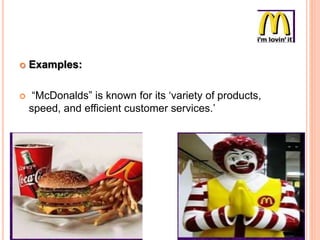
 “McDonalds” is known for its ‘variety of products,
speed, and efficient customer services.’
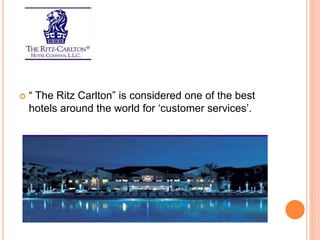
 “ The Ritz Carlton” is considered one of the best
hotels around the world for ‘customer services’.
DIFFERENTIATION
 In today’s cut throat competition, company
should differentiate their product/services from
those of their competitors to survive in the
market.
 It refers to the process of actually creating a
difference in the perception of a product in the
mind of customers.
 It is closely related to product positioning.
DIFFERENTIATION AND POSITIONING STRATEGY
 The positioning task consists of three steps:
1. Identifying a set of differentiating competitive
advantages,
2. Choosing the right competitive advantages,
3. Selecting the overall positioning strategy
1. Identifying a set of differentiating competitive advantages:
 Competitive advantage is defined as the strategic advantage
a business organisation has over its competitors in the
industry.
 Marketers can find different ways to create a differentiation by
analysing the whole set of customers’ experience with the
company’s product or service.
 A company can differentiate itself along the lines of the
 product,
 services,
 people, or
 image.
 Product Differentiation:
 Product differentiation refers to a differentiation created on the
features, performance, style, or design of the product.
 For instance,
 Favicol’s ad campaign differentiate their product by displaying super
quality even in the worst situation like in water too.
 Similarly, Hero Honda had used the campaign slogan of “fill it, shut it,
forget it” to differentiate itself of in terms of superior mileage.
 Services Differentiation:
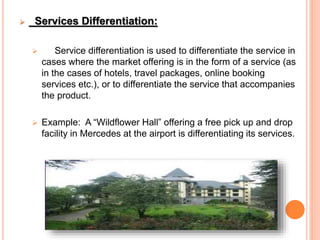
 Service differentiation is used to differentiate the service in
cases where the market offering is in the form of a service (as
in the cases of hotels, travel packages, online booking
services etc.), or to differentiate the service that accompanies
the product.
 Example: A “Wildflower Hall” offering a free pick up and drop
facility in Mercedes at the airport is differentiating its services.
 People Differentiation:
 People Differentiation is especially significant in the case of
services where human interaction is a key aspect of the value
sought by the consumer.
 Example:
 Customer service provider of vodaphone
 Services provided by Hotels, Hospitals, Consultancy firm etc.
 Image Differentiation:
 Consumers often use the brand’s image to perceive the
difference among competing brands.
 For instance, if a company wants to differentiate itself with a
brand image of being trendy, the image should reflect in all its
communication including the company logos, the staff
uniforms, the websites, brand endorsers, colour patterns used
in the ad campaigns etc.
 Examples:
 Fastrack watches is generally perceived as the product
for youth
 Thumps Up ad campaign differentiate themselves in
energetic drink in India.
 BATA is famous for quality product
 Idea n Vodaphone for unbreakable network....
2. CHOOSING THE RIGHT COMPETITIVE
ADVANTAGES
 A company may discover several potential differentiations that
may provide competitive advantages. It must then decide
which competitive advantages to promote.
 In the United States for instance, when General Motors
positioned its brand Chevrolet through an ad campaign as a
“large, small, cheap, expensive car”, understandably, the
consumers were confused. The 50 percent market share of
General Motors steadily declined to 29 percent.
 Not all brand differences may be considered meaningful or
worthwhile by the consumer. A difference has the potential to
create company costs (in order to fulfil the brand promise),
and to create customer benefits.
 In general, for differences to be worth establishing, they
must meet the following criteria;
 Important
 Distinctive
 Superior
 Communicative
 Pre-emptive
 Affordable
 Profitable.
3. SELECTING AN OVERALL
POSITIONING STRATEGY
 The overall positioning of a brand refers to the
brand’s value proposition which includes the full set
of benefits upon which it is positioned.
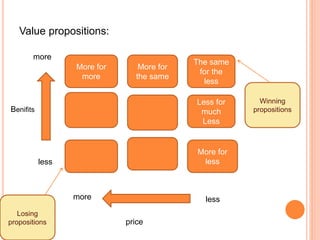
 The possible value propositions upon which a
company might position its products can be
classified into categories as depicted in the picture.
More for
more
More for
less
More for
the same
Less for
much
Less
The same
for the
less
more
Value propositions:
less
more less
Benifits
price
Winning
propositions
Losing
propositions
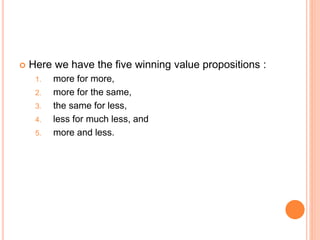
 Here we have the five winning value propositions :
1. more for more,
2. more for the same,
3. the same for less,
4. less for much less, and
5. more and less.
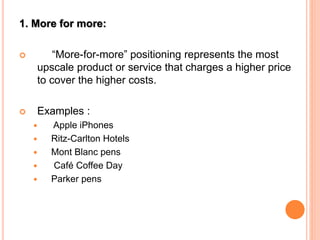
1. More for more:
 “More-for-more” positioning represents the most
upscale product or service that charges a higher price
to cover the higher costs.
 Examples :
 Apple iPhones
 Ritz-Carlton Hotels
 Mont Blanc pens
 Café Coffee Day
 Parker pens
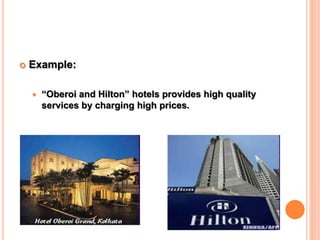
 Example:
 “Oberoi and Hilton” hotels provides high quality
services by charging high prices.
2. More for the same:
 Companies attack its high-priced competing brand by
introducing a brand that offers matching or comparable
quality but at a lower price.
 Examples:
 Toyota’s Lexus lines of cars against Mercedes and BMW
 Samsung has launched phones that offer features
comparable to iPhones at a lesser cost.
 And also micromax has launched phones that offers
features comarable to samsung and other android phones
3. The Same for Less:
 “The same for less” proposition is based on the fact that
most consumers like a good deal.
 Many companies claim not to give better or superior
products but the same products at much lower prices.
 Examples
 Croma, the electronics retail stores
 Flipkart.com
 Amazon.com
 Letsbuy.com
4. Less for much less:
 “Less-for-much-less” positioning is usually a high
volume category that meets consumers’ lower quality
requirements at a much lower price.
 Example:
 Maruti 800, and Tata Nano
 Low priced hotels,
5. More for less:
 “More-for-less” represents the best value proposition
that offers the best or nearly the best in terms of
product benefits but cost much less.
 Examples
 Tata Indica’s offer that claimed to give “more car per car.
CHANGING THE PRODUCT POSITIONING
 Changing the identity of a product or a company in
the mind of stake holders and competitors.
 The company need to consider a repositioning
strategy if they have a weak brand, if they have not
remained competitive in the market, or if there is a
change in the economy.
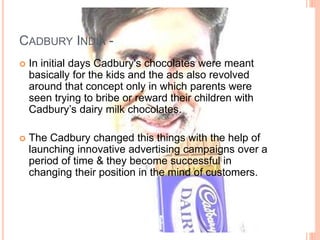
CADBURY INDIA -
 In initial days Cadbury's chocolates were meant
basically for the kids and the ads also revolved
around that concept only in which parents were
seen trying to bribe or reward their children with
Cadbury’s dairy milk chocolates.
 The Cadbury changed this things with the help of
launching innovative advertising campaigns over a
period of time & they become successful in
changing their position in the mind of customers.
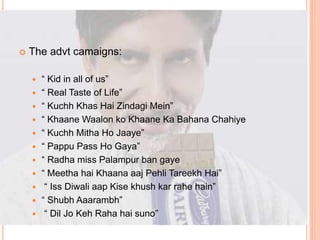
 The advt camaigns:
 “ Kid in all of us”
 “ Real Taste of Life”
 “ Kuchh Khas Hai Zindagi Mein”
 “ Khaane Waalon ko Khaane Ka Bahana Chahiye
 “ Kuchh Mitha Ho Jaaye”
 “ Pappu Pass Ho Gaya”
 “ Radha miss Palampur ban gaye
 “ Meetha hai Khaana aaj Pehli Tareekh Hai”
 “ Iss Diwali aap Kise khush kar rahe hain”
 “ Shubh Aaarambh”
 “ Dil Jo Keh Raha hai suno”
BIBLIOGRAPHY
 www.marketing91.com
 www.wikipedia.org
 www.basicmarketingfundas4u.blogspot.in
 www.dynamicebiz.com
 i-nurture SLM
 Marketing Management- A south Asian Perspective
 by Philip Kotler , Kevin Keller, Abraham Koshy,
Mithileshwar Jha
THANK
YOU

Market segmentation

  • 1.
    Prepared by: Kiran Pata KinjalPatel Parag Chitroda Jugal Shah Bhavesh Vaghamshi
  • 2.
    CONCEPT AND DEFINITION The concept of market segment is based on the fact that the market of commodities are not homogeneous but they are heterogeneous. Market represent a group of customer having common characteristics but two customer are never common in their nature, habits, hobbies income and purchasing techniques.
  • 3.
     Market Segmentationis a method of “dividing a market (Large) into smaller groupings of consumers or organizations in which each segment has a common characteristic such as needs or behavior.”
  • 4.
    LEVELS OF MARKETSEGMENTATION
  • 5.
    1. SEGMENT MARKETING .Consists of a group of customers who share a similar set of needs and wants. Identifiable Group with in a Market with Similar • Wants • Purchasing Power • Geographical Location • Buying Attitudes
  • 6.
    BASIS FOR MARKETSEGMENTATION  Following are the main basis for market segmentation. 1. Geographical segmentation 2. Demographic segmentation 3. Psychographic segmentation 4. Behavioural segmentation
  • 7.
  • 8.
    GEOGRAPHIC SEGMENTATION  Dividethe market into different group based on : • Region : • South India , North , Western Region, East • City : • Metro cities, cities with population more than 1 million.  Rural and semi-urban areas:  Rural villages with a population of over 10,000; semi-urban areas ; small towns with a population between 20,000 and 50,000.
  • 9.
     Examples:  DainikBhaskar Group:  Dainik Bhaskar, in Hindi  Divya Bhaskar, in Gujarati  Divya Bhaskar in Marathi  DNA in English It is available in 14 states with different four launguages . It has 7 main editions & 28 District editions.
  • 10.
     Videocon D2H:  Videocon D2H provides different packages of channels to the customers like,  North, East& West India Packages  South India Packages
  • 11.
    DEMOGRAPHIC SEGMENTATION  Age: It is essentially a case of age based segment of market.  Example: Amul has segmented his product in different age group.  For kids : Amul Kool, chocolate milk, nutramul energy milk  For Youth : Amul cool cafe  For Women & older people : Amul calc+, Amul Shakti energy drink
  • 12.
     Family size: Young , single; young , married, no children ; young , married , youngest child under 6; young , married ,youngest child under 6 or over ; older ,married , with children ; older , married , no children under 18 ; older , single ; other.  Gender:  Male , Female  Example:  HUL provides Fair & lovely for women & men  Red Chief target men in India.
  • 13.
     Income:  Segmentingthe market by keeping in mind the customer’s income level.  Example:  Nokia  Nokia 2600 price RS 2750  Nokia 5130 price RS 5300  Nokia N73 price RS 12500  NokiaN95 price RS 22500  Occupation:  Unskilled worker , skilled worker , petty traders , shop owners , bussinessman/indusrialist , self-employed ( professionals , clerical/salespersons , supervisory levals , officers/junior exectives. Middle / senior executies .  Example : Raymond suits
  • 14.
     Education : Literate , school up to 4 years , school between 5 and 9 years , SSC/HSC , nongraduate , graduate/postgraduate ( general) , graduate/postgraduate (professional).  Example:  Navneet Publication offers guides & study material for schools as well as colleges. They olso publish reference books for competitive exams.
  • 15.
    PSYCHOGRAPHIC SEGMENTATION  Psychographicsegmentation divides buyers into different groups based on lifestyle, personality characteristics, or social class.  To better meet the psychological needs of people, marketers often segment their markets by consumer personalities and lifestyles.  Example:  Thums Up is marketed as a drink for tougher, action-oriented men whereas Pepsi is marketed predominantly as a youth drink.  CCD choose life style oriented, urban customers as target with youth.
  • 16.
    BEHAVIOURAL SEGMENTATION  InBehavioural Segmentation, buyers are divided into groups on the basis of their knowledge of, attitude towards, use of, or respond to a product.  Variables of buyer behaviour are:  Benefit sought: - Quality/economy/service/look etc of the product.  Example- Nestle has found a separate atta noodles as distinct from maida noodles  User status : Heavy user/ moderate user/ light user  Usage Rate : Regular/ potential/ first time user/ irregular/  Loyalty Status : Hard core loyal/ split loyal/ shifting/ switches
  • 17.
     Occassion:  Cadbury’sadvertisement to promote the product on the basis of various occasion.  On navratri, there will be a great demand for traditional clothes.  On Diwali occassion, people may purchase jewellary items so we’ll find more advertisement of jewellers like TBZ, Kalyan Jewellers . The same is true in marriage season.
  • 18.
    2. NICHE MARKETING Group of customers seeking a distinctive mix of benefits who are ready to pay extra premium.  Niche = segment sub – segments e.g Washing detergents hard & gentle washes . Surf excel for tough stains ( hard on clothes) & Ezee from Godrej for delicate clothes. - Astha , Sanskar , Q TV – focus on religion & spiritualism.  DISTINCT NEEDS  PAY PREMIUM  SPECIALIZATION  LESS COMPETITION  POTENTIAL
  • 19.
     Example:  HarleyDavidson bikes  Star channel provides various channels for different customer groups:  i.e for entertainment star plus  For youth - MTV  For hindi movies – Star Gold  For English movies – Star Movies  Also there are 4 different sports channel of star group Here they provide product/service to a specific customer group that’s why it can be considered as niche marketing.
  • 20.
  • 21.
    3. LOCAL MARKETING Marketing programs tailored to the needs & wants of local customer groups in trading areas, neighborhoods , etc.  This trend is called grass roots marketing. Example: - Shiva Bakery in porbandar surves bakery products only for limited area. - Induben Khakharawala in ahmedabad can also be considered as local marketing. - Mumbai’s Dabbawala also considered as local marketing.
  • 22.
    4. INDIVIDUAL MARKETING Ultimate segmentation – segments of 1 or customized marketing or one to one marketing.  Customerization – empower the consumers to design the product or service offering of their choice.  Example:  Airtel launched MYPLAN in which an individual person can know about data usages, balance information, n all activated plan.  SBI has also developed a mobile app “ SBI FREEDOM” which facilitates all banking facilities in mobile to an individual.
  • 24.
    TARGET MARKET Target marketselection is the process of fixing the target market for one particular product. Target marketing contrasts with mass marketing, which offers a single product to the entire market. Market segmentation involves dividing customers into groups (market segments) with common characteristics.
  • 25.
    STRATEGIES OF MARKETTARGETING 1. Single-segment concentration 2. Selective specialization 3. Product specialization 4. Market specialization 5. Total market coverage
  • 26.
    SINGLE-SEGMENT CONCENTRATION  Businessis focused on any one segment of the market .  example For cricket balls, cricket bats and related sporting gear, cricket clothing, etc. the business objectives could be to become the largest supplier of cricket accessories in a particular geographic market.
  • 27.
    SELECTIVE SPECIALIZATION  Thebusiness focuses on a number of segments in the market.  There may not necessarily be any relationship between the segments; however each segment has a high degree of value for the business objectives and resources.  Since, the segments can stand alone, the risk of failure is reduced by the diversification - the assumption is that at least one, or more, of the segments will be successful at any one time.
  • 28.
    PRODUCT SPECIALIZATION:  Thebusiness focuses on one product and it sells to a number of segments.  For example, a coffee distributor might sell coffee to a retail store chain, to a number of coffee shops, and even direct to the end consumer  By expanding one’s market through product specialization a firm can build a very strong brand for the product and its business. For example, Café Coffee Day specializes in different varieties of coffee.
  • 29.
    MARKET SPECIALIZATION:  Thebusiness focuses on supplying many products to one market segment.  For example, the business might be supplying all types of sporting goods to sporting goods stores (e.g. soccer, tennis, cricket, basketball, etc.). With this type of strategy
  • 30.
    TOTAL MARKET COVERAGE This type of targeting is attempted by large companies with a lot of financial strength.  The business has many products and services many markets.  The cost for this type of target marketing approach is high: the business must have strong distribution channels, large resources, and many products. Small businesses should not attempt total market coverage.
  • 32.
    • Positioning isnot what you do to a product. Positioning is what you do to the mind of the prospects.
  • 33.
    DEFINITION & CONCEPT “ Product positioning is defined as the process of establishing & maintaining a distinctive place in the market for an organization and/or its individuals product offerings.”  It involves a company’s product/services creating & occupying a place, in the minds of customers.
  • 34.
     Marketer shouldanalyse the current position occupied by their firms in the (present & prospective) customer’s minds & take necessary steps to create a distinct & effective position.
  • 35.
     Examples:  “McDonalds”is known for its ‘variety of products, speed, and efficient customer services.’
  • 36.
     “ TheRitz Carlton” is considered one of the best hotels around the world for ‘customer services’.
  • 37.
    DIFFERENTIATION  In today’scut throat competition, company should differentiate their product/services from those of their competitors to survive in the market.  It refers to the process of actually creating a difference in the perception of a product in the mind of customers.  It is closely related to product positioning.
  • 38.
    DIFFERENTIATION AND POSITIONINGSTRATEGY  The positioning task consists of three steps: 1. Identifying a set of differentiating competitive advantages, 2. Choosing the right competitive advantages, 3. Selecting the overall positioning strategy
  • 39.
    1. Identifying aset of differentiating competitive advantages:  Competitive advantage is defined as the strategic advantage a business organisation has over its competitors in the industry.  Marketers can find different ways to create a differentiation by analysing the whole set of customers’ experience with the company’s product or service.  A company can differentiate itself along the lines of the  product,  services,  people, or  image.
  • 40.
     Product Differentiation: Product differentiation refers to a differentiation created on the features, performance, style, or design of the product.  For instance,  Favicol’s ad campaign differentiate their product by displaying super quality even in the worst situation like in water too.  Similarly, Hero Honda had used the campaign slogan of “fill it, shut it, forget it” to differentiate itself of in terms of superior mileage.
  • 41.
     Services Differentiation: Service differentiation is used to differentiate the service in cases where the market offering is in the form of a service (as in the cases of hotels, travel packages, online booking services etc.), or to differentiate the service that accompanies the product.  Example: A “Wildflower Hall” offering a free pick up and drop facility in Mercedes at the airport is differentiating its services.
  • 42.
     People Differentiation: People Differentiation is especially significant in the case of services where human interaction is a key aspect of the value sought by the consumer.  Example:  Customer service provider of vodaphone  Services provided by Hotels, Hospitals, Consultancy firm etc.
  • 43.
     Image Differentiation: Consumers often use the brand’s image to perceive the difference among competing brands.  For instance, if a company wants to differentiate itself with a brand image of being trendy, the image should reflect in all its communication including the company logos, the staff uniforms, the websites, brand endorsers, colour patterns used in the ad campaigns etc.
  • 44.
     Examples:  Fastrackwatches is generally perceived as the product for youth  Thumps Up ad campaign differentiate themselves in energetic drink in India.  BATA is famous for quality product  Idea n Vodaphone for unbreakable network....
  • 45.
    2. CHOOSING THERIGHT COMPETITIVE ADVANTAGES  A company may discover several potential differentiations that may provide competitive advantages. It must then decide which competitive advantages to promote.  In the United States for instance, when General Motors positioned its brand Chevrolet through an ad campaign as a “large, small, cheap, expensive car”, understandably, the consumers were confused. The 50 percent market share of General Motors steadily declined to 29 percent.  Not all brand differences may be considered meaningful or worthwhile by the consumer. A difference has the potential to create company costs (in order to fulfil the brand promise), and to create customer benefits.
  • 46.
     In general,for differences to be worth establishing, they must meet the following criteria;  Important  Distinctive  Superior  Communicative  Pre-emptive  Affordable  Profitable.
  • 47.
    3. SELECTING ANOVERALL POSITIONING STRATEGY  The overall positioning of a brand refers to the brand’s value proposition which includes the full set of benefits upon which it is positioned.  The possible value propositions upon which a company might position its products can be classified into categories as depicted in the picture.
  • 48.
    More for more More for less Morefor the same Less for much Less The same for the less more Value propositions: less more less Benifits price Winning propositions Losing propositions
  • 49.
     Here wehave the five winning value propositions : 1. more for more, 2. more for the same, 3. the same for less, 4. less for much less, and 5. more and less.
  • 50.
    1. More formore:  “More-for-more” positioning represents the most upscale product or service that charges a higher price to cover the higher costs.  Examples :  Apple iPhones  Ritz-Carlton Hotels  Mont Blanc pens  Café Coffee Day  Parker pens
  • 51.
     Example:  “Oberoiand Hilton” hotels provides high quality services by charging high prices.
  • 52.
    2. More forthe same:  Companies attack its high-priced competing brand by introducing a brand that offers matching or comparable quality but at a lower price.  Examples:  Toyota’s Lexus lines of cars against Mercedes and BMW  Samsung has launched phones that offer features comparable to iPhones at a lesser cost.  And also micromax has launched phones that offers features comarable to samsung and other android phones
  • 53.
    3. The Samefor Less:  “The same for less” proposition is based on the fact that most consumers like a good deal.  Many companies claim not to give better or superior products but the same products at much lower prices.  Examples  Croma, the electronics retail stores  Flipkart.com  Amazon.com  Letsbuy.com
  • 54.
    4. Less formuch less:  “Less-for-much-less” positioning is usually a high volume category that meets consumers’ lower quality requirements at a much lower price.  Example:  Maruti 800, and Tata Nano  Low priced hotels,
  • 55.
    5. More forless:  “More-for-less” represents the best value proposition that offers the best or nearly the best in terms of product benefits but cost much less.  Examples  Tata Indica’s offer that claimed to give “more car per car.
  • 56.
    CHANGING THE PRODUCTPOSITIONING  Changing the identity of a product or a company in the mind of stake holders and competitors.  The company need to consider a repositioning strategy if they have a weak brand, if they have not remained competitive in the market, or if there is a change in the economy.
  • 57.
    CADBURY INDIA - In initial days Cadbury's chocolates were meant basically for the kids and the ads also revolved around that concept only in which parents were seen trying to bribe or reward their children with Cadbury’s dairy milk chocolates.  The Cadbury changed this things with the help of launching innovative advertising campaigns over a period of time & they become successful in changing their position in the mind of customers.
  • 58.
     The advtcamaigns:  “ Kid in all of us”  “ Real Taste of Life”  “ Kuchh Khas Hai Zindagi Mein”  “ Khaane Waalon ko Khaane Ka Bahana Chahiye  “ Kuchh Mitha Ho Jaaye”  “ Pappu Pass Ho Gaya”  “ Radha miss Palampur ban gaye  “ Meetha hai Khaana aaj Pehli Tareekh Hai”  “ Iss Diwali aap Kise khush kar rahe hain”  “ Shubh Aaarambh”  “ Dil Jo Keh Raha hai suno”
  • 59.
    BIBLIOGRAPHY  www.marketing91.com  www.wikipedia.org www.basicmarketingfundas4u.blogspot.in  www.dynamicebiz.com  i-nurture SLM  Marketing Management- A south Asian Perspective  by Philip Kotler , Kevin Keller, Abraham Koshy, Mithileshwar Jha
  • 60.