


Why Am I Here? Why Should I Stay?


Becka Colley
Dean of Students, University of Bradford
National Teaching Fellow
Content

• Understanding student doubters

• Building communities and encouraging
  belonging

• Taking responsibility and making change
  happen
Stating The Obvious But…


• Higher Education is changing… (has
  changed)
     “The university system is in need of
     „radical change‟ to provide a better deal
     for taxpayers and students”  (Willetts, 10 June 2010)


• How has the sector responded?
• What have you done differently?
Drivers for Change

• Diversity of entry routes
• Issues of dealing with developing autonomy
• Older – with additional responsibilities/issues?
• More local, many with existing established
  peer groups
• Earning whilst learning
• Disengaged learners seeking qualification
  whilst unsure what University life is about
• Reduction in places: increased competition
• In the UK, only 1 in 12 (8%) of students
  leave HE during their first year.

• Between 1/3 to 2/5 *think* about leaving.
Reasons for Doubting?

• Academic issues.

• Feelings of isolation and/or not fitting in.

• Concern about achieving future
  aspirations.
Why Do Students Leave University?


• Because they are not engaged

• Not engaged academically
  – “I am not clever enough”
  – “The course is not what I thought it would be”


• Not engaged socially
  – “I feel lonely”
  – “I am homesick”
  – “The other students are not friendly”
Why Are You Here?

• Because “I have nothing else to do”
• Because “my parents/siblings told me to
  come”
• Because “I don‟t want to get a job”
• Because “I want to study the subject”

• What impact will this have on
  engagement? How do we support a
  different learning experience?
Teaching, learning
                                   support, facilities


                                                                         Academic
                                                       Goal             Integration
                       Prior
                       qualifications               Commitment


                                                    Institutional
                                                    Commitment
                        Individual
                        attributes
                                                                              Dropout
                                                                             decisions
                       Family
                       attributes, e.g.
                       parental
                       education


                                        Debt,                          Social
                                     counselling,                   Integration
                                       medical,
                                      personal,
                                        family
Tinto’s (1993) model
                                       events.
The HERE Project


• Explored two themes associated with
  retention:

  I.   Impact of doubting on students’ decisions to
       persist

  II. Impact of individual programme teams on
      retention
Key Findings

• Approx 1/3 of first years     • Programme issues are
                                           Key Findings
  have experienced doubts         primary reason for
  sufficiently strong to make     doubting.
  them consider leaving.        • 4 main reasons to stay:
• Doubters are more likely        friends; adapting to
  to leave than non-              course; personal
  doubters.                       commitment; future goals.
• Doubters reported a           • Strongest doubts from
  poorer quality experience       students with least
  than non-doubters.              positive experiences.
• Usually more than one         • Some student groups
  reason for doubting.            more likely to doubt than
                                  others.
Key recommendations

1. Identify and respond to      5. Improve social integration.
   students at risk.            6. Improve a sense of belonging.
2. Help students to make        7. Foster motivation and help
   the transition to being         students understand how the
   effective learners at           programme can help achieve
   university                      their future goals.
3. Improve the                  8. Encourage students’ active
   communication and               engagement with the
   relationships with staff.       curriculum.
4. Help students make           9. Ensure that there is good
   more informed decisions         communication about and
   about choosing the right        access to additional student
   course in the first place.      support.
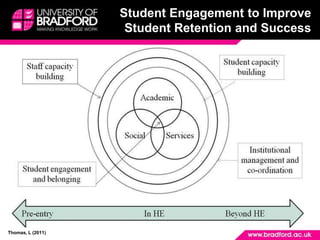
Student Engagement to Improve
                    Student Retention and Success


Thomas, L (2011)
Institutional Reflective Checklist

To what extent:
• Does the institution actively nurture a culture of belonging?
• Do staff feel responsible for student belonging, retention and
  success?
• Are high quality student centered learningh and teaching seen
  as integral?
• Does the institution develop the capacity of its students?
• Does institutional data and monitoring support student
  belonging?
• Do all students feel like they belong and are supported?
• How can educational development support
  change?
• How can we make things different?

• How can we ensure the reflective checklist
  is implemented?

• How do we make staff care about the
  student experience?
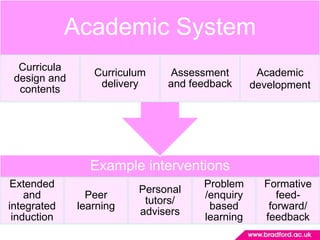
Academic System
  Curricula
                 Curriculum   Assessment        Academic
 design and
                  delivery    and feedback     development
  contents


                Example interventions
 Extended                           Problem      Formative
                         Personal
    and         Peer                /enquiry        feed-
                          tutors/
integrated    learning               based        forward/
                         advisers
 induction                          learning     feedback
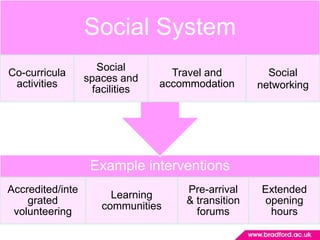
Social System
                     Social
Co-curricula                       Travel and         Social
                  spaces and
 activities                      accommodation      networking
                    facilities


                   Example interventions
Accredited/inte                      Pre-arrival    Extended
                       Learning
    grated                           & transition    opening
                     communities
 volunteering                          forums         hours
Professional Service
                 System
                                           Learning and         Progression
   Pre-entry            Pastoral
                                         Teaching (library,
(admissions, outr   (counselling, fina                        (Careers, alumni
                                          academic skills,
each, marketing)      nce help, SU)                               support)
                                         disability service


                    Example interventions
                      Early and
    Peer                                    Student
                      extended                                 Exit support
  mentoring                                 helpdesk
                      induction
Organisational System
  Corporate         Leadership, wh       Inclusive &         Co-ordinated,
mission, vision         ole staff          aligned             evidence
 & strategic         responsibility,      policies &           informed
  objectives              CPD            procedures             strategy


                    Example interventions
  Inclusive &                                  Staff             Managing
                  Triangulated data
 accountable                           recruitment, reward        student
                  use at programme
   validation                            and recognition        engagement
                         level
  processes                                  policies           opportunities
Building Communities


• Belonging is crucial

• Staff and students

• Do you feel you belong to the university
  community? How? Why? Evidence it!
• How do you create and maintain a
  community?
Why Have I Stayed?
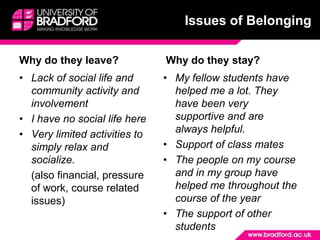
Issues of Belonging

Why do they leave?             Why do they stay?
• Lack of social life and      • My fellow students have
  community activity and         helped me a lot. They
  involvement                    have been very
• I have no social life here     supportive and are
• Very limited activities to     always helpful.
  simply relax and             • Support of class mates
  socialize.                   • The people on my course
  (also financial, pressure      and in my group have
  of work, course related        helped me throughout the
  issues)                        course of the year
                               • The support of other
                                 students
Ten Ways to Change Undergraduate Education


1. Make Research-Based Learning the Standard
2. Construct an Inquiry-Based Freshman Year
3. Build on the Freshman Foundation
4. Remove Barriers to Interdisciplinary Education
5. Link Communication Skills and Course Work
6. Use Information Technology Creatively
7. Culminate with a Capstone Experience
8. Educate Graduate Students as Apprentice Teachers
9. Change Faculty Reward Systems          The Boyer Commission on
                                          Educating Undergraduates
10. Cultivate a Sense of Community        in the Research University: REINVENTING
                                          UNDERGRADUATE EDUCATION
                                                         Boyer, 1999
Possible examples

• Group sessions
• Interactive activities
• Online and face2face support
• Personal tutor groups
• Links with other
  modules/courses/Schools/Colleges
• Links outside the curriculum e.g. Student
  Union
• Curriculum based induction
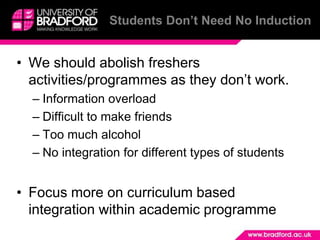
Students Don’t Need No Induction


• We should abolish freshers
  activities/programmes as they don’t work.
  – Information overload
  – Difficult to make friends
  – Too much alcohol
  – No integration for different types of students


• Focus more on curriculum based
  integration within academic programme
Individual level: What Can We Do?


•   Identify student expectations of University
•   Make explicit institutional requirements
•   Demystify the complex, codified structures
•   Provide holistic induction experience
•   Supportive assessment process
    – Provide early formative assessment
    – Engage with curriculum to inspire learners
• Define curriculum engagement
• Academic and Social integration
Intervention level: Core principles


                     Proactive
                                   Inclusive
 Collaborative


                    Intervention         Flexible
Integrated              level


                                   Transparent
      Timely
                      Ongoing
Any Questions?!
<Thank you!/>
And if all else fails……


                          Eat cake ;-)

Seda keynote may 2012

  • 1.
    Why Am IHere? Why Should I Stay? Becka Colley Dean of Students, University of Bradford National Teaching Fellow
  • 2.
    Content • Understanding studentdoubters • Building communities and encouraging belonging • Taking responsibility and making change happen
  • 3.
    Stating The ObviousBut… • Higher Education is changing… (has changed) “The university system is in need of „radical change‟ to provide a better deal for taxpayers and students” (Willetts, 10 June 2010) • How has the sector responded? • What have you done differently?
  • 4.
    Drivers for Change •Diversity of entry routes • Issues of dealing with developing autonomy • Older – with additional responsibilities/issues? • More local, many with existing established peer groups • Earning whilst learning • Disengaged learners seeking qualification whilst unsure what University life is about • Reduction in places: increased competition
  • 5.
    • In theUK, only 1 in 12 (8%) of students leave HE during their first year. • Between 1/3 to 2/5 *think* about leaving.
  • 6.
    Reasons for Doubting? •Academic issues. • Feelings of isolation and/or not fitting in. • Concern about achieving future aspirations.
  • 7.
    Why Do StudentsLeave University? • Because they are not engaged • Not engaged academically – “I am not clever enough” – “The course is not what I thought it would be” • Not engaged socially – “I feel lonely” – “I am homesick” – “The other students are not friendly”
  • 8.
    Why Are YouHere? • Because “I have nothing else to do” • Because “my parents/siblings told me to come” • Because “I don‟t want to get a job” • Because “I want to study the subject” • What impact will this have on engagement? How do we support a different learning experience?
  • 9.
    Teaching, learning support, facilities Academic Goal Integration Prior qualifications Commitment Institutional Commitment Individual attributes Dropout decisions Family attributes, e.g. parental education Debt, Social counselling, Integration medical, personal, family Tinto’s (1993) model events.
  • 10.
    The HERE Project •Explored two themes associated with retention: I. Impact of doubting on students’ decisions to persist II. Impact of individual programme teams on retention
  • 11.
    Key Findings • Approx1/3 of first years • Programme issues are Key Findings have experienced doubts primary reason for sufficiently strong to make doubting. them consider leaving. • 4 main reasons to stay: • Doubters are more likely friends; adapting to to leave than non- course; personal doubters. commitment; future goals. • Doubters reported a • Strongest doubts from poorer quality experience students with least than non-doubters. positive experiences. • Usually more than one • Some student groups reason for doubting. more likely to doubt than others.
  • 12.
    Key recommendations 1. Identifyand respond to 5. Improve social integration. students at risk. 6. Improve a sense of belonging. 2. Help students to make 7. Foster motivation and help the transition to being students understand how the effective learners at programme can help achieve university their future goals. 3. Improve the 8. Encourage students’ active communication and engagement with the relationships with staff. curriculum. 4. Help students make 9. Ensure that there is good more informed decisions communication about and about choosing the right access to additional student course in the first place. support.
  • 13.
    Student Engagement toImprove Student Retention and Success Thomas, L (2011)
  • 14.
    Institutional Reflective Checklist Towhat extent: • Does the institution actively nurture a culture of belonging? • Do staff feel responsible for student belonging, retention and success? • Are high quality student centered learningh and teaching seen as integral? • Does the institution develop the capacity of its students? • Does institutional data and monitoring support student belonging? • Do all students feel like they belong and are supported?
  • 15.
    • How caneducational development support change?
  • 16.
    • How canwe make things different? • How can we ensure the reflective checklist is implemented? • How do we make staff care about the student experience?
  • 17.
    Academic System Curricula Curriculum Assessment Academic design and delivery and feedback development contents Example interventions Extended Problem Formative Personal and Peer /enquiry feed- tutors/ integrated learning based forward/ advisers induction learning feedback
  • 18.
    Social System Social Co-curricula Travel and Social spaces and activities accommodation networking facilities Example interventions Accredited/inte Pre-arrival Extended Learning grated & transition opening communities volunteering forums hours
  • 19.
    Professional Service System Learning and Progression Pre-entry Pastoral Teaching (library, (admissions, outr (counselling, fina (Careers, alumni academic skills, each, marketing) nce help, SU) support) disability service Example interventions Early and Peer Student extended Exit support mentoring helpdesk induction
  • 20.
    Organisational System Corporate Leadership, wh Inclusive & Co-ordinated, mission, vision ole staff aligned evidence & strategic responsibility, policies & informed objectives CPD procedures strategy Example interventions Inclusive & Staff Managing Triangulated data accountable recruitment, reward student use at programme validation and recognition engagement level processes policies opportunities
  • 21.
    Building Communities • Belongingis crucial • Staff and students • Do you feel you belong to the university community? How? Why? Evidence it! • How do you create and maintain a community?
  • 22.
    Why Have IStayed?
  • 23.
    Issues of Belonging Whydo they leave? Why do they stay? • Lack of social life and • My fellow students have community activity and helped me a lot. They involvement have been very • I have no social life here supportive and are • Very limited activities to always helpful. simply relax and • Support of class mates socialize. • The people on my course (also financial, pressure and in my group have of work, course related helped me throughout the issues) course of the year • The support of other students
  • 24.
    Ten Ways toChange Undergraduate Education 1. Make Research-Based Learning the Standard 2. Construct an Inquiry-Based Freshman Year 3. Build on the Freshman Foundation 4. Remove Barriers to Interdisciplinary Education 5. Link Communication Skills and Course Work 6. Use Information Technology Creatively 7. Culminate with a Capstone Experience 8. Educate Graduate Students as Apprentice Teachers 9. Change Faculty Reward Systems The Boyer Commission on Educating Undergraduates 10. Cultivate a Sense of Community in the Research University: REINVENTING UNDERGRADUATE EDUCATION Boyer, 1999
  • 25.
    Possible examples • Groupsessions • Interactive activities • Online and face2face support • Personal tutor groups • Links with other modules/courses/Schools/Colleges • Links outside the curriculum e.g. Student Union • Curriculum based induction
  • 26.
    Students Don’t NeedNo Induction • We should abolish freshers activities/programmes as they don’t work. – Information overload – Difficult to make friends – Too much alcohol – No integration for different types of students • Focus more on curriculum based integration within academic programme
  • 27.
    Individual level: WhatCan We Do? • Identify student expectations of University • Make explicit institutional requirements • Demystify the complex, codified structures • Provide holistic induction experience • Supportive assessment process – Provide early formative assessment – Engage with curriculum to inspire learners • Define curriculum engagement • Academic and Social integration
  • 28.
    Intervention level: Coreprinciples Proactive Inclusive Collaborative Intervention Flexible Integrated level Transparent Timely Ongoing
  • 29.
  • 30.
  • 31.
    And if allelse fails…… Eat cake ;-)

Editor's Notes

  • #5 Possible clicker Q: How many of you teach classes with a) international students, b) disabled students, c) BME students, d) Students who live at home, e) mature studentsA: none of the aboveB: 1 of aboveC: 2 / 3 of the aboveD: 4 / 5 of the above
  • #10 Travel – wrong mode of transport for destination, lack of planning etc
  • #31 Relevant Student centred Strategy levelMulti-pronged: Addressing multiple aspects of student experience; range of interventions Collaborative Range of interventions Across student lifecycle Co-ordinated Whole staff responsibility Transparent Intervention level Timely – at the right time and in advance Collaborative