Divination and Forecasting: What Will Happen in the Future of HE?Becka ColleyDean of StudentsNational Teaching Fellow
The Runes They Say…
By the end of this keynote I predict that…Chris might finally have started to relaxEloise will have knitted a sexy jumper for everyone in the audienceEd will snigger every time I mention technology3 people will fall asleepMatches and gas lamps will have made a comeback, but only in booths in the CrownI will have spoken too fast, againAnd it will all still be Nick Clegg’s fault
Areas of Focus…Changing nature of student population and expectations about HE experienceImpact on institutions of new funding regimeRole of Learning Development
But first!Let’s do some shared thinking… not really ;-)
Card sort instructionsTo get you thinking…In groups, discuss the student quotesDecide if they are related to issues of:socialacademicprofessional serviceorganisationalWhat would you do to support the student? How would you do this?5mins!
Students 2.0?Who/what are modern students? A vision of students today(Wesch, 2007)Engaging Students at Bradford (Currant, 2009)What issues do they face? What challenges does this pose for us?How do we respond to differences from the ‘norm’?
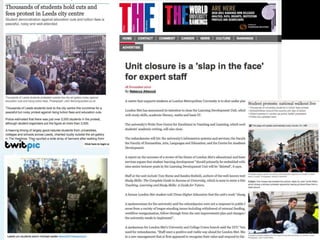
Stating the Obvious But……Higher Education is changing:“The university system is in need of ‘radical change’ to provide a better deal for taxpayers and students” (Willetts, 10 June 2010)How is the sector going to respond?What will you do differently?How can Learning Development support this process?
The Impact of ‘massification’Over last 20 years Higher education has undergone radical and unprecedented change (Education Act, 1992; Dearing Report, 1997; Roberts Report, 2003; Leitch Report, 2006; Browne, 2010; CSR, 2010)Learners are entering with different expectations and assumptions about their experiencesThe student body has become dramatically more heterogeneous and has fragmented in some cases
What will happen to HE?
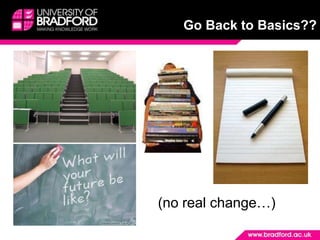
Go Back to Basics??(no real change…)
Become Futuristic??
Universities 2.0?Diversity of entry routesIssues of dealing with developing autonomyEarning whilst learningDisengaged learners seeking qualificationPressures on the system and individualsChanging processes within an inflexible systemTradition and history
“£9000 a year fees will be the exception not the rule.”
In the context of…“Certain tutors appear arrogant and unwilling to listen to student's views. Tutors are often unable to make lectures interesting and/or teach the subject matter in a way that clearly communicates the information and is stimulating. £3,000+ per year definitely not worth it.” [quote from NSS]
How long to see the impact and effects?And how long before even more change??
Outcome = Mixed (imho…)	Those that can, will and those that can’t, will (struggle…)What does this mean forStaffStudents InstitutionsSocietyLearning DevelopmentYou???
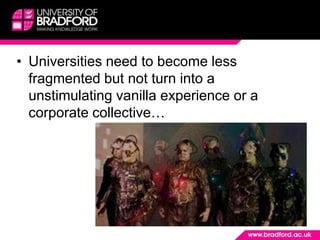
Universities need to become less fragmented but not turn into a unstimulating vanilla experience or a corporate collective…
It’s All About Expectations…Expectation management is keySupportIntegrationTransition issuesSuccessAwarenessPersonalisation within a complicated and fragmented system
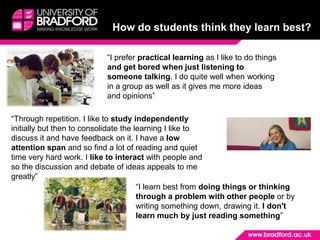
How do students think they learn best?“I prefer practical learning as I like to do things and get bored when just listening to someone talking. I do quite well when working in a group as well as it gives me more ideas and opinions” “Through repetition. I like to study independently initially but then to consolidate the learning I like to discuss it and have feedback on it. I have a low attention span and so find a lot of reading and quiet time very hard work. I like to interact with people and so the discussion and debate of ideas appeals to me greatly” “I learn best from doing things or thinking through a problem with other people or by writing something down, drawing it. I don't learn much by just reading something”
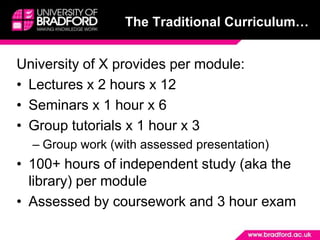
The Traditional Curriculum…University of X provides per module:Lectures x 2 hours x 12Seminars x 1 hour x 6Group tutorials x 1 hour x 3Group work (with assessed presentation)100+ hours of independent study (aka the library) per moduleAssessed by coursework and 3 hour exam
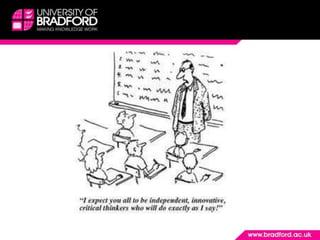
And if they’re really lucky they get…
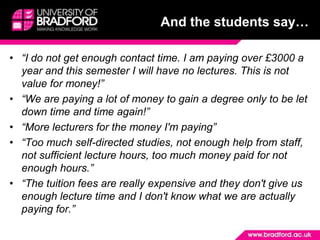
And the students say…“I do not get enough contact time. I am paying over £3000 a year and this semester I will have no lectures. This is not value for money!”“We are paying a lot of money to gain a degree only to be let down time and time again!”“More lecturers for the money I'm paying”“Too much self-directed studies, not enough help from staff, not sufficient lecture hours, too much money paid for not enough hours.”“The tuition fees are really expensive and they don't give us enough lecture time and I don't know what we are actually paying for.”
	(and that’s before £9000 for September 2012…)
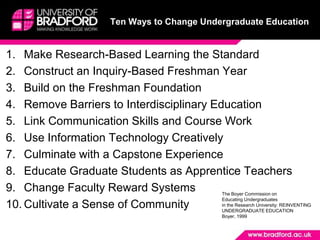
Ten Ways to Change Undergraduate EducationMake Research-Based Learning the StandardConstruct an Inquiry-Based Freshman YearBuild on the Freshman Foundation Remove Barriers to Interdisciplinary EducationLink Communication Skills and Course WorkUse Information Technology Creatively Culminate with a Capstone ExperienceEducate Graduate Students as Apprentice TeachersChange Faculty Reward SystemsCultivate a Sense of CommunityThe Boyer Commission onEducating Undergraduatesin the Research University: REINVENTING UNDERGRADUATE EDUCATIONBoyer, 1999
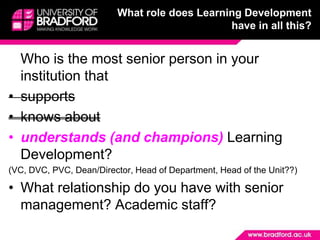
What role does Learning Development have in all this?	Who is the most senior person in your institution that supportsknows aboutunderstands (and champions) Learning Development?(VC, DVC, PVC, Dean/Director, Head of Department, Head of the Unit??)What relationship do you have with senior management? Academic staff?
	How many of your Units were mentioned in your University’s access agreement?
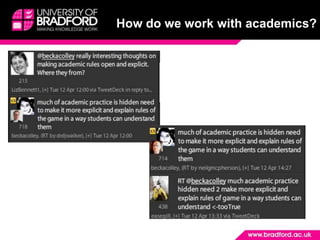
How do we work with academics?
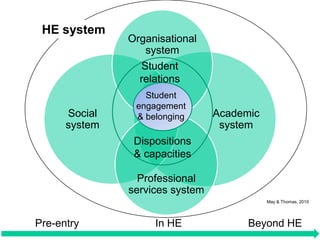
Organisational systemHE systemAcademic systemSocial systemStudent relationsStudent engagement & belongingProfessional services systemDispositions & capacitiesMay & Thomas, 2010
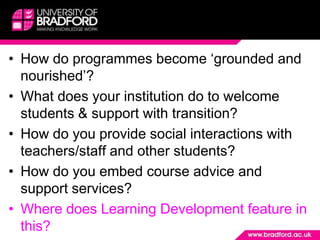
How do programmes become ‘grounded and nourished’?What does your institution do to welcome students & support with transition? How do you provide social interactions with teachers/staff and other students?How do you embed course advice and support services?Where does Learning Development feature in this?
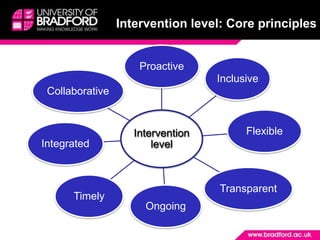
Intervention level: Core principles
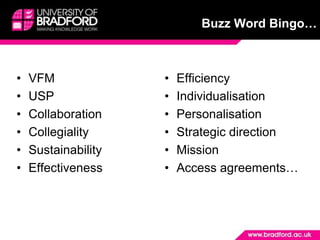
Buzz Word Bingo…VFMUSPCollaborationCollegialitySustainabilityEffectivenessEfficiencyIndividualisationPersonalisationStrategic directionMissionAccess agreements…
The role of learning development is crucialTo help staff succeed, we are vitalTo help students succeed, we are vitalTo help institutions succeed, we are vitalPosition to influenceKeep fighting!
	“I think things have changed so much since I started working in LD in 2006 - we have so much more confidence as a professional community now, but we do still need to be reminded of the importance of being pro-active and not reactive.”
Remember…the only certainty is uncertainty.
The Runes Said:Poerdh: time of crisis, many choices open but what choice is made will affect you and others for a long time to come. This rune is a danger sign…Thorn: updating of thoughts and opinions, think carefully about what is wanted.Os [r]: misjudgement, outcome disaster if action not changed.Rad[r]: challenge the way things are seen.Hoel: struggle and effort needed, victory can be won but at a cost. Conflict can not be avoided, destruction of obsolete, removal of the irrelevant.Nyd: great opportunities at hand.Ehwis: strength, courage, tenacity, perseverance.Ing: wisdom and advice from others, gathering of friends. Laying of foundations that will last for a long time, good time in life, approval of others.Interpretation: it’s gonna be hard but we’ll get there…!
Any Questions?!
<Thank you!/>
Shameless Plug…Manchester19-20 June 2011http://efye2011.blogspot.com/

Aldinhe keynote becka colley

  • 1.
    Divination and Forecasting:What Will Happen in the Future of HE?Becka ColleyDean of StudentsNational Teaching Fellow
  • 2.
  • 3.
    By the endof this keynote I predict that…Chris might finally have started to relaxEloise will have knitted a sexy jumper for everyone in the audienceEd will snigger every time I mention technology3 people will fall asleepMatches and gas lamps will have made a comeback, but only in booths in the CrownI will have spoken too fast, againAnd it will all still be Nick Clegg’s fault
  • 4.
    Areas of Focus…Changingnature of student population and expectations about HE experienceImpact on institutions of new funding regimeRole of Learning Development
  • 5.
    But first!Let’s dosome shared thinking… not really ;-)
  • 6.
    Card sort instructionsToget you thinking…In groups, discuss the student quotesDecide if they are related to issues of:socialacademicprofessional serviceorganisationalWhat would you do to support the student? How would you do this?5mins!
  • 7.
    Students 2.0?Who/what aremodern students? A vision of students today(Wesch, 2007)Engaging Students at Bradford (Currant, 2009)What issues do they face? What challenges does this pose for us?How do we respond to differences from the ‘norm’?
  • 8.
    Stating the ObviousBut……Higher Education is changing:“The university system is in need of ‘radical change’ to provide a better deal for taxpayers and students” (Willetts, 10 June 2010)How is the sector going to respond?What will you do differently?How can Learning Development support this process?
  • 10.
    The Impact of‘massification’Over last 20 years Higher education has undergone radical and unprecedented change (Education Act, 1992; Dearing Report, 1997; Roberts Report, 2003; Leitch Report, 2006; Browne, 2010; CSR, 2010)Learners are entering with different expectations and assumptions about their experiencesThe student body has become dramatically more heterogeneous and has fragmented in some cases
  • 11.
  • 12.
    Go Back toBasics??(no real change…)
  • 13.
  • 14.
    Universities 2.0?Diversity ofentry routesIssues of dealing with developing autonomyEarning whilst learningDisengaged learners seeking qualificationPressures on the system and individualsChanging processes within an inflexible systemTradition and history
  • 15.
    “£9000 a yearfees will be the exception not the rule.”
  • 16.
    In the contextof…“Certain tutors appear arrogant and unwilling to listen to student's views. Tutors are often unable to make lectures interesting and/or teach the subject matter in a way that clearly communicates the information and is stimulating. £3,000+ per year definitely not worth it.” [quote from NSS]
  • 17.
    How long tosee the impact and effects?And how long before even more change??
  • 18.
    Outcome = Mixed(imho…) Those that can, will and those that can’t, will (struggle…)What does this mean forStaffStudents InstitutionsSocietyLearning DevelopmentYou???
  • 19.
    Universities need tobecome less fragmented but not turn into a unstimulating vanilla experience or a corporate collective…
  • 20.
    It’s All AboutExpectations…Expectation management is keySupportIntegrationTransition issuesSuccessAwarenessPersonalisation within a complicated and fragmented system
  • 21.
    How do studentsthink they learn best?“I prefer practical learning as I like to do things and get bored when just listening to someone talking. I do quite well when working in a group as well as it gives me more ideas and opinions” “Through repetition. I like to study independently initially but then to consolidate the learning I like to discuss it and have feedback on it. I have a low attention span and so find a lot of reading and quiet time very hard work. I like to interact with people and so the discussion and debate of ideas appeals to me greatly” “I learn best from doing things or thinking through a problem with other people or by writing something down, drawing it. I don't learn much by just reading something”
  • 22.
    The Traditional Curriculum…Universityof X provides per module:Lectures x 2 hours x 12Seminars x 1 hour x 6Group tutorials x 1 hour x 3Group work (with assessed presentation)100+ hours of independent study (aka the library) per moduleAssessed by coursework and 3 hour exam
  • 23.
    And if they’rereally lucky they get…
  • 25.
    And the studentssay…“I do not get enough contact time. I am paying over £3000 a year and this semester I will have no lectures. This is not value for money!”“We are paying a lot of money to gain a degree only to be let down time and time again!”“More lecturers for the money I'm paying”“Too much self-directed studies, not enough help from staff, not sufficient lecture hours, too much money paid for not enough hours.”“The tuition fees are really expensive and they don't give us enough lecture time and I don't know what we are actually paying for.”
  • 26.
    (and that’s before£9000 for September 2012…)
  • 27.
    Ten Ways toChange Undergraduate EducationMake Research-Based Learning the StandardConstruct an Inquiry-Based Freshman YearBuild on the Freshman Foundation Remove Barriers to Interdisciplinary EducationLink Communication Skills and Course WorkUse Information Technology Creatively Culminate with a Capstone ExperienceEducate Graduate Students as Apprentice TeachersChange Faculty Reward SystemsCultivate a Sense of CommunityThe Boyer Commission onEducating Undergraduatesin the Research University: REINVENTING UNDERGRADUATE EDUCATIONBoyer, 1999
  • 28.
    What role doesLearning Development have in all this? Who is the most senior person in your institution that supportsknows aboutunderstands (and champions) Learning Development?(VC, DVC, PVC, Dean/Director, Head of Department, Head of the Unit??)What relationship do you have with senior management? Academic staff?
  • 29.
    How many ofyour Units were mentioned in your University’s access agreement?
  • 30.
    How do wework with academics?
  • 31.
    Organisational systemHE systemAcademicsystemSocial systemStudent relationsStudent engagement & belongingProfessional services systemDispositions & capacitiesMay & Thomas, 2010
  • 32.
    How do programmesbecome ‘grounded and nourished’?What does your institution do to welcome students & support with transition? How do you provide social interactions with teachers/staff and other students?How do you embed course advice and support services?Where does Learning Development feature in this?
  • 33.
  • 34.
  • 35.
    The role oflearning development is crucialTo help staff succeed, we are vitalTo help students succeed, we are vitalTo help institutions succeed, we are vitalPosition to influenceKeep fighting!
  • 36.
    “I think thingshave changed so much since I started working in LD in 2006 - we have so much more confidence as a professional community now, but we do still need to be reminded of the importance of being pro-active and not reactive.”
  • 37.
  • 38.
    The Runes Said:Poerdh:time of crisis, many choices open but what choice is made will affect you and others for a long time to come. This rune is a danger sign…Thorn: updating of thoughts and opinions, think carefully about what is wanted.Os [r]: misjudgement, outcome disaster if action not changed.Rad[r]: challenge the way things are seen.Hoel: struggle and effort needed, victory can be won but at a cost. Conflict can not be avoided, destruction of obsolete, removal of the irrelevant.Nyd: great opportunities at hand.Ehwis: strength, courage, tenacity, perseverance.Ing: wisdom and advice from others, gathering of friends. Laying of foundations that will last for a long time, good time in life, approval of others.Interpretation: it’s gonna be hard but we’ll get there…!
  • 39.
  • 40.
  • 41.
    Shameless Plug…Manchester19-20 June2011http://efye2011.blogspot.com/

Editor's Notes

  • #7 Produce 1 x A3 card sort results sheet per group Upload electronic A4 sheet to bb
  • #34 Relevant Student centred Strategy levelMulti-pronged: Addressing multiple aspects of student experience; range of interventions Collaborative Range of interventions Across student lifecycle Co-ordinated Whole staff responsibility Transparent Intervention level Timely – at the right time and in advance Collaborative