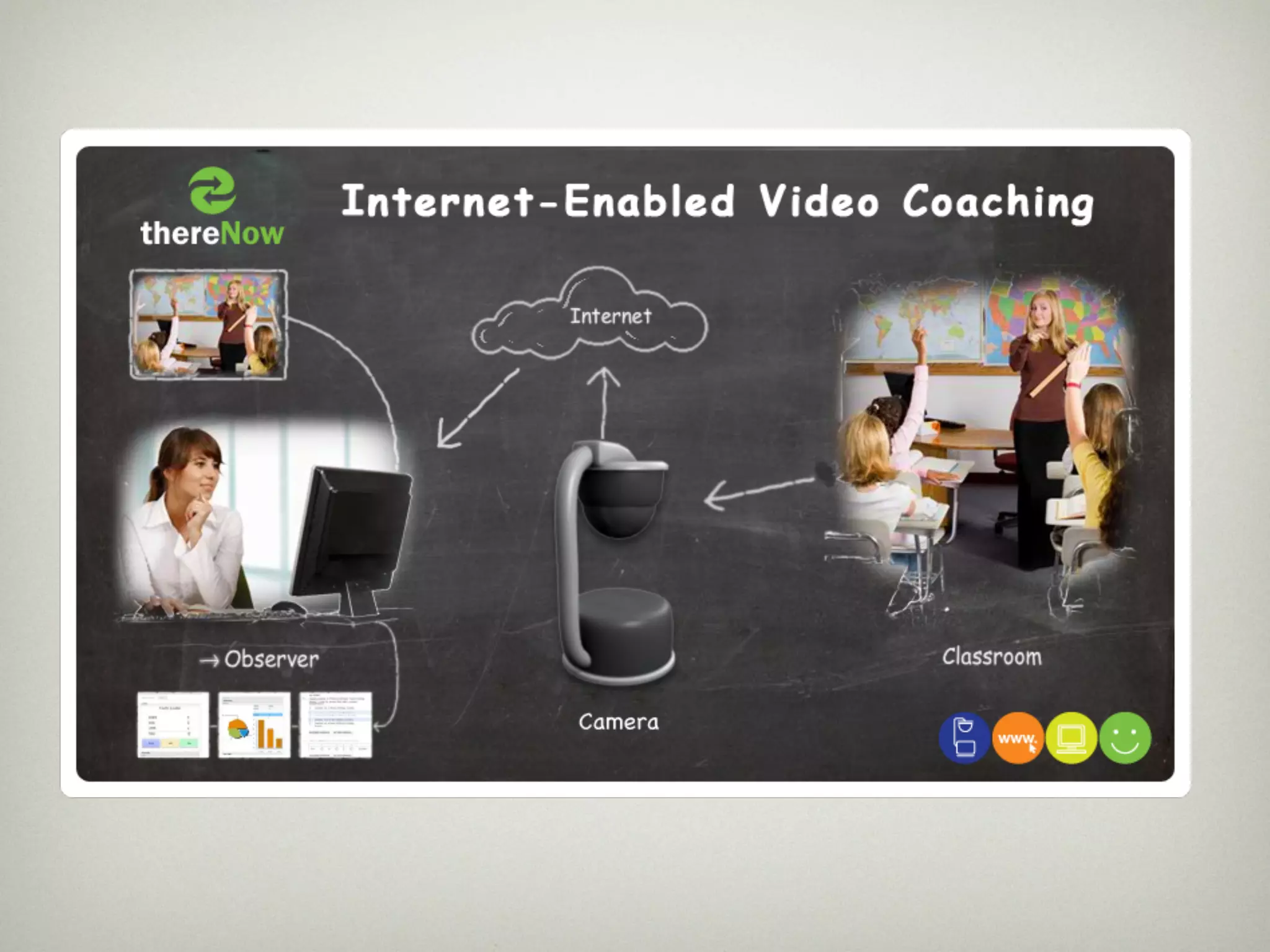
thereNow
Casey C. Elliott
   Vice President
     thereNow
   Casey@thereNow.net
What is thereNow?


                  In a nutshell...
We make classroom cameras to enable effective teacher
     coaching and professional development.


                                             thereNow
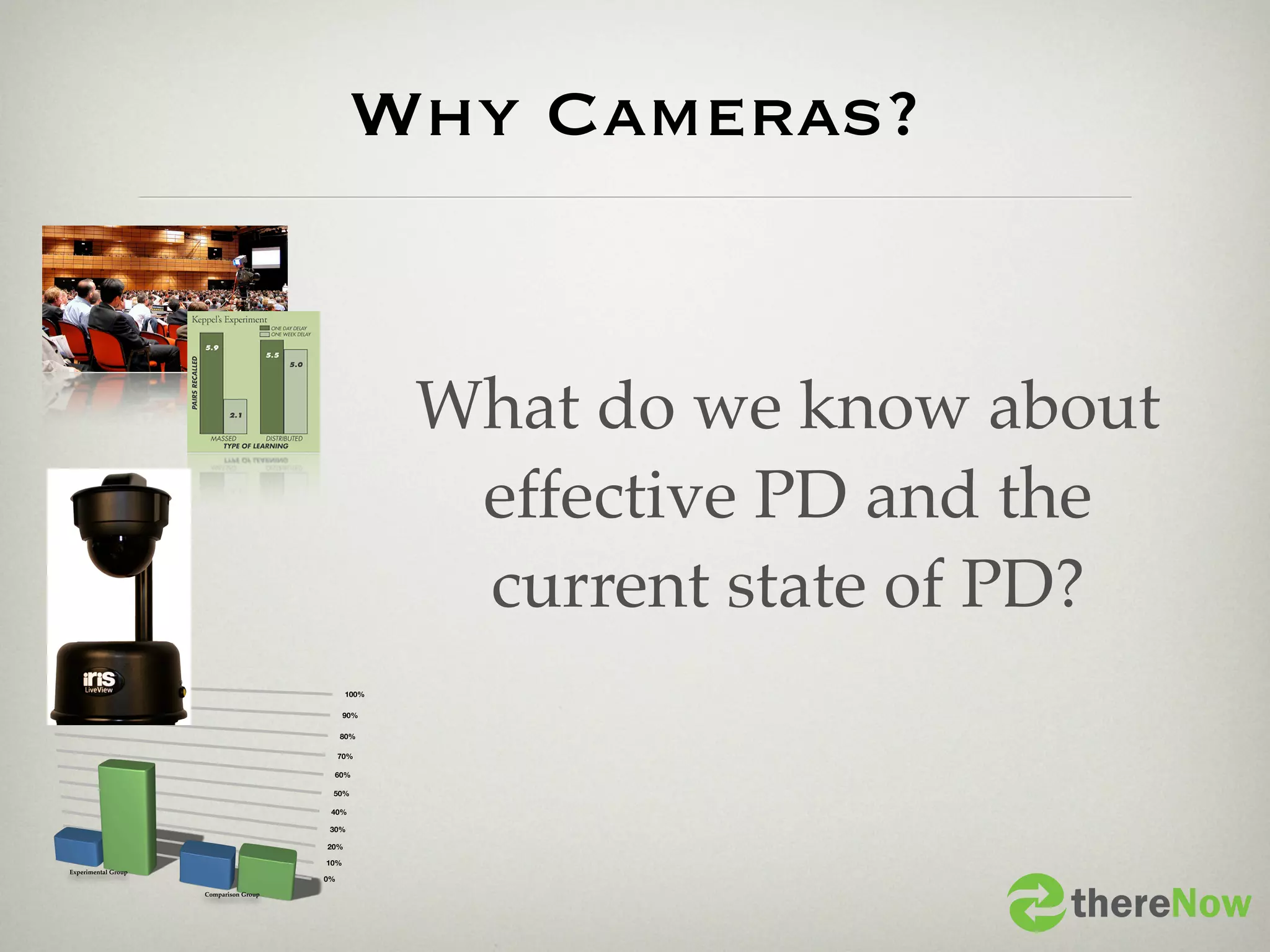
Why Cameras?


                                                     What do we know about
                                                      effective PD and the
                                                      current state of PD?
                                              100%

                                              90%

                                             80%

                                             70%

                                         60%

                                         50%

                                         40%

                                         30%

                                        20%

                                        10%
Experimental Group
                                        0%

                     Comparison Group


                                                                       thereNow
The Current Status of
                     Teacher PD

• Teacher quality is the most important factor in student
  achievement.
  (e.g., NCTAF, 1997, 2007; Darling-Hammond, 2000; Darling-Hammond & Ball, 1997)


• An estimated $14 Billion is spent each year on TPD
  (Kennedy, M, 2005)


• Many common PD activities are criticized (e.g., the
  drive-by workshop).
  (Guskey, 2000; Joyce & Showers, 2002; Wayne, Suk Yoon, Zhu, Cronen, & Garet, 2008)


                                                                                       thereNow
The Current Status
       of Teacher PD
“Experts variously say that [teacher professional development]
lacks coherence, that it misconceives of the way adults learn
best, and that it fails to appreciate the complexity of teachers’
work.”
                                                       Rebora (2004)


                           “Conventional approaches to
                           professional development, such as one-
                           time workshops, typically do not lead
                           to significant change in teaching
                           methodologies.”
                                                 Hawley & Valley (1999)


                                                             thereNow
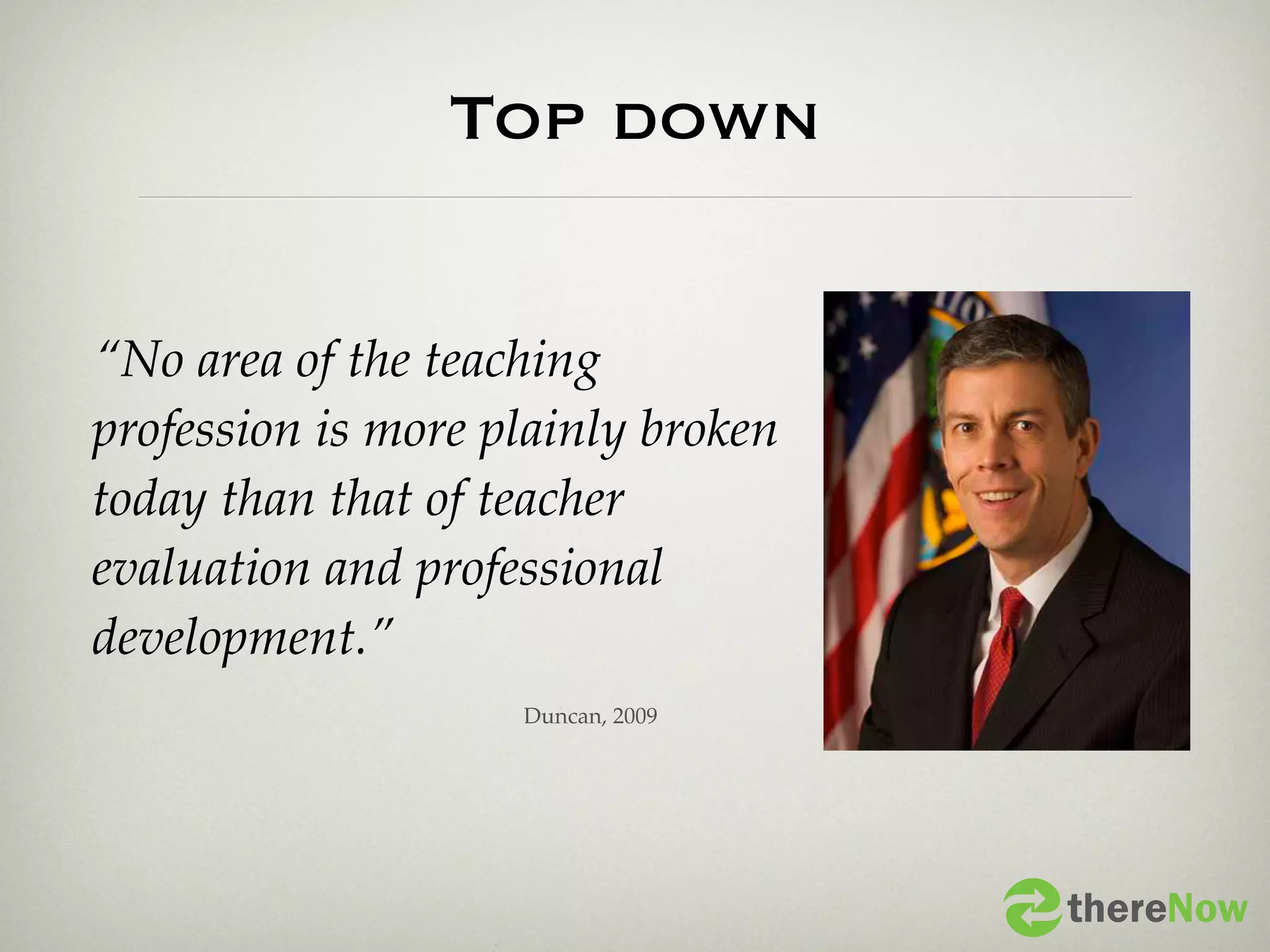
Top down

“No area of the teaching
profession is more plainly broken
today than that of teacher
evaluation and professional
development.”
                    Duncan, 2009


                                    thereNow
Why are Conventional
Approaches Ineffective?

• They fail to change behavior.

• That is, teachers do not actually
  enact what they are learning.


                                      thereNow
What IS Effective PD?
• “Collaborative learning environments, teacher research
  and inquiry, engagement in practical tasks of instruction
  and assessment, and consistent feedback and follow-up
  activities” (Rebora, 2004).

• Professional development must combine theory,
  modeling, practice, feedback, and coaching in order to
  lead to classroom implementation (Joyce and Showers
  1980, 1995).

• The U.S. Department of Education (2000) conducted a
  longitudinal study indicating that both duration and
  active learning opportunities are essential to effective
  professional development.

                                                             thereNow
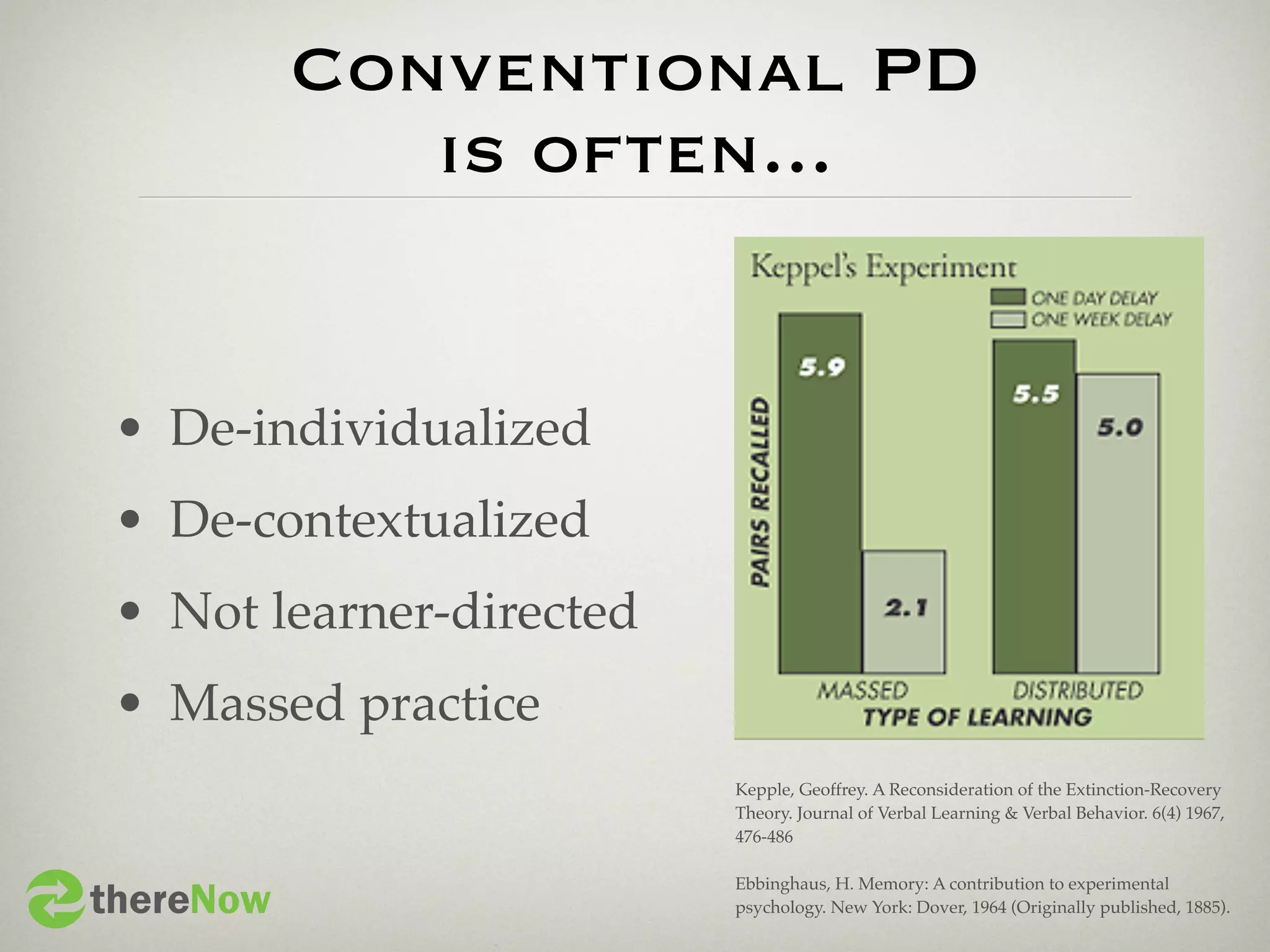
Conventional PD
              is often...


 • De-individualized
 • De-contextualized
 • Not learner-directed
 • Massed practice
                          Kepple, Geoffrey. A Reconsideration of the Extinction-Recovery
                          Theory. Journal of Verbal Learning & Verbal Behavior. 6(4) 1967,
                          476-486


thereNow
                          Ebbinghaus, H. Memory: A contribution to experimental
                          psychology. New York: Dover, 1964 (Originally published, 1885).
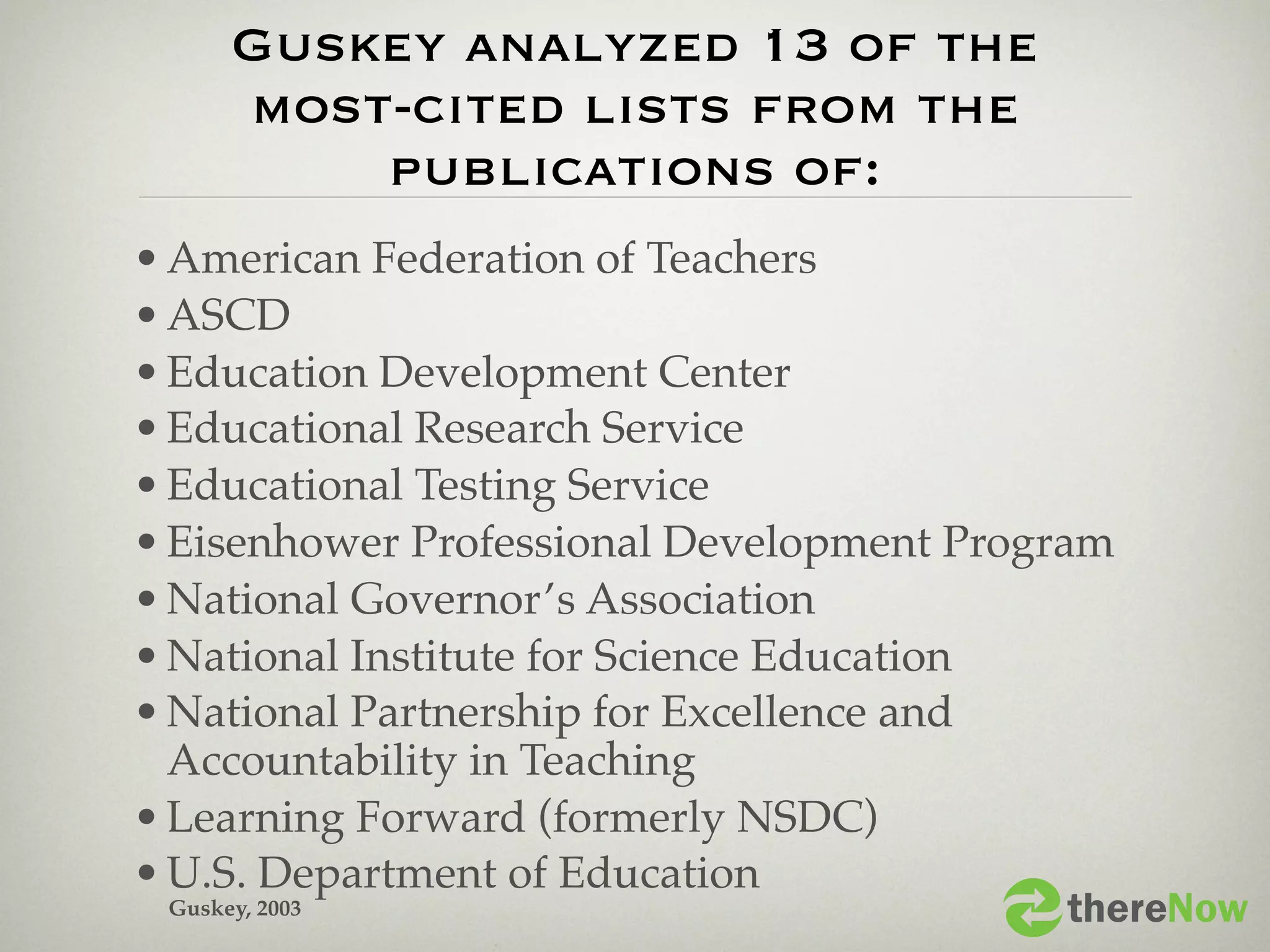
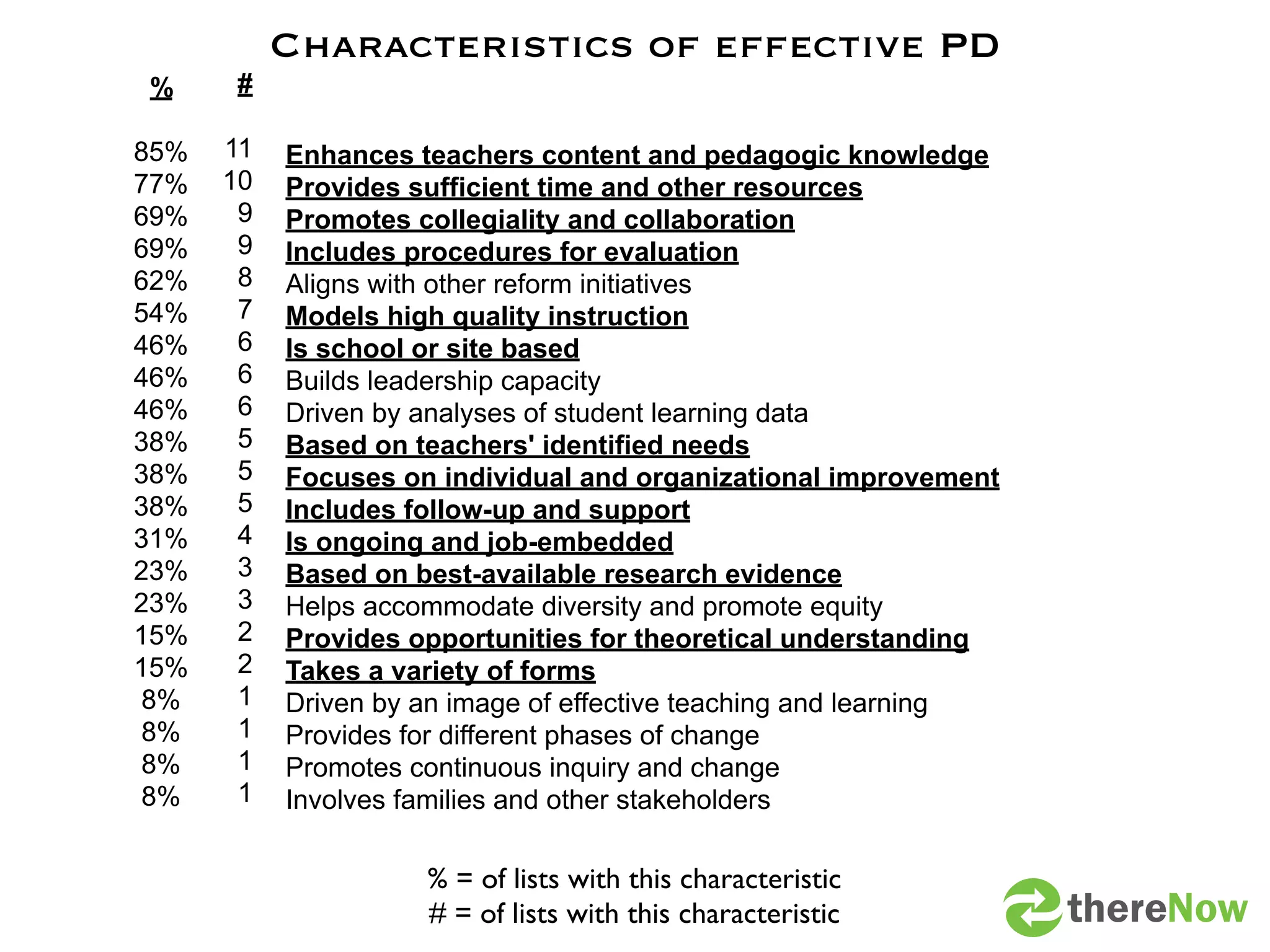
Guskey analyzed 13 of the
    most-cited lists from the
        publications of:
• American Federation of Teachers
• ASCD
• Education Development Center
• Educational Research Service
• Educational Testing Service
• Eisenhower Professional Development Program
• National Governor’s Association
• National Institute for Science Education
• National Partnership for Excellence and
  Accountability in Teaching
• Learning Forward (formerly NSDC)
• U.S. Department of Education
  Guskey, 2003                              thereNow
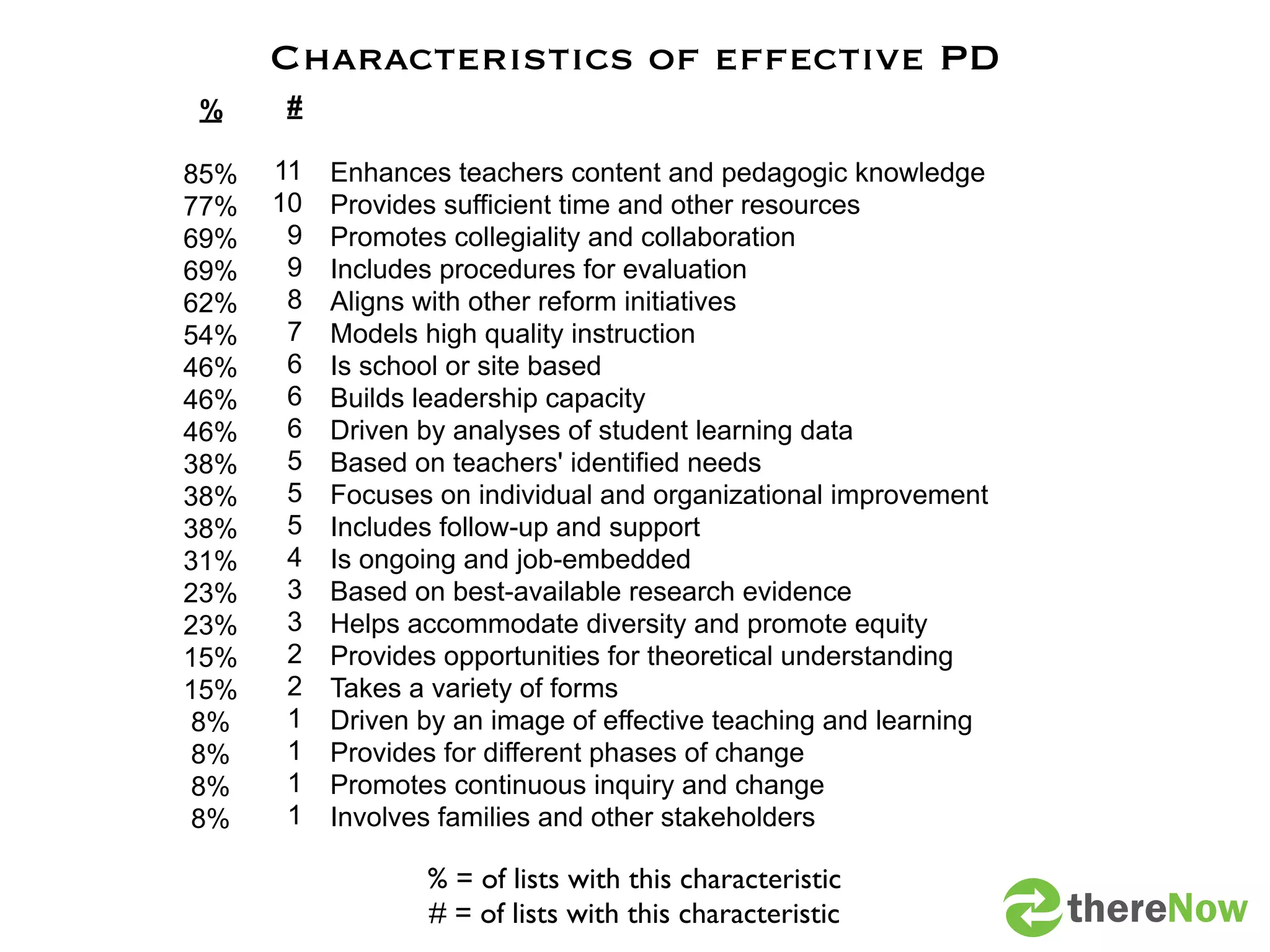
Characteristics of effective PD
%     #

85%   11   Enhances teachers content and pedagogic knowledge
77%   10   Provides sufficient time and other resources
69%    9   Promotes collegiality and collaboration
69%    9   Includes procedures for evaluation
62%    8   Aligns with other reform initiatives
54%    7   Models high quality instruction
46%    6   Is school or site based
46%    6   Builds leadership capacity
46%    6   Driven by analyses of student learning data
38%    5   Based on teachers' identified needs
38%    5   Focuses on individual and organizational improvement
38%    5   Includes follow-up and support
31%    4   Is ongoing and job-embedded
23%    3   Based on best-available research evidence
23%    3   Helps accommodate diversity and promote equity
15%    2   Provides opportunities for theoretical understanding
15%    2   Takes a variety of forms
 8%    1   Driven by an image of effective teaching and learning
 8%    1   Provides for different phases of change
 8%    1   Promotes continuous inquiry and change
 8%    1   Involves families and other stakeholders

                  % = of lists with this characteristic
                  # = of lists with this characteristic            thereNow
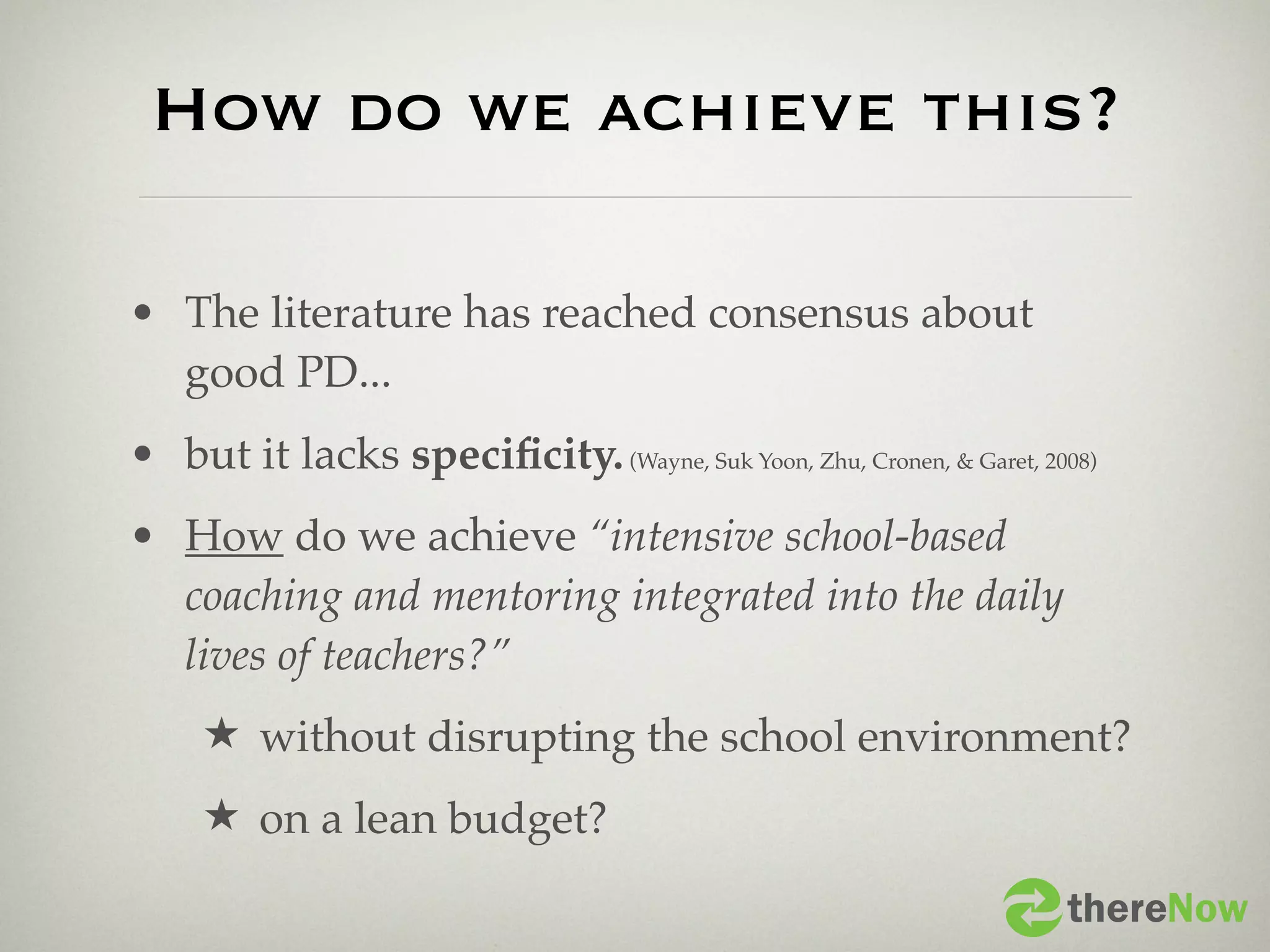
How do we achieve this?

• The literature has reached consensus about
  good PD...
• but it lacks specificity. (Wayne, Suk Yoon, Zhu, Cronen, & Garet, 2008)
• How do we achieve “intensive school-based
  coaching and mentoring integrated into the daily
  lives of teachers?”
     ★ without disrupting the school environment?
     ★ on a lean budget?

                                                                     thereNow
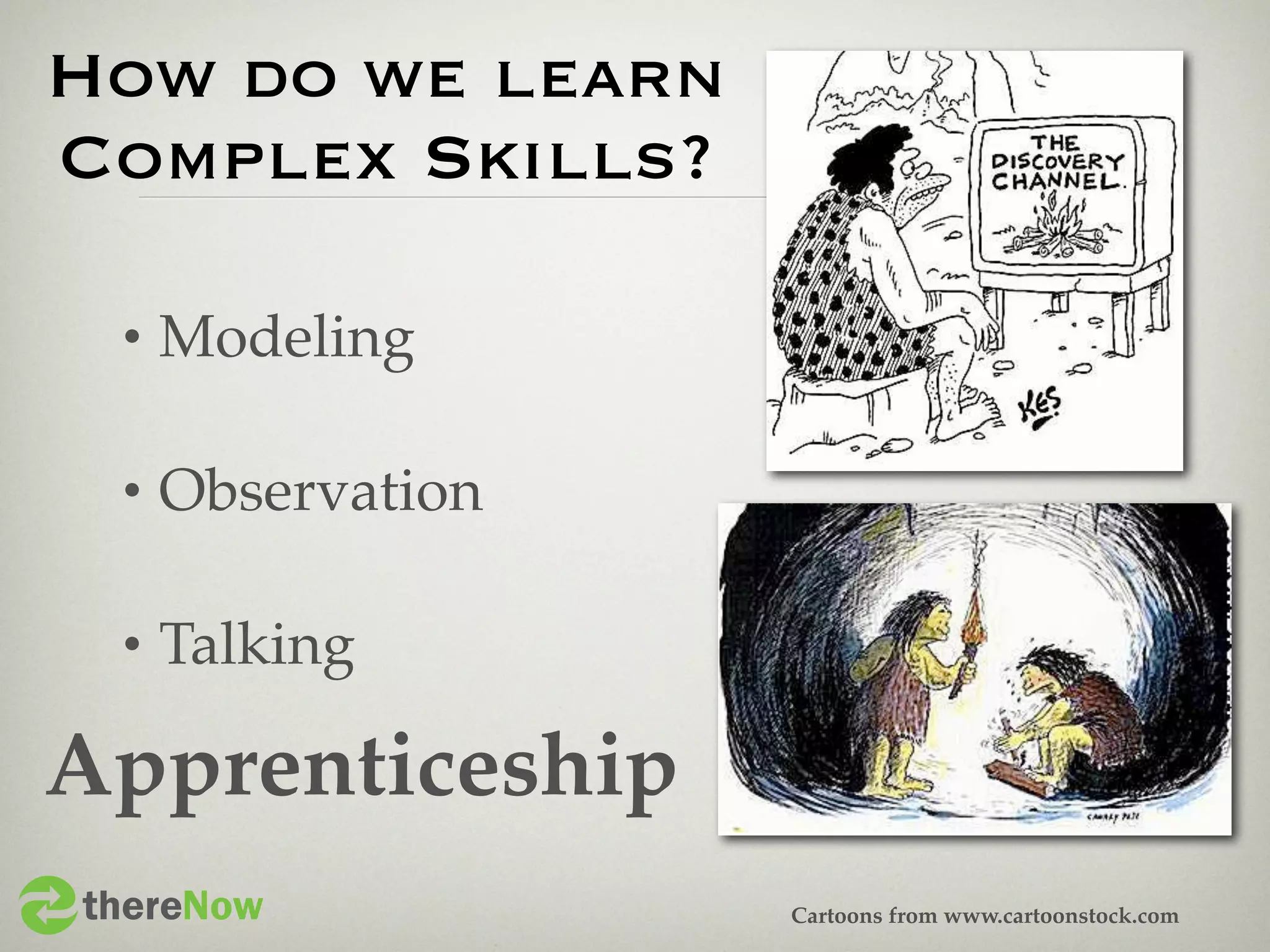
How do we learn
Complex Skills?

 •   Modeling

 •   Observation

 •   Talking

Apprenticeship
thereNow           Cartoons from www.cartoonstock.com
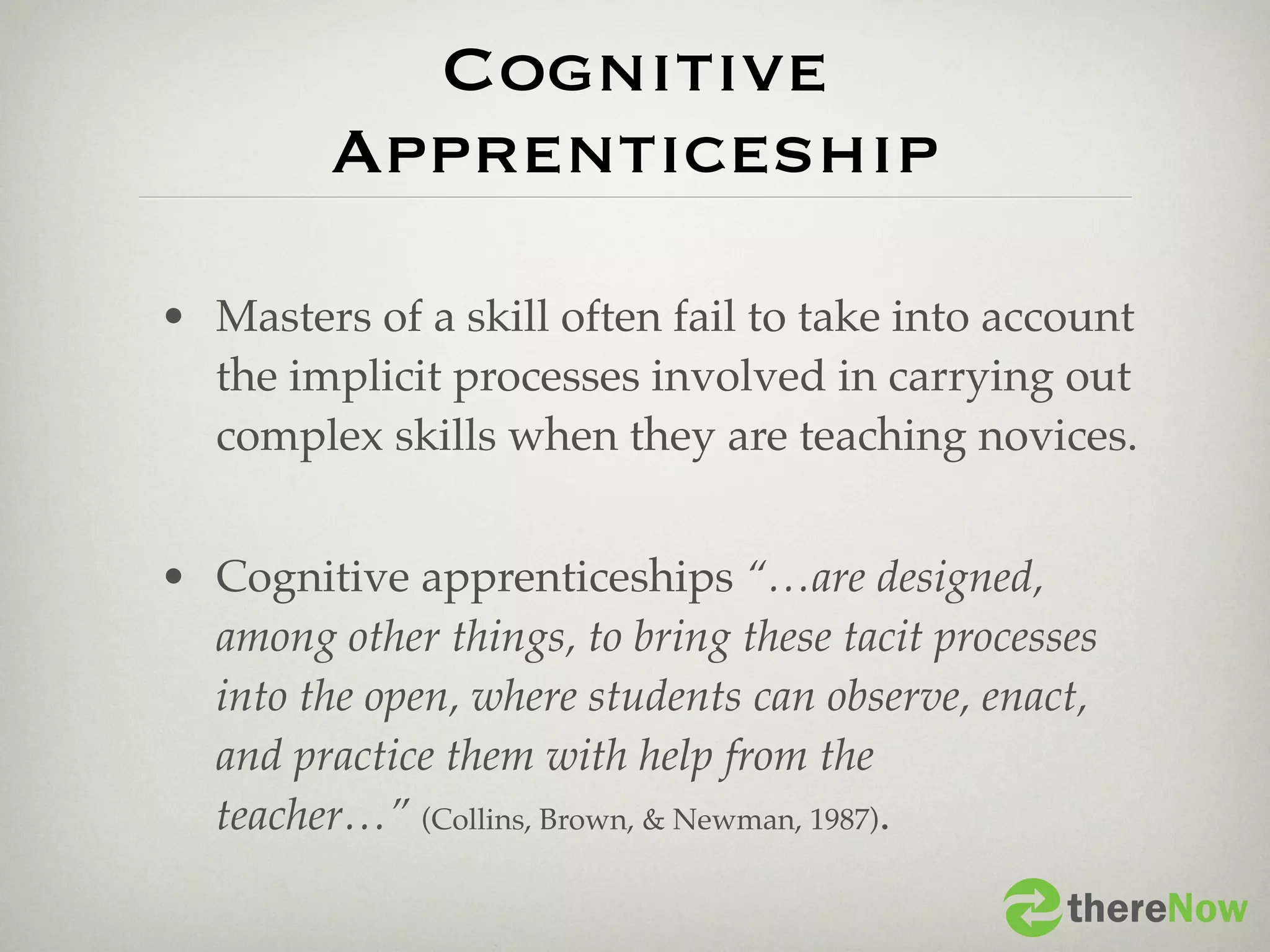
Cognitive
         Apprenticeship

• Masters of a skill often fail to take into account
  the implicit processes involved in carrying out
  complex skills when they are teaching novices.


• Cognitive apprenticeships “…are designed,
  among other things, to bring these tacit processes
  into the open, where students can observe, enact,
  and practice them with help from the
  teacher…” (Collins, Brown, & Newman, 1987).

                                                  thereNow
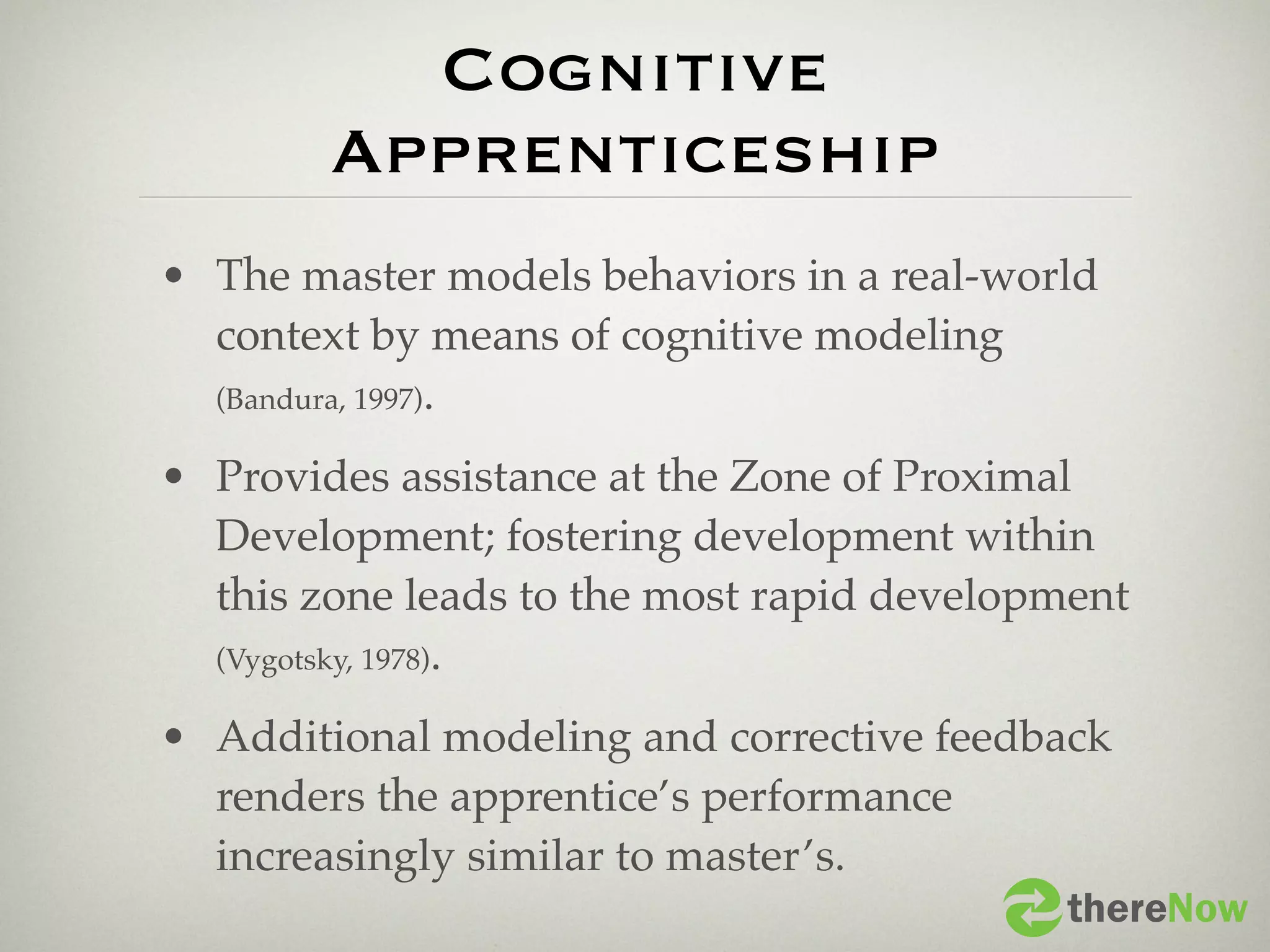
Cognitive
        Apprenticeship
• The master models behaviors in a real-world
  context by means of cognitive modeling
  (Bandura, 1997).

• Provides assistance at the Zone of Proximal
  Development; fostering development within
  this zone leads to the most rapid development
  (Vygotsky, 1978).

• Additional modeling and corrective feedback
  renders the apprentice’s performance
  increasingly similar to master’s.
                                           thereNow
Characteristics of effective PD
%     #

85%   11   Enhances teachers content and pedagogic knowledge
77%   10   Provides sufficient time and other resources
69%    9   Promotes collegiality and collaboration
69%    9   Includes procedures for evaluation
62%    8   Aligns with other reform initiatives
54%    7   Models high quality instruction
46%    6   Is school or site based
46%    6   Builds leadership capacity
46%    6   Driven by analyses of student learning data
38%    5   Based on teachers' identified needs
38%    5   Focuses on individual and organizational improvement
38%    5   Includes follow-up and support
31%    4   Is ongoing and job-embedded
23%    3   Based on best-available research evidence
23%    3   Helps accommodate diversity and promote equity
15%    2   Provides opportunities for theoretical understanding
15%    2   Takes a variety of forms
 8%    1   Driven by an image of effective teaching and learning
 8%    1   Provides for different phases of change
 8%    1   Promotes continuous inquiry and change
 8%    1   Involves families and other stakeholders

                     % = of lists with this characteristic
                     # = of lists with this characteristic         thereNow
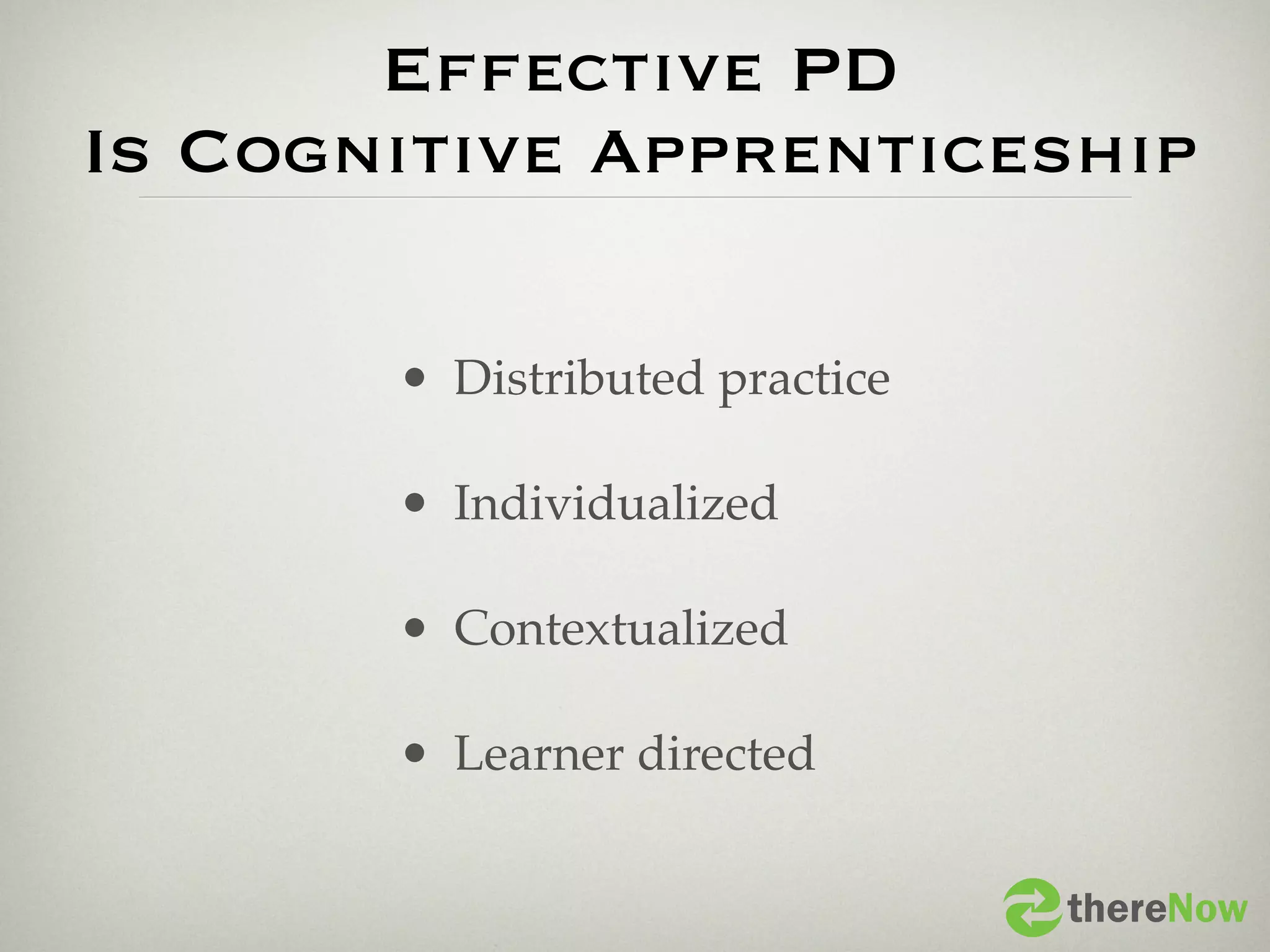
Effective PD
Is Cognitive Apprenticeship

       • Distributed practice

       • Individualized

       • Contextualized

       • Learner directed

                                thereNow
Challenges to
 Cognitive Apprenticeship

 • Requires frequent, on-site interaction
 • Travel makes mentors or coaches
   inefficient
 • Can be obtrusive to classroom
   environment


Can technology solve these problems?
                                            thereNow
What Technology
             Can enable
     Cognitive Apprenticeships?

    In order for technology to enable cognitive
    apprenticeship it must:
• Be portable
• Be reliable
• Be simple
• Attend to critical characteristics of
  communication
• Impart the sense coaches are actually present
  when they are not!
                                            thereNow
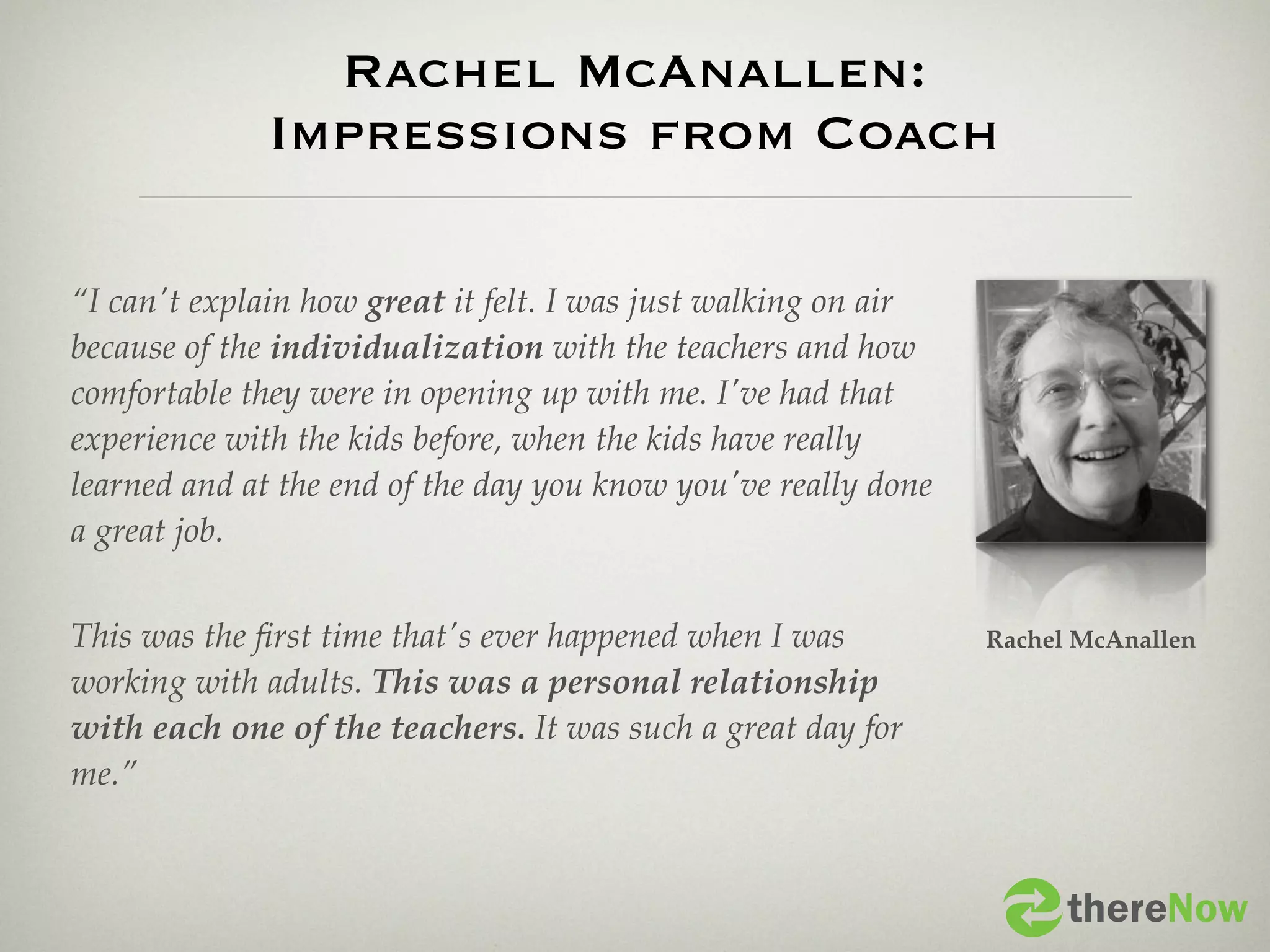
Rachel McAnallen:
              Impressions from Coach

“I can't explain how great it felt. I was just walking on air
because of the individualization with the teachers and how
comfortable they were in opening up with me. I've had that
experience with the kids before, when the kids have really
learned and at the end of the day you know you've really done
a great job.


This was the first time that's ever happened when I was          Rachel McAnallen
working with adults. This was a personal relationship
with each one of the teachers. It was such a great day for
me.”


                                                                      thereNow
thereNow technology
   Design objectives:
• Remote observation through a web browser
• Timely feedback
• Portability
• Ease of use
• Price
• Bandwidth friendly
• Security and privacy
• Data collection and data management
                                             thereNow
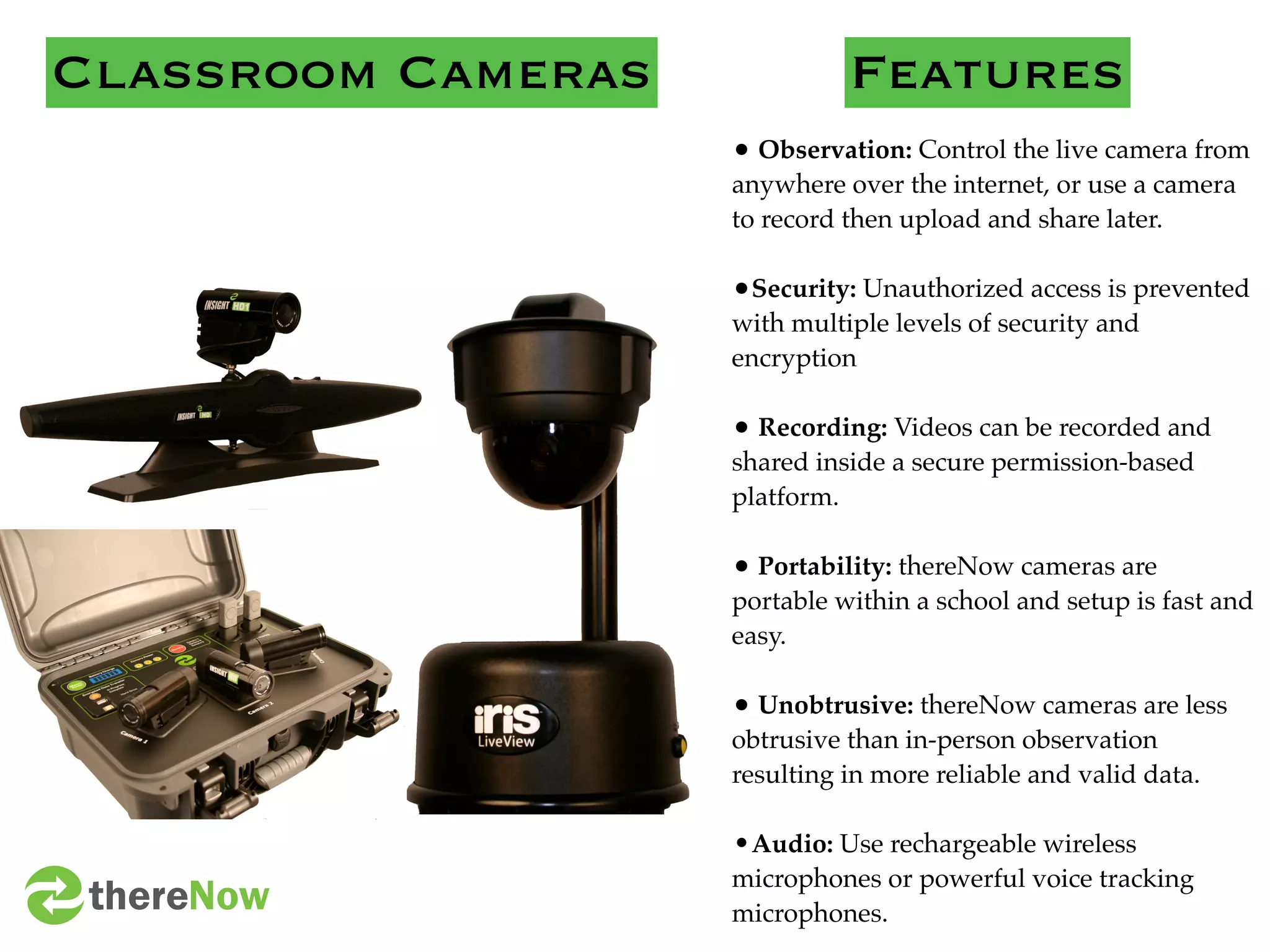
Classroom Cameras             Features
                    • Observation: Control the live camera from
                    anywhere over the internet, or use a camera
                    to record then upload and share later.

                    •Security: Unauthorized access is prevented
                    with multiple levels of security and
                    encryption

                    • Recording: Videos can be recorded and
                    shared inside a secure permission-based
                    platform.

                    • Portability: thereNow cameras are
                    portable within a school and setup is fast and
                    easy.

                    • Unobtrusive: thereNow cameras are less
                    obtrusive than in-person observation
                    resulting in more reliable and valid data.

                    •Audio: Use rechargeable wireless
                    microphones or powerful voice tracking
 thereNow           microphones.
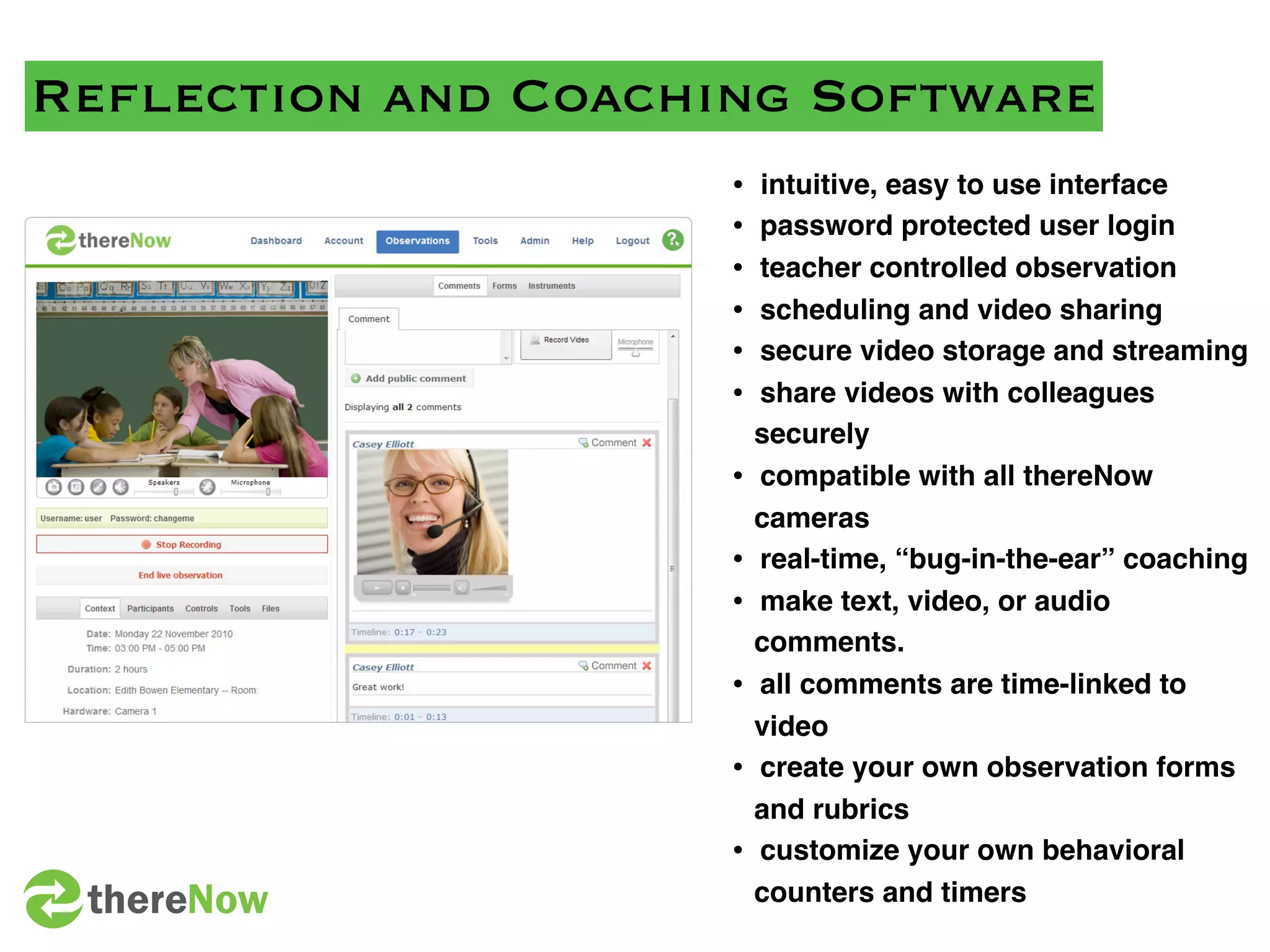
Reflection and Coaching Software
                    •   intuitive, easy to use interface
                    •   password protected user login
                    •   teacher controlled observation
                    •   scheduling and video sharing
                    •   secure video storage and streaming
                    •   share videos with colleagues
                        securely
                    •   compatible with all thereNow
                        cameras
                    •   real-time, “bug-in-the-ear” coaching
                    •   make text, video, or audio
                        comments.
                    •   all comments are time-linked to
                        video
                    •   create your own observation forms
                        and rubrics
                    •   customize your own behavioral
 thereNow               counters and timers
Partner


PD 360 is filled with over 1,800 indexed and searchable videos
segments containing best practices and real classroom examples...


                        Modeling!
                                                              thereNow
thereNow technology

  Applications:


• Pre-service training
• Teacher induction
• Teacher professional development
• Observational research

                                     thereNow
Contact Information

       Casey Elliott
    casey@thereNow.net
       801-499-4393


    www.thereNow.net

Gates ipd there now presentation

  • 1.
    thereNow Casey C. Elliott Vice President thereNow Casey@thereNow.net
  • 3.
    What is thereNow? In a nutshell... We make classroom cameras to enable effective teacher coaching and professional development. thereNow
  • 4.
    Why Cameras? What do we know about effective PD and the current state of PD? 100% 90% 80% 70% 60% 50% 40% 30% 20% 10% Experimental Group 0% Comparison Group thereNow
  • 5.
    The Current Statusof Teacher PD • Teacher quality is the most important factor in student achievement. (e.g., NCTAF, 1997, 2007; Darling-Hammond, 2000; Darling-Hammond & Ball, 1997) • An estimated $14 Billion is spent each year on TPD (Kennedy, M, 2005) • Many common PD activities are criticized (e.g., the drive-by workshop). (Guskey, 2000; Joyce & Showers, 2002; Wayne, Suk Yoon, Zhu, Cronen, & Garet, 2008) thereNow
  • 6.
    The Current Status of Teacher PD “Experts variously say that [teacher professional development] lacks coherence, that it misconceives of the way adults learn best, and that it fails to appreciate the complexity of teachers’ work.” Rebora (2004) “Conventional approaches to professional development, such as one- time workshops, typically do not lead to significant change in teaching methodologies.” Hawley & Valley (1999) thereNow
  • 7.
    Top down “No areaof the teaching profession is more plainly broken today than that of teacher evaluation and professional development.” Duncan, 2009 thereNow
  • 8.
    Why are Conventional ApproachesIneffective? • They fail to change behavior. • That is, teachers do not actually enact what they are learning. thereNow
  • 9.
    What IS EffectivePD? • “Collaborative learning environments, teacher research and inquiry, engagement in practical tasks of instruction and assessment, and consistent feedback and follow-up activities” (Rebora, 2004). • Professional development must combine theory, modeling, practice, feedback, and coaching in order to lead to classroom implementation (Joyce and Showers 1980, 1995). • The U.S. Department of Education (2000) conducted a longitudinal study indicating that both duration and active learning opportunities are essential to effective professional development. thereNow
  • 10.
    Conventional PD is often... • De-individualized • De-contextualized • Not learner-directed • Massed practice Kepple, Geoffrey. A Reconsideration of the Extinction-Recovery Theory. Journal of Verbal Learning & Verbal Behavior. 6(4) 1967, 476-486 thereNow Ebbinghaus, H. Memory: A contribution to experimental psychology. New York: Dover, 1964 (Originally published, 1885).
  • 11.
    Guskey analyzed 13of the most-cited lists from the publications of: • American Federation of Teachers • ASCD • Education Development Center • Educational Research Service • Educational Testing Service • Eisenhower Professional Development Program • National Governor’s Association • National Institute for Science Education • National Partnership for Excellence and Accountability in Teaching • Learning Forward (formerly NSDC) • U.S. Department of Education Guskey, 2003 thereNow
  • 12.
    Characteristics of effectivePD % # 85% 11 Enhances teachers content and pedagogic knowledge 77% 10 Provides sufficient time and other resources 69% 9 Promotes collegiality and collaboration 69% 9 Includes procedures for evaluation 62% 8 Aligns with other reform initiatives 54% 7 Models high quality instruction 46% 6 Is school or site based 46% 6 Builds leadership capacity 46% 6 Driven by analyses of student learning data 38% 5 Based on teachers' identified needs 38% 5 Focuses on individual and organizational improvement 38% 5 Includes follow-up and support 31% 4 Is ongoing and job-embedded 23% 3 Based on best-available research evidence 23% 3 Helps accommodate diversity and promote equity 15% 2 Provides opportunities for theoretical understanding 15% 2 Takes a variety of forms 8% 1 Driven by an image of effective teaching and learning 8% 1 Provides for different phases of change 8% 1 Promotes continuous inquiry and change 8% 1 Involves families and other stakeholders % = of lists with this characteristic # = of lists with this characteristic thereNow
  • 13.
    How do weachieve this? • The literature has reached consensus about good PD... • but it lacks specificity. (Wayne, Suk Yoon, Zhu, Cronen, & Garet, 2008) • How do we achieve “intensive school-based coaching and mentoring integrated into the daily lives of teachers?” ★ without disrupting the school environment? ★ on a lean budget? thereNow
  • 14.
    How do welearn Complex Skills? • Modeling • Observation • Talking Apprenticeship thereNow Cartoons from www.cartoonstock.com
  • 15.
    Cognitive Apprenticeship • Masters of a skill often fail to take into account the implicit processes involved in carrying out complex skills when they are teaching novices. • Cognitive apprenticeships “…are designed, among other things, to bring these tacit processes into the open, where students can observe, enact, and practice them with help from the teacher…” (Collins, Brown, & Newman, 1987). thereNow
  • 16.
    Cognitive Apprenticeship • The master models behaviors in a real-world context by means of cognitive modeling (Bandura, 1997). • Provides assistance at the Zone of Proximal Development; fostering development within this zone leads to the most rapid development (Vygotsky, 1978). • Additional modeling and corrective feedback renders the apprentice’s performance increasingly similar to master’s. thereNow
  • 17.
    Characteristics of effectivePD % # 85% 11 Enhances teachers content and pedagogic knowledge 77% 10 Provides sufficient time and other resources 69% 9 Promotes collegiality and collaboration 69% 9 Includes procedures for evaluation 62% 8 Aligns with other reform initiatives 54% 7 Models high quality instruction 46% 6 Is school or site based 46% 6 Builds leadership capacity 46% 6 Driven by analyses of student learning data 38% 5 Based on teachers' identified needs 38% 5 Focuses on individual and organizational improvement 38% 5 Includes follow-up and support 31% 4 Is ongoing and job-embedded 23% 3 Based on best-available research evidence 23% 3 Helps accommodate diversity and promote equity 15% 2 Provides opportunities for theoretical understanding 15% 2 Takes a variety of forms 8% 1 Driven by an image of effective teaching and learning 8% 1 Provides for different phases of change 8% 1 Promotes continuous inquiry and change 8% 1 Involves families and other stakeholders % = of lists with this characteristic # = of lists with this characteristic thereNow
  • 18.
    Effective PD Is CognitiveApprenticeship • Distributed practice • Individualized • Contextualized • Learner directed thereNow
  • 19.
    Challenges to CognitiveApprenticeship • Requires frequent, on-site interaction • Travel makes mentors or coaches inefficient • Can be obtrusive to classroom environment Can technology solve these problems? thereNow
  • 20.
    What Technology Can enable Cognitive Apprenticeships? In order for technology to enable cognitive apprenticeship it must: • Be portable • Be reliable • Be simple • Attend to critical characteristics of communication • Impart the sense coaches are actually present when they are not! thereNow
  • 21.
    Rachel McAnallen: Impressions from Coach “I can't explain how great it felt. I was just walking on air because of the individualization with the teachers and how comfortable they were in opening up with me. I've had that experience with the kids before, when the kids have really learned and at the end of the day you know you've really done a great job. This was the first time that's ever happened when I was Rachel McAnallen working with adults. This was a personal relationship with each one of the teachers. It was such a great day for me.” thereNow
  • 22.
    thereNow technology Design objectives: • Remote observation through a web browser • Timely feedback • Portability • Ease of use • Price • Bandwidth friendly • Security and privacy • Data collection and data management thereNow
  • 23.
    Classroom Cameras Features • Observation: Control the live camera from anywhere over the internet, or use a camera to record then upload and share later. •Security: Unauthorized access is prevented with multiple levels of security and encryption • Recording: Videos can be recorded and shared inside a secure permission-based platform. • Portability: thereNow cameras are portable within a school and setup is fast and easy. • Unobtrusive: thereNow cameras are less obtrusive than in-person observation resulting in more reliable and valid data. •Audio: Use rechargeable wireless microphones or powerful voice tracking thereNow microphones.
  • 24.
    Reflection and CoachingSoftware • intuitive, easy to use interface • password protected user login • teacher controlled observation • scheduling and video sharing • secure video storage and streaming • share videos with colleagues securely • compatible with all thereNow cameras • real-time, “bug-in-the-ear” coaching • make text, video, or audio comments. • all comments are time-linked to video • create your own observation forms and rubrics • customize your own behavioral thereNow counters and timers
  • 25.
    Partner PD 360 isfilled with over 1,800 indexed and searchable videos segments containing best practices and real classroom examples... Modeling! thereNow
  • 26.
    thereNow technology Applications: • Pre-service training • Teacher induction • Teacher professional development • Observational research thereNow
  • 27.
    Contact Information Casey Elliott casey@thereNow.net 801-499-4393 www.thereNow.net