
Supporting a different learning experience Understanding student expectations and experiencesBecka Currant Dean of StudentsUniversity of Bradford
Listening to the narrativesWhat do our students think about their experiences?How do they feel about being at university?
Expectations prior to arrival“I hope I can become more confident as well as stretch myself in lots of new ways, push my boundaries. I hope University can support me in this and help me when I flounder”“I didn't really know what to expect...”I didn’t have any idea how it was going to be because…it is just different than in my country, and the way of teaching and everything
Concerns/Worries“I was concerned about having the skills because I hadn't studied for a long time”“I had not done anything like it for 13 odd years, so that adds another level of toughness to it”“I was expecting it to be tough and harder than it was”“I think anyone coming to Uni with an expectation of it being easy is fooling themselves”
How do students think they learn best?“I prefer practical learning as I like to do things and get bored when just listening to someone talking. I do quite well when working in a group as well as it gives me more ideas and opinions” “Through repetition. I like to study independently initially but then to consolidate the learning I like to discuss it and have feedback on it. I have a low attention span and so find a lot of reading and quiet time very hard work. I like to interact with people and so the discussion and debate of ideas appeals to me greatly” “I learn best from doing things or thinking through a problem with other people or by writing something down, drawing it. I don't learn much by just reading something”
Feelings About the Course“It’s challenging but its good fun I really enjoy it, the content I really, really like”“I am really enjoying it”“I like, love it! ...the content and just I am really enjoying learning... taking all the information in… although it is a lot of work I just really enjoy that part of it, sort of doing the research going to the library and finding out the stuff”
What is their best experience?“I think the best part for me was meeting so many new people. I didn't know anyone else before I came here, and I was worried about not making friends, not fitting in etc. But on my very first day (the welcome talk), I already got talking to a few people, and that really worked wonders for my confidence” “The tutorials were very helpful to guide the students during the year. Also seminars and other supporting classes. I felt that the lecturers were people who we can speak with and this is necessary for a non English student”
Stating The Obvious But…Higher Education is changing…“The university system is in need of ‘radical change’ to provide a better deal for taxpayers and students” (Willetts, 10 June 2010)How is the sector going to respond?
The Impact of ‘massification’Over last 20 years Higher education has undergone radical and unprecedented change (Education Act, 1992; Dearing Report, 1997; Roberts Report, 2003; Leitch Report, 2006)Learners are entering with different expectations and assumptions about their experiencesThe student body has become dramatically more heterogeneous and has fragmented in some cases
Students 2.0?Who/what are modern students? A vision of students todayWesch (2007)Engaging Students at Bradford (Currant, 2009)What issues do they face? What challenges does this pose for us?How do we respond to differences from the ‘norm’?
What about Universities 2.0?Diversity of entry routesIssues of dealing with developing autonomyOlder – with additional responsibilities/issues?More local, many with existing established peer groupsEarning whilst learningDisengaged learners seeking qualification whilst unsure what University life is aboutReduction in places: increased competition
Possible Policy Changes?Reduce burden on tax payerStrengthen finances of universitiesImprove the quality of the student experienceExample?“Students should be able to study for a degree at any university in England, but attend lectures at their local further education college.” (Willetts, 10 June 2010)
NecessaryAn Acrostic Activity (sort of…!)NeverEatCherriesEatSlicedSausagesAndRaspberryYogurt
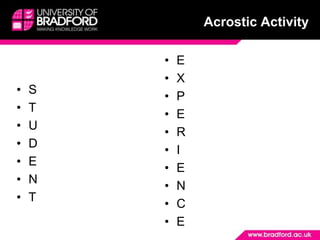
Acrostic ActivitySTUDENTEX PERIENCE
What Will This Mean For Us?Significant changes to how we do what we doIncrease in part time students?More flexibility?How will we engage diverse learners and support a different learning experience?
Why Do Students Leave University?Because they are not engagedNot engaged academically“I am not clever enough”“The course is not what I thought it would be”Not engaged socially“I feel lonely”“I am homesick”“The other students are not friendly”
Do we know…What ‘transition’ means to different individuals?What does ‘transition’ mean to you?What have you done to address issues of student transition, expectations and engagement?What impact has this had?
TransitionTransition is a key issue with regard to the First Year Experience (Tinto, 1987, 1993; Pitkethly & Prosser, 2001; Longden and Yorke, 2008; the STAR project, 2008)Transition starts before students arrive – from the moment they think about applyingTransition continues throughout their University lives – between semesters, modules, concepts, years/stages and upon exit
Student successBetter preparationFair admissionsFlexible progressionFirst steps in HEStudent Life Cycle ModelLayer et al, 2002
Student successClear expectationsFlexible assessment, regular feedbackExplicit requirementsSupport during first yearTransitions Life Cycle ModelCurrant, 2009
Why Come to University?Balance of power between intrinsic and extrinsic motivation Why have they decided to come to University at all?What do they expect… of University itself?to do once they leave?
Why Are You Here?Because “I have nothing else to do”Because “my parents/siblings told me to come”Because “I don’t want to get a job”Because “I want to study the subject”What impact will this have on engagement? How do we support a different learning experience?
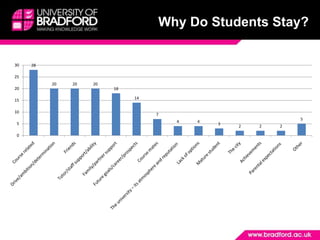
Why Do Students Stay?
Why Have I Stayed?
What does all this mean?Challenges with engaging students in their studiesConflicting pressures and concerns taking focus away from UniversityLack of ‘academic maturity’ and poor decision making in some casesFocus on positives; making time to listen and hear…
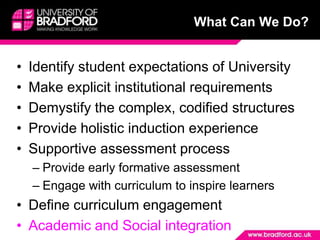
What Can We Do?Identify student expectations of University Make explicit institutional requirementsDemystify the complex, codified structuresProvide holistic induction experienceSupportive assessment processProvide early formative assessmentEngage with curriculum to inspire learnersDefine curriculum engagementAcademic and Social integration
Some areas of focus…Induction, transition and initial engagementEngaging students in University life - building a real, sustainable and workable University communityResearch into the student experience – listening to the student voice and making changes
Develop Me!Skills trackingMeet and chat, pre-entry activitiesOnline resourcesMobile guidesdevelopme.ning.comStudent voiceExpectations survey
First Year Experience questionnaire
Student experience researchwww.bradford.ac.uk/developmewww.braduni.mobiMeet and chat online

Iag keynote

  • 1.
    Supporting a differentlearning experience Understanding student expectations and experiencesBecka Currant Dean of StudentsUniversity of Bradford
  • 2.
    Listening to thenarrativesWhat do our students think about their experiences?How do they feel about being at university?
  • 3.
    Expectations prior toarrival“I hope I can become more confident as well as stretch myself in lots of new ways, push my boundaries. I hope University can support me in this and help me when I flounder”“I didn't really know what to expect...”I didn’t have any idea how it was going to be because…it is just different than in my country, and the way of teaching and everything
  • 4.
    Concerns/Worries“I was concernedabout having the skills because I hadn't studied for a long time”“I had not done anything like it for 13 odd years, so that adds another level of toughness to it”“I was expecting it to be tough and harder than it was”“I think anyone coming to Uni with an expectation of it being easy is fooling themselves”
  • 5.
    How do studentsthink they learn best?“I prefer practical learning as I like to do things and get bored when just listening to someone talking. I do quite well when working in a group as well as it gives me more ideas and opinions” “Through repetition. I like to study independently initially but then to consolidate the learning I like to discuss it and have feedback on it. I have a low attention span and so find a lot of reading and quiet time very hard work. I like to interact with people and so the discussion and debate of ideas appeals to me greatly” “I learn best from doing things or thinking through a problem with other people or by writing something down, drawing it. I don't learn much by just reading something”
  • 6.
    Feelings About theCourse“It’s challenging but its good fun I really enjoy it, the content I really, really like”“I am really enjoying it”“I like, love it! ...the content and just I am really enjoying learning... taking all the information in… although it is a lot of work I just really enjoy that part of it, sort of doing the research going to the library and finding out the stuff”
  • 7.
    What is theirbest experience?“I think the best part for me was meeting so many new people. I didn't know anyone else before I came here, and I was worried about not making friends, not fitting in etc. But on my very first day (the welcome talk), I already got talking to a few people, and that really worked wonders for my confidence” “The tutorials were very helpful to guide the students during the year. Also seminars and other supporting classes. I felt that the lecturers were people who we can speak with and this is necessary for a non English student”
  • 8.
    Stating The ObviousBut…Higher Education is changing…“The university system is in need of ‘radical change’ to provide a better deal for taxpayers and students” (Willetts, 10 June 2010)How is the sector going to respond?
  • 9.
    The Impact of‘massification’Over last 20 years Higher education has undergone radical and unprecedented change (Education Act, 1992; Dearing Report, 1997; Roberts Report, 2003; Leitch Report, 2006)Learners are entering with different expectations and assumptions about their experiencesThe student body has become dramatically more heterogeneous and has fragmented in some cases
  • 10.
    Students 2.0?Who/what aremodern students? A vision of students todayWesch (2007)Engaging Students at Bradford (Currant, 2009)What issues do they face? What challenges does this pose for us?How do we respond to differences from the ‘norm’?
  • 11.
    What about Universities2.0?Diversity of entry routesIssues of dealing with developing autonomyOlder – with additional responsibilities/issues?More local, many with existing established peer groupsEarning whilst learningDisengaged learners seeking qualification whilst unsure what University life is aboutReduction in places: increased competition
  • 12.
    Possible Policy Changes?Reduceburden on tax payerStrengthen finances of universitiesImprove the quality of the student experienceExample?“Students should be able to study for a degree at any university in England, but attend lectures at their local further education college.” (Willetts, 10 June 2010)
  • 13.
    NecessaryAn Acrostic Activity(sort of…!)NeverEatCherriesEatSlicedSausagesAndRaspberryYogurt
  • 14.
  • 15.
    What Will ThisMean For Us?Significant changes to how we do what we doIncrease in part time students?More flexibility?How will we engage diverse learners and support a different learning experience?
  • 16.
    Why Do StudentsLeave University?Because they are not engagedNot engaged academically“I am not clever enough”“The course is not what I thought it would be”Not engaged socially“I feel lonely”“I am homesick”“The other students are not friendly”
  • 17.
    Do we know…What‘transition’ means to different individuals?What does ‘transition’ mean to you?What have you done to address issues of student transition, expectations and engagement?What impact has this had?
  • 18.
    TransitionTransition is akey issue with regard to the First Year Experience (Tinto, 1987, 1993; Pitkethly & Prosser, 2001; Longden and Yorke, 2008; the STAR project, 2008)Transition starts before students arrive – from the moment they think about applyingTransition continues throughout their University lives – between semesters, modules, concepts, years/stages and upon exit
  • 19.
    Student successBetter preparationFairadmissionsFlexible progressionFirst steps in HEStudent Life Cycle ModelLayer et al, 2002
  • 20.
    Student successClear expectationsFlexibleassessment, regular feedbackExplicit requirementsSupport during first yearTransitions Life Cycle ModelCurrant, 2009
  • 21.
    Why Come toUniversity?Balance of power between intrinsic and extrinsic motivation Why have they decided to come to University at all?What do they expect… of University itself?to do once they leave?
  • 22.
    Why Are YouHere?Because “I have nothing else to do”Because “my parents/siblings told me to come”Because “I don’t want to get a job”Because “I want to study the subject”What impact will this have on engagement? How do we support a different learning experience?
  • 23.
  • 24.
    Why Have IStayed?
  • 25.
    What does allthis mean?Challenges with engaging students in their studiesConflicting pressures and concerns taking focus away from UniversityLack of ‘academic maturity’ and poor decision making in some casesFocus on positives; making time to listen and hear…
  • 26.
    What Can WeDo?Identify student expectations of University Make explicit institutional requirementsDemystify the complex, codified structuresProvide holistic induction experienceSupportive assessment processProvide early formative assessmentEngage with curriculum to inspire learnersDefine curriculum engagementAcademic and Social integration
  • 27.
    Some areas offocus…Induction, transition and initial engagementEngaging students in University life - building a real, sustainable and workable University communityResearch into the student experience – listening to the student voice and making changes
  • 28.
    Develop Me!Skills trackingMeetand chat, pre-entry activitiesOnline resourcesMobile guidesdevelopme.ning.comStudent voiceExpectations survey
  • 29.
    First Year Experiencequestionnaire
  • 30.

Editor's Notes

  • #19 Rich body of literature out there, contact me if you need some starting points!
  • #23 Travel – wrong mode of transport for destination, lack of planning etc
  • #29 Develop Me! The Develop Me! model was first piloted in 2006. Since then it has grown considerably in response to feedback from staff and students. Develop Me! currently consists of five different strands. These are:A social network hosted in ning and found online at http://developme.ning.comSaPRA: our in-house Skills and Personal Development Activity. SaPRA focuses on helping students to identify their levels of confidence in different skill areas such as academic reading, academic writing, communication skills and so on. SaPRA utilises PebblePad. More information about SaPRA can be found on our website.Online skills development resources. These resources provide 24/7 help and support to students who have identified that they need to develop a particular skill area. Students interact with the resources in a number of different ways for example as a result of a 121 intervention with an LDU adviser, after completing SaPRA or after attending an LDU workshop.Mobile Guides. The mobile guides are available at www.braduni.mobi and provide students with information about the University in an easy to access format. We are currently pursuing the idea of creating a iPhone app that users can download onto their iPhones or iPod touches. This will be followed up with versions for windows based devices in the near future. Research into the Student Experience. We have been actively researching the student experience at Bradford since 2005. This research has been fundamental to the implementation and refinement of the Develop Me! approach. Without regular feedback from the student body I would feel less confident that our approach was meeting the needs of students. However because we have such an open dialogue with the student body I am confident that what we are doing is meeting their needs and doing so in a way that they want it to be done. Many Universities have developed social networks in the last few years, but I am especially proud of the way in which we have done this at Bradford as it’s been truly student led.