What Works?
Academic themes from two of the projects
Findings from two projects
• Student integration
     – Sunderland, Hull & Newcastle


• HERE Project - Student doubters, impact
  of course teams
     – NTU, Bournemouth & Bradford


7/31/2012                                   2
Student Integration
• Does a student’s sense of integration support
  their retention?
  – Looked at STEM students, mature students, part-time
    & local students
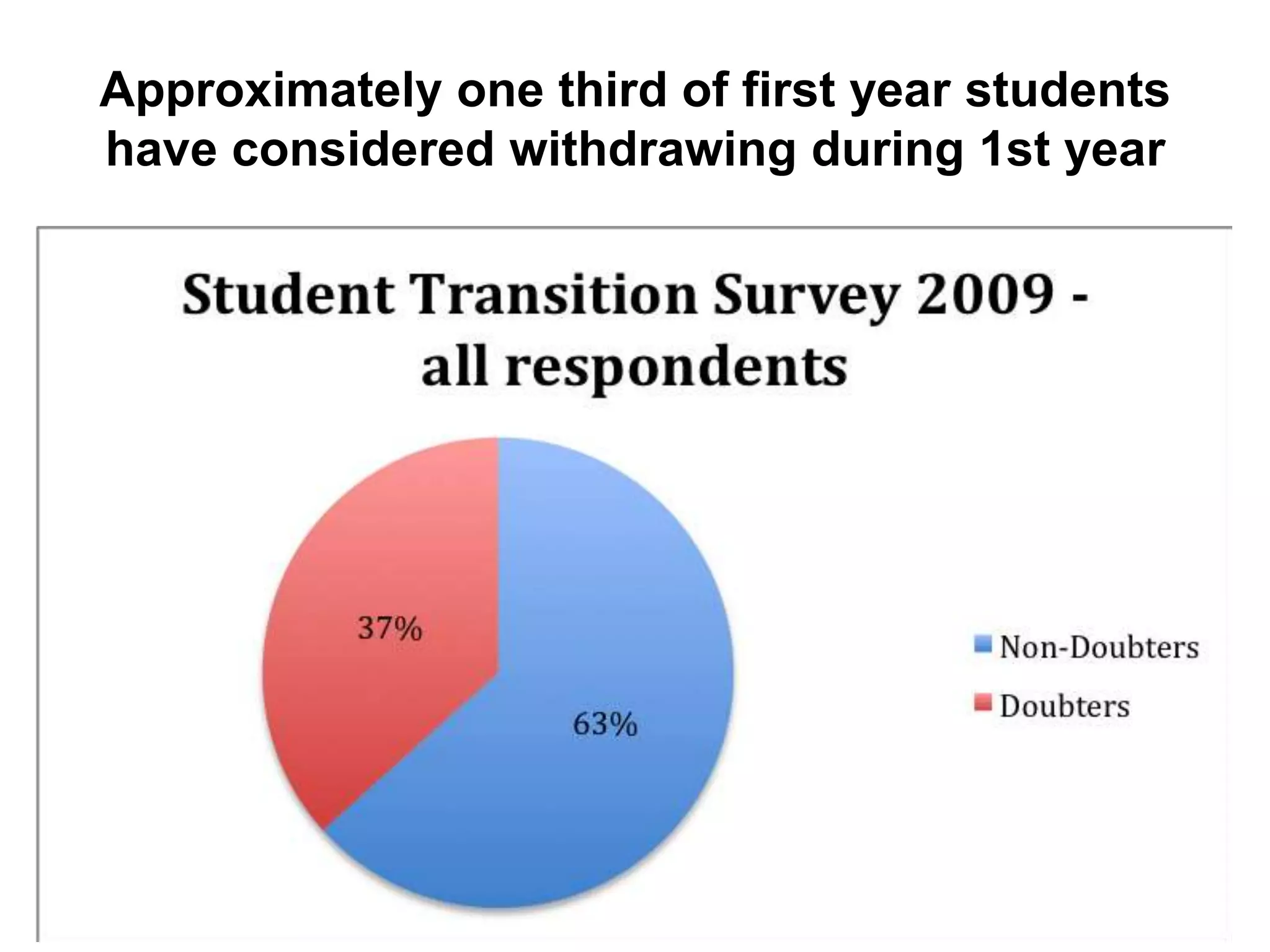
  – Found 1/3 of students had considered withdrawing
  – Academic factors more important than social ones
     • Integrating social into academic most valuable
Key messages
1. Integration of the social and academic elements of university
   life is key to the integration of students into the School and
   wider University community

2. Early imposition of structures upon students by staff appears
   effective in giving a sense of continuity & purpose

3. Teams and groups working collaboratively on academic tasks
   enhance their social opportunities

4. Integrating social and academic elements of university life
   encourages students to build relations with each other, with
   staff and to engage with the curriculum
University of Hull
• Study Skills Summer School
  – 2 day non-residential event for new and continuing
    part-time & mature students –range of learning &
    teaching – intended to offer authentic university
    experience


• Mature Student Welcome lunch
  – Week prior to registration – ‘Social event, but with a
    purpose’ - early opportunities to form social bonds
    leading to sustained friendships
University of Sunderland
• Curriculum related fundraising activities
  (Childhood studies)
  – Included sponsored walk, mini-Olympics, spooky
    sleepover, importantly is done in teams of students
    from across the years

• Problem-based learning (Psychology)
  – Students noted that the experience was highly
    enjoyable, but also lead to effective learning and
    social bonds
University of Sunderland
• Field trips (Tourism)
   – Field trips were used to encourage social integration,
     one of which is compulsory during induction, mixture
     of local and exotic


• Sandbox Studio (Psychology)
   – Student community space within the psychology
     department, books, magazines, video games – space
     for students to belong to student community and wider
     community of scholars
Newcastle University
• Engineering teams
  – Students put into groups during induction

  – “in the first hour…you were sat in the introductory
    lecture thinking „I don‟t know anyone‟, „how am I going
    to make friends?‟ and they said „we are going to put
    you into these teams‟ and instantly there was like 10 or
    11 other people you knew straight away.”

  – Not problem free, but vast majority of students
    reported enjoying working in teams
Newcastle University
• The t-shirt exercise
• Induction activity
  – Everyone given a t-shirt & marker pens
  – Students given clear instructions to draw
    representations of their interests on the t-shirt,
    circulate & find other people with similar interests
  – Had to form a group that had to be mixed and formed
    the basis for later group activity
Activity - Retaining students
• Resource from Newcastle University
  – 2 hour workshop
    • Promotes themes of the project
    • Activities on preparedness, ice breakers, team
      working, dealing with diversity
    • Checklists for colleagues
The HERE Project
 Ed Foster & Sarah Lawther - Nottingham Trent University
 Christine Keenan & Natalie Bates – Bournemouth University
 Becka Colley & Ruth Lefever – University of Bradford


www.HEREproject.org.uk
The HERE Project
     Higher Education: Retention &
             Engagement

Two areas of work
- Impact of doubting on student retention
- Impact that course teams can make on
retention

Focus on first year
Doubting
• Defined as having doubts about the course/
  university serious enough to consider leaving
• How many students are doubters in the literature?
  – 21% Rickinson and Rutherford (1995) – 39% Sodexo
    (2010)

• Doubting as a cause of withdrawal
  – Gradual accumulation of doubts - Ozga and
    Sukhnandan (1998)

• But UK progression is good
  – NAO (2007) suggests that progression to yr 2 is
    approx 90%
  – Our work is therefore also about engagement
Engagement
• Kuh et al (2008) describe student engagement
  as:
  – “the quality of effort students themselves devote to
    educationally purposeful activities that contribute
    directly to desired outcomes and the effort institutions
    devote to using effective educational practices”.


• Hardy and Bryson (2010) student engagement
  – More than the classroom activities, encompasses
    whole person
Some Key Findings
Approximately one third of first year students
have considered withdrawing during 1st year
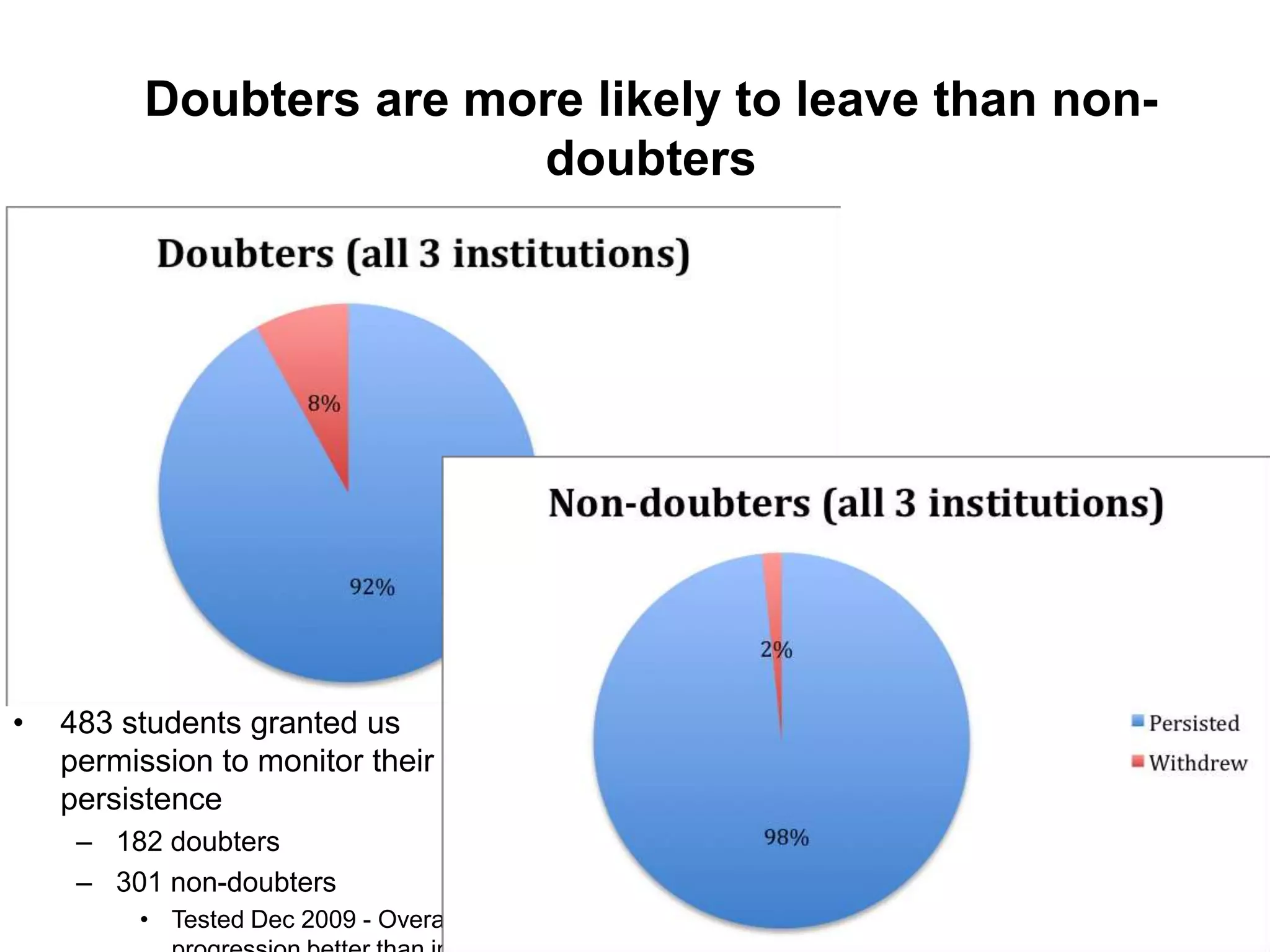
Doubters are more likely to leave than non-
                         doubters


•   483 students granted us
    permission to monitor their
    persistence
     – 182 doubters
     – 301 non-doubters
         • Tested Dec 2009 - Overall
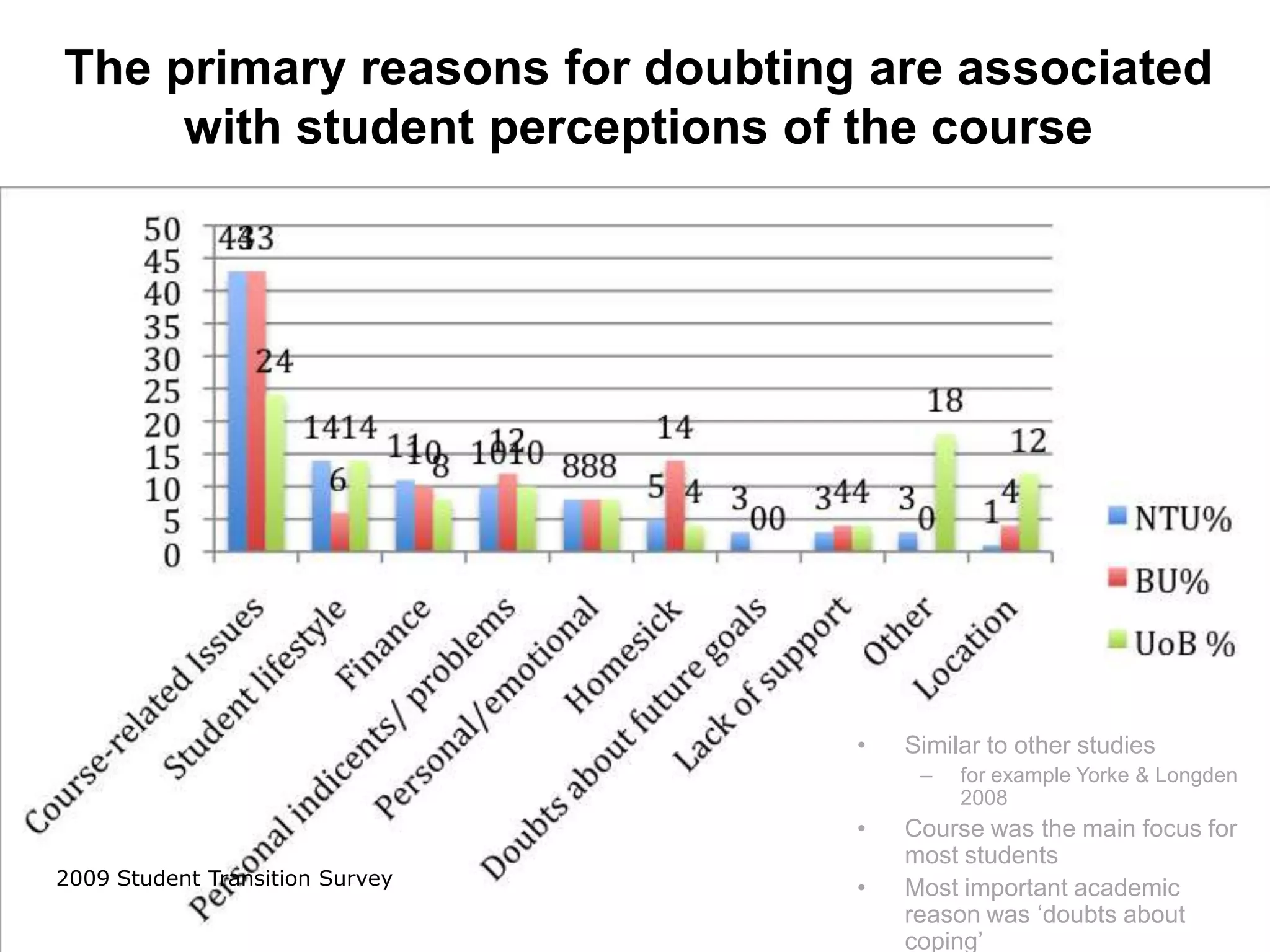
The primary reasons for doubting are associated
     with student perceptions of the course


                                 •   Similar to other studies
                                      –   for example Yorke & Longden
                                          2008
                                 •   Course was the main focus for
                                     most students
2009 Student Transition Survey   •   Most important academic
                                     reason was ‘doubts about
                                     coping’
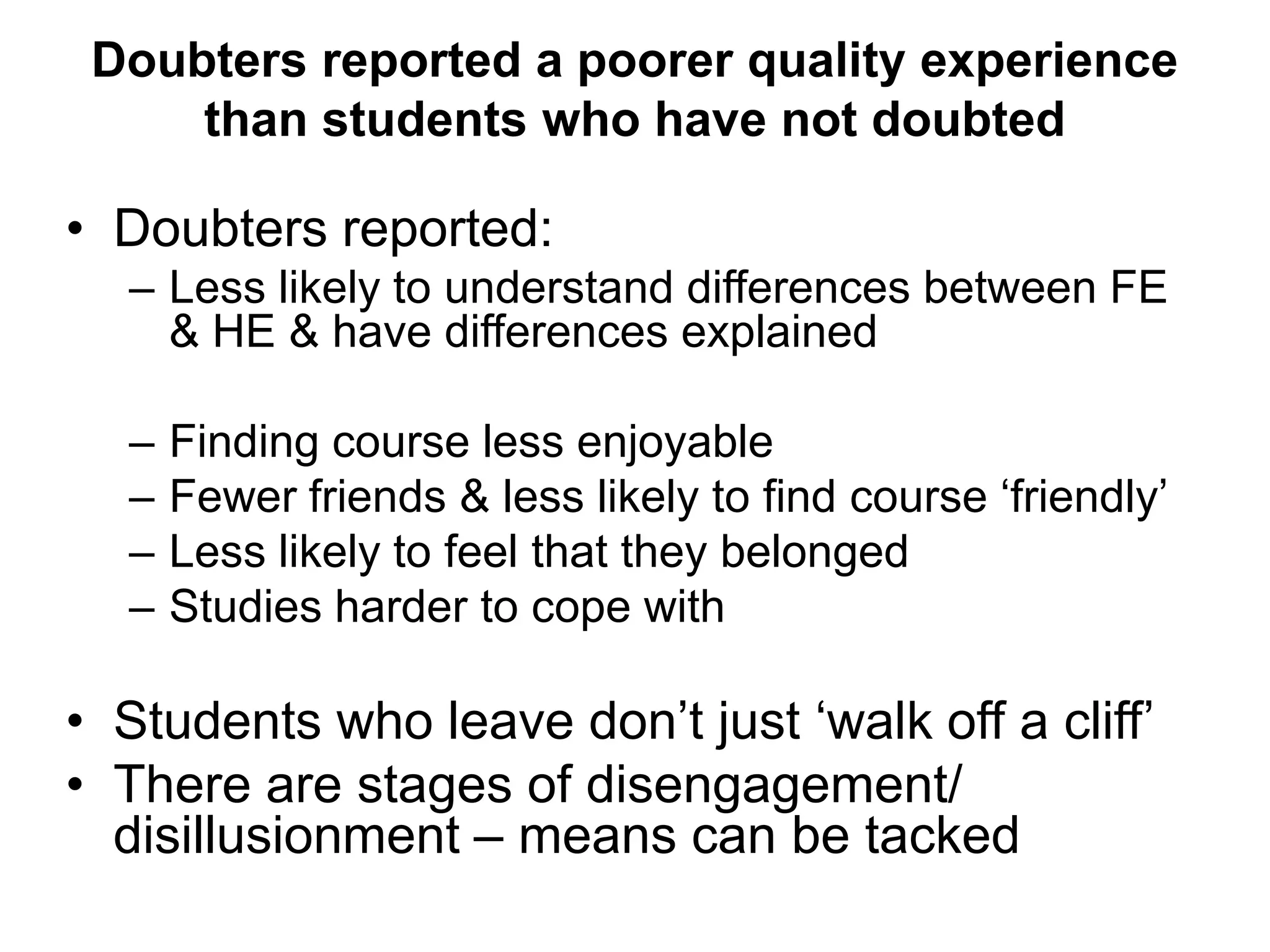
Doubters reported a poorer quality experience
     than students who have not doubted

• Doubters reported:
  – Less likely to understand differences between FE
    & HE & have differences explained

  –   Finding course less enjoyable
  –   Fewer friends & less likely to find course ‘friendly’
  –   Less likely to feel that they belonged
  –   Studies harder to cope with

• Students who leave don’t just ‘walk off a cliff’
• There are stages of disengagement/
  disillusionment – means can be tacked
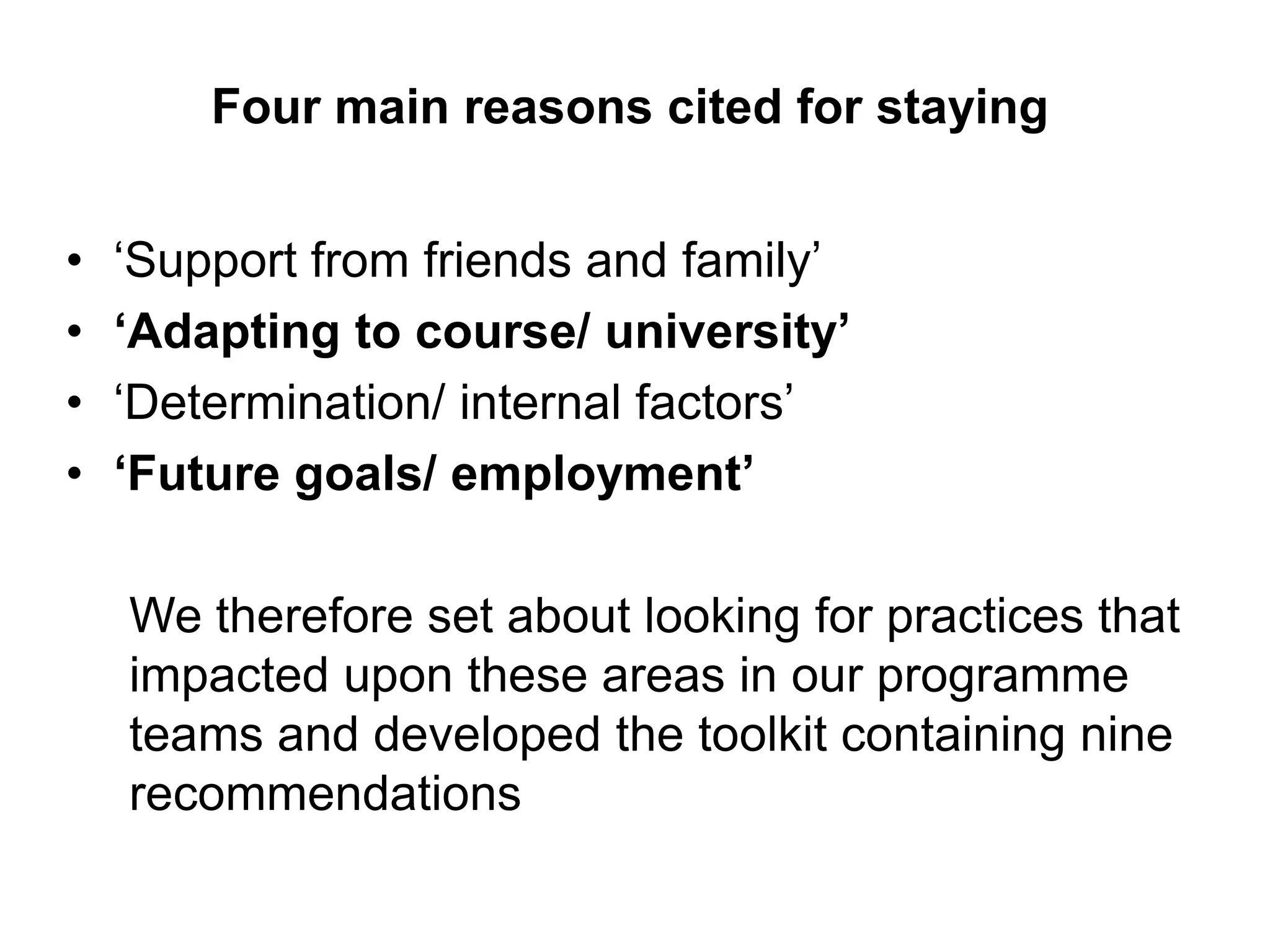
Four main reasons cited for staying


•   ‘Support from friends and family’
•   „Adapting to course/ university‟
•   ‘Determination/ internal factors’
•   „Future goals/ employment‟

    We therefore set about looking for practices that
    impacted upon these areas in our programme
    teams and developed the toolkit containing nine
    recommendations
The HERE Project toolkit
How it was designed
• We used our work on doubters to develop
  areas for exploration
• Developed case studies from 10 courses
     – Staff interviews, student surveys

• Loosely two strands
     – Preventing students from doubting
     – Supporting doubters to remain

• 9 recommendations
     – Learning & teaching, transition, relationships,
       belonging & community
7/31/2012                                                22
Using the toolkit
• Aimed at programme teams
  – Tool for discussion at team meetings & away days
  – In a perfect world, would be facilitated

  – Has been used to bring about change at institutional
    level
     • E.g. NTU enhanced academic tutorials programme

• Experiences so far
  – Staff just grateful for the opportunity to discuss
  – Interesting that communication across programmes
    weaker than we expected
  – Staff tend to just ‘leap in’
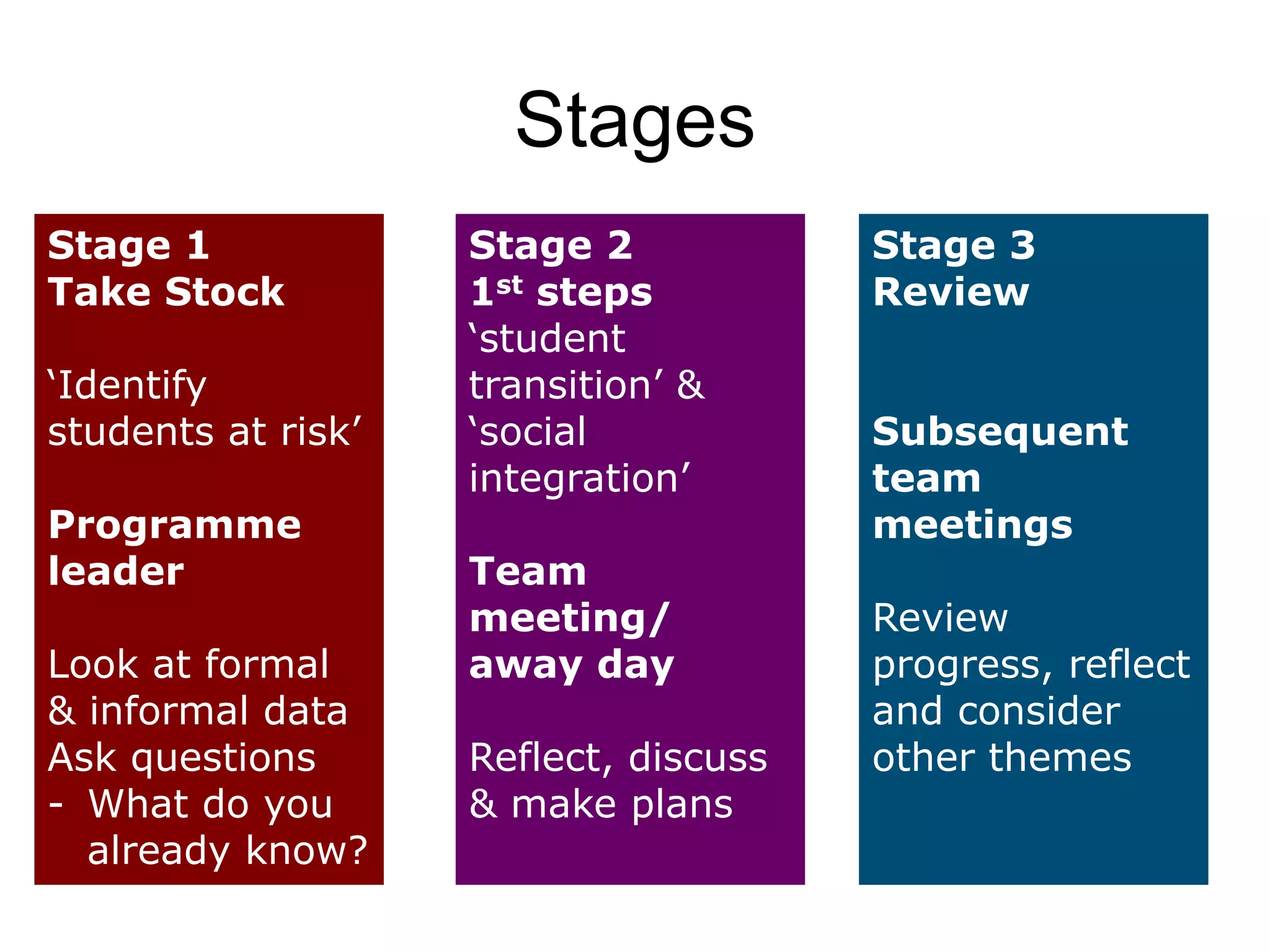
Stages
Stage 1             Stage 2            Stage 3
Take Stock          1st steps          Review
                    ‘student
‘Identify           transition’ &
students at risk’   ‘social            Subsequent
                    integration’       team
Programme                              meetings
leader              Team
                    meeting/           Review
Look at formal      away day           progress, reflect
& informal data                        and consider
Ask questions       Reflect, discuss   other themes
- What do you       & make plans
  already know?
Activity
• Exploring two themes:
     – “Help students to make the transition to
       being effective learners in HE”

     – “Foster motivation & help students
       understand how the course can help them
       achieve their future goals”

            • Working in two groups we’d like you to use the
              recipe cards, discuss and consider some actions
7/31/2012
              you can take back at your work place.             25
Discussion
• Having had some time to look at two
  different approaches:
     – What issues arise for colleagues you work
       with?
     – How difficult might they be to implement?
     – What suggestions do you have for improving
       their efficacy?


7/31/2012                                           26

What Works Academic Themes

  • 1.
    What Works? Academic themesfrom two of the projects
  • 2.
    Findings from twoprojects • Student integration – Sunderland, Hull & Newcastle • HERE Project - Student doubters, impact of course teams – NTU, Bournemouth & Bradford 7/31/2012 2
  • 3.
    Student Integration • Doesa student’s sense of integration support their retention? – Looked at STEM students, mature students, part-time & local students – Found 1/3 of students had considered withdrawing – Academic factors more important than social ones • Integrating social into academic most valuable
  • 4.
    Key messages 1. Integrationof the social and academic elements of university life is key to the integration of students into the School and wider University community 2. Early imposition of structures upon students by staff appears effective in giving a sense of continuity & purpose 3. Teams and groups working collaboratively on academic tasks enhance their social opportunities 4. Integrating social and academic elements of university life encourages students to build relations with each other, with staff and to engage with the curriculum
  • 5.
    University of Hull •Study Skills Summer School – 2 day non-residential event for new and continuing part-time & mature students –range of learning & teaching – intended to offer authentic university experience • Mature Student Welcome lunch – Week prior to registration – ‘Social event, but with a purpose’ - early opportunities to form social bonds leading to sustained friendships
  • 6.
    University of Sunderland •Curriculum related fundraising activities (Childhood studies) – Included sponsored walk, mini-Olympics, spooky sleepover, importantly is done in teams of students from across the years • Problem-based learning (Psychology) – Students noted that the experience was highly enjoyable, but also lead to effective learning and social bonds
  • 7.
    University of Sunderland •Field trips (Tourism) – Field trips were used to encourage social integration, one of which is compulsory during induction, mixture of local and exotic • Sandbox Studio (Psychology) – Student community space within the psychology department, books, magazines, video games – space for students to belong to student community and wider community of scholars
  • 8.
    Newcastle University • Engineeringteams – Students put into groups during induction – “in the first hour…you were sat in the introductory lecture thinking „I don‟t know anyone‟, „how am I going to make friends?‟ and they said „we are going to put you into these teams‟ and instantly there was like 10 or 11 other people you knew straight away.” – Not problem free, but vast majority of students reported enjoying working in teams
  • 9.
    Newcastle University • Thet-shirt exercise • Induction activity – Everyone given a t-shirt & marker pens – Students given clear instructions to draw representations of their interests on the t-shirt, circulate & find other people with similar interests – Had to form a group that had to be mixed and formed the basis for later group activity
  • 10.
    Activity - Retainingstudents • Resource from Newcastle University – 2 hour workshop • Promotes themes of the project • Activities on preparedness, ice breakers, team working, dealing with diversity • Checklists for colleagues
  • 11.
    The HERE Project Ed Foster & Sarah Lawther - Nottingham Trent University Christine Keenan & Natalie Bates – Bournemouth University Becka Colley & Ruth Lefever – University of Bradford www.HEREproject.org.uk
  • 12.
    The HERE Project Higher Education: Retention & Engagement Two areas of work - Impact of doubting on student retention - Impact that course teams can make on retention Focus on first year
  • 13.
    Doubting • Defined ashaving doubts about the course/ university serious enough to consider leaving • How many students are doubters in the literature? – 21% Rickinson and Rutherford (1995) – 39% Sodexo (2010) • Doubting as a cause of withdrawal – Gradual accumulation of doubts - Ozga and Sukhnandan (1998) • But UK progression is good – NAO (2007) suggests that progression to yr 2 is approx 90% – Our work is therefore also about engagement
  • 14.
    Engagement • Kuh etal (2008) describe student engagement as: – “the quality of effort students themselves devote to educationally purposeful activities that contribute directly to desired outcomes and the effort institutions devote to using effective educational practices”. • Hardy and Bryson (2010) student engagement – More than the classroom activities, encompasses whole person
  • 15.
  • 16.
    Approximately one thirdof first year students have considered withdrawing during 1st year
  • 17.
    Doubters are morelikely to leave than non- doubters • 483 students granted us permission to monitor their persistence – 182 doubters – 301 non-doubters • Tested Dec 2009 - Overall
  • 18.
    The primary reasonsfor doubting are associated with student perceptions of the course • Similar to other studies – for example Yorke & Longden 2008 • Course was the main focus for most students 2009 Student Transition Survey • Most important academic reason was ‘doubts about coping’
  • 19.
    Doubters reported apoorer quality experience than students who have not doubted • Doubters reported: – Less likely to understand differences between FE & HE & have differences explained – Finding course less enjoyable – Fewer friends & less likely to find course ‘friendly’ – Less likely to feel that they belonged – Studies harder to cope with • Students who leave don’t just ‘walk off a cliff’ • There are stages of disengagement/ disillusionment – means can be tacked
  • 20.
    Four main reasonscited for staying • ‘Support from friends and family’ • „Adapting to course/ university‟ • ‘Determination/ internal factors’ • „Future goals/ employment‟ We therefore set about looking for practices that impacted upon these areas in our programme teams and developed the toolkit containing nine recommendations
  • 21.
  • 22.
    How it wasdesigned • We used our work on doubters to develop areas for exploration • Developed case studies from 10 courses – Staff interviews, student surveys • Loosely two strands – Preventing students from doubting – Supporting doubters to remain • 9 recommendations – Learning & teaching, transition, relationships, belonging & community 7/31/2012 22
  • 23.
    Using the toolkit •Aimed at programme teams – Tool for discussion at team meetings & away days – In a perfect world, would be facilitated – Has been used to bring about change at institutional level • E.g. NTU enhanced academic tutorials programme • Experiences so far – Staff just grateful for the opportunity to discuss – Interesting that communication across programmes weaker than we expected – Staff tend to just ‘leap in’
  • 24.
    Stages Stage 1 Stage 2 Stage 3 Take Stock 1st steps Review ‘student ‘Identify transition’ & students at risk’ ‘social Subsequent integration’ team Programme meetings leader Team meeting/ Review Look at formal away day progress, reflect & informal data and consider Ask questions Reflect, discuss other themes - What do you & make plans already know?
  • 25.
    Activity • Exploring twothemes: – “Help students to make the transition to being effective learners in HE” – “Foster motivation & help students understand how the course can help them achieve their future goals” • Working in two groups we’d like you to use the recipe cards, discuss and consider some actions 7/31/2012 you can take back at your work place. 25
  • 26.
    Discussion • Having hadsome time to look at two different approaches: – What issues arise for colleagues you work with? – How difficult might they be to implement? – What suggestions do you have for improving their efficacy? 7/31/2012 26

Editor's Notes

  • #17 At NTU, most had decided to stay
  • #18 Small number of non-doubters who withdrew