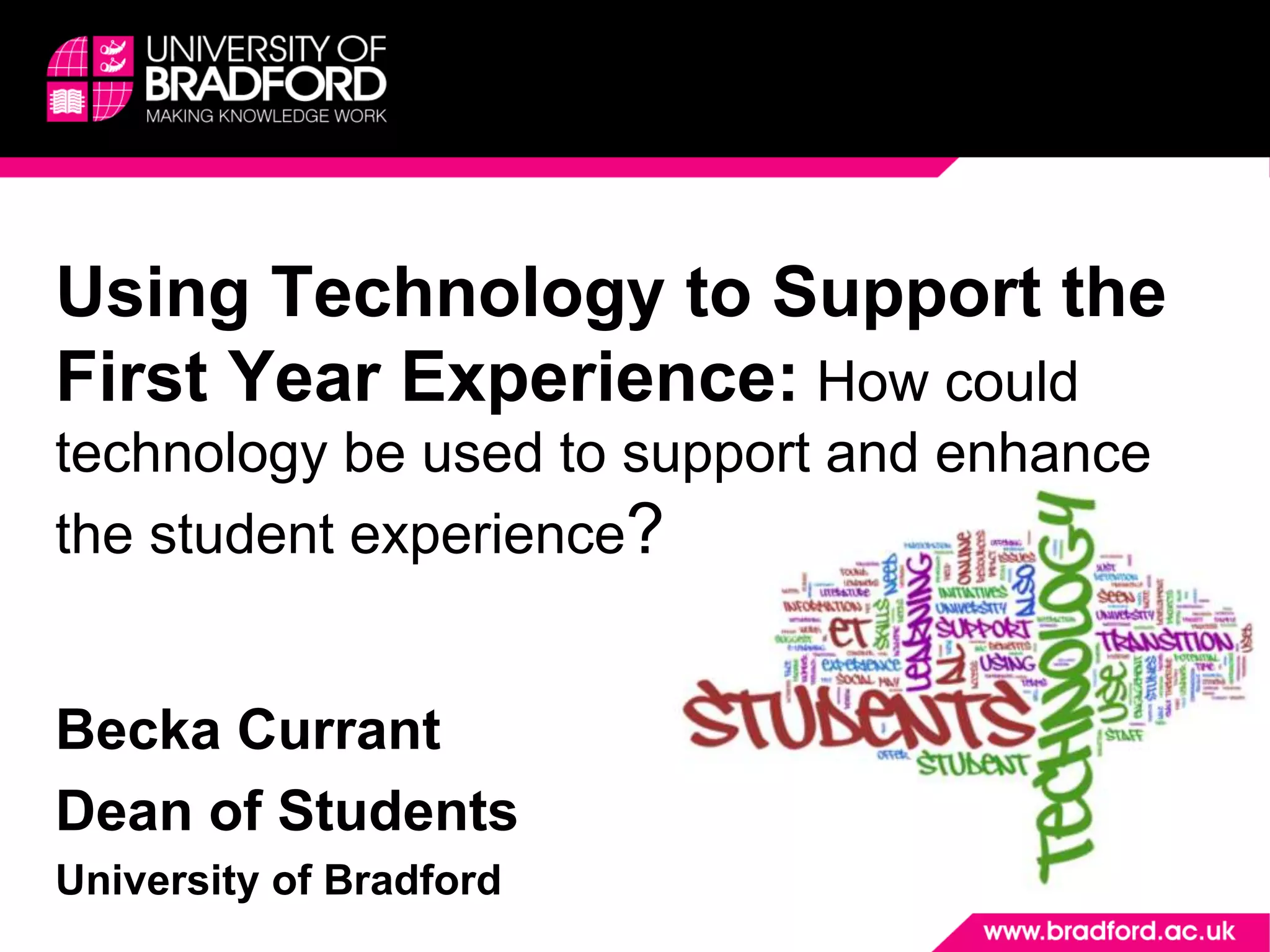
Using Technology to Support the
First Year Experience: How could
technology be used to support and enhance
the student experience?
Becka Currant
Dean of Students
University of Bradford
• "... programs which most effectively meet the range of
transition issues…must be grounded and nourished
within the "everyday life" of universities, in their
learning & teaching environments and in their student
support services, rather than developed and
implemented from above. Qualitative data suggest that
the extent to which students are "welcomed", their
social interactions with teachers and their early
experiences of course advice and support services
are the most crucial variables in successful
transition."
Pargetter et al (1998) in Cook & Ashton, Student Transition: Practices and policies to
promote retention
Context
• How do your programmes become
‘grounded and nourished’?
• What do you do to welcome your
students? How?
• Do you provide social interactions with
teachers?
• How do you embed course advice and
support services?
Key Questions…
What preparation do
our students do
before they come?
We need to help students understand…
• What modes of transport are available
• Which mode is the most relevant for that stage of
the journey
• How they can revise their travel plans accordingly
in the event of:
– Accidents and emergencies
– Roadworks
– Adverse conditions
– Last minutes changes to plans
Students 2.0?
• Who/what are modern students?
• A vision of students today Wesch (2007)
• JISC Learner Experiences projects
• What issues do they face?
• What challenges does this pose for us?
• How do we respond to differences from the
‘norm’?
What about Universities 2.0?
• Diversity of entry routes
• Issues of dealing with developing autonomy
• Older – with additional responsibilities/issues?
• More local, many with existing established peer groups
• Earning whilst learning
• Unsure what University life is about
– Moving from modular, assessment based units to ‘reading’ for a
degree?
• Funding issues; pressure to find solutions outside of ‘normal’
model
Why Do Students Leave University?
• Because they are not engaged
• Not engaged academically
– “I am not clever enough”
– “The course is not what I thought it would be”
• Not engaged socially
– “I feel lonely”
– “I am homesick”
– “The other students are not friendly”
• Not engaged professionally
– The course is not helping me develop the skills I need for future work
– I don’t want to be xxxx anymore
• How students manage the process of
transition?
• What mode of transport are they using?
• What do they expect to happen?
• What are their hopes, fears and
aspirations?
Do we know…
Why Come to University?
• Balance of power between intrinsic and
extrinsic motivation
• Why have they decided to come to
University at all?
• What do they expect…
– of University itself?
– to do once they leave?
Why Are You Here?
• Because “I have nothing else to do”
• Because “my parents/siblings told me to
come”
• Because “I don’t want to get a job”
• Because “I want to study the subject”
• What impact will this have on engagement?
• What does it mean for our learners’ journey?
• How can technology support the process?
What does all this mean?
• Challenges with engaging students in their
studies
• Conflicting pressures and concerns taking
focus away from University
• Lack of ‘academic maturity’
• Poor decision making
• What we can do to make it easier/more
effective?
Do we know…
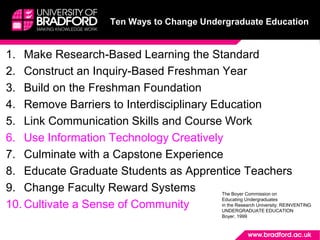
1. Make Research-Based Learning the Standard
2. Construct an Inquiry-Based Freshman Year
3. Build on the Freshman Foundation
4. Remove Barriers to Interdisciplinary Education
5. Link Communication Skills and Course Work
6. Use Information Technology Creatively
7. Culminate with a Capstone Experience
8. Educate Graduate Students as Apprentice Teachers
9. Change Faculty Reward Systems
10. Cultivate a Sense of Community
Ten Ways to Change Undergraduate Education
The Boyer Commission on
Educating Undergraduates
in the Research University: REINVENTING
UNDERGRADUATE EDUCATION
Boyer, 1999
What Can We Do?
• Identify student expectations of University
• Make explicit institutional requirements
• Provide holistic induction experience
• Support assessment process
– Provide early formative assessment
– Engage with curriculum to inspire learners
• Define curriculum engagement
• Academic and Social integration
“Technology isn’t a solution though
is it? People should be spending
more time on campus face to face
to deal with these issues. Students
should be engaging with each
other. Let’s have less online and
more face to face.”
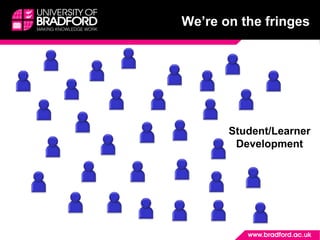
Student/Learner
Development
We’re on the fringes
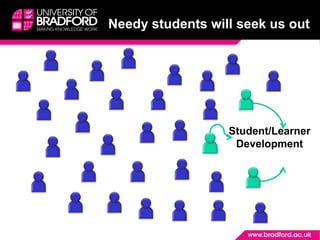
Needy students will seek us out
Student/Learner
Development
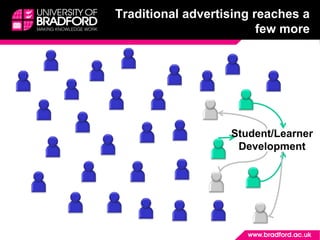
Traditional advertising reaches a
few more
Student/Learner
Development
What about social networking tools?
There are many more but these are the ones we’ve been using
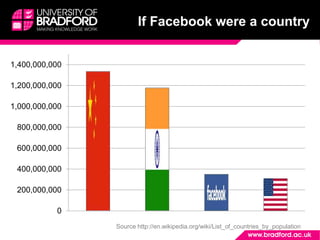
If Facebook were a country
0
200,000,000
400,000,000
600,000,000
800,000,000
1,000,000,000
1,200,000,000
1,400,000,000
Source http://en.wikipedia.org/wiki/List_of_countries_by_population
Two options
Use existing networks Create a new network
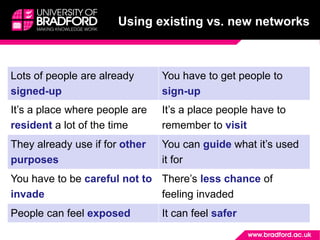
Using existing vs. new networks
Existing New
Lots of people are already
signed-up
You have to get people to
sign-up
It’s a place where people are
resident a lot of the time
It’s a place people have to
remember to visit
They already use if for other
purposes
You can guide what it’s used
it for
You have to be careful not to
invade
There’s less chance of
feeling invaded
People can feel exposed It can feel safer
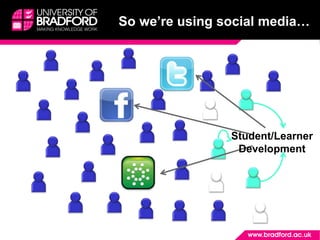
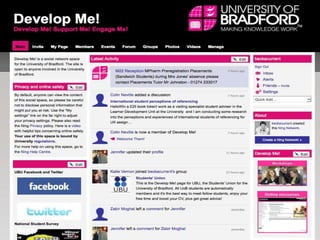
So we’re using social media…
Student/Learner
Development
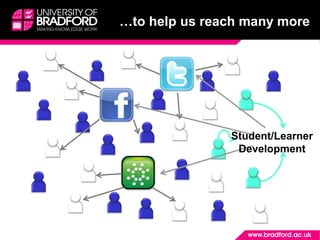
…to help us reach many more
Student/Learner
Development
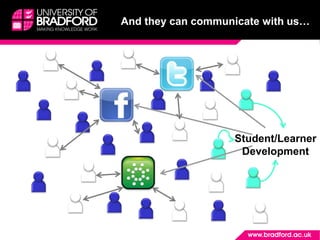
And they can communicate with us…
Student/Learner
Development
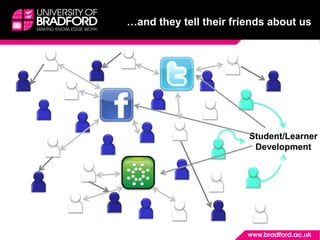
…and they tell their friends about us
Student/Learner
Development
…and they tell their friends about us
Student/Learn
Developmen
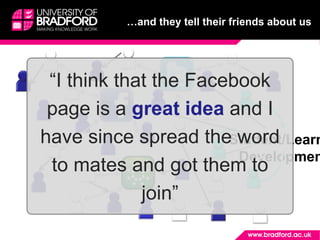
“I think that the Facebook
page is a great idea and I
have since spread the word
to mates and got them to
join”
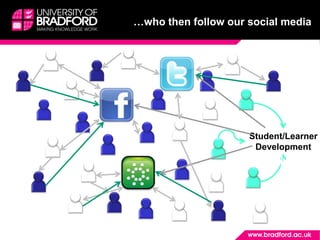
…who then follow our social media
Student/Learner
Development
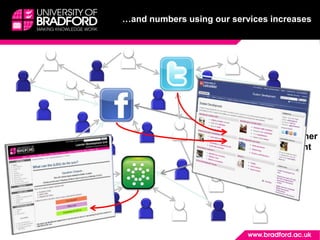
…and numbers using our services increases
Student/Learner
Development
• Induction, transition and initial engagement
• Engaging students in University life -
building a real, sustainable and workable
University community
• Research into the student experience –
listening to the student voice and making
changes
Some areas of focus…
• How do your programmes become ‘grounded
and nourished’?
• What do you do to welcome your students?
How?
• Do you provide social interactions with
teachers?
• How do you embed course advice and
support services?
• Can technology provide a solution to some of
the issues?
Becka currant elfyse march 2010

Becka currant elfyse march 2010

  • 1.
    Using Technology toSupport the First Year Experience: How could technology be used to support and enhance the student experience? Becka Currant Dean of Students University of Bradford
  • 2.
    • "... programswhich most effectively meet the range of transition issues…must be grounded and nourished within the "everyday life" of universities, in their learning & teaching environments and in their student support services, rather than developed and implemented from above. Qualitative data suggest that the extent to which students are "welcomed", their social interactions with teachers and their early experiences of course advice and support services are the most crucial variables in successful transition." Pargetter et al (1998) in Cook & Ashton, Student Transition: Practices and policies to promote retention Context
  • 3.
    • How doyour programmes become ‘grounded and nourished’? • What do you do to welcome your students? How? • Do you provide social interactions with teachers? • How do you embed course advice and support services? Key Questions…
  • 4.
    What preparation do ourstudents do before they come?
  • 5.
    We need tohelp students understand… • What modes of transport are available • Which mode is the most relevant for that stage of the journey • How they can revise their travel plans accordingly in the event of: – Accidents and emergencies – Roadworks – Adverse conditions – Last minutes changes to plans
  • 6.
    Students 2.0? • Who/whatare modern students? • A vision of students today Wesch (2007) • JISC Learner Experiences projects • What issues do they face? • What challenges does this pose for us? • How do we respond to differences from the ‘norm’?
  • 7.
    What about Universities2.0? • Diversity of entry routes • Issues of dealing with developing autonomy • Older – with additional responsibilities/issues? • More local, many with existing established peer groups • Earning whilst learning • Unsure what University life is about – Moving from modular, assessment based units to ‘reading’ for a degree? • Funding issues; pressure to find solutions outside of ‘normal’ model
  • 8.
    Why Do StudentsLeave University? • Because they are not engaged • Not engaged academically – “I am not clever enough” – “The course is not what I thought it would be” • Not engaged socially – “I feel lonely” – “I am homesick” – “The other students are not friendly” • Not engaged professionally – The course is not helping me develop the skills I need for future work – I don’t want to be xxxx anymore
  • 9.
    • How studentsmanage the process of transition? • What mode of transport are they using? • What do they expect to happen? • What are their hopes, fears and aspirations? Do we know…
  • 10.
    Why Come toUniversity? • Balance of power between intrinsic and extrinsic motivation • Why have they decided to come to University at all? • What do they expect… – of University itself? – to do once they leave?
  • 11.
    Why Are YouHere? • Because “I have nothing else to do” • Because “my parents/siblings told me to come” • Because “I don’t want to get a job” • Because “I want to study the subject” • What impact will this have on engagement? • What does it mean for our learners’ journey? • How can technology support the process?
  • 12.
    What does allthis mean? • Challenges with engaging students in their studies • Conflicting pressures and concerns taking focus away from University • Lack of ‘academic maturity’ • Poor decision making
  • 13.
    • What wecan do to make it easier/more effective? Do we know…
  • 14.
    1. Make Research-BasedLearning the Standard 2. Construct an Inquiry-Based Freshman Year 3. Build on the Freshman Foundation 4. Remove Barriers to Interdisciplinary Education 5. Link Communication Skills and Course Work 6. Use Information Technology Creatively 7. Culminate with a Capstone Experience 8. Educate Graduate Students as Apprentice Teachers 9. Change Faculty Reward Systems 10. Cultivate a Sense of Community Ten Ways to Change Undergraduate Education The Boyer Commission on Educating Undergraduates in the Research University: REINVENTING UNDERGRADUATE EDUCATION Boyer, 1999
  • 15.
    What Can WeDo? • Identify student expectations of University • Make explicit institutional requirements • Provide holistic induction experience • Support assessment process – Provide early formative assessment – Engage with curriculum to inspire learners • Define curriculum engagement • Academic and Social integration
  • 16.
    “Technology isn’t asolution though is it? People should be spending more time on campus face to face to deal with these issues. Students should be engaging with each other. Let’s have less online and more face to face.”
  • 17.
  • 18.
    Needy students willseek us out Student/Learner Development
  • 19.
    Traditional advertising reachesa few more Student/Learner Development
  • 20.
    What about socialnetworking tools? There are many more but these are the ones we’ve been using
  • 21.
    If Facebook werea country 0 200,000,000 400,000,000 600,000,000 800,000,000 1,000,000,000 1,200,000,000 1,400,000,000 Source http://en.wikipedia.org/wiki/List_of_countries_by_population
  • 22.
    Two options Use existingnetworks Create a new network
  • 23.
    Using existing vs.new networks Existing New Lots of people are already signed-up You have to get people to sign-up It’s a place where people are resident a lot of the time It’s a place people have to remember to visit They already use if for other purposes You can guide what it’s used it for You have to be careful not to invade There’s less chance of feeling invaded People can feel exposed It can feel safer
  • 24.
    So we’re usingsocial media… Student/Learner Development
  • 25.
    …to help usreach many more Student/Learner Development
  • 26.
    And they cancommunicate with us… Student/Learner Development
  • 27.
    …and they telltheir friends about us Student/Learner Development
  • 28.
    …and they telltheir friends about us Student/Learn Developmen “I think that the Facebook page is a great idea and I have since spread the word to mates and got them to join”
  • 29.
    …who then followour social media Student/Learner Development
  • 30.
    …and numbers usingour services increases Student/Learner Development
  • 31.
    • Induction, transitionand initial engagement • Engaging students in University life - building a real, sustainable and workable University community • Research into the student experience – listening to the student voice and making changes Some areas of focus…
  • 32.
    • How doyour programmes become ‘grounded and nourished’? • What do you do to welcome your students? How? • Do you provide social interactions with teachers? • How do you embed course advice and support services? • Can technology provide a solution to some of the issues?

Editor's Notes

  • #5 But before we focus on that I just want to take a few moments to reflect on the preparation that students do/don’t do before they come to university. Journey metaphor: areas to think about. 2 mins for audience to reflect/scribble down some thoughts.
  • #6 Sticking with the metaphor of transport for a moment…
  • #12 Travel – wrong mode of transport for destination, lack of planning etc
  • #22 'in Britain there are 23 million active facebook users - that's 1 in 3 of us' http://www.bbc.co.uk/virtualrevolution/