Electric FieldsSection 2Topic 1
All matter is made up of atoms and molecules;contain charged particles,the proton and electron.The charges on each are equal;but opposite in sign.Charges
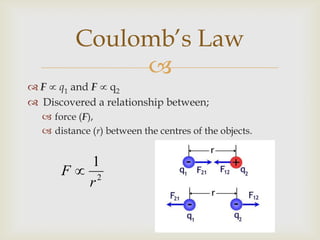
Fq1 and F q2 Discovered a relationship between;force (F),distance (r) between the centres of the objects.Coulomb’s Law
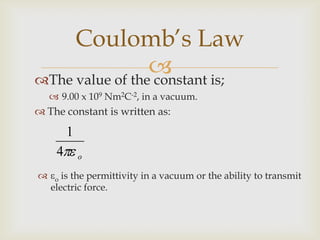
Coulomb’s LawThe value of the constant is;9.00 x 10⁹ Nm2C-2, in a vacuum.The constant is written as:o is the permittivity in a vacuum or the ability to transmit electric force.Force is a vector and so must have a direction.The force is along a line joining the two centres. If charges are the same,there is repulsionIf different,there is attraction.Coulomb’s Law states:Coulomb’s Law
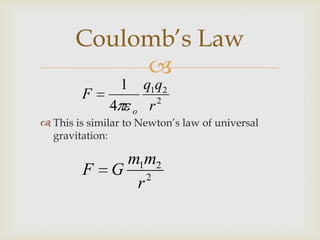
The force acting between two charges q1 and q2;who are separated by a distance d,is directly proportional to the product of the charges,and inversely proportional to the square of the distance between them.The force is along the line joining the centres of the charges.Coulomb’s Law
This is similar to Newton’s law of universal gravitation:Coulomb’s Law
Coulomb’s & Newton’s Law1.	The interaction acts on both bodies.2.	Both forces act at a distance without the bodies touching.3.	Both directly proportional to the product of the properties causing the interaction.4.	Both inversely proportional to the distance between the bodies.5.  Forces are consistent with N III
They are dissimilar in that:1.	Gravitation is a force of attraction only while charges can attract and repel.2.	The force between charges depends on the medium while gravity does not.Coulomb’s & Newton’s Law
As force is a vector we cannot algebraically add forces if there is more than one point charge present.The law that we use to determine to total force is called the law of superposition.When two or more point charges are present;the total force is equal to,the vector sum of the forces,due to each of the other point charges.Principle of Superposition
To use this principle, follow the rules given below:1.	Draw a labelled diagramUse coulombs law to determine the magnitude;ignore the direction at this stage3.	Determine if the force is attractive or repulsive.4.	Repeat step 2 for any other combinations of charges.5.	Draw a vector diagram.Principle of Superposition
Find the resultant;using Pythagoras theorem,trigonometryDetermine the direction using trigonometry.Principle of Superposition
An electric field is a region in space where;an object will experience a force due to,its charge,without the charges necessarily touching.The Electric Field
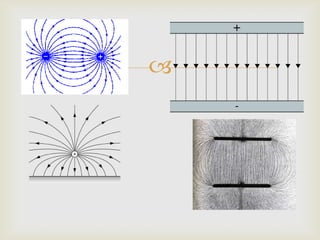
A diagram representing the relative strength of a field at any point can be drawn.The lines drawn give,direction of the force on a tiny positive charge.If the charge were allowed to move,the charge would move along the field line.Lines of Electric Force
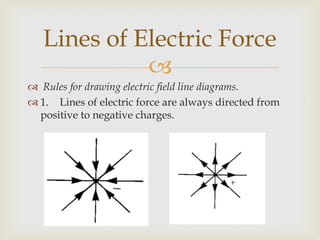
 Rules for drawing electric field line diagrams.1.	Lines of electric force are always directed from positive to negative charges.Lines of Electric Force
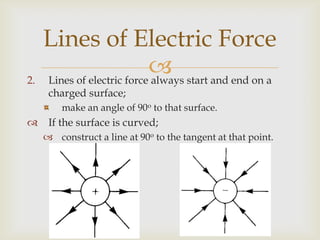
Lines of electric force always start and end on a charged surface;make an angle of 90o to that surface.If the surface is curved;construct a line at 90o to the tangent at that point.Lines of Electric Force
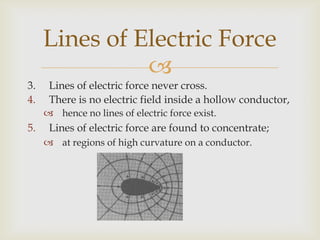
3.	Lines of electric force never cross.There is no electric field inside a hollow conductor,hence no lines of electric force exist.Lines of electric force are found to concentrate;at regions of high curvature on a conductor.Lines of Electric Force
The field may be strong enoughat the sharp pointto ionise the air.Charges may then move awayfrom the conductor.This is called Corona Discharge.Lines of Electric Force
Make sure that the number of field lines per unit area represents the field strength;when close together the field is strong,when far apart the field is weak. Where the field lines are parallel and equally spaced;the field is said to be uniform.Lines of Electric Force
The field becomes curved;or non uniform.This is known as the end effect.If the separation of the plates becomes too large;the end effect encroaches on the region between the plates.Lines of Electric Force
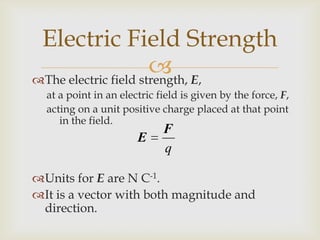
The electric field strength, E,at a point in an electric field is given by the force, F,acting on a unit positive charge placed at that point in the field.Units for E are NC-1.It is a vector with both magnitude and direction.Electric Field Strength
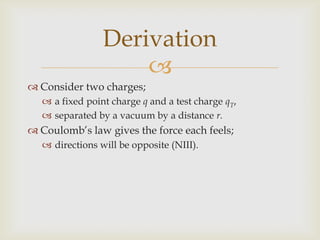
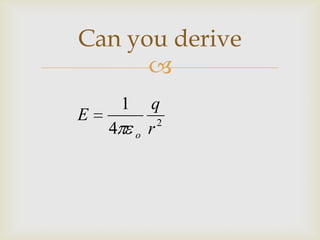
Consider two charges;a fixed point charge q and a test charge qT,separated by a vacuum by a distance r.Coulomb’s law gives the force each feels;directions will be opposite (NIII).Derivation
Can you derive
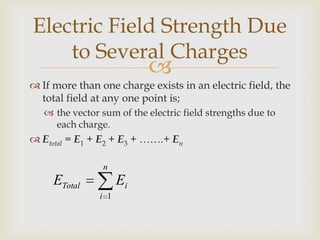
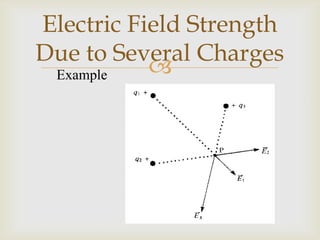
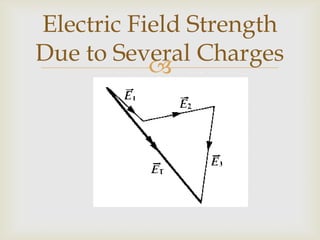
If more than one charge exists in an electric field, the total field at any one point is;the vector sum of the electric field strengths due to each charge.Etotal = E1 + E2 + E3 + …….+ EnElectric Field Strength Due to Several Charges
Electric Field Strength Due to Several ChargesExample
Electric Field Strength Due to Several Charges
There are five steps in the process.The examination will focus only on corona dischargePhotocopiers & Laser Printers
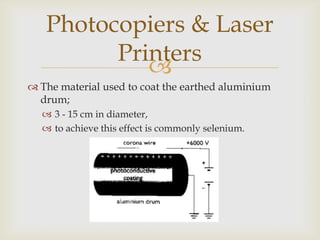
Step 1:Charging the Photoconductive Drum.The drum has the special property of being an electrical insulator in the dark;an electrical conductor when exposed to light.Near the drum is a thin corona wire;voltage of about 6000V between it and the drum,extends for the length of the drum.The polarity can vary depending on the design.Photocopiers & Laser Printers
The material used to coat the earthed aluminium drum;3 - 15 cm in diameter,to achieve this effect is commonly selenium.Photocopiers & Laser Printers
The electric field near the corona wire;accelerates any ions in the atmosphere,to high velocities.They in turn collide with neutral atoms in the air;knocking out some electrons.These free electrons attach themselves to other neutral atoms.From this process;large amounts of positive and negative ions are formed,as more and more collisions occur.Photocopiers & Laser Printers
These charged ions are attracted to either;the corona wire,or the drum.On reaching the drum;they charge the photoconductive coating uniformly,as the drum rotates.Photocopiers & Laser Printers
Transferring the Toner to the PaperThe paper is charged the same sign as that on the drum;using another corona wire,called the transfer corona.Photocopiers & Laser Printers
So the paper does not cling to the drum, the extra charge on the paper is removed;using another oppositely charged corona wire,called the separation corona.Photocopiers & Laser Printers
Motion of Particles in Electric FieldsSection 2Topic 2
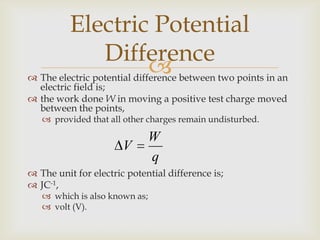
W = FsW = Uand U = qEd;this can be equated to a gravitational field,U = mgh.d = distance the charge q;is moved in a uniform field E.W = qEdV = EdW = qV Electric Potential Difference
The electric potential difference between two points in an electric field is;the work done W in moving a positive test charge moved between the points,provided that all other charges remain undisturbed.The unit for electric potential difference is;JC-1,which is also known as;volt (V).Electric Potential Difference
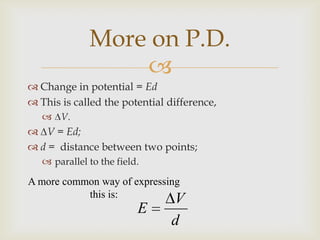
Change in potential = EdThis is called the potential difference,V.V = Ed;d =  distance between two points;parallel to the field.More on P.D.A more common way of expressing this is:
If an electron is accelerated;across a potential difference of 5 volts,K.E. = 5 times its chargei.e. 5 x 1.6 x 10-19 = 8.0 x 10⁻¹⁹JOne electron volt is the energy that an electron would gain;if it were to accelerate,across a potential difference of 1 volt.Symbol for the electron volt is eV.1 electron volt = 1.6 x 10⁻¹⁹ JElectron Volt
A charge that is free to move in a uniform electric field;behaves in a similar way to a mass in a gravitational field.In a gravitational field, an object which moves towards the earth;experiences a force that converts P.E. to K.E.When energy is converted from one form to another;work is done.No work is done in the component that is parallel to the ground.Motion of Charges in a Field
In an electric field, the same applies.When a charge moves parallel to the conducting surface;no work is done.The force only acts radially from the surface;its velocity is unchanged.There cannot be a field inside a conductor no matter its shape.Motion of Charges in a Field
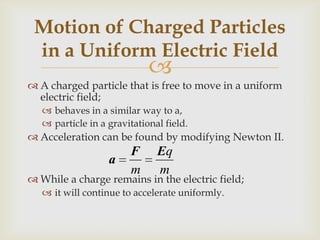
A charged particle that is free to move in a uniform electric field;behaves in a similar way to a,particle in a gravitational field.Acceleration can be found by modifying Newton II.While a charge remains in the electric field;it will continue to accelerate uniformly.Motion of Charged Particles in a Uniform Electric Field
Note:These equations only apply in a uniform field where;the acceleration is constant. The motion in two dimensions;must use vector techniques.Two other points must also be remembered:Motion of Charged Particles in a Uniform Electric Field
The acceleration of a particle is either;parallel to the lines of force;(+ive charge)or antiparallel (-ive charge).Any motion at an angle to the lines of electric force;will result in a parabolic path.The motion can be divided into its components;which are independent of each other. Motion of Charged Particles in a Uniform Electric Field
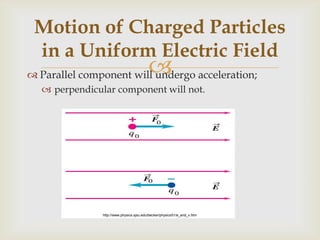
Motion of Charged Particles in a Uniform Electric FieldParallel component will undergo acceleration;perpendicular component will not.http://www.physics.sjsu.edu/becker/physics51/e_and_v.htm
Magnetic FieldsSection 2 Topic 3
Magnetic fields are produced by moving electric charges;hence by electric currents.In a bar magnet;iron atoms have electrons that spin.Each spinning electron;tiny ‘magnet’.Magnetic Fields
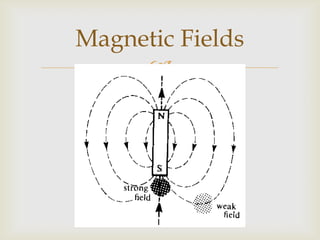
As all the electrons spin in the same direction;there is no cancellation,magnetic field is stable.Field lines can represent magnetic fields;As they did in electric fields.Magnetic Fields
Magnetic Fields
The field is concentric circles centred on the wire;strongest near the wire.This magnetic field is in addition to;electric field produced by the charges.Oersted’s Law
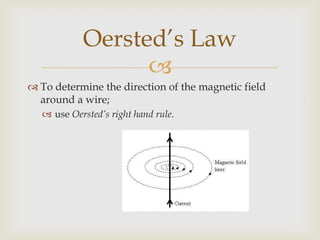
To determine the direction of the magnetic field around a wire;use Oersted’s right hand rule.Oersted’s Law
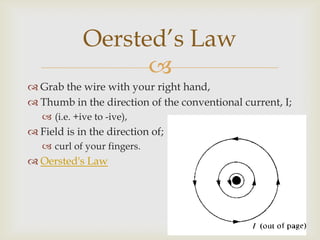
Grab the wire with your right hand,Thumb in the direction of the conventional current, I;(i.e. +ive to -ive),Field is in the direction of;curl of your fingers.Oersted's LawOersted’s Law
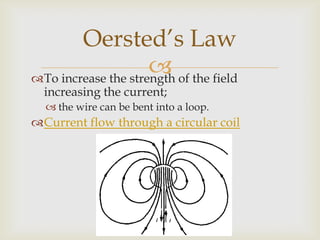
To increase the strength of the field increasing the current;the wire can be bent into a loop.Current flow through a circular coilOersted’s Law
To further increase the strength of the field at the centre of the loop;several loops are used instead of the single wire,to form a flat coil.Each loop of current carrying wire contributes;to a stronger magnetic field.Oersted’s Law
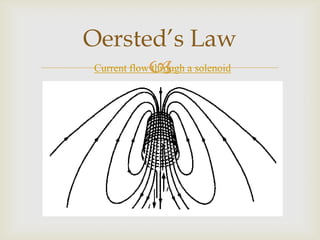
Oersted’s LawCurrent flow through a solenoid
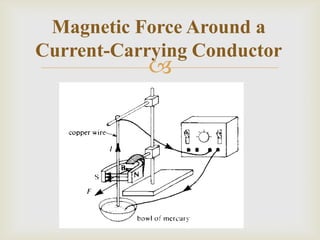
Magnetic Force Around a Current-Carrying Conductor
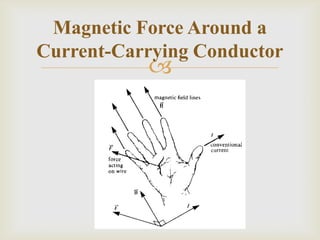
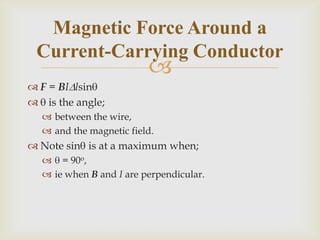
 F = BIlsinθF is the force on the wire,in newtons,I is the current flowing in the wire,in amperes,B is the magnetic induction of the magnetic field,in tesla,lsinθis the length of wire in the magnetic field,in metres.Magnetic Force Around a Current-Carrying Conductor
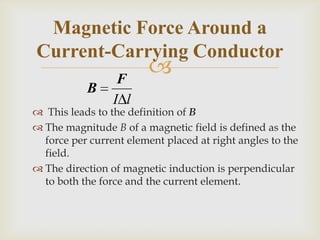
F = BIlsin is the angle;between the wire,and the magnetic field.Note sin is at a maximum when; = 90o,ie when Band I are perpendicular.Magnetic Force Around a Current-Carrying Conductor
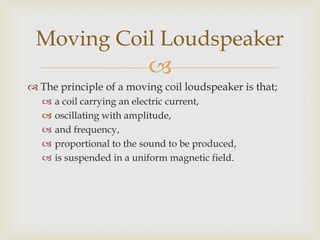
 This leads to the definition of BThe magnitude B of a magnetic field is defined as the force per current element placed at right angles to the field.The direction of magnetic induction is perpendicular to both the force and the current element.Magnetic Force Around a Current-Carrying Conductor
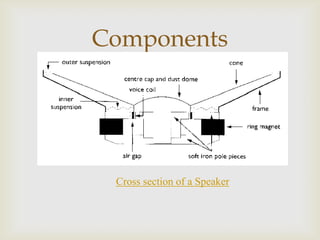
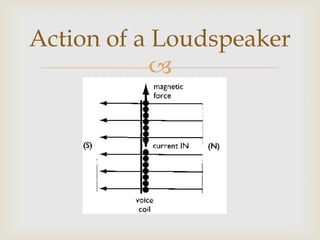
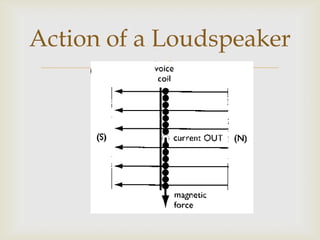
The principle of a moving coil loudspeaker is that;a coil carrying an electric current,oscillating with amplitude,and frequency,proportional to the sound to be produced,is suspended in a uniform magnetic field.Moving Coil Loudspeaker
ComponentsCross section of a Speaker
Action of a Loudspeaker
Motion of Particles in Magnetic FieldsSection 2Topic 4
Charges that are stationary;have no magnetic force applied to it.A wire that has no P.D. applied to its ends;has no magnetic force associated.We have investigated current carrying conductors;and the magnetic force associated with it.Forces on Moving Charges
Another way to produce an electric current is;to have a moving beam of charged particles.If the beam were to move perpendicularly into a magnetic field;then every charged particle would experience a force.Forces on Moving Charges
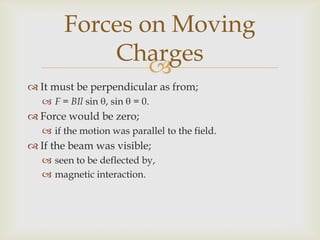
It must be perpendicular as from;F = BIl sin , sin  = 0.Force would be zero;if the motion was parallel to the field.If the beam was visible;seen to be deflected by,magnetic interaction.Forces on Moving Charges
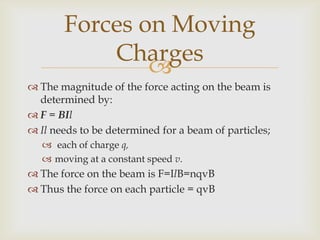
The magnitude of the force acting on the beam is determined by:F = BIlIl needs to be determined for a beam of particles; each of charge q,moving at a constant speed v.The force on the beam is F=IlB=nqvBThus the force on each particle = qvBForces on Moving Charges
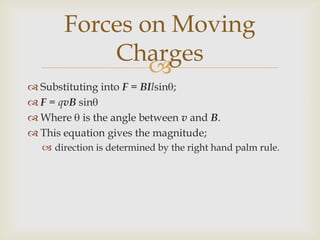
Substituting into F = BIlsin;F = qvB sinWhere  is the angle between v and B.This equation gives the magnitude;direction is determined by the right hand palm rule.Forces on Moving Charges
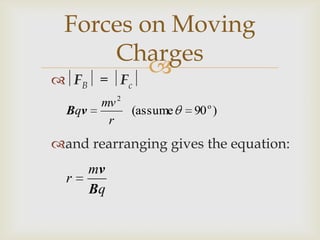
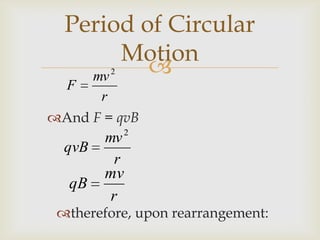
A beam of charged particles in a magnetic field;can follow a semi-circular path,with uniform circular motion.The radius and other features can easily be determined.The magnetic force,supplies a centripetal force, therefore:Forces on Moving Charges
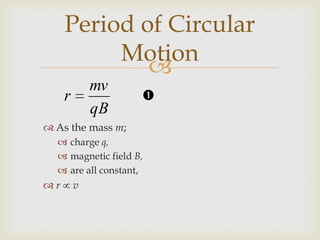
Forces on Moving ChargesFB = Fcand rearranging gives the equation:
This deflection occurs because;the charged particles are no longer constrained by,the lattice of metal ions in the wire. The deflection of the beam is determined;by the right hand palm rule.Be careful as the thumb must point in the direction of conventional current;i.e. +ive to -ive.Forces on Moving Charges
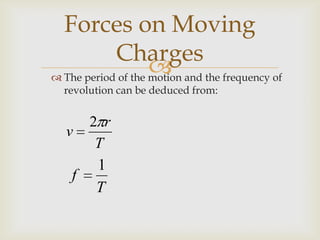
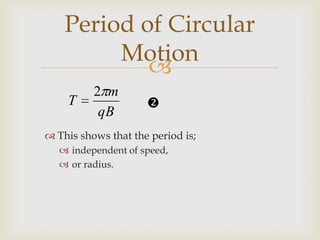
The period of the motion and the frequency of revolution can be deduced from:Forces on Moving Charges
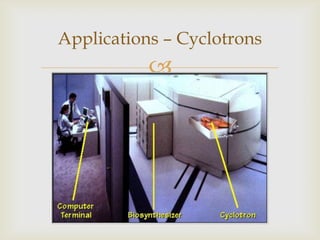
A cyclotron is a device used;to accelerate charged particles to high energies,generally so they may collide with atomic nuclei,and produce a nuclear reaction.Applications – Cyclotrons
Applications – Cyclotrons
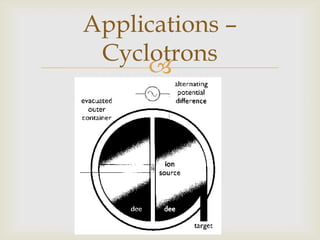
There are three main parts of a cyclotron:1.	Ion SourceA beam of protons;or sometimes deuteron,which is heavy hydrogen. Can be charged particlePositive IonNegative IonApplications – Cyclotrons
Modern ion sources are generated from an electric arc;external to the cyclotron,vacuum is not compromised.Applications – Cyclotrons
Applications – Cyclotrons
2.	Semicircular Metal Containers (‘dees’)Originally, two hollow copper electrodes;shaped like the letter ‘D’,their straight edges facing each other were used.Applications –Cyclotrons
A large ac P.D. is applied between the dees.The P.D. creates an electric field;in the gap between them,that is continuously changing.As the dees are closed hollow metal conductors;they have no electric field inside of them.Applications –Cyclotrons
The dees are in a magnetic field;produced by an electromagnet.This means that there is a magnetic field;within the dees.Within the gap there exists;an electric and magnetic field.Applications –Cyclotrons
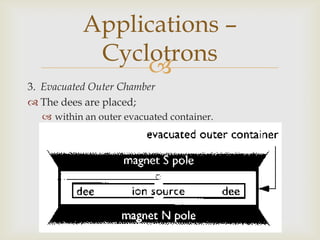
3.	Evacuated Outer ChamberThe dees are placed;within an outer evacuated container.Applications –Cyclotrons
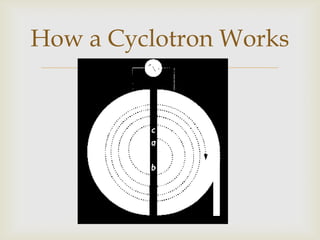
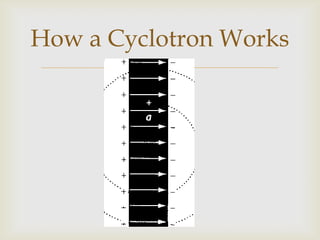
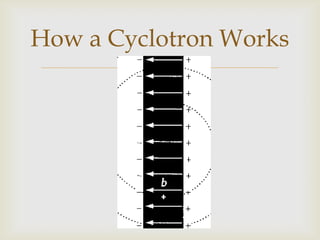
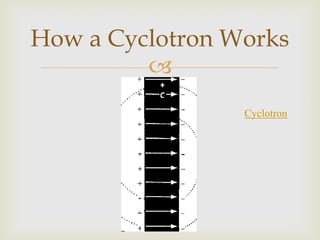
The function of the electric field;accelerate the ions to high energies.The longer the ions is in the electric field;the higher the energy.How a Cyclotron Works
The function of the magnetic field;Make the ions move in a circular path;it repeatedly comes under the influence of the electric field,increases the energy level.How a Cyclotron Works
How a Cyclotron Works
How a Cyclotron WorksCyclotron
As the ions pass through the gap;their speed increases,so must their kinetic energy.This means work is done.From previously;W = qVAs there are two passes of the gap per revolution;their kinetic energy per revolution,is 2qV.Energy Transferred to the Ions
The dees are placed between;poles of an electromagnet.The ions are not shielded from;magnetic field,unlike the electric field.This means the ions are affected;inside thedees,in the gap between them.Application- Cyclotrons
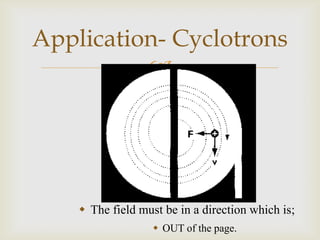
To make the ions move in circular path;uniform magnetic field is needed,perpendicular to the plane of the dees.Polarity of the field is important;to make the ions move in the right direction.The force is such that;always acting towards the centre of the circle,causing centripetal acceleration.Application- Cyclotrons
Application- CyclotronsThe field must be in a direction which is;
OUT of the page.Period of Circular MotionAnd F = qvBtherefore, upon rearrangement:
As the mass m;charge q,magnetic field B,are all constant,rvPeriod of Circular Motion
We also stated:The time for the ion to complete one semicircle is the same irrespective of the speed of the ion.From before, if the speed doubles;radius doubles.Period of Circular Motion
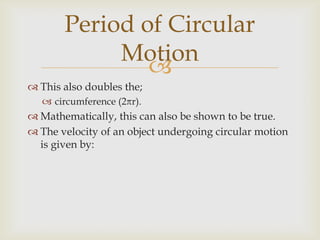
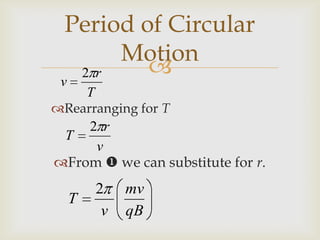
This also doubles the;circumference (2r).Mathematically, this can also be shown to be true.The velocity of an object undergoing circular motion is given by:Period of Circular Motion
Period of Circular MotionRearranging for TFrom  we can substitute for r.
This shows that the period is;independent of speed,or radius.Period of Circular Motion
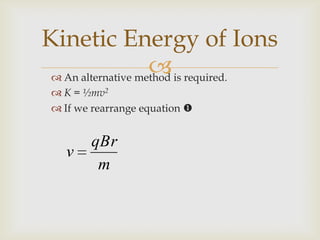
An alternative method is required.K = ½mv2If we rearrange equation Kinetic Energy of Ions
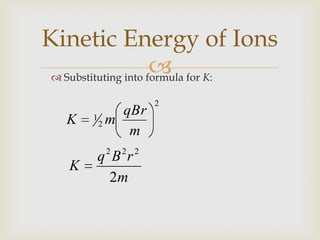
Substituting into formula for K:Kinetic Energy of Ions
This indicates that the kinetic energy of an ion;of given charge,and mass.Only depends on the radius;of the final circle,magnitude of the magnetic field.This can be understood due to two points.Kinetic Energy of Ions
Point 1If the magnetic field increases;the radii decreases,ions make more revolutions,more crossings of the gap between the dees.Kinetic Energy of Ions
At each crossing;they are accelerated,to higher kinetic energy.Increasing the magnetic field results in;increase of the kinetic energy,of the emerging ions,at a given radius.Kinetic Energy of Ions
Point 2If the P.D. is increased;the ions gain more speed with each crossing of the gap,and so make circles with larger radii,and make fewer revolutions.This means that a larger P.D. does not result in;a larger kinetic energy,of the emerging ions at a given radius.Kinetic Energy of Ions
The protons are used to bombard stable atoms;carbon,nitrogen,oxygen,Fluorine.To produce radioactive forms of these elements.Uses of Cyclotrons in Hospitals
They are then combine with glucose and are given to the patient.The radioactivity can then be detected;bodily functions that use the above chemicals,can be monitored.A medical diagnosis can then be made.Uses of Cyclotrons in Hospitals
Section2revision

Section2revision

  • 1.
  • 2.
    All matter ismade up of atoms and molecules;contain charged particles,the proton and electron.The charges on each are equal;but opposite in sign.Charges
  • 3.
    Fq1 and Fq2 Discovered a relationship between;force (F),distance (r) between the centres of the objects.Coulomb’s Law
  • 4.
    Coulomb’s LawThe valueof the constant is;9.00 x 10⁹ Nm2C-2, in a vacuum.The constant is written as:o is the permittivity in a vacuum or the ability to transmit electric force.Force is a vector and so must have a direction.The force is along a line joining the two centres. If charges are the same,there is repulsionIf different,there is attraction.Coulomb’s Law states:Coulomb’s Law
  • 5.
    The force actingbetween two charges q1 and q2;who are separated by a distance d,is directly proportional to the product of the charges,and inversely proportional to the square of the distance between them.The force is along the line joining the centres of the charges.Coulomb’s Law
  • 6.
    This is similarto Newton’s law of universal gravitation:Coulomb’s Law
  • 7.
    Coulomb’s & Newton’sLaw1. The interaction acts on both bodies.2. Both forces act at a distance without the bodies touching.3. Both directly proportional to the product of the properties causing the interaction.4. Both inversely proportional to the distance between the bodies.5. Forces are consistent with N III
  • 8.
    They are dissimilarin that:1. Gravitation is a force of attraction only while charges can attract and repel.2. The force between charges depends on the medium while gravity does not.Coulomb’s & Newton’s Law
  • 9.
    As force isa vector we cannot algebraically add forces if there is more than one point charge present.The law that we use to determine to total force is called the law of superposition.When two or more point charges are present;the total force is equal to,the vector sum of the forces,due to each of the other point charges.Principle of Superposition
  • 10.
    To use thisprinciple, follow the rules given below:1. Draw a labelled diagramUse coulombs law to determine the magnitude;ignore the direction at this stage3. Determine if the force is attractive or repulsive.4. Repeat step 2 for any other combinations of charges.5. Draw a vector diagram.Principle of Superposition
  • 11.
    Find the resultant;usingPythagoras theorem,trigonometryDetermine the direction using trigonometry.Principle of Superposition
  • 12.
    An electric fieldis a region in space where;an object will experience a force due to,its charge,without the charges necessarily touching.The Electric Field
  • 13.
    A diagram representingthe relative strength of a field at any point can be drawn.The lines drawn give,direction of the force on a tiny positive charge.If the charge were allowed to move,the charge would move along the field line.Lines of Electric Force
  • 14.
     Rules for drawingelectric field line diagrams.1. Lines of electric force are always directed from positive to negative charges.Lines of Electric Force
  • 15.
    Lines of electricforce always start and end on a charged surface;make an angle of 90o to that surface.If the surface is curved;construct a line at 90o to the tangent at that point.Lines of Electric Force
  • 16.
    3. Lines of electricforce never cross.There is no electric field inside a hollow conductor,hence no lines of electric force exist.Lines of electric force are found to concentrate;at regions of high curvature on a conductor.Lines of Electric Force
  • 17.
    The field maybe strong enoughat the sharp pointto ionise the air.Charges may then move awayfrom the conductor.This is called Corona Discharge.Lines of Electric Force
  • 18.
    Make sure thatthe number of field lines per unit area represents the field strength;when close together the field is strong,when far apart the field is weak. Where the field lines are parallel and equally spaced;the field is said to be uniform.Lines of Electric Force
  • 19.
    The field becomescurved;or non uniform.This is known as the end effect.If the separation of the plates becomes too large;the end effect encroaches on the region between the plates.Lines of Electric Force
  • 21.
    The electric fieldstrength, E,at a point in an electric field is given by the force, F,acting on a unit positive charge placed at that point in the field.Units for E are NC-1.It is a vector with both magnitude and direction.Electric Field Strength
  • 22.
    Consider two charges;afixed point charge q and a test charge qT,separated by a vacuum by a distance r.Coulomb’s law gives the force each feels;directions will be opposite (NIII).Derivation
  • 23.
  • 24.
    If more thanone charge exists in an electric field, the total field at any one point is;the vector sum of the electric field strengths due to each charge.Etotal = E1 + E2 + E3 + …….+ EnElectric Field Strength Due to Several Charges
  • 25.
    Electric Field StrengthDue to Several ChargesExample
  • 26.
    Electric Field StrengthDue to Several Charges
  • 27.
    There are fivesteps in the process.The examination will focus only on corona dischargePhotocopiers & Laser Printers
  • 28.
    Step 1:Charging thePhotoconductive Drum.The drum has the special property of being an electrical insulator in the dark;an electrical conductor when exposed to light.Near the drum is a thin corona wire;voltage of about 6000V between it and the drum,extends for the length of the drum.The polarity can vary depending on the design.Photocopiers & Laser Printers
  • 29.
    The material usedto coat the earthed aluminium drum;3 - 15 cm in diameter,to achieve this effect is commonly selenium.Photocopiers & Laser Printers
  • 30.
    The electric fieldnear the corona wire;accelerates any ions in the atmosphere,to high velocities.They in turn collide with neutral atoms in the air;knocking out some electrons.These free electrons attach themselves to other neutral atoms.From this process;large amounts of positive and negative ions are formed,as more and more collisions occur.Photocopiers & Laser Printers
  • 31.
    These charged ionsare attracted to either;the corona wire,or the drum.On reaching the drum;they charge the photoconductive coating uniformly,as the drum rotates.Photocopiers & Laser Printers
  • 32.
    Transferring the Tonerto the PaperThe paper is charged the same sign as that on the drum;using another corona wire,called the transfer corona.Photocopiers & Laser Printers
  • 33.
    So the paperdoes not cling to the drum, the extra charge on the paper is removed;using another oppositely charged corona wire,called the separation corona.Photocopiers & Laser Printers
  • 34.
    Motion of Particlesin Electric FieldsSection 2Topic 2
  • 35.
    W = FsW= Uand U = qEd;this can be equated to a gravitational field,U = mgh.d = distance the charge q;is moved in a uniform field E.W = qEdV = EdW = qV Electric Potential Difference
  • 36.
    The electric potentialdifference between two points in an electric field is;the work done W in moving a positive test charge moved between the points,provided that all other charges remain undisturbed.The unit for electric potential difference is;JC-1,which is also known as;volt (V).Electric Potential Difference
  • 37.
    Change in potential= EdThis is called the potential difference,V.V = Ed;d = distance between two points;parallel to the field.More on P.D.A more common way of expressing this is:
  • 38.
    If an electronis accelerated;across a potential difference of 5 volts,K.E. = 5 times its chargei.e. 5 x 1.6 x 10-19 = 8.0 x 10⁻¹⁹JOne electron volt is the energy that an electron would gain;if it were to accelerate,across a potential difference of 1 volt.Symbol for the electron volt is eV.1 electron volt = 1.6 x 10⁻¹⁹ JElectron Volt
  • 39.
    A charge thatis free to move in a uniform electric field;behaves in a similar way to a mass in a gravitational field.In a gravitational field, an object which moves towards the earth;experiences a force that converts P.E. to K.E.When energy is converted from one form to another;work is done.No work is done in the component that is parallel to the ground.Motion of Charges in a Field
  • 40.
    In an electricfield, the same applies.When a charge moves parallel to the conducting surface;no work is done.The force only acts radially from the surface;its velocity is unchanged.There cannot be a field inside a conductor no matter its shape.Motion of Charges in a Field
  • 41.
    A charged particlethat is free to move in a uniform electric field;behaves in a similar way to a,particle in a gravitational field.Acceleration can be found by modifying Newton II.While a charge remains in the electric field;it will continue to accelerate uniformly.Motion of Charged Particles in a Uniform Electric Field
  • 42.
    Note:These equations onlyapply in a uniform field where;the acceleration is constant. The motion in two dimensions;must use vector techniques.Two other points must also be remembered:Motion of Charged Particles in a Uniform Electric Field
  • 43.
    The acceleration ofa particle is either;parallel to the lines of force;(+ive charge)or antiparallel (-ive charge).Any motion at an angle to the lines of electric force;will result in a parabolic path.The motion can be divided into its components;which are independent of each other. Motion of Charged Particles in a Uniform Electric Field
  • 44.
    Motion of ChargedParticles in a Uniform Electric FieldParallel component will undergo acceleration;perpendicular component will not.http://www.physics.sjsu.edu/becker/physics51/e_and_v.htm
  • 45.
  • 46.
    Magnetic fields areproduced by moving electric charges;hence by electric currents.In a bar magnet;iron atoms have electrons that spin.Each spinning electron;tiny ‘magnet’.Magnetic Fields
  • 47.
    As all theelectrons spin in the same direction;there is no cancellation,magnetic field is stable.Field lines can represent magnetic fields;As they did in electric fields.Magnetic Fields
  • 48.
  • 49.
    The field isconcentric circles centred on the wire;strongest near the wire.This magnetic field is in addition to;electric field produced by the charges.Oersted’s Law
  • 50.
    To determine thedirection of the magnetic field around a wire;use Oersted’s right hand rule.Oersted’s Law
  • 51.
    Grab the wirewith your right hand,Thumb in the direction of the conventional current, I;(i.e. +ive to -ive),Field is in the direction of;curl of your fingers.Oersted's LawOersted’s Law
  • 52.
    To increase thestrength of the field increasing the current;the wire can be bent into a loop.Current flow through a circular coilOersted’s Law
  • 53.
    To further increasethe strength of the field at the centre of the loop;several loops are used instead of the single wire,to form a flat coil.Each loop of current carrying wire contributes;to a stronger magnetic field.Oersted’s Law
  • 54.
    Oersted’s LawCurrent flowthrough a solenoid
  • 55.
    Magnetic Force Arounda Current-Carrying Conductor
  • 56.
    Magnetic Force Arounda Current-Carrying Conductor
  • 57.
     F = BIlsinθFis the force on the wire,in newtons,I is the current flowing in the wire,in amperes,B is the magnetic induction of the magnetic field,in tesla,lsinθis the length of wire in the magnetic field,in metres.Magnetic Force Around a Current-Carrying Conductor
  • 58.
    F = BIlsinis the angle;between the wire,and the magnetic field.Note sin is at a maximum when; = 90o,ie when Band I are perpendicular.Magnetic Force Around a Current-Carrying Conductor
  • 59.
     This leads tothe definition of BThe magnitude B of a magnetic field is defined as the force per current element placed at right angles to the field.The direction of magnetic induction is perpendicular to both the force and the current element.Magnetic Force Around a Current-Carrying Conductor
  • 60.
    The principle ofa moving coil loudspeaker is that;a coil carrying an electric current,oscillating with amplitude,and frequency,proportional to the sound to be produced,is suspended in a uniform magnetic field.Moving Coil Loudspeaker
  • 61.
  • 62.
    Action of aLoudspeaker
  • 63.
    Action of aLoudspeaker
  • 64.
    Motion of Particlesin Magnetic FieldsSection 2Topic 4
  • 65.
    Charges that arestationary;have no magnetic force applied to it.A wire that has no P.D. applied to its ends;has no magnetic force associated.We have investigated current carrying conductors;and the magnetic force associated with it.Forces on Moving Charges
  • 66.
    Another way toproduce an electric current is;to have a moving beam of charged particles.If the beam were to move perpendicularly into a magnetic field;then every charged particle would experience a force.Forces on Moving Charges
  • 67.
    It must beperpendicular as from;F = BIl sin , sin  = 0.Force would be zero;if the motion was parallel to the field.If the beam was visible;seen to be deflected by,magnetic interaction.Forces on Moving Charges
  • 68.
    The magnitude ofthe force acting on the beam is determined by:F = BIlIl needs to be determined for a beam of particles; each of charge q,moving at a constant speed v.The force on the beam is F=IlB=nqvBThus the force on each particle = qvBForces on Moving Charges
  • 69.
    Substituting into F= BIlsin;F = qvB sinWhere  is the angle between v and B.This equation gives the magnitude;direction is determined by the right hand palm rule.Forces on Moving Charges
  • 70.
    A beam ofcharged particles in a magnetic field;can follow a semi-circular path,with uniform circular motion.The radius and other features can easily be determined.The magnetic force,supplies a centripetal force, therefore:Forces on Moving Charges
  • 71.
    Forces on MovingChargesFB = Fcand rearranging gives the equation:
  • 72.
    This deflection occursbecause;the charged particles are no longer constrained by,the lattice of metal ions in the wire. The deflection of the beam is determined;by the right hand palm rule.Be careful as the thumb must point in the direction of conventional current;i.e. +ive to -ive.Forces on Moving Charges
  • 73.
    The period ofthe motion and the frequency of revolution can be deduced from:Forces on Moving Charges
  • 74.
    A cyclotron isa device used;to accelerate charged particles to high energies,generally so they may collide with atomic nuclei,and produce a nuclear reaction.Applications – Cyclotrons
  • 75.
  • 76.
    There are threemain parts of a cyclotron:1. Ion SourceA beam of protons;or sometimes deuteron,which is heavy hydrogen. Can be charged particlePositive IonNegative IonApplications – Cyclotrons
  • 77.
    Modern ion sourcesare generated from an electric arc;external to the cyclotron,vacuum is not compromised.Applications – Cyclotrons
  • 78.
  • 79.
    2. Semicircular Metal Containers(‘dees’)Originally, two hollow copper electrodes;shaped like the letter ‘D’,their straight edges facing each other were used.Applications –Cyclotrons
  • 80.
    A large acP.D. is applied between the dees.The P.D. creates an electric field;in the gap between them,that is continuously changing.As the dees are closed hollow metal conductors;they have no electric field inside of them.Applications –Cyclotrons
  • 81.
    The dees arein a magnetic field;produced by an electromagnet.This means that there is a magnetic field;within the dees.Within the gap there exists;an electric and magnetic field.Applications –Cyclotrons
  • 82.
    3. Evacuated Outer ChamberThedees are placed;within an outer evacuated container.Applications –Cyclotrons
  • 83.
    The function ofthe electric field;accelerate the ions to high energies.The longer the ions is in the electric field;the higher the energy.How a Cyclotron Works
  • 84.
    The function ofthe magnetic field;Make the ions move in a circular path;it repeatedly comes under the influence of the electric field,increases the energy level.How a Cyclotron Works
  • 85.
  • 86.
  • 87.
  • 88.
    How a CyclotronWorksCyclotron
  • 89.
    As the ionspass through the gap;their speed increases,so must their kinetic energy.This means work is done.From previously;W = qVAs there are two passes of the gap per revolution;their kinetic energy per revolution,is 2qV.Energy Transferred to the Ions
  • 90.
    The dees areplaced between;poles of an electromagnet.The ions are not shielded from;magnetic field,unlike the electric field.This means the ions are affected;inside thedees,in the gap between them.Application- Cyclotrons
  • 91.
    To make theions move in circular path;uniform magnetic field is needed,perpendicular to the plane of the dees.Polarity of the field is important;to make the ions move in the right direction.The force is such that;always acting towards the centre of the circle,causing centripetal acceleration.Application- Cyclotrons
  • 92.
    Application- CyclotronsThe fieldmust be in a direction which is;
  • 93.
    OUT of thepage.Period of Circular MotionAnd F = qvBtherefore, upon rearrangement:
  • 94.
    As the massm;charge q,magnetic field B,are all constant,rvPeriod of Circular Motion
  • 95.
    We also stated:Thetime for the ion to complete one semicircle is the same irrespective of the speed of the ion.From before, if the speed doubles;radius doubles.Period of Circular Motion
  • 96.
    This also doublesthe;circumference (2r).Mathematically, this can also be shown to be true.The velocity of an object undergoing circular motion is given by:Period of Circular Motion
  • 97.
    Period of CircularMotionRearranging for TFrom  we can substitute for r.
  • 98.
    This shows thatthe period is;independent of speed,or radius.Period of Circular Motion
  • 99.
    An alternative methodis required.K = ½mv2If we rearrange equation Kinetic Energy of Ions
  • 100.
    Substituting into formulafor K:Kinetic Energy of Ions
  • 101.
    This indicates thatthe kinetic energy of an ion;of given charge,and mass.Only depends on the radius;of the final circle,magnitude of the magnetic field.This can be understood due to two points.Kinetic Energy of Ions
  • 102.
    Point 1If themagnetic field increases;the radii decreases,ions make more revolutions,more crossings of the gap between the dees.Kinetic Energy of Ions
  • 103.
    At each crossing;theyare accelerated,to higher kinetic energy.Increasing the magnetic field results in;increase of the kinetic energy,of the emerging ions,at a given radius.Kinetic Energy of Ions
  • 104.
    Point 2If theP.D. is increased;the ions gain more speed with each crossing of the gap,and so make circles with larger radii,and make fewer revolutions.This means that a larger P.D. does not result in;a larger kinetic energy,of the emerging ions at a given radius.Kinetic Energy of Ions
  • 105.
    The protons areused to bombard stable atoms;carbon,nitrogen,oxygen,Fluorine.To produce radioactive forms of these elements.Uses of Cyclotrons in Hospitals
  • 106.
    They are thencombine with glucose and are given to the patient.The radioactivity can then be detected;bodily functions that use the above chemicals,can be monitored.A medical diagnosis can then be made.Uses of Cyclotrons in Hospitals