KONGUNADU COLLEGE OF ENGINEERING AND TECHNOLOGY
DEPARTMENT OF ELECTRICAL AND ELECTRONICS ENGINEERING
1
Prepared by Mr.K.KarthiK -AP/ EEE
 1. Introduction about EMF
 2. Sources and Effects of EMF
 3. Coordinate Systems and Types
 4. Divergence & Curl
 5. Divergence Theorem and Stokes Theorem
2Prepared by Mr.K.KarthiK -AP/ EEE
 Static Electric Field
 Coulomb’s Law
 Electric field Intensity
 Electric Flux Density
 Potential difference
 P D in Sphere, isolated sphere and cable
 Capacitance
 C for parallel plate capacitor
 C for Sphere, isolated sphere and cable
 Energy Stored and Energy Density
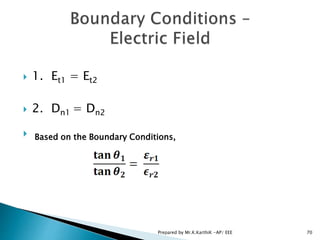
 Boundary Conditions
3Prepared by Mr.K.KarthiK -AP/ EEE
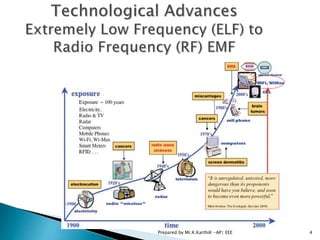
4Prepared by Mr.K.KarthiK -AP/ EEE
 When an event in one place has an effect on
something at a different location, we talk
about the events as being connected by a
“field”.
 A field is a spatial distribution of a quantity; in
general, it can be either scalar or vector in
nature.
5Prepared by Mr.K.KarthiK -AP/ EEE
 What are Electromagnetic Fields?
EMF always consists of both an electrical
field and a magnetic field.
The transmission of electrical energy
through wires, the broadcasting of radio
signals and the phenomenon of visible light
are examples of electromagnetic fields (EMF).
6Prepared by Mr.K.KarthiK -AP/ EEE
 What are the Common Sources of EMF?
 Electricity is the most common source of
power throughout the world
 because it is easily generated and transmitted
to where it is needed.
 As electricity moves through wires and
machines, it produces EMF.
 Once electricity is delivered to the user, it
continues to produce EMF throughout the
wiring systems of offices, homes, schools,
factories and other structures.
7Prepared by Mr.K.KarthiK -AP/ EEE
 In the workplace the generators of EMF
include
computers, cell phones, fax machines,
copy machines, fluorescent lights, printers,
scanners, telephone switching systems,
electrical instruments, motors and other
electrical devices.
8Prepared by Mr.K.KarthiK -AP/ EEE
In homes, the immediate sources of EMF
include
Electric blankets, electric water bed
heaters, hairdryers, electric shavers,
television sets, stereo systems, air
conditioners, fluorescent lights, telephone
answering machines, cell and portable
phones, refrigerators, blenders, portable
heaters, clothes washers and dryers, coffee
makers, vacuum cleaners, toasters, and
microwave ovens.
9Prepared by Mr.K.KarthiK -AP/ EEE
 EMF is not only produced by electricity
moving through wires or machines, but it is
the nature of all television and satellite
transmissions, as well as radio and
microwave communication systems,
including cell phones.
Transportation methods such as
automobiles, trucks, airplanes, electrical and
magnetic trains and subway systems are
significant sources of EMF.
10Prepared by Mr.K.KarthiK -AP/ EEE
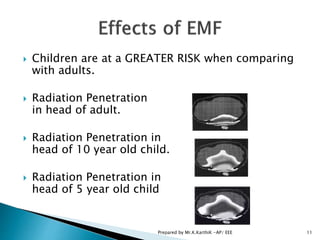
 Children are at a GREATER RISK when comparing
with adults.
 Radiation Penetration
in head of adult.
 Radiation Penetration in
head of 10 year old child.
 Radiation Penetration in
head of 5 year old child
11Prepared by Mr.K.KarthiK -AP/ EEE
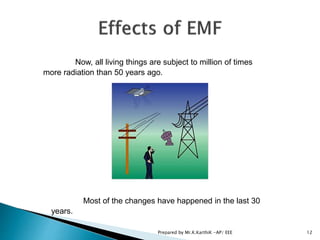
Now, all living things are subject to million of times
more radiation than 50 years ago.
Most of the changes have happened in the last 30
years.
12Prepared by Mr.K.KarthiK -AP/ EEE
We will never be able to experience this peaceful
world again
13Prepared by Mr.K.KarthiK -AP/ EEE
 EMF & Cell Phone Radiation could be the cause
of your headaches.
 Your lack of energy is not through doing too
much – it’s EMF.
 EMF & Cell Phone Radiation causes depression.
 The stress in your life is more likely to be EMF
than lifestyle!
 EMF & Cell Phone Radiation causes minor and
major illnesses including cancer.
 EMF & Cell Phone Radiation IS THE MAIN CAUSE
OF INSOMNIA!
 EMF & Cell Phone Radiation causes birth defects
and abortions .
14Prepared by Mr.K.KarthiK -AP/ EEE
15Prepared by Mr.K.KarthiK -AP/ EEE
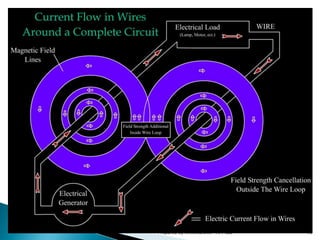
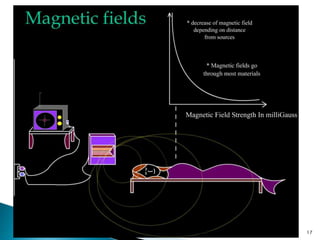
◦ Magnetic fields from current flow
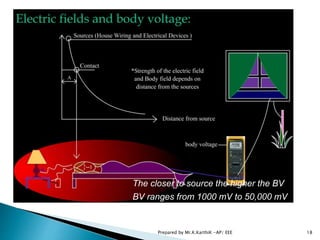
◦ Electric fields from energized potential
16Prepared by Mr.K.KarthiK -AP/ EEE
17Prepared by Mr.K.KarthiK -AP/ EEE
The closer to source the higher the BV
BV ranges from 1000 mV to 50,000 mV
18Prepared by Mr.K.KarthiK -AP/ EEE
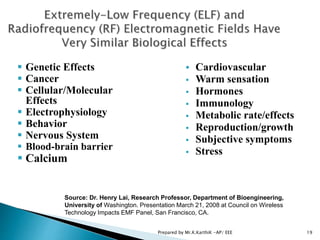
 Genetic Effects
 Cancer
 Cellular/Molecular
Effects
 Electrophysiology
 Behavior
 Nervous System
 Blood-brain barrier
 Calcium
 Cardiovascular
 Warm sensation
 Hormones
 Immunology
 Metabolic rate/effects
 Reproduction/growth
 Subjective symptoms
 Stress
Source: Dr. Henry Lai, Research Professor, Department of Bioengineering,
University of Washington. Presentation March 21, 2008 at Council on Wireless
Technology Impacts EMF Panel, San Francisco, CA.
19Prepared by Mr.K.KarthiK -AP/ EEE
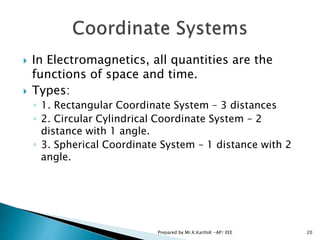
 In Electromagnetics, all quantities are the
functions of space and time.
 Types:
◦ 1. Rectangular Coordinate System – 3 distances
◦ 2. Circular Cylindrical Coordinate System – 2
distance with 1 angle.
◦ 3. Spherical Coordinate System – 1 distance with 2
angle.
20Prepared by Mr.K.KarthiK -AP/ EEE
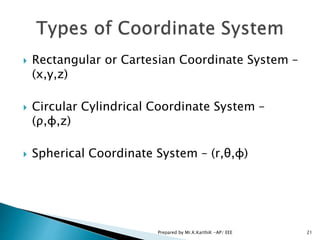
 Rectangular or Cartesian Coordinate System –
(x,y,z)
 Circular Cylindrical Coordinate System –
(ρ,φ,z)
 Spherical Coordinate System – (r,θ,φ)
21Prepared by Mr.K.KarthiK -AP/ EEE
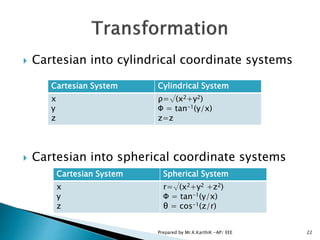
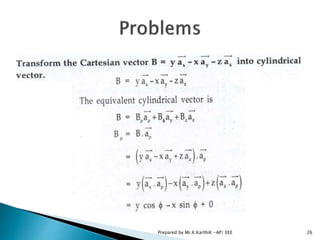
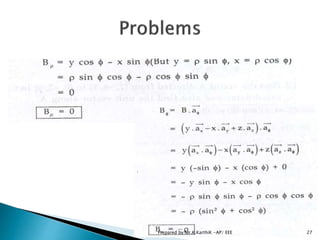
 Cartesian into cylindrical coordinate systems
 Cartesian into spherical coordinate systems
Cartesian System Cylindrical System
x
y
z
ρ=√(x2+y2)
Ф = tan-1(y/x)
z=z
Cartesian System Spherical System
x
y
z
r=√(x2+y2 +z2)
Ф = tan-1(y/x)
θ = cos-1(z/r)
22Prepared by Mr.K.KarthiK -AP/ EEE
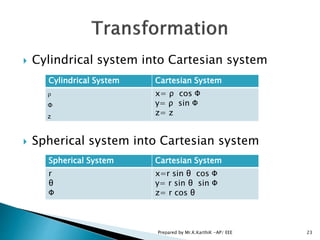
 Cylindrical system into Cartesian system
 Spherical system into Cartesian system
Cylindrical System Cartesian System
ρ
Ф
z
x= ρ cos Ф
y= ρ sin Ф
z= z
Spherical System Cartesian System
r
θ
Ф
x=r sin θ cos Ф
y= r sin θ sin Ф
z= r cos θ
23Prepared by Mr.K.KarthiK -AP/ EEE
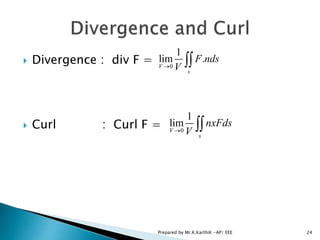
 Divergence : div F =
 Curl : Curl F =
0
1
lim .
V
s
F nds
V 
0
1
lim
V
s
nxFds
V 
24Prepared by Mr.K.KarthiK -AP/ EEE
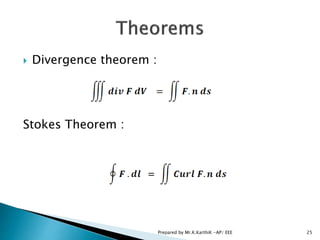
 Divergence theorem :
Stokes Theorem :
25Prepared by Mr.K.KarthiK -AP/ EEE
26Prepared by Mr.K.KarthiK -AP/ EEE
27Prepared by Mr.K.KarthiK -AP/ EEE
 Electrostatics is the branch of
electromagnetics dealing with the effects
of electric charges at rest.
 The fundamental law of electrostatics is
Coulomb’s law.
28Prepared by Mr.K.KarthiK -AP/ EEE
 Electrical phenomena caused by friction are part of
our everyday lives, and can be understood in terms
of electrical charge.
 The effects of electrical charge can be observed in the
attraction/repulsion of various objects when
“charged.”
 Charge comes in two varieties called “positive” and
“negative.”
29Prepared by Mr.K.KarthiK -AP/ EEE
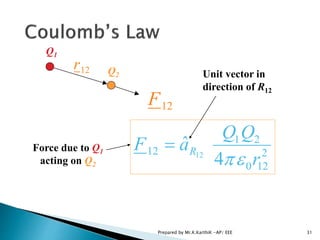
 Coulomb’s law is the “law of action” between
charged bodies.
 Coulomb’s law gives the electric force between
two point charges in an otherwise empty
universe.
 A point charge is a charge that occupies a region
of space which is negligibly small compared to
the distance between the point charge and any
other object.
30Prepared by Mr.K.KarthiK -AP/ EEE
2
120
21
12
4
ˆ 12
r
QQ
aF R


Q1
Q2
12r
12F
Force due to Q1
acting on Q2
Unit vector in
direction of R12
31Prepared by Mr.K.KarthiK -AP/ EEE
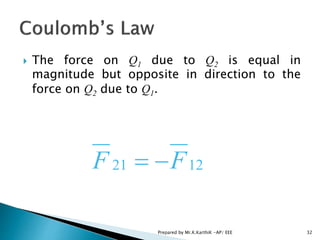
 The force on Q1 due to Q2 is equal in
magnitude but opposite in direction to the
force on Q2 due to Q1.
1221 FF 
32Prepared by Mr.K.KarthiK -AP/ EEE
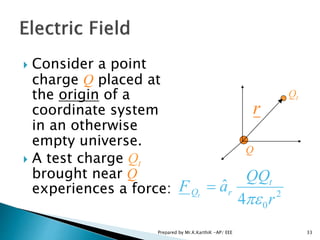
 Consider a point
charge Q placed at
the origin of a
coordinate system
in an otherwise
empty universe.
 A test charge Qt
brought near Q
experiences a force: 2
04
ˆ
r
QQ
aF t
rQt


Q
Qt
r
33Prepared by Mr.K.KarthiK -AP/ EEE
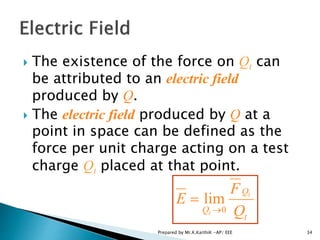
 The existence of the force on Qt can
be attributed to an electric field
produced by Q.
 The electric field produced by Q at a
point in space can be defined as the
force per unit charge acting on a test
charge Qt placed at that point.
t
Q
Q Q
F
E t
t 0
lim


34Prepared by Mr.K.KarthiK -AP/ EEE
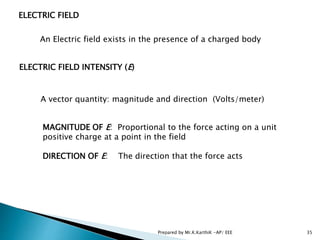
ELECTRIC FIELD
An Electric field exists in the presence of a charged body
ELECTRIC FIELD INTENSITY (E)
A vector quantity: magnitude and direction (Volts/meter)
MAGNITUDE OF E: Proportional to the force acting on a unit
positive charge at a point in the field
DIRECTION OF E: The direction that the force acts
35Prepared by Mr.K.KarthiK -AP/ EEE
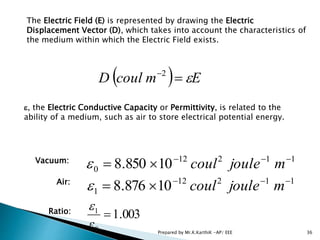
The Electric Field (E) is represented by drawing the Electric
Displacement Vector (D), which takes into account the characteristics of
the medium within which the Electric Field exists.
  EmcoulD 2
, the Electric Conductive Capacity or Permittivity, is related to the
ability of a medium, such as air to store electrical potential energy.
11212
0 10850.8 
 mjoulecoulVacuum:
11212
1 10876.8 
 mjoulecoulAir:
Ratio:
003.1
0
1



36Prepared by Mr.K.KarthiK -AP/ EEE
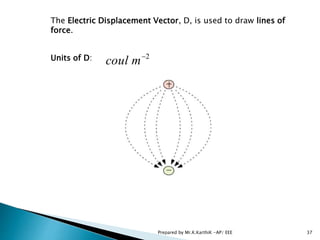
The Electric Displacement Vector, D, is used to draw lines of
force.
2
mcoulUnits of D:
37Prepared by Mr.K.KarthiK -AP/ EEE
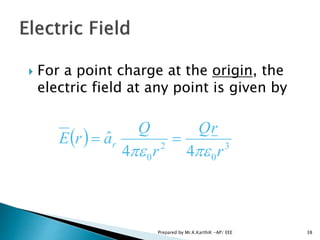
 For a point charge at the origin, the
electric field at any point is given by
  3
0
2
0 44
ˆ
r
rQ
r
Q
arE r


38Prepared by Mr.K.KarthiK -AP/ EEE
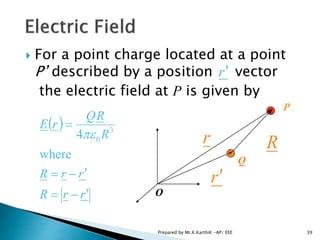
 For a point charge located at a point
P’ described by a position vector
the electric field at P is given by
 
rrR
rrR
R
RQ
rE



where
4 3
0
r
Q
P
r R
r
O
39Prepared by Mr.K.KarthiK -AP/ EEE
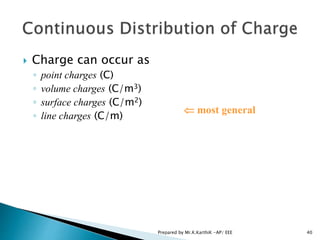
 Charge can occur as
◦ point charges (C)
◦ volume charges (C/m3)
◦ surface charges (C/m2)
◦ line charges (C/m)
 most general
40Prepared by Mr.K.KarthiK -AP/ EEE
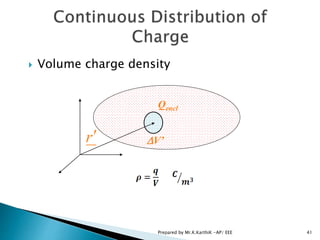
 Volume charge density
Qencl
r DV’
41Prepared by Mr.K.KarthiK -AP/ EEE
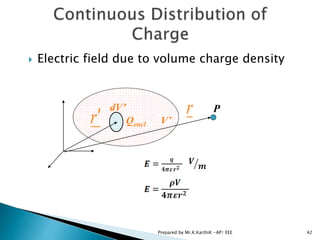
 Electric field due to volume charge density
Qenclr
dV’
V’
Pr
42Prepared by Mr.K.KarthiK -AP/ EEE
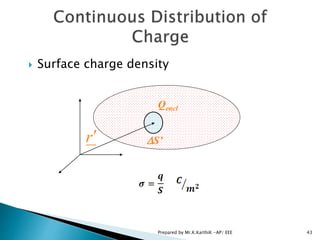
 Surface charge density
Qencl
r DS’
43Prepared by Mr.K.KarthiK -AP/ EEE
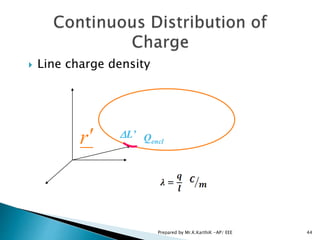
 Line charge density
Qenclr DL’
44Prepared by Mr.K.KarthiK -AP/ EEE
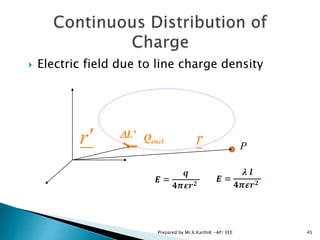
 Electric field due to line charge density
Qenclr DL’
r P
45Prepared by Mr.K.KarthiK -AP/ EEE
 An electric field is a force field.
 If a body being acted on by a force is
moved from one point to another, then
work is done.
 The concept of scalar electric potential
provides a measure of the work done in
moving charged bodies in an electrostatic
field.
46Prepared by Mr.K.KarthiK -AP/ EEE
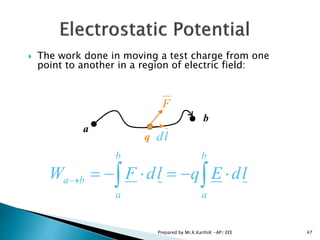
 The work done in moving a test charge from one
point to another in a region of electric field:
 
b
a
b
a
ba ldEqldFW
a
b
q
F
ld
47Prepared by Mr.K.KarthiK -AP/ EEE
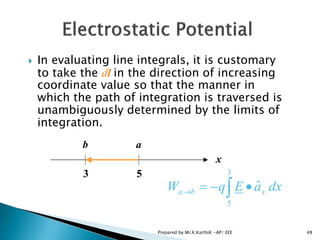
 In evaluating line integrals, it is customary
to take the dl in the direction of increasing
coordinate value so that the manner in
which the path of integration is traversed is
unambiguously determined by the limits of
integration.
 
3
5
ˆ dxaEqW xba
x
3 5
b a
48Prepared by Mr.K.KarthiK -AP/ EEE
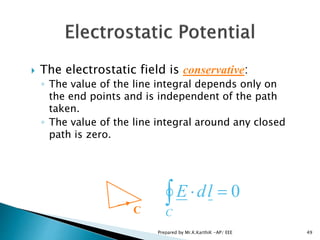
 The electrostatic field is conservative:
◦ The value of the line integral depends only on
the end points and is independent of the path
taken.
◦ The value of the line integral around any closed
path is zero.
0C
ldE
C
49Prepared by Mr.K.KarthiK -AP/ EEE
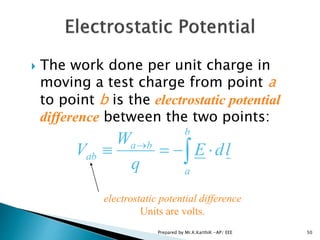
 The work done per unit charge in
moving a test charge from point a
to point b is the electrostatic potential
difference between the two points:
  
b
a
ba
ab ldE
q
W
V
electrostatic potential difference
Units are volts.
50Prepared by Mr.K.KarthiK -AP/ EEE
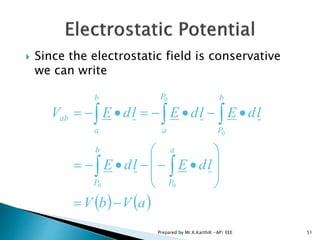
 Since the electrostatic field is conservative
we can write
   aVbV
ldEldE
ldEldEldEV
a
P
b
P
b
P
P
a
b
a
ab













00
0
0
51Prepared by Mr.K.KarthiK -AP/ EEE
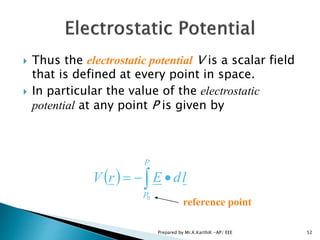
 Thus the electrostatic potential V is a scalar field
that is defined at every point in space.
 In particular the value of the electrostatic
potential at any point P is given by
   
P
P
ldErV
0
reference point
52Prepared by Mr.K.KarthiK -AP/ EEE
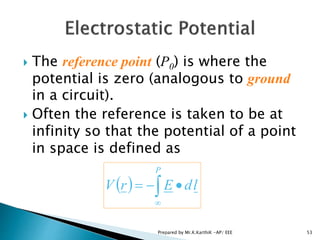
 The reference point (P0) is where the
potential is zero (analogous to ground
in a circuit).
 Often the reference is taken to be at
infinity so that the potential of a point
in space is defined as
  

P
ldErV
53Prepared by Mr.K.KarthiK -AP/ EEE
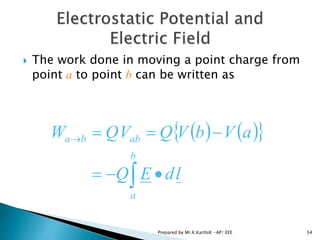
 The work done in moving a point charge from
point a to point b can be written as
    
 

b
a
abba
ldEQ
aVbVQVQW
54Prepared by Mr.K.KarthiK -AP/ EEE
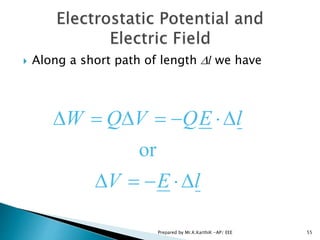
 Along a short path of length Dl we have
lEV
lEQVQW
DD
DDD
or
55Prepared by Mr.K.KarthiK -AP/ EEE
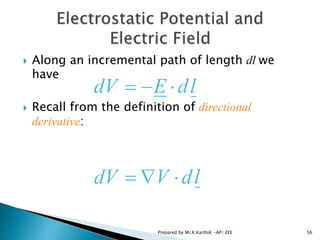
 Along an incremental path of length dl we
have
 Recall from the definition of directional
derivative:
ldEdV 
ldVdV 
56Prepared by Mr.K.KarthiK -AP/ EEE
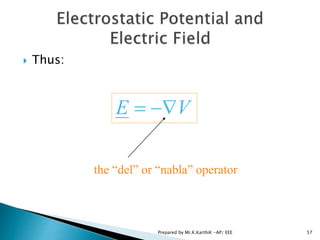
 Thus:
VE 
the “del” or “nabla” operator
57Prepared by Mr.K.KarthiK -AP/ EEE
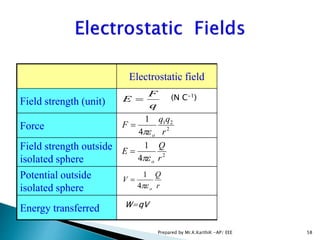
Electrostatic field
Field strength (unit)
Force
Field strength outside
isolated sphere
Potential outside
isolated sphere
Energy transferred
q
F
E  (N C-1)
2
21
4
1
r
qq
F
o

2
4
1
r
Q
E
o

r
Q
V
o4
1

W=qV
58Prepared by Mr.K.KarthiK -AP/ EEE
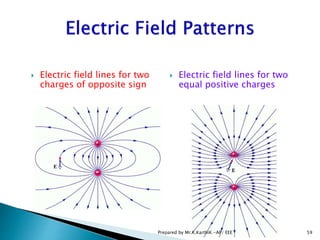
 Electric field lines for two
charges of opposite sign
 Electric field lines for two
equal positive charges
59Prepared by Mr.K.KarthiK -AP/ EEE
 Capacitance: the ratio between
charge and potential of a body
 Measured in coulombs/volt. This
unit is called the farad [F].
 Capacitance is only defined for two
conducting bodies, across which the
potential difference is connected.
C =
Q
V
C
V
60Prepared by Mr.K.KarthiK -AP/ EEE
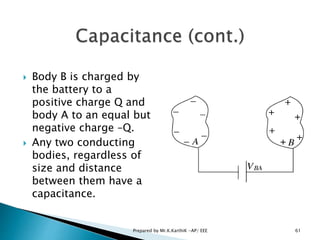
 Body B is charged by
the battery to a
positive charge Q and
body A to an equal but
negative charge –Q.
 Any two conducting
bodies, regardless of
size and distance
between them have a
capacitance.
61Prepared by Mr.K.KarthiK -AP/ EEE
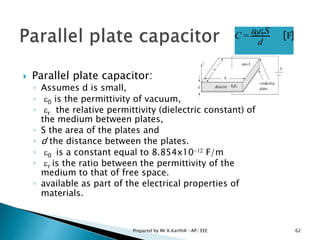
 Parallel plate capacitor:
◦ Assumes d is small,
◦ 0 is the permittivity of vacuum,
◦ r the relative permittivity (dielectric constant) of
the medium between plates,
◦ S the area of the plates and
◦ d the distance between the plates.
◦ 0 is a constant equal to 8.854x10 F/m
◦ r is the ratio between the permittivity of the
medium to that of free space.
◦ available as part of the electrical properties of
materials.
C = 0rS
d
F
62Prepared by Mr.K.KarthiK -AP/ EEE
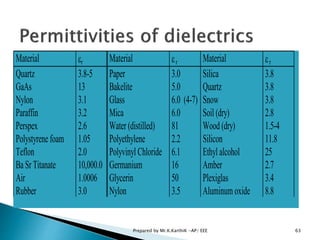
Material r Material r Material r
Quartz 3.8-5 Paper 3.0 Silica 3.8
GaAs 13 Bakelite 5.0 Quartz 3.8
Nylon 3.1 Glass 6.0 (4-7) Snow 3.8
Paraffin 3.2 Mica 6.0 Soil (dry) 2.8
Perspex 2.6 Water (distilled) 81 Wood (dry) 1.5-4
Polystyrene foam 1.05 Polyethylene 2.2 Silicon 11.8
Teflon 2.0 Polyvinyl Chloride 6.1 Ethyl alcohol 25
Ba Sr Titanate 10,000.0 Germanium 16 Amber 2.7
Air 1.0006 Glycerin 50 Plexiglas 3.4
Rubber 3.0 Nylon 3.5 Aluminum oxide 8.8
63Prepared by Mr.K.KarthiK -AP/ EEE
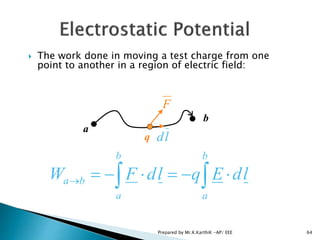
 The work done in moving a test charge from one
point to another in a region of electric field:
 
b
a
b
a
ba ldEqldFW
a
b
q
F
ld
64Prepared by Mr.K.KarthiK -AP/ EEE
65Prepared by Mr.K.KarthiK -AP/ EEE
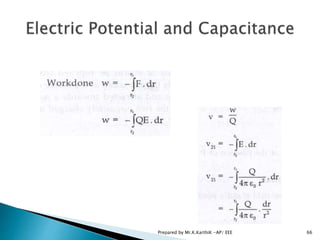
66Prepared by Mr.K.KarthiK -AP/ EEE
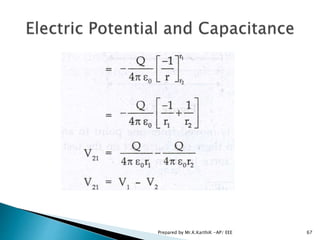
67Prepared by Mr.K.KarthiK -AP/ EEE
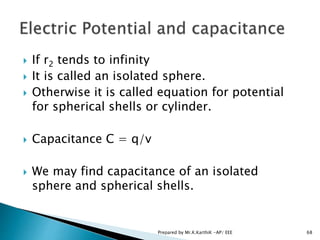
 If r2 tends to infinity
 It is called an isolated sphere.
 Otherwise it is called equation for potential
for spherical shells or cylinder.
 Capacitance C = q/v
 We may find capacitance of an isolated
sphere and spherical shells.
68Prepared by Mr.K.KarthiK -AP/ EEE
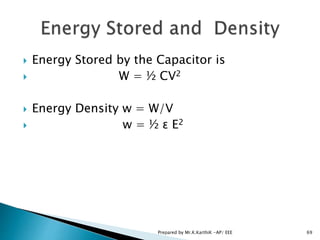
 Energy Stored by the Capacitor is
 W = ½ CV2
 Energy Density w = W/V
 w = ½ ɛ E2
69Prepared by Mr.K.KarthiK -AP/ EEE
 1. Et1 = Et2
 2. Dn1 = Dn2
 Based on the Boundary Conditions,
70Prepared by Mr.K.KarthiK -AP/ EEE
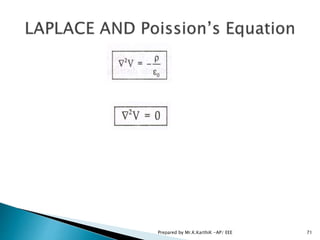
71Prepared by Mr.K.KarthiK -AP/ EEE
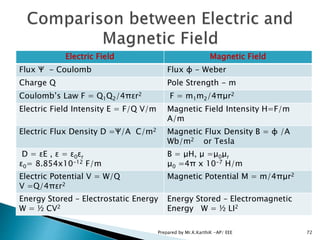
Electric Field Magnetic Field
Flux Ψ - Coulomb Flux φ - Weber
Charge Q Pole Strength - m
Coulomb’s Law F = Q1Q2/4πɛr2 F = m1m2/4πμr2
Electric Field Intensity E = F/Q V/m Magnetic Field Intensity H=F/m
A/m
Electric Flux Density D =Ψ/A C/m2 Magnetic Flux Density B = φ /A
Wb/m2 or Tesla
D = ɛE , ɛ = ɛ0ɛr
ɛ0= 8.854x10⁻¹² F/m
B = μH, μ =μ0μr
μ0 =4π x 10-7 H/m
Electric Potential V = W/Q
V =Q/4πɛr2
Magnetic Potential M = m/4πμr2
Energy Stored – Electrostatic Energy
W = ½ CV2
Energy Stored – Electromagnetic
Energy W = ½ LI2
72Prepared by Mr.K.KarthiK -AP/ EEE
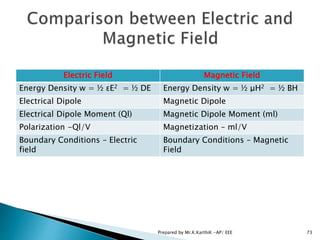
Electric Field Magnetic Field
Energy Density w = ½ ɛE2 = ½ DE Energy Density w = ½ μH2 = ½ BH
Electrical Dipole Magnetic Dipole
Electrical Dipole Moment (Ql) Magnetic Dipole Moment (ml)
Polarization -Ql/V Magnetization – ml/V
Boundary Conditions – Electric
field
Boundary Conditions – Magnetic
Field
73Prepared by Mr.K.KarthiK -AP/ EEE

ELECTROMAGNETIC FIELD

  • 1.
    KONGUNADU COLLEGE OFENGINEERING AND TECHNOLOGY DEPARTMENT OF ELECTRICAL AND ELECTRONICS ENGINEERING 1 Prepared by Mr.K.KarthiK -AP/ EEE
  • 2.
     1. Introductionabout EMF  2. Sources and Effects of EMF  3. Coordinate Systems and Types  4. Divergence & Curl  5. Divergence Theorem and Stokes Theorem 2Prepared by Mr.K.KarthiK -AP/ EEE
  • 3.
     Static ElectricField  Coulomb’s Law  Electric field Intensity  Electric Flux Density  Potential difference  P D in Sphere, isolated sphere and cable  Capacitance  C for parallel plate capacitor  C for Sphere, isolated sphere and cable  Energy Stored and Energy Density  Boundary Conditions 3Prepared by Mr.K.KarthiK -AP/ EEE
  • 4.
  • 5.
     When anevent in one place has an effect on something at a different location, we talk about the events as being connected by a “field”.  A field is a spatial distribution of a quantity; in general, it can be either scalar or vector in nature. 5Prepared by Mr.K.KarthiK -AP/ EEE
  • 6.
     What areElectromagnetic Fields? EMF always consists of both an electrical field and a magnetic field. The transmission of electrical energy through wires, the broadcasting of radio signals and the phenomenon of visible light are examples of electromagnetic fields (EMF). 6Prepared by Mr.K.KarthiK -AP/ EEE
  • 7.
     What arethe Common Sources of EMF?  Electricity is the most common source of power throughout the world  because it is easily generated and transmitted to where it is needed.  As electricity moves through wires and machines, it produces EMF.  Once electricity is delivered to the user, it continues to produce EMF throughout the wiring systems of offices, homes, schools, factories and other structures. 7Prepared by Mr.K.KarthiK -AP/ EEE
  • 8.
     In theworkplace the generators of EMF include computers, cell phones, fax machines, copy machines, fluorescent lights, printers, scanners, telephone switching systems, electrical instruments, motors and other electrical devices. 8Prepared by Mr.K.KarthiK -AP/ EEE
  • 9.
    In homes, theimmediate sources of EMF include Electric blankets, electric water bed heaters, hairdryers, electric shavers, television sets, stereo systems, air conditioners, fluorescent lights, telephone answering machines, cell and portable phones, refrigerators, blenders, portable heaters, clothes washers and dryers, coffee makers, vacuum cleaners, toasters, and microwave ovens. 9Prepared by Mr.K.KarthiK -AP/ EEE
  • 10.
     EMF isnot only produced by electricity moving through wires or machines, but it is the nature of all television and satellite transmissions, as well as radio and microwave communication systems, including cell phones. Transportation methods such as automobiles, trucks, airplanes, electrical and magnetic trains and subway systems are significant sources of EMF. 10Prepared by Mr.K.KarthiK -AP/ EEE
  • 11.
     Children areat a GREATER RISK when comparing with adults.  Radiation Penetration in head of adult.  Radiation Penetration in head of 10 year old child.  Radiation Penetration in head of 5 year old child 11Prepared by Mr.K.KarthiK -AP/ EEE
  • 12.
    Now, all livingthings are subject to million of times more radiation than 50 years ago. Most of the changes have happened in the last 30 years. 12Prepared by Mr.K.KarthiK -AP/ EEE
  • 13.
    We will neverbe able to experience this peaceful world again 13Prepared by Mr.K.KarthiK -AP/ EEE
  • 14.
     EMF &Cell Phone Radiation could be the cause of your headaches.  Your lack of energy is not through doing too much – it’s EMF.  EMF & Cell Phone Radiation causes depression.  The stress in your life is more likely to be EMF than lifestyle!  EMF & Cell Phone Radiation causes minor and major illnesses including cancer.  EMF & Cell Phone Radiation IS THE MAIN CAUSE OF INSOMNIA!  EMF & Cell Phone Radiation causes birth defects and abortions . 14Prepared by Mr.K.KarthiK -AP/ EEE
  • 15.
  • 16.
    ◦ Magnetic fieldsfrom current flow ◦ Electric fields from energized potential 16Prepared by Mr.K.KarthiK -AP/ EEE
  • 17.
  • 18.
    The closer tosource the higher the BV BV ranges from 1000 mV to 50,000 mV 18Prepared by Mr.K.KarthiK -AP/ EEE
  • 19.
     Genetic Effects Cancer  Cellular/Molecular Effects  Electrophysiology  Behavior  Nervous System  Blood-brain barrier  Calcium  Cardiovascular  Warm sensation  Hormones  Immunology  Metabolic rate/effects  Reproduction/growth  Subjective symptoms  Stress Source: Dr. Henry Lai, Research Professor, Department of Bioengineering, University of Washington. Presentation March 21, 2008 at Council on Wireless Technology Impacts EMF Panel, San Francisco, CA. 19Prepared by Mr.K.KarthiK -AP/ EEE
  • 20.
     In Electromagnetics,all quantities are the functions of space and time.  Types: ◦ 1. Rectangular Coordinate System – 3 distances ◦ 2. Circular Cylindrical Coordinate System – 2 distance with 1 angle. ◦ 3. Spherical Coordinate System – 1 distance with 2 angle. 20Prepared by Mr.K.KarthiK -AP/ EEE
  • 21.
     Rectangular orCartesian Coordinate System – (x,y,z)  Circular Cylindrical Coordinate System – (ρ,φ,z)  Spherical Coordinate System – (r,θ,φ) 21Prepared by Mr.K.KarthiK -AP/ EEE
  • 22.
     Cartesian intocylindrical coordinate systems  Cartesian into spherical coordinate systems Cartesian System Cylindrical System x y z ρ=√(x2+y2) Ф = tan-1(y/x) z=z Cartesian System Spherical System x y z r=√(x2+y2 +z2) Ф = tan-1(y/x) θ = cos-1(z/r) 22Prepared by Mr.K.KarthiK -AP/ EEE
  • 23.
     Cylindrical systeminto Cartesian system  Spherical system into Cartesian system Cylindrical System Cartesian System ρ Ф z x= ρ cos Ф y= ρ sin Ф z= z Spherical System Cartesian System r θ Ф x=r sin θ cos Ф y= r sin θ sin Ф z= r cos θ 23Prepared by Mr.K.KarthiK -AP/ EEE
  • 24.
     Divergence :div F =  Curl : Curl F = 0 1 lim . V s F nds V  0 1 lim V s nxFds V  24Prepared by Mr.K.KarthiK -AP/ EEE
  • 25.
     Divergence theorem: Stokes Theorem : 25Prepared by Mr.K.KarthiK -AP/ EEE
  • 26.
  • 27.
  • 28.
     Electrostatics isthe branch of electromagnetics dealing with the effects of electric charges at rest.  The fundamental law of electrostatics is Coulomb’s law. 28Prepared by Mr.K.KarthiK -AP/ EEE
  • 29.
     Electrical phenomenacaused by friction are part of our everyday lives, and can be understood in terms of electrical charge.  The effects of electrical charge can be observed in the attraction/repulsion of various objects when “charged.”  Charge comes in two varieties called “positive” and “negative.” 29Prepared by Mr.K.KarthiK -AP/ EEE
  • 30.
     Coulomb’s lawis the “law of action” between charged bodies.  Coulomb’s law gives the electric force between two point charges in an otherwise empty universe.  A point charge is a charge that occupies a region of space which is negligibly small compared to the distance between the point charge and any other object. 30Prepared by Mr.K.KarthiK -AP/ EEE
  • 31.
    2 120 21 12 4 ˆ 12 r QQ aF R   Q1 Q2 12r 12F Forcedue to Q1 acting on Q2 Unit vector in direction of R12 31Prepared by Mr.K.KarthiK -AP/ EEE
  • 32.
     The forceon Q1 due to Q2 is equal in magnitude but opposite in direction to the force on Q2 due to Q1. 1221 FF  32Prepared by Mr.K.KarthiK -AP/ EEE
  • 33.
     Consider apoint charge Q placed at the origin of a coordinate system in an otherwise empty universe.  A test charge Qt brought near Q experiences a force: 2 04 ˆ r QQ aF t rQt   Q Qt r 33Prepared by Mr.K.KarthiK -AP/ EEE
  • 34.
     The existenceof the force on Qt can be attributed to an electric field produced by Q.  The electric field produced by Q at a point in space can be defined as the force per unit charge acting on a test charge Qt placed at that point. t Q Q Q F E t t 0 lim   34Prepared by Mr.K.KarthiK -AP/ EEE
  • 35.
    ELECTRIC FIELD An Electricfield exists in the presence of a charged body ELECTRIC FIELD INTENSITY (E) A vector quantity: magnitude and direction (Volts/meter) MAGNITUDE OF E: Proportional to the force acting on a unit positive charge at a point in the field DIRECTION OF E: The direction that the force acts 35Prepared by Mr.K.KarthiK -AP/ EEE
  • 36.
    The Electric Field(E) is represented by drawing the Electric Displacement Vector (D), which takes into account the characteristics of the medium within which the Electric Field exists.   EmcoulD 2 , the Electric Conductive Capacity or Permittivity, is related to the ability of a medium, such as air to store electrical potential energy. 11212 0 10850.8   mjoulecoulVacuum: 11212 1 10876.8   mjoulecoulAir: Ratio: 003.1 0 1    36Prepared by Mr.K.KarthiK -AP/ EEE
  • 37.
    The Electric DisplacementVector, D, is used to draw lines of force. 2 mcoulUnits of D: 37Prepared by Mr.K.KarthiK -AP/ EEE
  • 38.
     For apoint charge at the origin, the electric field at any point is given by   3 0 2 0 44 ˆ r rQ r Q arE r   38Prepared by Mr.K.KarthiK -AP/ EEE
  • 39.
     For apoint charge located at a point P’ described by a position vector the electric field at P is given by   rrR rrR R RQ rE    where 4 3 0 r Q P r R r O 39Prepared by Mr.K.KarthiK -AP/ EEE
  • 40.
     Charge canoccur as ◦ point charges (C) ◦ volume charges (C/m3) ◦ surface charges (C/m2) ◦ line charges (C/m)  most general 40Prepared by Mr.K.KarthiK -AP/ EEE
  • 41.
     Volume chargedensity Qencl r DV’ 41Prepared by Mr.K.KarthiK -AP/ EEE
  • 42.
     Electric fielddue to volume charge density Qenclr dV’ V’ Pr 42Prepared by Mr.K.KarthiK -AP/ EEE
  • 43.
     Surface chargedensity Qencl r DS’ 43Prepared by Mr.K.KarthiK -AP/ EEE
  • 44.
     Line chargedensity Qenclr DL’ 44Prepared by Mr.K.KarthiK -AP/ EEE
  • 45.
     Electric fielddue to line charge density Qenclr DL’ r P 45Prepared by Mr.K.KarthiK -AP/ EEE
  • 46.
     An electricfield is a force field.  If a body being acted on by a force is moved from one point to another, then work is done.  The concept of scalar electric potential provides a measure of the work done in moving charged bodies in an electrostatic field. 46Prepared by Mr.K.KarthiK -AP/ EEE
  • 47.
     The workdone in moving a test charge from one point to another in a region of electric field:   b a b a ba ldEqldFW a b q F ld 47Prepared by Mr.K.KarthiK -AP/ EEE
  • 48.
     In evaluatingline integrals, it is customary to take the dl in the direction of increasing coordinate value so that the manner in which the path of integration is traversed is unambiguously determined by the limits of integration.   3 5 ˆ dxaEqW xba x 3 5 b a 48Prepared by Mr.K.KarthiK -AP/ EEE
  • 49.
     The electrostaticfield is conservative: ◦ The value of the line integral depends only on the end points and is independent of the path taken. ◦ The value of the line integral around any closed path is zero. 0C ldE C 49Prepared by Mr.K.KarthiK -AP/ EEE
  • 50.
     The workdone per unit charge in moving a test charge from point a to point b is the electrostatic potential difference between the two points:    b a ba ab ldE q W V electrostatic potential difference Units are volts. 50Prepared by Mr.K.KarthiK -AP/ EEE
  • 51.
     Since theelectrostatic field is conservative we can write    aVbV ldEldE ldEldEldEV a P b P b P P a b a ab              00 0 0 51Prepared by Mr.K.KarthiK -AP/ EEE
  • 52.
     Thus theelectrostatic potential V is a scalar field that is defined at every point in space.  In particular the value of the electrostatic potential at any point P is given by     P P ldErV 0 reference point 52Prepared by Mr.K.KarthiK -AP/ EEE
  • 53.
     The referencepoint (P0) is where the potential is zero (analogous to ground in a circuit).  Often the reference is taken to be at infinity so that the potential of a point in space is defined as     P ldErV 53Prepared by Mr.K.KarthiK -AP/ EEE
  • 54.
     The workdone in moving a point charge from point a to point b can be written as         b a abba ldEQ aVbVQVQW 54Prepared by Mr.K.KarthiK -AP/ EEE
  • 55.
     Along ashort path of length Dl we have lEV lEQVQW DD DDD or 55Prepared by Mr.K.KarthiK -AP/ EEE
  • 56.
     Along anincremental path of length dl we have  Recall from the definition of directional derivative: ldEdV  ldVdV  56Prepared by Mr.K.KarthiK -AP/ EEE
  • 57.
     Thus: VE  the“del” or “nabla” operator 57Prepared by Mr.K.KarthiK -AP/ EEE
  • 58.
    Electrostatic field Field strength(unit) Force Field strength outside isolated sphere Potential outside isolated sphere Energy transferred q F E  (N C-1) 2 21 4 1 r qq F o  2 4 1 r Q E o  r Q V o4 1  W=qV 58Prepared by Mr.K.KarthiK -AP/ EEE
  • 59.
     Electric fieldlines for two charges of opposite sign  Electric field lines for two equal positive charges 59Prepared by Mr.K.KarthiK -AP/ EEE
  • 60.
     Capacitance: theratio between charge and potential of a body  Measured in coulombs/volt. This unit is called the farad [F].  Capacitance is only defined for two conducting bodies, across which the potential difference is connected. C = Q V C V 60Prepared by Mr.K.KarthiK -AP/ EEE
  • 61.
     Body Bis charged by the battery to a positive charge Q and body A to an equal but negative charge –Q.  Any two conducting bodies, regardless of size and distance between them have a capacitance. 61Prepared by Mr.K.KarthiK -AP/ EEE
  • 62.
     Parallel platecapacitor: ◦ Assumes d is small, ◦ 0 is the permittivity of vacuum, ◦ r the relative permittivity (dielectric constant) of the medium between plates, ◦ S the area of the plates and ◦ d the distance between the plates. ◦ 0 is a constant equal to 8.854x10 F/m ◦ r is the ratio between the permittivity of the medium to that of free space. ◦ available as part of the electrical properties of materials. C = 0rS d F 62Prepared by Mr.K.KarthiK -AP/ EEE
  • 63.
    Material r Materialr Material r Quartz 3.8-5 Paper 3.0 Silica 3.8 GaAs 13 Bakelite 5.0 Quartz 3.8 Nylon 3.1 Glass 6.0 (4-7) Snow 3.8 Paraffin 3.2 Mica 6.0 Soil (dry) 2.8 Perspex 2.6 Water (distilled) 81 Wood (dry) 1.5-4 Polystyrene foam 1.05 Polyethylene 2.2 Silicon 11.8 Teflon 2.0 Polyvinyl Chloride 6.1 Ethyl alcohol 25 Ba Sr Titanate 10,000.0 Germanium 16 Amber 2.7 Air 1.0006 Glycerin 50 Plexiglas 3.4 Rubber 3.0 Nylon 3.5 Aluminum oxide 8.8 63Prepared by Mr.K.KarthiK -AP/ EEE
  • 64.
     The workdone in moving a test charge from one point to another in a region of electric field:   b a b a ba ldEqldFW a b q F ld 64Prepared by Mr.K.KarthiK -AP/ EEE
  • 65.
  • 66.
  • 67.
  • 68.
     If r2tends to infinity  It is called an isolated sphere.  Otherwise it is called equation for potential for spherical shells or cylinder.  Capacitance C = q/v  We may find capacitance of an isolated sphere and spherical shells. 68Prepared by Mr.K.KarthiK -AP/ EEE
  • 69.
     Energy Storedby the Capacitor is  W = ½ CV2  Energy Density w = W/V  w = ½ ɛ E2 69Prepared by Mr.K.KarthiK -AP/ EEE
  • 70.
     1. Et1= Et2  2. Dn1 = Dn2  Based on the Boundary Conditions, 70Prepared by Mr.K.KarthiK -AP/ EEE
  • 71.
  • 72.
    Electric Field MagneticField Flux Ψ - Coulomb Flux φ - Weber Charge Q Pole Strength - m Coulomb’s Law F = Q1Q2/4πɛr2 F = m1m2/4πμr2 Electric Field Intensity E = F/Q V/m Magnetic Field Intensity H=F/m A/m Electric Flux Density D =Ψ/A C/m2 Magnetic Flux Density B = φ /A Wb/m2 or Tesla D = ɛE , ɛ = ɛ0ɛr ɛ0= 8.854x10⁻¹² F/m B = μH, μ =μ0μr μ0 =4π x 10-7 H/m Electric Potential V = W/Q V =Q/4πɛr2 Magnetic Potential M = m/4πμr2 Energy Stored – Electrostatic Energy W = ½ CV2 Energy Stored – Electromagnetic Energy W = ½ LI2 72Prepared by Mr.K.KarthiK -AP/ EEE
  • 73.
    Electric Field MagneticField Energy Density w = ½ ɛE2 = ½ DE Energy Density w = ½ μH2 = ½ BH Electrical Dipole Magnetic Dipole Electrical Dipole Moment (Ql) Magnetic Dipole Moment (ml) Polarization -Ql/V Magnetization – ml/V Boundary Conditions – Electric field Boundary Conditions – Magnetic Field 73Prepared by Mr.K.KarthiK -AP/ EEE