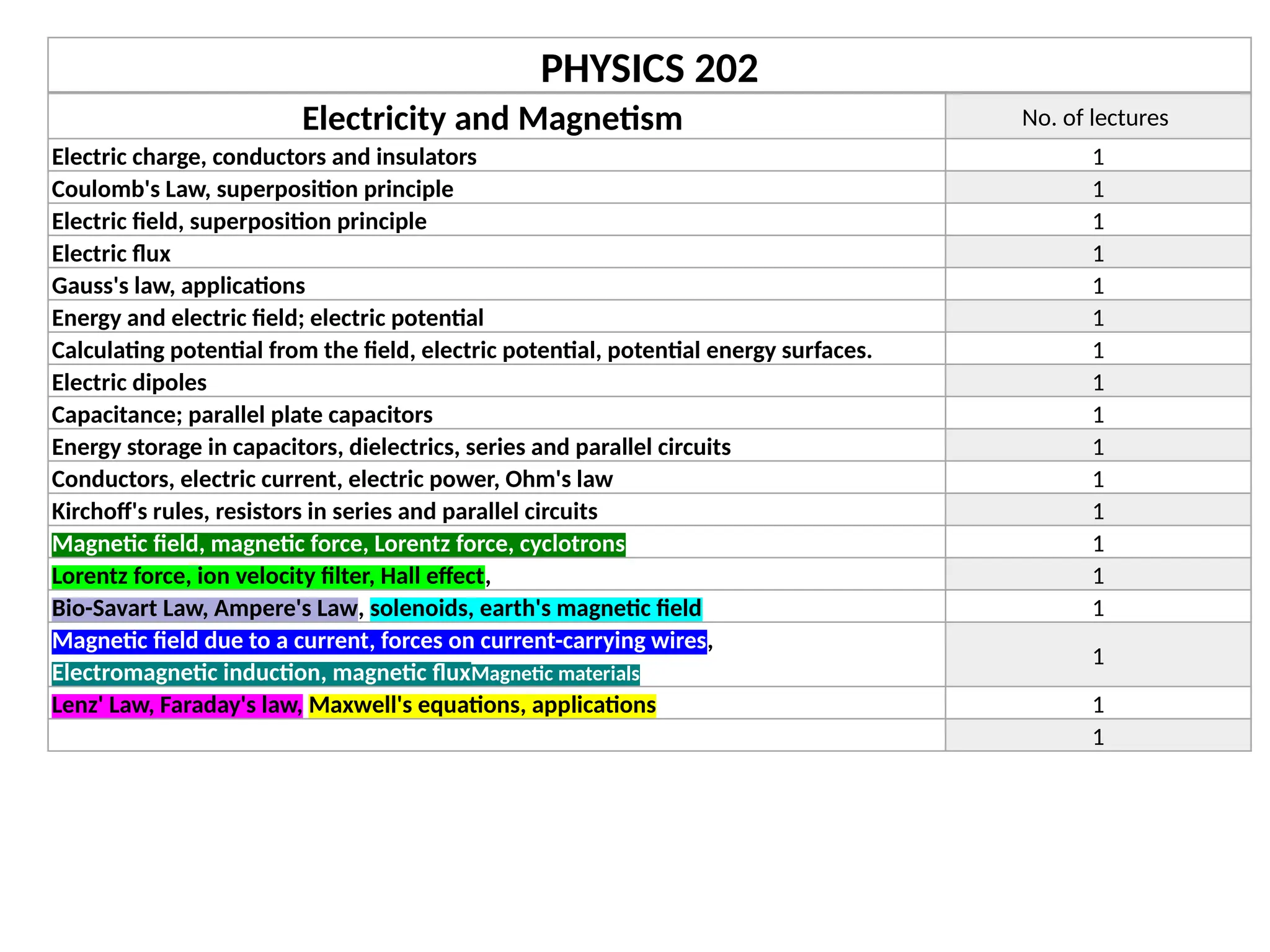
PHYSICS 202
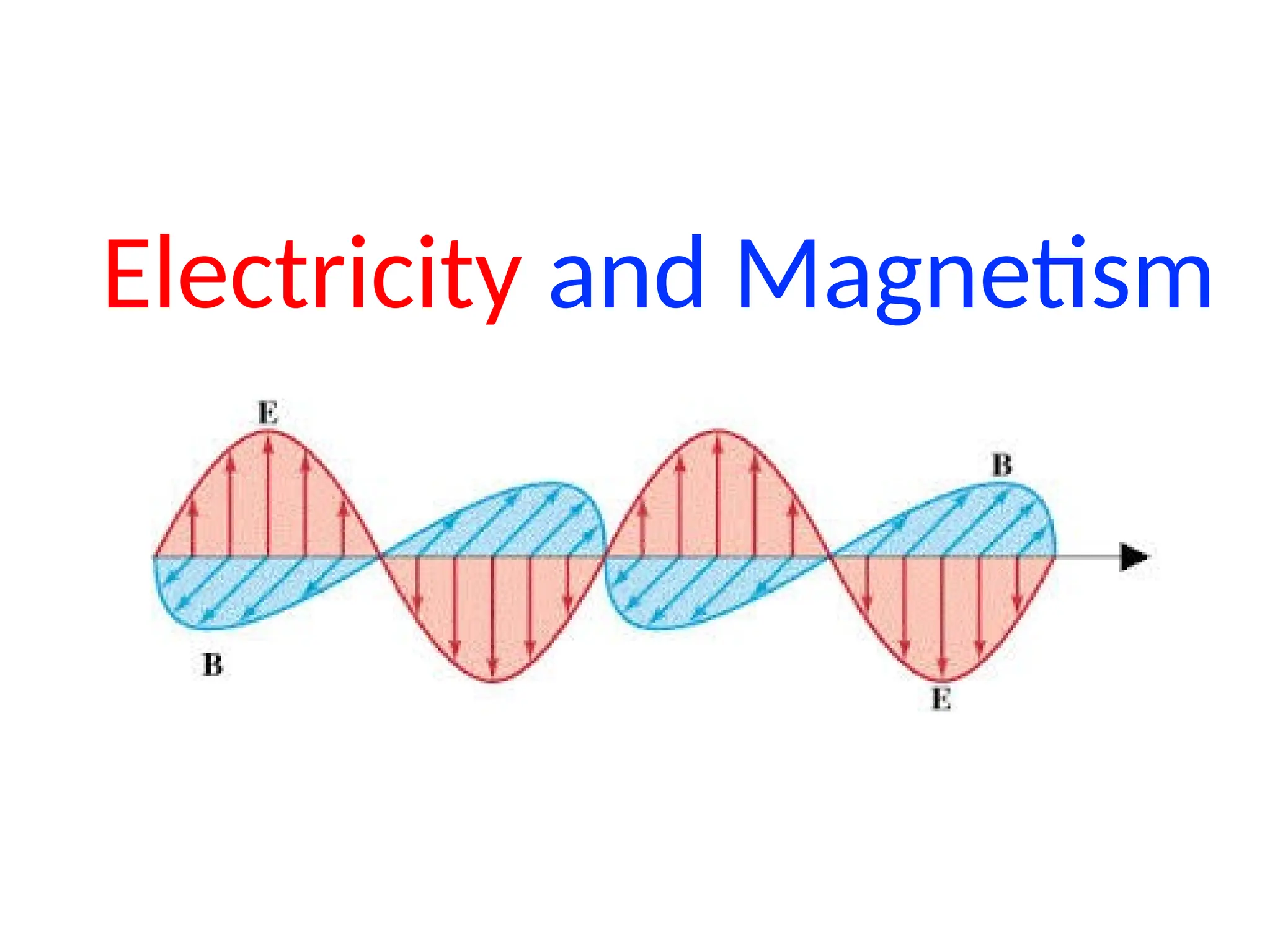
Electricity andMagnetism No. of lectures
Electric charge, conductors and insulators 1
Coulomb's Law, superposition principle 1
Electric field, superposition principle 1
Electric flux 1
Gauss's law, applications 1
Energy and electric field; electric potential 1
Calculating potential from the field, electric potential, potential energy surfaces. 1
Electric dipoles 1
Capacitance; parallel plate capacitors 1
Energy storage in capacitors, dielectrics, series and parallel circuits 1
Conductors, electric current, electric power, Ohm's law 1
Kirchoff's rules, resistors in series and parallel circuits 1
Magnetic field, magnetic force, Lorentz force, cyclotrons 1
Lorentz force, ion velocity filter, Hall effect, 1
Bio-Savart Law, Ampere's Law, solenoids, earth's magnetic field 1
Magnetic field due to a current, forces on current-carrying wires,
Electromagnetic induction, magnetic fluxMagnetic materials
1
Lenz' Law, Faraday's law, Maxwell's equations, applications 1
1
3.
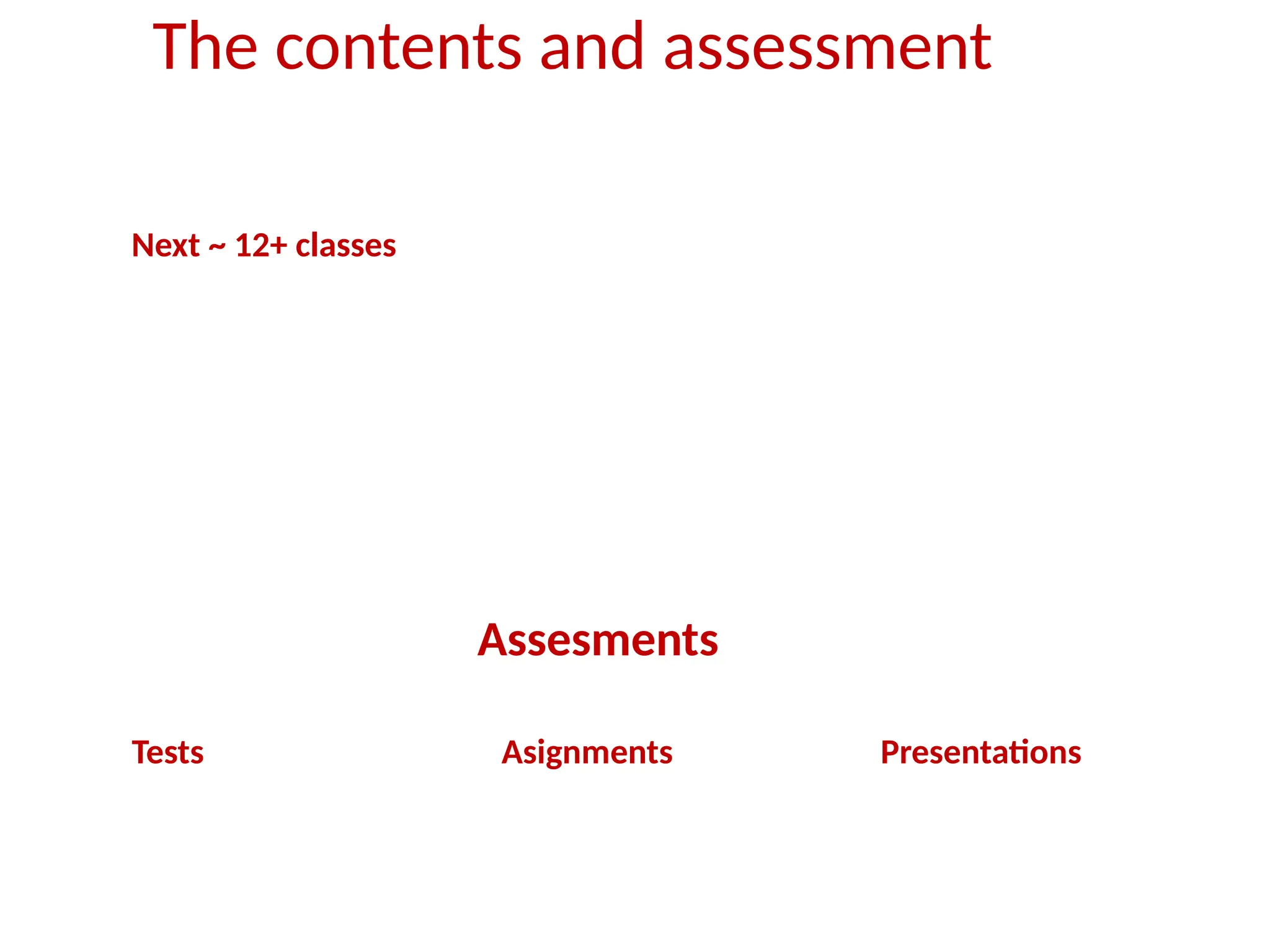
Next ~ 12+classes
Tests Asignments Presentations
Assesments
The contents and assessment
Electromagnetism
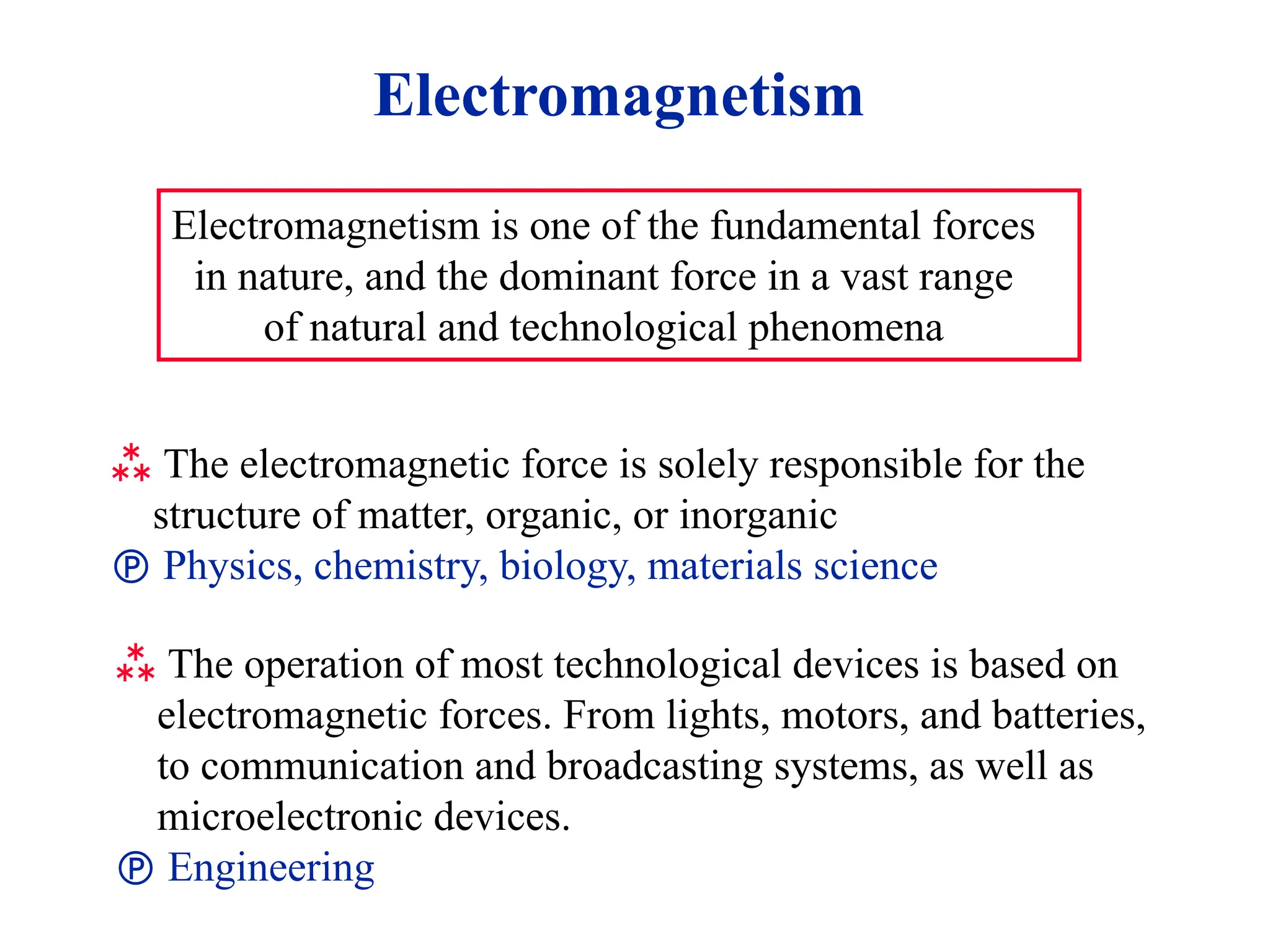
Electromagnetism is oneof the fundamental forces
in nature, and the dominant force in a vast range
of natural and technological phenomena
The electromagnetic force is solely responsible for the
structure of matter, organic, or inorganic
Physics, chemistry, biology, materials science
The operation of most technological devices is based on
electromagnetic forces. From lights, motors, and batteries,
to communication and broadcasting systems, as well as
microelectronic devices.
Engineering
6.
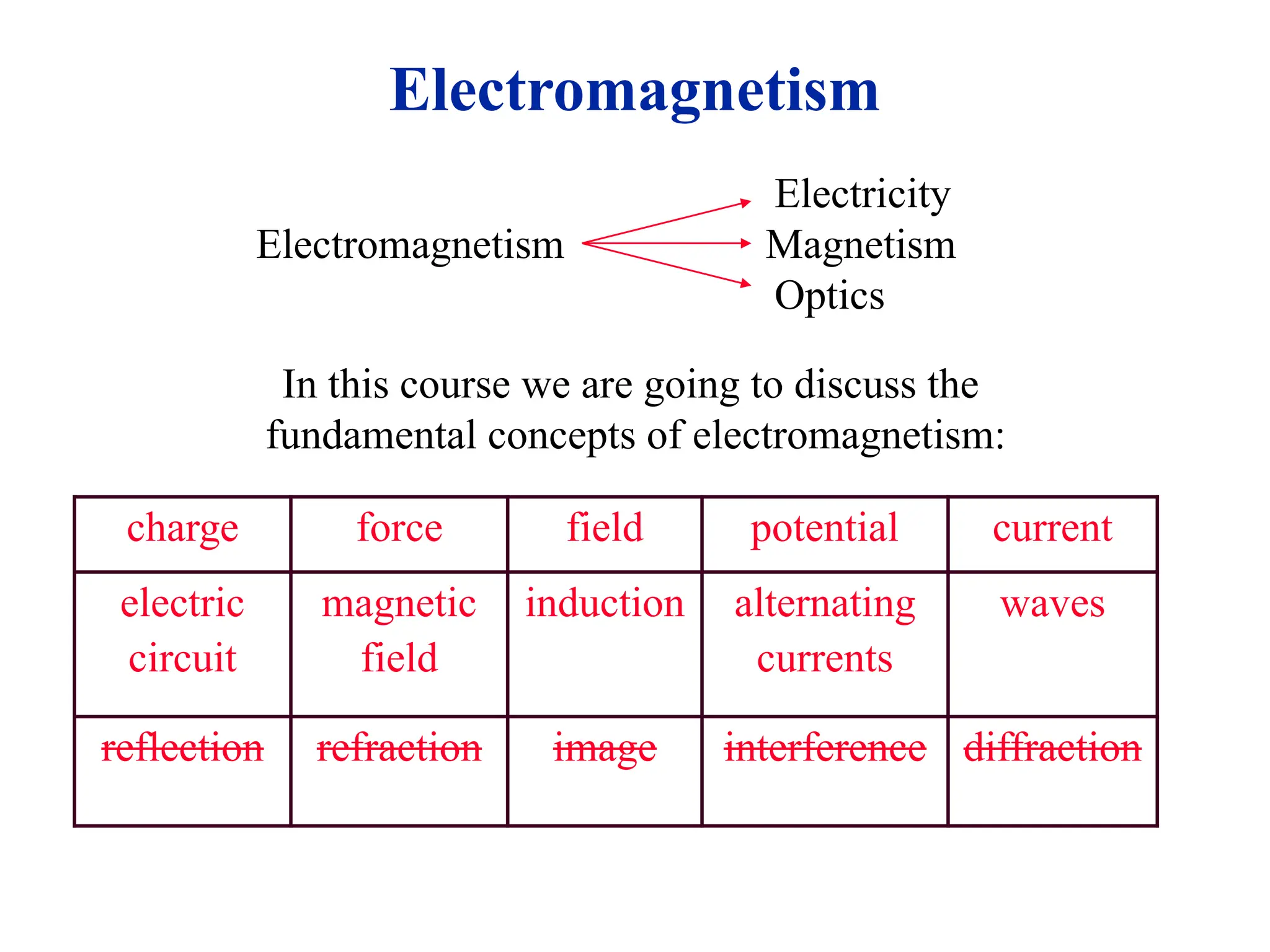
Electromagnetism
Electricity
Electromagnetism Magnetism
Optics
In thiscourse we are going to discuss the
fundamental concepts of electromagnetism:
charge force field potential current
electric
circuit
magnetic
field
induction alternating
currents
waves
reflection refraction image interference diffraction
7.
System of Units
Wewill use the SI system – SI International System of Units
Fundamental Quantities
Length - meter [m]
Mass - kilogram [kg]
Time - second [s]
Other Units
Current - ampere [A]
Derived Quantities
Force-newton 1 N = 1 kg m / s2
Energy - joule 1 J = 1 N m
Charge - coulomb 1 C = 1 A s
Electric Potential - volt 1 V = 1 J / C
Resistance - ohm 1 = 1 V / A
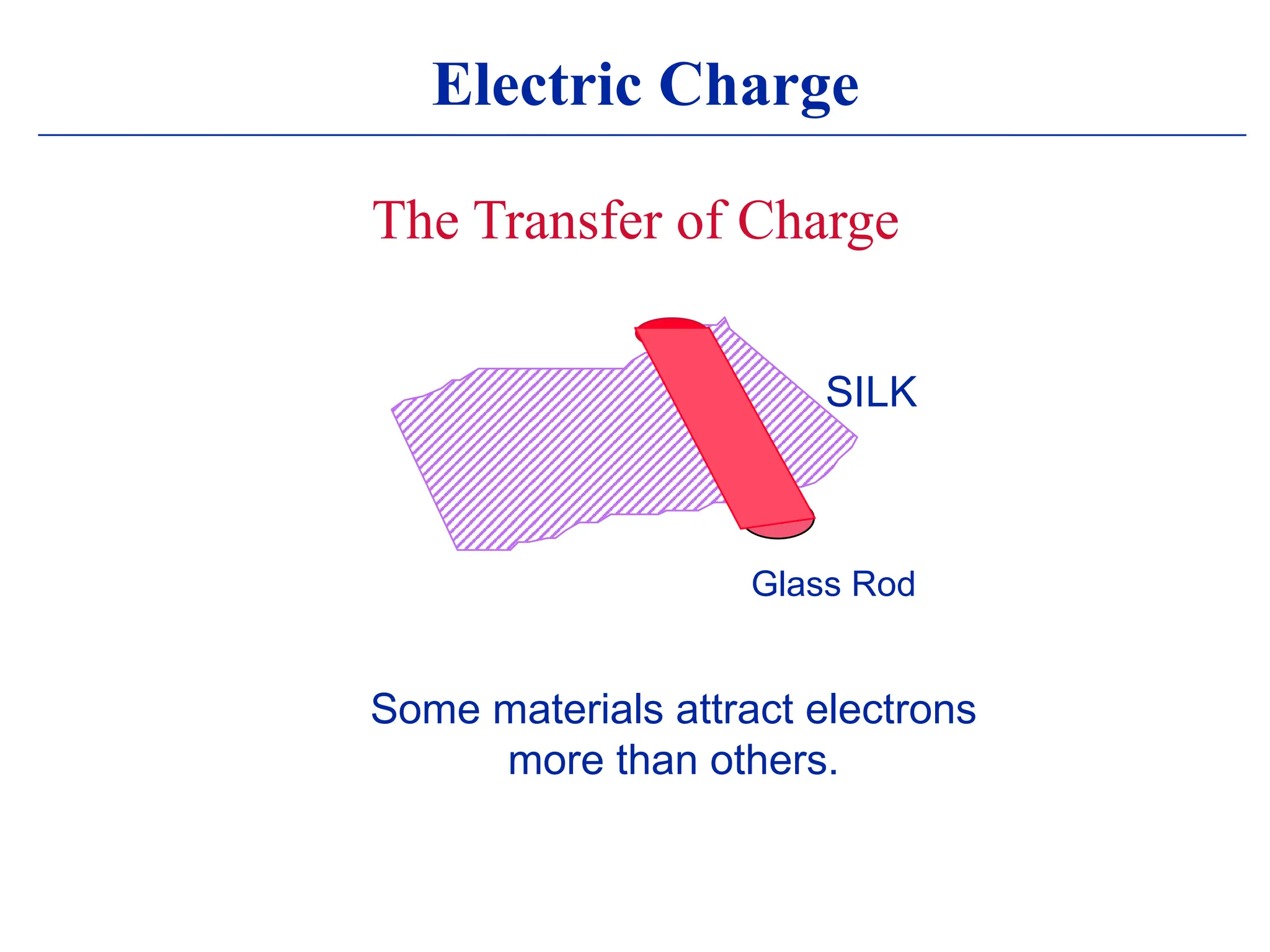
Electric Charge
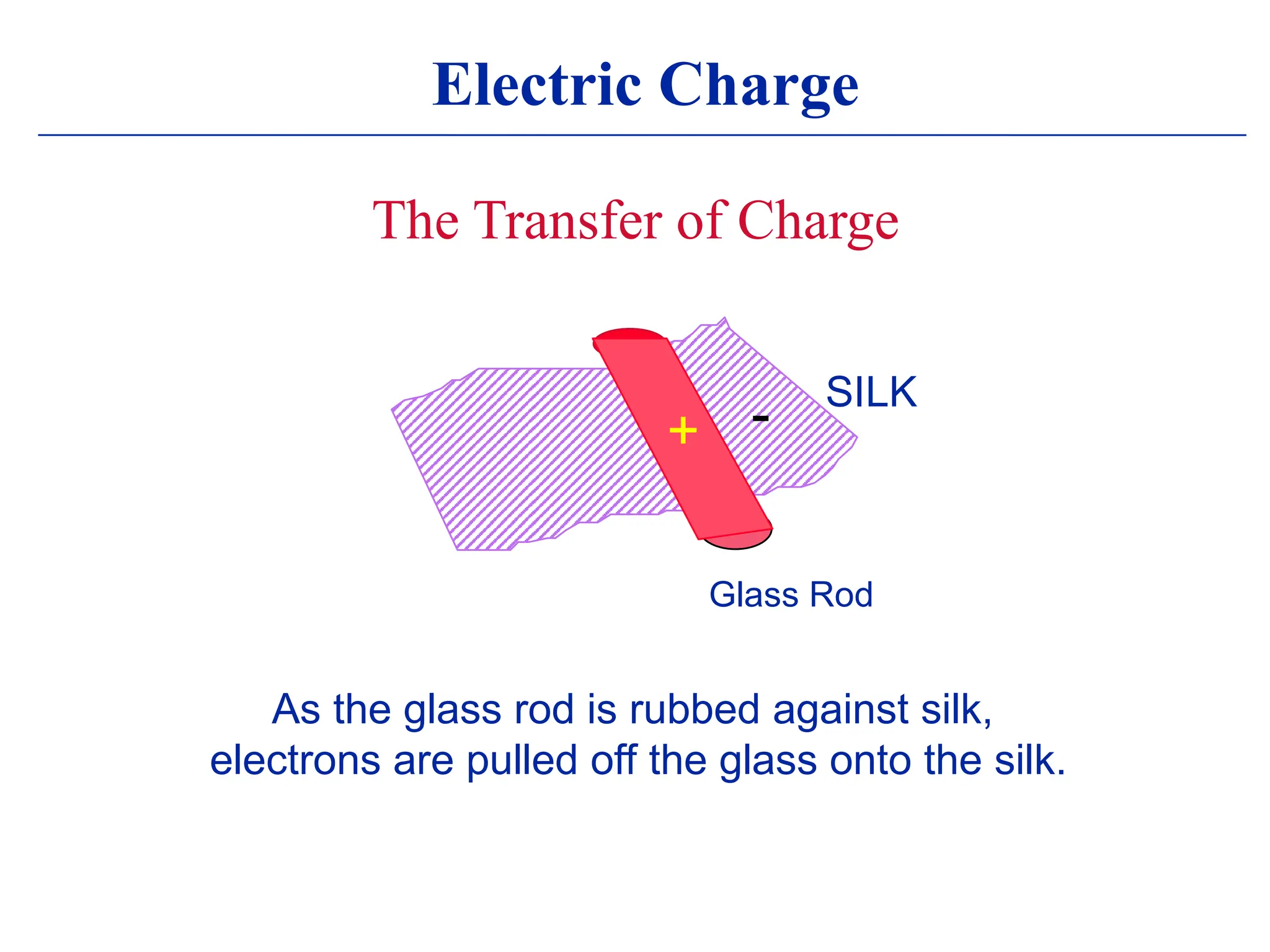
The Transferof Charge
SILK
Glass Rod
-
+
As the glass rod is rubbed against silk,
electrons are pulled off the glass onto the silk.
10.
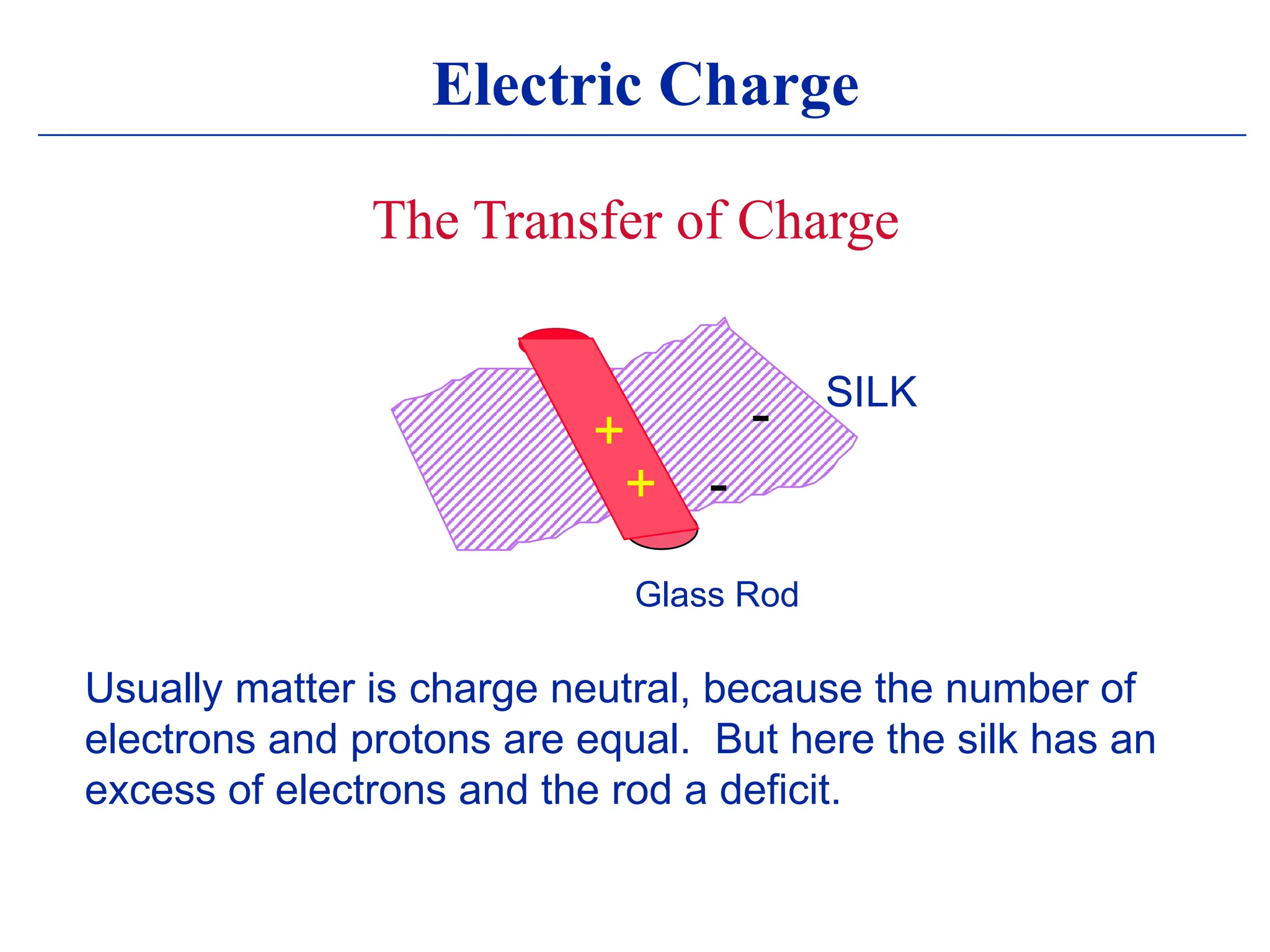
Electric Charge
The Transferof Charge
SILK
Glass Rod
-
-
+
+
Usually matter is charge neutral, because the number of
electrons and protons are equal. But here the silk has an
excess of electrons and the rod a deficit.
11.
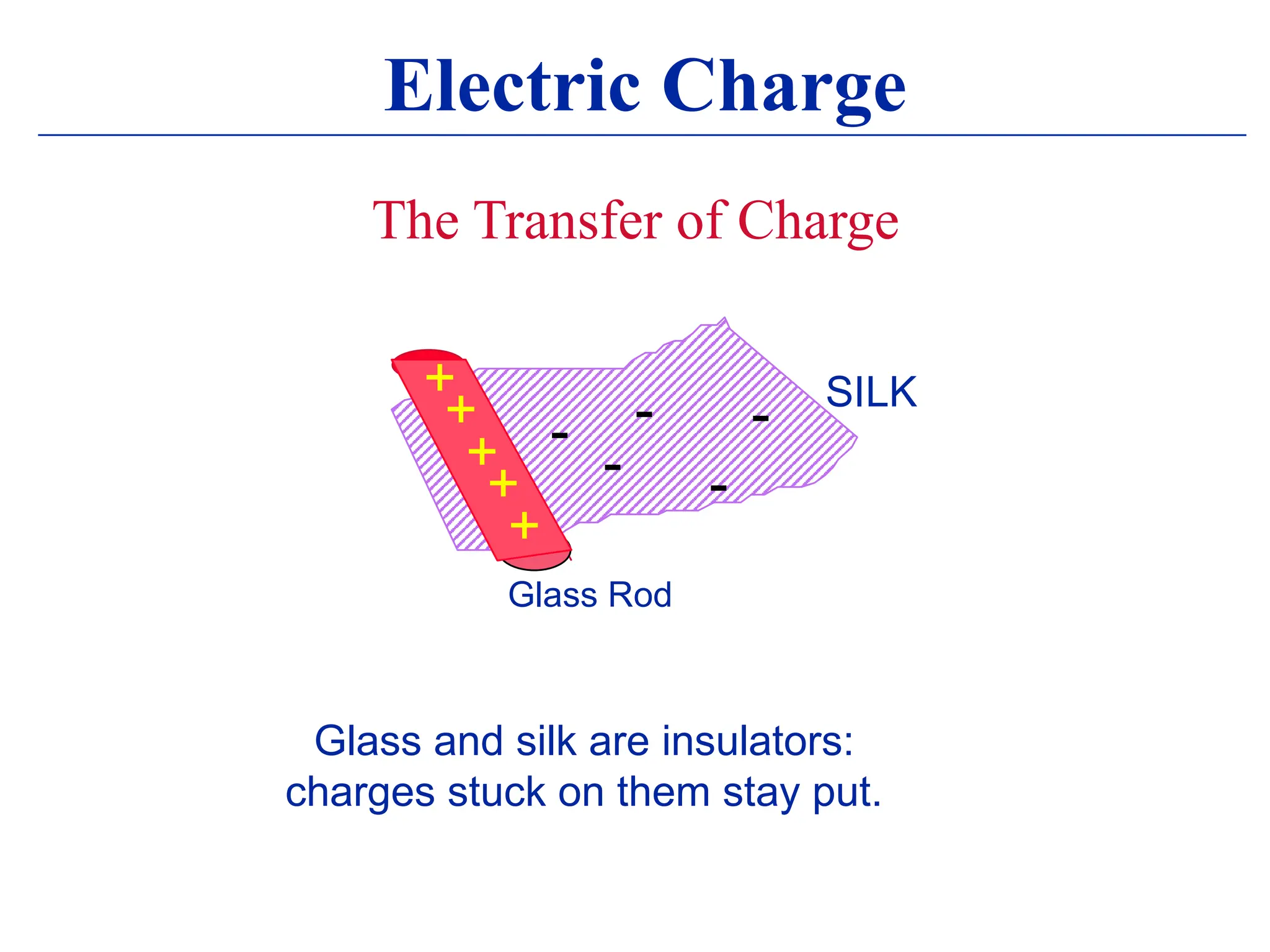
Electric Charge
The Transferof Charge
SILK
Glass Rod
-
+
+
+
+
+
Glass and silk are insulators:
charges stuck on them stay put.
-
-
-
-
Electric Charge
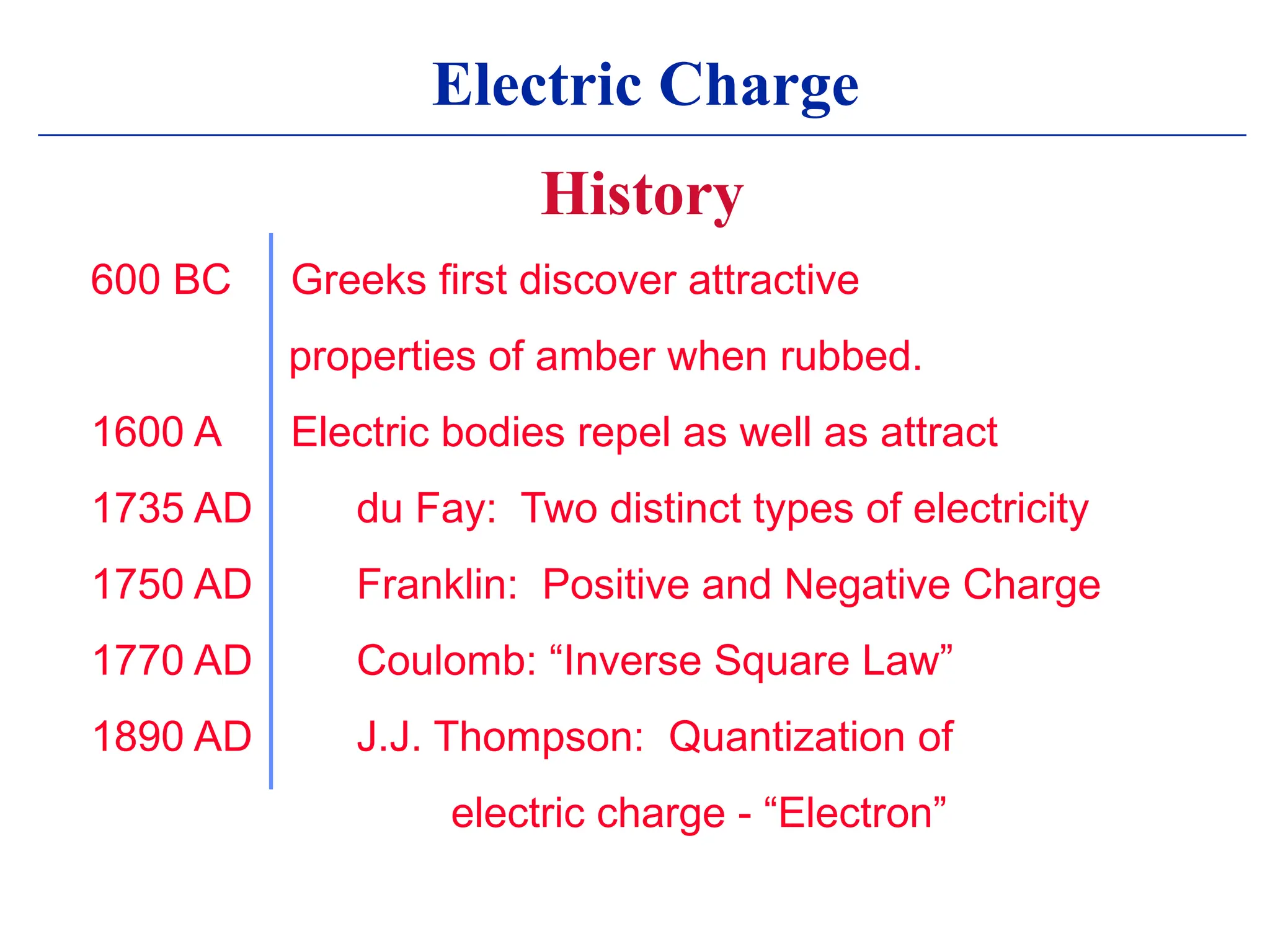
History
600 BCGreeks first discover attractive
properties of amber when rubbed.
1600 A Electric bodies repel as well as attract
1735 AD du Fay: Two distinct types of electricity
1750 AD Franklin: Positive and Negative Charge
1770 AD Coulomb: “Inverse Square Law”
1890 AD J.J. Thompson: Quantization of
electric charge - “Electron”
14.
Electric Charge
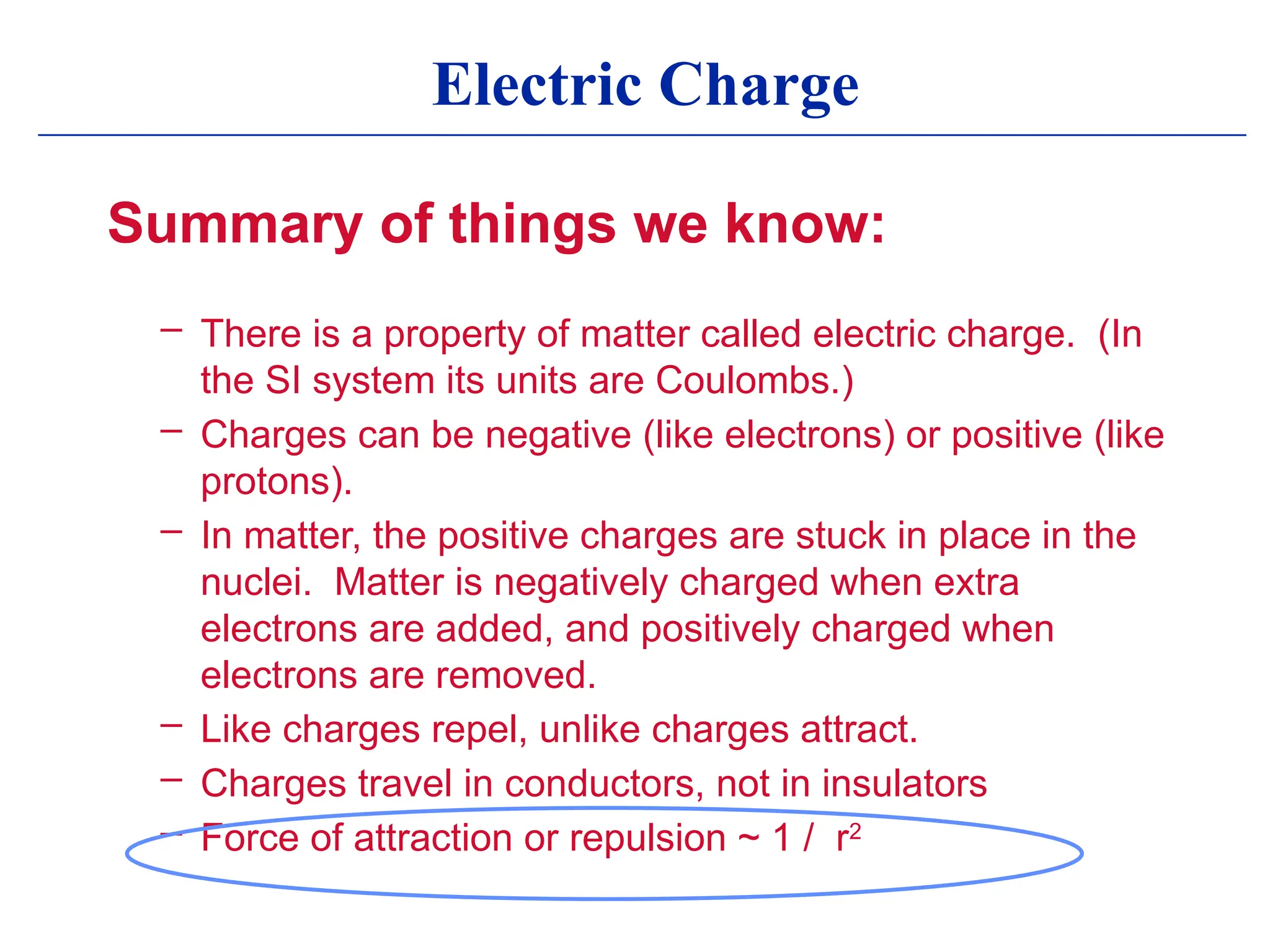
Summary ofthings we know:
– There is a property of matter called electric charge. (In
the SI system its units are Coulombs.)
– Charges can be negative (like electrons) or positive (like
protons).
– In matter, the positive charges are stuck in place in the
nuclei. Matter is negatively charged when extra
electrons are added, and positively charged when
electrons are removed.
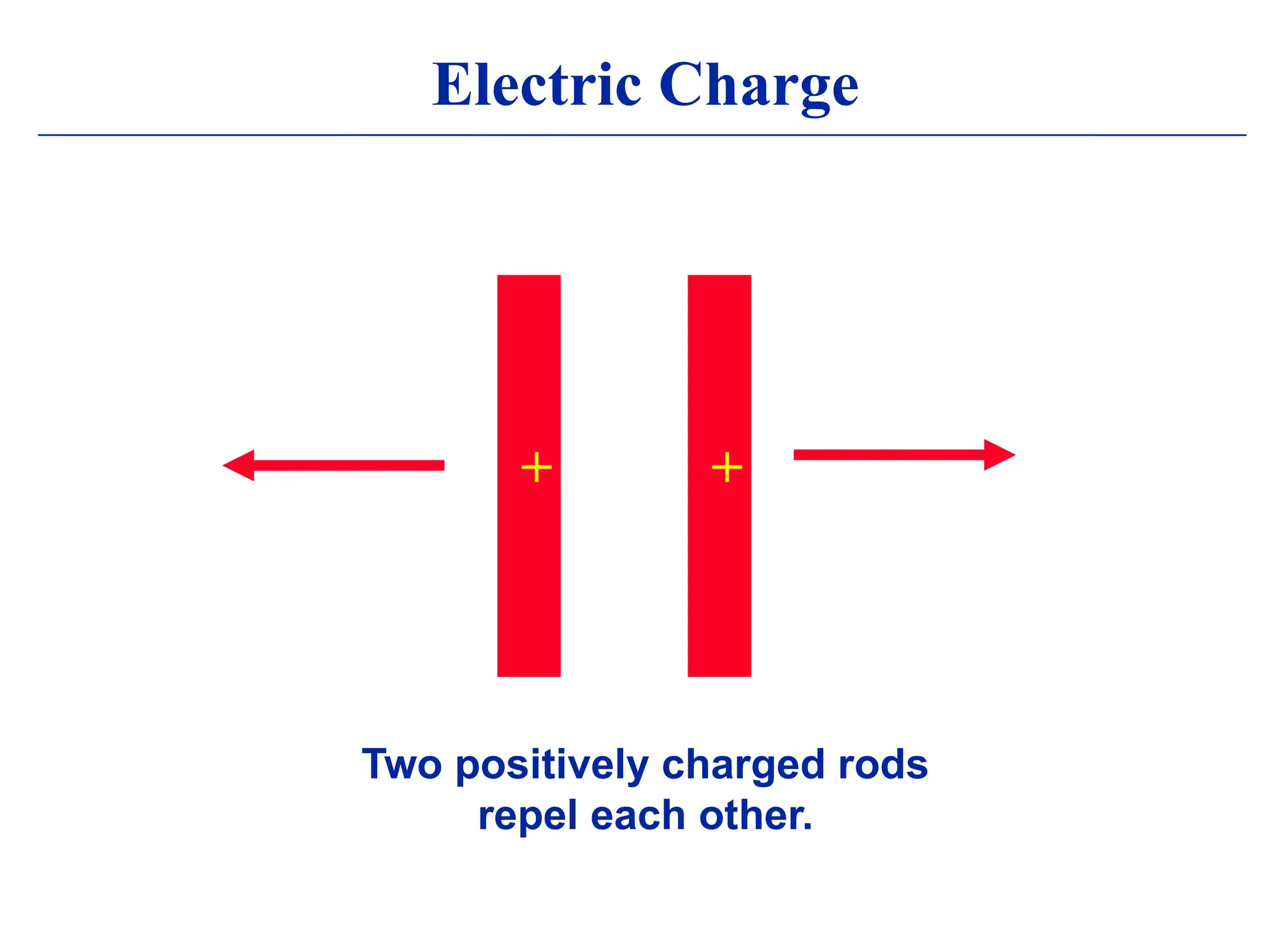
– Like charges repel, unlike charges attract.
– Charges travel in conductors, not in insulators
– Force of attraction or repulsion ~ 1 / r2
15.
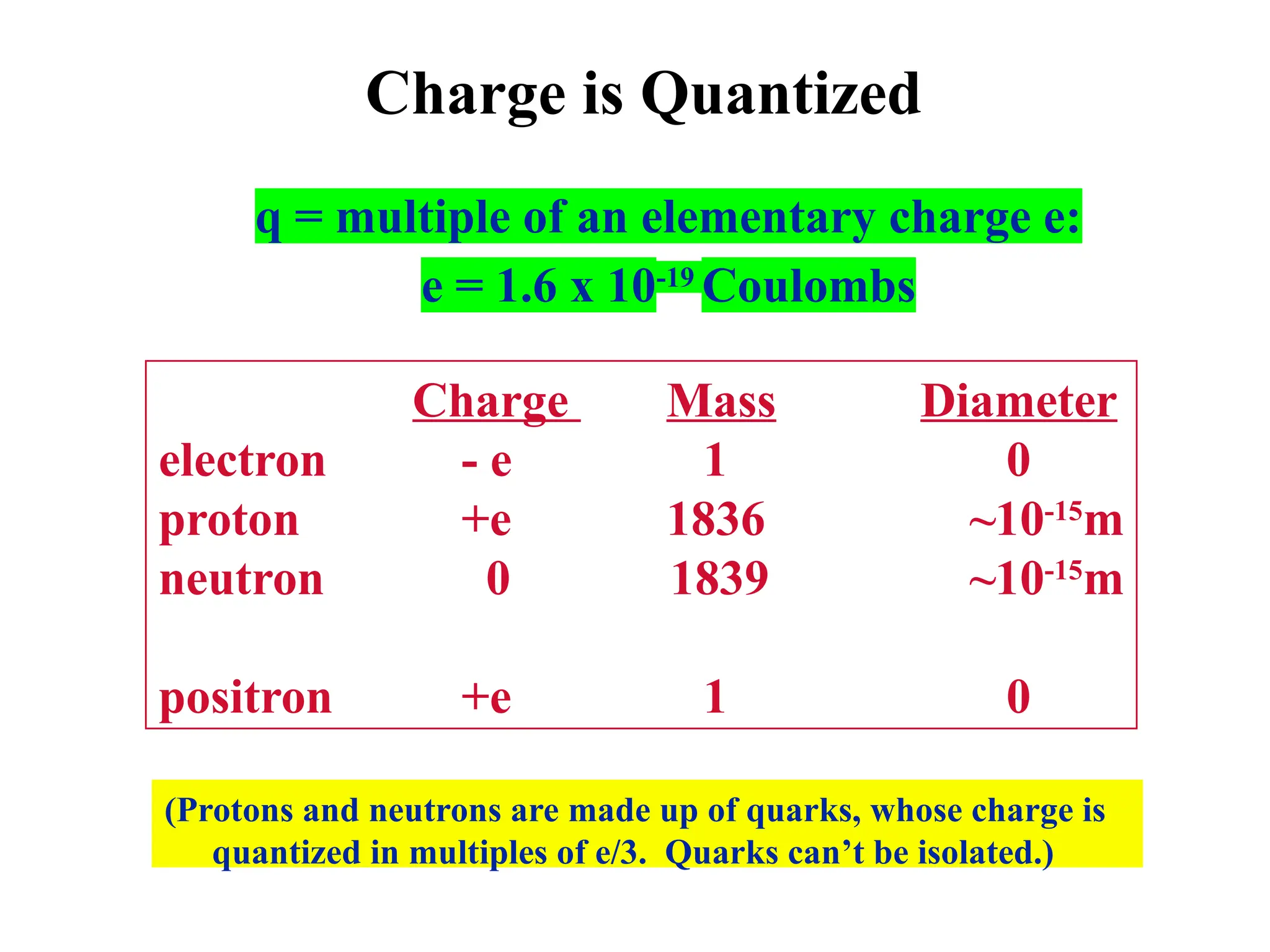
Charge is Quantized
q= multiple of an elementary charge e:
e = 1.6 x 10⁻¹⁹
Coulombs
Charge Mass Diameter
electron - e 1 0
proton +e 1836 ~10-15
m
neutron 0 1839 ~10-15
m
positron +e 1 0
(Protons and neutrons are made up of quarks, whose charge is
quantized in multiples of e/3. Quarks can’t be isolated.)
16.
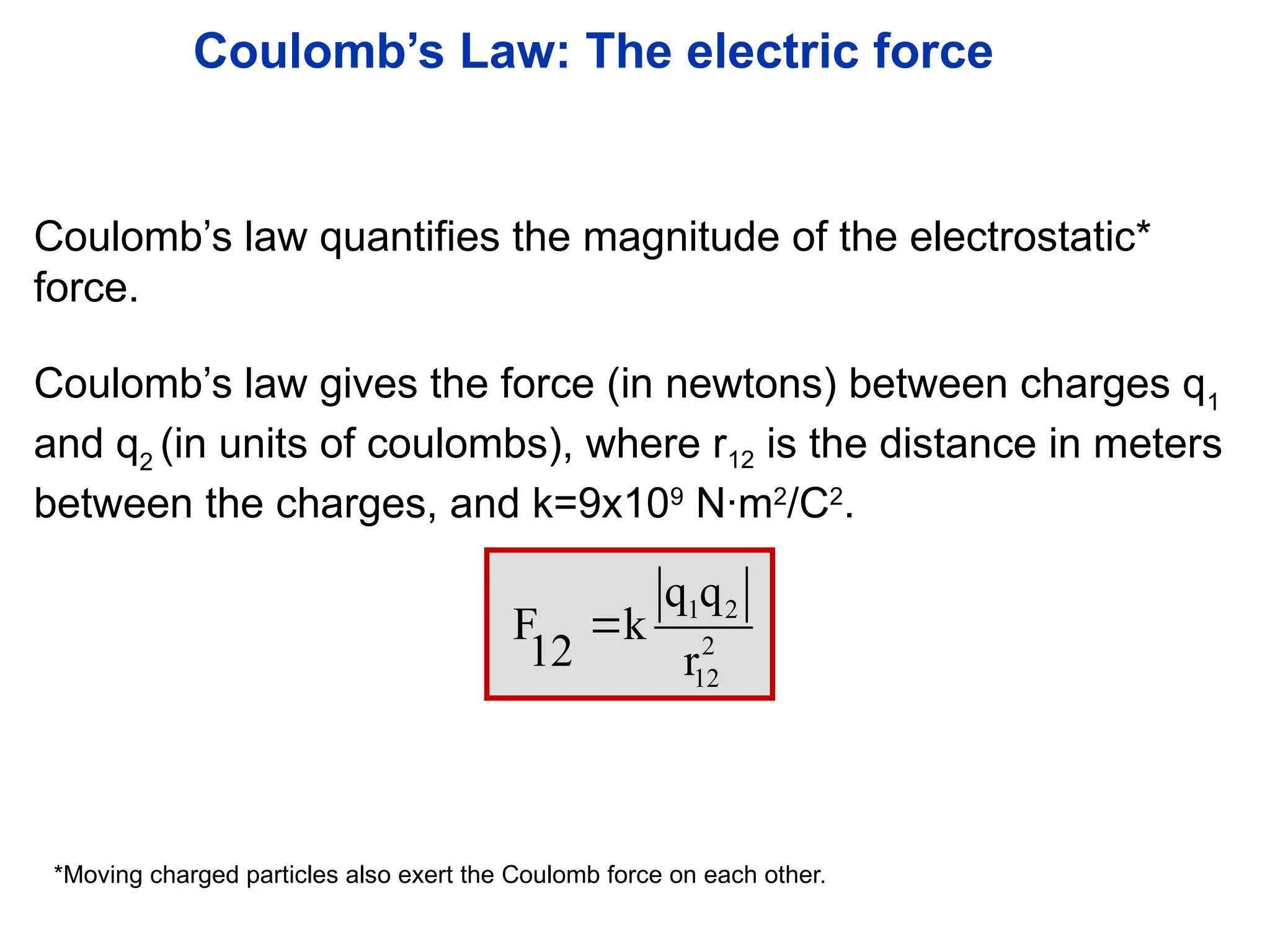
Coulomb’s Law: Theelectric force
1 2
2
12
q q
F k
12 r
Coulomb’s law gives the force (in newtons) between charges q1
and q2
(in units of coulombs), where r12 is the distance in meters
between the charges, and k=9x10⁹
N·m2
/C2
.
Coulomb’s law quantifies the magnitude of the electrostatic*
force.
*Moving charged particles also exert the Coulomb force on each other.
17.
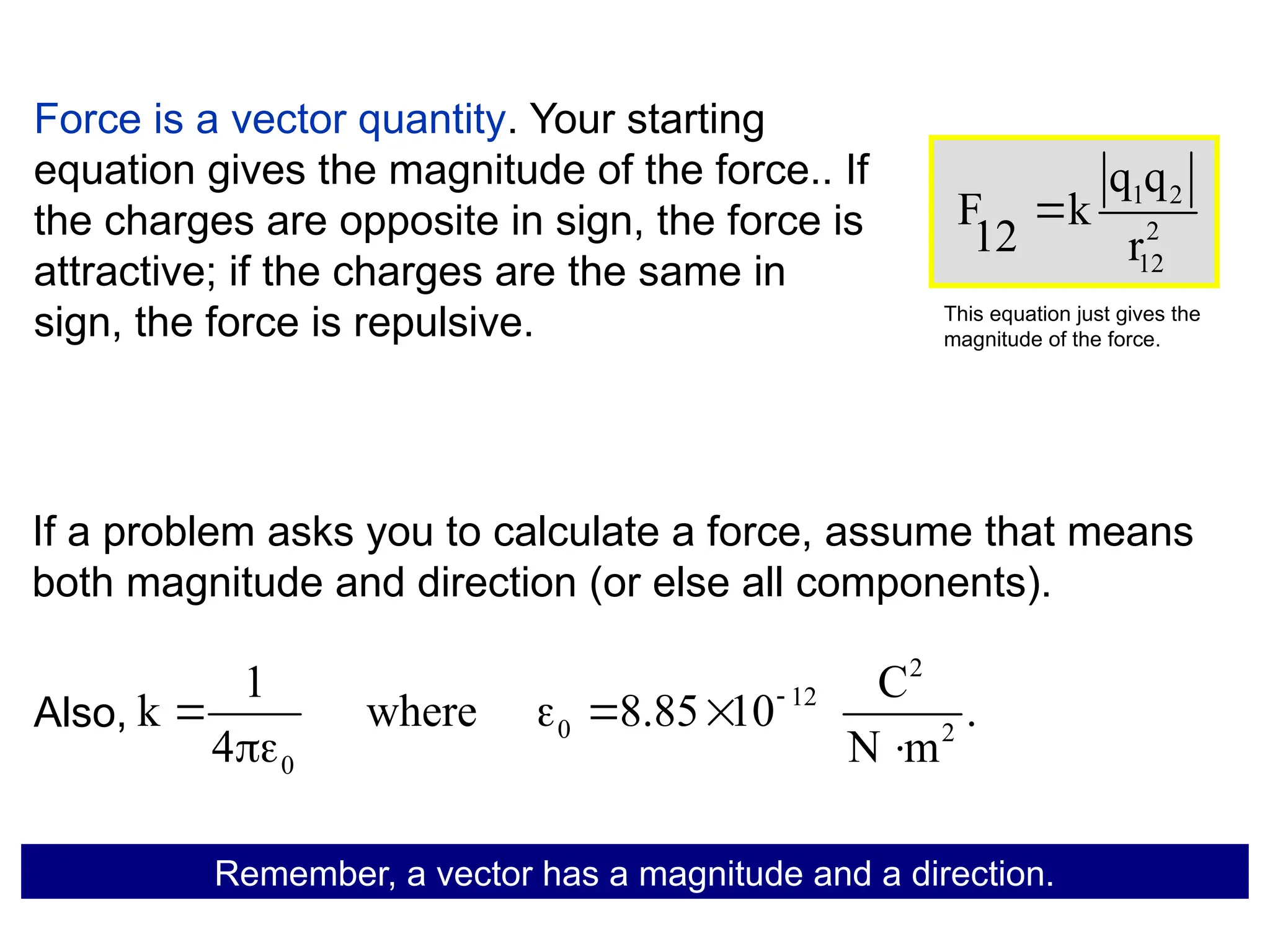
Force is avector quantity. Your starting
equation gives the magnitude of the force.. If
the charges are opposite in sign, the force is
attractive; if the charges are the same in
sign, the force is repulsive.
2
12
0 2
0
1 C
k where 8.85 10 .
4 N m
Remember, a vector has a magnitude and a direction.
Also,
1 2
2
12
q q
F k
12 r
This equation just gives the
magnitude of the force.
If a problem asks you to calculate a force, assume that means
both magnitude and direction (or else all components).
18.
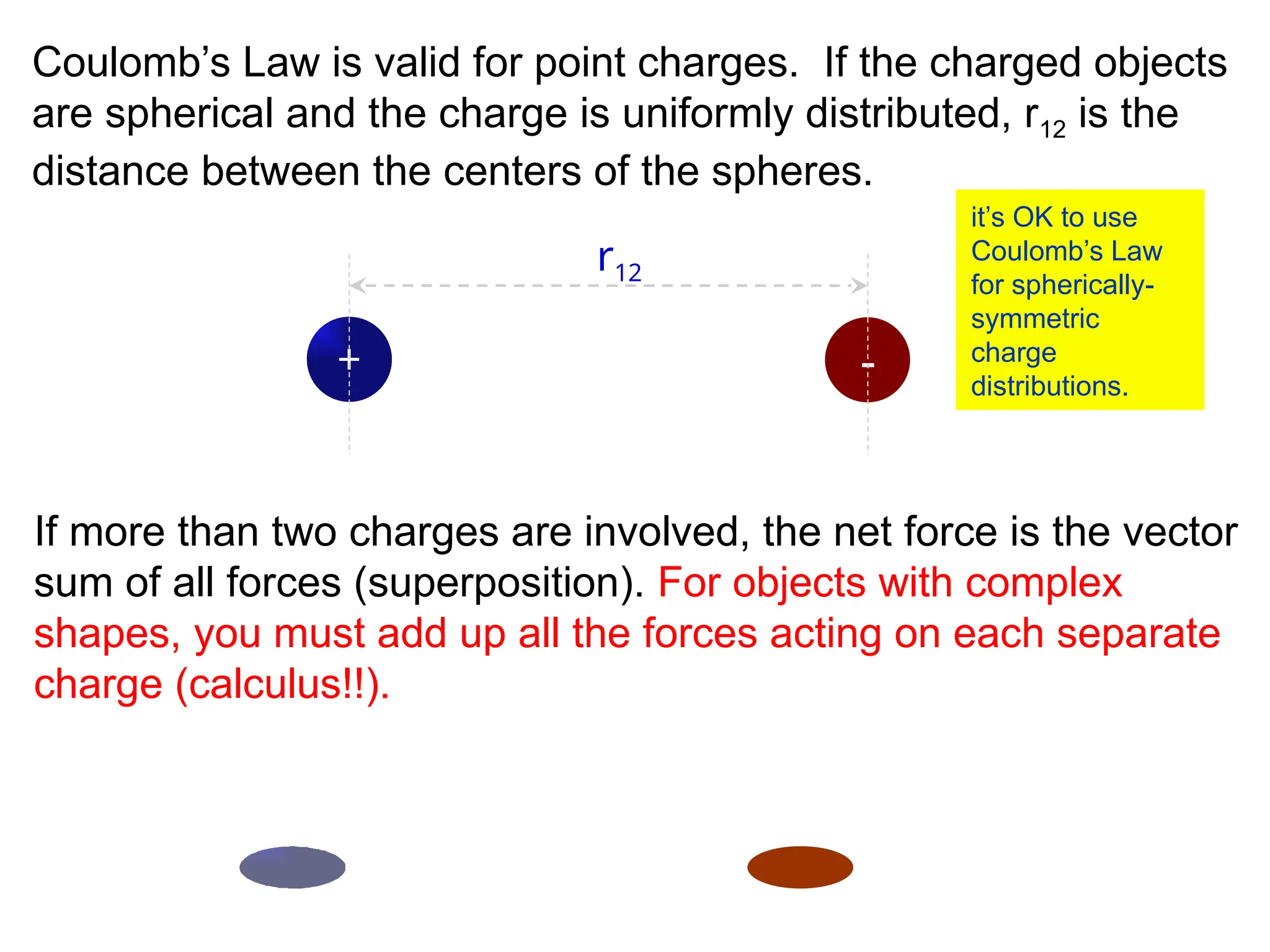
Coulomb’s Law isvalid for point charges. If the charged objects
are spherical and the charge is uniformly distributed, r12 is the
distance between the centers of the spheres.
If more than two charges are involved, the net force is the vector
sum of all forces (superposition). For objects with complex
shapes, you must add up all the forces acting on each separate
charge (calculus!!).
+ -
r12
+
+
+
-
-
-
it’s OK to use
Coulomb’s Law
for spherically-
symmetric
charge
distributions.
19.
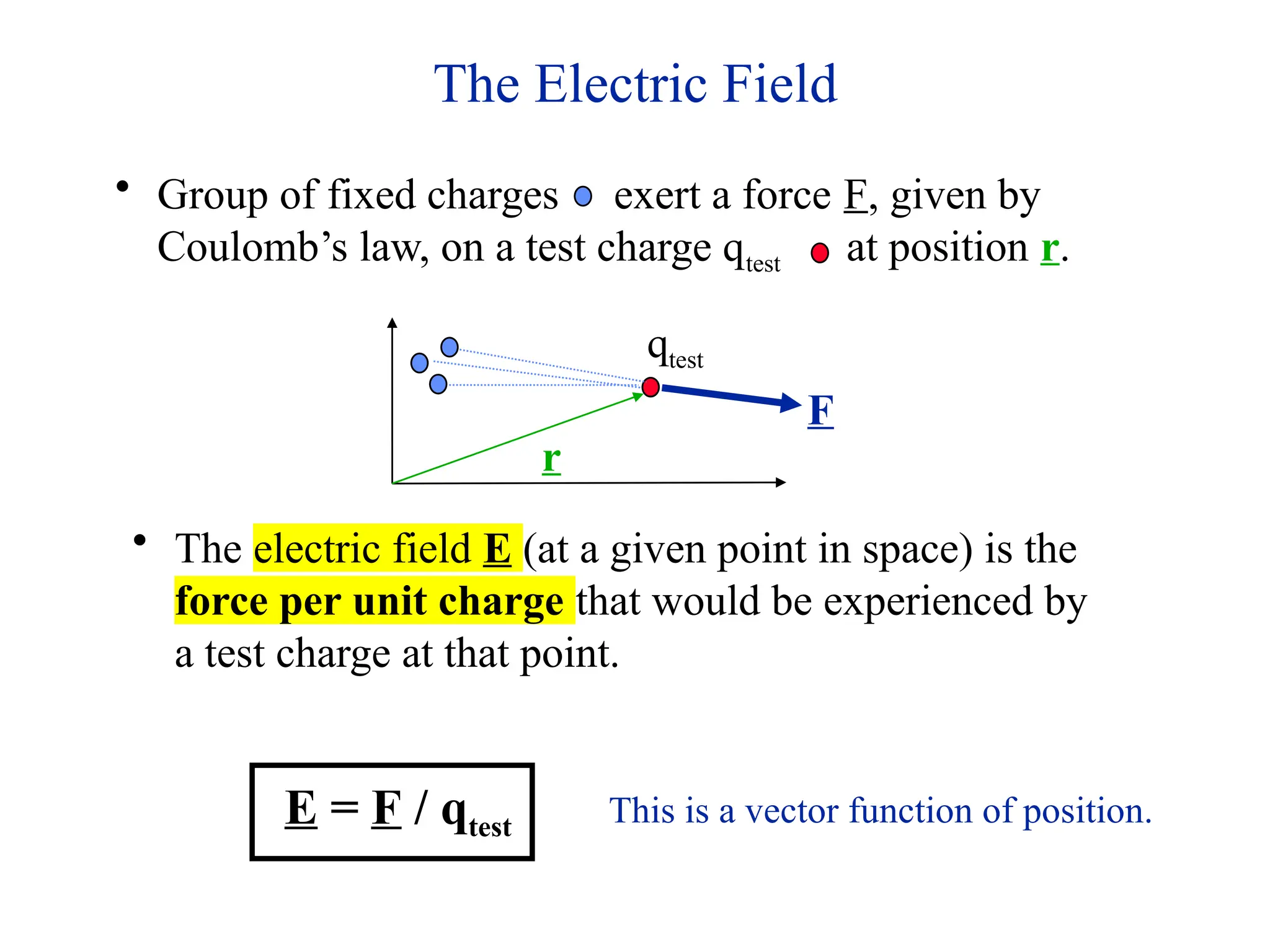
• Group offixed charges exert a force F, given by
Coulomb’s law, on a test charge qtest at position r.
The Electric Field
• The electric field E (at a given point in space) is the
force per unit charge that would be experienced by
a test charge at that point.
r
F
qtest
This is a vector function of position.
E = F / qtest
20.
Electric Field ofa Point Charge
• Dividing out qtest gives the electric field at r:
Radially outward,
falling off as 1/r2
F
1
40
Qqtest
r2
ˆ
r
E(
r)
1
40
Q
r
2
ˆ
r
r
qtest
Q
F
r̂
21.
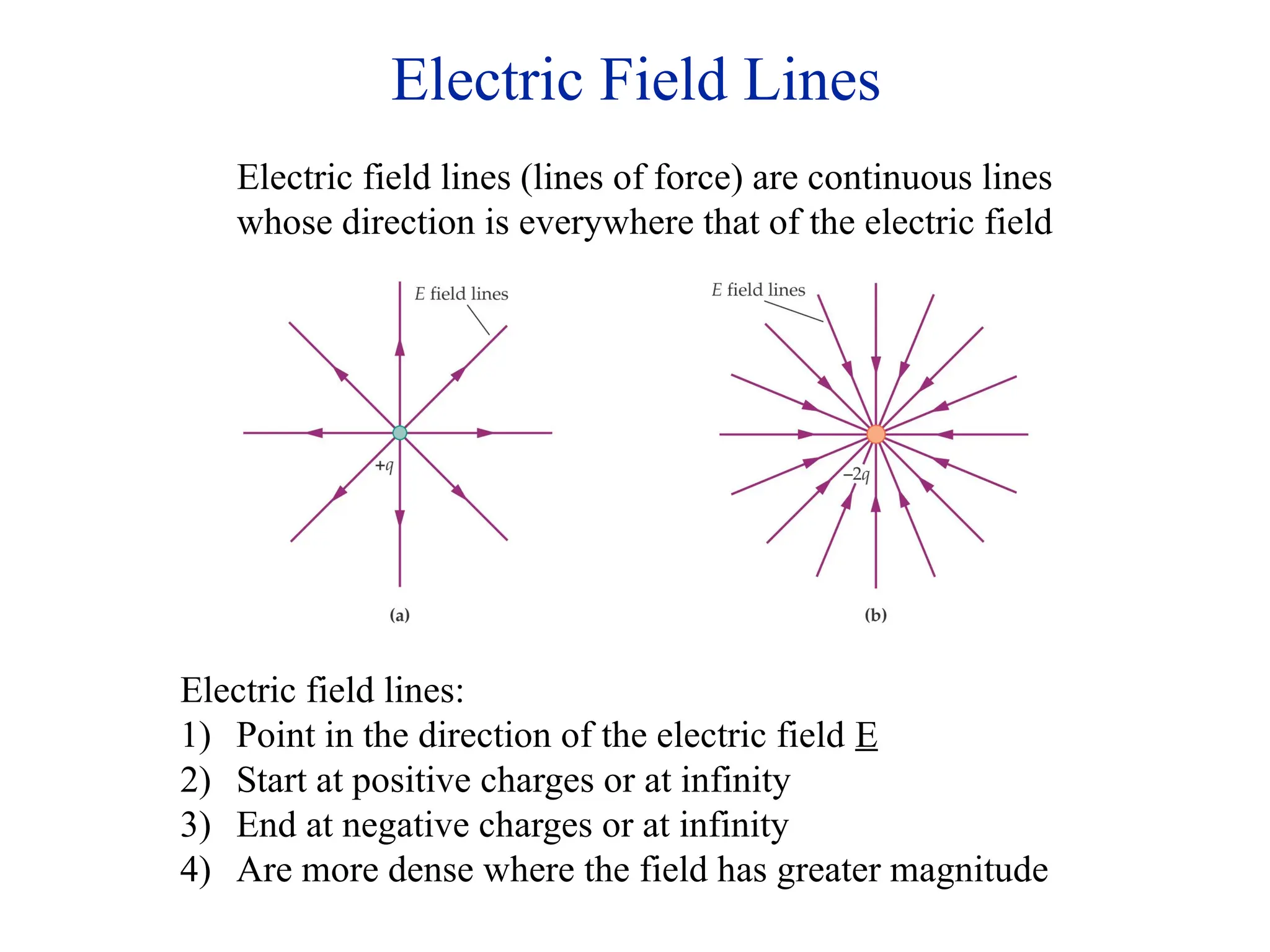
Electric Field Lines
Electricfield lines (lines of force) are continuous lines
whose direction is everywhere that of the electric field
Electric field lines:
1) Point in the direction of the electric field E
2) Start at positive charges or at infinity
3) End at negative charges or at infinity
4) Are more dense where the field has greater magnitude
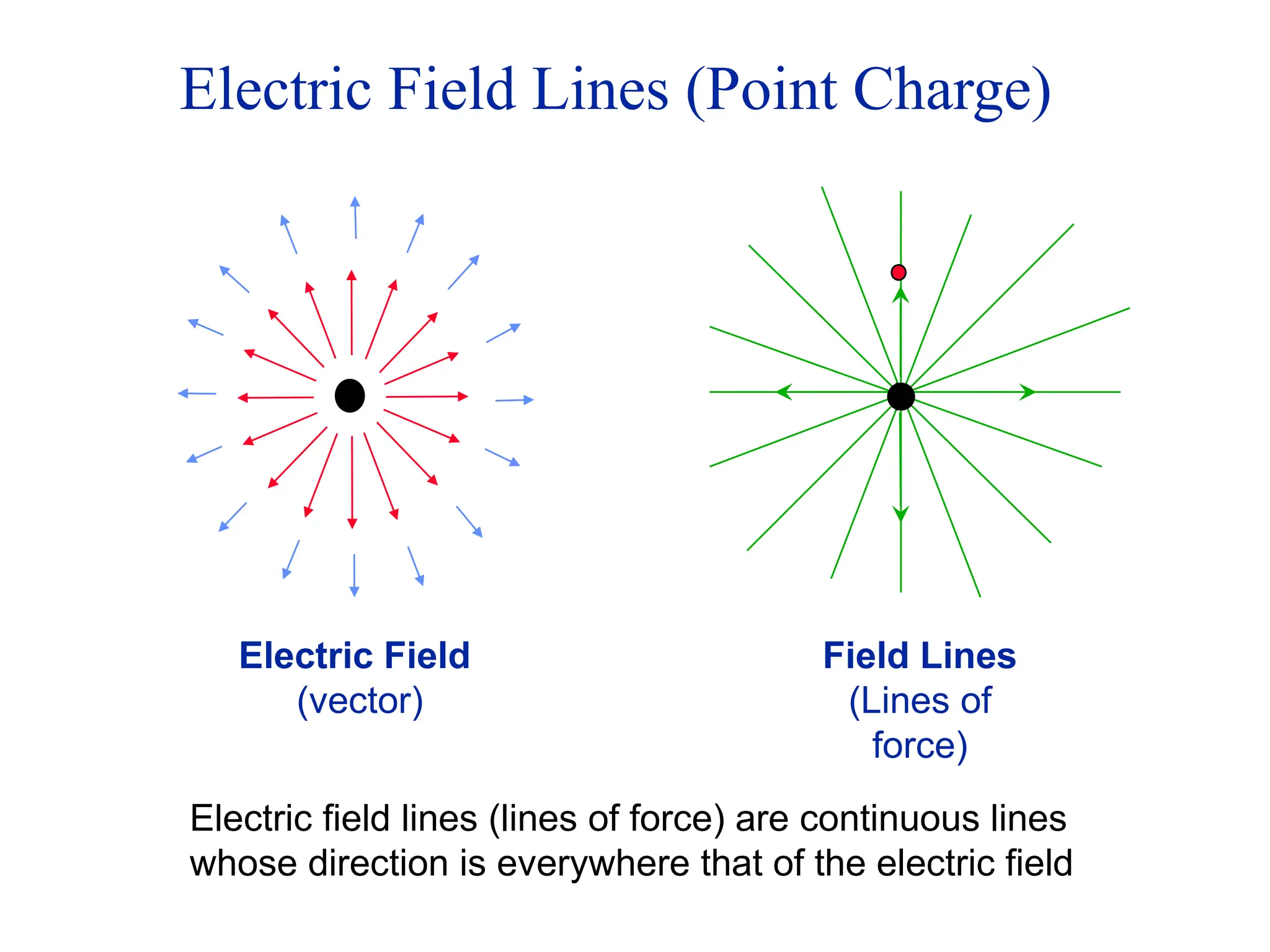
Electric Field Lines(Point Charge)
Electric Field
(vector)
Field Lines
(Lines of
force)
Electric field lines (lines of force) are continuous lines
whose direction is everywhere that of the electric field
24.
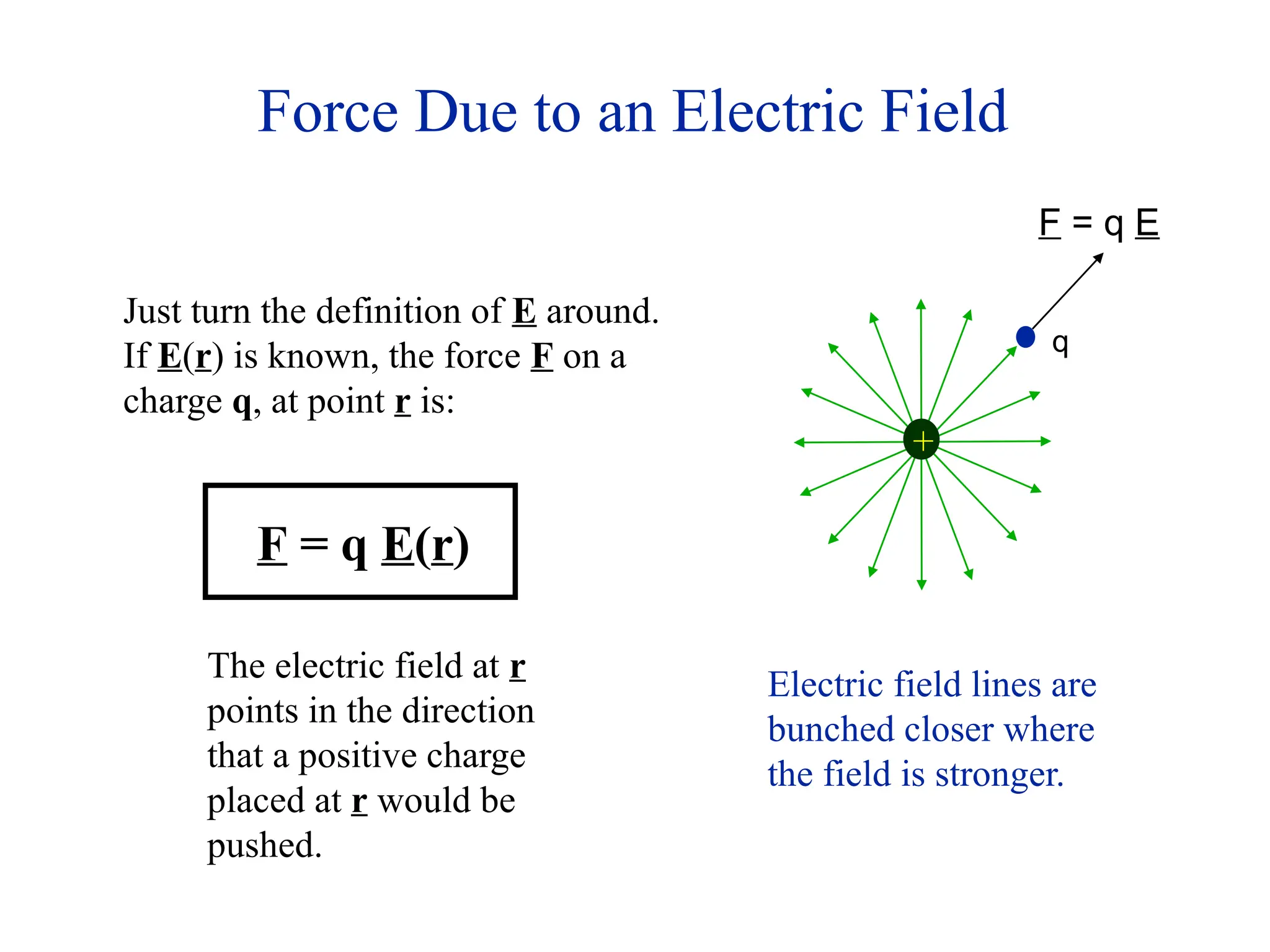
Force Due toan Electric Field
Just turn the definition of E around.
If E(r) is known, the force F on a
charge q, at point r is:
The electric field at r
points in the direction
that a positive charge
placed at r would be
pushed.
Electric field lines are
bunched closer where
the field is stronger.
F = q E(r)
q
+
F = q E
25.
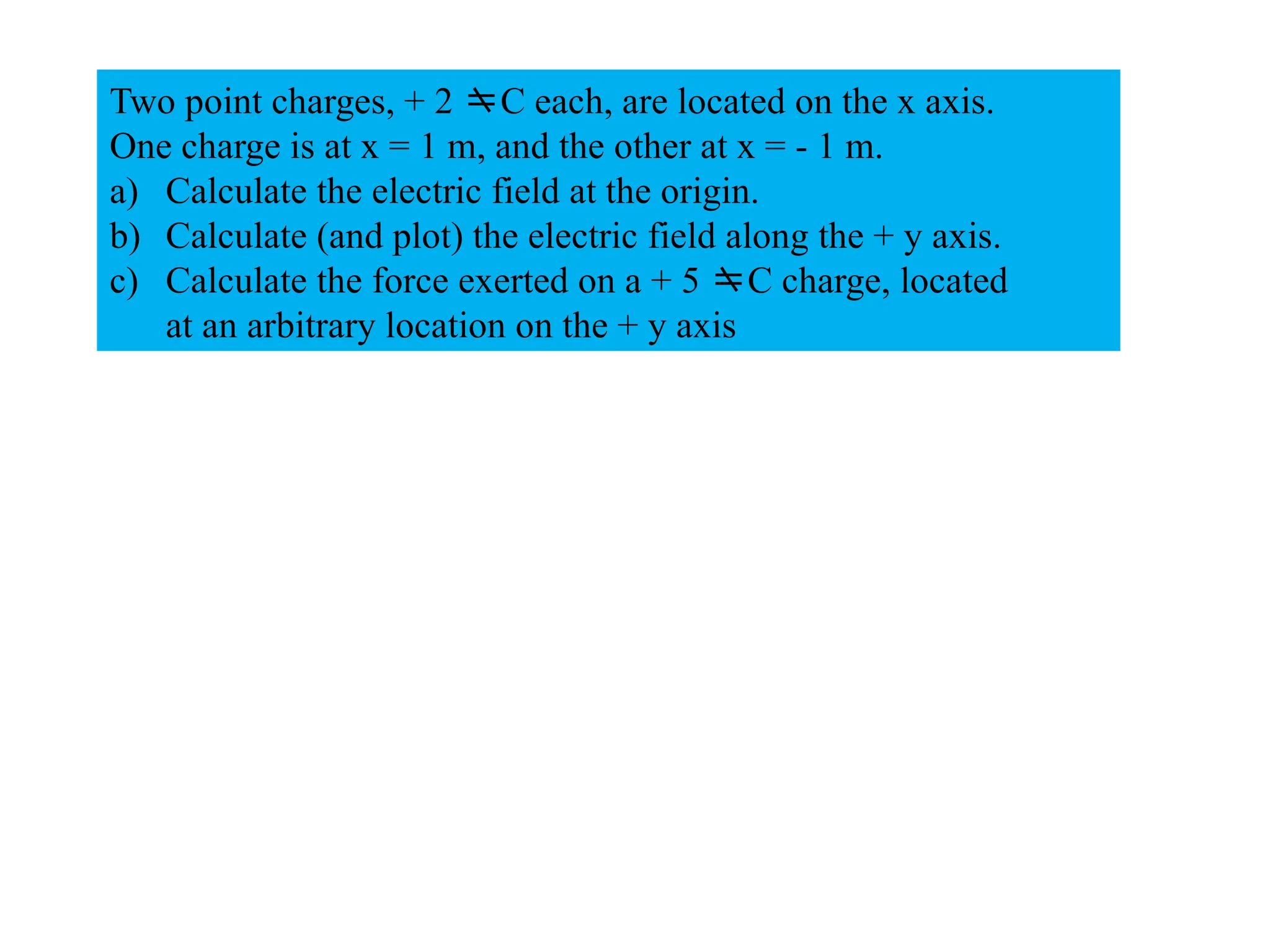
Two point charges,+ 2 C each, are located on the x axis.
One charge is at x = 1 m, and the other at x = - 1 m.
a) Calculate the electric field at the origin.
b) Calculate (and plot) the electric field along the + y axis.
c) Calculate the force exerted on a + 5 C charge, located
at an arbitrary location on the + y axis
26.
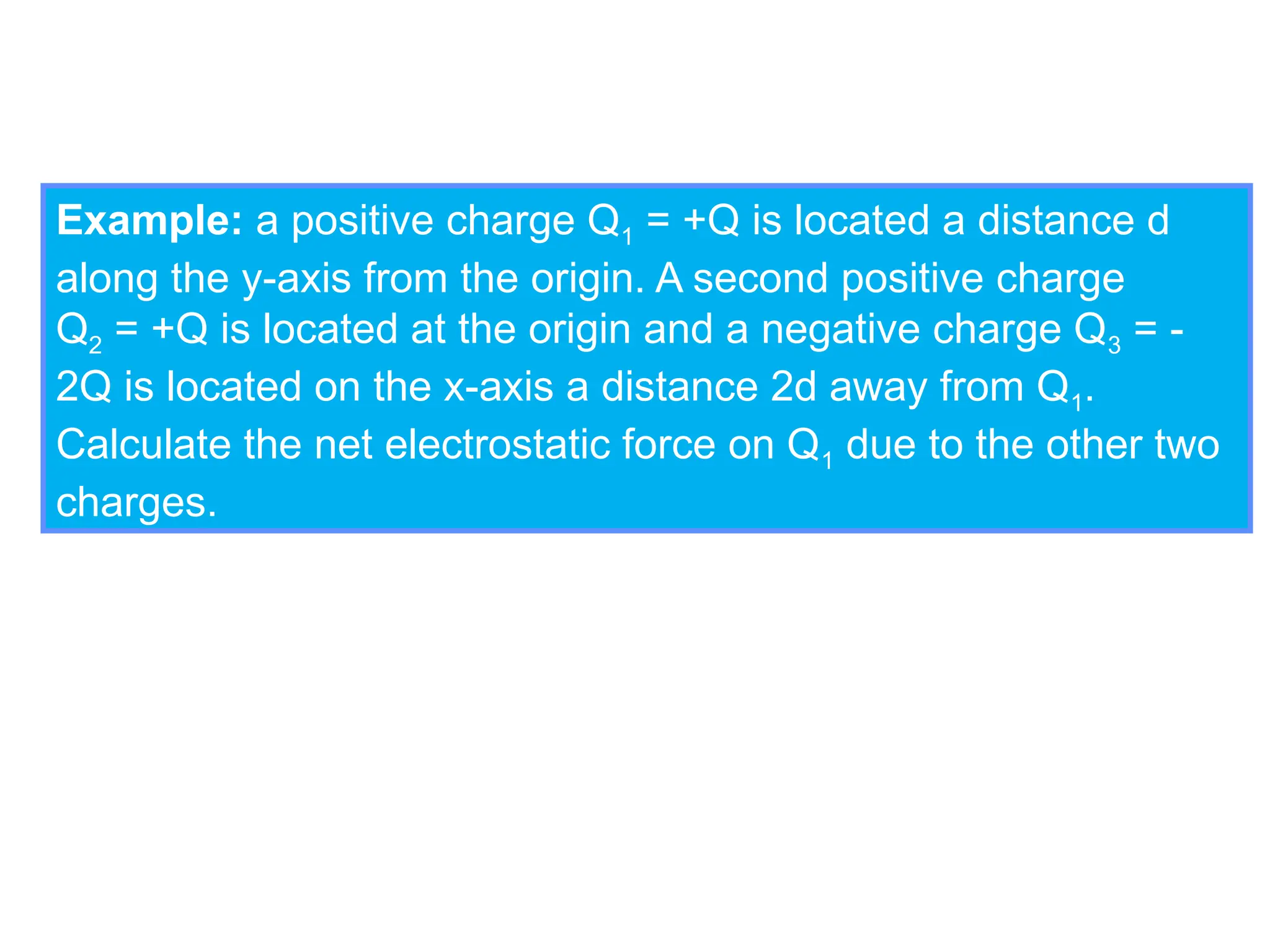
Example: a positivecharge Q1 = +Q is located a distance d
along the y-axis from the origin. A second positive charge
Q2 = +Q is located at the origin and a negative charge Q3 = -
2Q is located on the x-axis a distance 2d away from Q1.
Calculate the net electrostatic force on Q1 due to the other two
charges.
![System of Units
We will use the SI system – SI International System of Units
Fundamental Quantities
Length - meter [m]
Mass - kilogram [kg]
Time - second [s]
Other Units
Current - ampere [A]
Derived Quantities
Force-newton 1 N = 1 kg m / s2
Energy - joule 1 J = 1 N m
Charge - coulomb 1 C = 1 A s
Electric Potential - volt 1 V = 1 J / C
Resistance - ohm 1 = 1 V / A](https://image.slidesharecdn.com/1-250404080151-8102bc32/75/understanding-coulomb-e-Law-with-simple-persentation-7-2048.jpg)