Applied Physics
Imtiaz Ali
Electric Fields
1
Electric Charge and
Electric Field
2
Static electricity from this plastic slide causes the child’s hair to stand on end. The sliding
motion stripped electrons away from the child’s body, leaving an excess of positive
charges, which repel each other along each strand of hair. (credit: Ken
Learning Objectives
 Define electric charge, and describe how the two
types of charge interact.
 Desribe three common situations that generate
static electricity. State the law of conservation of
charge.
 Describe three methods for charging an object.
 State Coulomb’s law
 Describe an electric field diagram of a positive
point charge; of a negative point charge with twice
the magnitude of positive charge
 Draw the electric field lines between two points of
the same charge; between two points of opposite3
Introduction to Electric Charge and Electric
Field
4
 Benjamin Franklin
(1706-1790)
Fig: When Benjamin Franklin demonstrated that lightning was related to static
electricity, he made a connection that is now part of the evidence that all directly
experienced forces except the gravitational force are manifestations of the
electromagnetic force
Static Electricity and Charge: Conservation
of Charge
5
Basic characteristics of static electricity :
 The effects of static electricity are explained by a
physical quantity called electric charge.
 There are only two types of charge, one called
positive and the other called negative.
 Like charges repel, whereas unlike charges attract.
 The force between charges decreases with distance
Charge Carried by Electrons and Protons
6
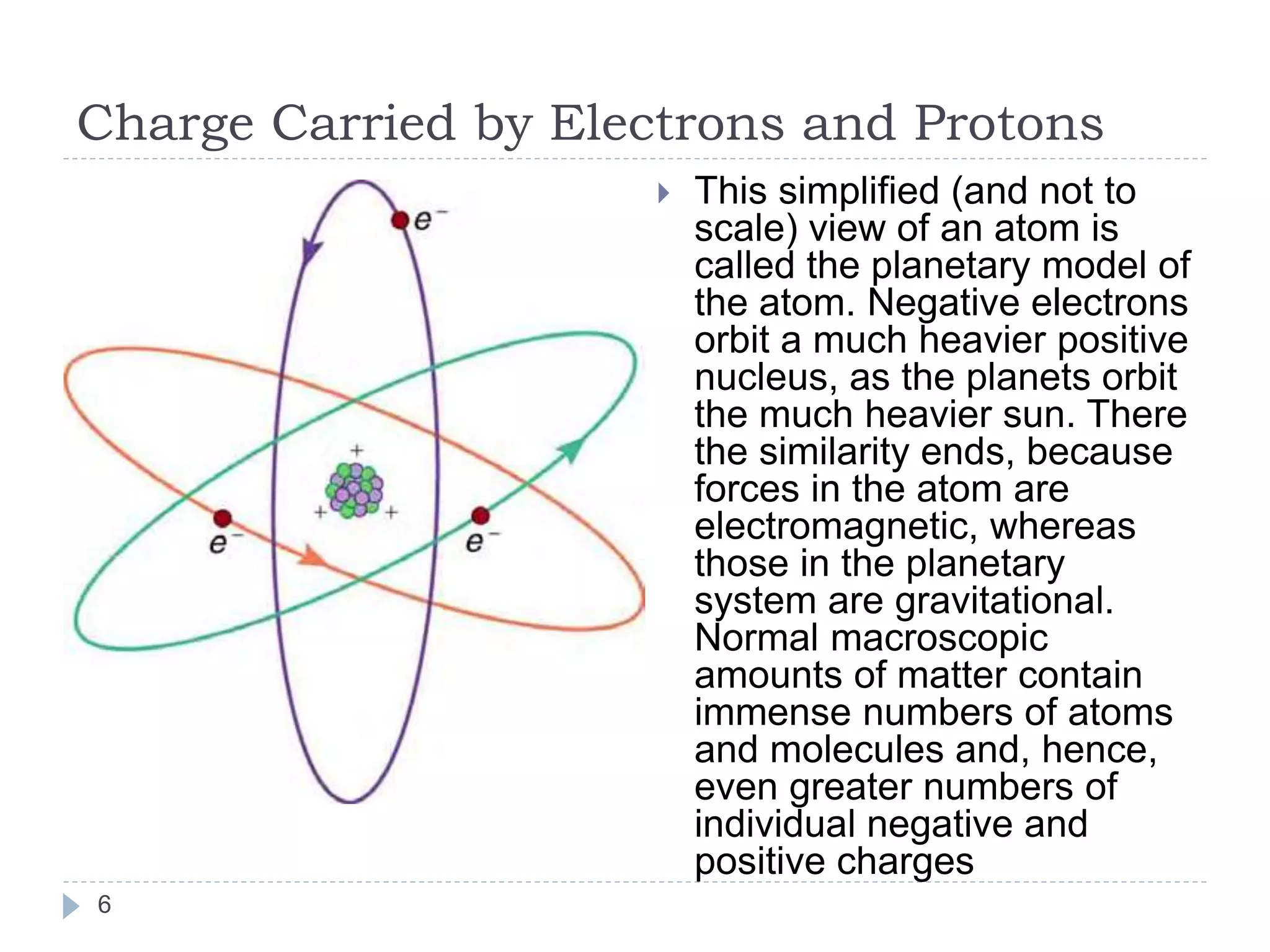
 This simplified (and not to
scale) view of an atom is
called the planetary model of
the atom. Negative electrons
orbit a much heavier positive
nucleus, as the planets orbit
the much heavier sun. There
the similarity ends, because
forces in the atom are
electromagnetic, whereas
those in the planetary
system are gravitational.
Normal macroscopic
amounts of matter contain
immense numbers of atoms
and molecules and, hence,
even greater numbers of
individual negative and
positive charges
Separation of Charge in atoms
7
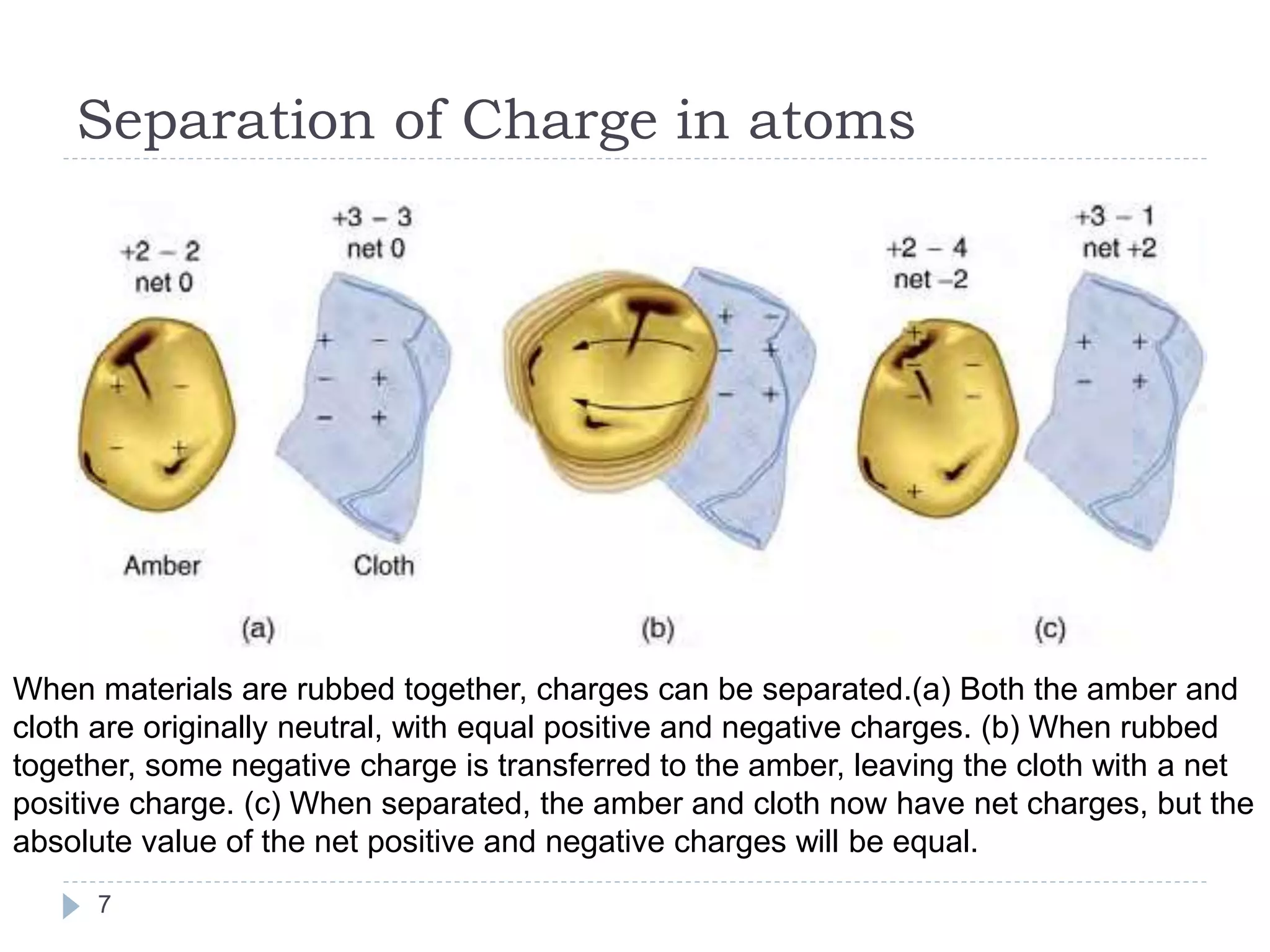
When materials are rubbed together, charges can be separated.(a) Both the amber and
cloth are originally neutral, with equal positive and negative charges. (b) When rubbed
together, some negative charge is transferred to the amber, leaving the cloth with a net
positive charge. (c) When separated, the amber and cloth now have net charges, but the
absolute value of the net positive and negative charges will be equal.
Conductors and Insulators
8
This power adapter uses metal wires and connectors to conduct electricity from the
wall socket to a laptop computer move freely through the cables, which are shielded
by rubber and plastic. These materials act as insulators that don’t allow electric
charge to escape outward. (credit: EvanAmos, wikimedia Commons)
Charging by Contact
9
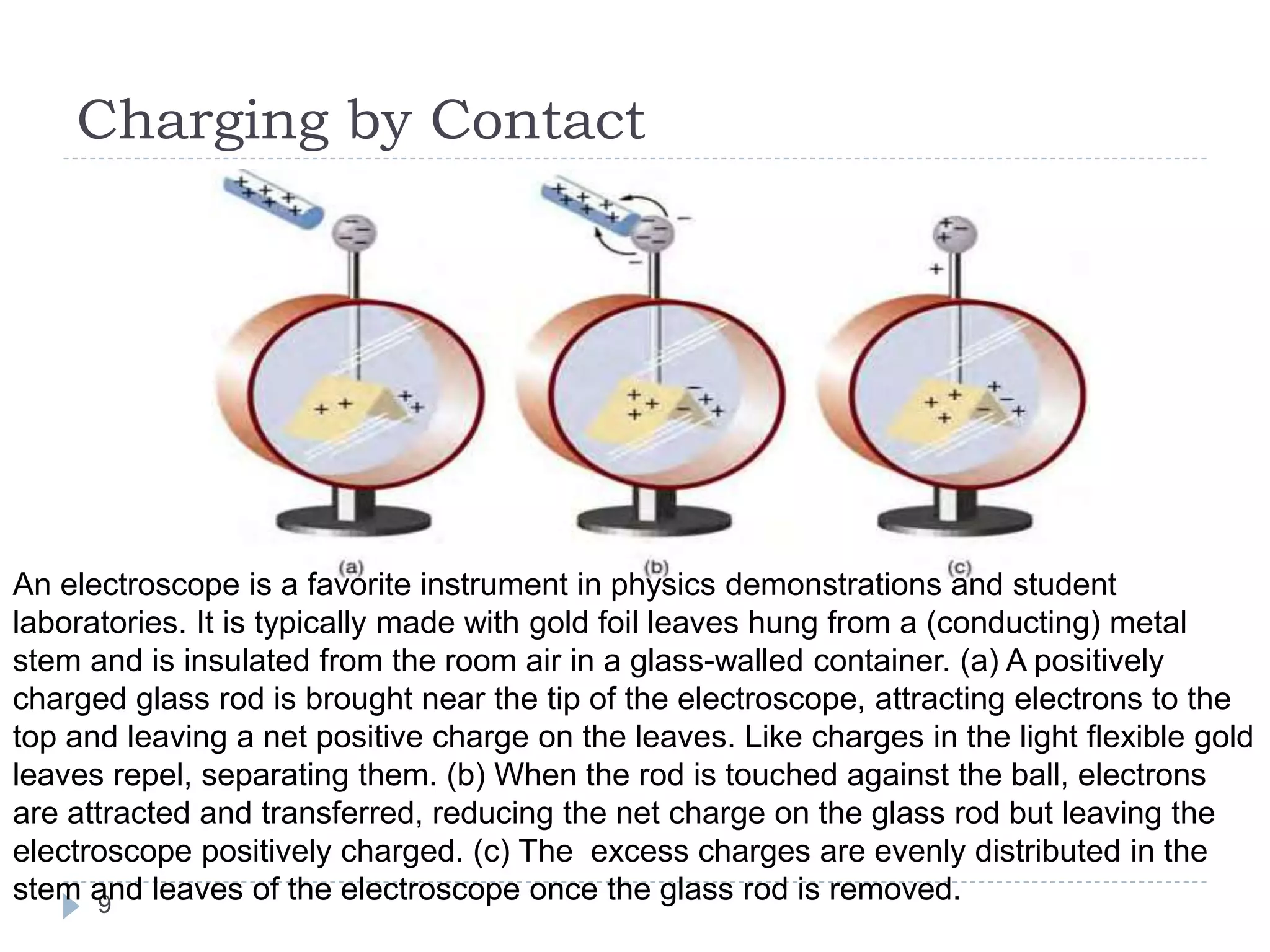
An electroscope is a favorite instrument in physics demonstrations and student
laboratories. It is typically made with gold foil leaves hung from a (conducting) metal
stem and is insulated from the room air in a glass-walled container. (a) A positively
charged glass rod is brought near the tip of the electroscope, attracting electrons to the
top and leaving a net positive charge on the leaves. Like charges in the light flexible gold
leaves repel, separating them. (b) When the rod is touched against the ball, electrons
are attracted and transferred, reducing the net charge on the glass rod but leaving the
electroscope positively charged. (c) The excess charges are evenly distributed in the
stem and leaves of the electroscope once the glass rod is removed.
Charging by Induction
10
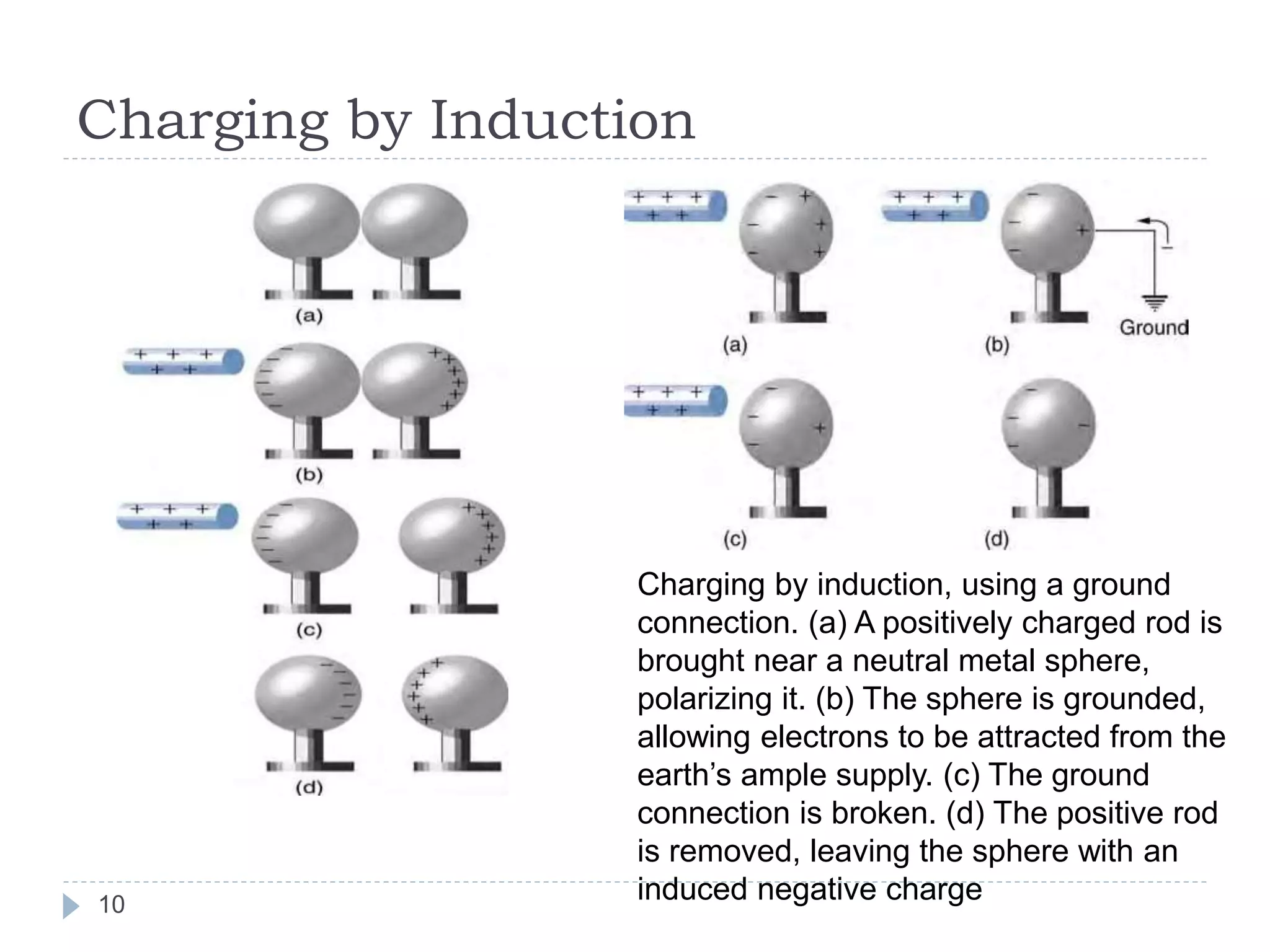
Charging by induction, using a ground
connection. (a) A positively charged rod is
brought near a neutral metal sphere,
polarizing it. (b) The sphere is grounded,
allowing electrons to be attracted from the
earth’s ample supply. (c) The ground
connection is broken. (d) The positive rod
is removed, leaving the sphere with an
induced negative charge
Polarization of Atoms and Molecules in
Neutral atoms
11
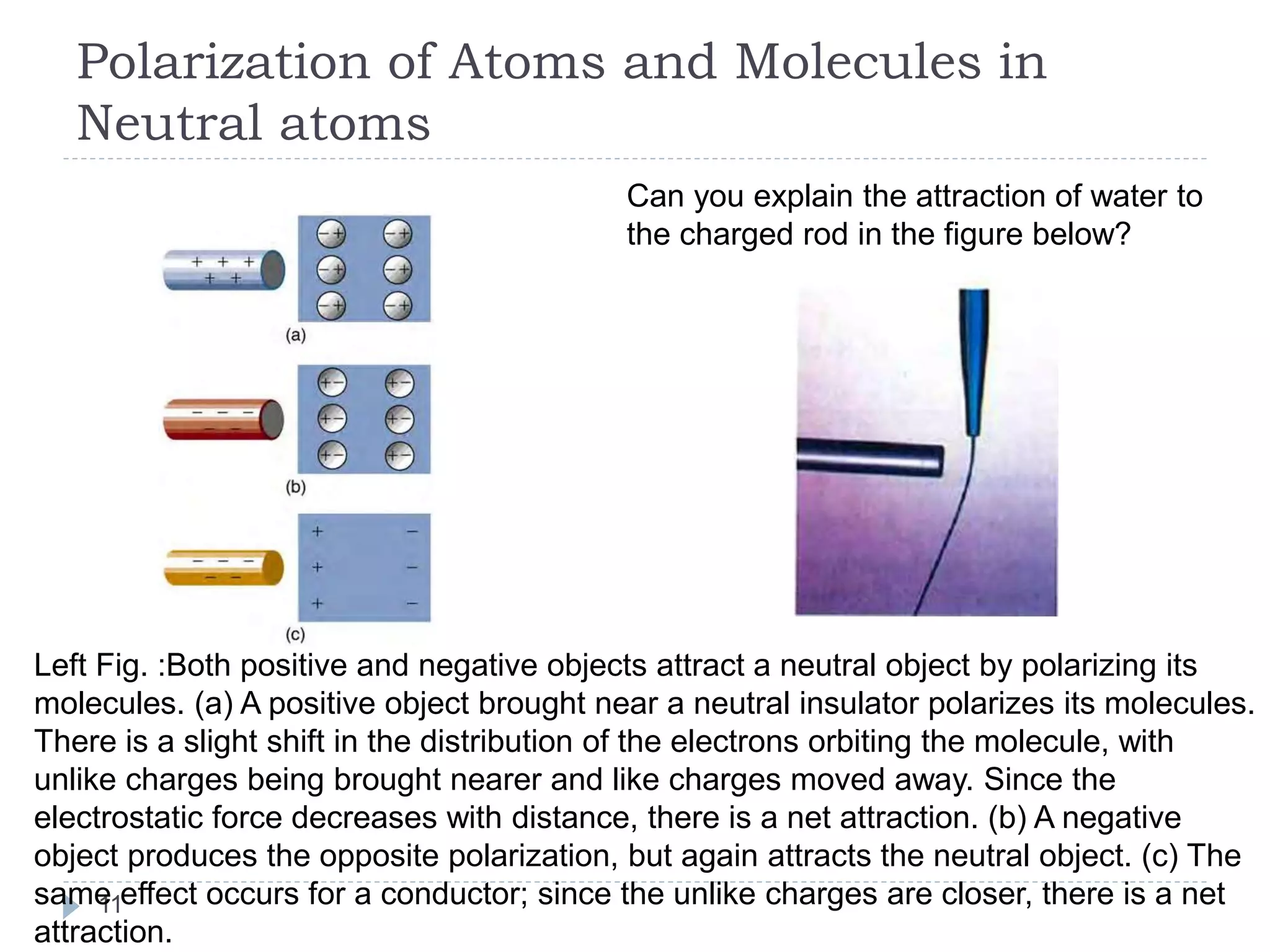
Left Fig. :Both positive and negative objects attract a neutral object by polarizing its
molecules. (a) A positive object brought near a neutral insulator polarizes its molecules.
There is a slight shift in the distribution of the electrons orbiting the molecule, with
unlike charges being brought nearer and like charges moved away. Since the
electrostatic force decreases with distance, there is a net attraction. (b) A negative
object produces the opposite polarization, but again attracts the neutral object. (c) The
same effect occurs for a conductor; since the unlike charges are closer, there is a net
attraction.
Can you explain the attraction of water to
the charged rod in the figure below?
Coulomb’s Law
12
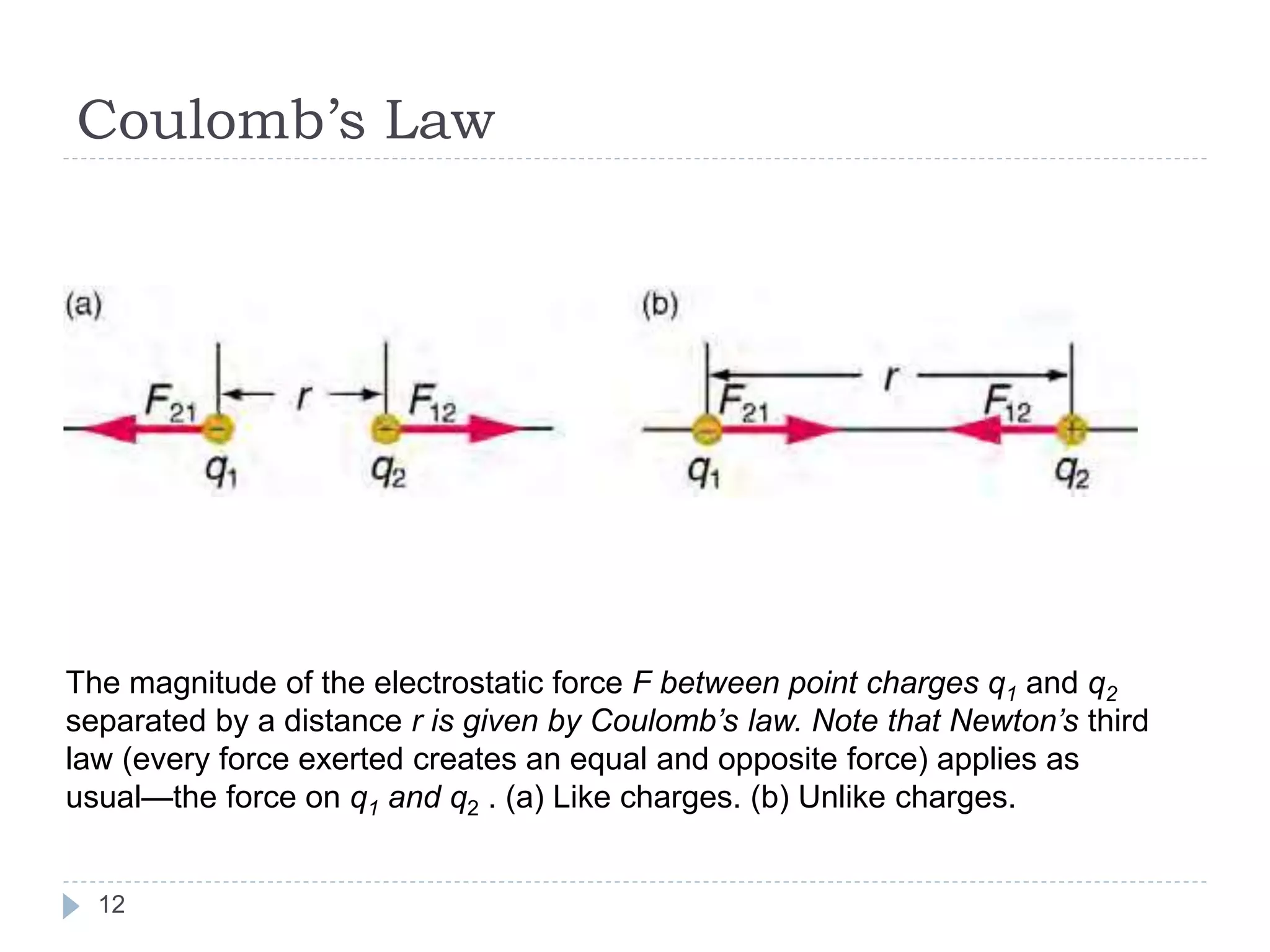
The magnitude of the electrostatic force F between point charges q1 and q2
separated by a distance r is given by Coulomb’s law. Note that Newton’s third
law (every force exerted creates an equal and opposite force) applies as
usual—the force on q1 and q2 . (a) Like charges. (b) Unlike charges.
Electric Field: Concept of Field
13
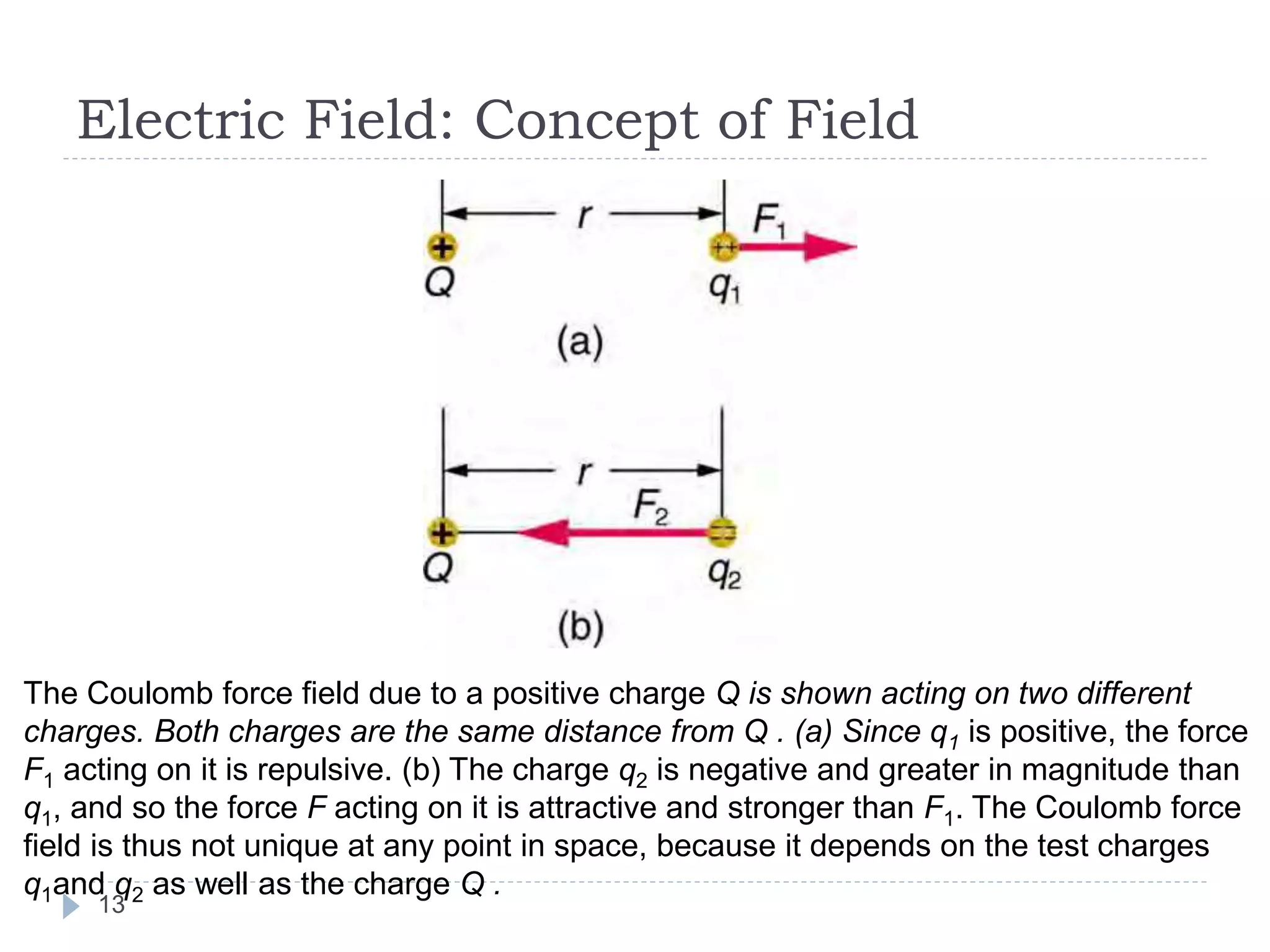
The Coulomb force field due to a positive charge Q is shown acting on two different
charges. Both charges are the same distance from Q . (a) Since q1 is positive, the force
F1 acting on it is repulsive. (b) The charge q2 is negative and greater in magnitude than
q1, and so the force F acting on it is attractive and stronger than F1. The Coulomb force
field is thus not unique at any point in space, because it depends on the test charges
q1and q2 as well as the charge Q .
Electric Field Lines: Multiple Charges
14
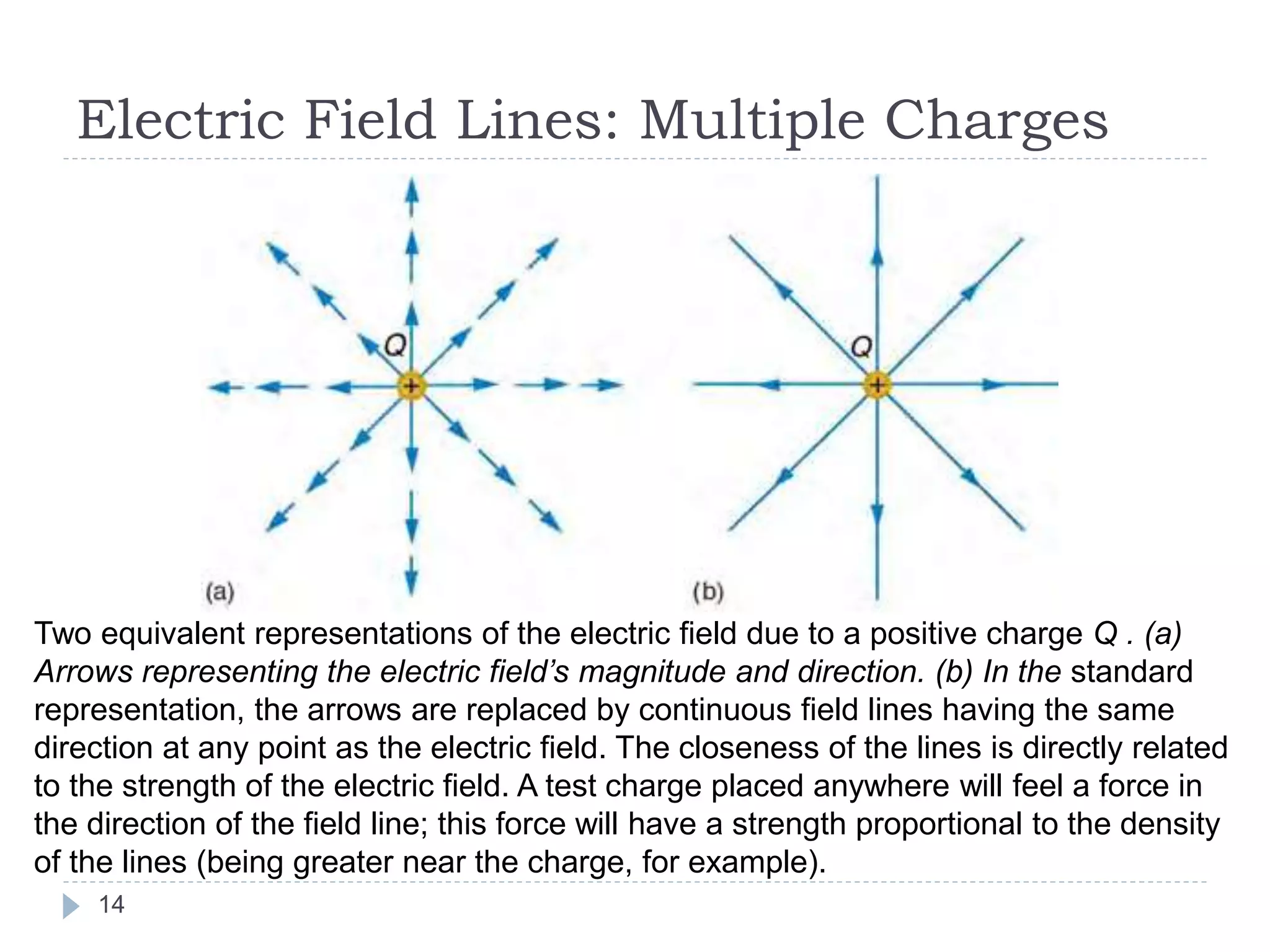
Two equivalent representations of the electric field due to a positive charge Q . (a)
Arrows representing the electric field’s magnitude and direction. (b) In the standard
representation, the arrows are replaced by continuous field lines having the same
direction at any point as the electric field. The closeness of the lines is directly related
to the strength of the electric field. A test charge placed anywhere will feel a force in
the direction of the field line; this force will have a strength proportional to the density
of the lines (being greater near the charge, for example).
Electric Field Lines: Multiple Charges
15
The electric field surrounding three different point charges. (a) A positive charge.
(b) A negative charge of equal magnitude. (c) A larger negative charge.
Electric Field Lines: Multiple Charges
16
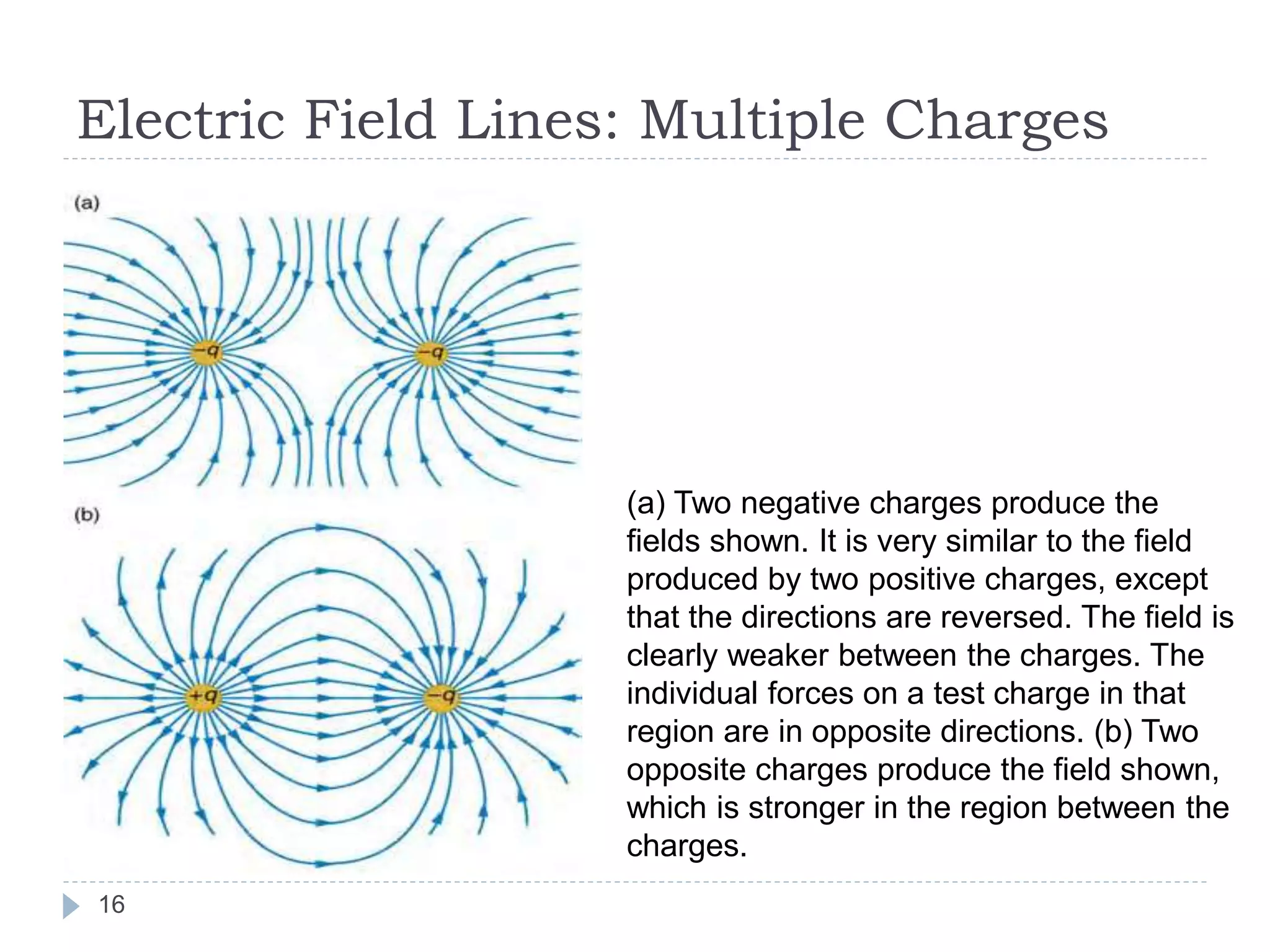
(a) Two negative charges produce the
fields shown. It is very similar to the field
produced by two positive charges, except
that the directions are reversed. The field is
clearly weaker between the charges. The
individual forces on a test charge in that
region are in opposite directions. (b) Two
opposite charges produce the field shown,
which is stronger in the region between the
charges.
Properties of Electric Field Lines
17
1. Field lines must begin on positive charges and
terminate on negative charges, or at infinity in the
hypothetical case of isolated charges.
2. The number of field lines leaving a positive charge
or entering a negative charge is proportional to the
magnitude of the charge.
3. The strength of the field is proportional to the
closeness of the field lines—more precisely, it is
proportional to the number of lines per unit area
perpendicular to the lines.
4. The direction of the electric field is tangent to the
field line at any point in space.
5. Field lines can never cross.

Electric field

  • 1.
  • 2.
    Electric Charge and ElectricField 2 Static electricity from this plastic slide causes the child’s hair to stand on end. The sliding motion stripped electrons away from the child’s body, leaving an excess of positive charges, which repel each other along each strand of hair. (credit: Ken
  • 3.
    Learning Objectives  Defineelectric charge, and describe how the two types of charge interact.  Desribe three common situations that generate static electricity. State the law of conservation of charge.  Describe three methods for charging an object.  State Coulomb’s law  Describe an electric field diagram of a positive point charge; of a negative point charge with twice the magnitude of positive charge  Draw the electric field lines between two points of the same charge; between two points of opposite3
  • 4.
    Introduction to ElectricCharge and Electric Field 4  Benjamin Franklin (1706-1790) Fig: When Benjamin Franklin demonstrated that lightning was related to static electricity, he made a connection that is now part of the evidence that all directly experienced forces except the gravitational force are manifestations of the electromagnetic force
  • 5.
    Static Electricity andCharge: Conservation of Charge 5 Basic characteristics of static electricity :  The effects of static electricity are explained by a physical quantity called electric charge.  There are only two types of charge, one called positive and the other called negative.  Like charges repel, whereas unlike charges attract.  The force between charges decreases with distance
  • 6.
    Charge Carried byElectrons and Protons 6  This simplified (and not to scale) view of an atom is called the planetary model of the atom. Negative electrons orbit a much heavier positive nucleus, as the planets orbit the much heavier sun. There the similarity ends, because forces in the atom are electromagnetic, whereas those in the planetary system are gravitational. Normal macroscopic amounts of matter contain immense numbers of atoms and molecules and, hence, even greater numbers of individual negative and positive charges
  • 7.
    Separation of Chargein atoms 7 When materials are rubbed together, charges can be separated.(a) Both the amber and cloth are originally neutral, with equal positive and negative charges. (b) When rubbed together, some negative charge is transferred to the amber, leaving the cloth with a net positive charge. (c) When separated, the amber and cloth now have net charges, but the absolute value of the net positive and negative charges will be equal.
  • 8.
    Conductors and Insulators 8 Thispower adapter uses metal wires and connectors to conduct electricity from the wall socket to a laptop computer move freely through the cables, which are shielded by rubber and plastic. These materials act as insulators that don’t allow electric charge to escape outward. (credit: EvanAmos, wikimedia Commons)
  • 9.
    Charging by Contact 9 Anelectroscope is a favorite instrument in physics demonstrations and student laboratories. It is typically made with gold foil leaves hung from a (conducting) metal stem and is insulated from the room air in a glass-walled container. (a) A positively charged glass rod is brought near the tip of the electroscope, attracting electrons to the top and leaving a net positive charge on the leaves. Like charges in the light flexible gold leaves repel, separating them. (b) When the rod is touched against the ball, electrons are attracted and transferred, reducing the net charge on the glass rod but leaving the electroscope positively charged. (c) The excess charges are evenly distributed in the stem and leaves of the electroscope once the glass rod is removed.
  • 10.
    Charging by Induction 10 Chargingby induction, using a ground connection. (a) A positively charged rod is brought near a neutral metal sphere, polarizing it. (b) The sphere is grounded, allowing electrons to be attracted from the earth’s ample supply. (c) The ground connection is broken. (d) The positive rod is removed, leaving the sphere with an induced negative charge
  • 11.
    Polarization of Atomsand Molecules in Neutral atoms 11 Left Fig. :Both positive and negative objects attract a neutral object by polarizing its molecules. (a) A positive object brought near a neutral insulator polarizes its molecules. There is a slight shift in the distribution of the electrons orbiting the molecule, with unlike charges being brought nearer and like charges moved away. Since the electrostatic force decreases with distance, there is a net attraction. (b) A negative object produces the opposite polarization, but again attracts the neutral object. (c) The same effect occurs for a conductor; since the unlike charges are closer, there is a net attraction. Can you explain the attraction of water to the charged rod in the figure below?
  • 12.
    Coulomb’s Law 12 The magnitudeof the electrostatic force F between point charges q1 and q2 separated by a distance r is given by Coulomb’s law. Note that Newton’s third law (every force exerted creates an equal and opposite force) applies as usual—the force on q1 and q2 . (a) Like charges. (b) Unlike charges.
  • 13.
    Electric Field: Conceptof Field 13 The Coulomb force field due to a positive charge Q is shown acting on two different charges. Both charges are the same distance from Q . (a) Since q1 is positive, the force F1 acting on it is repulsive. (b) The charge q2 is negative and greater in magnitude than q1, and so the force F acting on it is attractive and stronger than F1. The Coulomb force field is thus not unique at any point in space, because it depends on the test charges q1and q2 as well as the charge Q .
  • 14.
    Electric Field Lines:Multiple Charges 14 Two equivalent representations of the electric field due to a positive charge Q . (a) Arrows representing the electric field’s magnitude and direction. (b) In the standard representation, the arrows are replaced by continuous field lines having the same direction at any point as the electric field. The closeness of the lines is directly related to the strength of the electric field. A test charge placed anywhere will feel a force in the direction of the field line; this force will have a strength proportional to the density of the lines (being greater near the charge, for example).
  • 15.
    Electric Field Lines:Multiple Charges 15 The electric field surrounding three different point charges. (a) A positive charge. (b) A negative charge of equal magnitude. (c) A larger negative charge.
  • 16.
    Electric Field Lines:Multiple Charges 16 (a) Two negative charges produce the fields shown. It is very similar to the field produced by two positive charges, except that the directions are reversed. The field is clearly weaker between the charges. The individual forces on a test charge in that region are in opposite directions. (b) Two opposite charges produce the field shown, which is stronger in the region between the charges.
  • 17.
    Properties of ElectricField Lines 17 1. Field lines must begin on positive charges and terminate on negative charges, or at infinity in the hypothetical case of isolated charges. 2. The number of field lines leaving a positive charge or entering a negative charge is proportional to the magnitude of the charge. 3. The strength of the field is proportional to the closeness of the field lines—more precisely, it is proportional to the number of lines per unit area perpendicular to the lines. 4. The direction of the electric field is tangent to the field line at any point in space. 5. Field lines can never cross.