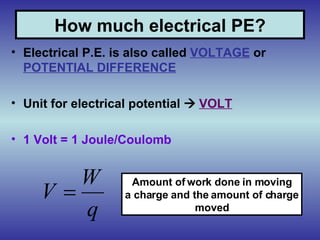
1) Electrical potential energy, also called voltage or potential difference, is a measure of the work required to move a charge in an electric field.
2) Voltage is calculated by dividing the work done (in Joules) by the charge moved (in Coulombs).
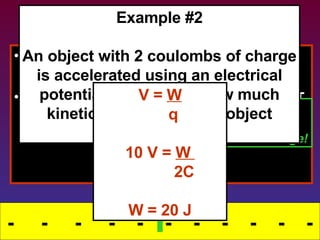
3) Stored electrical potential energy can be released as kinetic energy when charges are accelerated by a voltage and moved in an electric field.
How can wemanipulate energy in electric fields? + + Apply FORCE to push like charges TOGETHER + - Apply FORCE to push unlike charges APART F A F A F A F A
3.
How much electricalPE? Electrical P.E. is also called VOLTAGE or POTENTIAL DIFFERENCE Unit for electrical potential VOLT 1 Volt = 1 Joule/Coulomb Amount of work done in moving a charge and the amount of charge moved
4.
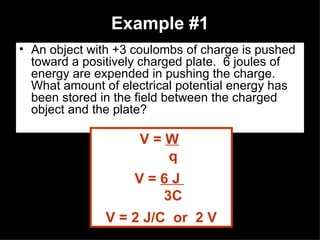
Example #1 Anobject with +3 coulombs of charge is pushed toward a positively charged plate. 6 joules of energy are expended in pushing the charge. What amount of electrical potential energy has been stored in the field between the charged object and the plate? V = W q V = 6 J 3C V = 2 J/C or 2 V
5.
Removing Energy Thisstored energy can also be released. What happens to energy that comes OUT of a field? Transfers into kinetic energy - - - - - - - - - - - STORING ENERGY The field releases the energy, doing WORK on the charge! Example #2 An object with 2 coulombs of charge is accelerated using an electrical potential of 10 volts. How much kinetic energy does the object receive? V = W q 10 V = W 2C W = 20 J - -
6.
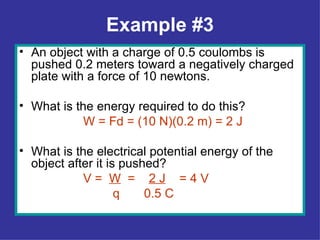
Example #3 Anobject with a charge of 0.5 coulombs is pushed 0.2 meters toward a negatively charged plate with a force of 10 newtons. What is the energy required to do this? W = Fd = (10 N)(0.2 m) = 2 J What is the electrical potential energy of the object after it is pushed? V = W = 2 J = 4 V q 0.5 C
7.
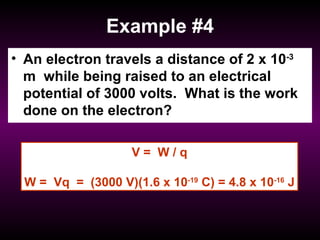
Example #4 Anelectron travels a distance of 2 x 10 -3 m while being raised to an electrical potential of 3000 volts. What is the work done on the electron? V = W / q W = Vq = (3000 V)(1.6 x 10 -19 C) = 4.8 x 10 -16 J
8.
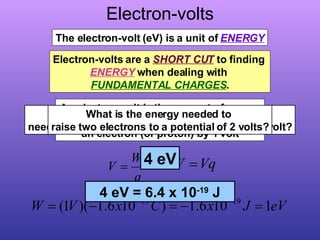
Electron-volts An electron-voltis the amount of energy needed to raise the electrical potential of an electron (or proton) by 1 volt The electron-volt (eV) is a unit of ENERGY Electron-volts are a SHORT CUT to finding ENERGY when dealing with FUNDAMENTAL CHARGES . What is the energy needed to raise two electrons to a potential of 1 volt? 2 eV What is the energy needed to raise two electrons to a potential of 2 volts? 4 eV 2 eV = 3.2 x 10 -19 J 4 eV = 6.4 x 10 -19 J
9.
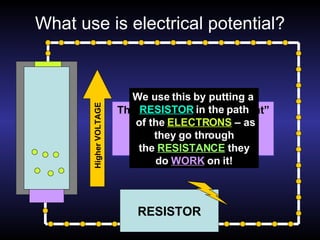
What use iselectrical potential? A battery is a tool that forces electrons to a higher electrical P.E. - gives them VOLTAGE Higher VOLTAGE The electrons naturally “want” to drop to a lower energy How do they get there? We use this by putting a RESISTOR in the path of the ELECTRONS – as they go through the RESISTANCE they do WORK on it! RESISTOR