Representation“Identify is complicated Everyone thinks they’ve got one. Artists play with the idea in modern society. ” – David Gauntlett
To reinforce basic representation theoryTo understand how to evaluate our coursework against key theoriesObjectives
David Chandler- Representation refers to the construction in any medium of aspects of ‘reality’ such as people, places, objects, events, cultural identities and other abstract conceptsRepresentation always involves 'theconstruction of reality'What is Representation?
Systems of representation are themeans by which the concerns of ideologies are framed; such systems ‘position’ their subjectsRoland Barthes ‘Myth’ – mythic in the sense of having the appearance of being natural or commonsenseThings Appear Natural
WHO or WHAT is being represented?HOW is the representation created?WHO has created the representation?WHY has it been created in that way?WHAT is the effect of the representation?Questions…
All texts, however 'realistic' they may seem to be, are constructed representations rather than simply transparent 'reflections', recordings, transcriptions or reproductions of a pre-existing realityRepresentations which become familiar through constant re-use come to feel 'natural' and unmediatedSemiotics
The representation is constructed with a set of ideas / values (intended meaning)The context of the representation is part of the representation (form, genre expectations, media language)The audience reacts to this representation and this depends on their own personal interpretational context i.e. age, gender, beliefs (negotiated meaning)The Constructionist Approach
Archetype – a familiar characters from hundreds of years of fairytalesStereotype – generalisations used to appeal to particular audiences; easily recognisableGeneric type – familiar through particular genresCharacter Typing
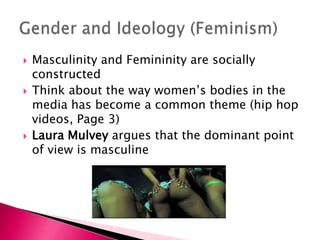
Masculinity and Femininity are socially constructedThink about the way women’s bodies in the media has become a common theme (hip hop videos, Page 3)Laura Mulveyargues that the dominant point of view is masculineGender and Ideology (Feminism)
John Berger:	“Men act and women appear” 	“Men look at women. Women watch themselves being looked at”Ways of Seeing
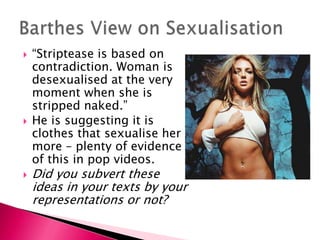
“Striptease is based on contradiction. Woman is desexualised at the very moment when she is stripped naked.”He is suggesting it is clothes that sexualise her more – plenty of evidence of this in pop videos. Did you subvert these ideas in your texts by your representations or not?Barthes View on Sexualisation
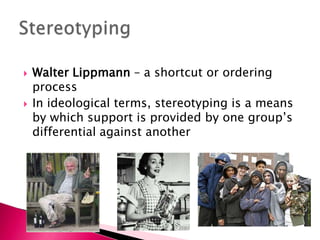
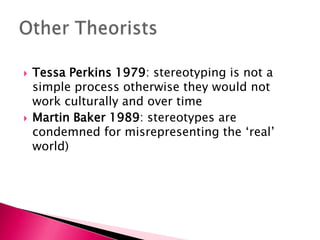
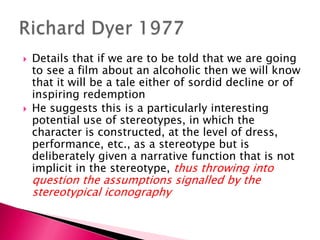
Walter Lippmann – a shortcut or ordering processIn ideological terms, stereotyping is a means by which support is provided by one group’s differential against anotherStereotyping
Tessa Perkins 1979: stereotyping is not a simple process otherwise they would not work culturally and over timeMartin Baker 1989: stereotypes are condemned for misrepresenting the ‘real’ world)Other Theorists
Details that if we are to be told that we are going to see a film about an alcoholic then we will know that it will be a tale either of sordid decline or of inspiring redemptionHe suggests this is a particularly interesting potential use of stereotypes, in which the character is constructed, at the level of dress, performance, etc., as a stereotype but is deliberately given a narrative function that is not implicit in the stereotype, thus throwing into question the assumptions signalled by the stereotypical iconographyRichard Dyer 1977
‘Representations in media texts are often simplistic and reinforce dominant ideologies so that audiences can make sense of them’Evaluate the ways you have used/challenged simplistic representations in one of the media products you have produces. Practice

Section 1 b representation

  • 1.
    Representation“Identify is complicatedEveryone thinks they’ve got one. Artists play with the idea in modern society. ” – David Gauntlett
  • 2.
    To reinforce basicrepresentation theoryTo understand how to evaluate our coursework against key theoriesObjectives
  • 3.
    David Chandler- Representationrefers to the construction in any medium of aspects of ‘reality’ such as people, places, objects, events, cultural identities and other abstract conceptsRepresentation always involves 'theconstruction of reality'What is Representation?
  • 4.
    Systems of representationare themeans by which the concerns of ideologies are framed; such systems ‘position’ their subjectsRoland Barthes ‘Myth’ – mythic in the sense of having the appearance of being natural or commonsenseThings Appear Natural
  • 5.
    WHO or WHATis being represented?HOW is the representation created?WHO has created the representation?WHY has it been created in that way?WHAT is the effect of the representation?Questions…
  • 6.
    All texts, however'realistic' they may seem to be, are constructed representations rather than simply transparent 'reflections', recordings, transcriptions or reproductions of a pre-existing realityRepresentations which become familiar through constant re-use come to feel 'natural' and unmediatedSemiotics
  • 7.
    The representation isconstructed with a set of ideas / values (intended meaning)The context of the representation is part of the representation (form, genre expectations, media language)The audience reacts to this representation and this depends on their own personal interpretational context i.e. age, gender, beliefs (negotiated meaning)The Constructionist Approach
  • 8.
    Archetype – afamiliar characters from hundreds of years of fairytalesStereotype – generalisations used to appeal to particular audiences; easily recognisableGeneric type – familiar through particular genresCharacter Typing
  • 9.
    Masculinity and Femininityare socially constructedThink about the way women’s bodies in the media has become a common theme (hip hop videos, Page 3)Laura Mulveyargues that the dominant point of view is masculineGender and Ideology (Feminism)
  • 10.
    John Berger: “Men actand women appear” “Men look at women. Women watch themselves being looked at”Ways of Seeing
  • 11.
    “Striptease is basedon contradiction. Woman is desexualised at the very moment when she is stripped naked.”He is suggesting it is clothes that sexualise her more – plenty of evidence of this in pop videos. Did you subvert these ideas in your texts by your representations or not?Barthes View on Sexualisation
  • 12.
    Walter Lippmann –a shortcut or ordering processIn ideological terms, stereotyping is a means by which support is provided by one group’s differential against anotherStereotyping
  • 13.
    Tessa Perkins 1979:stereotyping is not a simple process otherwise they would not work culturally and over timeMartin Baker 1989: stereotypes are condemned for misrepresenting the ‘real’ world)Other Theorists
  • 14.
    Details that ifwe are to be told that we are going to see a film about an alcoholic then we will know that it will be a tale either of sordid decline or of inspiring redemptionHe suggests this is a particularly interesting potential use of stereotypes, in which the character is constructed, at the level of dress, performance, etc., as a stereotype but is deliberately given a narrative function that is not implicit in the stereotype, thus throwing into question the assumptions signalled by the stereotypical iconographyRichard Dyer 1977
  • 15.
    ‘Representations in mediatexts are often simplistic and reinforce dominant ideologies so that audiences can make sense of them’Evaluate the ways you have used/challenged simplistic representations in one of the media products you have produces. Practice