Representation
If only it was that simple…
what is it
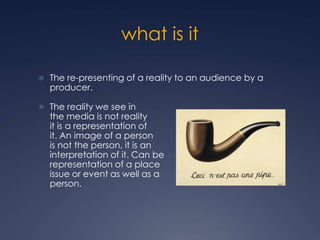
 The re-presenting of a reality to an audience by a
producer.
 The reality we see in
the media is not reality
it is a representation of
it. An image of a person
is not the person, it is an
interpretation of it. Can be
representation of a place
issue or event as well as a
person.
mediation
 Is the process of taking a reality, interpreting it,
and re-presenting it to the audience.
 All media goes through this process, it cannot be
otherwise.
 Even reality TV is not real reality, Big Brother for
example has carefully chosen housemates, the
cameras will select certain angles, and the
program makers will select certain scenes to
broadcast and some not to.
Types of representation
 Reflective – taking a true meaning and trying to
replicate it. Is this how the news works?
 Intentional – what becomes influential here is the
person doing the representation, so that they
create a representation that will mean the same
to the audience as the producer intended.
 Constructionist – acknowledges the audiences
mind to accept or reject what it sees.
Constructionist representation
 Each representation has four factors
 The thing itself
 The opinions of the people doing the
representation
 The reaction of the individual to the
representation
 The context of the society in which the
representation is taking place
Questions to ask
 What/who is being represented?
 In what way? Using what codes? Within what genre?
 By whom? At whom is it targeted?
 Why are they being represented this way?
 What does it mean to you? For others?
 Is the representation fair and accurate?
 What opportunities exist for self-representation for the
subject?
Richard Dyer
 “How we are seen determines how we are
treated, how we treat others is based on how we
see them, How we see them comes from
representation’ ( The Matter of Images)
 Your only experience of the group being
represented might be the media text that the
representation is in.
David Chandler
 Representation refers to the construction in any
medium of aspects of ‘reality’ such as people,
places, objects, events, cultural identities and
other abstract concepts.
 Representation always involves ‘the construction
of reality’
Myths
 Representations can be founded on a reality or
indeed a reality that does not exist
 Roland Barthes argued that representations are
mythic in the sense that they have an
appearance of being natural or commonsensial.
 Representations are problematic and simulations
of realities which don’t exist, A blurring between
what is real and what is not, eg celebrity images.
This hyper reality theory was developed by Jean
Baudrillard
reading the photograph
 As an iconic sign the photograph closely
resembles the object.
 Fiske 1982 ‘Denotation is what is photographed
and connotation is how it is photographed’
 Because the photographic signifier closely
resembles its signified, it can appear a ‘natural
sign’ one made intervention of any codes
(Barthes 1980)
Dick Hebdidge
 A subculture is a group who feel neglected by
societal standards, and develop a sense of
identity differing from the dominant.
 They use style of represent their resistance to the
dominant ideologies of a corrupt society. They
use symbols like clothes, scooters
(Quadrophenia) and modify them to show
their alternative values.
Ken Gelder - subcultures
 Ken Gelder lists 6 ways they can be identified
 1) negative attitude to work
2) negative attitude to class
3) association with territory rather tan property
4) excess
5) social groups more important than family
6) refusing to engage in banalities of life.
 Other ways might be symbolism of clothes,
music, personal affectations tatooes piercings.
TV and representation
 ‘Television is... the most rewarding medium to use
when teaching representations of class because
of the contradictions which involve a mass
medium attempting to reach all the parts of its
class-differentiated audience simultaneously...’
(Alvarado et al. 1987)
Stereotyping
 Walter Lippman said that stereotypes were a
shortcut or an ordering process.
 A way of segregating groups of highlighting
differences, the otherness of a group.
 Tessa Perkins (1979) stereotyping is not a simple
process other wise it wouldn’t work
 Martin Baker (1989) stereotypes are condemned
for misrepresenting the ‘real world,
So what does this mean for you?
 You have all used representations, you have all
imaged something that is real, even though it
might have been a creation ad represented it in
your work.
 But how have you done that?
 The signs and symbols you have used and the
technical codes you have used.
Break it down
 You created your character, you dressed them a
certain way, make-up, hair, body adornment.
 You had them act a certain way, body language,
facial expression
 You imaged them a certain way – lighting style,
camera angle, shot them from close or far, direct or
indirect mode of address, close up or long shots
 You then carried out post-production on that image
to colourize, increase contrast, correct blemishes
Your answer will….
 Put all these different aspects together, the
theory and what you did to create the
representation that you created.
 Simple…..

1brepresentation

  • 1.
    Representation If only itwas that simple…
  • 2.
    what is it The re-presenting of a reality to an audience by a producer.  The reality we see in the media is not reality it is a representation of it. An image of a person is not the person, it is an interpretation of it. Can be representation of a place issue or event as well as a person.
  • 3.
    mediation  Is theprocess of taking a reality, interpreting it, and re-presenting it to the audience.  All media goes through this process, it cannot be otherwise.  Even reality TV is not real reality, Big Brother for example has carefully chosen housemates, the cameras will select certain angles, and the program makers will select certain scenes to broadcast and some not to.
  • 4.
    Types of representation Reflective – taking a true meaning and trying to replicate it. Is this how the news works?  Intentional – what becomes influential here is the person doing the representation, so that they create a representation that will mean the same to the audience as the producer intended.  Constructionist – acknowledges the audiences mind to accept or reject what it sees.
  • 5.
    Constructionist representation  Eachrepresentation has four factors  The thing itself  The opinions of the people doing the representation  The reaction of the individual to the representation  The context of the society in which the representation is taking place
  • 6.
    Questions to ask What/who is being represented?  In what way? Using what codes? Within what genre?  By whom? At whom is it targeted?  Why are they being represented this way?  What does it mean to you? For others?  Is the representation fair and accurate?  What opportunities exist for self-representation for the subject?
  • 7.
    Richard Dyer  “Howwe are seen determines how we are treated, how we treat others is based on how we see them, How we see them comes from representation’ ( The Matter of Images)  Your only experience of the group being represented might be the media text that the representation is in.
  • 8.
    David Chandler  Representationrefers to the construction in any medium of aspects of ‘reality’ such as people, places, objects, events, cultural identities and other abstract concepts.  Representation always involves ‘the construction of reality’
  • 9.
    Myths  Representations canbe founded on a reality or indeed a reality that does not exist  Roland Barthes argued that representations are mythic in the sense that they have an appearance of being natural or commonsensial.  Representations are problematic and simulations of realities which don’t exist, A blurring between what is real and what is not, eg celebrity images. This hyper reality theory was developed by Jean Baudrillard
  • 10.
    reading the photograph As an iconic sign the photograph closely resembles the object.  Fiske 1982 ‘Denotation is what is photographed and connotation is how it is photographed’  Because the photographic signifier closely resembles its signified, it can appear a ‘natural sign’ one made intervention of any codes (Barthes 1980)
  • 11.
    Dick Hebdidge  Asubculture is a group who feel neglected by societal standards, and develop a sense of identity differing from the dominant.  They use style of represent their resistance to the dominant ideologies of a corrupt society. They use symbols like clothes, scooters (Quadrophenia) and modify them to show their alternative values.
  • 12.
    Ken Gelder -subcultures  Ken Gelder lists 6 ways they can be identified  1) negative attitude to work 2) negative attitude to class 3) association with territory rather tan property 4) excess 5) social groups more important than family 6) refusing to engage in banalities of life.  Other ways might be symbolism of clothes, music, personal affectations tatooes piercings.
  • 13.
    TV and representation ‘Television is... the most rewarding medium to use when teaching representations of class because of the contradictions which involve a mass medium attempting to reach all the parts of its class-differentiated audience simultaneously...’ (Alvarado et al. 1987)
  • 14.
    Stereotyping  Walter Lippmansaid that stereotypes were a shortcut or an ordering process.  A way of segregating groups of highlighting differences, the otherness of a group.  Tessa Perkins (1979) stereotyping is not a simple process other wise it wouldn’t work  Martin Baker (1989) stereotypes are condemned for misrepresenting the ‘real world,
  • 15.
    So what doesthis mean for you?  You have all used representations, you have all imaged something that is real, even though it might have been a creation ad represented it in your work.  But how have you done that?  The signs and symbols you have used and the technical codes you have used.
  • 16.
    Break it down You created your character, you dressed them a certain way, make-up, hair, body adornment.  You had them act a certain way, body language, facial expression  You imaged them a certain way – lighting style, camera angle, shot them from close or far, direct or indirect mode of address, close up or long shots  You then carried out post-production on that image to colourize, increase contrast, correct blemishes
  • 17.
    Your answer will…. Put all these different aspects together, the theory and what you did to create the representation that you created.  Simple…..