G235: Critical
Perspectives in Media

Theoretical Evaluation
         of Production

   1b) Representation
Aims/Objectives
•   To reinforce basic representation
    theory.
•   To have a basic understanding of how
    to evaluate your coursework against
    key representation theory.
•   To produce a narrative answer
This is about…
• For your coursework, this will focus on you
  analysing how you have represented:
• Place (regional identity)
• People (gender, class, ethnicity, disability,
  sexuality, age)
• There must be a comment about the ideas
  you have communicated about them
  (ideologies) and whether they are
  stereotypical or/reinforce
  traditional/dominant ideologies or not.
1. Representation – Basic Definition
  • Stuart Hall (1980)
  • How the media shows us things about
    society – but this is through careful
    mediation. Hence re-presentation.
  • For representation to be meaningful to
    audiences there needs to be a shared
    recognition of people, situations, ideas etc.
Mediation works in 3 ways
• James Baker (2007)
• 1. Selection: Whatever ends up on the
  screen or in the paper, much more will
  have been left out.
• 2. Organisation: The various elements will
  be organised carefully in ways that real life
  is not
• 3. Focusing: mediation always ends up with
  us, the audience being encouraged towards
  concentrating on one aspect of the text and
  ignoring others.
Task 1. Mediation
• You have 5 minutes to write down what
  you are representing in your production
  (Place? People?).
• Pick 1 example write down how you:
• 1. Selected certain elements to mediate
  your representation.
• 2. Organised these elements to mediate
  your representations.
• 3. How you encouraged your audience to
  focus on one aspect to help mediate your
  representations.
2. Context of representation
 • Richard Dyer (1983) posed a few questions
   when analysing media representations in
   general.
 • 1. What sense of the world is it making?
 • 2. What does it imply? Is it typical of the
   world or deviant?
 • 3. Who is it speaking to? For whom? To
   whom?
 • 4. What does it represent to us and why?
   How do we respond to the representation?
• James Baker (2007) suggests that there are 3
  ways to look at representation:
• The Reflective view
• According to this view, when we represent
  something, we are taking its true meaning and
  trying to create a replica of it in the mind of our
  audience — like a reflection.
• The Intentional view
• This is the opposite of the Reflective idea. This
  time the most important thing in the process of
  representation is the person doing the
  representing to mean (adverts).
.
The Constructionist view
As an individual to make up your own mind and
  the influences of the society that you live in on
  the way that you do so.
• Any representation is a mixture of:
• 1. The thing itself.
• 2. The opinions of the people doing the
  representation
• 3. The reaction of the individual to the
  representation
• 4. The context of the society in which the
  representation is taking place.
Task 2. Context/Reception
• Pick 1 example.
• How have you been tried to be reflective
  ( create a mirror of reality)?
• How have you been intentional
  (deliberately encoded point of view)?
• How are your audience meant to respond
  to this representation?
3. Ideologies behind representation
 Tim O’Sullivan et al. (1998) Ideology – refers to a
 set of ideas which produces a partial and
 selective view of reality. Notion of ideology
 entails widely held ideas or beliefs which are
 seen as ‘common’ sense and become
 naturalised.

 What is important is that, in Marxist terms, the
 media’s role may be seen as :
 •Circulating and reinforcing dominant ideologies
 •(less frequently) undermining and challenging
 such ideologies.
Ideologies and Representation (MARXISM)
• A hegemonic view of society – fundamental
  inequalities in power between social
  groups. Groups in power exercise their
  influence culturally rather than by force.
• Concept has origins in Marxist theory -
  ruling capitalist class are able to protect
  their economic interests.
• Representations are encoded into mass
  media texts in order to do this – reinforce
  dominant ideologies in society – links
  therefore to mediation and creating a
  preferred meaning for the audience.
Task 3. Ideologies
• Pick 1/2 examples.
• What dominant ideologies have you
  reinforced in your representations?
• How have you done this?

• If you have challenged dominant
  ideologies, how have you done this?
4. Stereotypes and Countertypes
• O’Sullivan et al (1998) details that a
  stereotype is a label that involves a process
  of categorisation and evaluation.
• We can call stereotypes shorthand to
  narratives because such simplistic
  representations define our understanding
  of media texts – e.g we know who is good
  and who is evil.
• First coined by Walter Lippmann the word
  stereotype wasn’t meant to be negative
  and was simply meant as a shortcut or
  ordering process.
• In ideological terms, stereotyping is a
  means by which support is provided by one
  group’s differential against another.

• Richard Dyer (1977) the types produced by
  different social groups according to their sense
  of who belongs and who doesn't, who is 'in' and
  who is not creates stereotypes.
• Tessa Perkins (1979) says, however, that
  stereotyping is not a simple process. She
  identified that some of the many ways that
  stereotypes are assumed to operate aren’t
  true.
• Perkins argues that if stereotypes were always
  so simple then they would not work culturally
  and over time.
• Countertypes are representations that
  deliberately go against cultural, hegemonic
  stereotypes.
Task 4. Stereotypes
• Pick 3 examples.
• Did you use stereotypes to represent/tell
  stories about place/person/ reinforce
  ideology?

• If you have used countertypes, how have
  you done this?
5. Representing the social –
             Gender/Race/Age
• Gender
• Masculinity and femininity are socially
  constructed.
• Ideas about gender are produced and reflected in
  language O’ Sullivan et al (1998).
• Feminism is a label that refers to a broad range of
  views containing one shared assumption – gender
  inequalities in society, historically masculine
  power (patriarchy) exercised at right of women’s
  interests and rights.
• Age
• Representations of age are clearly based on ideas
  about binary opposition (Strauss, 1958).

• De Fleur suggested that carefully mediated
  representations create social value statements
  and they change accordingly over time.

• Youth groups have been ‘demonised’ by the mass
  media, creating moral panics (Stanley Cohen,
  1972) about youth groups and subcultures.
• Race
• Representations of race are clearly based on ideas
  about binary opposition (Strauss, 1958).

• Edward Said (1978) that representations of non-
  white groups are based on the notion of the
  ‘other’, constructed as something ‘exotic’ (Hall,
  1997).
Task 5. Representing the social
• Pick 3 examples.
• Look at the theories from within feminism,
  racial, age discourses.
• Did you represent age/gender/race
  stereotypically?
• Why did you do this?
John Berger ‘Ways Of Seeing’ (1972)
“Men act and women appear”. “Men
  look at women. Women watch
  themselves being looked at”.
“Women are aware of being seen by a
  male spectator”
Gay Gaze
• It can be argued that we can also have a
  ‘gay male gaze’ (Steve Neale, 1992).
  Images which show men in passive,
  submissive, sexualised poses – lying down,
  looking up at the camera so that the viewer
  is dominant can be described as
  homoerotic. In this case the male subject
  will have hands behind their heads in a
  pose which could suggest relaxation but
  could also be read as submissive and non-
  aggressive.
POSTMODERNISM AND
 REPRESENTATIONS OF REALITY
• In a media saturated world, the distinction
  between reality and media representations
  becomes blurred or invisible to us (Julian
  McDougall, 2009).
• Modern period came before – people were
  concerned with representing reality, but
  now this gets mixed around and we end up
  with pastiche, parody and intertextuality.
  For example, Daniel Strinati (1995) details
  that “reality is now only definable in terms
  of the reflections of the mirror”.
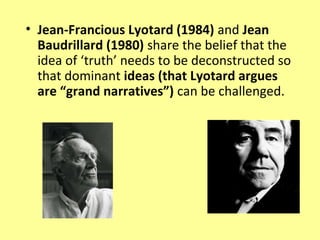
• Jean-Francious Lyotard (1984) and Jean
  Baudrillard (1980) share the belief that the
  idea of ‘truth’ needs to be deconstructed so
  that dominant ideas (that Lyotard argues
  are “grand narratives”) can be challenged.
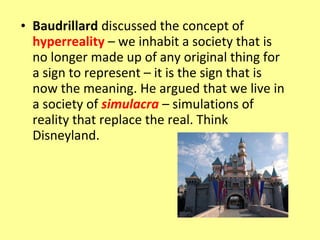
• Baudrillard discussed the concept of
  hyperreality – we inhabit a society that is
  no longer made up of any original thing for
  a sign to represent – it is the sign that is
  now the meaning. He argued that we live in
  a society of simulacra – simulations of
  reality that replace the real. Think
  Disneyland.
Essay
• Analyse one of your media productions in
  relation to representation.

• It is vital for this that you have an
  understanding of how representations have
  been created in existing media texts as you
  will need to reference these with explicit
  examples as part of your essay.

Representation exam

  • 1.
    G235: Critical Perspectives inMedia Theoretical Evaluation of Production 1b) Representation
  • 2.
    Aims/Objectives • To reinforce basic representation theory. • To have a basic understanding of how to evaluate your coursework against key representation theory. • To produce a narrative answer
  • 3.
    This is about… •For your coursework, this will focus on you analysing how you have represented: • Place (regional identity) • People (gender, class, ethnicity, disability, sexuality, age) • There must be a comment about the ideas you have communicated about them (ideologies) and whether they are stereotypical or/reinforce traditional/dominant ideologies or not.
  • 4.
    1. Representation –Basic Definition • Stuart Hall (1980) • How the media shows us things about society – but this is through careful mediation. Hence re-presentation. • For representation to be meaningful to audiences there needs to be a shared recognition of people, situations, ideas etc.
  • 5.
    Mediation works in3 ways • James Baker (2007) • 1. Selection: Whatever ends up on the screen or in the paper, much more will have been left out. • 2. Organisation: The various elements will be organised carefully in ways that real life is not • 3. Focusing: mediation always ends up with us, the audience being encouraged towards concentrating on one aspect of the text and ignoring others.
  • 6.
    Task 1. Mediation •You have 5 minutes to write down what you are representing in your production (Place? People?). • Pick 1 example write down how you: • 1. Selected certain elements to mediate your representation. • 2. Organised these elements to mediate your representations. • 3. How you encouraged your audience to focus on one aspect to help mediate your representations.
  • 7.
    2. Context ofrepresentation • Richard Dyer (1983) posed a few questions when analysing media representations in general. • 1. What sense of the world is it making? • 2. What does it imply? Is it typical of the world or deviant? • 3. Who is it speaking to? For whom? To whom? • 4. What does it represent to us and why? How do we respond to the representation?
  • 8.
    • James Baker(2007) suggests that there are 3 ways to look at representation: • The Reflective view • According to this view, when we represent something, we are taking its true meaning and trying to create a replica of it in the mind of our audience — like a reflection. • The Intentional view • This is the opposite of the Reflective idea. This time the most important thing in the process of representation is the person doing the representing to mean (adverts). .
  • 9.
    The Constructionist view Asan individual to make up your own mind and the influences of the society that you live in on the way that you do so. • Any representation is a mixture of: • 1. The thing itself. • 2. The opinions of the people doing the representation • 3. The reaction of the individual to the representation • 4. The context of the society in which the representation is taking place.
  • 10.
    Task 2. Context/Reception •Pick 1 example. • How have you been tried to be reflective ( create a mirror of reality)? • How have you been intentional (deliberately encoded point of view)? • How are your audience meant to respond to this representation?
  • 11.
    3. Ideologies behindrepresentation Tim O’Sullivan et al. (1998) Ideology – refers to a set of ideas which produces a partial and selective view of reality. Notion of ideology entails widely held ideas or beliefs which are seen as ‘common’ sense and become naturalised. What is important is that, in Marxist terms, the media’s role may be seen as : •Circulating and reinforcing dominant ideologies •(less frequently) undermining and challenging such ideologies.
  • 12.
    Ideologies and Representation(MARXISM) • A hegemonic view of society – fundamental inequalities in power between social groups. Groups in power exercise their influence culturally rather than by force. • Concept has origins in Marxist theory - ruling capitalist class are able to protect their economic interests. • Representations are encoded into mass media texts in order to do this – reinforce dominant ideologies in society – links therefore to mediation and creating a preferred meaning for the audience.
  • 13.
    Task 3. Ideologies •Pick 1/2 examples. • What dominant ideologies have you reinforced in your representations? • How have you done this? • If you have challenged dominant ideologies, how have you done this?
  • 14.
    4. Stereotypes andCountertypes • O’Sullivan et al (1998) details that a stereotype is a label that involves a process of categorisation and evaluation. • We can call stereotypes shorthand to narratives because such simplistic representations define our understanding of media texts – e.g we know who is good and who is evil.
  • 15.
    • First coinedby Walter Lippmann the word stereotype wasn’t meant to be negative and was simply meant as a shortcut or ordering process. • In ideological terms, stereotyping is a means by which support is provided by one group’s differential against another. • Richard Dyer (1977) the types produced by different social groups according to their sense of who belongs and who doesn't, who is 'in' and who is not creates stereotypes.
  • 16.
    • Tessa Perkins(1979) says, however, that stereotyping is not a simple process. She identified that some of the many ways that stereotypes are assumed to operate aren’t true. • Perkins argues that if stereotypes were always so simple then they would not work culturally and over time. • Countertypes are representations that deliberately go against cultural, hegemonic stereotypes.
  • 17.
    Task 4. Stereotypes •Pick 3 examples. • Did you use stereotypes to represent/tell stories about place/person/ reinforce ideology? • If you have used countertypes, how have you done this?
  • 18.
    5. Representing thesocial – Gender/Race/Age • Gender • Masculinity and femininity are socially constructed. • Ideas about gender are produced and reflected in language O’ Sullivan et al (1998). • Feminism is a label that refers to a broad range of views containing one shared assumption – gender inequalities in society, historically masculine power (patriarchy) exercised at right of women’s interests and rights.
  • 19.
    • Age • Representationsof age are clearly based on ideas about binary opposition (Strauss, 1958). • De Fleur suggested that carefully mediated representations create social value statements and they change accordingly over time. • Youth groups have been ‘demonised’ by the mass media, creating moral panics (Stanley Cohen, 1972) about youth groups and subcultures.
  • 20.
    • Race • Representationsof race are clearly based on ideas about binary opposition (Strauss, 1958). • Edward Said (1978) that representations of non- white groups are based on the notion of the ‘other’, constructed as something ‘exotic’ (Hall, 1997).
  • 21.
    Task 5. Representingthe social • Pick 3 examples. • Look at the theories from within feminism, racial, age discourses. • Did you represent age/gender/race stereotypically? • Why did you do this?
  • 22.
    John Berger ‘WaysOf Seeing’ (1972) “Men act and women appear”. “Men look at women. Women watch themselves being looked at”. “Women are aware of being seen by a male spectator”
  • 23.
    Gay Gaze • Itcan be argued that we can also have a ‘gay male gaze’ (Steve Neale, 1992). Images which show men in passive, submissive, sexualised poses – lying down, looking up at the camera so that the viewer is dominant can be described as homoerotic. In this case the male subject will have hands behind their heads in a pose which could suggest relaxation but could also be read as submissive and non- aggressive.
  • 24.
    POSTMODERNISM AND REPRESENTATIONSOF REALITY • In a media saturated world, the distinction between reality and media representations becomes blurred or invisible to us (Julian McDougall, 2009). • Modern period came before – people were concerned with representing reality, but now this gets mixed around and we end up with pastiche, parody and intertextuality. For example, Daniel Strinati (1995) details that “reality is now only definable in terms of the reflections of the mirror”.
  • 25.
    • Jean-Francious Lyotard(1984) and Jean Baudrillard (1980) share the belief that the idea of ‘truth’ needs to be deconstructed so that dominant ideas (that Lyotard argues are “grand narratives”) can be challenged.
  • 26.
    • Baudrillard discussedthe concept of hyperreality – we inhabit a society that is no longer made up of any original thing for a sign to represent – it is the sign that is now the meaning. He argued that we live in a society of simulacra – simulations of reality that replace the real. Think Disneyland.
  • 27.
    Essay • Analyse oneof your media productions in relation to representation. • It is vital for this that you have an understanding of how representations have been created in existing media texts as you will need to reference these with explicit examples as part of your essay.