Four key concepts
Audience
The key issue here is to explore, who is being represented and why, and by whom and how?
Fairness of representation has always been a critical area of enquiry in Media Studies. The key
questions are: who are the target audience, what is missing & why? Every media text is made with
someone in mind, so we have to think who do you think the preferred audience is for this text, and
how do you think they are expected to interpret it? If it's an ad, will they buy the product? If it's a
title sequence, will they keep watching?
Institution
Issues of ownership and control, marketing, advertising, commercial influence on products,
regulatory bodies, gatekeeping etc.
Media institutions arrange, create, illustrate, design, put together, print or broadcast, advertise and
distribute media products to the masses. It’s important to understand how these media institutions
work and how they work can influence the media products. How a text is influenced by various
institutions? Your next step is to consider who constructed the text. Was it a big, powerful company
with millions of dollars to command, or is it a small, local production?
language
Media messages are encoded and then interpreted by audience. Encoding is the process by which a
source performs conversion of information into data. Interpreting is the reverse process of
converting data into information understandable by a receiver. Encoding is the process of expressing
messages, that is, person's skill of using language to carry messages. Decoding is the process of
analysing the message, that is, a person's skill of understanding language. Language is a code
established through rules and regulations. These rules govern the meaning and usage of the code.
The understanding (decoding) and production (encoding) of the code is also based on mutual
agreement of these rules. This process of communication requires the use of media language. News
and information, analysis and interpretations, education, public relations, sales and advertising are
mass messages. These messages are the noticeable part of our relationship to the media and it is
for these messages that we pay attention to media.
representation
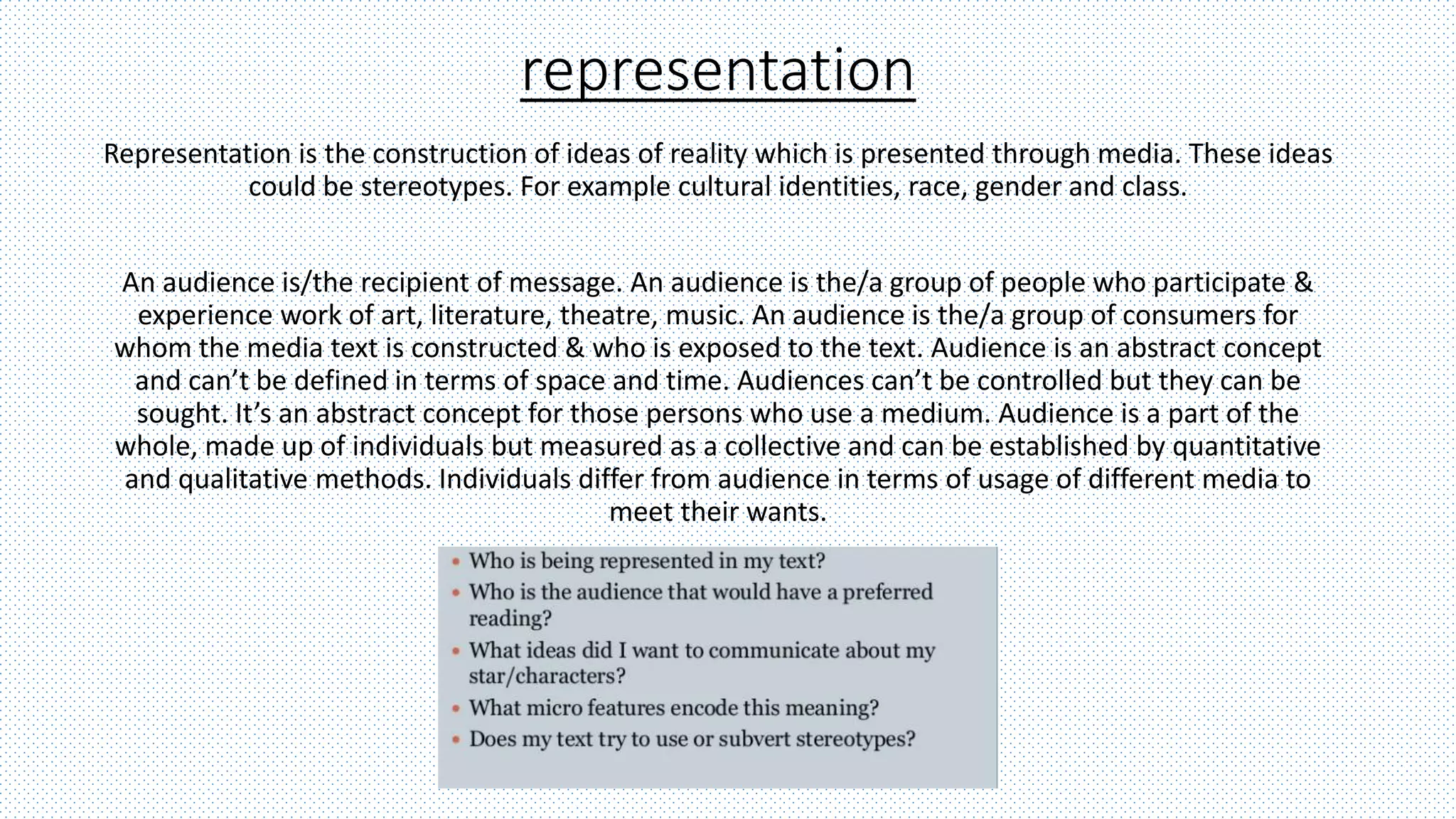
Representation is the construction of ideas of reality which is presented through media. These ideas
could be stereotypes. For example cultural identities, race, gender and class.
An audience is/the recipient of message. An audience is the/a group of people who participate &
experience work of art, literature, theatre, music. An audience is the/a group of consumers for
whom the media text is constructed & who is exposed to the text. Audience is an abstract concept
and can’t be defined in terms of space and time. Audiences can’t be controlled but they can be
sought. It’s an abstract concept for those persons who use a medium. Audience is a part of the
whole, made up of individuals but measured as a collective and can be established by quantitative
and qualitative methods. Individuals differ from audience in terms of usage of different media to
meet their wants.
How do these key concepts relate
to game shows?
Audience
Here we need to think about why game shows have stayed so popular through decades. It is
important to consider the demographic profile of different audience groups. Why do audiences
watch television game shows? By exploring a range of examples, there is different reasons to how
game shows appeal to different audiences. Consider that television game shows tend to feature on
the schedules of daytime television.
institution
Who produces television game shows is important in this key concept. Game shows have a long
tradition of being associated with spin-offs. For example, board games. Increasingly these spin-offs
have become more varied and a study of this will help people to recognise the value of synergies,
convergence and multi-platform promotion.
language
The genre is broad and many subgenres exist and fall under the umbrella of the television game
show. however, there is more typical style and accepted set of conventions that ensures that they
appeal to audiences. The tension and excitement for contestants, studio audience and viewers
watching it at home is also a very important factor. The role of the host- managing and leading
contestants through various rounds and stages of the competition. With that comes catchphrases
(some of which have become part of our everyday vocabulary). Hosts put the contestants at ease
and often us humour.
Representation
Many television shows are aimed at mainstream audiences and have broad appeal. Part of that
appeal is having contestants from all walks of life competing- either just for a challenge, but often
the fantastic prizes. Audiences can relate to these people. It is important to recognise how the
contestants are represented and why are they presented in that way. This then links to how the host
in represented for example, could be formal.

Four key concepts of media studies

  • 1.
  • 2.
    Audience The key issuehere is to explore, who is being represented and why, and by whom and how? Fairness of representation has always been a critical area of enquiry in Media Studies. The key questions are: who are the target audience, what is missing & why? Every media text is made with someone in mind, so we have to think who do you think the preferred audience is for this text, and how do you think they are expected to interpret it? If it's an ad, will they buy the product? If it's a title sequence, will they keep watching?
  • 3.
    Institution Issues of ownershipand control, marketing, advertising, commercial influence on products, regulatory bodies, gatekeeping etc. Media institutions arrange, create, illustrate, design, put together, print or broadcast, advertise and distribute media products to the masses. It’s important to understand how these media institutions work and how they work can influence the media products. How a text is influenced by various institutions? Your next step is to consider who constructed the text. Was it a big, powerful company with millions of dollars to command, or is it a small, local production?
  • 4.
    language Media messages areencoded and then interpreted by audience. Encoding is the process by which a source performs conversion of information into data. Interpreting is the reverse process of converting data into information understandable by a receiver. Encoding is the process of expressing messages, that is, person's skill of using language to carry messages. Decoding is the process of analysing the message, that is, a person's skill of understanding language. Language is a code established through rules and regulations. These rules govern the meaning and usage of the code. The understanding (decoding) and production (encoding) of the code is also based on mutual agreement of these rules. This process of communication requires the use of media language. News and information, analysis and interpretations, education, public relations, sales and advertising are mass messages. These messages are the noticeable part of our relationship to the media and it is for these messages that we pay attention to media.
  • 5.
    representation Representation is theconstruction of ideas of reality which is presented through media. These ideas could be stereotypes. For example cultural identities, race, gender and class. An audience is/the recipient of message. An audience is the/a group of people who participate & experience work of art, literature, theatre, music. An audience is the/a group of consumers for whom the media text is constructed & who is exposed to the text. Audience is an abstract concept and can’t be defined in terms of space and time. Audiences can’t be controlled but they can be sought. It’s an abstract concept for those persons who use a medium. Audience is a part of the whole, made up of individuals but measured as a collective and can be established by quantitative and qualitative methods. Individuals differ from audience in terms of usage of different media to meet their wants.
  • 6.
    How do thesekey concepts relate to game shows?
  • 7.
    Audience Here we needto think about why game shows have stayed so popular through decades. It is important to consider the demographic profile of different audience groups. Why do audiences watch television game shows? By exploring a range of examples, there is different reasons to how game shows appeal to different audiences. Consider that television game shows tend to feature on the schedules of daytime television.
  • 8.
    institution Who produces televisiongame shows is important in this key concept. Game shows have a long tradition of being associated with spin-offs. For example, board games. Increasingly these spin-offs have become more varied and a study of this will help people to recognise the value of synergies, convergence and multi-platform promotion.
  • 9.
    language The genre isbroad and many subgenres exist and fall under the umbrella of the television game show. however, there is more typical style and accepted set of conventions that ensures that they appeal to audiences. The tension and excitement for contestants, studio audience and viewers watching it at home is also a very important factor. The role of the host- managing and leading contestants through various rounds and stages of the competition. With that comes catchphrases (some of which have become part of our everyday vocabulary). Hosts put the contestants at ease and often us humour.
  • 10.
    Representation Many television showsare aimed at mainstream audiences and have broad appeal. Part of that appeal is having contestants from all walks of life competing- either just for a challenge, but often the fantastic prizes. Audiences can relate to these people. It is important to recognise how the contestants are represented and why are they presented in that way. This then links to how the host in represented for example, could be formal.