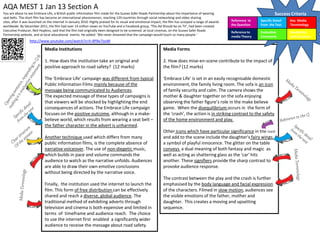
AQA MEST 1 Jan 13 Section A
You are about to see Embrace Life, a British public information film made for the Sussex Safer Roads Partnership about the importance of wearing
seat belts. The short film has become an international phenomenon, reaching 129 countries through social networking and video sharing
sites, after it was launched on the internet in January 2010. Highly praised for its visual and emotional impact, the film has scooped a range of awards
worldwide. By December 2011, the film had over 14 million views on YouTube and a Facebook group, ‘This Ad Should be on TV’, had been created.
Executive Producer, Neil Hopkins, said that the film had originally been designed to be screened at local cinemas, on the Sussex Safer Roads
Partnership website, and at local educational events. He added: ‘We never dreamed that the campaign would touch so many people.’

Success Criteria
Reference to
the Question

Specific Detail
from the Text

Key Media
Terminology

Reference to
media Theory

Evaluative
Comments

Readability
and Structure

http://www.youtube.com/watch?v=h-8PBx7isoM

Media Institutions

Media Forms

1. How does the institution take an original and
positive approach to road safety? (12 marks)

2. How does mise-en-scene contribute to the impact of
the film? (12 marks)

The 'Embrace Life' campaign was different from typical
Public Information Films mainly because of the
message being communicated to Audiences.
The expected message of these types of campaigns is
that viewers will be shocked by highlighting the end
consequences of actions. The Embrace Life campaign
focuses on the positive outcome, although in a makebelieve world, which results from wearing a seat belt –
the father character in the advert is unharmed.

'Embrace Life' is set in an easily recognisable domestic
environment, the family living room. The sofa is an icon
of family security and calm. The camera shows the
mother & daughter together on the sofa enjoying
observing the father figure’s role in the make believe
game. When the disequilibrium occurs in the form of
the ‘crash’, the action is in striking contrast to the safety
of the home environment and play.

Another technique used which differs from many
public information films, is the complete absence of
narrative voiceover. The use of non-diegetic music,
which builds in pace and volume commands the
audience to watch as the narrative unfolds. Audiences
are able to draw their own emotive conclusions
without being directed by the narrative voice.
Finally, the institution used the internet to launch the
film. This form of free distribution can be effectively
shared and reach a diverse, global audience. The
traditional method of exhibiting adverts through
television and cinema is both expensive and limited in
terms of timeframe and audience reach. The choice
to use the internet first enabled a significantly wider
audience to receive the message about road safety.

Other icons which have particular significance in the film
and add to the scene include the daughter's fairy wings,
a symbol of playful innocence. The glitter on the table
conveys a dual meaning of both fantasy and magic as
well as acting as shattering glass as the 'car' hits
another. These signifiers provide the sharp contrast to
provoke audience response.
The contrast between the play and the crash is further
emphasised by the body language and facial expression
of the characters. Filmed in slow motion, audiences see
the visible emotions of the father, mother and
daughter. This creates a moving and upsetting
sequence.
Success Criteria
Reference to
the Question

Specific Detail
from the Text

Key Media
Terminology

Reference to
media Theory

Evaluative
Comments

Readability
and Structure

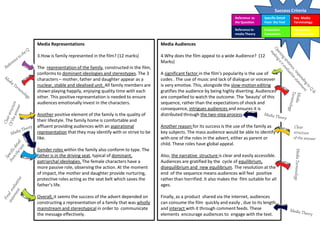
Media Representations

Media Audiences

3.How is family represented in the film? (12 marks)

4.Why does the film appeal to a wide Audience? (12
Marks)

The representation of the family, constructed in the film,
conforms to dominant ideologies and stereotypes. The 3
characters – mother, father and daughter appear as a
nuclear, stable and idealised unit. All family members are
shown playing happily, enjoying quality time with each
other. This positive representation is needed to ensure
audiences emotionally invest in the characters.
Another positive element of the family is the quality of
their lifestyle. The family home is comfortable and
affluent providing audiences with an aspirational
representation that they may identify with or strive to be
like.

A significant factor in the film's popularity is the use of
codes . The use of music and lack of dialogue or voiceover
is very emotive. This, alongside the slow-motion editing
gratifies the audience by being highly diverting. Audiences
are compelled to watch the outcome. The ‘beauty’ of this
sequence, rather than the expectations of shock and
consequence, intrigues audiences and ensures it is
distributed through the two-step process.
Another reason for its success is the use of the family as
key subjects. The mass audience would be able to identify
with one of the roles in the advert, either as parent or
child. These roles have global appeal.

Gender roles within the family also conform to type. The
father is in the driving seat, typical of dominant,
patriarchal ideologies. The female characters have a
more passive role, observing the action. At the moment
of impact, the mother and daughter provide nurturing,
protective roles acting as the seat belt which saves the
father’s life.

Also, the narrative structure is clear and easily accessible.
Audiences are gratified by the cycle of equilibrium,
disequilibrium and new equilibrium. The resolution at the
end of the sequence means audiences will feel positive
rather than horrified. It also makes the film suitable for all
ages.

Overall, it seems the success of the advert depended on
constructing a representation of a family that was wholly
mainstream and stereotypical in order to communicate
the message effectively.

Finally, as a product shared via the internet, audiences
can consume the film quickly and easily , due to its length,
and interact with it through comment feeds. These
elements encourage audiences to engage with the text.

Exam mentor mat

  • 1.
    AQA MEST 1Jan 13 Section A You are about to see Embrace Life, a British public information film made for the Sussex Safer Roads Partnership about the importance of wearing seat belts. The short film has become an international phenomenon, reaching 129 countries through social networking and video sharing sites, after it was launched on the internet in January 2010. Highly praised for its visual and emotional impact, the film has scooped a range of awards worldwide. By December 2011, the film had over 14 million views on YouTube and a Facebook group, ‘This Ad Should be on TV’, had been created. Executive Producer, Neil Hopkins, said that the film had originally been designed to be screened at local cinemas, on the Sussex Safer Roads Partnership website, and at local educational events. He added: ‘We never dreamed that the campaign would touch so many people.’ Success Criteria Reference to the Question Specific Detail from the Text Key Media Terminology Reference to media Theory Evaluative Comments Readability and Structure http://www.youtube.com/watch?v=h-8PBx7isoM Media Institutions Media Forms 1. How does the institution take an original and positive approach to road safety? (12 marks) 2. How does mise-en-scene contribute to the impact of the film? (12 marks) The 'Embrace Life' campaign was different from typical Public Information Films mainly because of the message being communicated to Audiences. The expected message of these types of campaigns is that viewers will be shocked by highlighting the end consequences of actions. The Embrace Life campaign focuses on the positive outcome, although in a makebelieve world, which results from wearing a seat belt – the father character in the advert is unharmed. 'Embrace Life' is set in an easily recognisable domestic environment, the family living room. The sofa is an icon of family security and calm. The camera shows the mother & daughter together on the sofa enjoying observing the father figure’s role in the make believe game. When the disequilibrium occurs in the form of the ‘crash’, the action is in striking contrast to the safety of the home environment and play. Another technique used which differs from many public information films, is the complete absence of narrative voiceover. The use of non-diegetic music, which builds in pace and volume commands the audience to watch as the narrative unfolds. Audiences are able to draw their own emotive conclusions without being directed by the narrative voice. Finally, the institution used the internet to launch the film. This form of free distribution can be effectively shared and reach a diverse, global audience. The traditional method of exhibiting adverts through television and cinema is both expensive and limited in terms of timeframe and audience reach. The choice to use the internet first enabled a significantly wider audience to receive the message about road safety. Other icons which have particular significance in the film and add to the scene include the daughter's fairy wings, a symbol of playful innocence. The glitter on the table conveys a dual meaning of both fantasy and magic as well as acting as shattering glass as the 'car' hits another. These signifiers provide the sharp contrast to provoke audience response. The contrast between the play and the crash is further emphasised by the body language and facial expression of the characters. Filmed in slow motion, audiences see the visible emotions of the father, mother and daughter. This creates a moving and upsetting sequence.
  • 2.
    Success Criteria Reference to theQuestion Specific Detail from the Text Key Media Terminology Reference to media Theory Evaluative Comments Readability and Structure Media Representations Media Audiences 3.How is family represented in the film? (12 marks) 4.Why does the film appeal to a wide Audience? (12 Marks) The representation of the family, constructed in the film, conforms to dominant ideologies and stereotypes. The 3 characters – mother, father and daughter appear as a nuclear, stable and idealised unit. All family members are shown playing happily, enjoying quality time with each other. This positive representation is needed to ensure audiences emotionally invest in the characters. Another positive element of the family is the quality of their lifestyle. The family home is comfortable and affluent providing audiences with an aspirational representation that they may identify with or strive to be like. A significant factor in the film's popularity is the use of codes . The use of music and lack of dialogue or voiceover is very emotive. This, alongside the slow-motion editing gratifies the audience by being highly diverting. Audiences are compelled to watch the outcome. The ‘beauty’ of this sequence, rather than the expectations of shock and consequence, intrigues audiences and ensures it is distributed through the two-step process. Another reason for its success is the use of the family as key subjects. The mass audience would be able to identify with one of the roles in the advert, either as parent or child. These roles have global appeal. Gender roles within the family also conform to type. The father is in the driving seat, typical of dominant, patriarchal ideologies. The female characters have a more passive role, observing the action. At the moment of impact, the mother and daughter provide nurturing, protective roles acting as the seat belt which saves the father’s life. Also, the narrative structure is clear and easily accessible. Audiences are gratified by the cycle of equilibrium, disequilibrium and new equilibrium. The resolution at the end of the sequence means audiences will feel positive rather than horrified. It also makes the film suitable for all ages. Overall, it seems the success of the advert depended on constructing a representation of a family that was wholly mainstream and stereotypical in order to communicate the message effectively. Finally, as a product shared via the internet, audiences can consume the film quickly and easily , due to its length, and interact with it through comment feeds. These elements encourage audiences to engage with the text.