Stereotypes
Representation Stereotyping is the most common form of representation  found in the media. Remember   the media offer us a “Re-presentation” of reality rather than reality itself In creating any media product there is a careful selection process to determine which stories/images/events will be shown –  Mediation. Stereotypes are the  most heavily constructed type of representation
Simplification Mediation involves a large element of simplification to produce a text that is clear and direct for an audience to consume. E.g. Selecting and highlighting important details (Controversial, dramatic, conflict) This means neutral or “run of the mill” events get pushed aside  Therefore it is often conflict/drama that the media select and use to represent the world
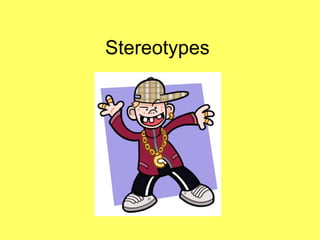
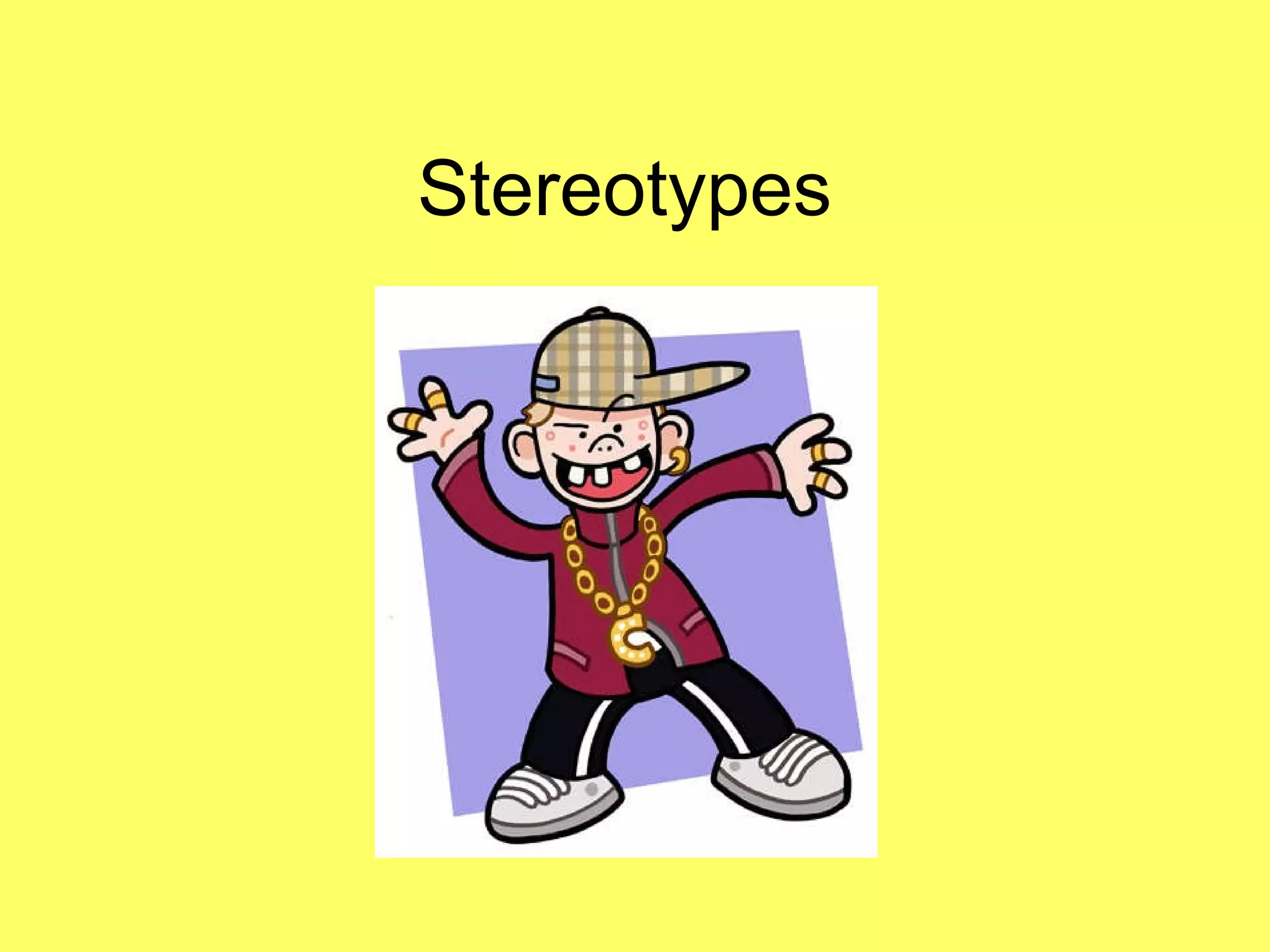
Stereotypes This same process can be applied to the way the media represent individuals and groups Appearance, clothing, language, attitude, beliefs are all simplified and exaggerated  This results in a “type” being created who is seen to represent an entire group, region, country or race.  E.g. A Chav
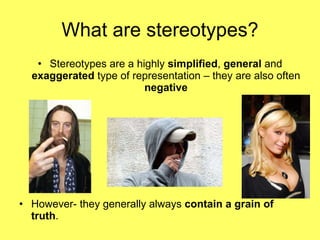
What are stereotypes? Stereotypes are a highly  simplified ,  general  and  exaggerated  type of representation – they are also often  negative However- they generally always  contain a grain of truth .
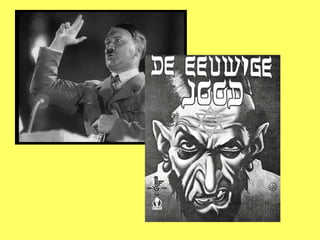
Why are stereotypes used? Stereotypes  offer a shortcut  for meaning as they convey a lot of information quickly. Stereotypes  condense complex information  into  a character who is easy to recognise  and easy to deal with. Stereotypes are often of  minority groups . Stereotyping can be used to  marginalise and devalue groups within society .
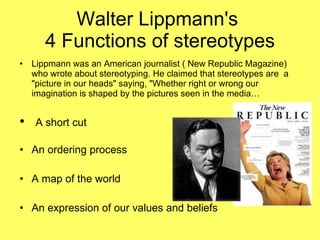
Walter Lippmann's  4 Functions of stereotypes Lippmann was an American journalist ( New Republic Magazine) who wrote about stereotyping. He claimed that stereotypes are  a "picture in our heads" saying, "Whether right or wrong our imagination is shaped by the pictures seen in the media… A short cut An ordering process A map of the world An expression of our values and beliefs
Problems? What possible problems and issues arise from these heavily mediated representations?
 
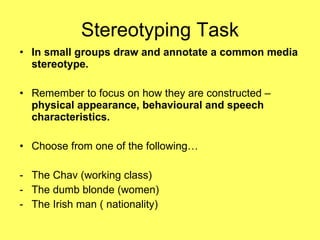
Stereotyping Task In small groups draw and annotate a common media stereotype. Remember to focus on how they are constructed –  physical appearance, behavioural and speech characteristics. Choose from one of the following… The Chav (working class) The dumb blonde (women) The Irish man ( nationality)
The Media and Stereotyping The media uses stereotypes all the time. Essential as this shortcut to meaning about characters and situations/narratives.

Stereotypes pp

  • 1.
  • 2.
    Representation Stereotyping isthe most common form of representation found in the media. Remember the media offer us a “Re-presentation” of reality rather than reality itself In creating any media product there is a careful selection process to determine which stories/images/events will be shown – Mediation. Stereotypes are the most heavily constructed type of representation
  • 3.
    Simplification Mediation involvesa large element of simplification to produce a text that is clear and direct for an audience to consume. E.g. Selecting and highlighting important details (Controversial, dramatic, conflict) This means neutral or “run of the mill” events get pushed aside Therefore it is often conflict/drama that the media select and use to represent the world
  • 4.
    Stereotypes This sameprocess can be applied to the way the media represent individuals and groups Appearance, clothing, language, attitude, beliefs are all simplified and exaggerated This results in a “type” being created who is seen to represent an entire group, region, country or race. E.g. A Chav
  • 5.
    What are stereotypes?Stereotypes are a highly simplified , general and exaggerated type of representation – they are also often negative However- they generally always contain a grain of truth .
  • 6.
    Why are stereotypesused? Stereotypes offer a shortcut for meaning as they convey a lot of information quickly. Stereotypes condense complex information into a character who is easy to recognise and easy to deal with. Stereotypes are often of minority groups . Stereotyping can be used to marginalise and devalue groups within society .
  • 7.
    Walter Lippmann's 4 Functions of stereotypes Lippmann was an American journalist ( New Republic Magazine) who wrote about stereotyping. He claimed that stereotypes are a "picture in our heads" saying, "Whether right or wrong our imagination is shaped by the pictures seen in the media… A short cut An ordering process A map of the world An expression of our values and beliefs
  • 8.
    Problems? What possibleproblems and issues arise from these heavily mediated representations?
  • 9.
  • 10.
    Stereotyping Task Insmall groups draw and annotate a common media stereotype. Remember to focus on how they are constructed – physical appearance, behavioural and speech characteristics. Choose from one of the following… The Chav (working class) The dumb blonde (women) The Irish man ( nationality)
  • 11.
    The Media andStereotyping The media uses stereotypes all the time. Essential as this shortcut to meaning about characters and situations/narratives.