A2 Exam Q1b
Representation
How the media shows us things about
society through careful mediation of
representing a shared view of the world.
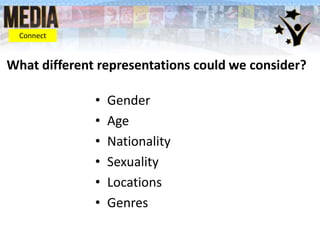
• Gender
• Age
• Nationality
• Sexuality
• Locations
• Genres
What different representations could we consider?
Connect
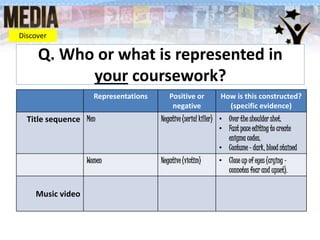
Q. Who or what is represented in
your coursework?
Representations Positive or
negative
How is this constructed?
(specific evidence)
Title sequence Men Negative (serial killer) • Over the shoulder shot.
• Fast pace editing to create
enigma codes.
• Costume – dark, blood stained
Women Negative (victim) • Close up of eyes (crying –
connotes fear and upset).
Music video
Discover
Stuart Hall
In our modern world our life is saturated with
visual representations
Discover
Ferdinand de Saussure -
Semiotics
• Meaning is constructed through the
interpretation of signs.
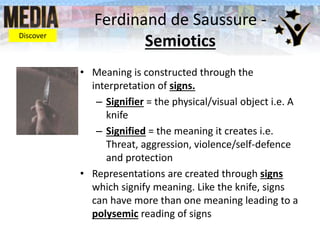
– Signifier = the physical/visual object i.e. A
knife
– Signified = the meaning it creates i.e.
Threat, aggression, violence/self-defence
and protection
• Representations are created through signs
which signify meaning. Like the knife, signs
can have more than one meaning leading to a
polysemic reading of signs
Discover
Richard Dyer
Stereotypes
• Stereotype (first used as a term by Walter
Lippmann in 1956)
• Has come to be defined as a negative
representation or over-simplification of a
category of people in a group
• Dyer explains that stereotypes reinforce ideas
of differences between people which are
natural – i.e. Criminals are represented as low-
lifes, untrustworthy...
Discover
Counter argument – Tessa
Perkins (1979)
• Stereotypes are not always negative
• Are not always about minority groups
• Stereotypes are not always false
• Apply this to your characters in your films
– E.g. What social group(s) do your characters
belong to? How is this made clear?
– What age group do your characters belong to (e.g.
Nervous, unsure teenagers...)
Discover
Counter Argument – David
Gauntlett and Martin
Barker
• Identities are not given but are constructed
and negotiated (Gauntlett)
• Martin Barker condemned stereotypes for
mis-representing the real world by reinforcing
false stereotypes
Discover
Baudrillard
• Postmodern theorist
• Argues that representations no longer refer to reality or real things
• The representation has become more real to us than the reality – i.e. The
representation of mob bosses as Italian Mafia men instilled through The
Godfather, Goodfellas, The Sopranos
• This is re-presentation of reality is termed a simulacrum – a copy of reality
• For Baudrillard, these images have become hyperreal – have no
relationship to the real. CSI and Silent Witness as examples of forensic
science investigations that through their popularity seem to typify our
perception of what that reality is like
Discover

Representation for section 1b

  • 1.
    A2 Exam Q1b Representation Howthe media shows us things about society through careful mediation of representing a shared view of the world.
  • 2.
    • Gender • Age •Nationality • Sexuality • Locations • Genres What different representations could we consider? Connect
  • 3.
    Q. Who orwhat is represented in your coursework? Representations Positive or negative How is this constructed? (specific evidence) Title sequence Men Negative (serial killer) • Over the shoulder shot. • Fast pace editing to create enigma codes. • Costume – dark, blood stained Women Negative (victim) • Close up of eyes (crying – connotes fear and upset). Music video Discover
  • 4.
    Stuart Hall In ourmodern world our life is saturated with visual representations Discover
  • 5.
    Ferdinand de Saussure- Semiotics • Meaning is constructed through the interpretation of signs. – Signifier = the physical/visual object i.e. A knife – Signified = the meaning it creates i.e. Threat, aggression, violence/self-defence and protection • Representations are created through signs which signify meaning. Like the knife, signs can have more than one meaning leading to a polysemic reading of signs Discover
  • 6.
    Richard Dyer Stereotypes • Stereotype(first used as a term by Walter Lippmann in 1956) • Has come to be defined as a negative representation or over-simplification of a category of people in a group • Dyer explains that stereotypes reinforce ideas of differences between people which are natural – i.e. Criminals are represented as low- lifes, untrustworthy... Discover
  • 7.
    Counter argument –Tessa Perkins (1979) • Stereotypes are not always negative • Are not always about minority groups • Stereotypes are not always false • Apply this to your characters in your films – E.g. What social group(s) do your characters belong to? How is this made clear? – What age group do your characters belong to (e.g. Nervous, unsure teenagers...) Discover
  • 8.
    Counter Argument –David Gauntlett and Martin Barker • Identities are not given but are constructed and negotiated (Gauntlett) • Martin Barker condemned stereotypes for mis-representing the real world by reinforcing false stereotypes Discover
  • 9.
    Baudrillard • Postmodern theorist •Argues that representations no longer refer to reality or real things • The representation has become more real to us than the reality – i.e. The representation of mob bosses as Italian Mafia men instilled through The Godfather, Goodfellas, The Sopranos • This is re-presentation of reality is termed a simulacrum – a copy of reality • For Baudrillard, these images have become hyperreal – have no relationship to the real. CSI and Silent Witness as examples of forensic science investigations that through their popularity seem to typify our perception of what that reality is like Discover