Representation
‘the process by which the media
present the ‘real world’ (Rayner)
REPRESENTATION
• This is the process whereby the media
construct versions of people, places and
events in mages, words or sound for the
transmission through media texts to
audiences. Representation is the basis of
all media products. We live our lives
through actual experience of others and
the world around us. Media products
construct versions of reality.What does this trailer say about ‘the media’?
What is the overarching message the media
communicates with regards to gender
representation?
REPRESENTATION and THE MEDIA
• The media impacts the way we understand the
world and ourselves.
• The media is the message and the
messenger… a powerful one
• To understand society you have to understand
media
• Media delivers content that shapes society
• The development of NMT has widened the
reach of the media
• Restrictions and access to media to very
different to back in the day
• Jane Fonda “Media creates consciousness” –
the irony!
• The media reflect a patriarchal world through
the use of misogynistic images
(representations of women)
REPRESENTATION
• Representations provide models of how we see
gender, social groups and places – aspects of the
world we inhabit
• They are ideological in that they are constructed
within a framework of values and beliefs
• They are mediated by individuals and media
organisations and reflect the value systems of
their sources
• No representations are real; they are only versions
of the real.
Ideology is ideas,
values and beliefs
in a society. These
are often taken for
granted and seen
as ‘commonsense’.
Key Point - Selection
everything in the media is a representation –
everything we see is being represented.
the selection process is:
The decision over what is chosen to be represented
and what is rejected;
The choices made when organising the
representation:
The options taken to focus the audience in a certain
way.
• David Chandler- Representation refers to
the construction in any medium of aspects
of ‘reality’ such as people, places, objects,
events, cultural identities and other
abstract concepts
• Representation always involves 'the
construction of reality'
What is Representation?
• Systems of representation are the
means by which the concerns of
ideologies are framed; such systems
‘position’ their subjects
• Roland Barthes ‘Myth’ – mythic in the
sense of having the appearance of being
natural or commonsense
Things Appear Natural
Questions we would ask when
analysing representations:
WHO or WHAT is being represented?
HOW is the representation created?
WHO has created the representation?
WHY is the representation created in that
way? What is the intention?
WHAT is the effect of the representation?
Gatekeeping
A theorist called White (1961) spoke of the
‘gatekeepers’ - that is the people who are
part of the decision making process in the
construction of media texts.
Who do you consider to be gatekeepers?
Richard Dyer - The Matter Of
Images
Dyer said: ‘How we are seen determines
how we are treated, how we treat others is
based on how we see them. How we see
them comes from representation.’
QUESTIONS ON REPRESENTATION
• Richard Dyer (1983) posed a few questions
when analysing media representations in
general.
1.What sense of the world is it making?
2.What does it imply? Is it typical of the world
or deviant?
3.Who is it speaking to? For whom? To whom?
4.What does it represent to us and why? How
do we respond to the representation?
• Masculinity and Femininity are socially
constructed
• Think about the way women’s bodies in
the media has become a common theme
(hip hop videos, Page 3)
• Laura Mulvey argues that the dominant
point of view is masculine
Gender and Ideology (Feminism)
Laura Mulvey
• Laura Mulvey (1975) argues that
the dominant point of view is
masculine. The female body is
displayed for the male gaze in
order to provide erotic pleasure for
the male (vouyerism). Women are
therefore objectified by the camera
lens and whatever gender the
spectator/audience is positioned to
accept the masculine POV.
• Does a female gaze exist now?
• John Berger:
“Men act and women appear”
“Men look at women. Women watch
themselves being looked at”
Ways of Seeing
• “Striptease is based on
contradiction. Woman is
desexualised at the very
moment when she is
stripped naked.”
• He is suggesting it is
clothes that sexualise her
more – plenty of evidence
of this in pop videos.
• Did you subvert these
ideas in your texts by your
representations or not?
Barthes View on Sexualisation
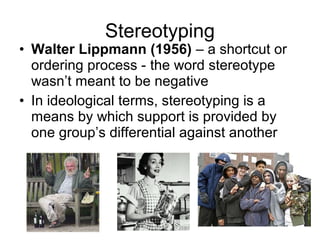
• Walter Lippmann (1956) – a shortcut or
ordering process - the word stereotype
wasn’t meant to be negative
• In ideological terms, stereotyping is a
means by which support is provided by
one group’s differential against another
Stereotyping
Stereotypes?
• OSullivan et al (1998) details that a
stereotype is a label that involves a
process of categorisation and evaluation.
• We can call stereotypes shorthand to
narratives because such simplistic
representations define our understanding
of media texts e.g we know who is good
and who is evil.
Stereotypes?
• Tessa Perkins (1979) says, however, that
stereotyping is not a simple process. She identified
that some of the many ways that stereotypes are
assumed to operate aren’t true. They aren’t always
negative (French good cooks)
• They aren’t always about minority groups or those less
• powerful (upper class twits)
• They are not always false - supported by empirical
evidence.
• They are not always rigid and unchanging.
• Perkins argues that if stereotypes were always so
simple then they would not work culturally and over
time.
Stereotypes
• Martin Barker (1989) - stereotypes are
condemned for misrepresenting the real
world. (e.g. Reinforcing that the (false)
stereotype that women are available for sex
at any time) . He also says stereotypes are
condemned for being too close to real world
(e.g showing women in home servicing men,
which many still do).
• Bears out Perkins point that for stereotypes
to work they need audience recognition.
REPRESENTATION
What should be done in terms of your coursework is
three things:
1.You must detail how and why you have used Media
Language to represent people (gender, class, age,
sexuality), places and ideas (the storyline)?
2.Detail what you have done to represent the genre?
3.What ideological messages have you
communicated through the way you have
represented? (this may be address through the
previous two questions)
‘Representations in media texts are often
simplistic and reinforce dominant
ideologies so that audiences can make
sense of them’
Evaluate the ways you have
used/challenged simplistic representations
in one of the media products you have
produces.
Practice
Analyse media
Deconstruct your production.
Choose elements to discuss that
will allow you to focus on the
importance of REPRESENTATION
Deconstruct your production.
Choose elements to discuss that
will allow you to focus on the
importance of REPRESENTATION Thriller Film, Music
Video, poster???
Thriller Film, Music
Video, poster???
What did you
create?
What did you
create?
What is your
understanding of
representation?
(use
quotes/theory)
What is your
understanding of
representation?
(use
quotes/theory)
Conclude: How useful is it
applying the theories of
representations to your
products.
Conclude: How useful is it
applying the theories of
representations to your
products.
How have you constructed
certain representations in
your product? E.g. gender
representations age
representation, place?
How have you constructed
certain representations in
your product? E.g. gender
representations age
representation, place?
in one of your coursework productions.
What was the
intended effect of the
representation? (Stuart
Hall)
What was the
intended effect of the
representation? (Stuart
Hall)

Representation theory

  • 1.
    Representation ‘the process bywhich the media present the ‘real world’ (Rayner)
  • 2.
    REPRESENTATION • This isthe process whereby the media construct versions of people, places and events in mages, words or sound for the transmission through media texts to audiences. Representation is the basis of all media products. We live our lives through actual experience of others and the world around us. Media products construct versions of reality.What does this trailer say about ‘the media’? What is the overarching message the media communicates with regards to gender representation?
  • 3.
    REPRESENTATION and THEMEDIA • The media impacts the way we understand the world and ourselves. • The media is the message and the messenger… a powerful one • To understand society you have to understand media • Media delivers content that shapes society • The development of NMT has widened the reach of the media • Restrictions and access to media to very different to back in the day • Jane Fonda “Media creates consciousness” – the irony! • The media reflect a patriarchal world through the use of misogynistic images (representations of women)
  • 4.
    REPRESENTATION • Representations providemodels of how we see gender, social groups and places – aspects of the world we inhabit • They are ideological in that they are constructed within a framework of values and beliefs • They are mediated by individuals and media organisations and reflect the value systems of their sources • No representations are real; they are only versions of the real. Ideology is ideas, values and beliefs in a society. These are often taken for granted and seen as ‘commonsense’.
  • 5.
    Key Point -Selection everything in the media is a representation – everything we see is being represented. the selection process is: The decision over what is chosen to be represented and what is rejected; The choices made when organising the representation: The options taken to focus the audience in a certain way.
  • 6.
    • David Chandler-Representation refers to the construction in any medium of aspects of ‘reality’ such as people, places, objects, events, cultural identities and other abstract concepts • Representation always involves 'the construction of reality' What is Representation?
  • 7.
    • Systems ofrepresentation are the means by which the concerns of ideologies are framed; such systems ‘position’ their subjects • Roland Barthes ‘Myth’ – mythic in the sense of having the appearance of being natural or commonsense Things Appear Natural
  • 8.
    Questions we wouldask when analysing representations: WHO or WHAT is being represented? HOW is the representation created? WHO has created the representation? WHY is the representation created in that way? What is the intention? WHAT is the effect of the representation?
  • 9.
    Gatekeeping A theorist calledWhite (1961) spoke of the ‘gatekeepers’ - that is the people who are part of the decision making process in the construction of media texts. Who do you consider to be gatekeepers?
  • 10.
    Richard Dyer -The Matter Of Images Dyer said: ‘How we are seen determines how we are treated, how we treat others is based on how we see them. How we see them comes from representation.’
  • 11.
    QUESTIONS ON REPRESENTATION •Richard Dyer (1983) posed a few questions when analysing media representations in general. 1.What sense of the world is it making? 2.What does it imply? Is it typical of the world or deviant? 3.Who is it speaking to? For whom? To whom? 4.What does it represent to us and why? How do we respond to the representation?
  • 12.
    • Masculinity andFemininity are socially constructed • Think about the way women’s bodies in the media has become a common theme (hip hop videos, Page 3) • Laura Mulvey argues that the dominant point of view is masculine Gender and Ideology (Feminism)
  • 13.
    Laura Mulvey • LauraMulvey (1975) argues that the dominant point of view is masculine. The female body is displayed for the male gaze in order to provide erotic pleasure for the male (vouyerism). Women are therefore objectified by the camera lens and whatever gender the spectator/audience is positioned to accept the masculine POV. • Does a female gaze exist now?
  • 14.
    • John Berger: “Menact and women appear” “Men look at women. Women watch themselves being looked at” Ways of Seeing
  • 15.
    • “Striptease isbased on contradiction. Woman is desexualised at the very moment when she is stripped naked.” • He is suggesting it is clothes that sexualise her more – plenty of evidence of this in pop videos. • Did you subvert these ideas in your texts by your representations or not? Barthes View on Sexualisation
  • 16.
    • Walter Lippmann(1956) – a shortcut or ordering process - the word stereotype wasn’t meant to be negative • In ideological terms, stereotyping is a means by which support is provided by one group’s differential against another Stereotyping
  • 17.
    Stereotypes? • OSullivan etal (1998) details that a stereotype is a label that involves a process of categorisation and evaluation. • We can call stereotypes shorthand to narratives because such simplistic representations define our understanding of media texts e.g we know who is good and who is evil.
  • 18.
    Stereotypes? • Tessa Perkins(1979) says, however, that stereotyping is not a simple process. She identified that some of the many ways that stereotypes are assumed to operate aren’t true. They aren’t always negative (French good cooks) • They aren’t always about minority groups or those less • powerful (upper class twits) • They are not always false - supported by empirical evidence. • They are not always rigid and unchanging. • Perkins argues that if stereotypes were always so simple then they would not work culturally and over time.
  • 19.
    Stereotypes • Martin Barker(1989) - stereotypes are condemned for misrepresenting the real world. (e.g. Reinforcing that the (false) stereotype that women are available for sex at any time) . He also says stereotypes are condemned for being too close to real world (e.g showing women in home servicing men, which many still do). • Bears out Perkins point that for stereotypes to work they need audience recognition.
  • 20.
    REPRESENTATION What should bedone in terms of your coursework is three things: 1.You must detail how and why you have used Media Language to represent people (gender, class, age, sexuality), places and ideas (the storyline)? 2.Detail what you have done to represent the genre? 3.What ideological messages have you communicated through the way you have represented? (this may be address through the previous two questions)
  • 21.
    ‘Representations in mediatexts are often simplistic and reinforce dominant ideologies so that audiences can make sense of them’ Evaluate the ways you have used/challenged simplistic representations in one of the media products you have produces. Practice
  • 22.
    Analyse media Deconstruct yourproduction. Choose elements to discuss that will allow you to focus on the importance of REPRESENTATION Deconstruct your production. Choose elements to discuss that will allow you to focus on the importance of REPRESENTATION Thriller Film, Music Video, poster??? Thriller Film, Music Video, poster??? What did you create? What did you create? What is your understanding of representation? (use quotes/theory) What is your understanding of representation? (use quotes/theory) Conclude: How useful is it applying the theories of representations to your products. Conclude: How useful is it applying the theories of representations to your products. How have you constructed certain representations in your product? E.g. gender representations age representation, place? How have you constructed certain representations in your product? E.g. gender representations age representation, place? in one of your coursework productions. What was the intended effect of the representation? (Stuart Hall) What was the intended effect of the representation? (Stuart Hall)

Editor's Notes

  • #3 Media is actually the plural of medium Break this down a little more and show video – trailer for Miss Representation - the point being to understand how much media the average person consumes on a regular basis and how that impacts the way we understand the world and ourselves. The media is the message and the messenger… a powerful one To understand society you have to understand media Media delivers content that shapes society The development of NMT has widened the reach of the media Restrictions and access to media to very different to back in the day Jane Fonda ‘Media creates consciousness’ The media reflect a patriarchal world and through the use of misogynistic images (representations of women)
  • #12 Questions to help them think – These are questions not necessarily to be answered but to get you thinking about HOW you have used the concept of REPRESENTATION
  • #21 This is just guidance and can be deviated away from