Seed Dormancy
BY: Dr. Sunita Sangwan
Assistant Professor, Botany
Dept. of Higher Education, Haryana
Content
» Definition
»Types of seed dormancy
»Causes of seed dormancy
»Methods for removing the seed dormancy
Seed Dormancy
Seed dormancy is defined as a state in which seeds are prevented
from germinating even under environmental conditions
normally favorable for germination.
This minimizes metabolic activity and therefore helps an organism
to conserve to energy.
Dormant = not active or growing but able to become active later.
In such cases, the completely dry ripe seed is physiologically
inactive and is said to be in a resting stage.
The seed is called dormant and the phenomenon is termed
dormancy.
Conti…
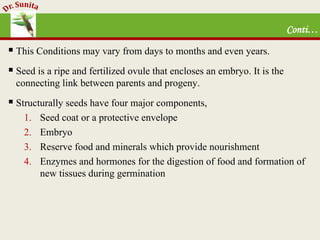
 This Conditions may vary from days to months and even years.
 Seed is a ripe and fertilized ovule that encloses an embryo. It is the
connecting link between parents and progeny.
 Structurally seeds have four major components,
1. Seed coat or a protective envelope
2. Embryo
3. Reserve food and minerals which provide nourishment
4. Enzymes and hormones for the digestion of food and formation of
new tissues during germination
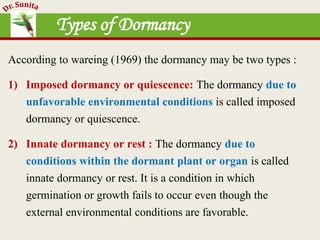
Types of Dormancy
According to wareing (1969) the dormancy may be two types :
1) Imposed dormancy or quiescence: The dormancy due to
unfavorable environmental conditions is called imposed
dormancy or quiescence.
2) Innate dormancy or rest : The dormancy due to
conditions within the dormant plant or organ is called
innate dormancy or rest. It is a condition in which
germination or growth fails to occur even though the
external environmental conditions are favorable.
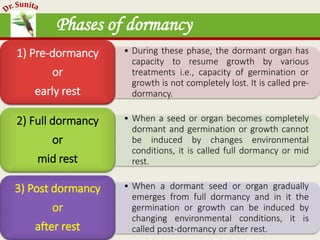
• During these phase, the dormant organ has
capacity to resume growth by various
treatments i.e., capacity of germination or
growth is not completely lost. It is called pre-
dormancy.
1) Pre-dormancy
or
early rest
• When a seed or organ becomes completely
dormant and germination or growth cannot
be induced by changes environmental
conditions, it is called full dormancy or mid
rest.
2) Full dormancy
or
mid rest
• When a dormant seed or organ gradually
emerges from full dormancy and in it the
germination or growth can be induced by
changing environmental conditions, it is
called post-dormancy or after rest.
3) Post dormancy
or
after rest
Phases of dormancy
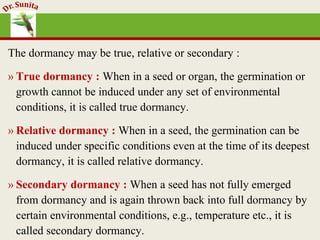
The dormancy may be true, relative or secondary :
» True dormancy : When in a seed or organ, the germination or
growth cannot be induced under any set of environmental
conditions, it is called true dormancy.
» Relative dormancy : When in a seed, the germination can be
induced under specific conditions even at the time of its deepest
dormancy, it is called relative dormancy.
» Secondary dormancy : When a seed has not fully emerged
from dormancy and is again thrown back into full dormancy by
certain environmental conditions, e.g., temperature etc., it is
called secondary dormancy.
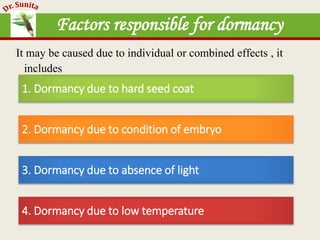
Factors responsible for dormancy
It may be caused due to individual or combined effects , it
includes
1. Dormancy due to hard seed coat
2. Dormancy due to condition of embryo
3. Dormancy due to absence of light
4. Dormancy due to low temperature
Coat imposed dormancy
Imposed by seed coat and other enclosing tissues like endosperm ,
pericarp and extra floral organs.
The seed coat is mostly formed by the integumentary layers of
ovules.
The seed coat consists of two layers – the outer is testa and the inner
is tegmen.
Seed coat is mainly made up of complex mixture of polysaccharides,
hemicelluloses, fats, waxes and proteins.
During seed ripening it gets dehydrated and forms a hard and tough
protective covering around the embryo.
Such seed coats prevents the seeds from germination .
Hard seed coat prevents germination due to -
1. Water impermeability : Seed coats of many plants belonging to
families Leguminosae, Chenopodiaceae, Malvaceae,
Convolvulaceae, Solanaceae and Nymphaeaceae etc. have very
hard seed coats so, it cannot permeable to entry of water in seed.
2. Gas impermeability : The seed coat of certain seeds are
impermeable to gases such as O2 and CO2. Since oxygen is
required for early respiratory activity in germinating seeds, the
seeds fail to prolong germination. e.g., Xanthium.
3. Mechanical resistance : In certain wild plants the such hard and
tough seed coat physically prevents the expansion of the embryo.
Thus they remain dormant. E.g., Alisma, Amaranthus, Capsella
etc.
Breaking of seed coat dormancy
Seed coat dormancy can be lifted by weakening or breaking
the seed coat by natural and artificial processes.
The natural processes include microbial action, mechanical
abrasion , passing of seeds through the digestive tract of
animals etc.
Artificial processes include scarification(scratching) of the
seeds with abrasives ,soaking of the seeds in concentrated
sulphuric acid , washing of seeds with alcohol , treating the
seeds with potassium nitrate , thiourea and gibberellic acid ,
subjecting the seeds to hydraulic pressure etc.
Embryo dormancy
Already inherent in embryo and is not due to the influence
of seed coat or other surrounding tissues.
Commonest type of dormancy
Dormancy due to embryo condition may be of two types-
1. Rudimentary and poorly developed embryo
2. Embryo fully developed but unable to resume growth.
1. Rudimentary and poorly developed embryo
The embryos are still immature and rudimentary when the
seeds are dispersed. This is seen in many species like
Anemone nemorosa, Ginkgo biloba, members of
Orchidaceae, Orobanchaceae etc.
In such seeds the embryo does not develop as rapidly as
surrounding tissues.
2. Embryo fully developed but unable to resume growth
In many species, e.g., Seeds of apple, peach, Iris, cherry,
tulip, poplar, pines, peas, etc., although the embryos are
completely developed in ripe seed but the seeds fails to
germinate even when the environmental conditions for
germinations are favorable. The embryo of such seeds does not
germinate even if the seed coats are removed.
The germination in such seeds can be induced if they are stored in
moist, well aerated and low temperature conditions. This
process is called Stratification or after- ripening.
Dormancy due to absence of light
In case of photoblastic seeds some seeds require light to
Germinate
Dormancy due to Specific Light Requirement : The seeds of
certain plant species such as Lactona sativa, Lythrum salicaria,
Nicotiana tabacum etc. have specific light requirement for
germination.
Light not only qualitatively but also quantitativly. The
germination of certain seeds requires a specific photoperiod,
e.g., Bignonia requires a photoperiod of 12 or more hours for
seed germination.
The light sensitive seeds are called photoblastic
Dormancy due to Germination Inhibitors
Seeds of certain plants contain compounds which inhibit
their germination. Such natural germination inhibitors have
been found in the pulp of the fruits, seed coat, endosperm
and embryos or structures surrounding them etc. (e.g., in
tomatoes, in glumes of Oats etc.).
A number of chemical substances such as organic acids,
phenolics, tannins, alkaloids, unsaturated lactones,
ammonia and cyanide releasing substances, indoles and
gibberellins etc. have isolated from seed which are
germination inhibitors. Besides, other inhibitors are ABA,
ammonia, phthalides, coumarin and parascorbic acid.
Due to the absence of low temperature
low temperature is required by some plants, So in such plants
dormancy is due to absence of low temperature.
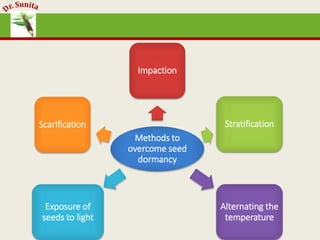
Methods to
overcome seed
dormancy
Impaction
Stratification
Alternating the
temperature
Exposure of
seeds to light
Scarification
Scarification
The method is used for breaking dormancy of seeds caused by
hard seed coats which become impermeable to water and gases
etc. The method employed in softening or weakening the
seed coat is called Scarification.
Under natural conditions in the soil , micro organisms such as
fungi and bacteria , act upon the seed coat and decompose it.
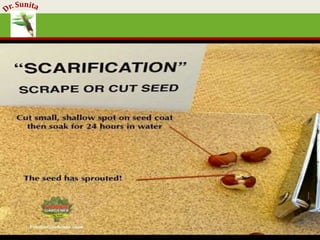
When mechanical breaking of seed coat is done at one or
more places, it is called Mechanical Scarification.
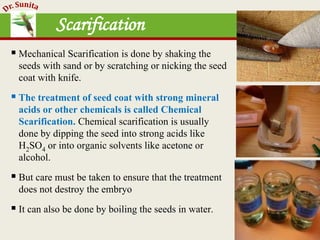
 Mechanical Scarification is done by shaking the
seeds with sand or by scratching or nicking the seed
coat with knife.
 The treatment of seed coat with strong mineral
acids or other chemicals is called Chemical
Scarification. Chemical scarification is usually
done by dipping the seed into strong acids like
H2SO4 or into organic solvents like acetone or
alcohol.
 But care must be taken to ensure that the treatment
does not destroy the embryo
 It can also be done by boiling the seeds in water.
Scarification
Impaction
In some seeds water and oxygen are unable to penetrate ,
because their entry is blocked by a cork like filling in the
small opening in the seed coat
These seeds are shaken vigorously to remove the plug. This
treatment is called impaction
E.g., Crotolaria, Trigonella seed.
Stratification
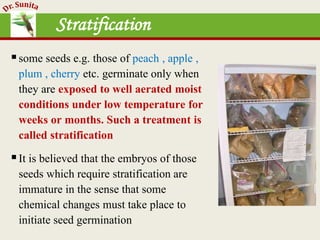
some seeds e.g. those of peach , apple ,
plum , cherry etc. germinate only when
they are exposed to well aerated moist
conditions under low temperature for
weeks or months. Such a treatment is
called stratification
It is believed that the embryos of those
seeds which require stratification are
immature in the sense that some
chemical changes must take place to
initiate seed germination
Alternating the temperature
Germination of some seeds is strongly promoted by
alternating the daily temperature.
This is not directly related to the cold requirement for
germination , though it is useful in those seeds in which
dormancy is due to immature embryos.
The difference between the alternating temperatures should
not be more than 10 -20 degree C.
Exposure of Seeds To Light
A number of seeds require light for their germination. They are
called photoblastic seeds.
There are three categories of seeds
1. Positively photoblastic: E.g., Amaranthus, Betula, Capsella,
Epilobium, Lactuca etc. The dormancy of positive photoblastic
seeds can be broken by exposing them to red light (660 nm).
2. Negatively photoblastic
3. Non photoblastic seeds
Pressure
Davies (1928) reported the seed germination in certain
plants like sweet clover (Melilotus alba) and alfalfa
(Medicago sativa) can be greatly improved after being
subjected to hydraulic pressure of about 2000 atm. at 18°C
for about 5-20 minutes.
It is strongly believed that the pressure increases the
permeability of the seed coats to water.
Growth Regulators
Kinetins and gibberellins have been used to induce
germination in positively photoblastic seeds like lettuce and
tobacco etc.
Counteracting the effect of growth inhibitors by soaking the
seeds in KNO3, ethylene chlorohydrin, thiourea,
gibberellins.
Advantages of seed dormancy
1. Adaptation to ensure that seed germination occurs only under
favorable conditions
2. Enables embryo to tide over the unfavorable condition
3. Enables storage of cereals , millets , pulses etc to be used later
for food or for sowing in the next season
4. Introduces a delay in seed germination and there by provides
additional time for seed dispersal
5. Maximizes the survival of seedlings by preventing seed
germination under unfavorable condition
You tube link of videos on these topics
 https://youtu.be/Cw_DtZ_DKfM seed dormancy part-1
 https://youtu.be/Qs6os5GWcXw seed dormancy- part2
 Please like and subscribe the video so that it can reach upto maximum
number of students and they get benefitted
Seed dormancy

Seed dormancy

  • 1.
    Seed Dormancy BY: Dr.Sunita Sangwan Assistant Professor, Botany Dept. of Higher Education, Haryana
  • 2.
    Content » Definition »Types ofseed dormancy »Causes of seed dormancy »Methods for removing the seed dormancy
  • 3.
    Seed Dormancy Seed dormancyis defined as a state in which seeds are prevented from germinating even under environmental conditions normally favorable for germination. This minimizes metabolic activity and therefore helps an organism to conserve to energy. Dormant = not active or growing but able to become active later. In such cases, the completely dry ripe seed is physiologically inactive and is said to be in a resting stage. The seed is called dormant and the phenomenon is termed dormancy.
  • 4.
    Conti…  This Conditionsmay vary from days to months and even years.  Seed is a ripe and fertilized ovule that encloses an embryo. It is the connecting link between parents and progeny.  Structurally seeds have four major components, 1. Seed coat or a protective envelope 2. Embryo 3. Reserve food and minerals which provide nourishment 4. Enzymes and hormones for the digestion of food and formation of new tissues during germination
  • 5.
    Types of Dormancy Accordingto wareing (1969) the dormancy may be two types : 1) Imposed dormancy or quiescence: The dormancy due to unfavorable environmental conditions is called imposed dormancy or quiescence. 2) Innate dormancy or rest : The dormancy due to conditions within the dormant plant or organ is called innate dormancy or rest. It is a condition in which germination or growth fails to occur even though the external environmental conditions are favorable.
  • 6.
    • During thesephase, the dormant organ has capacity to resume growth by various treatments i.e., capacity of germination or growth is not completely lost. It is called pre- dormancy. 1) Pre-dormancy or early rest • When a seed or organ becomes completely dormant and germination or growth cannot be induced by changes environmental conditions, it is called full dormancy or mid rest. 2) Full dormancy or mid rest • When a dormant seed or organ gradually emerges from full dormancy and in it the germination or growth can be induced by changing environmental conditions, it is called post-dormancy or after rest. 3) Post dormancy or after rest Phases of dormancy
  • 7.
    The dormancy maybe true, relative or secondary : » True dormancy : When in a seed or organ, the germination or growth cannot be induced under any set of environmental conditions, it is called true dormancy. » Relative dormancy : When in a seed, the germination can be induced under specific conditions even at the time of its deepest dormancy, it is called relative dormancy. » Secondary dormancy : When a seed has not fully emerged from dormancy and is again thrown back into full dormancy by certain environmental conditions, e.g., temperature etc., it is called secondary dormancy.
  • 8.
    Factors responsible fordormancy It may be caused due to individual or combined effects , it includes 1. Dormancy due to hard seed coat 2. Dormancy due to condition of embryo 3. Dormancy due to absence of light 4. Dormancy due to low temperature
  • 9.
    Coat imposed dormancy Imposedby seed coat and other enclosing tissues like endosperm , pericarp and extra floral organs. The seed coat is mostly formed by the integumentary layers of ovules. The seed coat consists of two layers – the outer is testa and the inner is tegmen. Seed coat is mainly made up of complex mixture of polysaccharides, hemicelluloses, fats, waxes and proteins. During seed ripening it gets dehydrated and forms a hard and tough protective covering around the embryo. Such seed coats prevents the seeds from germination .
  • 10.
    Hard seed coatprevents germination due to - 1. Water impermeability : Seed coats of many plants belonging to families Leguminosae, Chenopodiaceae, Malvaceae, Convolvulaceae, Solanaceae and Nymphaeaceae etc. have very hard seed coats so, it cannot permeable to entry of water in seed. 2. Gas impermeability : The seed coat of certain seeds are impermeable to gases such as O2 and CO2. Since oxygen is required for early respiratory activity in germinating seeds, the seeds fail to prolong germination. e.g., Xanthium. 3. Mechanical resistance : In certain wild plants the such hard and tough seed coat physically prevents the expansion of the embryo. Thus they remain dormant. E.g., Alisma, Amaranthus, Capsella etc.
  • 11.
    Breaking of seedcoat dormancy Seed coat dormancy can be lifted by weakening or breaking the seed coat by natural and artificial processes. The natural processes include microbial action, mechanical abrasion , passing of seeds through the digestive tract of animals etc. Artificial processes include scarification(scratching) of the seeds with abrasives ,soaking of the seeds in concentrated sulphuric acid , washing of seeds with alcohol , treating the seeds with potassium nitrate , thiourea and gibberellic acid , subjecting the seeds to hydraulic pressure etc.
  • 12.
    Embryo dormancy Already inherentin embryo and is not due to the influence of seed coat or other surrounding tissues. Commonest type of dormancy Dormancy due to embryo condition may be of two types- 1. Rudimentary and poorly developed embryo 2. Embryo fully developed but unable to resume growth.
  • 13.
    1. Rudimentary andpoorly developed embryo The embryos are still immature and rudimentary when the seeds are dispersed. This is seen in many species like Anemone nemorosa, Ginkgo biloba, members of Orchidaceae, Orobanchaceae etc. In such seeds the embryo does not develop as rapidly as surrounding tissues.
  • 14.
    2. Embryo fullydeveloped but unable to resume growth In many species, e.g., Seeds of apple, peach, Iris, cherry, tulip, poplar, pines, peas, etc., although the embryos are completely developed in ripe seed but the seeds fails to germinate even when the environmental conditions for germinations are favorable. The embryo of such seeds does not germinate even if the seed coats are removed. The germination in such seeds can be induced if they are stored in moist, well aerated and low temperature conditions. This process is called Stratification or after- ripening.
  • 15.
    Dormancy due toabsence of light In case of photoblastic seeds some seeds require light to Germinate Dormancy due to Specific Light Requirement : The seeds of certain plant species such as Lactona sativa, Lythrum salicaria, Nicotiana tabacum etc. have specific light requirement for germination. Light not only qualitatively but also quantitativly. The germination of certain seeds requires a specific photoperiod, e.g., Bignonia requires a photoperiod of 12 or more hours for seed germination. The light sensitive seeds are called photoblastic
  • 16.
    Dormancy due toGermination Inhibitors Seeds of certain plants contain compounds which inhibit their germination. Such natural germination inhibitors have been found in the pulp of the fruits, seed coat, endosperm and embryos or structures surrounding them etc. (e.g., in tomatoes, in glumes of Oats etc.). A number of chemical substances such as organic acids, phenolics, tannins, alkaloids, unsaturated lactones, ammonia and cyanide releasing substances, indoles and gibberellins etc. have isolated from seed which are germination inhibitors. Besides, other inhibitors are ABA, ammonia, phthalides, coumarin and parascorbic acid.
  • 17.
    Due to theabsence of low temperature low temperature is required by some plants, So in such plants dormancy is due to absence of low temperature.
  • 18.
    Methods to overcome seed dormancy Impaction Stratification Alternatingthe temperature Exposure of seeds to light Scarification
  • 19.
    Scarification The method isused for breaking dormancy of seeds caused by hard seed coats which become impermeable to water and gases etc. The method employed in softening or weakening the seed coat is called Scarification. Under natural conditions in the soil , micro organisms such as fungi and bacteria , act upon the seed coat and decompose it. When mechanical breaking of seed coat is done at one or more places, it is called Mechanical Scarification.
  • 20.
     Mechanical Scarificationis done by shaking the seeds with sand or by scratching or nicking the seed coat with knife.  The treatment of seed coat with strong mineral acids or other chemicals is called Chemical Scarification. Chemical scarification is usually done by dipping the seed into strong acids like H2SO4 or into organic solvents like acetone or alcohol.  But care must be taken to ensure that the treatment does not destroy the embryo  It can also be done by boiling the seeds in water. Scarification
  • 22.
    Impaction In some seedswater and oxygen are unable to penetrate , because their entry is blocked by a cork like filling in the small opening in the seed coat These seeds are shaken vigorously to remove the plug. This treatment is called impaction E.g., Crotolaria, Trigonella seed.
  • 23.
    Stratification some seeds e.g.those of peach , apple , plum , cherry etc. germinate only when they are exposed to well aerated moist conditions under low temperature for weeks or months. Such a treatment is called stratification It is believed that the embryos of those seeds which require stratification are immature in the sense that some chemical changes must take place to initiate seed germination
  • 24.
    Alternating the temperature Germinationof some seeds is strongly promoted by alternating the daily temperature. This is not directly related to the cold requirement for germination , though it is useful in those seeds in which dormancy is due to immature embryos. The difference between the alternating temperatures should not be more than 10 -20 degree C.
  • 25.
    Exposure of SeedsTo Light A number of seeds require light for their germination. They are called photoblastic seeds. There are three categories of seeds 1. Positively photoblastic: E.g., Amaranthus, Betula, Capsella, Epilobium, Lactuca etc. The dormancy of positive photoblastic seeds can be broken by exposing them to red light (660 nm). 2. Negatively photoblastic 3. Non photoblastic seeds
  • 26.
    Pressure Davies (1928) reportedthe seed germination in certain plants like sweet clover (Melilotus alba) and alfalfa (Medicago sativa) can be greatly improved after being subjected to hydraulic pressure of about 2000 atm. at 18°C for about 5-20 minutes. It is strongly believed that the pressure increases the permeability of the seed coats to water.
  • 27.
    Growth Regulators Kinetins andgibberellins have been used to induce germination in positively photoblastic seeds like lettuce and tobacco etc. Counteracting the effect of growth inhibitors by soaking the seeds in KNO3, ethylene chlorohydrin, thiourea, gibberellins.
  • 28.
    Advantages of seeddormancy 1. Adaptation to ensure that seed germination occurs only under favorable conditions 2. Enables embryo to tide over the unfavorable condition 3. Enables storage of cereals , millets , pulses etc to be used later for food or for sowing in the next season 4. Introduces a delay in seed germination and there by provides additional time for seed dispersal 5. Maximizes the survival of seedlings by preventing seed germination under unfavorable condition
  • 29.
    You tube linkof videos on these topics  https://youtu.be/Cw_DtZ_DKfM seed dormancy part-1  https://youtu.be/Qs6os5GWcXw seed dormancy- part2  Please like and subscribe the video so that it can reach upto maximum number of students and they get benefitted