 The number, relative activity and state of
occupancy of specific receptor on the plasma
membrane or in the cytoplasm or nucleus.
 The metabolism of hormone on target cell.
 Presence of other factors that are necessary
for the hormone response.
 Up or down regulation of receptor.
 Post receptor desensitization of cell
including down regulation of receptor.
 A hormone is a substance that is synthesized
in one organ and transported by circulatory
system to act on another tissue.
 A diverse array of hormones –each with a
distinctive mechanism of action and
properties of biosynthesis, storage, secretion,
transport and metabolism.
 Hormones are chemically diverse. A large series
derived from cholesterol.
 Glucocorticoids
 Mineralocorticoids
 Estrogens
 Progesterone etc
 In some cases a steroid hormone is a precursor
molecule of another hormone.
 Progesterone is a hormone in its own but also a
precursor in the formation of
glucocorticoids.,mineralocorticoids,testosterone
and estrogen.
 Testosterone is an obligatory intermediate in
the biosynthesis of estradiol.
 Amino acid tyrosine is the starting point in
the synthesis of both catecholamine and
thyroid hormone.
 Many hormones are polypeptide or
glycoprotein. These range in size from a
small thyrotropin releasing hormone-a
tripeptide to a single chain polypeptide like
adrenocorticotropic hormone.(ACTH 39
Aminoacids)
 Parathyroid hormone
 And
 GH(191) Aminoacids
 Insulin is a AB heterodimer of 21 and 30
amino acidsw.
 The rate of synthesis and secretion of hormone.
 The proximity of target cell to hormone source.
 The dissociation constant of hormone with
specific plasma protein.
 The conversion of inactive or sub optimally active
forms of hormones into the fully active form.
 The rate of clearance from plasma by other tissue
or by digestion, metabolism, or excretion.
 Hormones can be classified according to
chemical composition, solubility properties,
location of receptor, and nature of signal
used to mediate hormonal action within cell.
The classification based on solubility
properties is described as followed.
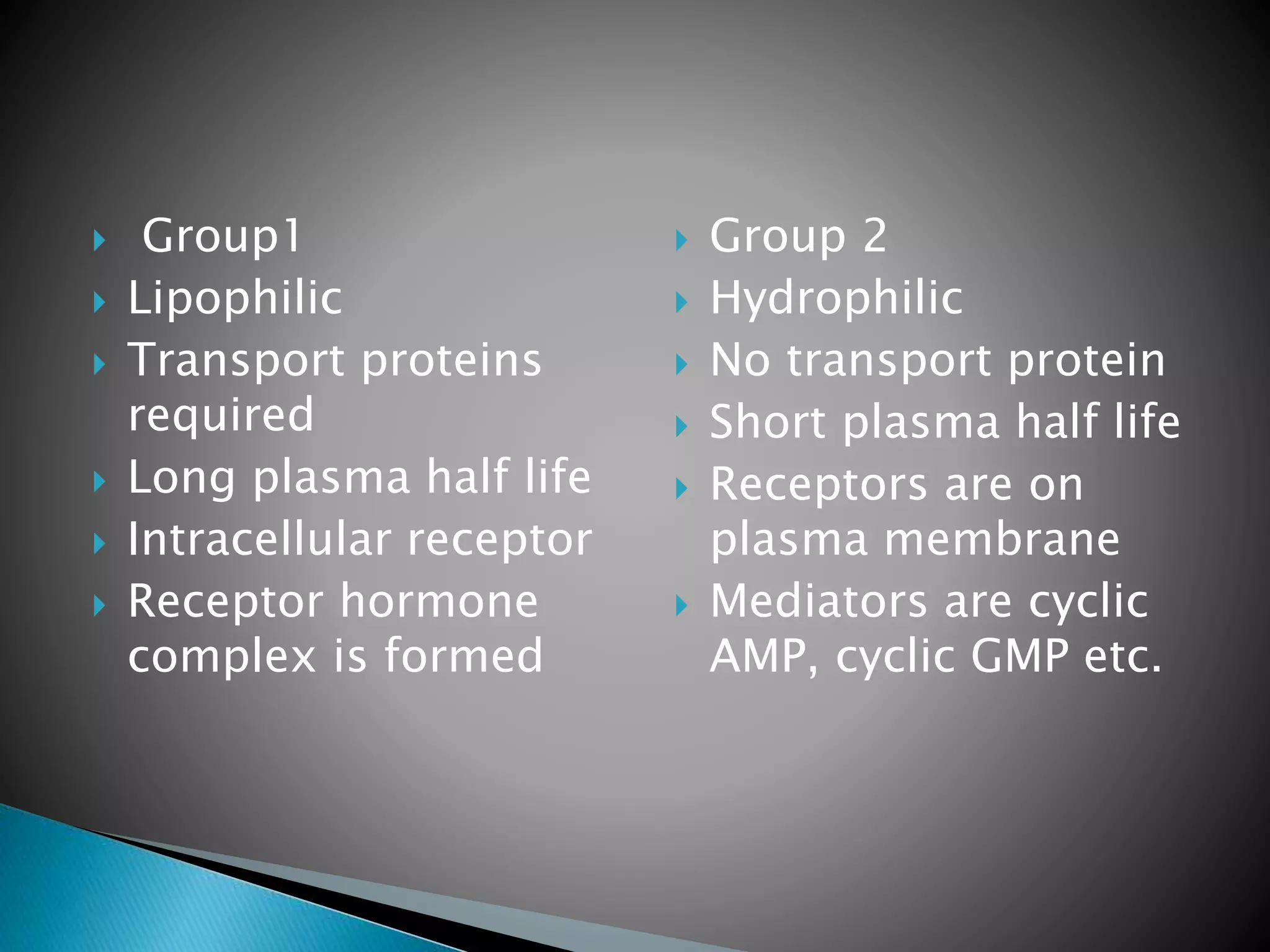
 Group1
 Lipophilic
 Transport proteins
required
 Long plasma half life
 Intracellular receptor
 Receptor hormone
complex is formed
 Group 2
 Hydrophilic
 No transport protein
 Short plasma half life
 Receptors are on
plasma membrane
 Mediators are cyclic
AMP, cyclic GMP etc.
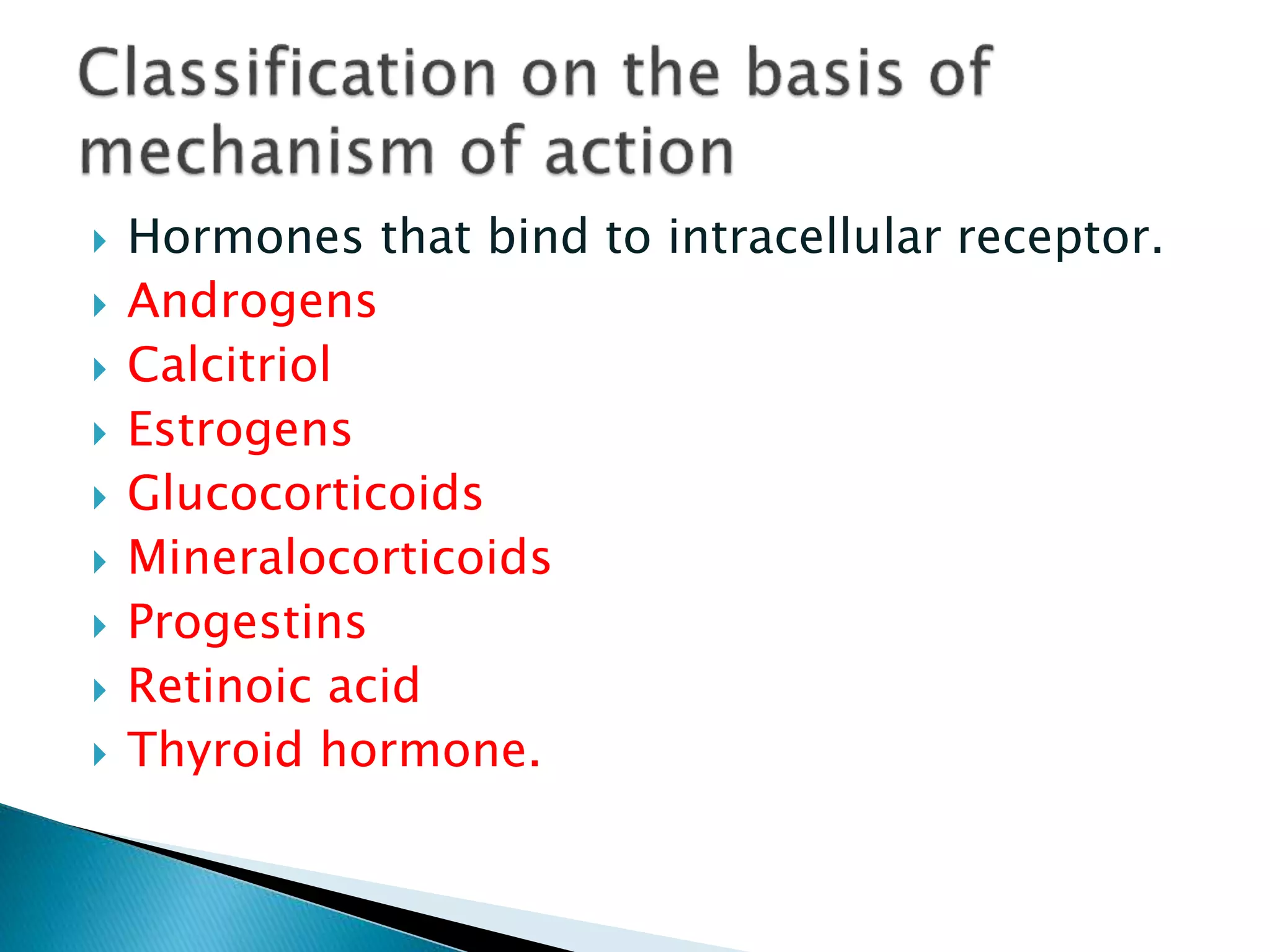
 Hormones that bind to intracellular receptor.
 Androgens
 Calcitriol
 Estrogens
 Glucocorticoids
 Mineralocorticoids
 Progestins
 Retinoic acid
 Thyroid hormone.
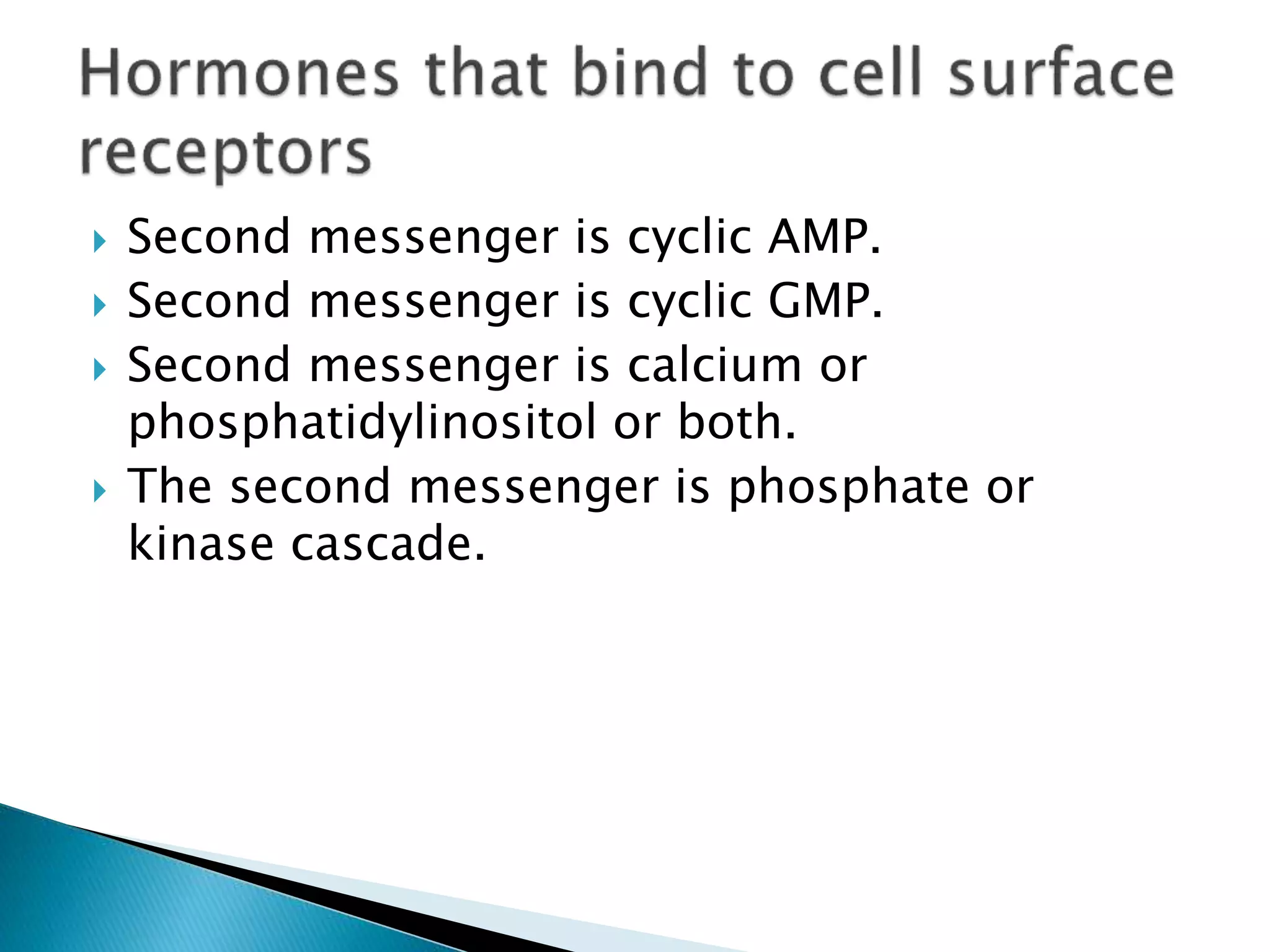
 Second messenger is cyclic AMP.
 Second messenger is cyclic GMP.
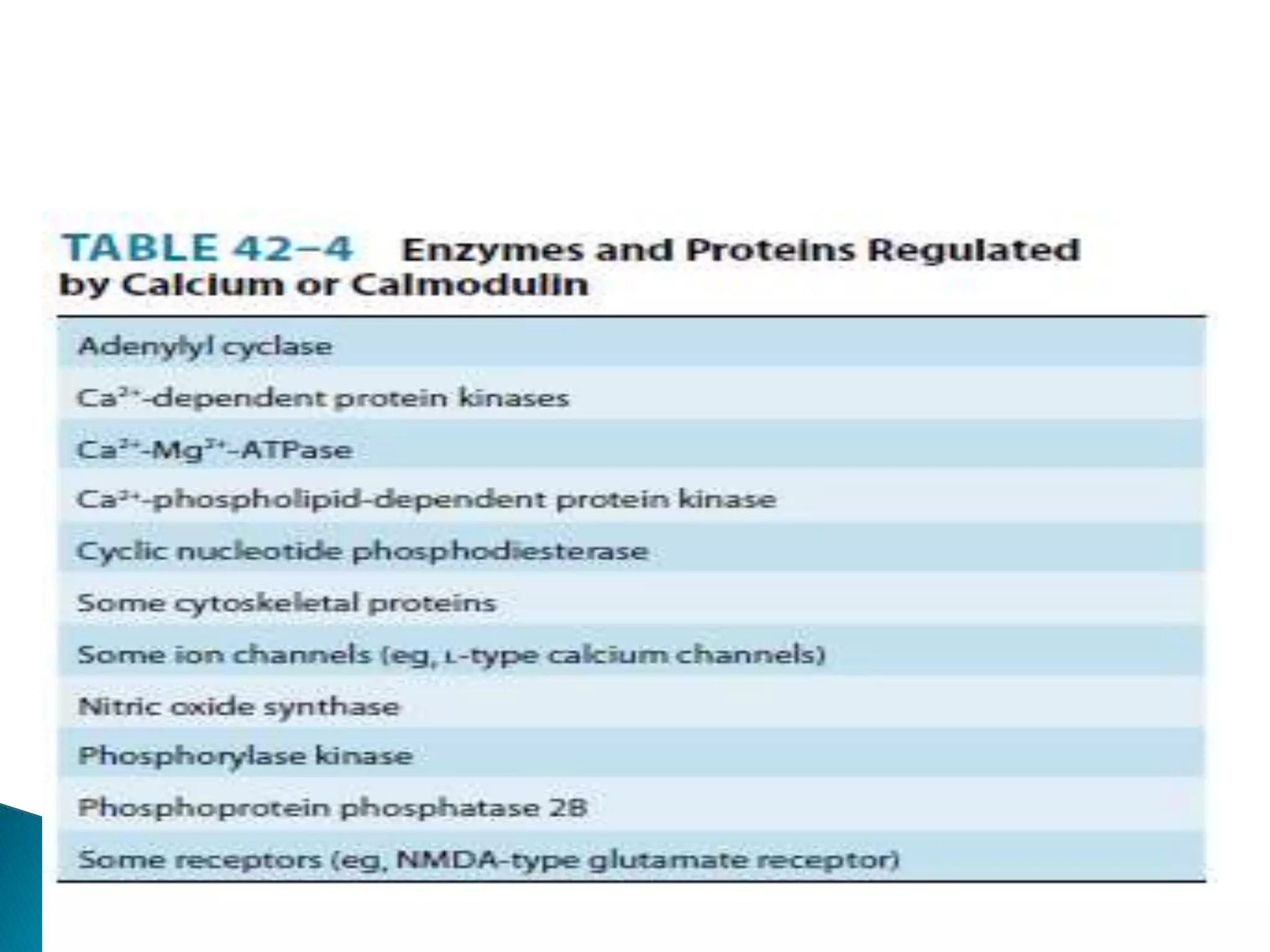
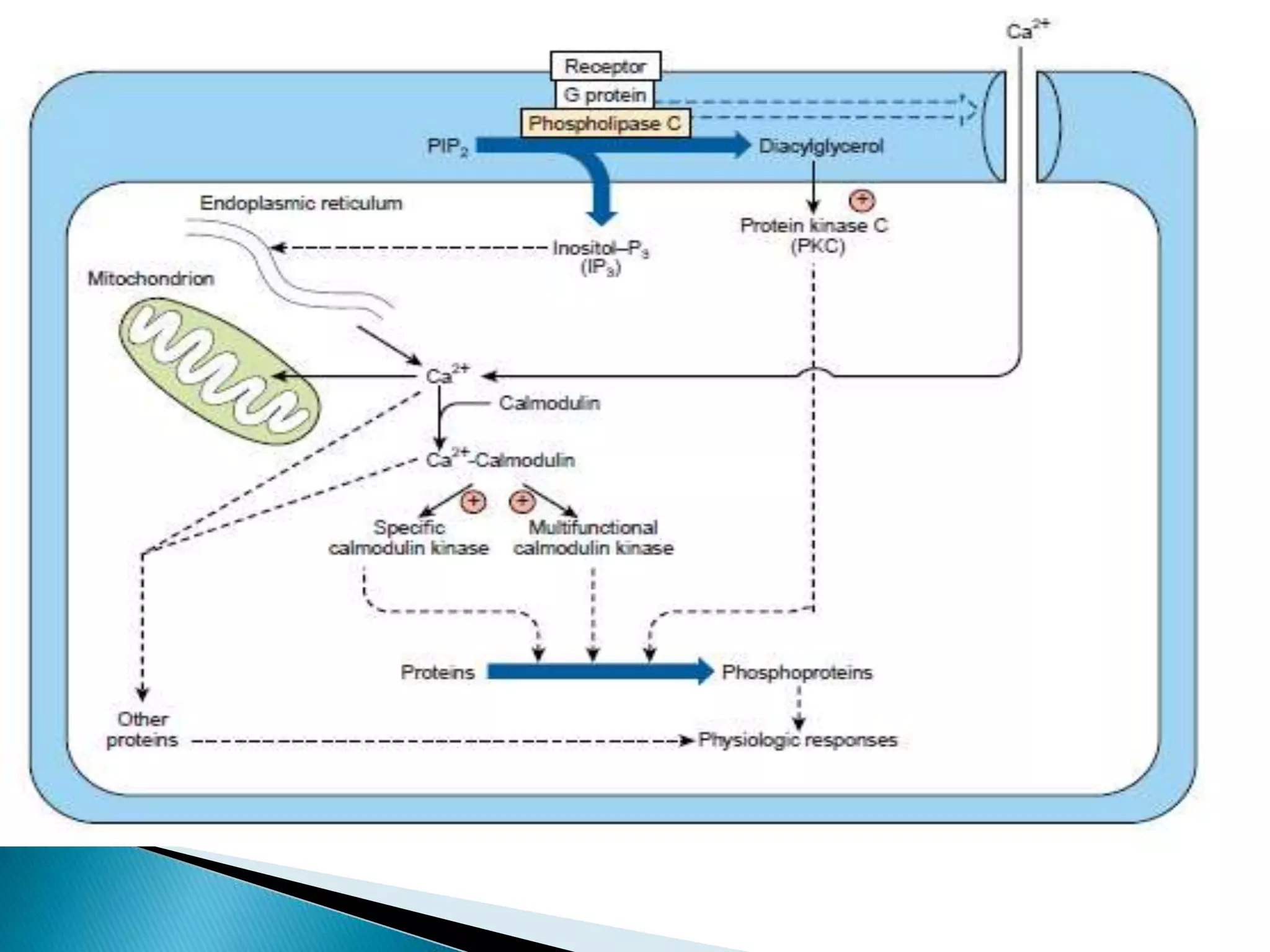
 Second messenger is calcium or
phosphatidylinositol or both.
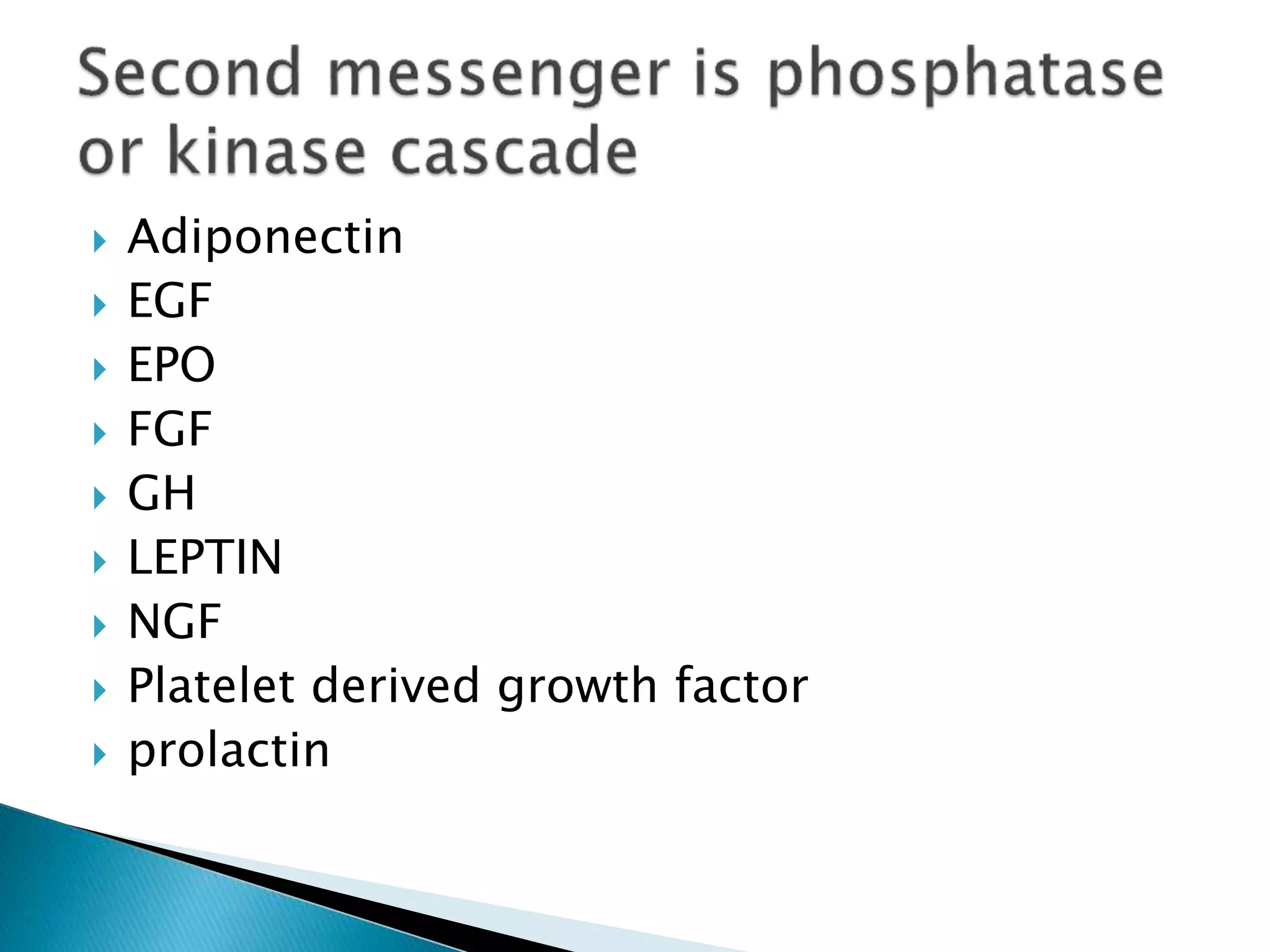
 The second messenger is phosphate or
kinase cascade.
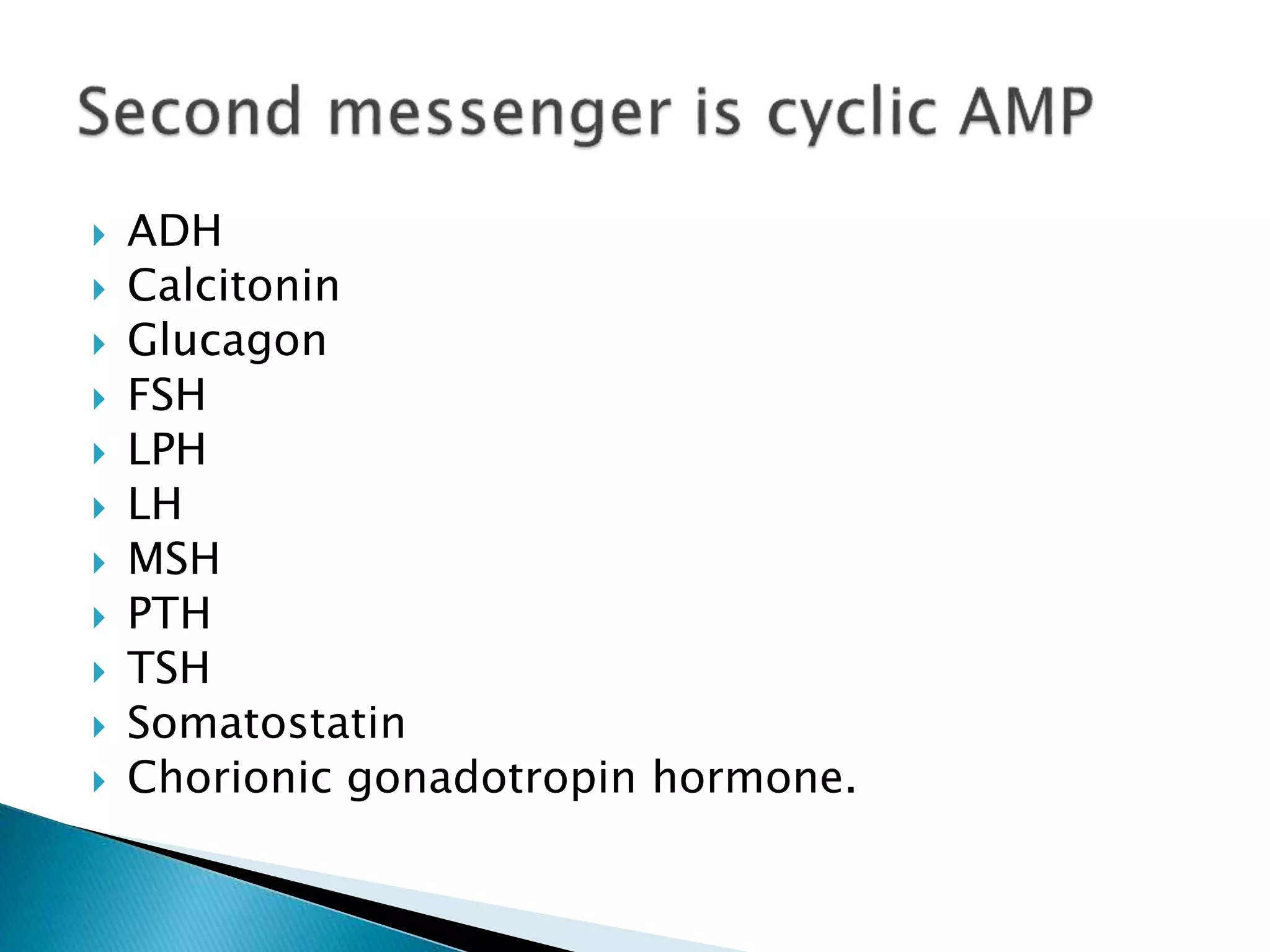
 ADH
 Calcitonin
 Glucagon
 FSH
 LPH
 LH
 MSH
 PTH
 TSH
 Somatostatin
 Chorionic gonadotropin hormone.
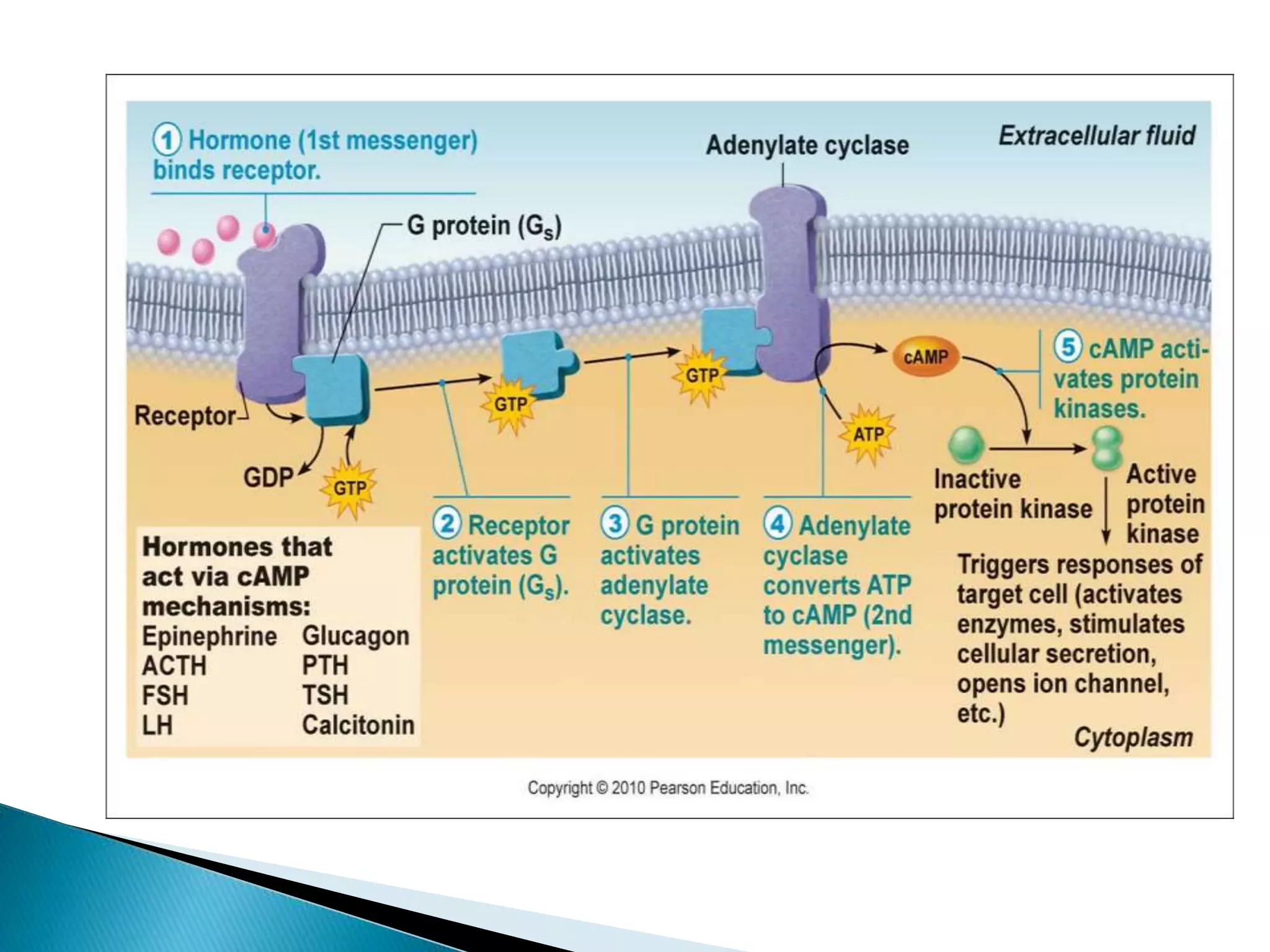
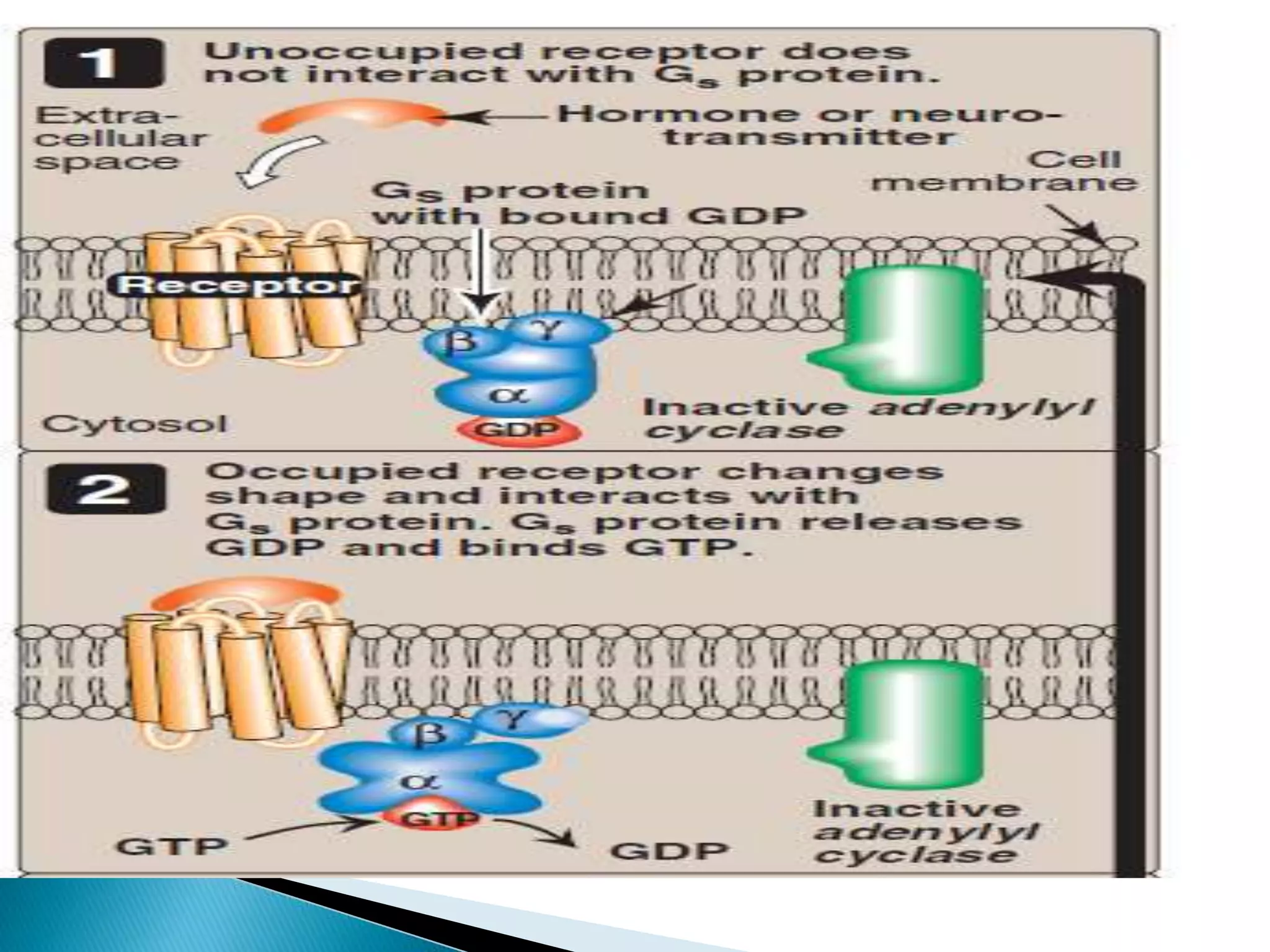
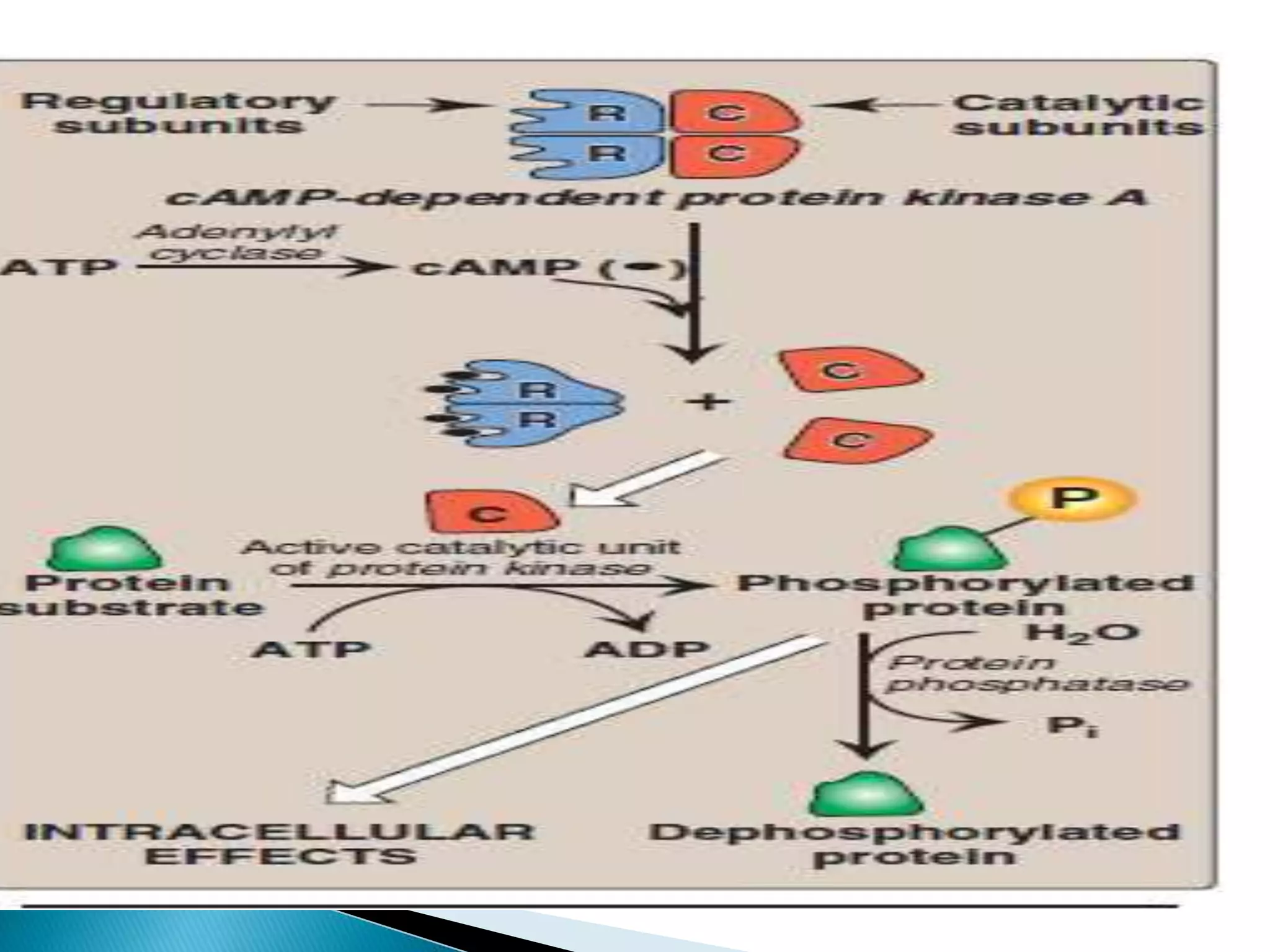
 Cyclic AMP was the first intracellular second
messenger signal identified in mammalian
cells. Several components comprise a system
for generation, degradation, and action of
cyclic AMP.
 Different hormones can stimulate or inhibit
the production of cyclic AMP from adenylyl
cyclase.
 Two parallel system
 A stimulatory
 And an inhibitory
 Converge upon a catalytic subunit.
 Each consists of a receptor Rs and Ri
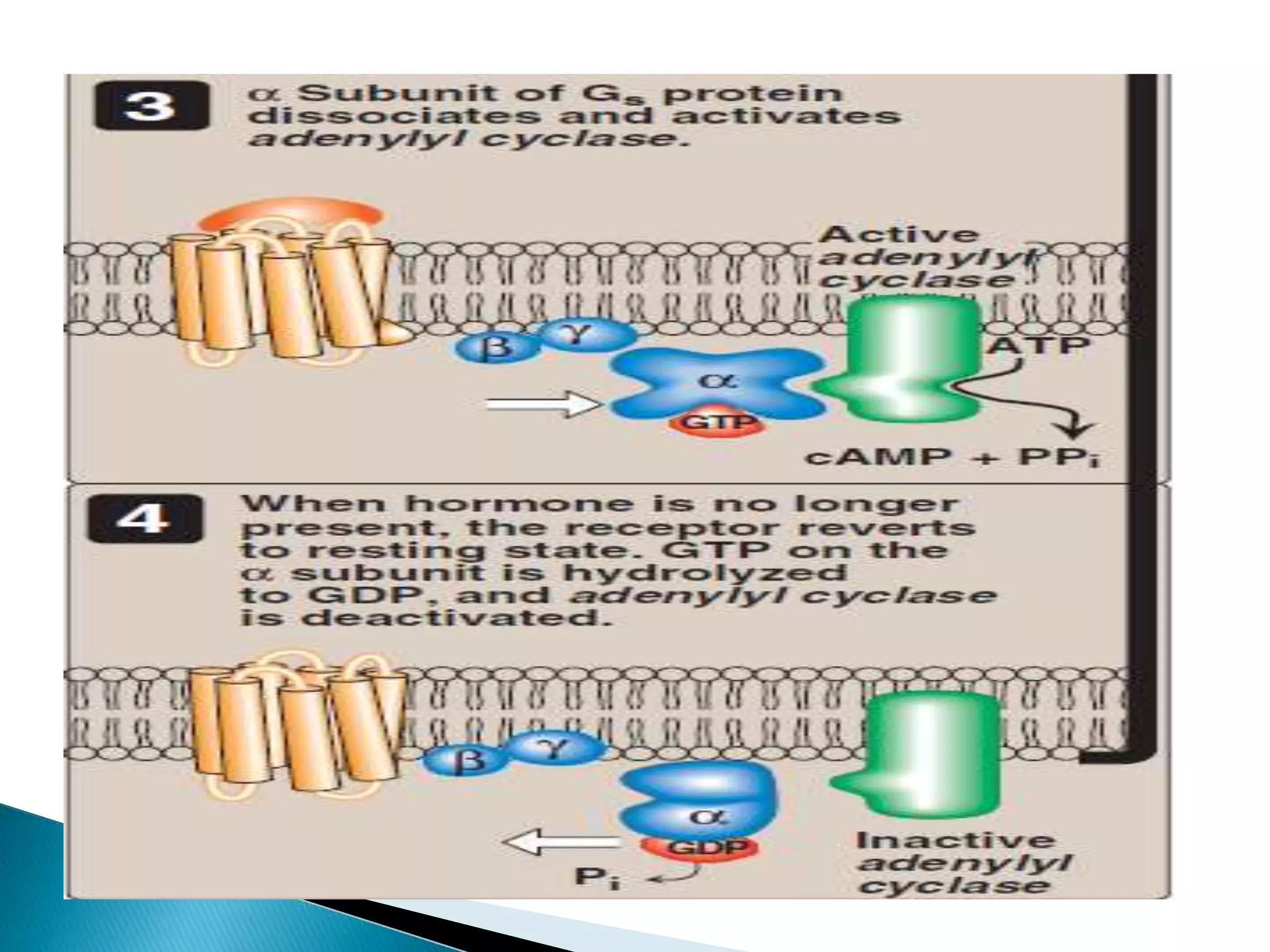
 Gs and Gi are heterotrimeric G proteins
composed of alpha,beta,gamma subunits.
 Alpha subunit in Gs differs from Gi.
 Alpha subunit binds guanine nucleotide.
 Beta and gamma subunit appear to act as
heterodimer.
 Binding of hormone to Rs and Ri result in
receptor mediated activation of G protein.
 Exchange of GDP by GTP.
 The alpha s protein has intrinsic GTPase
activity
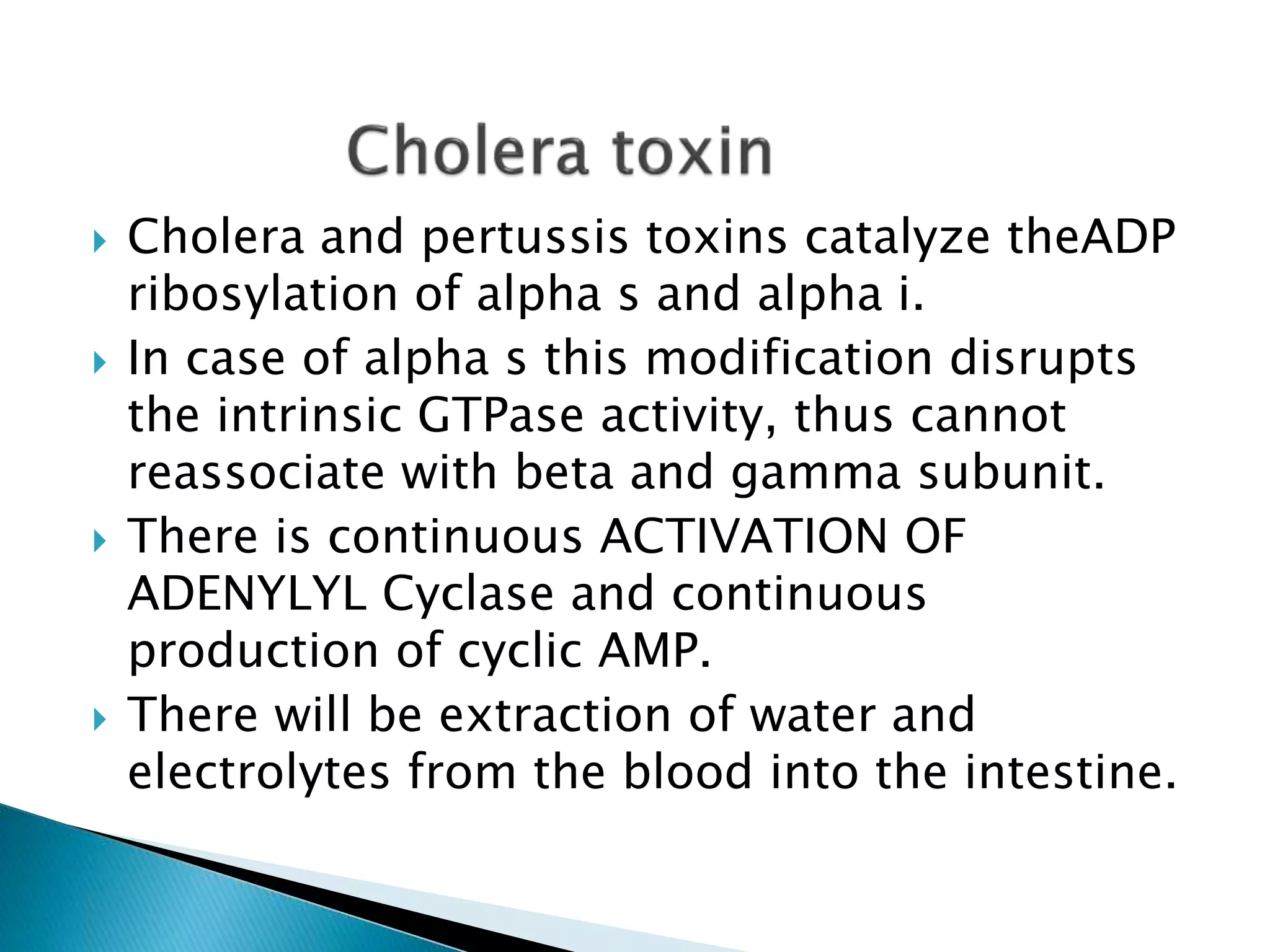
 Cholera and pertussis toxins catalyze theADP
ribosylation of alpha s and alpha i.
 In case of alpha s this modification disrupts
the intrinsic GTPase activity, thus cannot
reassociate with beta and gamma subunit.
 There is continuous ACTIVATION OF
ADENYLYL Cyclase and continuous
production of cyclic AMP.
 There will be extraction of water and
electrolytes from the blood into the intestine.
 The clinical description of cholera begins with
sudden onset of massive diarrhea.
 Pt loses water and electrolytes.
 ANP
 Nitric oxide
 Atrial natriuretic factor is produced by cells in
atrium of heart in response to distension,
binds to ANF receptor in vascular smooth
muscle and in kidney.
 The ANF receptor spans the membrane and
has guanylate cyclase activity associated with
cytoplasmic domain.
 It causes relaxation of the vascular smooth
muscle, resulting in vasodilatation, and in
kidney it promotes sodium and water
excretion.
 Nitric oxide is produced in vascular
endothelium in response to vasodilators. It
diffuses into surrounding vascular smooth
muscle, where it directly binds the heme
group of soluble guanylate cyclase, activating
the enzyme.
 Both ANF receptor and soluble guanylyl
cyclase are associated with the same vascular
smooth muscle cell.
 The sequence from receptor to protein kinase
is quite similar to one above for cAMP with
two important variations.
 The ANP receptor has intrinsic guanylate
cyclase activity, because no G protein is
required in the membrane, the receptor lacks
the 7-helix membrane spanning domain.
 Nitric oxide diffuses into the the cell and directly activates a
soluble ,cytoplasmic guanylate cyclase,so no receptor or G
protein is required.
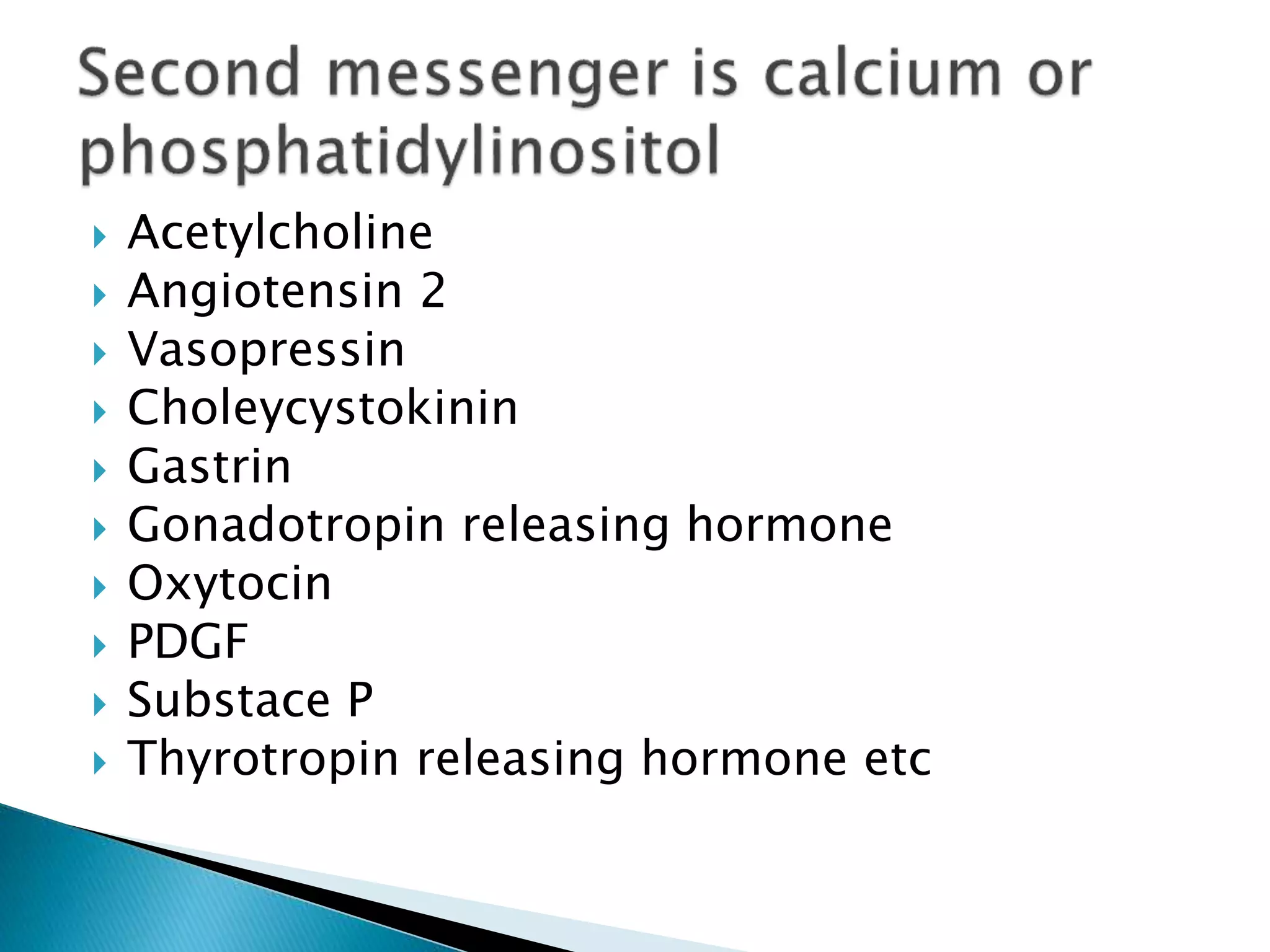
 Acetylcholine
 Angiotensin 2
 Vasopressin
 Choleycystokinin
 Gastrin
 Gonadotropin releasing hormone
 Oxytocin
 PDGF
 Substace P
 Thyrotropin releasing hormone etc
 Adiponectin
 EGF
 EPO
 FGF
 GH
 LEPTIN
 NGF
 Platelet derived growth factor
 prolactin
 A protein kinase is an enzyme that
phosphorylates many other proteins,
changing their activity.
cAMP Gs Adenyl
cyclase
cAMP Protein
kinase A
PIP2 Gq Phospholipa
se C
DAG,IP3,calc
ium
Protein
kinase C
cGMP NONE Guanyl
cyclase
cGMP Protein
kinase G
INSULIN,GRO
WTH
FACTORS
Monomeric
p21
------- ------ Tyrosine
kinase
activity of
receptor.
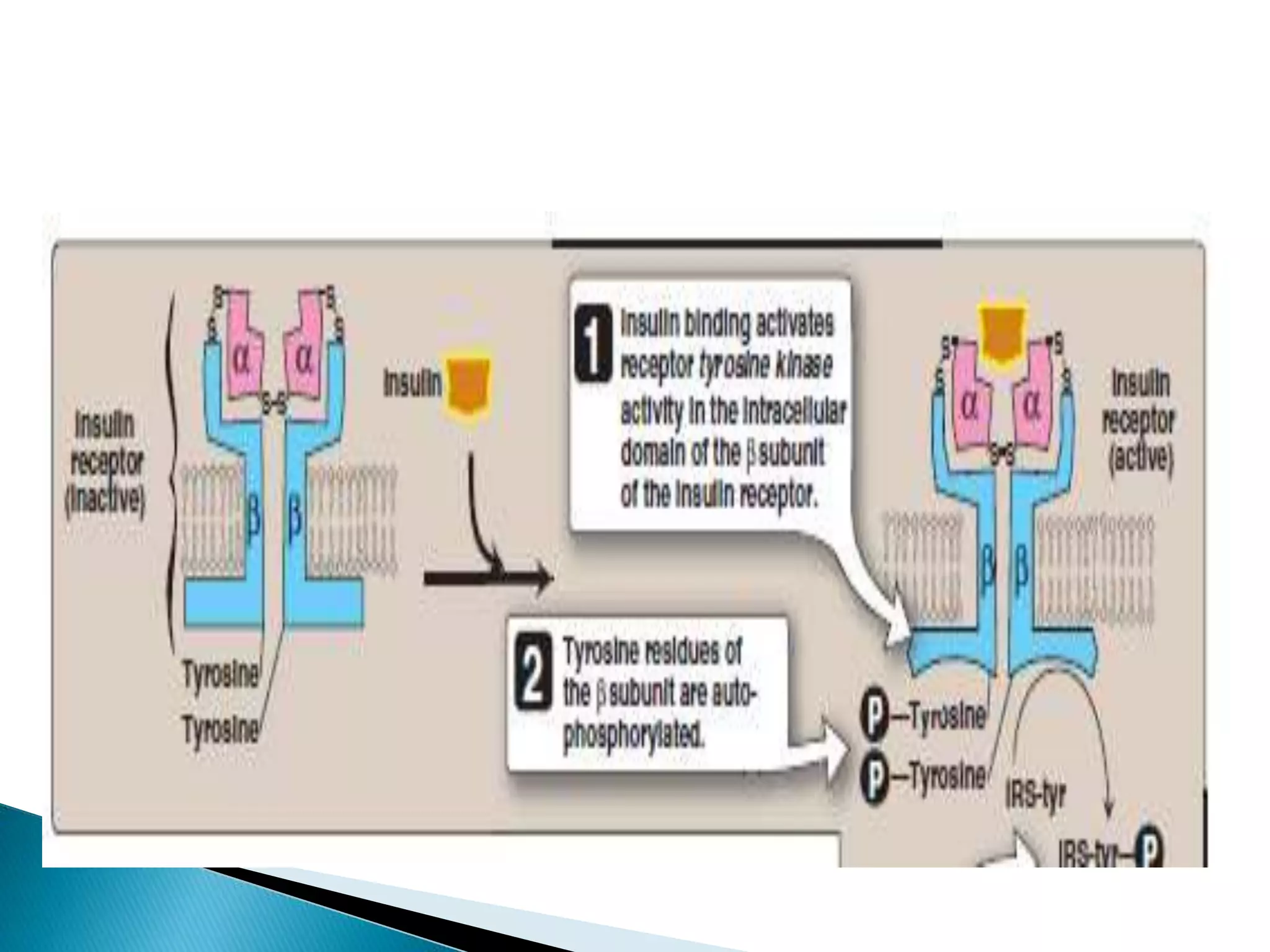
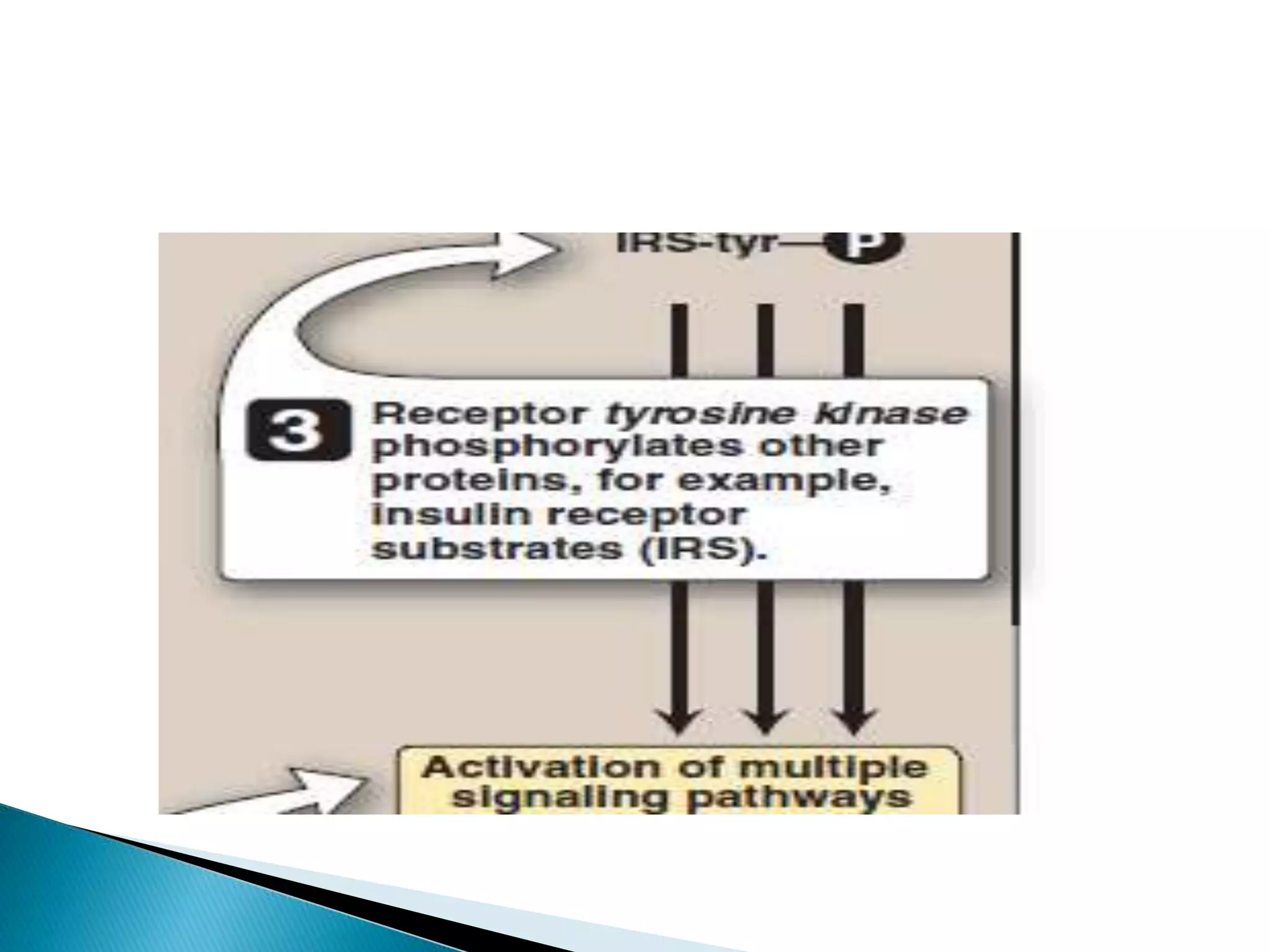
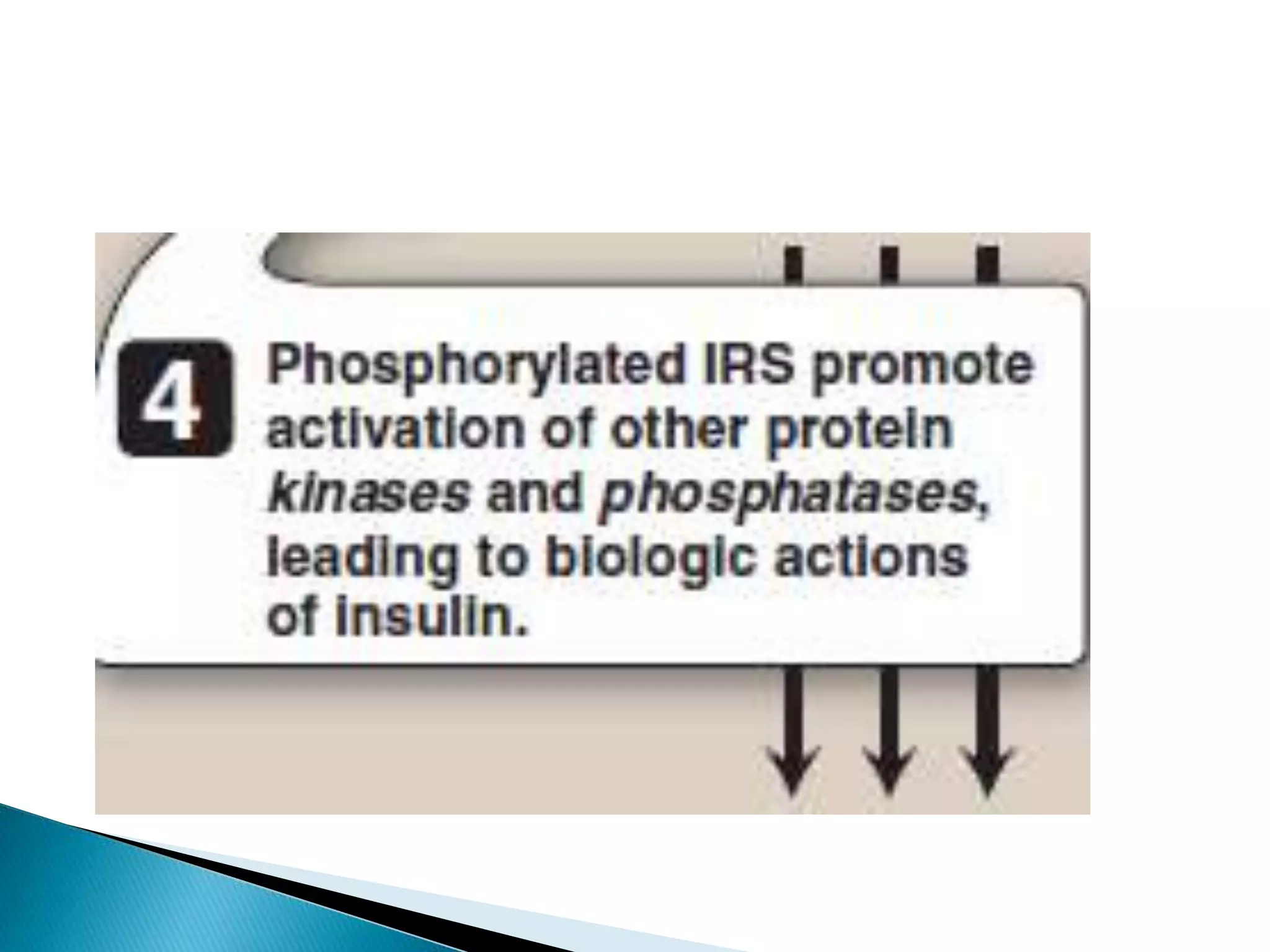
 Some water soluble hormone bind to receptor
with intrinsic tyrosine kinase activity. In this
case no second messenger is required for
protein kinase activation.
 Cyclic GMP is made from GTP by the enzyme guanylyl cyclase,
 which exists in soluble and membrane-bound forms.
 The atriopeptins, a family of peptides produced in cardiac atrial tissues,
cause natriuresis, diuresis, vasodilation, and inhibition of aldosterone
secretion.
 These peptides (eg, atrial natriuretic factor) bind to and activate the
membrane-bound form of guanylyl cyclase.
 This results in an increase of cGMP by as much as 50-fold in some
cases, and this is thought to mediate the effects mentioned above.
 Other evidence links cGMP to vasodilation. A series of compounds,
including nitroprusside, nitroglycerin, nitric oxide, sodium nitrite, and
sodium azide, all cause smooth muscle relaxation and are potent
vasodilators.
 These agents increase cGMP by activating the soluble form of guanylyl
cyclase, and inhibitors of cGMP phosphodiesterase (the drug sildenafil
[Viagra], for example) enhance and prolong these responses.
 The increased cGMP activates cGMP-dependent protein kinase (PKG),
which in turn phosphorylates a number of smooth muscle proteins.
Presumably, this is involved in relaxation of smooth muscle and
vasodilation

Second messengers and classification of hormone

  • 2.
     The number,relative activity and state of occupancy of specific receptor on the plasma membrane or in the cytoplasm or nucleus.  The metabolism of hormone on target cell.  Presence of other factors that are necessary for the hormone response.  Up or down regulation of receptor.  Post receptor desensitization of cell including down regulation of receptor.
  • 3.
     A hormoneis a substance that is synthesized in one organ and transported by circulatory system to act on another tissue.  A diverse array of hormones –each with a distinctive mechanism of action and properties of biosynthesis, storage, secretion, transport and metabolism.
  • 4.
     Hormones arechemically diverse. A large series derived from cholesterol.  Glucocorticoids  Mineralocorticoids  Estrogens  Progesterone etc  In some cases a steroid hormone is a precursor molecule of another hormone.  Progesterone is a hormone in its own but also a precursor in the formation of glucocorticoids.,mineralocorticoids,testosterone and estrogen.
  • 5.
     Testosterone isan obligatory intermediate in the biosynthesis of estradiol.  Amino acid tyrosine is the starting point in the synthesis of both catecholamine and thyroid hormone.  Many hormones are polypeptide or glycoprotein. These range in size from a small thyrotropin releasing hormone-a tripeptide to a single chain polypeptide like adrenocorticotropic hormone.(ACTH 39 Aminoacids)
  • 6.
     Parathyroid hormone And  GH(191) Aminoacids  Insulin is a AB heterodimer of 21 and 30 amino acidsw.
  • 7.
     The rateof synthesis and secretion of hormone.  The proximity of target cell to hormone source.  The dissociation constant of hormone with specific plasma protein.  The conversion of inactive or sub optimally active forms of hormones into the fully active form.  The rate of clearance from plasma by other tissue or by digestion, metabolism, or excretion.
  • 8.
     Hormones canbe classified according to chemical composition, solubility properties, location of receptor, and nature of signal used to mediate hormonal action within cell. The classification based on solubility properties is described as followed.
  • 9.
     Group1  Lipophilic Transport proteins required  Long plasma half life  Intracellular receptor  Receptor hormone complex is formed  Group 2  Hydrophilic  No transport protein  Short plasma half life  Receptors are on plasma membrane  Mediators are cyclic AMP, cyclic GMP etc.
  • 10.
     Hormones thatbind to intracellular receptor.  Androgens  Calcitriol  Estrogens  Glucocorticoids  Mineralocorticoids  Progestins  Retinoic acid  Thyroid hormone.
  • 11.
     Second messengeris cyclic AMP.  Second messenger is cyclic GMP.  Second messenger is calcium or phosphatidylinositol or both.  The second messenger is phosphate or kinase cascade.
  • 12.
     ADH  Calcitonin Glucagon  FSH  LPH  LH  MSH  PTH  TSH  Somatostatin  Chorionic gonadotropin hormone.
  • 13.
     Cyclic AMPwas the first intracellular second messenger signal identified in mammalian cells. Several components comprise a system for generation, degradation, and action of cyclic AMP.
  • 14.
     Different hormonescan stimulate or inhibit the production of cyclic AMP from adenylyl cyclase.  Two parallel system  A stimulatory  And an inhibitory  Converge upon a catalytic subunit.  Each consists of a receptor Rs and Ri
  • 15.
     Gs andGi are heterotrimeric G proteins composed of alpha,beta,gamma subunits.  Alpha subunit in Gs differs from Gi.  Alpha subunit binds guanine nucleotide.  Beta and gamma subunit appear to act as heterodimer.  Binding of hormone to Rs and Ri result in receptor mediated activation of G protein.  Exchange of GDP by GTP.  The alpha s protein has intrinsic GTPase activity
  • 20.
     Cholera andpertussis toxins catalyze theADP ribosylation of alpha s and alpha i.  In case of alpha s this modification disrupts the intrinsic GTPase activity, thus cannot reassociate with beta and gamma subunit.  There is continuous ACTIVATION OF ADENYLYL Cyclase and continuous production of cyclic AMP.  There will be extraction of water and electrolytes from the blood into the intestine.
  • 21.
     The clinicaldescription of cholera begins with sudden onset of massive diarrhea.  Pt loses water and electrolytes.
  • 22.
  • 23.
     Atrial natriureticfactor is produced by cells in atrium of heart in response to distension, binds to ANF receptor in vascular smooth muscle and in kidney.  The ANF receptor spans the membrane and has guanylate cyclase activity associated with cytoplasmic domain.  It causes relaxation of the vascular smooth muscle, resulting in vasodilatation, and in kidney it promotes sodium and water excretion.
  • 24.
     Nitric oxideis produced in vascular endothelium in response to vasodilators. It diffuses into surrounding vascular smooth muscle, where it directly binds the heme group of soluble guanylate cyclase, activating the enzyme.  Both ANF receptor and soluble guanylyl cyclase are associated with the same vascular smooth muscle cell.
  • 25.
     The sequencefrom receptor to protein kinase is quite similar to one above for cAMP with two important variations.  The ANP receptor has intrinsic guanylate cyclase activity, because no G protein is required in the membrane, the receptor lacks the 7-helix membrane spanning domain.  Nitric oxide diffuses into the the cell and directly activates a soluble ,cytoplasmic guanylate cyclase,so no receptor or G protein is required.
  • 26.
     Acetylcholine  Angiotensin2  Vasopressin  Choleycystokinin  Gastrin  Gonadotropin releasing hormone  Oxytocin  PDGF  Substace P  Thyrotropin releasing hormone etc
  • 29.
     Adiponectin  EGF EPO  FGF  GH  LEPTIN  NGF  Platelet derived growth factor  prolactin
  • 34.
     A proteinkinase is an enzyme that phosphorylates many other proteins, changing their activity.
  • 35.
    cAMP Gs Adenyl cyclase cAMPProtein kinase A PIP2 Gq Phospholipa se C DAG,IP3,calc ium Protein kinase C cGMP NONE Guanyl cyclase cGMP Protein kinase G INSULIN,GRO WTH FACTORS Monomeric p21 ------- ------ Tyrosine kinase activity of receptor.
  • 36.
     Some watersoluble hormone bind to receptor with intrinsic tyrosine kinase activity. In this case no second messenger is required for protein kinase activation.
  • 37.
     Cyclic GMPis made from GTP by the enzyme guanylyl cyclase,  which exists in soluble and membrane-bound forms.  The atriopeptins, a family of peptides produced in cardiac atrial tissues, cause natriuresis, diuresis, vasodilation, and inhibition of aldosterone secretion.  These peptides (eg, atrial natriuretic factor) bind to and activate the membrane-bound form of guanylyl cyclase.  This results in an increase of cGMP by as much as 50-fold in some cases, and this is thought to mediate the effects mentioned above.  Other evidence links cGMP to vasodilation. A series of compounds, including nitroprusside, nitroglycerin, nitric oxide, sodium nitrite, and sodium azide, all cause smooth muscle relaxation and are potent vasodilators.  These agents increase cGMP by activating the soluble form of guanylyl cyclase, and inhibitors of cGMP phosphodiesterase (the drug sildenafil [Viagra], for example) enhance and prolong these responses.  The increased cGMP activates cGMP-dependent protein kinase (PKG), which in turn phosphorylates a number of smooth muscle proteins. Presumably, this is involved in relaxation of smooth muscle and vasodilation