Receptor Down-regulation
Chander K Negi
M.S (Pharm)
chandernegi09@gmail.com
Department of Pharmacology and Toxicology
National Institute of Pharmaceutical Education and Research (NIPER)
Sector-67, S.A.S. Nagar, Mohali, Punjab-160062
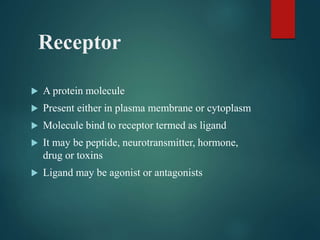
Receptor
 A protein molecule
 Present either in plasma membrane or cytoplasm
 Molecule bind to receptor termed as ligand
 It may be peptide, neurotransmitter, hormone,
drug or toxins
 Ligand may be agonist or antagonists
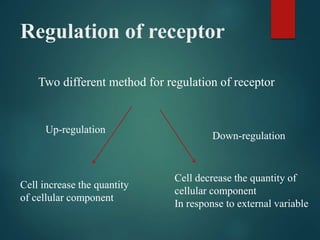
Regulation of receptor
Two different method for regulation of receptor
Up-regulation
Down-regulation
Cell increase the quantity
of cellular component
Cell decrease the quantity of
cellular component
In response to external variable
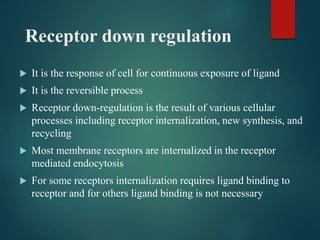
Receptor down regulation
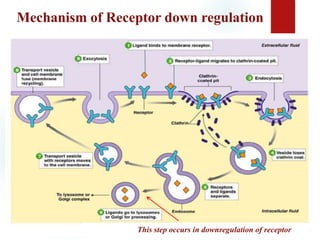
 It is the response of cell for continuous exposure of ligand
 It is the reversible process
 Receptor down-regulation is the result of various cellular
processes including receptor internalization, new synthesis, and
recycling
 Most membrane receptors are internalized in the receptor
mediated endocytosis
 For some receptors internalization requires ligand binding to
receptor and for others ligand binding is not necessary
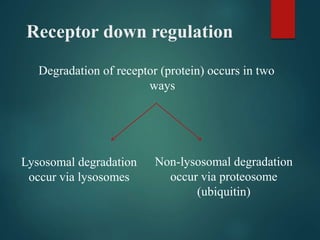
Receptor down regulation
Degradation of receptor (protein) occurs in two
ways
Lysosomal degradation
occur via lysosomes
Non-lysosomal degradation
occur via proteosome
(ubiquitin)
This step occurs in downregulation of receptor
Mechanism of Receptor down regulation
TECHNIQUES FOR DETERMINATION
OF DOWNREGULATION
IMMUNOFLUORESCENCE
PHOSPHORIMAGING
AUTORADIOGRAPHY
IMMUNOFLUORESCENCE
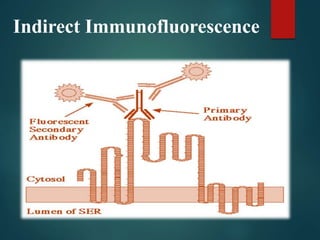
 Immunofluorescence is the labeling of antibodies or
antigens with fluorescent dyes
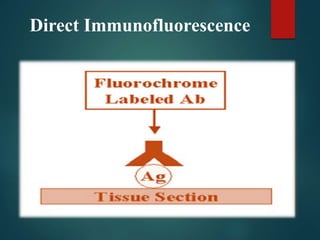
Direct immunofluorescence
Indirect immunofluorescence
 It is detect location and abundance of any protein.
 For immunofluorescence, we need antibody against
particular receptor (protein)
 Example : GPCR
Direct Immunofluorescence
Indirect Immunofluorescence
PHOSPHORIMAGING
 PHOSPHOR + IMAGING
 PHOSPHOR means a substance that exhibits a phenomenon
of PHOSPHORESCENCE, sustained release of light after
exposure to energized particles such as electrons or UV.
 A phosphorimaging is based on imaging plates.
 Imaging plates consists of a thin layer of special crystal
doped with a lanthanides.
 A quantitative (sensitive) imaging technique
 Uses storage phosphor screens and lasers to detect
radioactivity
 Generates images similar to autoradiographs
• Take a sample which is previously hybridized
with labeled probe ( P 32)
• It is placed in contact with phosphor image plate
on specimen microscope slide
• When we apply radiation to the sample it will
excites sample molecules on the plates
• This molecules remain in excited state until the
phosphor imager scans the plate with laser, it
produce latent image
 beta rays energy trapped by plate is released in the
form of visible light
 And this visible light is monitored by
computerized detector
 A false color image produced where the different
color represent different of radioactivity from
lowest (yellow) to highest (black)
AUTORADIOGRAPHY
 X-ray film based
 Used radioactive labeled molecule or
sample
 Recording medium : photographic
emulsion
 Living cells are briefly exposed to a ‘pulse’ of a specific
radioactive compound.
 The tissue is left for a variable time.
 Samples are taken, fixed, and processed for light or electron
microscopy.
 Sections are cut and overlaid with a thin film of photographic
emulsion.
 Left in the dark for days or weeks (while the radioisotope
decays). This exposure time depends on the activity of the
isotope, the temperature and the background radiation (this will
produce with time a contaminating increase in ‘background’
silver grains in the film).
 The photographic emulsion is developed (as for conventional
photography).
 Counterstaining e.g. with toluidine blue, shows the
histological details of the tissue. The staining must be able to
penetrate, but not have an adverse affect on the emulsion
 Alternatively, pre-staining of the entire block of tissue can be
done (e.g. with Osmium on plastic sections coated with
stripping film [or dipping emulsion] as in papers by
McGeachie and Grounds) before exposure to the
photographic emulsion. This avoids the need for individually
(post-) staining each slide.
Receptor down regulation

Receptor down regulation

  • 1.
    Receptor Down-regulation Chander KNegi M.S (Pharm) chandernegi09@gmail.com Department of Pharmacology and Toxicology National Institute of Pharmaceutical Education and Research (NIPER) Sector-67, S.A.S. Nagar, Mohali, Punjab-160062
  • 2.
    Receptor  A proteinmolecule  Present either in plasma membrane or cytoplasm  Molecule bind to receptor termed as ligand  It may be peptide, neurotransmitter, hormone, drug or toxins  Ligand may be agonist or antagonists
  • 3.
    Regulation of receptor Twodifferent method for regulation of receptor Up-regulation Down-regulation Cell increase the quantity of cellular component Cell decrease the quantity of cellular component In response to external variable
  • 4.
    Receptor down regulation It is the response of cell for continuous exposure of ligand  It is the reversible process  Receptor down-regulation is the result of various cellular processes including receptor internalization, new synthesis, and recycling  Most membrane receptors are internalized in the receptor mediated endocytosis  For some receptors internalization requires ligand binding to receptor and for others ligand binding is not necessary
  • 5.
    Receptor down regulation Degradationof receptor (protein) occurs in two ways Lysosomal degradation occur via lysosomes Non-lysosomal degradation occur via proteosome (ubiquitin)
  • 6.
    This step occursin downregulation of receptor Mechanism of Receptor down regulation
  • 7.
    TECHNIQUES FOR DETERMINATION OFDOWNREGULATION IMMUNOFLUORESCENCE PHOSPHORIMAGING AUTORADIOGRAPHY
  • 8.
    IMMUNOFLUORESCENCE  Immunofluorescence isthe labeling of antibodies or antigens with fluorescent dyes Direct immunofluorescence Indirect immunofluorescence  It is detect location and abundance of any protein.  For immunofluorescence, we need antibody against particular receptor (protein)  Example : GPCR
  • 9.
  • 10.
  • 11.
    PHOSPHORIMAGING  PHOSPHOR +IMAGING  PHOSPHOR means a substance that exhibits a phenomenon of PHOSPHORESCENCE, sustained release of light after exposure to energized particles such as electrons or UV.  A phosphorimaging is based on imaging plates.  Imaging plates consists of a thin layer of special crystal doped with a lanthanides.  A quantitative (sensitive) imaging technique  Uses storage phosphor screens and lasers to detect radioactivity  Generates images similar to autoradiographs
  • 12.
    • Take asample which is previously hybridized with labeled probe ( P 32) • It is placed in contact with phosphor image plate on specimen microscope slide • When we apply radiation to the sample it will excites sample molecules on the plates • This molecules remain in excited state until the phosphor imager scans the plate with laser, it produce latent image
  • 13.
     beta raysenergy trapped by plate is released in the form of visible light  And this visible light is monitored by computerized detector  A false color image produced where the different color represent different of radioactivity from lowest (yellow) to highest (black)
  • 14.
    AUTORADIOGRAPHY  X-ray filmbased  Used radioactive labeled molecule or sample  Recording medium : photographic emulsion
  • 15.
     Living cellsare briefly exposed to a ‘pulse’ of a specific radioactive compound.  The tissue is left for a variable time.  Samples are taken, fixed, and processed for light or electron microscopy.  Sections are cut and overlaid with a thin film of photographic emulsion.  Left in the dark for days or weeks (while the radioisotope decays). This exposure time depends on the activity of the isotope, the temperature and the background radiation (this will produce with time a contaminating increase in ‘background’ silver grains in the film).  The photographic emulsion is developed (as for conventional photography).
  • 16.
     Counterstaining e.g.with toluidine blue, shows the histological details of the tissue. The staining must be able to penetrate, but not have an adverse affect on the emulsion  Alternatively, pre-staining of the entire block of tissue can be done (e.g. with Osmium on plastic sections coated with stripping film [or dipping emulsion] as in papers by McGeachie and Grounds) before exposure to the photographic emulsion. This avoids the need for individually (post-) staining each slide.