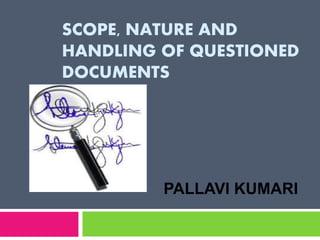
SCOPE, NATURE AND
HANDLING OF QUESTIONED
DOCUMENTS
PALLAVI KUMARI
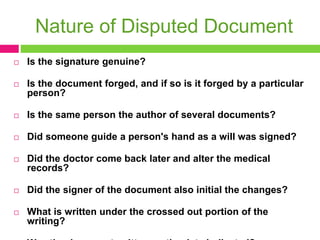
Nature of Disputed Document
 Is the signature genuine?
 Is the document forged, and if so is it forged by a particular
person?
 Is the same person the author of several documents?
 Did someone guide a person's hand as a will was signed?
 Did the doctor come back later and alter the medical
records?
 Did the signer of the document also initial the changes?
 What is written under the crossed out portion of the
writing?
Nature of Disputed Document

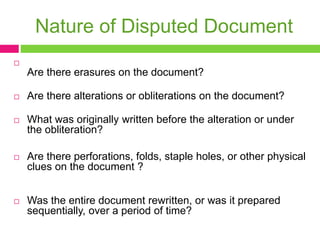
Are there erasures on the document?
 Are there alterations or obliterations on the document?
 What was originally written before the alteration or under
the obliteration?
 Are there perforations, folds, staple holes, or other physical
clues on the document ?
 Was the entire document rewritten, or was it prepared
sequentially, over a period of time?
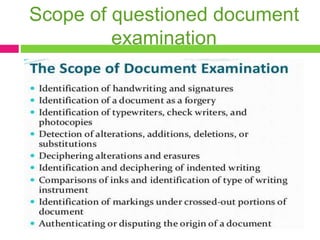
Scope of questioned document
examination
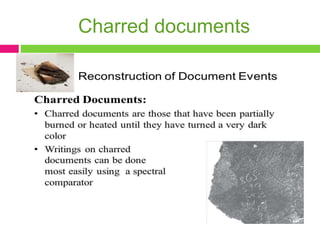
Charred documents
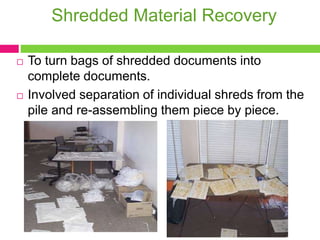
Shredded Material Recovery
 To turn bags of shredded documents into
complete documents.
 Involved separation of individual shreds from the
pile and re-assembling them piece by piece.
Handling of documents
 The proper care and preservation of
documentary evidence, such as forged
checks, anonymous letters, and comparison
specimens ("standards") of a suspect's writing,
is as much the responsibility of investigating
officers as is the original investigation
conducted for the purpose of obtaining or
discovering these documents.
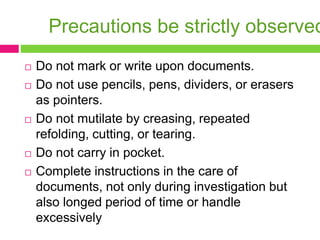
Precautions be strictly observed
 Do not mark or write upon documents.
 Do not use pencils, pens, dividers, or erasers
as pointers.
 Do not mutilate by creasing, repeated
refolding, cutting, or tearing.
 Do not carry in pocket.
 Complete instructions in the care of
documents, not only during investigation but
also longed period of time or handle
excessively
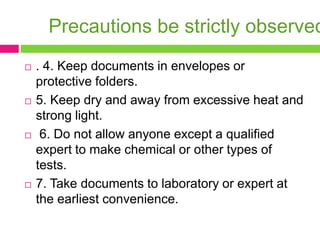
Precautions be strictly observed
 . 4. Keep documents in envelopes or
protective folders.
 5. Keep dry and away from excessive heat and
strong light.
 6. Do not allow anyone except a qualified
expert to make chemical or other types of
tests.
 7. Take documents to laboratory or expert at
the earliest convenience.
FAQ’s
 How burnt documents are treated?
 Which chemical is used to harden burnt
paper?
References
 O. Hilton, Scientific Examination of Questioned
Documents, CRC Press, Boca Raton (1982).
 R.N. Morris, Forensic Handwriting
Identification: Fundamental Concepts and
Principles, Academic Press, London (2000).
 E. David, The Scientific Examination of
Documents – Methods and Techniques, 2nd
Edition, Taylor & Francis, Hants (1997).

scope_and_nature_of_questioned_documents.ppt

  • 1.
    SCOPE, NATURE AND HANDLINGOF QUESTIONED DOCUMENTS PALLAVI KUMARI
  • 2.
    Nature of DisputedDocument  Is the signature genuine?  Is the document forged, and if so is it forged by a particular person?  Is the same person the author of several documents?  Did someone guide a person's hand as a will was signed?  Did the doctor come back later and alter the medical records?  Did the signer of the document also initial the changes?  What is written under the crossed out portion of the writing?
  • 3.
    Nature of DisputedDocument  Are there erasures on the document?  Are there alterations or obliterations on the document?  What was originally written before the alteration or under the obliteration?  Are there perforations, folds, staple holes, or other physical clues on the document ?  Was the entire document rewritten, or was it prepared sequentially, over a period of time?
  • 4.
    Scope of questioneddocument examination
  • 5.
  • 6.
    Shredded Material Recovery To turn bags of shredded documents into complete documents.  Involved separation of individual shreds from the pile and re-assembling them piece by piece.
  • 7.
    Handling of documents The proper care and preservation of documentary evidence, such as forged checks, anonymous letters, and comparison specimens ("standards") of a suspect's writing, is as much the responsibility of investigating officers as is the original investigation conducted for the purpose of obtaining or discovering these documents.
  • 8.
    Precautions be strictlyobserved  Do not mark or write upon documents.  Do not use pencils, pens, dividers, or erasers as pointers.  Do not mutilate by creasing, repeated refolding, cutting, or tearing.  Do not carry in pocket.  Complete instructions in the care of documents, not only during investigation but also longed period of time or handle excessively
  • 9.
    Precautions be strictlyobserved  . 4. Keep documents in envelopes or protective folders.  5. Keep dry and away from excessive heat and strong light.  6. Do not allow anyone except a qualified expert to make chemical or other types of tests.  7. Take documents to laboratory or expert at the earliest convenience.
  • 10.
    FAQ’s  How burntdocuments are treated?  Which chemical is used to harden burnt paper?
  • 11.
    References  O. Hilton,Scientific Examination of Questioned Documents, CRC Press, Boca Raton (1982).  R.N. Morris, Forensic Handwriting Identification: Fundamental Concepts and Principles, Academic Press, London (2000).  E. David, The Scientific Examination of Documents – Methods and Techniques, 2nd Edition, Taylor & Francis, Hants (1997).