COMPARISON OF HANDWRITTEN
DOCUMENT
Session-7
2
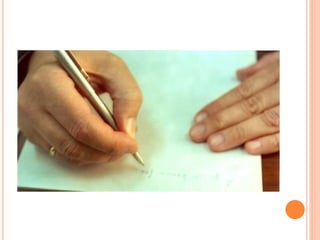
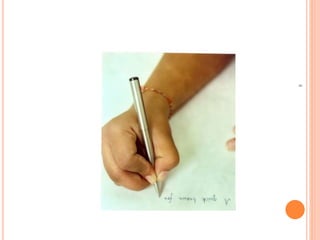
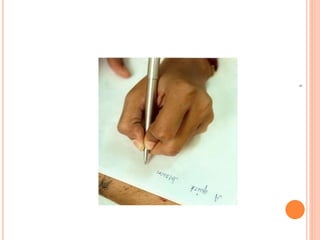
DIFFERENT
STYLES OF PEN
HOLDING
4
7
8
9
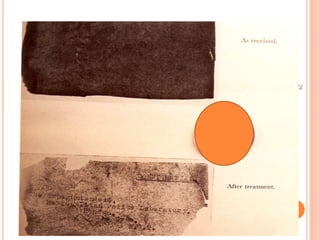
 Modern day questioned document problems are
becoming more complex and the document
examiner is being asked to answer more diversified
questions concerning the production and/or
authenticity of questioned documents.
 Fortunately with the advent of specialized
photographic techniques, computer-based systems
for image enhancement, and recent developments
in relative ink and paper dating by forensic
chemists, the arsenal of analytical tools continues
to expand with more conclusive determinations
being made by the competent expert who is familiar
with their proper applications and uses.
 POSSIBLE CAUSES OF ERROR
The main cause of error in handwriting examinations
is the misinterpretations of the significance of the
various features found within the questioned and
known writings.
Sometimes an inexperienced examiner will place
more weight on class similarities existing between
the two writings as opposed to concentrating on the
individual features important for identification
purposes.
 Additional causes of errors include;
1). Basing an opinion upon inadequate amounts of
questioned writings;
2). Inadequate amount of exemplar writings;
3). Basing conclusions based on outside statements
provided by an interested party;
4). Interpreting all differences as disguised;
5). Allow prejudice or sympathy to affect a conclusion;
6). A hasty or superficial examination;
7). Inability to properly assess and interpret the
different characteristics or qualities of the disputed
and known writing.
FACTORS: Just as internal variation is a fundamental part of the
writing act, external factors surrounding the writing act also
may produce additional variations in handwriting, to include:
a. physical or mental condition of the writer
b. writing instrument employed
c. surface characteristics
d. purpose for which the writing is intended (Informal signature
on a gas receipt versus a formal signature on a more
important document)
e. intoxication
f. drug ingestion
g. occupational influences
h. deficient eye-sight influences
I. extreme temperature
J. writing position
k. extreme fatigue
L. cramping of muscles in writing hand
 A simulated forged signature, whether
accomplished through tracing or free-hand
simulation displays close attention to the writing act
whereas a genuine signature displays little attention
even when crudely written by a poorly skilled writer.
 Removing the pen from the paper and carefully
returning it creating delicate patching and
retouching are not consistent with natural variation
or genuineness but are instead attributes of the
simulated forged signature. Both tracings and
careful freehand sketches will normally reveal the
following identifying attributes:
a. slow broken stokes, tremulous lines and a basic
drawn appearance.
b. unnecessary retouching of strokes or letters.
c. blunt beginning and ending strokes
d. lack of difference in pressure on up-strokes and
down strokes
e. greater deliberation at the start of a word
f. awkward looking forms
g. meaningless marks
h. frequent change in the angle of writing
i. acute angles
j. differences of speed within the writing
MENTAL AND PHYSICAL ILLNESS AND THE WRITING OF
THE AGED
 It is essential that a Document Examiner be familiar with those
attributes of the writing act which are normally attributable to
an individual suffering from a chronic illness inasmuch as
some of these characteristics may be similar to those found in
forgeries made by tracing. Normally, writings which have been
affected adversely by the onset of old age or illness can
readily be identified and separated by those writings made in
imitation of others,( i.e. through simulation or tracings). Some
of the features frequently found in the writing of the physically
impaired individual are: tremor, sudden increase in pressure,
interrupted pressure, frequent and meaningless duplication,
exaggerated underlining, and a general lack of smooth and
rhythmic writing movement. An additional element of the
seriously ill writer is tremor, and normally this extends
throughout the writing.
FOLLOWING ARE THE PRINCIPLES OF
DOCUMENT ANALYSIS:-
1. INDIVIDUALITY
The handwriting of every person is unique in its own way.
Even though writing is a conscious effort, repetition
makes it a habit and the writing becomes a
subconscious act. The handwriting of a person
depends on his schooling, training, writing
experience, environments and occupation in addition
to mental, physical and emotional make-up at the
time of writing.
NATURAL VARITIONS
18
Natural variations are due to the fact that our brain does
not work like a computer. It is influenced by external and
internal factors, which include the following :
 Fatigue
 Illness
 Age
 Writing materials
 Writing position
 Physical disturbance
 Writing with the hand other than the one normally used
 Emotional disturbance
 Lack of concentration during the writing period
 Influence of drinks or drugs.
19
20
22
24
28
29
30

7.Comparison_of_Handwritten_Document.ppt

  • 1.
  • 2.
  • 4.
  • 7.
  • 8.
  • 9.
  • 10.
     Modern dayquestioned document problems are becoming more complex and the document examiner is being asked to answer more diversified questions concerning the production and/or authenticity of questioned documents.  Fortunately with the advent of specialized photographic techniques, computer-based systems for image enhancement, and recent developments in relative ink and paper dating by forensic chemists, the arsenal of analytical tools continues to expand with more conclusive determinations being made by the competent expert who is familiar with their proper applications and uses.
  • 11.
     POSSIBLE CAUSESOF ERROR The main cause of error in handwriting examinations is the misinterpretations of the significance of the various features found within the questioned and known writings. Sometimes an inexperienced examiner will place more weight on class similarities existing between the two writings as opposed to concentrating on the individual features important for identification purposes.
  • 12.
     Additional causesof errors include; 1). Basing an opinion upon inadequate amounts of questioned writings; 2). Inadequate amount of exemplar writings; 3). Basing conclusions based on outside statements provided by an interested party; 4). Interpreting all differences as disguised; 5). Allow prejudice or sympathy to affect a conclusion; 6). A hasty or superficial examination; 7). Inability to properly assess and interpret the different characteristics or qualities of the disputed and known writing.
  • 13.
    FACTORS: Just asinternal variation is a fundamental part of the writing act, external factors surrounding the writing act also may produce additional variations in handwriting, to include: a. physical or mental condition of the writer b. writing instrument employed c. surface characteristics d. purpose for which the writing is intended (Informal signature on a gas receipt versus a formal signature on a more important document) e. intoxication f. drug ingestion g. occupational influences h. deficient eye-sight influences I. extreme temperature J. writing position k. extreme fatigue L. cramping of muscles in writing hand
  • 14.
     A simulatedforged signature, whether accomplished through tracing or free-hand simulation displays close attention to the writing act whereas a genuine signature displays little attention even when crudely written by a poorly skilled writer.  Removing the pen from the paper and carefully returning it creating delicate patching and retouching are not consistent with natural variation or genuineness but are instead attributes of the simulated forged signature. Both tracings and careful freehand sketches will normally reveal the following identifying attributes:
  • 15.
    a. slow brokenstokes, tremulous lines and a basic drawn appearance. b. unnecessary retouching of strokes or letters. c. blunt beginning and ending strokes d. lack of difference in pressure on up-strokes and down strokes e. greater deliberation at the start of a word f. awkward looking forms g. meaningless marks h. frequent change in the angle of writing i. acute angles j. differences of speed within the writing
  • 16.
    MENTAL AND PHYSICALILLNESS AND THE WRITING OF THE AGED  It is essential that a Document Examiner be familiar with those attributes of the writing act which are normally attributable to an individual suffering from a chronic illness inasmuch as some of these characteristics may be similar to those found in forgeries made by tracing. Normally, writings which have been affected adversely by the onset of old age or illness can readily be identified and separated by those writings made in imitation of others,( i.e. through simulation or tracings). Some of the features frequently found in the writing of the physically impaired individual are: tremor, sudden increase in pressure, interrupted pressure, frequent and meaningless duplication, exaggerated underlining, and a general lack of smooth and rhythmic writing movement. An additional element of the seriously ill writer is tremor, and normally this extends throughout the writing.
  • 17.
    FOLLOWING ARE THEPRINCIPLES OF DOCUMENT ANALYSIS:- 1. INDIVIDUALITY The handwriting of every person is unique in its own way. Even though writing is a conscious effort, repetition makes it a habit and the writing becomes a subconscious act. The handwriting of a person depends on his schooling, training, writing experience, environments and occupation in addition to mental, physical and emotional make-up at the time of writing.
  • 18.
    NATURAL VARITIONS 18 Natural variationsare due to the fact that our brain does not work like a computer. It is influenced by external and internal factors, which include the following :  Fatigue  Illness  Age  Writing materials  Writing position  Physical disturbance  Writing with the hand other than the one normally used  Emotional disturbance  Lack of concentration during the writing period  Influence of drinks or drugs.
  • 19.
  • 20.
  • 22.
  • 24.
  • 28.
  • 29.
  • 30.