What Fingerprints Are
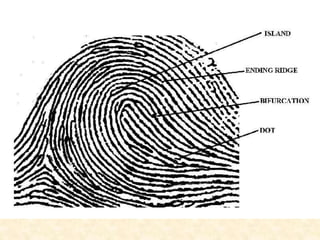
• Fingerprints are patterns of friction ridge
skin
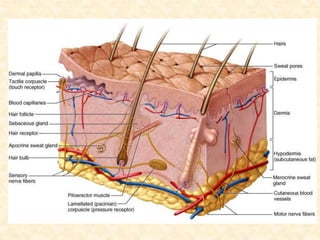
• Fingers and palms of hands, soles of feet
and are characterized by ridges (hills) and
valleys (furrows)
• Patterns form on skin surfaces early in
embryonic development and are carried
through life
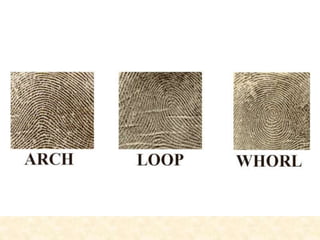
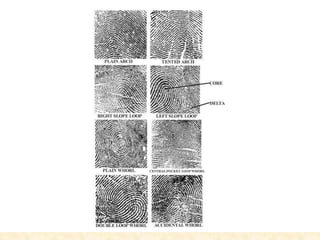
Fingerprint Patterns
• There are three basic patterns of fingerprints:
• Arches – can be plain or tented
• Loops – radial or ulnar, depending on whether
direction of slope of pattern is towards inner arm
bone (radius) or outer arm bone (ulna)
• Whorls - most complex, and contain central
pocket, double loop, and accidental
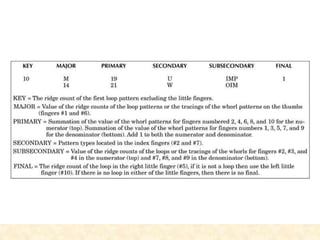
Henry System
• Parts of the Henry System are:
–Key
–Major
–Primary
–Secondary
–Subsecondary
–Second Sub Secondary
–Final
Computer Based Fingerprint Files
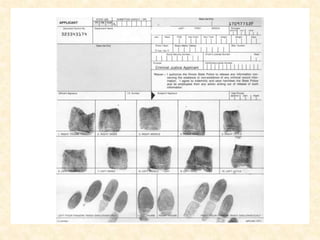
• Automated Fingerprint Identification
Systems (AFIS) are used by law
enforcement
• This system searches databases for 10
point set of prints and searching large files
for single prints retrieved from a crime
scene
Law Enforcement Information
Systems
• FBI recently made its criminal database of
known fingerprint cards (IAFIS) available
• Latent print examiners can search
unknown latent impressions to assist in
identification of suspects or victims
Types of Evidentiary Fingerprints
• Three types of fingerprints
encountered at crime scenes or
on evidence:
–Patent
–Plastic
–Latent
Types of Evidentiary Fingerprints
• Patent – clearly recognizable fingerprint that
needs no processing – could be in grease,
blood, dirt, or oil
• Plastic print – also called an impression or
indentation print- could be in tar, butter, silly
putty
• Latent print – requires additional processing to
be rendered suitable for comparison –
processing is called development or
enhancement
Development of Latent Prints
• Fingerprint residue, which is composed of
inorganic and organic residues, comes
from eccrine glands and from touching
areas where apocrine glands in body are
before touching item
• Fingerprints can also come from touching
external sources- oils, tars, etc and then
touching surface of object
Physical Methods
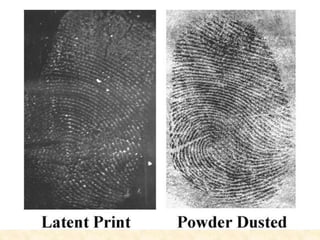
• Latent fingerprint powder dusting is primary
method of visualizing fingerprints
• Black fingerprint powders generally have best
results
• Magnetic powders and brushes are now
available
• Small particle reagent (SPR) is sprayed on print
and adheres to lipids from prints
Chemical Methods
• Chemical methods of techniques for
visualizing fingerprints are:
–Silver nitrate – rarely used anymore
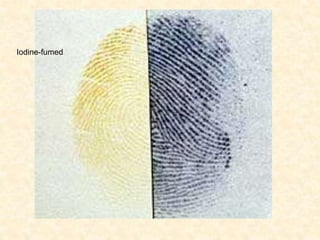
–Iodine fuming – very common –dirty
brown colored print and needs to
photographed quickly as it fades
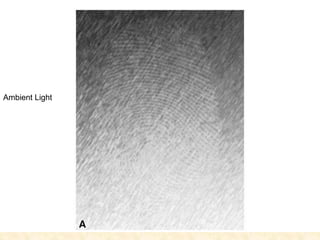
Ambient Light
Silver Nitrate
Iodine-fumed
Chemical Methods
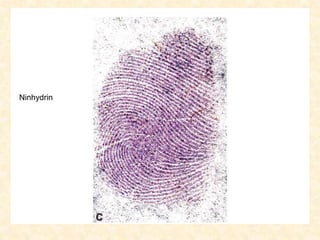
–Ninhydrin – used since 1910 and is slow
to react unless heat and humidity are
present – develops bluish-purple prints
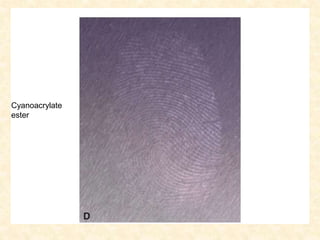
–Cyanoracrylate (superglue) is used to
fume and yields an off white colored
print – use of heat and humidity
accelerates process
Ninhydrin
Cyanoacrylate
ester
Chemical Methods
• Physical Developer (PD) photographic
type process based on deposition of silver
onto latent fingerprint residue
• US Secret Service modified procedure and
uses colloidal gold to enhance prints
• Normally used after ninhydrin
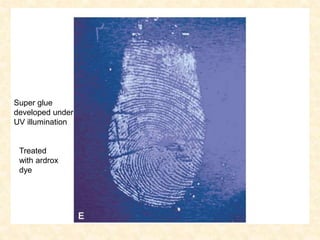
Super glue
developed under
UV illumination
Treated
with ardrox
dye
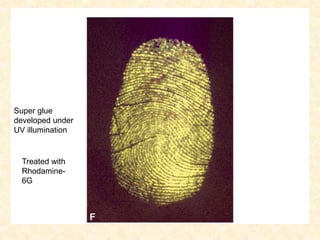
Super glue
developed under
UV illumination
Treated with
Rhodamine-
6G
Combination and Special Lighting
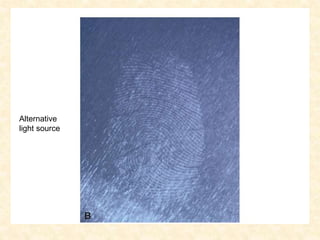
• Various types of lights are used to
illuminate fingerprints
• Bright white light (525 nanometers),
lasers, and black lights with the use of
fluorescent powders are commonly used
Alternative
light source
Bloody Fingerprints and Other
Special Situations
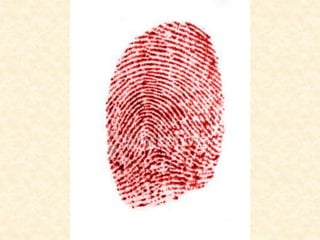
• Bloody fingerprints normally are not latent
– primarily composed of blood
• Most processes for latent print chemical
enhancement do not interfere with blood
collection for DNA profiling by PCR for
CODIS
• Many bloody fingerprints are enhanced by
peroxidase- reaction chemicals
Bloody Fingerprints and Other
Special Situations
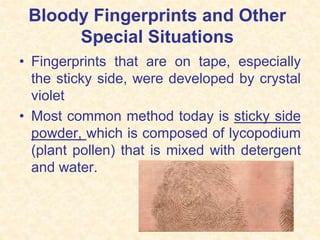
• Fingerprints that are on tape, especially
the sticky side, were developed by crystal
violet
• Most common method today is sticky side
powder, which is composed of lycopodium
(plant pollen) that is mixed with detergent
and water.
Recognition, Collection and
Preservation of Fingerprint
Evidence
• Fingerprints are among best evidence
• Objects at a crime scene which are believed to
contain prints should be collected
• If collection is impossible, latent development
techniques should be used
• Photographing of developed prints is advisable
Fingerprint Identification- The Heart
of the Matter
• David Ashbaugh (1999) noted fingerprint
individuality:
– Friction ridges develop in fetuses
– Friction ridges remain unchanged except for
scars
– Friction ridge patterns and details are unique
– Ridge patterns vary within certain boundaries
that allow patterns to be classified
Fingerprint Identification- The Heart
of the Matter
• Overall process of fingerprint examiner
according to Ashbaugh, A.C.E.V. :
–Analysis
–Comparison
–Evaluation
–Verification

Fingerprint.ppt

  • 1.
    What Fingerprints Are •Fingerprints are patterns of friction ridge skin • Fingers and palms of hands, soles of feet and are characterized by ridges (hills) and valleys (furrows) • Patterns form on skin surfaces early in embryonic development and are carried through life
  • 3.
    Fingerprint Patterns • Thereare three basic patterns of fingerprints: • Arches – can be plain or tented • Loops – radial or ulnar, depending on whether direction of slope of pattern is towards inner arm bone (radius) or outer arm bone (ulna) • Whorls - most complex, and contain central pocket, double loop, and accidental
  • 7.
    Henry System • Partsof the Henry System are: –Key –Major –Primary –Secondary –Subsecondary –Second Sub Secondary –Final
  • 10.
    Computer Based FingerprintFiles • Automated Fingerprint Identification Systems (AFIS) are used by law enforcement • This system searches databases for 10 point set of prints and searching large files for single prints retrieved from a crime scene
  • 11.
    Law Enforcement Information Systems •FBI recently made its criminal database of known fingerprint cards (IAFIS) available • Latent print examiners can search unknown latent impressions to assist in identification of suspects or victims
  • 12.
    Types of EvidentiaryFingerprints • Three types of fingerprints encountered at crime scenes or on evidence: –Patent –Plastic –Latent
  • 13.
    Types of EvidentiaryFingerprints • Patent – clearly recognizable fingerprint that needs no processing – could be in grease, blood, dirt, or oil • Plastic print – also called an impression or indentation print- could be in tar, butter, silly putty • Latent print – requires additional processing to be rendered suitable for comparison – processing is called development or enhancement
  • 14.
    Development of LatentPrints • Fingerprint residue, which is composed of inorganic and organic residues, comes from eccrine glands and from touching areas where apocrine glands in body are before touching item • Fingerprints can also come from touching external sources- oils, tars, etc and then touching surface of object
  • 15.
    Physical Methods • Latentfingerprint powder dusting is primary method of visualizing fingerprints • Black fingerprint powders generally have best results • Magnetic powders and brushes are now available • Small particle reagent (SPR) is sprayed on print and adheres to lipids from prints
  • 17.
    Chemical Methods • Chemicalmethods of techniques for visualizing fingerprints are: –Silver nitrate – rarely used anymore –Iodine fuming – very common –dirty brown colored print and needs to photographed quickly as it fades
  • 18.
  • 19.
  • 20.
  • 21.
    Chemical Methods –Ninhydrin –used since 1910 and is slow to react unless heat and humidity are present – develops bluish-purple prints –Cyanoracrylate (superglue) is used to fume and yields an off white colored print – use of heat and humidity accelerates process
  • 22.
  • 23.
  • 24.
    Chemical Methods • PhysicalDeveloper (PD) photographic type process based on deposition of silver onto latent fingerprint residue • US Secret Service modified procedure and uses colloidal gold to enhance prints • Normally used after ninhydrin
  • 25.
    Super glue developed under UVillumination Treated with ardrox dye
  • 26.
    Super glue developed under UVillumination Treated with Rhodamine- 6G
  • 27.
    Combination and SpecialLighting • Various types of lights are used to illuminate fingerprints • Bright white light (525 nanometers), lasers, and black lights with the use of fluorescent powders are commonly used
  • 28.
  • 29.
    Bloody Fingerprints andOther Special Situations • Bloody fingerprints normally are not latent – primarily composed of blood • Most processes for latent print chemical enhancement do not interfere with blood collection for DNA profiling by PCR for CODIS • Many bloody fingerprints are enhanced by peroxidase- reaction chemicals
  • 31.
    Bloody Fingerprints andOther Special Situations • Fingerprints that are on tape, especially the sticky side, were developed by crystal violet • Most common method today is sticky side powder, which is composed of lycopodium (plant pollen) that is mixed with detergent and water.
  • 32.
    Recognition, Collection and Preservationof Fingerprint Evidence • Fingerprints are among best evidence • Objects at a crime scene which are believed to contain prints should be collected • If collection is impossible, latent development techniques should be used • Photographing of developed prints is advisable
  • 33.
    Fingerprint Identification- TheHeart of the Matter • David Ashbaugh (1999) noted fingerprint individuality: – Friction ridges develop in fetuses – Friction ridges remain unchanged except for scars – Friction ridge patterns and details are unique – Ridge patterns vary within certain boundaries that allow patterns to be classified
  • 34.
    Fingerprint Identification- TheHeart of the Matter • Overall process of fingerprint examiner according to Ashbaugh, A.C.E.V. : –Analysis –Comparison –Evaluation –Verification