F O R E N S I C 4
Q U E S T I O N E D D O C U M E N T S E X A M I N A T I O N
I N T R O D U C T I O N
C H A P T E R 1
W H AT I S A D O C U M E N T ?
• A document is any material which contains marks, signs, or symbols,
which are visible, partially visible or invisible that may presently or
ultimately convey a meaning or message to someone.
• A document becomes a questioned document when it is being questioned
as to its originality, authorship, source and genuineness and when it is
placed under scrutiny to determine whether or not it is disputed.
W H AT I S A D O C U M E N T ?
•Latin word “documentum”, means “lesson,
or example (in Medieval Latin “instruction, or
official paper”), OR
•French word “docere”, means to teach.
W H AT I S A D O C U M E N T ?
• Pencil or ink typewriting, or printing on paper are the most usual forms of
document.
• Applies to writing, to words printed, lithographed, photographed, to maps
or plans, to seals, plates or even stones in which inscriptions.
• Plural form means deeds, agreements, contracts, title, letters, receipts
and other documents.
W H AT I S A Q U E S T I O N E D
D O C U M E N T ?
• It is any document about which some issue has been raised or placed
under scrutiny.
• It is a document that has been questioned in whole or in part with respect
to its authenticity, identity, origin, or its relation among its parts and to
other things.
• It is also defined as any signature, handwriting, typewriting, or other mark
whose source or authenticity is in dispute or doubtful.
W H AT I S A Q U E S T I O N E D
D O C U M E N T ?
• Questioned documents may be disputed or not.
• Not all questioned documents are disputed.
M O S T C O M M O N Q U E S T I O N E D
D O C U M E N T S
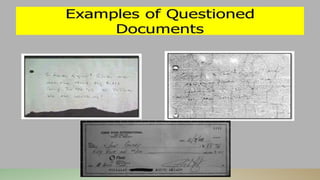
• Checks
• Certificates
• Wills
• Passports
• Licenses
• Money
M O S T C O M M O N Q U E S T I O N E D
D O C U M E N T S
• Letters
• Contracts
• Suicide Notes
• Receipts
• Even Lottery Tickets
D I S P U T E D D O C U M E N T S
• A term suggesting that there is an argument or controversy over the
document, and strictly speaking this is its true meaning. In this text, as
well as through prior usage, however, disputed document and questioned
document are employed interchangeably to signify a document that is
under special scrutiny.
K I N D S O F D O C U M E N T
1.Public Document- notarized by a notary public or
competent public official with solemnities required by
law.
2.Official Document- issued by the government or its
agents or its officers having the authority to do so and
the offices, which in accordance with their creation,
they are authorize to issue and be issued be in the
performance of their duties.
3.Private Document- executed by a private person without
the intervention of a notary public or of any person legally
authorized, by which documents, some disposition or
agreement is proved, evidenced or set forth.
4.Commercial Document- executed in accordance with the
Code of Commerce or any Mercantile Law, containing
disposition of commercial rights or obligations. These are
written records of commercial transactions.
5.Electronic Document (E-Document)- exist only in electronic
form such as data stored on a computer, network, back-up,
archive or other storage media.
W H AT I S Q U E S T I O N E D D O C U M E N T
E X A M I N AT I O N ?
• It has been a profession, at least 1870, and it is frequently done in cases
of forgery, counterfeiting, mail, fraud, kidnapping, con games,
embezzlement, gambling, organized crime, white collar crimes, art crime,
theft, robbery, arson, burglary, homicide, serial number, psychological
profiling, and deviant sex crimes.
T H E E X A M I N AT I O N O F
Q U E S T I O N E D D O C U M E N T S FA L L S
I N T O :
1. Criminalistic Examination – for detection of forgeries, alterations, and
obliterations.
2. Handwriting Identification – to find out who is the author of the writing.
C R I M I N A L I S T I C E X A M I N AT I O N
• is similar also to other laboratory work.
• “An intelligent police investigator can detect 75% of all of his magnifiers
and measuring tools” --- Dr. Wilson Harrison, a noted British Examiner
• The examination of document in criminalistics laboratory is also a
scientific procedure which can be learned in a very short time.
H A N D W R I T I N G I D E N T I F I C AT I O N
• It is more difficult procedure and requires a long study and experience.
• No person ever writes a letter exactly the same every time.
• The handwriting expert have to learn differences of forms and structures
by a sort of intuition, which is not easy to reduce to a science.
• The police investigator/laboratory criminalist should confine his work to
the detection of forgeries and erasures and leave the identification of
handwriting to a more qualified document expert.
S C I E N T I F I C H A N D W R I T I N G
E X A M I N AT I O N C O N S I S T S O F :
• 1. Recognition of characteristics (analysis)
• 2. Complete comparison of all characteristics (comparison)
• 3. Correct interpretation of characteristics (evaluation)
P R O C E S S E S I N S C I E N T I F I C
M E T H O D O F E X A M I N AT I O N
• Analysis – properties or characteristics are observed, measured, and
determined.
• Comparison – properties/characteristics of the unknown items
determined thru analysis are compared with the familiar or recorded
properties of known items.
• Evaluation – similarities/dissimilarities in property or characteristics that
have certain value for identification are determined by their likelihood or
occurrence.
• Document examination consists largely of comparing questioned
handwriting with known handwriting to determine the writer’s identity.
• It also includes the examination of hand printing, forgeries, type writing,
inks, papers, incented and eradicated writing, rubber stamp impressions,
charred paper and related items.
• No two people write exactly alike; the writing process is so complex that
personal peculiarities always persist in the handwriting of any given
individual.
• Detailed examination reveals these hidden characteristics which can the
form the basis for an expert’s opinion.
F O R E N S I C Q U E S T I O N E D
D O C U M E N T E X A M I N AT I O N
• means the application of this science to law or court litigations.
• Forensic science uses highly developed technologies to uncover scientific
evidence in a variety of fields.
• It identifies the identity of a document in question
• In courts of law a witness is not allowed to give his opinion about certain
matters unless the court has decided that he has the necessary fitness to
qualify as an expert.
Forensic-4-Chapter-1.pptx

Forensic-4-Chapter-1.pptx

  • 1.
    F O RE N S I C 4 Q U E S T I O N E D D O C U M E N T S E X A M I N A T I O N
  • 2.
    I N TR O D U C T I O N C H A P T E R 1
  • 3.
    W H ATI S A D O C U M E N T ? • A document is any material which contains marks, signs, or symbols, which are visible, partially visible or invisible that may presently or ultimately convey a meaning or message to someone. • A document becomes a questioned document when it is being questioned as to its originality, authorship, source and genuineness and when it is placed under scrutiny to determine whether or not it is disputed.
  • 4.
    W H ATI S A D O C U M E N T ? •Latin word “documentum”, means “lesson, or example (in Medieval Latin “instruction, or official paper”), OR •French word “docere”, means to teach.
  • 5.
    W H ATI S A D O C U M E N T ? • Pencil or ink typewriting, or printing on paper are the most usual forms of document. • Applies to writing, to words printed, lithographed, photographed, to maps or plans, to seals, plates or even stones in which inscriptions. • Plural form means deeds, agreements, contracts, title, letters, receipts and other documents.
  • 6.
    W H ATI S A Q U E S T I O N E D D O C U M E N T ? • It is any document about which some issue has been raised or placed under scrutiny. • It is a document that has been questioned in whole or in part with respect to its authenticity, identity, origin, or its relation among its parts and to other things. • It is also defined as any signature, handwriting, typewriting, or other mark whose source or authenticity is in dispute or doubtful.
  • 7.
    W H ATI S A Q U E S T I O N E D D O C U M E N T ? • Questioned documents may be disputed or not. • Not all questioned documents are disputed.
  • 9.
    M O ST C O M M O N Q U E S T I O N E D D O C U M E N T S • Checks • Certificates • Wills • Passports • Licenses • Money
  • 10.
    M O ST C O M M O N Q U E S T I O N E D D O C U M E N T S • Letters • Contracts • Suicide Notes • Receipts • Even Lottery Tickets
  • 11.
    D I SP U T E D D O C U M E N T S • A term suggesting that there is an argument or controversy over the document, and strictly speaking this is its true meaning. In this text, as well as through prior usage, however, disputed document and questioned document are employed interchangeably to signify a document that is under special scrutiny.
  • 12.
    K I ND S O F D O C U M E N T 1.Public Document- notarized by a notary public or competent public official with solemnities required by law. 2.Official Document- issued by the government or its agents or its officers having the authority to do so and the offices, which in accordance with their creation, they are authorize to issue and be issued be in the performance of their duties.
  • 13.
    3.Private Document- executedby a private person without the intervention of a notary public or of any person legally authorized, by which documents, some disposition or agreement is proved, evidenced or set forth. 4.Commercial Document- executed in accordance with the Code of Commerce or any Mercantile Law, containing disposition of commercial rights or obligations. These are written records of commercial transactions. 5.Electronic Document (E-Document)- exist only in electronic form such as data stored on a computer, network, back-up, archive or other storage media.
  • 14.
    W H ATI S Q U E S T I O N E D D O C U M E N T E X A M I N AT I O N ? • It has been a profession, at least 1870, and it is frequently done in cases of forgery, counterfeiting, mail, fraud, kidnapping, con games, embezzlement, gambling, organized crime, white collar crimes, art crime, theft, robbery, arson, burglary, homicide, serial number, psychological profiling, and deviant sex crimes.
  • 15.
    T H EE X A M I N AT I O N O F Q U E S T I O N E D D O C U M E N T S FA L L S I N T O : 1. Criminalistic Examination – for detection of forgeries, alterations, and obliterations. 2. Handwriting Identification – to find out who is the author of the writing.
  • 16.
    C R IM I N A L I S T I C E X A M I N AT I O N • is similar also to other laboratory work. • “An intelligent police investigator can detect 75% of all of his magnifiers and measuring tools” --- Dr. Wilson Harrison, a noted British Examiner • The examination of document in criminalistics laboratory is also a scientific procedure which can be learned in a very short time.
  • 17.
    H A ND W R I T I N G I D E N T I F I C AT I O N • It is more difficult procedure and requires a long study and experience. • No person ever writes a letter exactly the same every time. • The handwriting expert have to learn differences of forms and structures by a sort of intuition, which is not easy to reduce to a science. • The police investigator/laboratory criminalist should confine his work to the detection of forgeries and erasures and leave the identification of handwriting to a more qualified document expert.
  • 18.
    S C IE N T I F I C H A N D W R I T I N G E X A M I N AT I O N C O N S I S T S O F : • 1. Recognition of characteristics (analysis) • 2. Complete comparison of all characteristics (comparison) • 3. Correct interpretation of characteristics (evaluation)
  • 19.
    P R OC E S S E S I N S C I E N T I F I C M E T H O D O F E X A M I N AT I O N • Analysis – properties or characteristics are observed, measured, and determined. • Comparison – properties/characteristics of the unknown items determined thru analysis are compared with the familiar or recorded properties of known items. • Evaluation – similarities/dissimilarities in property or characteristics that have certain value for identification are determined by their likelihood or occurrence.
  • 20.
    • Document examinationconsists largely of comparing questioned handwriting with known handwriting to determine the writer’s identity. • It also includes the examination of hand printing, forgeries, type writing, inks, papers, incented and eradicated writing, rubber stamp impressions, charred paper and related items.
  • 21.
    • No twopeople write exactly alike; the writing process is so complex that personal peculiarities always persist in the handwriting of any given individual. • Detailed examination reveals these hidden characteristics which can the form the basis for an expert’s opinion.
  • 22.
    F O RE N S I C Q U E S T I O N E D D O C U M E N T E X A M I N AT I O N • means the application of this science to law or court litigations. • Forensic science uses highly developed technologies to uncover scientific evidence in a variety of fields. • It identifies the identity of a document in question • In courts of law a witness is not allowed to give his opinion about certain matters unless the court has decided that he has the necessary fitness to qualify as an expert.