QUESTIONED DOCUMENT
EXAMINATION
Session-2
 “When the authenticity or a document is
challenged it becomes a questioned
document”.
e.g. There are two different wills of a father
being presented by his two sons. Each
claims his will is genuine both the will
become questioned.
 A questioned document may have
pseudonymous an anonymous, a
threatening letter or a suicide letter. It may
contain secret code writing.
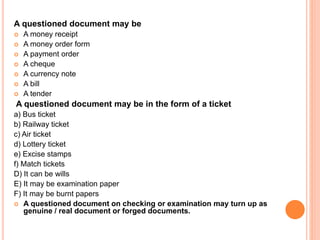
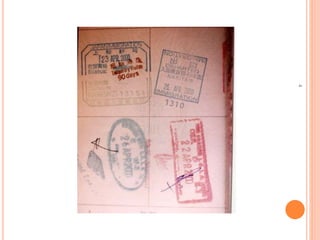
A questioned document may be
 A money receipt
 A money order form
 A payment order
 A cheque
 A currency note
 A bill
 A tender
A questioned document may be in the form of a ticket
a) Bus ticket
b) Railway ticket
c) Air ticket
d) Lottery ticket
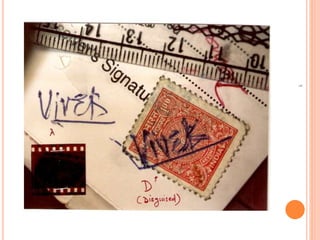
e) Excise stamps
f) Match tickets
D) It can be wills
E) It may be examination paper
F) It may be burnt papers
 A questioned document on checking or examination may turn up as
genuine / real document or forged documents.
4
5
6
Questioned Document Examination:
 Document examination is the discipline that seeks
to determine the history of a document by technical
or scientific processes.
 From the viewpoint of its application to civil and
criminal litigation, its forensic function,
“Forensic document examination is the study of
physical evidence, and physical evidence cannot
lie. Only its interpretation can err. Only the failure to
find it, or to hear its true testimony can deprive it of
its value.”
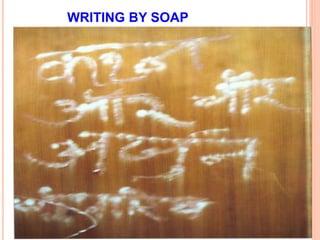
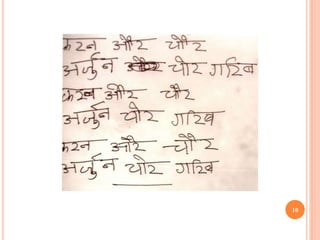
 Questioned handwriting and handlettering, however, may
be inscribed on walls or woodwork or on any other
physical object of any size, perhaps using paint instead of
ink, and broad markers, brushes, or spray cans, instead
of the customary writing instruments.
 The message may be threatening, offensive, obscene,
libelous, annoying, or incriminating, and the identity of the
author may be essential to the fixing of liability or
culpability.
 Understandably, the document examiner will be called
upon to apply his/her skills to identify the author of the
inscription, although the medium (e.g., a lavatory wall or a
concrete bridge) does not fall within the common
definition of a document. While these occasions are
infrequent, document examination and, in particular,
handwriting identification, should be thought of in this
broader context.
WRITING BY SOAP
9
10
The examination of a questioned document is
conducted to determine:
 Its origin, i.e., where did the document come from?
 Its production source, i.e., what person or machine
produced it?
 Its production process, i.e., how was it made?
 Its inscription, i.e., what has faded or been
obliterated?
 Its chastity, i.e., what changes, if any, have been
made to it?
 Its integrity, i.e., is it genuine or false?
 Its legitimacy, i.e., is it an original or a reproduction,
and if so, what generation?
12
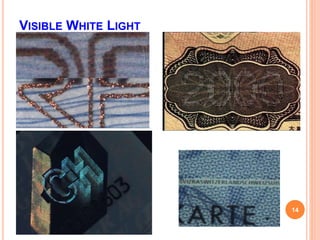
VISIBLE WHITE LIGHT
14
15
16
17
EMBEDDED INFORMATION
18
19
IMAGE

2.Questioned_Document_Examination.ppt

  • 1.
  • 2.
     “When theauthenticity or a document is challenged it becomes a questioned document”. e.g. There are two different wills of a father being presented by his two sons. Each claims his will is genuine both the will become questioned.  A questioned document may have pseudonymous an anonymous, a threatening letter or a suicide letter. It may contain secret code writing.
  • 3.
    A questioned documentmay be  A money receipt  A money order form  A payment order  A cheque  A currency note  A bill  A tender A questioned document may be in the form of a ticket a) Bus ticket b) Railway ticket c) Air ticket d) Lottery ticket e) Excise stamps f) Match tickets D) It can be wills E) It may be examination paper F) It may be burnt papers  A questioned document on checking or examination may turn up as genuine / real document or forged documents.
  • 4.
  • 5.
  • 6.
  • 7.
    Questioned Document Examination: Document examination is the discipline that seeks to determine the history of a document by technical or scientific processes.  From the viewpoint of its application to civil and criminal litigation, its forensic function, “Forensic document examination is the study of physical evidence, and physical evidence cannot lie. Only its interpretation can err. Only the failure to find it, or to hear its true testimony can deprive it of its value.”
  • 8.
     Questioned handwritingand handlettering, however, may be inscribed on walls or woodwork or on any other physical object of any size, perhaps using paint instead of ink, and broad markers, brushes, or spray cans, instead of the customary writing instruments.  The message may be threatening, offensive, obscene, libelous, annoying, or incriminating, and the identity of the author may be essential to the fixing of liability or culpability.  Understandably, the document examiner will be called upon to apply his/her skills to identify the author of the inscription, although the medium (e.g., a lavatory wall or a concrete bridge) does not fall within the common definition of a document. While these occasions are infrequent, document examination and, in particular, handwriting identification, should be thought of in this broader context.
  • 9.
  • 10.
  • 11.
    The examination ofa questioned document is conducted to determine:  Its origin, i.e., where did the document come from?  Its production source, i.e., what person or machine produced it?  Its production process, i.e., how was it made?  Its inscription, i.e., what has faded or been obliterated?  Its chastity, i.e., what changes, if any, have been made to it?  Its integrity, i.e., is it genuine or false?  Its legitimacy, i.e., is it an original or a reproduction, and if so, what generation?
  • 12.
  • 14.
  • 15.
  • 16.
  • 17.
  • 18.
  • 19.
  • 21.