INTRODUCTION OF LOGISTICS
                 MANAGEMENT


 Logistics is the art and science of managing and controlling the flow
  of goods, energy, information, other resources.

 Logistics is the process of getting products and services where they
  are required and when they desired

 Logistics is the process of strategically managing the
  procurement, movement and storage of materials, parts and finished
  inventory (and the related information flows) through the
  organization and its marketing channels in such a way that current
  and future profitability are maximized through the cost-effective
  fulfillment of orders"
Logistics - Science of managing (controlling) the movement and storage of goods
(or people) from acquisition to consumption.


Goods: Raw Materials      Final products, and everything in between.
       Logistics for services & people similar to goods logistics.
       Ex. Police, fire, ambulance, passenger airlines, taxi cabs, etc.

Movement         = Transportation (between locations).
Storage          = Inventory, Warehousing (at locations).

Difference between acquisition and consumption is a matter of space and
time.

Focus: Best way to overcome space and time that separates acquisition
and consumption.
Logistics embodies the effort to deliver:

  the right product

  in the right quantity

  in the right condition

  to the right place

  at the right time

  for the right customer

  at the right cost
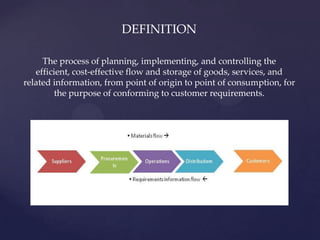
DEFINITION

     The process of planning, implementing, and controlling the
   efficient, cost-effective flow and storage of goods, services, and
related information, from point of origin to point of consumption, for
         the purpose of conforming to customer requirements.
LOGISTICS AS A PART OF SUPPLY CHAIN

 Logistics Management is the part of Supply chain management
  that plans, implements and controls the
  efficient, effective, forward, and reverse flow and storage of
  goods, services, and related information between the point of
  origin and the point of consumption in order to meet customer's
  requirements.

 It involves the integration of information
  , transportation, inventory, warehousing, material handling and
  packaging, and occasionally security.
OBJECTIVES OF LOGISTICS MANAGEMENT
 Cost reduction (variable costs)
 Capital reduction (investment, fixed costs)
 Inventory reduction
 Reliable and consistent performance
 Minimum product damages
 Quick responses
 Delivering customer services-
• Customers must be given more importance than the goods and
  services that have to be delivered.
• Product and services are of significance to the customers only
  when they are available to them exactly when customers need
  them.
DECISIONS IN LOGISTICS MANAGEMENT

     Product design
     Plant location
     Choice of markets/ sources
     Distribution/ dealer network design
     Location of warehouses
     Plant layout
    Allocation decisions
    Production planning
    Inventory management-stoking levels
    Transportation mode choice, shipment size and
          routing decisions and transport contracting
    Packaging
    Material handling
    Warehouse operations
Logistics cost

The performance of a supply chain can be illustrated with the help of
total logistics cost.

To define the logistics cost, one must define the desired outputs
From the logistics system and then seek to identify the costs associated
with providing those outputs.

The manager must understand how the behavior of one cost differs from
the behavior of another cost and for running a logistics system requires
the manager to understand and use a variety of cost information.

The cost of logistics varies from industry to industry.

Cost can be divided in many ways: Fixed, variable and semi-variable, Cash and
non cash, direct and indirect. Each of these costs may reveal important and
information for making logistics decisions.
Some of logistics cost are:
 Insurance

 Handling and warehouses operations
 Packaging
 Transportation
 Customers’ shopping
LOGISTICS FUNCTIONS

Logistics is not a single term actually it is a blend of number of
activities or functions:-

Order processing
Inventory management
Warehousing transportation
Material handling
Logistical packaging
Information
Models in logistics management
1.   Forecasting models- these models allow prediction of demand
     based on past data or other parameters that are independently
     available. They enable better planning, given the lead time
     necessary for response.
2.   Mathematical programming models- under this model, there
     are three models
     Location model
     Allocation model
     Distribution network design models
(a) Location model-
These models help in planning the optimal location of plants or
warehouses, considering the inbound and outbound transportation
costs and infrastructure cost at the locations.

Such models can be solved as an integer program or sometimes as
a linear program.

(b)Allocation models-

These models help in optimally allocating commodities from sources to
destinations in a multi-source multi-destination environment

(c) Distribution network design models-

These models are usually comprehensive in nature, deciding between a
two, three or even four stage distribution network, location of
warehouses and break bulk points, and sometimes even the
transportation mode choice.

Scm ppt

  • 1.
    INTRODUCTION OF LOGISTICS MANAGEMENT  Logistics is the art and science of managing and controlling the flow of goods, energy, information, other resources.  Logistics is the process of getting products and services where they are required and when they desired  Logistics is the process of strategically managing the procurement, movement and storage of materials, parts and finished inventory (and the related information flows) through the organization and its marketing channels in such a way that current and future profitability are maximized through the cost-effective fulfillment of orders"
  • 2.
    Logistics - Scienceof managing (controlling) the movement and storage of goods (or people) from acquisition to consumption. Goods: Raw Materials Final products, and everything in between. Logistics for services & people similar to goods logistics. Ex. Police, fire, ambulance, passenger airlines, taxi cabs, etc. Movement = Transportation (between locations). Storage = Inventory, Warehousing (at locations). Difference between acquisition and consumption is a matter of space and time. Focus: Best way to overcome space and time that separates acquisition and consumption.
  • 3.
    Logistics embodies theeffort to deliver:  the right product  in the right quantity  in the right condition  to the right place  at the right time  for the right customer  at the right cost
  • 4.
    DEFINITION The process of planning, implementing, and controlling the efficient, cost-effective flow and storage of goods, services, and related information, from point of origin to point of consumption, for the purpose of conforming to customer requirements.
  • 5.
    LOGISTICS AS APART OF SUPPLY CHAIN  Logistics Management is the part of Supply chain management that plans, implements and controls the efficient, effective, forward, and reverse flow and storage of goods, services, and related information between the point of origin and the point of consumption in order to meet customer's requirements.  It involves the integration of information , transportation, inventory, warehousing, material handling and packaging, and occasionally security.
  • 6.
    OBJECTIVES OF LOGISTICSMANAGEMENT  Cost reduction (variable costs)  Capital reduction (investment, fixed costs)  Inventory reduction  Reliable and consistent performance  Minimum product damages  Quick responses  Delivering customer services- • Customers must be given more importance than the goods and services that have to be delivered. • Product and services are of significance to the customers only when they are available to them exactly when customers need them.
  • 7.
    DECISIONS IN LOGISTICSMANAGEMENT  Product design  Plant location  Choice of markets/ sources  Distribution/ dealer network design  Location of warehouses  Plant layout  Allocation decisions  Production planning  Inventory management-stoking levels  Transportation mode choice, shipment size and routing decisions and transport contracting  Packaging  Material handling  Warehouse operations
  • 8.
    Logistics cost The performanceof a supply chain can be illustrated with the help of total logistics cost. To define the logistics cost, one must define the desired outputs From the logistics system and then seek to identify the costs associated with providing those outputs. The manager must understand how the behavior of one cost differs from the behavior of another cost and for running a logistics system requires the manager to understand and use a variety of cost information. The cost of logistics varies from industry to industry. Cost can be divided in many ways: Fixed, variable and semi-variable, Cash and non cash, direct and indirect. Each of these costs may reveal important and information for making logistics decisions.
  • 9.
    Some of logisticscost are:  Insurance  Handling and warehouses operations  Packaging  Transportation  Customers’ shopping
  • 10.
    LOGISTICS FUNCTIONS Logistics isnot a single term actually it is a blend of number of activities or functions:- Order processing Inventory management Warehousing transportation Material handling Logistical packaging Information
  • 11.
    Models in logisticsmanagement 1. Forecasting models- these models allow prediction of demand based on past data or other parameters that are independently available. They enable better planning, given the lead time necessary for response. 2. Mathematical programming models- under this model, there are three models Location model Allocation model Distribution network design models
  • 12.
    (a) Location model- Thesemodels help in planning the optimal location of plants or warehouses, considering the inbound and outbound transportation costs and infrastructure cost at the locations. Such models can be solved as an integer program or sometimes as a linear program. (b)Allocation models- These models help in optimally allocating commodities from sources to destinations in a multi-source multi-destination environment (c) Distribution network design models- These models are usually comprehensive in nature, deciding between a two, three or even four stage distribution network, location of warehouses and break bulk points, and sometimes even the transportation mode choice.