Dr M MATHIRAJAN Department of Management Studies Indian Institute of Science Bangalore LOGISTICS PLANNING
The Increased Importance of Logistics A Reduction in Economic Regulation Recognition by Prominent Non-Logisticians Technological Advances The Growing Power of Retailers Globalization of Trade Three objectives of logistics strategy: Cost reduction (variable costs) Capital reduction (investment, fixed costs) Service Improvement (may be at odds with  the above two objectives).
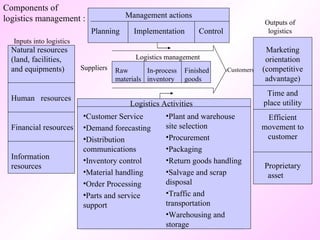
Marketing orientation (competitive advantage) Time and place utility Efficient movement to customer Proprietary asset  Natural resources (land, facilities, and equipments) Human  resources Financial resources Information resources Management actions Planning  Implementation  Control Logistics Activities Raw materials In-process inventory Finished goods Inputs into logistics Suppliers Logistics management Customers Outputs of logistics Components of logistics management : Plant and warehouse site selection Procurement Packaging Return goods handling Salvage and scrap disposal Traffic and transportation Warehousing and storage Customer Service Demand forecasting Distribution communications Inventory control Material handling Order Processing Parts and service  support
To gain a better grasp of the fundamental trade-offs in logistics, I will divide logistics activities into three categories: Production Storage Transportation The term “Resource” applies to all of the factors of production, including  materials  (e.g., Iron, fabric, parts),  equipment  (e.g., machines or vehicles),  energy  (e.g., oil, coal, electricity) and  labor .
PRODUCTION: Fundamental logistics questions are: (1) when should a resource be produced; and (2) where should a resource be produced. The “when” question includes the topics of  aggregate resource planning , and  production scheduling .  The “where” question includes the topics of  facility location  and  production allocation . Some of the important production questions are: (a) What outside source should be used to supply a part? (b) Where should a new facility be built? (c) When should a facility produce different items, taking into account: Seasonal demand patterns? Demand uncertainty? Cost of operating single, double, triple shifts? Labor costs? (d) When should a firm use two or more sources for a part?
INVENTORY: Fundamental logistics questions are (1) when should a resource (material, machine or labor) be put in inventory and taken out of inventory; and (2) where should a resource be stored. The “when” question includes the general topics of  economic-order-quantity  models,  safety stock  models and  seasonal  models, and specialized topics of  fleet management , and  personnel planning .  The “where” questions includes the topic of  inventory echelons . Some of the important inventory questions are: How much does it cost to store resources in inventory? How much “safety stock” should be carried in inventory to prevent against running out of a resource? How much inventory should be carried in order to smooth out seasonal variations in demand? (d) Where should replacement parts be stored in multi-echelon inventory system?
TRANSPORTATION: Fundamental logistics are: (1) where should resources be moved to, and by what mode and route; (2) when should resources be moved. The “where” question includes the topics of  terminal location ,  vehicle routing , and  shortest path methods  and  network flow allocation . The “when” question includes the topic of  distribution rules . Some of the important questions are: When should shipment be sent through terminals, and when should shipment be sent direct? Which, and how many, terminals should shipments be sent through? What are the best vehicle routes? (d)  When should a vehicle be dispatched over a route?
Logistics  - Science of managing (controlling) the  movement  and  storage  of  goods  (or people) from  acquisition  to  consumption . Goods : Raw Materials    Final products, and everything in between. Logistics for services & people similar to goods logistics. Ex. Police, fire, ambulance, passenger airlines, taxi cabs, etc. Movement  = Transportation (between locations). Storage   = Inventory, Warehousing (at locations). Difference between  acquisition  and  consumption  is a matter of space and time. NOTE: Logistics does not deal  with Technology of Production, such as the design of machines and vehicles and the design of finished products.  Focus : Best way to overcome space and time that separates acquisition and consumption.
1998 CLM DEFINITION OF LOGISTICS … .is  that part of the supply chain  process that plans, implements, and controls the efficient, effective flow and storage of goods, services, and related information from the point-of-origin to the point-of-consumption in order to meet customers' requirements.  Council of Logistics Management, 1998; www.CLM1.org
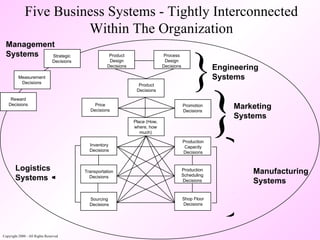
Five Business Systems - Tightly Interconnected Within The Organization Copyright 2000 - All Rights Reserved Measurement Decisions Management Systems Reward Decisions Strategic Decisions Transportation Decisions Sourcing Decisions Inventory Decisions Logistics Systems { Price Decisions Promotion Decisions Marketing Systems Product Decisions Place (How, where, how much) } Production Scheduling Decisions Production Capacity Decisions Shop Floor Decisions Manufacturing Systems } Product Design Decisions Process Design Decisions Engineering Systems }
Logistics – Mission [A Bill of “Rights”] Logistics embodies the effort to deliver: the right  product in the right  quantity in the right  condition to the right  place at the right  time for the right  customer at the right  cost
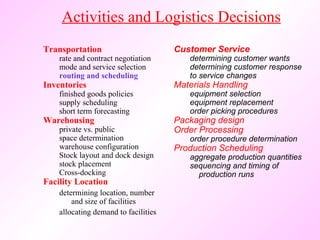
Activities and Logistics Decisions Transportation rate and contract negotiation mode and service selection routing and scheduling Inventories finished goods policies supply scheduling short term forecasting Warehousing private vs. public space determination warehouse configuration Stock layout and dock design stock placement Cross-docking Facility Location determining location, number   and size of facilities allocating demand to facilities Customer Service determining customer wants determining customer response to service changes Materials Handling equipment selection  equipment replacement order picking procedures Packaging design  Order Processing   order procedure determination Production Scheduling aggregate production quantities sequencing and timing of   production runs
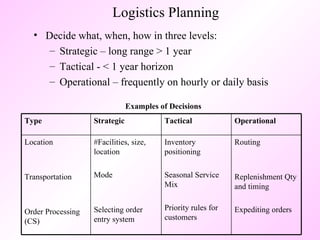
Logistics Planning Decide what, when, how in three levels: Strategic – long range > 1 year Tactical - < 1 year horizon Operational – frequently on hourly or daily basis Examples of Decisions Routing Replenishment Qty and timing Expediting orders Inventory positioning Seasonal Service Mix Priority rules for customers #Facilities, size, location Mode Selecting order entry system Location Transportation Order Processing (CS) Operational Tactical Strategic Type
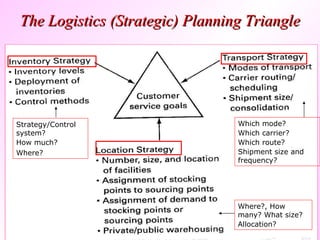
The Logistics (Strategic) Planning Triangle Which mode? Which carrier? Which route? Shipment size and frequency? Where?, How many? What size? Allocation? Strategy/Control system? How much? Where?
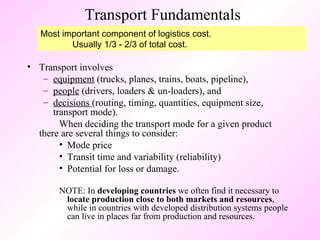
Transport Fundamentals Transport involves  equipment  (trucks, planes, trains, boats, pipeline),  people  (drivers, loaders & un-loaders), and  decisions  (routing, timing, quantities, equipment size, transport mode).  When deciding the transport mode for a given product  there are several things to consider: Mode price Transit time and variability (reliability) Potential for loss or damage. NOTE: In  developing countries  we often find it necessary to  locate production close to both markets and resources , while in countries with developed distribution systems people can live in places far from production and resources. Most important component of logistics cost. Usually 1/3 - 2/3 of total cost.
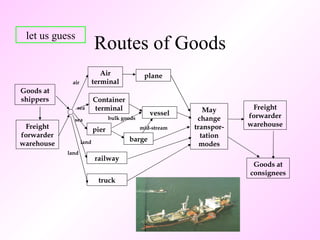
Routes of Goods Goods at shippers let us guess Freight forwarder warehouse Air terminal plane air Freight forwarder warehouse Goods at consignees Container terminal vessel sea May change transpor-tation modes truck land railway land barge mid-stream pier bulk goods sea
Single-mode Service Choices and Issues Air   Rapidly growing segment of transportation industry Lightweight, small items [Products: Perishable and time sensitive goods: Flowers, produce, electronics, mail, emergency shipments, documents, etc.] Quick, reliable, expensive Often combined with trucking operations Rail   Low cost, high-volume [Products: Heavy industry, minerals, chemicals, agricultural products, autos, etc.]  Improving flexibility intermodal service Truck   Most used mode  Flexible, small loads [Products: Medium and light manufacturing, food, clothing, all retail goods] Trucks can go door-to-door as opposed to planes and trains.
Single-mode Service Choices and Issues (Contd.) Water   One of oldest means of transport Low-cost, high-volume, slow  Bulky, heavy and/or large items (Products: Nonperishable bulk cargo -  Liquids, minerals, grain, petroleum, lumber, etc )] Standardized shipping containers improve service Combined with trucking & rail for complete systems International trade Pipeline   Primarily for oil & refined oil products Slurry lines carry coal or kaolin High capital investment Low operating costs Can cross difficult terrain  Highly reliable; Low product losses
Transport Cost Characteristics Fixed costs: Terminal facilities Transport equipment Carrier administration Roadway acquisition and maintenance [ Infrastructure (road, rail, pipeline, navigation, etc.)] Variable costs: Fuel Labor Equipment maintenance Handling, pickup & delivery, taxes NOTE : Cost structure varies by mode
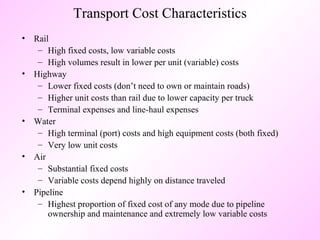
Transport Cost Characteristics Rail High fixed costs, low variable costs High volumes result in lower per unit (variable) costs Highway Lower fixed costs (don’t need to own or maintain roads) Higher unit costs than rail due to lower capacity per truck Terminal expenses and line-haul expenses Water High terminal (port) costs and high equipment costs (both fixed) Very low unit costs Air Substantial fixed costs Variable costs depend highly on distance traveled Pipeline Highest proportion of fixed cost of any mode due to pipeline ownership and maintenance and extremely low variable costs
Vehicle Routing: - Separate single origin and destination: Once we have selected a transport mode and have goods that need to go from point A to point B, we must decide  how to route a vehicle (or vehicles) from point A to point B .  Given a map of all of our route choices between A and B we can create a network representing these choices The problem then reduces to  the problem of finding the shortest path  in the network from point A to B.  This is a well solved problem that can use Dijkstra’s Algorithm for quick solution of small to medium (several thousand nodes) sized problems.
Suppose we have  multiple sources and multiple destinations , that each destination requires some integer number of truckloads, and that none of the sources have capacity restrictions [ No Capacity Restriction ].  In this case we can simply apply the  transportation method  of linear programming to determine the assignment of sources to destinations.  Vehicle Routing: -  Multiple Origin and Destination Points  Sources Destinations
- Coincident Origin and Destination: The TSP If  a vehicle must deliver to more than two customers , we must decide the order in which we will visit those customers so as to minimize the total cost of making the delivery.  We first suppose that any time that we make a delivery to customers we are able to make use of only a single vehicle, i.e., that vehicle capacity of our only truck is never an issue.  In this case, we need to dispatch a single vehicle from our depot to  n  - 1 customers, with the vehicle returning to the depot following its final delivery.  This is the well-known  Traveling Salesman Problem  ( TSP ).  The TSP has been well studied and solved for problem instances involving thousands of nodes.  We can formulate the TSP as follows: Vehicle Routing:
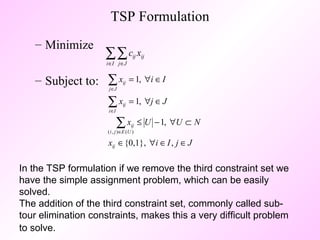
TSP Formulation Minimize Subject to: In the TSP formulation if we remove the third constraint set we have the simple assignment problem, which can be easily solved.  The addition of the third constraint set, commonly called sub-tour elimination constraints, makes this a very difficult problem to solve.
Questions about the TSP Given a problem with  n  nodes, how many distinct feasible tours exist? How many arcs will the network have? How many  x ij  variables will we have? How could we quantify the number of subtour elimination constraints? The complexity of the TSP has led to several  heuristic  or approximate methods for finding good feasible solutions.  The simplest solution we might think of is that of the nearest neighbor.
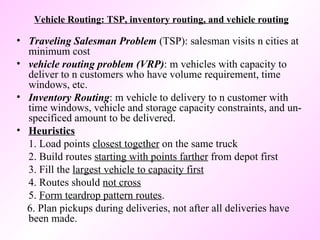
Vehicle Routing: TSP, inventory routing, and vehicle routing Traveling Salesman Problem  (TSP): salesman visits n cities at minimum cost  vehicle routing problem (VRP) : m vehicles with capacity to deliver to n customers who have volume requirement, time windows, etc. Inventory Routing : m vehicle to delivery to n customer with time windows, vehicle and storage capacity constraints, and un-specificed amount to be delivered.  Heuristics 1. Load points  closest together  on the same truck 2. Build routes  starting with points farther  from depot first 3. Fill the  largest vehicle to capacity first 4. Routes should  not cross 5.  Form teardrop pattern routes . 6. Plan pickups during deliveries, not after all deliveries have been made.
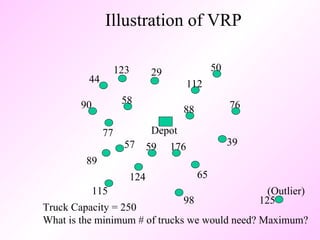
Illustration of VRP (Outlier) Depot 50 76 39 112 88 29 123 44 58 90 77 89 57 115 124 59 176 65 98 125 Truck Capacity = 250 What is the minimum # of trucks we would need? Maximum?
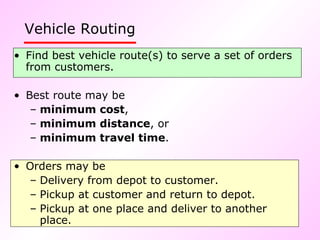
Vehicle Routing Find best vehicle route(s) to serve a set of orders from customers. Best route may be minimum cost , minimum distance , or  minimum travel time . Orders may be Delivery from depot to customer. Pickup at customer and return to depot. Pickup at one place and deliver to another place.
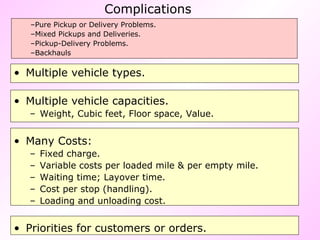
Complications Multiple vehicle types. Multiple vehicle capacities. Weight, Cubic feet, Floor space, Value.  Many Costs: Fixed charge. Variable costs per loaded mile & per empty mile. Waiting time; Layover time. Cost per stop (handling). Loading and unloading cost. Priorities for customers or orders. Pure Pickup or Delivery Problems. Mixed Pickups and Deliveries. Pickup-Delivery Problems. Backhauls
More Complications Time windows for pickup and delivery. Hard vs. soft Compatibility Vehicles and customers. Vehicles and orders. Order types. Drivers and vehicles. Driver rules (DOT) Max drive duration = 10 hrs. before 8 hr. break. Max work duration = 15 hrs. before 8 hr break. Max trip duration = 144 hrs.
Simple Models   Homogeneous vehicles. One capacity (weight or volume). Minimize distance.  No time windows or one time window per customer. No compatibility constraints. No DOT rules.
VRP Solutions   Heuristics Construction : build a feasible route. Improvement : improve a feasible route.   Not necessarily optimal, but fast. Performance depends on problem. Worst case performance may be very poor. Exact algorithms Integer programming. Branch and bound. Optimal, but usually slow and applicable for small size problem Difficult to include complications.
The VRP is applicable in many practical situations directly related to    the  physical delivery of goods  such as    distribution of petroleum products,    distribution of industrial gases,    newspaper deliveries,    delivery of goods to retail store,    garbage collection and disposal,    package pick-up and delivery,    milk pick-up and delivery, etc.    the  non-movement of goods  such as    picking up of students by school buses,    routing of salesmen,    reading of  electric meters,    preventive maintenance inspection tours,    employee pick-up and drop-off , etc. APPLICATIONS OF VRP
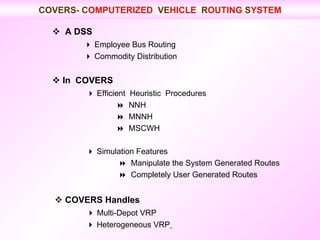
   A DSS    Employee Bus Routing    Commodity Distribution    In  COVERS      Efficient  Heuristic  Procedures     NNH    MNNH    MSCWH      Simulation Features        Manipulate the System Generated Routes        Completely User Generated Routes      COVERS Handles      Multi-Depot VRP      Heterogeneous VRP   COVERS -  C OMPUTERIZED  VE HICLE  R OUTING  S YSTEM
E MPLOYEE  P ICKUP   V E HICLE  R OUTING  P ROBLEM (EPVRP) – BANGALORE, KARNATAKA, INDIA  Indian Telephone Industries [ITI] Limited    Bharat Electronics Limited [BEL]    Hindustan Machine Tools [HMT]    Hindustan Aeronautics Limited [HAL]    Indian Space Research Organization [ISRO]    National Aeronautical Laboratory [NAL]     Central Machine Tools of India [CMTI]     ………
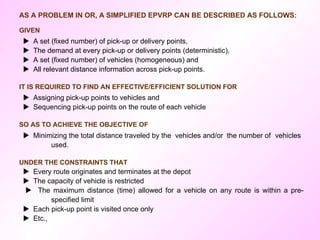
AS A PROBLEM IN OR, A SIMPLIFIED EPVRP CAN BE DESCRIBED AS FOLLOWS:  GIVEN    A set (fixed number) of pick-up or delivery points,    The demand at every pick-up or delivery points (deterministic),    A set (fixed number) of vehicles (homogeneous) and    All relevant distance information across pick-up points. IT IS REQUIRED TO FIND AN EFFECTIVE/EFFICIENT SOLUTION FOR    Assigning pick-up points to vehicles and    Sequencing pick-up points on the route of each vehicle  SO AS TO ACHIEVE THE OBJECTIVE OF    Minimizing the total distance traveled by the  vehicles and/or  the number of  vehicles  used. UNDER THE CONSTRAINTS THAT    Every route originates and terminates at the depot    The capacity of vehicle is restricted    The maximum distance (time) allowed for a vehicle on any route is within a pre- specified limit    Each pick-up point is visited once only     Etc.,
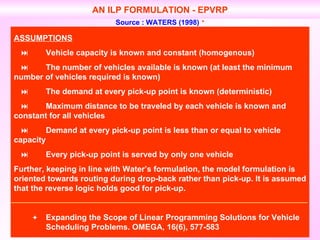
AN ILP FORMULATION - EPVRP Source : WATERS (1998)   ASSUMPTIONS  Vehicle capacity is known and constant (homogenous)    The number of vehicles available is known (at least the minimum  number of vehicles required is known)    The demand at every pick-up point is known (deterministic)    Maximum distance to be traveled by each vehicle is known and  constant for all vehicles    Demand at every pick-up point is less than or equal to vehicle  capacity    Every pick-up point is served by only one vehicle Further, keeping in line with Water’s formulation, the model formulation is oriented towards routing during drop-back rather than pick-up. It is assumed that the reverse logic holds good for pick-up.  Expanding the Scope of Linear Programming Solutions for Vehicle  Scheduling Problems. OMEGA, 16(6), 577-583
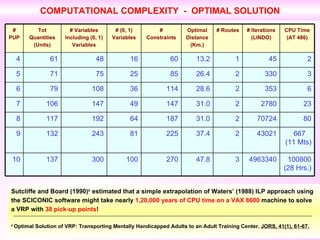
COMPUTATIONAL COMPLEXITY  -  OPTIMAL SOLUTION Sutcliffe and Board (1990)   estimated that a simple extrapolation of Waters’ (1988) ILP approach using the SCICONIC software might take nearly  1,20,000 years of CPU time on a VAX 8600  machine to solve a VRP with  38 pick-up points !    Optimal Solution of VRP: Transporting Mentally Handicapped Adults to an Adult Training Center.  JORS, 41(1), 61-67. 270 225 187 147 114 85 60 # Constraints 47.8 37.4 31.0 31.0 28.6 26.4 13.2 Optimal Distance (Km.) 3 2 2 2 2 2 1 # Routes 4963340 43021 70724 2780 353 330 45 # Iterations (LINDO) 3 25 75 71 5 2 16 48 61 4 23 49 147 106 7 6 36 108 79 6 667  (11 Mts) 81 243 132 9 80 64 192 117 8 100800 (28 Hrs.) 100 300 137 10 CPU Time (AT 486) # (0, 1) Variables # Variables Including (0, 1) Variables Tot Quantities (Units) # PUP
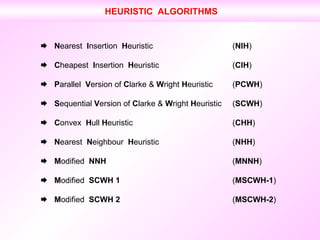
   N earest  I nsertion  H euristic ( NIH )    C heapest  I nsertion  H euristic ( CIH )    P arallel  V ersion of  C larke &  W right  H euristic  ( PCWH )    S equential  V ersion of  C larke &  W right  H euristic ( SCWH )    C onvex  H ull  H euristic ( CHH )    N earest  N eighbour  H euristic ( NHH )    M odified  NNH ( MNNH )     M odified  SCWH 1 ( MSCWH-1 )    M odified  SCWH 2 ( MSCWH-2 ) HEURISTIC  ALGORITHMS
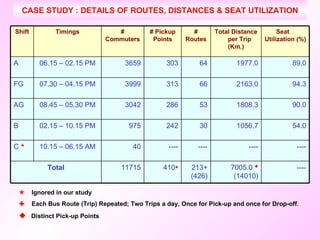
CASE STUDY : DETAILS OF ROUTES, DISTANCES & SEAT UTILIZATION    Ignored in our study      Each Bus Route (Trip) Repeated; Two Trips a day, Once for Pick-up and once for Drop-off .    Distinct Pick-up Points 213+ (426) ---- 30 53 66 64 # Routes 7005.0     (14010) ---- 1056.7 1808.3 2163.0 1977.0 Total Distance  per Trip (Km.) ---- ---- 54.0 90.0 94.3 89.0 Seat  Utilization (%) 313 3999 07.30 – 04.15 PM FG 303 3659 06.15 – 02.15 PM A 242 975 02.15 – 10.15 PM B 286 3042 08.45 – 05.30 PM AG 410  11715 Total ---- 40 10.15 – 06.15 AM C   # Pickup Points # Commuters Timings Shift
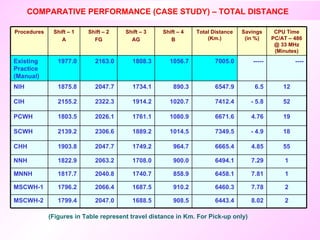
COMPARATIVE PERFORMANCE (CASE STUDY) – TOTAL DISTANCE  (Figures in Table represent travel distance in Km. For Pick-up only) 1 7.81 6458.1 858.9 1740.7 2040.8 1817.7 MNNH 2 7.78 6460.3 910.2 1687.5 2066.4 1796.2 MSCWH-1 1 7.29 6494.1 900.0 1708.0 2063.2 1822.9 NNH 1688.5 1749.2 1889.2 1761.1 1914.2 1734.1 1808.3 Shift – 3 AG 908.5 964.7 1014.5 1080.9 1020.7 890.3 1056.7 Shift – 4 B 6443.4 6665.4 7349.5 6671.6 7412.4 6547.9 7005.0 Total Distance (Km.) 8.02 4.85 - 4.9 4.76 - 5.8 6.5 ----- Savings (in %) 12 2047.7 1875.8 NIH ---- 2163.0 1977.0 Existing Practice (Manual) 19 2026.1 1803.5 PCWH 52 2322.3 2155.2 CIH 55 2047.7 1903.8 CHH 18 2306.6 2139.2 SCWH 2 2047.0 1799.4 MSCWH-2 CPU Time PC/AT – 486 @ 33 MHz (Minutes) Shift – 2 FG Shift – 1 A Procedures
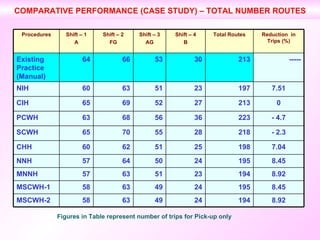
COMPARATIVE PERFORMANCE (CASE STUDY) – TOTAL NUMBER ROUTES Figures in Table represent number of trips for Pick-up only 8.92 194 23 51 63 57 MNNH 8.45 195 24 49 63 58 MSCWH-1 8.45 195 24 50 64 57 NNH 49 51 55 56 52 51 53 Shift – 3 AG 24 25 28 36 27 23 30 Shift – 4 B 194 198 218 223 213 197 213 Total Routes 8.92 7.04 - 2.3 - 4.7 0 7.51 ----- Reduction  in Trips (%) 63 60 NIH 66 64 Existing Practice (Manual) 68 63 PCWH 69 65 CIH 62 60 CHH 70 65 SCWH 63 58 MSCWH-2 Shift – 2 FG Shift – 1 A Procedures
   N earest  N eighbour  H euristic ( NHH )    M odified  NNH ( MNNH )     M odified  SCWH-2 ( MSCWH-2 ) HEURISTIC  ALGORITHMS - DSS IMPLEMENTATION
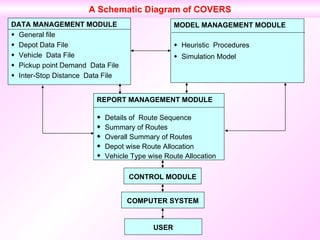
A Schematic Diagram of COVERS DATA MANAGEMENT MODULE    General file    Depot Data File    Vehicle  Data File    Pickup point Demand  Data File    Inter-Stop Distance  Data File MODEL MANAGEMENT MODULE    Heuristic  Procedures    Simulation Model REPORT MANAGEMENT MODULE    Details of  Route Sequence    Summary of Routes    Overall Summary of Routes    Depot wise Route Allocation    Vehicle Type wise Route Allocation CONTROL MODULE   COMPUTER SYSTEM   USER
ThankYou

LOGISTICS PLANNING

  • 1.
    Dr M MATHIRAJANDepartment of Management Studies Indian Institute of Science Bangalore LOGISTICS PLANNING
  • 2.
    The Increased Importanceof Logistics A Reduction in Economic Regulation Recognition by Prominent Non-Logisticians Technological Advances The Growing Power of Retailers Globalization of Trade Three objectives of logistics strategy: Cost reduction (variable costs) Capital reduction (investment, fixed costs) Service Improvement (may be at odds with the above two objectives).
  • 3.
    Marketing orientation (competitiveadvantage) Time and place utility Efficient movement to customer Proprietary asset Natural resources (land, facilities, and equipments) Human resources Financial resources Information resources Management actions Planning Implementation Control Logistics Activities Raw materials In-process inventory Finished goods Inputs into logistics Suppliers Logistics management Customers Outputs of logistics Components of logistics management : Plant and warehouse site selection Procurement Packaging Return goods handling Salvage and scrap disposal Traffic and transportation Warehousing and storage Customer Service Demand forecasting Distribution communications Inventory control Material handling Order Processing Parts and service support
  • 4.
    To gain abetter grasp of the fundamental trade-offs in logistics, I will divide logistics activities into three categories: Production Storage Transportation The term “Resource” applies to all of the factors of production, including materials (e.g., Iron, fabric, parts), equipment (e.g., machines or vehicles), energy (e.g., oil, coal, electricity) and labor .
  • 5.
    PRODUCTION: Fundamental logisticsquestions are: (1) when should a resource be produced; and (2) where should a resource be produced. The “when” question includes the topics of aggregate resource planning , and production scheduling . The “where” question includes the topics of facility location and production allocation . Some of the important production questions are: (a) What outside source should be used to supply a part? (b) Where should a new facility be built? (c) When should a facility produce different items, taking into account: Seasonal demand patterns? Demand uncertainty? Cost of operating single, double, triple shifts? Labor costs? (d) When should a firm use two or more sources for a part?
  • 6.
    INVENTORY: Fundamental logisticsquestions are (1) when should a resource (material, machine or labor) be put in inventory and taken out of inventory; and (2) where should a resource be stored. The “when” question includes the general topics of economic-order-quantity models, safety stock models and seasonal models, and specialized topics of fleet management , and personnel planning . The “where” questions includes the topic of inventory echelons . Some of the important inventory questions are: How much does it cost to store resources in inventory? How much “safety stock” should be carried in inventory to prevent against running out of a resource? How much inventory should be carried in order to smooth out seasonal variations in demand? (d) Where should replacement parts be stored in multi-echelon inventory system?
  • 7.
    TRANSPORTATION: Fundamental logisticsare: (1) where should resources be moved to, and by what mode and route; (2) when should resources be moved. The “where” question includes the topics of terminal location , vehicle routing , and shortest path methods and network flow allocation . The “when” question includes the topic of distribution rules . Some of the important questions are: When should shipment be sent through terminals, and when should shipment be sent direct? Which, and how many, terminals should shipments be sent through? What are the best vehicle routes? (d) When should a vehicle be dispatched over a route?
  • 8.
    Logistics -Science of managing (controlling) the movement and storage of goods (or people) from acquisition to consumption . Goods : Raw Materials  Final products, and everything in between. Logistics for services & people similar to goods logistics. Ex. Police, fire, ambulance, passenger airlines, taxi cabs, etc. Movement = Transportation (between locations). Storage = Inventory, Warehousing (at locations). Difference between acquisition and consumption is a matter of space and time. NOTE: Logistics does not deal with Technology of Production, such as the design of machines and vehicles and the design of finished products. Focus : Best way to overcome space and time that separates acquisition and consumption.
  • 9.
    1998 CLM DEFINITIONOF LOGISTICS … .is that part of the supply chain process that plans, implements, and controls the efficient, effective flow and storage of goods, services, and related information from the point-of-origin to the point-of-consumption in order to meet customers' requirements. Council of Logistics Management, 1998; www.CLM1.org
  • 10.
    Five Business Systems- Tightly Interconnected Within The Organization Copyright 2000 - All Rights Reserved Measurement Decisions Management Systems Reward Decisions Strategic Decisions Transportation Decisions Sourcing Decisions Inventory Decisions Logistics Systems { Price Decisions Promotion Decisions Marketing Systems Product Decisions Place (How, where, how much) } Production Scheduling Decisions Production Capacity Decisions Shop Floor Decisions Manufacturing Systems } Product Design Decisions Process Design Decisions Engineering Systems }
  • 11.
    Logistics – Mission[A Bill of “Rights”] Logistics embodies the effort to deliver: the right product in the right quantity in the right condition to the right place at the right time for the right customer at the right cost
  • 12.
    Activities and LogisticsDecisions Transportation rate and contract negotiation mode and service selection routing and scheduling Inventories finished goods policies supply scheduling short term forecasting Warehousing private vs. public space determination warehouse configuration Stock layout and dock design stock placement Cross-docking Facility Location determining location, number and size of facilities allocating demand to facilities Customer Service determining customer wants determining customer response to service changes Materials Handling equipment selection equipment replacement order picking procedures Packaging design Order Processing order procedure determination Production Scheduling aggregate production quantities sequencing and timing of production runs
  • 13.
    Logistics Planning Decidewhat, when, how in three levels: Strategic – long range > 1 year Tactical - < 1 year horizon Operational – frequently on hourly or daily basis Examples of Decisions Routing Replenishment Qty and timing Expediting orders Inventory positioning Seasonal Service Mix Priority rules for customers #Facilities, size, location Mode Selecting order entry system Location Transportation Order Processing (CS) Operational Tactical Strategic Type
  • 14.
    The Logistics (Strategic)Planning Triangle Which mode? Which carrier? Which route? Shipment size and frequency? Where?, How many? What size? Allocation? Strategy/Control system? How much? Where?
  • 15.
    Transport Fundamentals Transportinvolves equipment (trucks, planes, trains, boats, pipeline), people (drivers, loaders & un-loaders), and decisions (routing, timing, quantities, equipment size, transport mode). When deciding the transport mode for a given product there are several things to consider: Mode price Transit time and variability (reliability) Potential for loss or damage. NOTE: In developing countries we often find it necessary to locate production close to both markets and resources , while in countries with developed distribution systems people can live in places far from production and resources. Most important component of logistics cost. Usually 1/3 - 2/3 of total cost.
  • 16.
    Routes of GoodsGoods at shippers let us guess Freight forwarder warehouse Air terminal plane air Freight forwarder warehouse Goods at consignees Container terminal vessel sea May change transpor-tation modes truck land railway land barge mid-stream pier bulk goods sea
  • 17.
    Single-mode Service Choicesand Issues Air Rapidly growing segment of transportation industry Lightweight, small items [Products: Perishable and time sensitive goods: Flowers, produce, electronics, mail, emergency shipments, documents, etc.] Quick, reliable, expensive Often combined with trucking operations Rail Low cost, high-volume [Products: Heavy industry, minerals, chemicals, agricultural products, autos, etc.] Improving flexibility intermodal service Truck Most used mode Flexible, small loads [Products: Medium and light manufacturing, food, clothing, all retail goods] Trucks can go door-to-door as opposed to planes and trains.
  • 18.
    Single-mode Service Choicesand Issues (Contd.) Water One of oldest means of transport Low-cost, high-volume, slow Bulky, heavy and/or large items (Products: Nonperishable bulk cargo - Liquids, minerals, grain, petroleum, lumber, etc )] Standardized shipping containers improve service Combined with trucking & rail for complete systems International trade Pipeline Primarily for oil & refined oil products Slurry lines carry coal or kaolin High capital investment Low operating costs Can cross difficult terrain Highly reliable; Low product losses
  • 19.
    Transport Cost CharacteristicsFixed costs: Terminal facilities Transport equipment Carrier administration Roadway acquisition and maintenance [ Infrastructure (road, rail, pipeline, navigation, etc.)] Variable costs: Fuel Labor Equipment maintenance Handling, pickup & delivery, taxes NOTE : Cost structure varies by mode
  • 20.
    Transport Cost CharacteristicsRail High fixed costs, low variable costs High volumes result in lower per unit (variable) costs Highway Lower fixed costs (don’t need to own or maintain roads) Higher unit costs than rail due to lower capacity per truck Terminal expenses and line-haul expenses Water High terminal (port) costs and high equipment costs (both fixed) Very low unit costs Air Substantial fixed costs Variable costs depend highly on distance traveled Pipeline Highest proportion of fixed cost of any mode due to pipeline ownership and maintenance and extremely low variable costs
  • 21.
    Vehicle Routing: -Separate single origin and destination: Once we have selected a transport mode and have goods that need to go from point A to point B, we must decide how to route a vehicle (or vehicles) from point A to point B . Given a map of all of our route choices between A and B we can create a network representing these choices The problem then reduces to the problem of finding the shortest path in the network from point A to B. This is a well solved problem that can use Dijkstra’s Algorithm for quick solution of small to medium (several thousand nodes) sized problems.
  • 22.
    Suppose we have multiple sources and multiple destinations , that each destination requires some integer number of truckloads, and that none of the sources have capacity restrictions [ No Capacity Restriction ]. In this case we can simply apply the transportation method of linear programming to determine the assignment of sources to destinations. Vehicle Routing: - Multiple Origin and Destination Points Sources Destinations
  • 23.
    - Coincident Originand Destination: The TSP If a vehicle must deliver to more than two customers , we must decide the order in which we will visit those customers so as to minimize the total cost of making the delivery. We first suppose that any time that we make a delivery to customers we are able to make use of only a single vehicle, i.e., that vehicle capacity of our only truck is never an issue. In this case, we need to dispatch a single vehicle from our depot to n - 1 customers, with the vehicle returning to the depot following its final delivery. This is the well-known Traveling Salesman Problem ( TSP ). The TSP has been well studied and solved for problem instances involving thousands of nodes. We can formulate the TSP as follows: Vehicle Routing:
  • 24.
    TSP Formulation MinimizeSubject to: In the TSP formulation if we remove the third constraint set we have the simple assignment problem, which can be easily solved. The addition of the third constraint set, commonly called sub-tour elimination constraints, makes this a very difficult problem to solve.
  • 25.
    Questions about theTSP Given a problem with n nodes, how many distinct feasible tours exist? How many arcs will the network have? How many x ij variables will we have? How could we quantify the number of subtour elimination constraints? The complexity of the TSP has led to several heuristic or approximate methods for finding good feasible solutions. The simplest solution we might think of is that of the nearest neighbor.
  • 26.
    Vehicle Routing: TSP,inventory routing, and vehicle routing Traveling Salesman Problem (TSP): salesman visits n cities at minimum cost vehicle routing problem (VRP) : m vehicles with capacity to deliver to n customers who have volume requirement, time windows, etc. Inventory Routing : m vehicle to delivery to n customer with time windows, vehicle and storage capacity constraints, and un-specificed amount to be delivered. Heuristics 1. Load points closest together on the same truck 2. Build routes starting with points farther from depot first 3. Fill the largest vehicle to capacity first 4. Routes should not cross 5. Form teardrop pattern routes . 6. Plan pickups during deliveries, not after all deliveries have been made.
  • 27.
    Illustration of VRP(Outlier) Depot 50 76 39 112 88 29 123 44 58 90 77 89 57 115 124 59 176 65 98 125 Truck Capacity = 250 What is the minimum # of trucks we would need? Maximum?
  • 28.
    Vehicle Routing Findbest vehicle route(s) to serve a set of orders from customers. Best route may be minimum cost , minimum distance , or minimum travel time . Orders may be Delivery from depot to customer. Pickup at customer and return to depot. Pickup at one place and deliver to another place.
  • 29.
    Complications Multiple vehicletypes. Multiple vehicle capacities. Weight, Cubic feet, Floor space, Value. Many Costs: Fixed charge. Variable costs per loaded mile & per empty mile. Waiting time; Layover time. Cost per stop (handling). Loading and unloading cost. Priorities for customers or orders. Pure Pickup or Delivery Problems. Mixed Pickups and Deliveries. Pickup-Delivery Problems. Backhauls
  • 30.
    More Complications Timewindows for pickup and delivery. Hard vs. soft Compatibility Vehicles and customers. Vehicles and orders. Order types. Drivers and vehicles. Driver rules (DOT) Max drive duration = 10 hrs. before 8 hr. break. Max work duration = 15 hrs. before 8 hr break. Max trip duration = 144 hrs.
  • 31.
    Simple Models Homogeneous vehicles. One capacity (weight or volume). Minimize distance. No time windows or one time window per customer. No compatibility constraints. No DOT rules.
  • 32.
    VRP Solutions Heuristics Construction : build a feasible route. Improvement : improve a feasible route. Not necessarily optimal, but fast. Performance depends on problem. Worst case performance may be very poor. Exact algorithms Integer programming. Branch and bound. Optimal, but usually slow and applicable for small size problem Difficult to include complications.
  • 33.
    The VRP isapplicable in many practical situations directly related to  the physical delivery of goods such as  distribution of petroleum products,  distribution of industrial gases,  newspaper deliveries,  delivery of goods to retail store,  garbage collection and disposal,  package pick-up and delivery,  milk pick-up and delivery, etc.  the non-movement of goods such as  picking up of students by school buses,  routing of salesmen,  reading of electric meters,  preventive maintenance inspection tours,  employee pick-up and drop-off , etc. APPLICATIONS OF VRP
  • 34.
    A DSS  Employee Bus Routing  Commodity Distribution  In COVERS  Efficient Heuristic Procedures  NNH  MNNH  MSCWH  Simulation Features  Manipulate the System Generated Routes  Completely User Generated Routes  COVERS Handles  Multi-Depot VRP  Heterogeneous VRP COVERS - C OMPUTERIZED VE HICLE R OUTING S YSTEM
  • 35.
    E MPLOYEE P ICKUP V E HICLE R OUTING P ROBLEM (EPVRP) – BANGALORE, KARNATAKA, INDIA  Indian Telephone Industries [ITI] Limited  Bharat Electronics Limited [BEL]  Hindustan Machine Tools [HMT]  Hindustan Aeronautics Limited [HAL]  Indian Space Research Organization [ISRO]  National Aeronautical Laboratory [NAL]  Central Machine Tools of India [CMTI]  ………
  • 36.
    AS A PROBLEMIN OR, A SIMPLIFIED EPVRP CAN BE DESCRIBED AS FOLLOWS: GIVEN  A set (fixed number) of pick-up or delivery points,  The demand at every pick-up or delivery points (deterministic),  A set (fixed number) of vehicles (homogeneous) and  All relevant distance information across pick-up points. IT IS REQUIRED TO FIND AN EFFECTIVE/EFFICIENT SOLUTION FOR  Assigning pick-up points to vehicles and  Sequencing pick-up points on the route of each vehicle SO AS TO ACHIEVE THE OBJECTIVE OF  Minimizing the total distance traveled by the vehicles and/or the number of vehicles used. UNDER THE CONSTRAINTS THAT  Every route originates and terminates at the depot  The capacity of vehicle is restricted  The maximum distance (time) allowed for a vehicle on any route is within a pre- specified limit  Each pick-up point is visited once only  Etc.,
  • 37.
    AN ILP FORMULATION- EPVRP Source : WATERS (1998)  ASSUMPTIONS  Vehicle capacity is known and constant (homogenous)  The number of vehicles available is known (at least the minimum number of vehicles required is known)  The demand at every pick-up point is known (deterministic)  Maximum distance to be traveled by each vehicle is known and constant for all vehicles  Demand at every pick-up point is less than or equal to vehicle capacity  Every pick-up point is served by only one vehicle Further, keeping in line with Water’s formulation, the model formulation is oriented towards routing during drop-back rather than pick-up. It is assumed that the reverse logic holds good for pick-up.  Expanding the Scope of Linear Programming Solutions for Vehicle Scheduling Problems. OMEGA, 16(6), 577-583
  • 38.
    COMPUTATIONAL COMPLEXITY - OPTIMAL SOLUTION Sutcliffe and Board (1990)  estimated that a simple extrapolation of Waters’ (1988) ILP approach using the SCICONIC software might take nearly 1,20,000 years of CPU time on a VAX 8600 machine to solve a VRP with 38 pick-up points !  Optimal Solution of VRP: Transporting Mentally Handicapped Adults to an Adult Training Center. JORS, 41(1), 61-67. 270 225 187 147 114 85 60 # Constraints 47.8 37.4 31.0 31.0 28.6 26.4 13.2 Optimal Distance (Km.) 3 2 2 2 2 2 1 # Routes 4963340 43021 70724 2780 353 330 45 # Iterations (LINDO) 3 25 75 71 5 2 16 48 61 4 23 49 147 106 7 6 36 108 79 6 667 (11 Mts) 81 243 132 9 80 64 192 117 8 100800 (28 Hrs.) 100 300 137 10 CPU Time (AT 486) # (0, 1) Variables # Variables Including (0, 1) Variables Tot Quantities (Units) # PUP
  • 39.
    N earest I nsertion H euristic ( NIH )  C heapest I nsertion H euristic ( CIH )  P arallel V ersion of C larke & W right H euristic ( PCWH )  S equential V ersion of C larke & W right H euristic ( SCWH )  C onvex H ull H euristic ( CHH )  N earest N eighbour H euristic ( NHH )  M odified NNH ( MNNH )  M odified SCWH 1 ( MSCWH-1 )  M odified SCWH 2 ( MSCWH-2 ) HEURISTIC ALGORITHMS
  • 40.
    CASE STUDY :DETAILS OF ROUTES, DISTANCES & SEAT UTILIZATION  Ignored in our study  Each Bus Route (Trip) Repeated; Two Trips a day, Once for Pick-up and once for Drop-off .  Distinct Pick-up Points 213+ (426) ---- 30 53 66 64 # Routes 7005.0  (14010) ---- 1056.7 1808.3 2163.0 1977.0 Total Distance per Trip (Km.) ---- ---- 54.0 90.0 94.3 89.0 Seat Utilization (%) 313 3999 07.30 – 04.15 PM FG 303 3659 06.15 – 02.15 PM A 242 975 02.15 – 10.15 PM B 286 3042 08.45 – 05.30 PM AG 410  11715 Total ---- 40 10.15 – 06.15 AM C  # Pickup Points # Commuters Timings Shift
  • 41.
    COMPARATIVE PERFORMANCE (CASESTUDY) – TOTAL DISTANCE (Figures in Table represent travel distance in Km. For Pick-up only) 1 7.81 6458.1 858.9 1740.7 2040.8 1817.7 MNNH 2 7.78 6460.3 910.2 1687.5 2066.4 1796.2 MSCWH-1 1 7.29 6494.1 900.0 1708.0 2063.2 1822.9 NNH 1688.5 1749.2 1889.2 1761.1 1914.2 1734.1 1808.3 Shift – 3 AG 908.5 964.7 1014.5 1080.9 1020.7 890.3 1056.7 Shift – 4 B 6443.4 6665.4 7349.5 6671.6 7412.4 6547.9 7005.0 Total Distance (Km.) 8.02 4.85 - 4.9 4.76 - 5.8 6.5 ----- Savings (in %) 12 2047.7 1875.8 NIH ---- 2163.0 1977.0 Existing Practice (Manual) 19 2026.1 1803.5 PCWH 52 2322.3 2155.2 CIH 55 2047.7 1903.8 CHH 18 2306.6 2139.2 SCWH 2 2047.0 1799.4 MSCWH-2 CPU Time PC/AT – 486 @ 33 MHz (Minutes) Shift – 2 FG Shift – 1 A Procedures
  • 42.
    COMPARATIVE PERFORMANCE (CASESTUDY) – TOTAL NUMBER ROUTES Figures in Table represent number of trips for Pick-up only 8.92 194 23 51 63 57 MNNH 8.45 195 24 49 63 58 MSCWH-1 8.45 195 24 50 64 57 NNH 49 51 55 56 52 51 53 Shift – 3 AG 24 25 28 36 27 23 30 Shift – 4 B 194 198 218 223 213 197 213 Total Routes 8.92 7.04 - 2.3 - 4.7 0 7.51 ----- Reduction in Trips (%) 63 60 NIH 66 64 Existing Practice (Manual) 68 63 PCWH 69 65 CIH 62 60 CHH 70 65 SCWH 63 58 MSCWH-2 Shift – 2 FG Shift – 1 A Procedures
  • 43.
    N earest N eighbour H euristic ( NHH )  M odified NNH ( MNNH )  M odified SCWH-2 ( MSCWH-2 ) HEURISTIC ALGORITHMS - DSS IMPLEMENTATION
  • 44.
    A Schematic Diagramof COVERS DATA MANAGEMENT MODULE  General file  Depot Data File  Vehicle Data File  Pickup point Demand Data File  Inter-Stop Distance Data File MODEL MANAGEMENT MODULE  Heuristic Procedures  Simulation Model REPORT MANAGEMENT MODULE  Details of Route Sequence  Summary of Routes  Overall Summary of Routes  Depot wise Route Allocation  Vehicle Type wise Route Allocation CONTROL MODULE COMPUTER SYSTEM USER
  • 45.