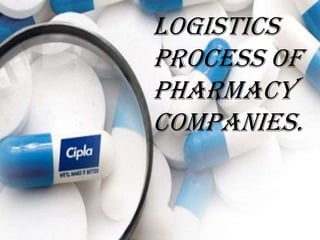
LOGISTICS
PROCESS OF
PHARMACY
COMPANIES.
MEMBERS
AKSHAY SURVE
Introduction
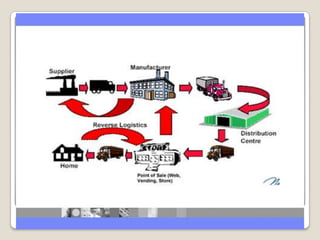
 Logistics is the management of the flow
of resources between the point of origin and the point of
consumption in order to meet some requirements.
 For example, of customers or corporations. The resources
managed in logistics can include physical items, such as
food, materials, equipment, liquids, and staff, as well as
abstract items, such as time, information, particles, and
energy.
Definition
The task of coordinating material flow and
information flow across the supply chain.
LOGISTICS PROCESS
The Supply Chain management
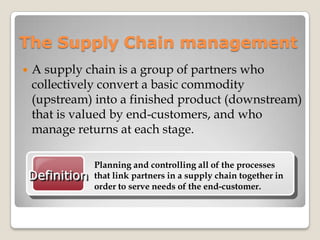
 A supply chain is a group of partners who
collectively convert a basic commodity
(upstream) into a finished product (downstream)
that is valued by end-customers, and who
manage returns at each stage.
Definition
Planning and controlling all of the processes
that link partners in a supply chain together in
order to serve needs of the end-customer.
PHARMACY
 Pharmacy is the science and technique of
preparing and dispensing drugs and medicines. It
is a health profession that links the health
sciences with the chemical sciences and aims to
ensure the safe and effective use
of pharmaceutical drugs.
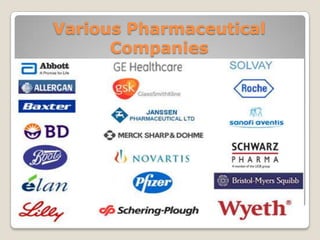
Various Pharmaceutical
Companies
CIPLA
 Cipla Limited is a pharmaceutical
company based in Mumbai, India.
Founded by nationalist Indian
scientist Khwaja Abdul Hamied as The
Chemical, Industrial &
Pharmaceutical Laboratories in 1935,
Cipla makes drugs to treat cardiovascular
disease, arthritis, diabetes, weight
control, depression and many other health
conditions.
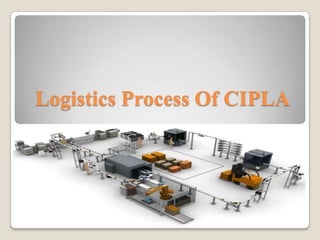
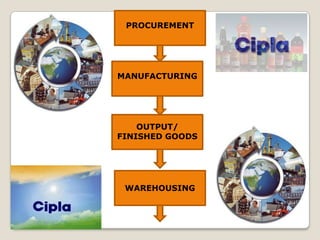
Logistics Process Of CIPLA
MANUFACTURING
PROCUREMENT
OUTPUT/
FINISHED GOODS
WAREHOUSING
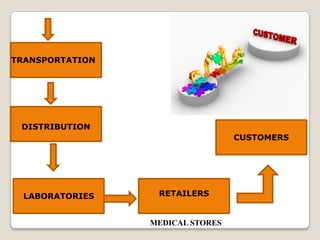
TRANSPORTATION
DISTRIBUTION
LABORATORIES RETAILERS
CUSTOMERS
MEDICAL STORES
13
Supplier Materials
 Biologic suppliers
◦ Chemicals
◦ Farm products (plants, eggs, animals, animal by-products)
◦ Laboratory animals
◦ Growth media, cell cultures
◦ Pathogens
◦ Proteins
◦ Test organisms
 Non-biologic suppliers
◦ Equipment
◦ Computers, software
◦ Databases (e.g., target molecules, DNA sequences)
◦ Clinical trial supplies
◦ Clinical trial subject population information
14
Make - Manufacturing (Commercialization)
SCM Strategies
 Standardization of manufacturing processes
◦ Terminology
◦ Metrics
◦ Product process “toolkits”
 Managing network assets
◦ Grouping plants with standard equipment and
processes geared to specific product types (e.g.,
dry products, freeze-dried, parenteral)
◦ Redundant facilities (security, shifting of work
between plants)
 Improved demand forecasting
◦ Global demand management center
◦ Centralized ownership of all forecasting tools and
databases
◦ Use of ERP web-enabled global planning capabilities
 Judicious use of contract manufacturing (e.g.,
packaging)
WAREHOUSING
 Cipla uses the latest in pharmaceutical technology to funnel
seven decades of experiences into one capsule that cures,
one drop that defends and one puff that protects. They
explore every drug to its last particle and instill safe and
sure healing to create one dose of confidence.
16
Distribute – Types of Counterfeit Drugs
 Identical copies
◦ Least common
◦ Made with same ingredients, formulas and
packaging but not by the same manufacturer
 Look-alikes:
◦ High-quality packaging and labeling; very
convincing appearance
◦ Little or no active ingredients
 Re-labels:
◦ Authentic drugs that have passed their expiration
dates
◦ Distributed by foreign sources.
17
 Pharmacy Group Purchasing Organizations (GPOs)
◦ Alliances of pharmacies, hospitals and other healthcare systems
◦ Leverage buying power to obtain manufacturer discounts
 Often turn to secondary distribution channels when
manufacturers or major distributors cannot supply critical drugs
when needed
◦ Drugs often stockpiled by secondary distributors for economic
reasons
◦ Drug markups can be 500 – 1,000% during shortages (e.g., a vial
of flu vaccine purchased by a wholesaler for $23.65 was resold to
an end-user for $147 in 2003)
 Temperature-sensitive products, when diverted, are often not
kept at the appropriate temperatures
 Retailers attribute 48 percent of pharmaceutical inventory loss
to employee theft
 Emerging requirements for secondary distributors to provide a
drug pedigree that can be tracked back to the original source
(manufacturer)
◦ Clear “chain of custody”
◦ Cost of maintaining custodial information will fall on manufacturers
Buy – The Retailers
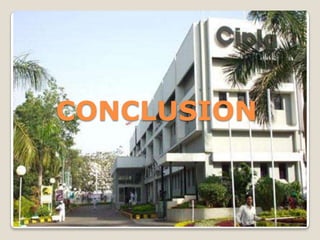
CONCLUSION
THANKYOU

Logistics ppt

  • 1.
  • 2.
  • 3.
    Introduction  Logistics isthe management of the flow of resources between the point of origin and the point of consumption in order to meet some requirements.  For example, of customers or corporations. The resources managed in logistics can include physical items, such as food, materials, equipment, liquids, and staff, as well as abstract items, such as time, information, particles, and energy. Definition The task of coordinating material flow and information flow across the supply chain.
  • 4.
  • 6.
    The Supply Chainmanagement  A supply chain is a group of partners who collectively convert a basic commodity (upstream) into a finished product (downstream) that is valued by end-customers, and who manage returns at each stage. Definition Planning and controlling all of the processes that link partners in a supply chain together in order to serve needs of the end-customer.
  • 7.
    PHARMACY  Pharmacy isthe science and technique of preparing and dispensing drugs and medicines. It is a health profession that links the health sciences with the chemical sciences and aims to ensure the safe and effective use of pharmaceutical drugs.
  • 8.
  • 9.
    CIPLA  Cipla Limitedis a pharmaceutical company based in Mumbai, India. Founded by nationalist Indian scientist Khwaja Abdul Hamied as The Chemical, Industrial & Pharmaceutical Laboratories in 1935, Cipla makes drugs to treat cardiovascular disease, arthritis, diabetes, weight control, depression and many other health conditions.
  • 10.
  • 11.
  • 12.
  • 13.
    13 Supplier Materials  Biologicsuppliers ◦ Chemicals ◦ Farm products (plants, eggs, animals, animal by-products) ◦ Laboratory animals ◦ Growth media, cell cultures ◦ Pathogens ◦ Proteins ◦ Test organisms  Non-biologic suppliers ◦ Equipment ◦ Computers, software ◦ Databases (e.g., target molecules, DNA sequences) ◦ Clinical trial supplies ◦ Clinical trial subject population information
  • 14.
    14 Make - Manufacturing(Commercialization) SCM Strategies  Standardization of manufacturing processes ◦ Terminology ◦ Metrics ◦ Product process “toolkits”  Managing network assets ◦ Grouping plants with standard equipment and processes geared to specific product types (e.g., dry products, freeze-dried, parenteral) ◦ Redundant facilities (security, shifting of work between plants)  Improved demand forecasting ◦ Global demand management center ◦ Centralized ownership of all forecasting tools and databases ◦ Use of ERP web-enabled global planning capabilities  Judicious use of contract manufacturing (e.g., packaging)
  • 15.
    WAREHOUSING  Cipla usesthe latest in pharmaceutical technology to funnel seven decades of experiences into one capsule that cures, one drop that defends and one puff that protects. They explore every drug to its last particle and instill safe and sure healing to create one dose of confidence.
  • 16.
    16 Distribute – Typesof Counterfeit Drugs  Identical copies ◦ Least common ◦ Made with same ingredients, formulas and packaging but not by the same manufacturer  Look-alikes: ◦ High-quality packaging and labeling; very convincing appearance ◦ Little or no active ingredients  Re-labels: ◦ Authentic drugs that have passed their expiration dates ◦ Distributed by foreign sources.
  • 17.
    17  Pharmacy GroupPurchasing Organizations (GPOs) ◦ Alliances of pharmacies, hospitals and other healthcare systems ◦ Leverage buying power to obtain manufacturer discounts  Often turn to secondary distribution channels when manufacturers or major distributors cannot supply critical drugs when needed ◦ Drugs often stockpiled by secondary distributors for economic reasons ◦ Drug markups can be 500 – 1,000% during shortages (e.g., a vial of flu vaccine purchased by a wholesaler for $23.65 was resold to an end-user for $147 in 2003)  Temperature-sensitive products, when diverted, are often not kept at the appropriate temperatures  Retailers attribute 48 percent of pharmaceutical inventory loss to employee theft  Emerging requirements for secondary distributors to provide a drug pedigree that can be tracked back to the original source (manufacturer) ◦ Clear “chain of custody” ◦ Cost of maintaining custodial information will fall on manufacturers Buy – The Retailers
  • 18.
  • 19.