Business English
Logistics & Transportation Engineering
    Seminar : Introduction to Logistics
         By Youssef Serroukh
       25/10/2011 ~ 01/11/2011


           Y.Serroukh – Anglais Commercial   1
Contents


• Part 1 What is Logistics
• Part 2 Activities in Logistics System


                   Y.Serroukh – Anglais Commercial   2
What is Logistics


There are various definitions of different
edition. But in general, there are mainly
two types of definition in practice.

              Y.Serroukh – Anglais Commercial   3
1.1 Definitions
                         Notes


1.There are various definitions of different
 edition.


                  Y.Serroukh – Anglais Commercial   4
2.In Business Terms, logistics means the physical movement of goods
  from the supplier point to the receive point. Based on practical
  need, integrated organically the variety of the basic functional
  activities including transportation, storage, loading and unloading,
  handling, package, distribution and information management, etc.

3.The Council of Logistics Management has adopted this definition of
  logistics:Logistics is that part of the supply chain process that
  plans, implements, and controls the efficient, effective flow and
  storage of goods, services, and related information from the point
  of origin to the point of consumption in order to meet customers’
  requirement.

4.However, when it comes to modern logistics, most professionals in
  the business consider it one of the most competitive and exciting
  jobs, invisible as it is.


                          Y.Serroukh – Anglais Commercial             5
5.This implies that management must first understand what hose
  requirements are before a logistics strategy can be developed and
  implemented to meet them.

6.In practice, logistics refers to the systematic management of the various
  activities required from the point of production to the customer.

7.Getting the right amount of goods to the right place at the right time is
  critical, especially in an age when budgets are tight and customers
  demands are unpredictable.

8.Logistics management has evolved over the last three decades from the
  narrowly defined distribution management to the integrated management
  and to the global supply chains.

9.In order to succeed in today’s global marketplace, companies must be
  ever cognizant of these trends and develop a logistics management
  strategy that capitalizes on the best-of-breed technology solution available
  today, so that they can meet the demands of their customers today and be
  well prepared for the future.


                             Y.Serroukh – Anglais Commercial                  6
1.2 The Importance of Logistics
Since the beginning of human civilization, there has been
the “move” of the goods, so we should say, “logistics is
anything but a newborn baby.” However, when it comes
to modern logistics, most professionals in the business
consider it one of the most competitive and exciting jobs,
invisible as it is. “Logistics is a unique global pipeline that
operates 24 hours a day, seven days a week and 52 weeks
a year, planning and coordinating the transport and
delivery of products and service to customers the world
over.”


                     Y.Serroukh – Anglais Commercial          7
1.3 Development of Logistics
            Management
Logistics management has evolved over the last three decades
from the narrowly defined distribution management to the
integrated management and to the global supply chains. The
mission of logistics management is to plan and coordinate all
activities to achieve desired levels of delivered service and
quality at he lowest possible cost. In order to succeed in
today’s global marketplace, companies must be ever
cognizant of these trends and develop a logistics management
strategy that capitalizes on the best-of-breed technology
solution available today, so that they can meet the demands
of their customers today and be well prepared for the future.


                     Y.Serroukh – Anglais Commercial        8
Exercices
1. Make a list of all different areas of Logistics you can think of by completing the
    diagram below


                                 Y.Serroukh – Anglais Commercial                        9
Exercices
2. Five people give their definition of Logistics. Complete the sentences using the
    words from the box:

  Provide Storage Support Distribution Delivery Maintenance

• Logistics means that you manage the procurement movement of goods
  and ________of the inventory.
• It means the ________of the goods the customer needs at the right time,
  in the right place, and of the right quality.
• My definition of logistics is this: it’s to plan, organize, and manage
  operations that ________services and goods.
• Logistics – that’s purchasing, maintenance, ________and replacement of
  material and staff.
• Logistics is the planning and ________of operations such as warehousing,
  inventory, transport, procurement, supply and ________ .


                                Y.Serroukh – Anglais Commercial                       10
Exercices
3. Complete the following table

   *                VERB                                       NOUN
   1               To provide
   2                                                            Storage
   3              To support
   4                                                            Delivery
   5              To distribute
   6                                                          Maintenance
   7              To transport
   8                                                          Purchasing


                            Y.Serroukh – Anglais Commercial                 11
Activities in Logistics System


A logistics system can be made up of many
different functional activities, some of which
are described briefly below.


                Y.Serroukh – Anglais Commercial   12
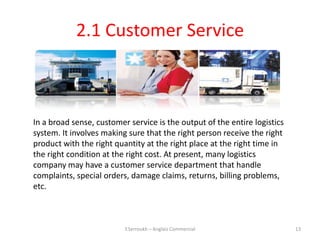
2.1 Customer Service


In a broad sense, customer service is the output of the entire logistics
system. It involves making sure that the right person receive the right
product with the right quantity at the right place at the right time in
the right condition at the right cost. At present, many logistics
company may have a customer service department that handle
complaints, special orders, damage claims, returns, billing problems,
etc.


                          Y.Serroukh – Anglais Commercial                  13
2.2 Demand Forecasting


Demand forecasting estimate the need for precise amount of product
and service that customers will require in the future. The logistics
system can ensure the right products or services are available to meet
those requirements. It involves in forecasting how much should be
ordered from its suppliers, and how much of finished products should
be transported in each market.


                           Y.Serroukh – Anglais Commercial               14
2.3 Transportation


Transportation refers to the physical movement of goods from one
point to another point. It includes specific activities such as selecting
the transport mode, choosing the particular route, selecting the right
carrier, complying with various local transportation regulations.
Transportation is usually the most costly logistics activity.
It may account for 40%-60% of a company’s total logistics cost.


                           Y.Serroukh – Anglais Commercial                  15
2.4 Warehousing


Warehousing is an integral part of every logistics system. It plays an
important role in providing a desired level of customer service at the
lowest possible total cost. It refers to places where goods can be stored
for a particular period of time. Generally, the greater the time lags
between production and consumption, the larger the level of
warehousing required.


                          Y.Serroukh – Anglais Commercial                   16
2.5 Inventory Management


Inventory management deals with balancing the cost of maintaining
additional products on hand against the risk of not having those items
when the customer wants them. This task has become more complex
as firms have gradually lowered inventory levels.


                         Y.Serroukh – Anglais Commercial                 17
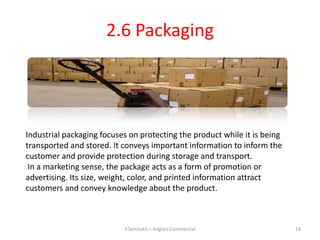
2.6 Packaging


Industrial packaging focuses on protecting the product while it is being
transported and stored. It conveys important information to inform the
customer and provide protection during storage and transport.
 In a marketing sense, the package acts as a form of promotion or
advertising. Its size, weight, color, and printed information attract
customers and convey knowledge about the product.


                           Y.Serroukh – Anglais Commercial                 18
2.7 Procurement


Procurement is the purchase of materials and services from outside
to support the firm’s operations from production to marketing,
sales and logistics. It includes the selection of supply source location,
timing of purchases, price determination, quality control and many
other facets.


                         Y.Serroukh – Anglais Commercial                    19
2.8 Material Handling


Material handling is a broad sense concerning all short-distance
movements of raw materials, work in process, or finished goods
within a factory or warehouse. As materials handling tends to add
costs rather than value to logistics systems, managers tends to
minimize the number of handling whenever possible.


                         Y.Serroukh – Anglais Commercial            20
2.9 Information Management


Information links all areas of the logistics system together.
Information processing is becoming increasingly automated,
complex, and rapid. It is critical to the efficient functioning of system.


                         Y.Serroukh – Anglais Commercial                     21
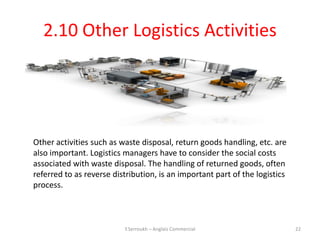
2.10 Other Logistics Activities


Other activities such as waste disposal, return goods handling, etc. are
also important. Logistics managers have to consider the social costs
associated with waste disposal. The handling of returned goods, often
referred to as reverse distribution, is an important part of the logistics
process.


                          Y.Serroukh – Anglais Commercial                    22
Components of logistics
management :                      Management actions                                     Outputs of
  Inputs into logistics                                                                   logistics
                             Planning      Implementation          Control
  Natural resources                                                                       Marketing
  (land, facilities,                        Logistics management                          orientation
  and equipments)         Suppliers   Raw       In-process   Finished        Customers   (competitive
                                      materials inventory    goods                        advantage)
                                                                                          Time and
  Human resources
                                            Logistics Activities                         place utility
                            •Customer Service           •Plant and warehouse              Efficient
  Financial resources       •Demand forecasting         site selection                   movement to
                            •Distribution               •Procurement                      customer
                            communications              •Packaging
  Information
  resources                 •Inventory control          •Return goods handling           Proprietary
                            •Material handling          •Salvage and scrap                  asset
                            •Order Processing           disposal
                            •Parts and service          •Traffic and
                            support                     transportation
                                                        •Warehousing and
                                                        storage
Exercices
1. Replace the underlined verbs with the words from the box
   that have the same meaning.
Provide Train Organise Ensure Inform about Check
•   We supply software for the car industry.
•   I often advise clients on the most suitable transport method.
•   In my job, I have to make sure that passengers arrive on schedule.
•   My job is to supervise incoming goods.
•   I also plan the transport of goods.
•   I instruct staff.


                            Y.Serroukh – Anglais Commercial              24
Exercices
2. Put the words in the Right order by using the correct form of
   the verb.

• an excellent/provide/delivery service/my company.
• you/ how much/ handle/ cargo/ per year?
• to other countries/ not ship/ we/ chemical products.
• responsible for/ be/ the warehouse manager/ also/ vehicles and
  machinery.
• to foreign companies/ car parts/ this vendor/ supply?
• usually / arrange / for companies/ a freight forwarder/ documentation.


                           Y.Serroukh – Anglais Commercial                 25
Exercices
3. Complete the crossword puzzle with words from this unit.

Across
4 Another word for freight
5 What you store in the warehouse
6 Work closely together with somebody

Down
1 Another word for organise
2 To give information about the price
3 Another word for supervise
5 Send goods


                                Y.Serroukh – Anglais Commercial   26
Thank you for your attention


         Y.Serroukh – Anglais Commercial   27

Introduction 2 Logistics

  • 1.
    Business English Logistics &Transportation Engineering Seminar : Introduction to Logistics By Youssef Serroukh 25/10/2011 ~ 01/11/2011 Y.Serroukh – Anglais Commercial 1
  • 2.
    Contents • Part 1What is Logistics • Part 2 Activities in Logistics System Y.Serroukh – Anglais Commercial 2
  • 3.
    What is Logistics Thereare various definitions of different edition. But in general, there are mainly two types of definition in practice. Y.Serroukh – Anglais Commercial 3
  • 4.
    1.1 Definitions Notes 1.There are various definitions of different edition. Y.Serroukh – Anglais Commercial 4
  • 5.
    2.In Business Terms,logistics means the physical movement of goods from the supplier point to the receive point. Based on practical need, integrated organically the variety of the basic functional activities including transportation, storage, loading and unloading, handling, package, distribution and information management, etc. 3.The Council of Logistics Management has adopted this definition of logistics:Logistics is that part of the supply chain process that plans, implements, and controls the efficient, effective flow and storage of goods, services, and related information from the point of origin to the point of consumption in order to meet customers’ requirement. 4.However, when it comes to modern logistics, most professionals in the business consider it one of the most competitive and exciting jobs, invisible as it is. Y.Serroukh – Anglais Commercial 5
  • 6.
    5.This implies thatmanagement must first understand what hose requirements are before a logistics strategy can be developed and implemented to meet them. 6.In practice, logistics refers to the systematic management of the various activities required from the point of production to the customer. 7.Getting the right amount of goods to the right place at the right time is critical, especially in an age when budgets are tight and customers demands are unpredictable. 8.Logistics management has evolved over the last three decades from the narrowly defined distribution management to the integrated management and to the global supply chains. 9.In order to succeed in today’s global marketplace, companies must be ever cognizant of these trends and develop a logistics management strategy that capitalizes on the best-of-breed technology solution available today, so that they can meet the demands of their customers today and be well prepared for the future. Y.Serroukh – Anglais Commercial 6
  • 7.
    1.2 The Importanceof Logistics Since the beginning of human civilization, there has been the “move” of the goods, so we should say, “logistics is anything but a newborn baby.” However, when it comes to modern logistics, most professionals in the business consider it one of the most competitive and exciting jobs, invisible as it is. “Logistics is a unique global pipeline that operates 24 hours a day, seven days a week and 52 weeks a year, planning and coordinating the transport and delivery of products and service to customers the world over.” Y.Serroukh – Anglais Commercial 7
  • 8.
    1.3 Development ofLogistics Management Logistics management has evolved over the last three decades from the narrowly defined distribution management to the integrated management and to the global supply chains. The mission of logistics management is to plan and coordinate all activities to achieve desired levels of delivered service and quality at he lowest possible cost. In order to succeed in today’s global marketplace, companies must be ever cognizant of these trends and develop a logistics management strategy that capitalizes on the best-of-breed technology solution available today, so that they can meet the demands of their customers today and be well prepared for the future. Y.Serroukh – Anglais Commercial 8
  • 9.
    Exercices 1. Make alist of all different areas of Logistics you can think of by completing the diagram below Y.Serroukh – Anglais Commercial 9
  • 10.
    Exercices 2. Five peoplegive their definition of Logistics. Complete the sentences using the words from the box: Provide Storage Support Distribution Delivery Maintenance • Logistics means that you manage the procurement movement of goods and ________of the inventory. • It means the ________of the goods the customer needs at the right time, in the right place, and of the right quality. • My definition of logistics is this: it’s to plan, organize, and manage operations that ________services and goods. • Logistics – that’s purchasing, maintenance, ________and replacement of material and staff. • Logistics is the planning and ________of operations such as warehousing, inventory, transport, procurement, supply and ________ . Y.Serroukh – Anglais Commercial 10
  • 11.
    Exercices 3. Complete thefollowing table * VERB NOUN 1 To provide 2 Storage 3 To support 4 Delivery 5 To distribute 6 Maintenance 7 To transport 8 Purchasing Y.Serroukh – Anglais Commercial 11
  • 12.
    Activities in LogisticsSystem A logistics system can be made up of many different functional activities, some of which are described briefly below. Y.Serroukh – Anglais Commercial 12
  • 13.
    2.1 Customer Service Ina broad sense, customer service is the output of the entire logistics system. It involves making sure that the right person receive the right product with the right quantity at the right place at the right time in the right condition at the right cost. At present, many logistics company may have a customer service department that handle complaints, special orders, damage claims, returns, billing problems, etc. Y.Serroukh – Anglais Commercial 13
  • 14.
    2.2 Demand Forecasting Demandforecasting estimate the need for precise amount of product and service that customers will require in the future. The logistics system can ensure the right products or services are available to meet those requirements. It involves in forecasting how much should be ordered from its suppliers, and how much of finished products should be transported in each market. Y.Serroukh – Anglais Commercial 14
  • 15.
    2.3 Transportation Transportation refersto the physical movement of goods from one point to another point. It includes specific activities such as selecting the transport mode, choosing the particular route, selecting the right carrier, complying with various local transportation regulations. Transportation is usually the most costly logistics activity. It may account for 40%-60% of a company’s total logistics cost. Y.Serroukh – Anglais Commercial 15
  • 16.
    2.4 Warehousing Warehousing isan integral part of every logistics system. It plays an important role in providing a desired level of customer service at the lowest possible total cost. It refers to places where goods can be stored for a particular period of time. Generally, the greater the time lags between production and consumption, the larger the level of warehousing required. Y.Serroukh – Anglais Commercial 16
  • 17.
    2.5 Inventory Management Inventorymanagement deals with balancing the cost of maintaining additional products on hand against the risk of not having those items when the customer wants them. This task has become more complex as firms have gradually lowered inventory levels. Y.Serroukh – Anglais Commercial 17
  • 18.
    2.6 Packaging Industrial packagingfocuses on protecting the product while it is being transported and stored. It conveys important information to inform the customer and provide protection during storage and transport. In a marketing sense, the package acts as a form of promotion or advertising. Its size, weight, color, and printed information attract customers and convey knowledge about the product. Y.Serroukh – Anglais Commercial 18
  • 19.
    2.7 Procurement Procurement isthe purchase of materials and services from outside to support the firm’s operations from production to marketing, sales and logistics. It includes the selection of supply source location, timing of purchases, price determination, quality control and many other facets. Y.Serroukh – Anglais Commercial 19
  • 20.
    2.8 Material Handling Materialhandling is a broad sense concerning all short-distance movements of raw materials, work in process, or finished goods within a factory or warehouse. As materials handling tends to add costs rather than value to logistics systems, managers tends to minimize the number of handling whenever possible. Y.Serroukh – Anglais Commercial 20
  • 21.
    2.9 Information Management Informationlinks all areas of the logistics system together. Information processing is becoming increasingly automated, complex, and rapid. It is critical to the efficient functioning of system. Y.Serroukh – Anglais Commercial 21
  • 22.
    2.10 Other LogisticsActivities Other activities such as waste disposal, return goods handling, etc. are also important. Logistics managers have to consider the social costs associated with waste disposal. The handling of returned goods, often referred to as reverse distribution, is an important part of the logistics process. Y.Serroukh – Anglais Commercial 22
  • 23.
    Components of logistics management: Management actions Outputs of Inputs into logistics logistics Planning Implementation Control Natural resources Marketing (land, facilities, Logistics management orientation and equipments) Suppliers Raw In-process Finished Customers (competitive materials inventory goods advantage) Time and Human resources Logistics Activities place utility •Customer Service •Plant and warehouse Efficient Financial resources •Demand forecasting site selection movement to •Distribution •Procurement customer communications •Packaging Information resources •Inventory control •Return goods handling Proprietary •Material handling •Salvage and scrap asset •Order Processing disposal •Parts and service •Traffic and support transportation •Warehousing and storage
  • 24.
    Exercices 1. Replace theunderlined verbs with the words from the box that have the same meaning. Provide Train Organise Ensure Inform about Check • We supply software for the car industry. • I often advise clients on the most suitable transport method. • In my job, I have to make sure that passengers arrive on schedule. • My job is to supervise incoming goods. • I also plan the transport of goods. • I instruct staff. Y.Serroukh – Anglais Commercial 24
  • 25.
    Exercices 2. Put thewords in the Right order by using the correct form of the verb. • an excellent/provide/delivery service/my company. • you/ how much/ handle/ cargo/ per year? • to other countries/ not ship/ we/ chemical products. • responsible for/ be/ the warehouse manager/ also/ vehicles and machinery. • to foreign companies/ car parts/ this vendor/ supply? • usually / arrange / for companies/ a freight forwarder/ documentation. Y.Serroukh – Anglais Commercial 25
  • 26.
    Exercices 3. Complete thecrossword puzzle with words from this unit. Across 4 Another word for freight 5 What you store in the warehouse 6 Work closely together with somebody Down 1 Another word for organise 2 To give information about the price 3 Another word for supervise 5 Send goods Y.Serroukh – Anglais Commercial 26
  • 27.
    Thank you foryour attention Y.Serroukh – Anglais Commercial 27