PARA PLEGIASDR.PRAVEEN NAGULA
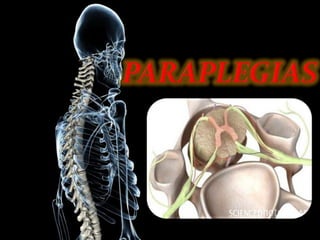
PARAPLEGIAS
Important termsPARALYSIS – loss of power of voluntary movements in a muscle through injury or disease of it or its nerve supply.PARAPLEGIA – paralysis of both lower extremities.QUADRIPLEGIA – paralysis of all four limbs.HEMIPLEGIA –paralysis of one side of the body.CROSSED HEMIPLEGIA – hemiplegia on one side with C/L cranial nerve palsies.ANESTHESIA – absent perception of all sensations , mainly touch.PARESTHESIAS – spontaneous abnormal sensations  that is not unpleasant.DYSESTHESIAS –unpleasant abnormal sensation described by the patient.HYPERPATHIA – abnormally painful and exaggerated reaction to a painful stimulus.HYPERALGESIA – extreme sensitivity to painful stimulus.ALLODYNIA –pain perception with non painful stimulus.
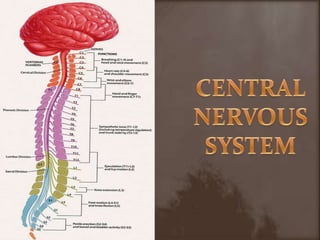
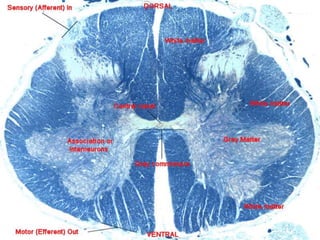
SPINAL CORD ANATOMYThin tubular extension  of the CNS contained within the bony spinal canal.It originates at the medulla and continues caudally to the conusmedullaris at the lumbar level.Filumterminale is the fibrous extension of the cord terminates at the coccyx.It is 46 cm in length ,oval in shape Cervical and lumbar enlargements –neurons innervating upper limb and lower limb are located.Inner gray matter  outer white matter Ascending sensory and descending motor tracts are located peripherally.Gray matter containing the nerve cell bodies –four leaf clove shapeSurrounds a central canal –extension of fourth ventricle.
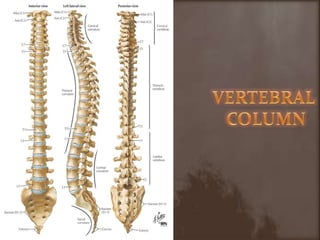
VERTEBRAL COLUMN
CENTRAL NERVOUSSYSTEM
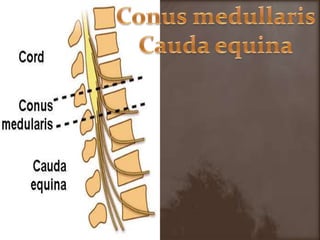
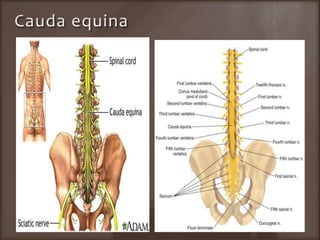
ConusmedullarisCaudaequina
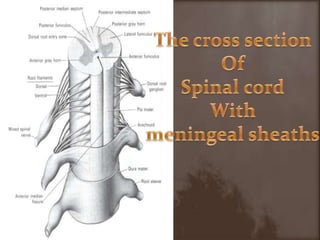
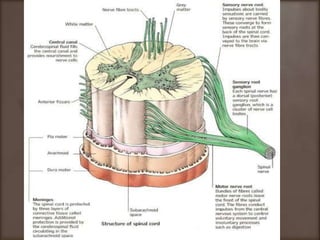
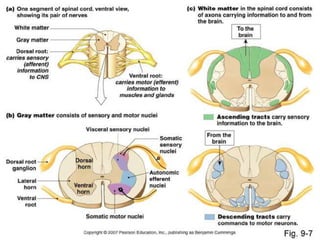
The cross sectionOf Spinal cordWith meningeal sheaths
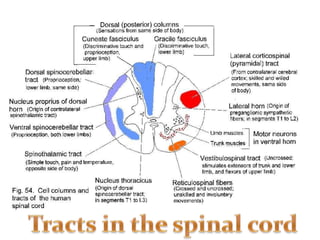
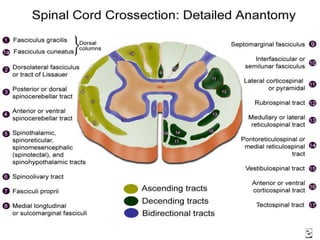
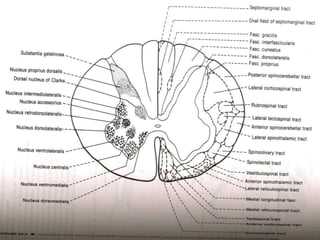
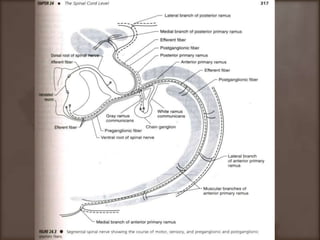
Tracts in the spinal cord
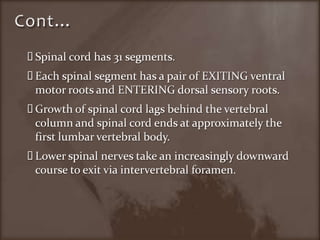
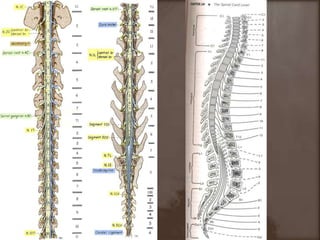
Cont…Spinal cord has 31 segments.Each spinal segment has a pair of EXITING ventral motor roots and ENTERING dorsal sensory roots.Growth of spinal cord lags behind the vertebral column and spinal cord ends at approximately the first lumbar vertebral body.Lower spinal nerves take an increasingly downward course to exit via intervertebral foramen.
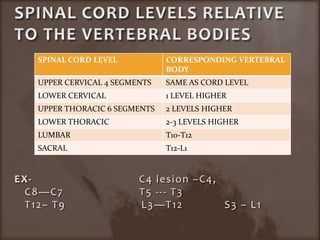
SPINAL CORD LEVELS RELATIVE TO THE VERTEBRAL BODIESEX-                               C4 lesion –C4,   C8—C7                      T5 --- T3   T12– T9                      L3—T12            S3 – L1
DETERMINING THE LEVEL OF LESIONThe presence  of  a  horizontally  defined  level  below which  sensory , motor  and  autonomic function  is impaired  is a  hallmark  of  spinal cord  disease
Sensory levelIdentify the pin prick or cold stimulus applied to the proximal legs and lower trunk subesequently moving up towards the neck on each side.Sensory loss below the level is as a result of damage to the SPINOTHALAMIC TRACT on the OPPOSITE SIDE one to two segments higher in case of a unilateral lesion and at the level of a bilateral lesion.Why ?Course of the SECOND ORDER SENSORY FIBERS ,which originate in the dorsal horn, and ascend for one or two levels as they cross ANTERIOR to CENTRAL CANAL to join the OPPOSITE SPINOTHALAMIC TRACT.
TRANSECTION OF THE CORTICOSPINAL TRACTS,MOTOR TRACTSParaplegia or quadriplegia with heightened DTRs ,babinskisign,SPASTICITY.UPPER MOTOR NEURON SYNDROME –below the level of transectionLOWER MOTOR NEURON SYNDROME – at the level of the lesion.
AUTONOMIC DYSFUNCTIONAbsent sweating below the implicated cord level and bowel ,bladder ,sexual dysfunction.
Level of the lesionSegmental  signs corresponding to the disturbed motor and sensory innervation by an individual cord segment.What could be found at the level of lesion?A band of altered sensation (hyperalgesia or hyperpathia )Fasciculations or atrophy in muscles innervated by one or several segments Muted or absent DTR at the level.Plus signs of long tract damage SPINAL CORD DISEASE
SPINAL SHOCKWith severe and acute transverse lesions the limbs may be initially FLACCID rather than SPASTIC.This state is called as SPINAL SHOCKMay  last for several days ,rarely for weeks D.D – AHC damage over many segments , acute polyneuropathyThe loss of motor function at the time of injury are accompanied by immediate atonic paralysis of bladder and bowel , gastric atony , loss of sensation below a level corresponding to the spinal cord lesion ,muscular flaccidity and almost complete suppression of all spinal segmental reflex activity below the lesion.
SPINAL SHOCKCONTROL OF AUTONOMIC FUNCTION is also lost below the level of lesion.Vasomotor tone is abolished –POSTURAL HYPOTENSIONSweating and piloerection lost – skin becomes dry and pale ,ulcerations developSphincters of bladder and bowel remain CONTRACTED –loss of inhibitory influence of higher centres.DETRUSOR OF BLADDER AND SMOOTH MUSCLE OF RECTUM ARE ATONIC –OVERFLOW INCONTINENCEParalytic ileusGENITAL RELFEXES ARE ABOLISHED.
BULBOCAVERNOUS REFLEX IS THE FIRST TO RETURN.CONTRACTION OF THE ANAL SPHINCTER TO BE CHECKED.F WAVES – ELECTROPHYSIOLOGICAL RESPONSES THAT REFLECT THE FUNCTIONING OF THE MOTOR NEURONS OF THE ISOLATED SEGMENT OF THE CORD APPEAR
WHY DOES SPINAL SHOCK OCCUR?It is due to the sudden  interruption of SUPRASEGMENTAL DESCENDING FIBER SYSTEMS THAT NORMALLY KEEP THE SPINAL MOTOR NEURONS IN A CONTINUOUS STATE OF READINESS.The facilitatory tracts are the RETICULOSPINAL AND VESTIBULOSPINAL TRACTS.?CORTICOSPINAL TRACTS.
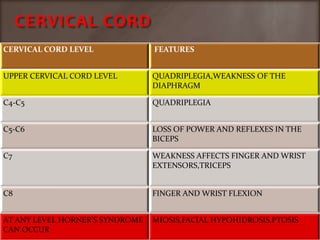
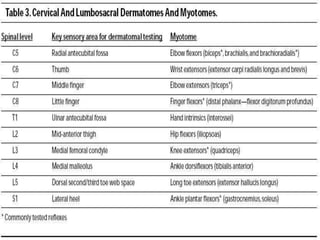
CERVICAL CORD
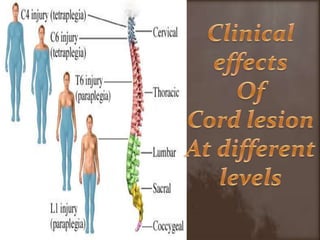
Clinical effectsOf Cord lesionAt differentlevels
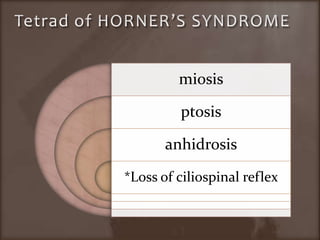
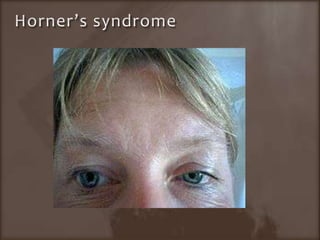
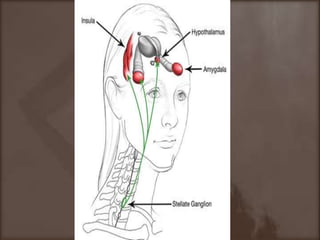
HORNER’S SYNDROMEOCULOSYMPATHETIC SYNDROMEBERNARD –HORNER SYNDROMEInterruption of postganglionic sympathetic fibers at any point along the internal carotid arteries or a lesion of the superior cervical ganglion results in miosis,drooping of the eyelid,and abolition of sweating over one side of the face –anhidrosis.Can also be caused by interupption of the preganglionic fibers.Interruption of the uncrossed hypothalamospinal pathway in the tegmentum of brainstem or cervical cord.
Tetrad of HORNER’S SYNDROME
CAUSES 1.neoplastic  or inflammatory involvement of the cervical lymph nodes or proximal part of brachial plexus.2.surgical or other types of trauma –jugular venous catheter.3.carotid artery dissection4.syringomyelic or traumatic lesions of the first and second thoracic spinal segments5.infarcts  of lateral part of medulla WALLENBERG SYNDROME .6.idiopathic
If a horner’s syndrome develops early in life ,the iris on the affected side fails to become pigmented and remains blue or mottled gray brown .HETEROCHROMIA IRIDIS
Horner’s syndrome
STELLATE GANGLION LESIONCompression by a tumor arising from the superior sulcus of the lung (PAN COAST’S TUMOR )Combination of HORNER’S syndrome plus paralysis of sympathetic reflexes in the limb (the hand and arm are dry and warm)Preganglionic lesions –facial flushing on the side of sympathetic disorder , increased on exercise (HARLEQUIN EFFECT )
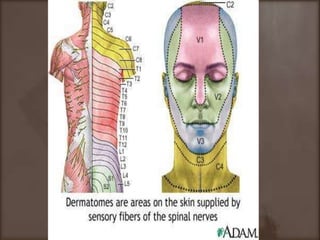
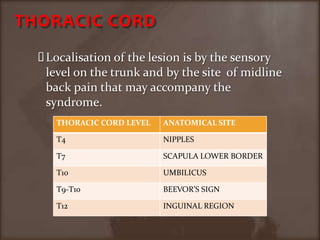
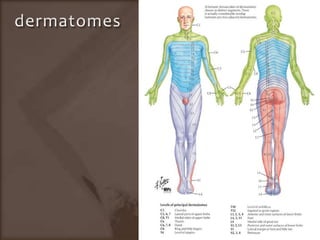
THORACIC CORDLocalisation of the lesion is by the sensory level on the trunk and by the site  of midline back pain that may accompany the syndrome.
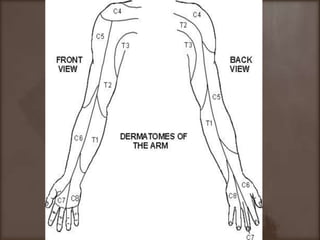
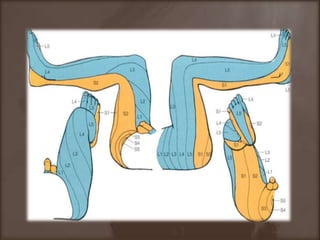
dermatomes
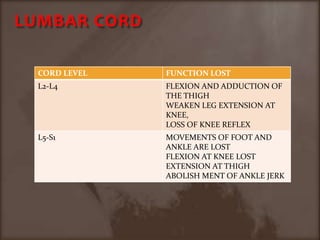
LUMBAR CORD
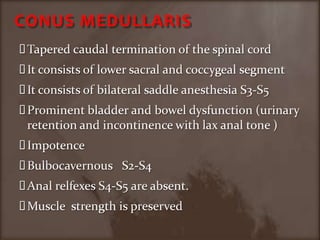
CONUS MEDULLARISTapered caudal termination of the spinal cord It consists of lower sacral and coccygeal segmentIt consists of bilateral saddle anesthesia S3-S5 Prominent bladder and bowel dysfunction (urinary retention and incontinence with lax anal tone )ImpotenceBulbocavernous   S2-S4 Anal relfexes S4-S5 are absent.Muscle  strength is preserved
CAUDA EQUINAIT is the name given to the nerve roots that arise from the cord.Low back and radicular painAsymmetric leg weakness and sensory lossVariable areflexia in the lower extremities.Relative sparing of the bowel and bladder function
Caudaequina
A  babinski sign indicates that the spinal cord is involved above the fifth lumbar segment
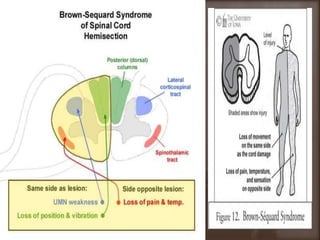
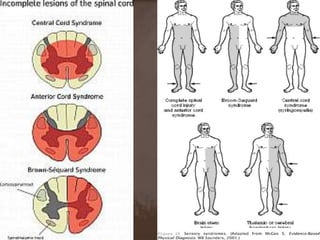
BROWN SEQUARD HEMICORD SYNDROMEIpsilateral weakness (corticospinal tract ) Loss of joint position and vibratory sense (posterior column)Contralateral loss of pain and temperature sense (spinothalaamic tract ) one or two levels below the level of lesionUnilateral segmental signs such as radicularpain,muslce atrophy  and loss of deep tendon reflex.Partial forms are more common than fully developed syndrome
Slide of diagram
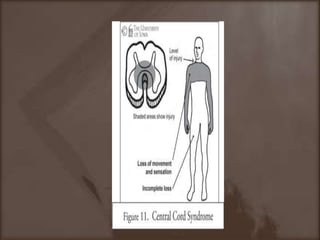
CENTRAL CORD SYNDROMESelective damage to the gray matter nerve cells and crossing spinothalamic tracts surrounding the central canal.Arm weakness out of proportion to leg weakness and a dissosciated sensory loss meaning loss of pain and temperature sensations over the shoulder,lower neck and upper trunk (cape distribution)Preservation of light touch,jointposition,vibration sense in these regions.Causes –syringomyelia,spinal trauma.
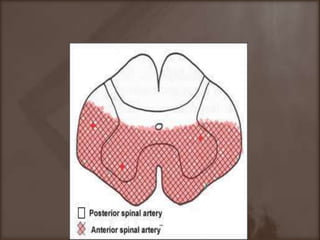
ANTERIOR SPINAL ARTERY SYNDROMEEXTENSIVE BILATERAL destruction that spares the posterior columns.All spinal cord functions –motor,sensory,autonomic are lost below the level of the lesion,with exception of retained vibration and position sensation.
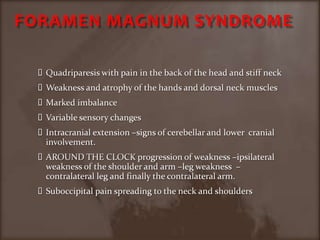
FORAMEN MAGNUM SYNDROMEQuadriparesis with pain in the back of the head and stiff neckWeakness and atrophy of the hands and dorsal neck musclesMarked imbalanceVariable sensory changesIntracranial extension –signs of cerebellar and lower  cranial involvement.AROUND THE CLOCK progression of weakness –ipsilateral weakness of the shoulder and arm –leg weakness  –contralateral leg and finally the contralateral arm.Suboccipital pain spreading to the neck and shoulders
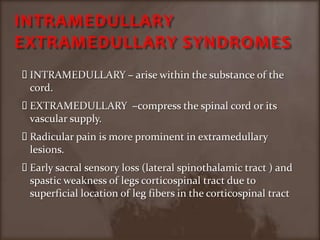
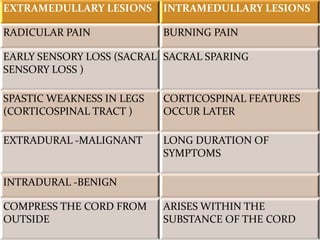
INTRAMEDULLARYEXTRAMEDULLARY SYNDROMES INTRAMEDULLARY – arise within the substance of the cord.EXTRAMEDULLARY  –compress the spinal cord or its vascular supply.Radicular pain is more prominent in extramedullary lesions.Early sacral sensory loss (lateral spinothalamic tract ) and spastic weakness of legs corticospinal tract due to superficial location of leg fibers in the corticospinal tract
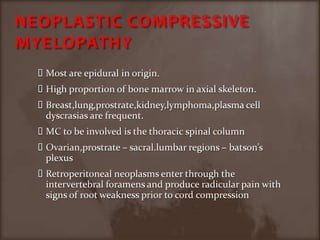
NEOPLASTIC COMPRESSIVE MYELOPATHYMost are epidural in origin.High proportion of bone marrow in axial skeleton.Breast,lung,prostrate,kidney,lymphoma,plasma cell dyscrasias are frequent.MC to be involved is the thoracic spinal columnOvarian,prostrate – sacral.lumbar regions – batson’s plexus Retroperitoneal neoplasms enter through the intervertebral foramens and produce radicular pain with signs of root weakness prior to cord compression
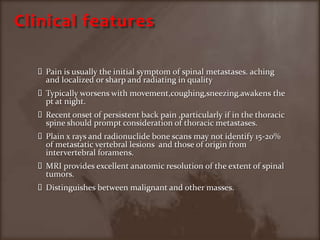
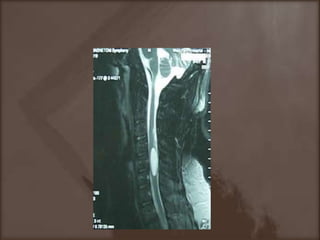
Clinical featuresPain is usually the initial symptom of spinal metastases. aching and localized or sharp and radiating in qualityTypically worsens with movement,coughing,sneezing.awakens the pt at night.Recent onset of persistent back pain ,particularly if in the thoracic spine should prompt consideration of thoracic metastases.Plain x rays and radionuclide bone scans may not identify 15-20% of metastatic vertebral lesions  and those of origin from intervertebral foramens.MRI provides excellent anatomic resolution of the extent of spinal tumors.Distinguishes between malignant and other masses.
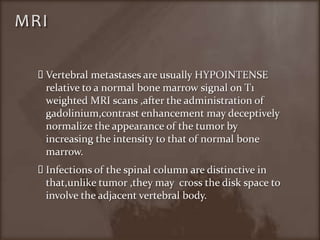
MRIVertebral metastases are usually HYPOINTENSE relative to a normal bone marrow signal on T1 weighted MRI scans ,after the administration of gadolinium,contrast enhancement may deceptively normalize the appearance of the tumor by increasing the intensity to that of normal bone marrow.Infections of the spinal column are distinctive in that,unlike tumor ,they may  cross the disk space to involve the adjacent vertebral body.
Upto 40 % of patients who present with compression at one level are found to have asymptomatic epidural metastases else where ,thus the length of spine should be imaged when epidural malignancy in question.
TreatmentGlucocorticoids –to reduce cord edemaLocal radiotherapySpecific therapy to the underlying lesionDexamethasone 40 mg dailyRadiotherapy 3000  cGy in 15 daily fractionsGood response if ambulatory at presentation.Motor deficits >12 hrs donot usually improve Beyond 48 hrs the prognosis for recovery is poor.Recurrence usually occurs ..Surgery when the above treatment fails…
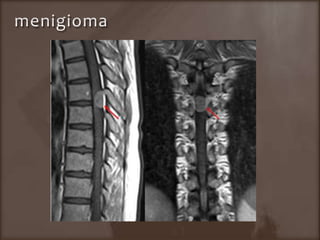
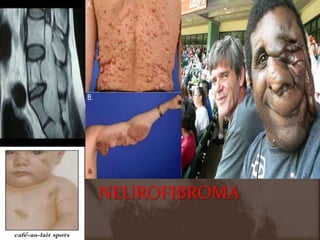
INTRADURAL LESIONSUsually benignSlow growingMENINGIOMANEUROFIBROMAMeningioma –located posterior to thoracic cord or near the foramen magnum .Neurofibromas  arise from the posterior root .Radicular sensory symptoms followed by an asymmetric progressive spinal cord syndrome.SURGICAL RESECTION
menigioma
NEUROFIBROMA
SPINAL EPIDURAL ABSCESSClinical triad of midline dorsal pain ,fever ,progressive limb weakness.Pain over the spine or radicular pain .Duration of pain <2 weeks.Spinal cord damage is because of venous congestion and thrombosis.
Risk  are people –diabetes mellitus,renalfailure,alcoholism,malignancy,IV drug abuse.2/3 from hematogenous spread of bacteria from the skin furunculosis,soft tissue pharyngeal abscess,deep viscera.Predisposing conditions are vertebral osteomyelitis,decubitusulcers,lumbarpuncture,epiduralanesthesia,spinal surgery.Most are due to s.aureus,streptococcus,gram negativeMRI is for diagnosisAccompanied meningitis <25 % cases.Organism  identified  only in presence of  meningitis.
TreatmentDecompressivelaminectomyDebridement Long term anitbiotic treatmentAntibiotics continued for 4 weeks2/3 patients significantly improve.
ACUTE TRANSVERSE MYELOPATHYSpinal cord infarctionSLE SarcoidosisDemyelinating disorders –multiple sclerosis,NMOPost infectious Infectious MRI initially to rule out compressive causesCSF ANALYSISOTHER STUDIES BASED ON SUSPICION
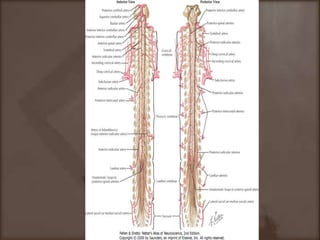
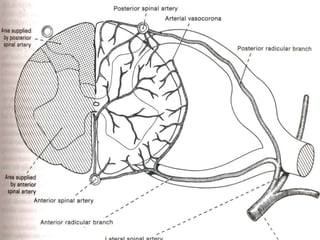
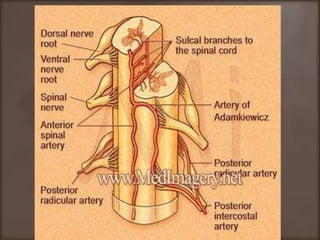
SPINAL CORD BLOOD SUPPLYSupplied by three arteries that course vertically over its surface.A single anterior spinal arteryPaired posterior spinal arteriesAnterior spinal artery is fed by radicular vessels that arise at C6,at an upper thoracic level,at T11-L2 –artery of Adamkiewicz.At each segment paired penetrating vessels branch from the anterior spinal artery to supply the anterior two thirds of the spinal cord.The posterior spinal arteries become less distinct below the mid thoracic level supply the posterior columns.
ischemiaCan occur at any levelWatershed of marginal blood flow in upper thoracic segments by artery of ADAMKIEWICZGreatest   ischemic risk usually at T3-T4At boundary zones between anterior and posterior spinal artery territories.Rapid progressive syndrome over hours of weakness and spasticity with little sensory change.
causesAortic atherosclerosisDissecting aortic aneurysmVertebral artery occlusionAortic surgeryprofound hypotension from any causeTreatment---anticoagulation
MULTIPLE SCLEROSISMay present with acute myelitis in asian or african ancestry.Mild swelling and edema of the cord and diffuse or multifocal areas of abnormal signal on T 2 weighted images.Contrast enhancement is present in many cases.Normal BRAIN scan indicates that the risk of evoltuion to MS is low 10-15% over 5 years.Multiple periventricular T2bright images –higher risk >50% over 5 years.,90% by 14 years.Presence of oligoclonal bands –a diagnosis of MS is more likely.
TreatmentIV METHYLPREDNISOLONE 500 mg over 3 daysOral prednisolone 1 mg/kg /day for several weeks then taperPlasma exchange …
POSTINFECTIOUS MYELITISFollow an infection or vaccinationEBV,CMV,mycoplasma,influenza,measles,varicella,rubellaBegins as the patient appears to be recovering from an an acute febrile infection No organism could be isolated from nervous system or spinal fluid.It represents an autoimmune disorder triggered by infection ..Treatment –glucocorticoids ,plasma exchange
SPONDYLITIC MYELOPATHYMost common cause of chronic cord compressionNeck and shoulder pain with stiffness are early symptomsRadicular arm pain in a C5 or C 6 distribution.Compression of cervical cord <1/3 casesSlowly progressive spastic paraparesis
AsymmetricParesthesias in feets and handsDiminished vibration sense in legsPostiveromberg’s signDiminshed DTR mostly at the level of bicepsDermatomal sensory loss in arms atrophy of intrinsic hand muscles increased DTR in legs extensor plantar responses
TreatmentPlain x rays are less useful’MRI T2 WEIGHTED images –reveal areas of high signal intensity within the cord adjacent to the site of compression.Cervical collarSurgical decompressionPosterior laminectomyAnterior apporach with disk resection
SYRINGOMYELIADevelopmental cavity of the cervical cord that is  prone to enlarge and produce progressive myelopathy.Begin insidiously in adolescence or early adulthood,progress irregularly ,and may undergo spontaneuos arrest for several years.Cervical thoracic scoliosis>50% chiari type I malformation –cerebellar tonsils protrude through the foramen magnum and into the cervical spinal canal.
Interference with CSF flow is likely for expansion.Acquired cavitations of the cord in areas of necrosis are also termed syrinx cavities –follow trauma,myleitis,chronicarachnoiditisPresentation is of central cord syndromeMost cases begin asymmetrically with u/l sensory loss over hands
Muscle wasting in the lower neck ,shoulders,arms and hands with asymmetric or absent reflexes in arms –expansion of the cavity into the gray matter of the cord.Further enlargement of the cavity – spasticity and weakness of the legs,bladder and bowel dysfunction,horner’s syndromeFacial numbness –c2 Cough induced headache and neck arm pain Palatal or vocal cord paralysis –syringobulbiaMRI of brain and whole spinal cord needed
TreatmentSuboccipitalcraniectomy –chiaritonsillarherniationUpper cervical laminectomyPlacement of dural graft
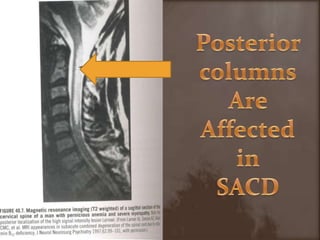
SUBACUTE COMBINED DEGENERATION Paresthesias in hands and feet Loss of vibration and position sensationProgressive spastic and ataxic weakness.Loss of reflexes due to peripheral neuropathy plus a positive babinski sign is an imp diagnostic clue.optic atrophy and irritability may be prominent in advanced cases but are rarely the presenting symptoms
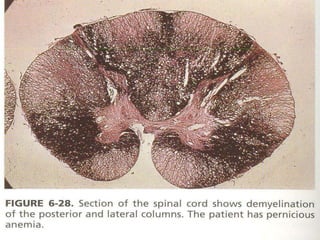
Diffuse rather than focalSigns are generally symmetric Predominant involvement of posterior and lateral tracts Positive romberg’s sign.Diagnosis by finding of macrocyticRBC,low serum b12 conc,elevated levels of serum homocysteine,methylmalonic acid.Treatment – 1000ug of IM vitamin b12
Posterior columnsAre Affected in SACD
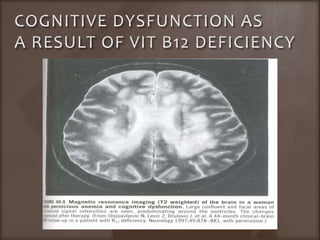
COGNITIVE DYSFUNCTION AS A RESULT OF VIT B12 DEFICIENCY
THANK YOU

Paraplegias

  • 1.
  • 2.
  • 3.
    Important termsPARALYSIS –loss of power of voluntary movements in a muscle through injury or disease of it or its nerve supply.PARAPLEGIA – paralysis of both lower extremities.QUADRIPLEGIA – paralysis of all four limbs.HEMIPLEGIA –paralysis of one side of the body.CROSSED HEMIPLEGIA – hemiplegia on one side with C/L cranial nerve palsies.ANESTHESIA – absent perception of all sensations , mainly touch.PARESTHESIAS – spontaneous abnormal sensations that is not unpleasant.DYSESTHESIAS –unpleasant abnormal sensation described by the patient.HYPERPATHIA – abnormally painful and exaggerated reaction to a painful stimulus.HYPERALGESIA – extreme sensitivity to painful stimulus.ALLODYNIA –pain perception with non painful stimulus.
  • 4.
    SPINAL CORD ANATOMYThintubular extension of the CNS contained within the bony spinal canal.It originates at the medulla and continues caudally to the conusmedullaris at the lumbar level.Filumterminale is the fibrous extension of the cord terminates at the coccyx.It is 46 cm in length ,oval in shape Cervical and lumbar enlargements –neurons innervating upper limb and lower limb are located.Inner gray matter outer white matter Ascending sensory and descending motor tracts are located peripherally.Gray matter containing the nerve cell bodies –four leaf clove shapeSurrounds a central canal –extension of fourth ventricle.
  • 5.
  • 6.
  • 7.
  • 8.
    The cross sectionOfSpinal cordWith meningeal sheaths
  • 11.
    Tracts in thespinal cord
  • 14.
    Cont…Spinal cord has31 segments.Each spinal segment has a pair of EXITING ventral motor roots and ENTERING dorsal sensory roots.Growth of spinal cord lags behind the vertebral column and spinal cord ends at approximately the first lumbar vertebral body.Lower spinal nerves take an increasingly downward course to exit via intervertebral foramen.
  • 16.
    SPINAL CORD LEVELSRELATIVE TO THE VERTEBRAL BODIESEX- C4 lesion –C4, C8—C7 T5 --- T3 T12– T9 L3—T12 S3 – L1
  • 19.
    DETERMINING THE LEVELOF LESIONThe presence of a horizontally defined level below which sensory , motor and autonomic function is impaired is a hallmark of spinal cord disease
  • 20.
    Sensory levelIdentify thepin prick or cold stimulus applied to the proximal legs and lower trunk subesequently moving up towards the neck on each side.Sensory loss below the level is as a result of damage to the SPINOTHALAMIC TRACT on the OPPOSITE SIDE one to two segments higher in case of a unilateral lesion and at the level of a bilateral lesion.Why ?Course of the SECOND ORDER SENSORY FIBERS ,which originate in the dorsal horn, and ascend for one or two levels as they cross ANTERIOR to CENTRAL CANAL to join the OPPOSITE SPINOTHALAMIC TRACT.
  • 21.
    TRANSECTION OF THECORTICOSPINAL TRACTS,MOTOR TRACTSParaplegia or quadriplegia with heightened DTRs ,babinskisign,SPASTICITY.UPPER MOTOR NEURON SYNDROME –below the level of transectionLOWER MOTOR NEURON SYNDROME – at the level of the lesion.
  • 22.
    AUTONOMIC DYSFUNCTIONAbsent sweatingbelow the implicated cord level and bowel ,bladder ,sexual dysfunction.
  • 23.
    Level of thelesionSegmental signs corresponding to the disturbed motor and sensory innervation by an individual cord segment.What could be found at the level of lesion?A band of altered sensation (hyperalgesia or hyperpathia )Fasciculations or atrophy in muscles innervated by one or several segments Muted or absent DTR at the level.Plus signs of long tract damage SPINAL CORD DISEASE
  • 24.
    SPINAL SHOCKWith severeand acute transverse lesions the limbs may be initially FLACCID rather than SPASTIC.This state is called as SPINAL SHOCKMay last for several days ,rarely for weeks D.D – AHC damage over many segments , acute polyneuropathyThe loss of motor function at the time of injury are accompanied by immediate atonic paralysis of bladder and bowel , gastric atony , loss of sensation below a level corresponding to the spinal cord lesion ,muscular flaccidity and almost complete suppression of all spinal segmental reflex activity below the lesion.
  • 25.
    SPINAL SHOCKCONTROL OFAUTONOMIC FUNCTION is also lost below the level of lesion.Vasomotor tone is abolished –POSTURAL HYPOTENSIONSweating and piloerection lost – skin becomes dry and pale ,ulcerations developSphincters of bladder and bowel remain CONTRACTED –loss of inhibitory influence of higher centres.DETRUSOR OF BLADDER AND SMOOTH MUSCLE OF RECTUM ARE ATONIC –OVERFLOW INCONTINENCEParalytic ileusGENITAL RELFEXES ARE ABOLISHED.
  • 26.
    BULBOCAVERNOUS REFLEX ISTHE FIRST TO RETURN.CONTRACTION OF THE ANAL SPHINCTER TO BE CHECKED.F WAVES – ELECTROPHYSIOLOGICAL RESPONSES THAT REFLECT THE FUNCTIONING OF THE MOTOR NEURONS OF THE ISOLATED SEGMENT OF THE CORD APPEAR
  • 27.
    WHY DOES SPINALSHOCK OCCUR?It is due to the sudden interruption of SUPRASEGMENTAL DESCENDING FIBER SYSTEMS THAT NORMALLY KEEP THE SPINAL MOTOR NEURONS IN A CONTINUOUS STATE OF READINESS.The facilitatory tracts are the RETICULOSPINAL AND VESTIBULOSPINAL TRACTS.?CORTICOSPINAL TRACTS.
  • 28.
  • 29.
    Clinical effectsOf CordlesionAt differentlevels
  • 30.
    HORNER’S SYNDROMEOCULOSYMPATHETIC SYNDROMEBERNARD–HORNER SYNDROMEInterruption of postganglionic sympathetic fibers at any point along the internal carotid arteries or a lesion of the superior cervical ganglion results in miosis,drooping of the eyelid,and abolition of sweating over one side of the face –anhidrosis.Can also be caused by interupption of the preganglionic fibers.Interruption of the uncrossed hypothalamospinal pathway in the tegmentum of brainstem or cervical cord.
  • 31.
  • 32.
    CAUSES 1.neoplastic or inflammatory involvement of the cervical lymph nodes or proximal part of brachial plexus.2.surgical or other types of trauma –jugular venous catheter.3.carotid artery dissection4.syringomyelic or traumatic lesions of the first and second thoracic spinal segments5.infarcts of lateral part of medulla WALLENBERG SYNDROME .6.idiopathic
  • 33.
    If a horner’ssyndrome develops early in life ,the iris on the affected side fails to become pigmented and remains blue or mottled gray brown .HETEROCHROMIA IRIDIS
  • 34.
  • 35.
    STELLATE GANGLION LESIONCompressionby a tumor arising from the superior sulcus of the lung (PAN COAST’S TUMOR )Combination of HORNER’S syndrome plus paralysis of sympathetic reflexes in the limb (the hand and arm are dry and warm)Preganglionic lesions –facial flushing on the side of sympathetic disorder , increased on exercise (HARLEQUIN EFFECT )
  • 37.
    THORACIC CORDLocalisation ofthe lesion is by the sensory level on the trunk and by the site of midline back pain that may accompany the syndrome.
  • 38.
  • 42.
  • 44.
    CONUS MEDULLARISTapered caudaltermination of the spinal cord It consists of lower sacral and coccygeal segmentIt consists of bilateral saddle anesthesia S3-S5 Prominent bladder and bowel dysfunction (urinary retention and incontinence with lax anal tone )ImpotenceBulbocavernous S2-S4 Anal relfexes S4-S5 are absent.Muscle strength is preserved
  • 45.
    CAUDA EQUINAIT isthe name given to the nerve roots that arise from the cord.Low back and radicular painAsymmetric leg weakness and sensory lossVariable areflexia in the lower extremities.Relative sparing of the bowel and bladder function
  • 46.
  • 47.
    A babinskisign indicates that the spinal cord is involved above the fifth lumbar segment
  • 48.
    BROWN SEQUARD HEMICORDSYNDROMEIpsilateral weakness (corticospinal tract ) Loss of joint position and vibratory sense (posterior column)Contralateral loss of pain and temperature sense (spinothalaamic tract ) one or two levels below the level of lesionUnilateral segmental signs such as radicularpain,muslce atrophy and loss of deep tendon reflex.Partial forms are more common than fully developed syndrome
  • 49.
  • 50.
    CENTRAL CORD SYNDROMESelectivedamage to the gray matter nerve cells and crossing spinothalamic tracts surrounding the central canal.Arm weakness out of proportion to leg weakness and a dissosciated sensory loss meaning loss of pain and temperature sensations over the shoulder,lower neck and upper trunk (cape distribution)Preservation of light touch,jointposition,vibration sense in these regions.Causes –syringomyelia,spinal trauma.
  • 52.
    ANTERIOR SPINAL ARTERYSYNDROMEEXTENSIVE BILATERAL destruction that spares the posterior columns.All spinal cord functions –motor,sensory,autonomic are lost below the level of the lesion,with exception of retained vibration and position sensation.
  • 55.
    FORAMEN MAGNUM SYNDROMEQuadriparesiswith pain in the back of the head and stiff neckWeakness and atrophy of the hands and dorsal neck musclesMarked imbalanceVariable sensory changesIntracranial extension –signs of cerebellar and lower cranial involvement.AROUND THE CLOCK progression of weakness –ipsilateral weakness of the shoulder and arm –leg weakness –contralateral leg and finally the contralateral arm.Suboccipital pain spreading to the neck and shoulders
  • 56.
    INTRAMEDULLARYEXTRAMEDULLARY SYNDROMES INTRAMEDULLARY– arise within the substance of the cord.EXTRAMEDULLARY –compress the spinal cord or its vascular supply.Radicular pain is more prominent in extramedullary lesions.Early sacral sensory loss (lateral spinothalamic tract ) and spastic weakness of legs corticospinal tract due to superficial location of leg fibers in the corticospinal tract
  • 58.
    NEOPLASTIC COMPRESSIVE MYELOPATHYMostare epidural in origin.High proportion of bone marrow in axial skeleton.Breast,lung,prostrate,kidney,lymphoma,plasma cell dyscrasias are frequent.MC to be involved is the thoracic spinal columnOvarian,prostrate – sacral.lumbar regions – batson’s plexus Retroperitoneal neoplasms enter through the intervertebral foramens and produce radicular pain with signs of root weakness prior to cord compression
  • 59.
    Clinical featuresPain isusually the initial symptom of spinal metastases. aching and localized or sharp and radiating in qualityTypically worsens with movement,coughing,sneezing.awakens the pt at night.Recent onset of persistent back pain ,particularly if in the thoracic spine should prompt consideration of thoracic metastases.Plain x rays and radionuclide bone scans may not identify 15-20% of metastatic vertebral lesions and those of origin from intervertebral foramens.MRI provides excellent anatomic resolution of the extent of spinal tumors.Distinguishes between malignant and other masses.
  • 60.
    MRIVertebral metastases areusually HYPOINTENSE relative to a normal bone marrow signal on T1 weighted MRI scans ,after the administration of gadolinium,contrast enhancement may deceptively normalize the appearance of the tumor by increasing the intensity to that of normal bone marrow.Infections of the spinal column are distinctive in that,unlike tumor ,they may cross the disk space to involve the adjacent vertebral body.
  • 62.
    Upto 40 %of patients who present with compression at one level are found to have asymptomatic epidural metastases else where ,thus the length of spine should be imaged when epidural malignancy in question.
  • 63.
    TreatmentGlucocorticoids –to reducecord edemaLocal radiotherapySpecific therapy to the underlying lesionDexamethasone 40 mg dailyRadiotherapy 3000 cGy in 15 daily fractionsGood response if ambulatory at presentation.Motor deficits >12 hrs donot usually improve Beyond 48 hrs the prognosis for recovery is poor.Recurrence usually occurs ..Surgery when the above treatment fails…
  • 64.
    INTRADURAL LESIONSUsually benignSlowgrowingMENINGIOMANEUROFIBROMAMeningioma –located posterior to thoracic cord or near the foramen magnum .Neurofibromas arise from the posterior root .Radicular sensory symptoms followed by an asymmetric progressive spinal cord syndrome.SURGICAL RESECTION
  • 65.
  • 66.
  • 67.
    SPINAL EPIDURAL ABSCESSClinicaltriad of midline dorsal pain ,fever ,progressive limb weakness.Pain over the spine or radicular pain .Duration of pain <2 weeks.Spinal cord damage is because of venous congestion and thrombosis.
  • 68.
    Risk arepeople –diabetes mellitus,renalfailure,alcoholism,malignancy,IV drug abuse.2/3 from hematogenous spread of bacteria from the skin furunculosis,soft tissue pharyngeal abscess,deep viscera.Predisposing conditions are vertebral osteomyelitis,decubitusulcers,lumbarpuncture,epiduralanesthesia,spinal surgery.Most are due to s.aureus,streptococcus,gram negativeMRI is for diagnosisAccompanied meningitis <25 % cases.Organism identified only in presence of meningitis.
  • 69.
    TreatmentDecompressivelaminectomyDebridement Long termanitbiotic treatmentAntibiotics continued for 4 weeks2/3 patients significantly improve.
  • 70.
    ACUTE TRANSVERSE MYELOPATHYSpinalcord infarctionSLE SarcoidosisDemyelinating disorders –multiple sclerosis,NMOPost infectious Infectious MRI initially to rule out compressive causesCSF ANALYSISOTHER STUDIES BASED ON SUSPICION
  • 71.
    SPINAL CORD BLOODSUPPLYSupplied by three arteries that course vertically over its surface.A single anterior spinal arteryPaired posterior spinal arteriesAnterior spinal artery is fed by radicular vessels that arise at C6,at an upper thoracic level,at T11-L2 –artery of Adamkiewicz.At each segment paired penetrating vessels branch from the anterior spinal artery to supply the anterior two thirds of the spinal cord.The posterior spinal arteries become less distinct below the mid thoracic level supply the posterior columns.
  • 73.
    ischemiaCan occur atany levelWatershed of marginal blood flow in upper thoracic segments by artery of ADAMKIEWICZGreatest ischemic risk usually at T3-T4At boundary zones between anterior and posterior spinal artery territories.Rapid progressive syndrome over hours of weakness and spasticity with little sensory change.
  • 74.
    causesAortic atherosclerosisDissecting aorticaneurysmVertebral artery occlusionAortic surgeryprofound hypotension from any causeTreatment---anticoagulation
  • 77.
    MULTIPLE SCLEROSISMay presentwith acute myelitis in asian or african ancestry.Mild swelling and edema of the cord and diffuse or multifocal areas of abnormal signal on T 2 weighted images.Contrast enhancement is present in many cases.Normal BRAIN scan indicates that the risk of evoltuion to MS is low 10-15% over 5 years.Multiple periventricular T2bright images –higher risk >50% over 5 years.,90% by 14 years.Presence of oligoclonal bands –a diagnosis of MS is more likely.
  • 78.
    TreatmentIV METHYLPREDNISOLONE 500mg over 3 daysOral prednisolone 1 mg/kg /day for several weeks then taperPlasma exchange …
  • 79.
    POSTINFECTIOUS MYELITISFollow aninfection or vaccinationEBV,CMV,mycoplasma,influenza,measles,varicella,rubellaBegins as the patient appears to be recovering from an an acute febrile infection No organism could be isolated from nervous system or spinal fluid.It represents an autoimmune disorder triggered by infection ..Treatment –glucocorticoids ,plasma exchange
  • 80.
    SPONDYLITIC MYELOPATHYMost commoncause of chronic cord compressionNeck and shoulder pain with stiffness are early symptomsRadicular arm pain in a C5 or C 6 distribution.Compression of cervical cord <1/3 casesSlowly progressive spastic paraparesis
  • 81.
    AsymmetricParesthesias in feetsand handsDiminished vibration sense in legsPostiveromberg’s signDiminshed DTR mostly at the level of bicepsDermatomal sensory loss in arms atrophy of intrinsic hand muscles increased DTR in legs extensor plantar responses
  • 82.
    TreatmentPlain x raysare less useful’MRI T2 WEIGHTED images –reveal areas of high signal intensity within the cord adjacent to the site of compression.Cervical collarSurgical decompressionPosterior laminectomyAnterior apporach with disk resection
  • 83.
    SYRINGOMYELIADevelopmental cavity ofthe cervical cord that is prone to enlarge and produce progressive myelopathy.Begin insidiously in adolescence or early adulthood,progress irregularly ,and may undergo spontaneuos arrest for several years.Cervical thoracic scoliosis>50% chiari type I malformation –cerebellar tonsils protrude through the foramen magnum and into the cervical spinal canal.
  • 84.
    Interference with CSFflow is likely for expansion.Acquired cavitations of the cord in areas of necrosis are also termed syrinx cavities –follow trauma,myleitis,chronicarachnoiditisPresentation is of central cord syndromeMost cases begin asymmetrically with u/l sensory loss over hands
  • 85.
    Muscle wasting inthe lower neck ,shoulders,arms and hands with asymmetric or absent reflexes in arms –expansion of the cavity into the gray matter of the cord.Further enlargement of the cavity – spasticity and weakness of the legs,bladder and bowel dysfunction,horner’s syndromeFacial numbness –c2 Cough induced headache and neck arm pain Palatal or vocal cord paralysis –syringobulbiaMRI of brain and whole spinal cord needed
  • 86.
  • 87.
    SUBACUTE COMBINED DEGENERATIONParesthesias in hands and feet Loss of vibration and position sensationProgressive spastic and ataxic weakness.Loss of reflexes due to peripheral neuropathy plus a positive babinski sign is an imp diagnostic clue.optic atrophy and irritability may be prominent in advanced cases but are rarely the presenting symptoms
  • 88.
    Diffuse rather thanfocalSigns are generally symmetric Predominant involvement of posterior and lateral tracts Positive romberg’s sign.Diagnosis by finding of macrocyticRBC,low serum b12 conc,elevated levels of serum homocysteine,methylmalonic acid.Treatment – 1000ug of IM vitamin b12
  • 90.
  • 91.
    COGNITIVE DYSFUNCTION ASA RESULT OF VIT B12 DEFICIENCY
  • 92.