Interactive Stories 
and Serious Games 
for Social Interaction 
Jeroen Linssen | PhD student 
Human Media Interaction 
University of Twente
Part 1: The VST 
• The Virtual Storyteller: 
• Story generation 
• Interactive stories 
• In-character and out-of-character 
Outline 
Part 2: Serious games 
• Training through gaming 
• Socially intelligent agents 
• Meta-techniques 
2/30
PART 1 
The Virtual Storyteller 
3/30
• Story generation through simulation [http://vimeo.com/11836534] 
• Emergent narrative in a multi-agent system 
• From simulation for story generation to interactive stories 
The Virtual Storyteller 
4/30
• Story emerges from characters’ actions 
• Inspiration: improvisational theatre 
• Offers & accepts 
Emergent narrative 
5/30
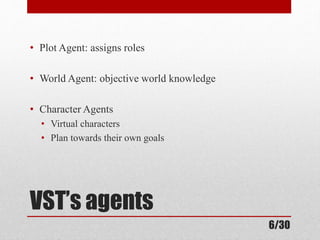
• Plot Agent: assigns roles 
• World Agent: objective world knowledge 
• Character Agents 
• Virtual characters 
• Plan towards their own goals 
VST’s agents 
6/30
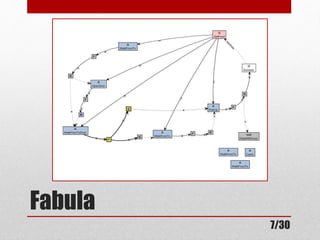
Fabula 
7/30
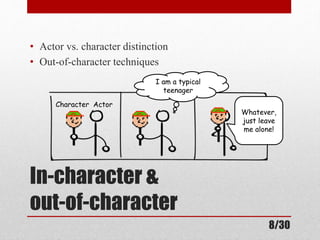
• Actor vs. character distinction 
• Out-of-character techniques 
Character Actor 
I am a typical 
teenager 
In-character & 
out-of-character 
Whatever, 
just leave 
me alone! 
8/30
Pirate domain 
Scurvy wants to get the piece of cheese. 
Scurvy assumes the cheese is in the 
galley. 
Scurvy walks to the cargo hold via the 
door. 
Scurvy walks to the gun deck via the 
ladder. 
Scurvy opens the door to the galley. 
Scurvy can see the cheese is not in the 
galley. 
O’Malley sees Scurvy. 
O’Malley wants to catch Scurvy. 
O’Malley walks to the gun deck via the 
door. 
Princess domain 
Once upon a time, there was a 
beautiful princess called 
Amalia. A knight from a far 
way country was in love with 
her and she was in love with a 
young prince. The knight was 
jealous, so he wished to 
kidnap her. Because the 
princess lived in a large castle, 
he went to the castle. He tried 
to open the heavy gate. The 
knight climbed into a high 
tree. [..] 
Generated stories 
9/30
• Authoring is an iterative process 
• Examples of ‘mis-generated’ stories: 
• A pirate wants to go to an island... 
• A pirate wants to send someone to hell... 
• Authoring: specifying the story world 
Authoring for emergence 
10/30
• Little Red Riding Hood [http://vimeo.com/68865491] 
• Co-creation 
• Discovering the story world 
The Interactive Storyteller 
11/30
PART 2 
Serious games 
12/30
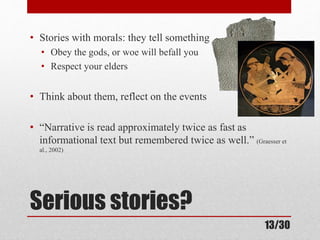
• Stories with morals: they tell something 
• Obey the gods, or woe will befall you 
• Respect your elders 
• Think about them, reflect on the events 
• “Narrative is read approximately twice as fast as 
informational text but remembered twice as well.” (Graesser et 
al., 2002) 
Serious stories? 
13/30
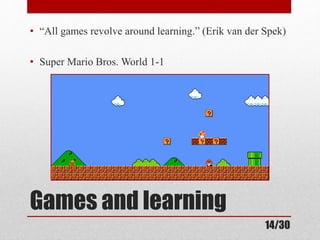
• “All games revolve around learning.” (Erik van der Spek) 
• Super Mario Bros. World 1-1 
Games and learning 
14/30
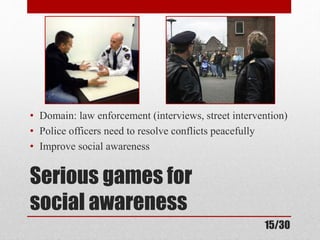
• Domain: law enforcement (interviews, street intervention) 
• Police officers need to resolve conflicts peacefully 
• Improve social awareness 
Serious games for 
social awareness 
15/30
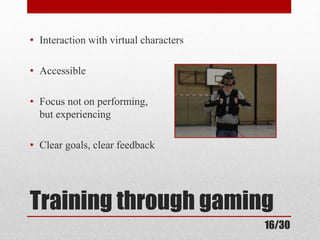
• Interaction with virtual characters 
• Accessible 
• Focus not on performing, 
but experiencing 
• Clear goals, clear feedback 
Training through gaming 
16/30
• Focus on learning goals 
• Insight in procedure 
• Improving awareness 
• Interaction in a system 
• Don’t simulate, exaggerate 
• Playful interaction 
• Abstract from real world 
• Convey knowledge using metaphors 
Serious game design 
17/30
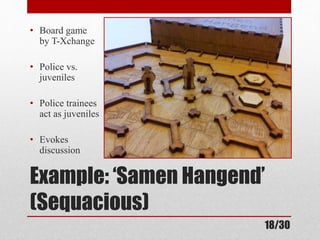
• Board game 
by T-Xchange 
• Police vs. 
juveniles 
• Police trainees 
act as juveniles 
• Evokes 
discussion 
Example: ‘Samen Hangend’ 
(Sequacious) 
18/30
• Interaction with virtual agents 
• Let agents use theories on social interaction 
• Again, an emergent narrative 
LOITER: Interaction with 
virtual characters 
19/30
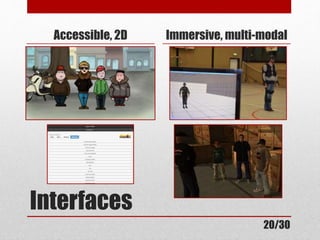
Accessible, 2D Immersive, multi-modal 
Interfaces 
20/30
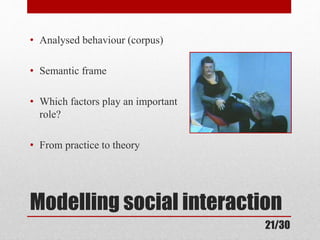
• Analysed behaviour (corpus) 
• Semantic frame 
• Which factors play an important 
role? 
• From practice to theory 
Modelling social interaction 
21/30
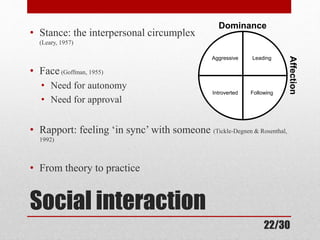
• Stance: the interpersonal circumplex 
(Leary, 1957) 
• Face (Goffman, 1955) 
• Need for autonomy 
• Need for approval 
• Rapport: feeling ‘in sync’ with someone (Tickle-Degnen & Rosenthal, 
1992) 
• From theory to practice 
Social interaction 
Dominance 
Affection 
Aggressive Leading 
Introverted Following 
22/30
• Learning goals based on theories from social psychology 
• Examples: recognise stance and adopt a stance 
• Feedback 
• Explainable AI 
• Supports the learning goals 
Learning goals and feedback 
23/30
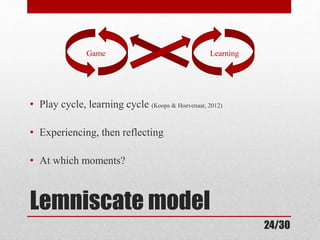
Game Learning 
• Play cycle, learning cycle (Koops & Hoevenaar, 2012) 
• Experiencing, then reflecting 
• At which moments? 
Lemniscate model 
24/30
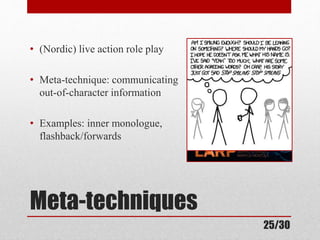
• (Nordic) live action role play 
• Meta-technique: communicating 
out-of-character information 
• Examples: inner monologue, 
flashback/forwards 
Meta-techniques 
25/30
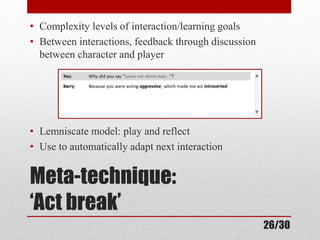
• Complexity levels of interaction/learning goals 
• Between interactions, feedback through discussion 
between character and player 
• Lemniscate model: play and reflect 
• Use to automatically adapt next interaction 
Meta-technique: 
‘Act break’ 
26/30
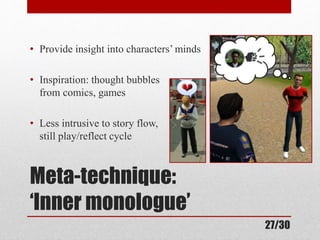
• Provide insight into characters’ minds 
• Inspiration: thought bubbles 
from comics, games 
• Less intrusive to story flow, 
still play/reflect cycle 
Meta-technique: 
‘Inner monologue’ 
27/30
• How much do these meta-techniques contribute to 
learning? 
• How do different interfaces influence learning? 
• Story structure: toward emergent narrative 
• OOC adaptation to player: adaptive difficulty 
LOITER: Next steps 
28/30
Take Home Message 
Be meta 
Get inspired by other fields 
Don’t take everything too seriously 
29/30
Thanks Thanks for 
listening! 
listening! 
Let’s Let’s discuss... 
mail j.m.linssen@utwente.nl 
blog jmlin.eu/phd 
Virtual Storyteller virtualstoryteller.info 
commit-nl.nl 
And they learned happily ever after... 
30/30
• Theune, M., Linssen, J.M., & Alofs, T. (2013). Acting, Playing or Talking about the 
Story: Children’s Communication during Interactive Digital Storytelling. In Proceedings of 
the International Conference on Interactive Digital Storytelling. 
• Bruijnes, M., Linssen, J.M., op den Akker, H.J.A., Theune, M., Wapperom, S., Broekema, 
C., & Heylen, D.K.J. (2014). Social Behaviour in Police Interviews: Relating Data to 
Theories, in Poggi, I., Vincze, L., & Vinciarelli, A. (eds.) Conflict and Negotiation: Social 
Research and Machine Intelligence, Springer, Berlin. 
• Linssen, J.M., Theune, M., & de Groot, T.F. (2013). What Is at Play? Meta-techniques in 
Serious Games and Their Effects on Social Believability and Learning. In Proceedings of the 
Social Believability in Games Workshop. 
• Linssen, J.M., de Groot, T.F., & Theune, M. (In press). Beyond Simulations: Serious Games 
for Training Interpersonal Skills in Law Enforcement. In Proceedings of the International 
Conference of the European Social Simulation Association. 
• van Oostendorp, H., van der Spek, E.D., & Linssen, J.M. (2014). Adapting the Complexity 
Level of a Serious Game to the Proficiency of Players. EAI Endorsed Transactions on 
Serious Games, 14(2). 
Publications 
31/30
• Belarbi, S., Bergström, K., Ebbehøj, S. L., Hansen, E. E., Fatland, E., 
Giæver, O. P., … Westlund, A. (2010). Nordic larp. (J. Stenros & M. 
Montola, Eds.). 
• Swartjes, I. M. T. (2010). Whose story is it anyway? How improv 
informs agency and authorship of emergent narrative. Centre for 
Telematics and Information Technology University of Twente. 
• XKCD.com, comic 1089 
• Graesser, A.C., Olde, B., and Klettke, B. (2002). How does the mind 
construct and represent stories? In M.C. Green, J.J. Strange & T.C. 
Brock (Eds.), Narrative Impact: Social and Cognitive Foundations 
(231-263). Mahwah NJ: Lawrence Erlbaum Associates. 
• Koops, M., & Hoevenaar, M. (2012). Conceptual Change During a 
Serious Game: Using a Lemniscate Model to Compare Strategies in a 
Physics Game. Simulation & Gaming, 44(4), 544–561. 
References 
32/30
• Human Media Interaction: http://hmi.ewi.utwente.nl 
• T-Xchange: http://www.txchange.nl 
• re-lion: http://www.re-lion.com 
Links 
33/30
• Mariët Theune, coordinator (2002 – now) 
• Hans ten Brinke, perceptions and assumptions (2014) 
• Thijs Alofs, Interactive Storyteller (2012) 
• Ivo Swartjes, lead designer (2006 – 2010) 
• Pjotter Tommassen, plot control (2009) 
• Nanda Slabbers, language generation (2006) 
Virtual Storyteller credits 
34/30

Interactive stories and serious games for social interaction

  • 1.
    Interactive Stories andSerious Games for Social Interaction Jeroen Linssen | PhD student Human Media Interaction University of Twente
  • 2.
    Part 1: TheVST • The Virtual Storyteller: • Story generation • Interactive stories • In-character and out-of-character Outline Part 2: Serious games • Training through gaming • Socially intelligent agents • Meta-techniques 2/30
  • 3.
    PART 1 TheVirtual Storyteller 3/30
  • 4.
    • Story generationthrough simulation [http://vimeo.com/11836534] • Emergent narrative in a multi-agent system • From simulation for story generation to interactive stories The Virtual Storyteller 4/30
  • 5.
    • Story emergesfrom characters’ actions • Inspiration: improvisational theatre • Offers & accepts Emergent narrative 5/30
  • 6.
    • Plot Agent:assigns roles • World Agent: objective world knowledge • Character Agents • Virtual characters • Plan towards their own goals VST’s agents 6/30
  • 7.
  • 8.
    • Actor vs.character distinction • Out-of-character techniques Character Actor I am a typical teenager In-character & out-of-character Whatever, just leave me alone! 8/30
  • 9.
    Pirate domain Scurvywants to get the piece of cheese. Scurvy assumes the cheese is in the galley. Scurvy walks to the cargo hold via the door. Scurvy walks to the gun deck via the ladder. Scurvy opens the door to the galley. Scurvy can see the cheese is not in the galley. O’Malley sees Scurvy. O’Malley wants to catch Scurvy. O’Malley walks to the gun deck via the door. Princess domain Once upon a time, there was a beautiful princess called Amalia. A knight from a far way country was in love with her and she was in love with a young prince. The knight was jealous, so he wished to kidnap her. Because the princess lived in a large castle, he went to the castle. He tried to open the heavy gate. The knight climbed into a high tree. [..] Generated stories 9/30
  • 10.
    • Authoring isan iterative process • Examples of ‘mis-generated’ stories: • A pirate wants to go to an island... • A pirate wants to send someone to hell... • Authoring: specifying the story world Authoring for emergence 10/30
  • 11.
    • Little RedRiding Hood [http://vimeo.com/68865491] • Co-creation • Discovering the story world The Interactive Storyteller 11/30
  • 12.
    PART 2 Seriousgames 12/30
  • 13.
    • Stories withmorals: they tell something • Obey the gods, or woe will befall you • Respect your elders • Think about them, reflect on the events • “Narrative is read approximately twice as fast as informational text but remembered twice as well.” (Graesser et al., 2002) Serious stories? 13/30
  • 14.
    • “All gamesrevolve around learning.” (Erik van der Spek) • Super Mario Bros. World 1-1 Games and learning 14/30
  • 15.
    • Domain: lawenforcement (interviews, street intervention) • Police officers need to resolve conflicts peacefully • Improve social awareness Serious games for social awareness 15/30
  • 16.
    • Interaction withvirtual characters • Accessible • Focus not on performing, but experiencing • Clear goals, clear feedback Training through gaming 16/30
  • 17.
    • Focus onlearning goals • Insight in procedure • Improving awareness • Interaction in a system • Don’t simulate, exaggerate • Playful interaction • Abstract from real world • Convey knowledge using metaphors Serious game design 17/30
  • 18.
    • Board game by T-Xchange • Police vs. juveniles • Police trainees act as juveniles • Evokes discussion Example: ‘Samen Hangend’ (Sequacious) 18/30
  • 19.
    • Interaction withvirtual agents • Let agents use theories on social interaction • Again, an emergent narrative LOITER: Interaction with virtual characters 19/30
  • 20.
    Accessible, 2D Immersive,multi-modal Interfaces 20/30
  • 21.
    • Analysed behaviour(corpus) • Semantic frame • Which factors play an important role? • From practice to theory Modelling social interaction 21/30
  • 22.
    • Stance: theinterpersonal circumplex (Leary, 1957) • Face (Goffman, 1955) • Need for autonomy • Need for approval • Rapport: feeling ‘in sync’ with someone (Tickle-Degnen & Rosenthal, 1992) • From theory to practice Social interaction Dominance Affection Aggressive Leading Introverted Following 22/30
  • 23.
    • Learning goalsbased on theories from social psychology • Examples: recognise stance and adopt a stance • Feedback • Explainable AI • Supports the learning goals Learning goals and feedback 23/30
  • 24.
    Game Learning •Play cycle, learning cycle (Koops & Hoevenaar, 2012) • Experiencing, then reflecting • At which moments? Lemniscate model 24/30
  • 25.
    • (Nordic) liveaction role play • Meta-technique: communicating out-of-character information • Examples: inner monologue, flashback/forwards Meta-techniques 25/30
  • 26.
    • Complexity levelsof interaction/learning goals • Between interactions, feedback through discussion between character and player • Lemniscate model: play and reflect • Use to automatically adapt next interaction Meta-technique: ‘Act break’ 26/30
  • 27.
    • Provide insightinto characters’ minds • Inspiration: thought bubbles from comics, games • Less intrusive to story flow, still play/reflect cycle Meta-technique: ‘Inner monologue’ 27/30
  • 28.
    • How muchdo these meta-techniques contribute to learning? • How do different interfaces influence learning? • Story structure: toward emergent narrative • OOC adaptation to player: adaptive difficulty LOITER: Next steps 28/30
  • 29.
    Take Home Message Be meta Get inspired by other fields Don’t take everything too seriously 29/30
  • 30.
    Thanks Thanks for listening! listening! Let’s Let’s discuss... mail j.m.linssen@utwente.nl blog jmlin.eu/phd Virtual Storyteller virtualstoryteller.info commit-nl.nl And they learned happily ever after... 30/30
  • 31.
    • Theune, M.,Linssen, J.M., & Alofs, T. (2013). Acting, Playing or Talking about the Story: Children’s Communication during Interactive Digital Storytelling. In Proceedings of the International Conference on Interactive Digital Storytelling. • Bruijnes, M., Linssen, J.M., op den Akker, H.J.A., Theune, M., Wapperom, S., Broekema, C., & Heylen, D.K.J. (2014). Social Behaviour in Police Interviews: Relating Data to Theories, in Poggi, I., Vincze, L., & Vinciarelli, A. (eds.) Conflict and Negotiation: Social Research and Machine Intelligence, Springer, Berlin. • Linssen, J.M., Theune, M., & de Groot, T.F. (2013). What Is at Play? Meta-techniques in Serious Games and Their Effects on Social Believability and Learning. In Proceedings of the Social Believability in Games Workshop. • Linssen, J.M., de Groot, T.F., & Theune, M. (In press). Beyond Simulations: Serious Games for Training Interpersonal Skills in Law Enforcement. In Proceedings of the International Conference of the European Social Simulation Association. • van Oostendorp, H., van der Spek, E.D., & Linssen, J.M. (2014). Adapting the Complexity Level of a Serious Game to the Proficiency of Players. EAI Endorsed Transactions on Serious Games, 14(2). Publications 31/30
  • 32.
    • Belarbi, S.,Bergström, K., Ebbehøj, S. L., Hansen, E. E., Fatland, E., Giæver, O. P., … Westlund, A. (2010). Nordic larp. (J. Stenros & M. Montola, Eds.). • Swartjes, I. M. T. (2010). Whose story is it anyway? How improv informs agency and authorship of emergent narrative. Centre for Telematics and Information Technology University of Twente. • XKCD.com, comic 1089 • Graesser, A.C., Olde, B., and Klettke, B. (2002). How does the mind construct and represent stories? In M.C. Green, J.J. Strange & T.C. Brock (Eds.), Narrative Impact: Social and Cognitive Foundations (231-263). Mahwah NJ: Lawrence Erlbaum Associates. • Koops, M., & Hoevenaar, M. (2012). Conceptual Change During a Serious Game: Using a Lemniscate Model to Compare Strategies in a Physics Game. Simulation & Gaming, 44(4), 544–561. References 32/30
  • 33.
    • Human MediaInteraction: http://hmi.ewi.utwente.nl • T-Xchange: http://www.txchange.nl • re-lion: http://www.re-lion.com Links 33/30
  • 34.
    • Mariët Theune,coordinator (2002 – now) • Hans ten Brinke, perceptions and assumptions (2014) • Thijs Alofs, Interactive Storyteller (2012) • Ivo Swartjes, lead designer (2006 – 2010) • Pjotter Tommassen, plot control (2009) • Nanda Slabbers, language generation (2006) Virtual Storyteller credits 34/30

Editor's Notes

  • #2 My background
  • #5 - Video: +/- 5 minutes
  • #6 No longer a branching narrative Characters together make story Improv: de Lama’s; build a story brick by brick, can offer and accept new bits
  • #8 Causal chain for plan to get food in a different room Top-right: goal motivates all actions Top-left, clockwise: character walks, opens door, walks through the door, sees the food, and walks to the other location where he picks up the food and has a successful outcome
  • #9 Interactivity and story as concepts are at odds: a pre-determined story can not be influenced We can have either one or the other Solution: IC/OOC distinction
  • #10 Pirate domain: rat and cat Goal Assumption Perception Princess domain: Using the fabula, NLG! Status quo Goal with reason Planning Failing Re-planning
  • #11 Authoring for emergent narrative is iterative Island: Pirate can use a cannon Cannon can shoot objects to locations Pirate shoots himself from the cannon to the island Hell: Hell is a place Pirate knows that holding something will take it with him somewhere Pirate knows that killing himself will send him to hell So he holds onto someone, kills himself and they both end up in hell
  • #12 Young target group (8-10 y/o) Video +/- 2 min. Not all discussed techniques implemented in this system Co-creation: jointly making a story, adding external elements to the interaction What we also saw during analysis of children’s interactions with the Interactive Storyteller is that they first have to discover what is actually possible in the story world before they can plan toward certain goals... AGENCY!
  • #15 When I was studying CAI, I did my master’s thesis on adaptive difficulty in a serious game E. v.d. S.: PhD from UU, research on serious games Super Mario Bros.: typical example In the first level, all the basic ingredients for the complete gameplay are introduced An enemy, a power up, ? blocks, brick blocks, multiple levels and a pipe All of these things cry for interaction and give feedback on what happens if you interact with them Thus, within the first minute of playing, you have already learned the basics
  • #16 My research now: also serious games Social/soft skills
  • #17 More accessible: low(er) effort to play (also motivational!) Experiencing different situations: players may do something wrong and learn from that! Clearer: more abstract, simple
  • #18 A few important points to take with you when you think about serious game design: The serious The game Next, I’ll show you an example of a game that doesn’t look that serious, but still is a ‘serious’ game
  • #19 Learning goal: get insight that juveniles want to hang together and that you have to disperse them Various ways to do so When a group gets large, it can become larger even faster
  • #20 Scenario: loitering juveniles, player has to resolve conflict No pre-scripted storyline to let players experience what could actually happen; providing lots of agency
  • #21 Next slide: Now, to make characters behave believably...
  • #22 Annotations to actions in terms of theories to rule-based approach Semantic frame Next slide: Theories from social psychology
  • #23 Theory to practice: create actions based on variations of combinations of these theories
  • #24 Explainable AI: Characters can explain their actions In terms of social theories
  • #26 Again, the distinction between story world and meta-world Meta-technique: as the name implies... used to enrich story!
  • #27 Explanation in terms of social theories Adaptation: if the player asks questions about one type of action or fails to answer questions from the character correctly, then add more of that behaviour to the next interaction
  • #28 Examples from games? (TWD, The Sims)
  • #30 Balance agency in game Look beyond your own field, use art, sociology, etc. Try things, don’t be too formal or theoretical, see what kind of crazy stuff your game or system can do
  • #31 Having said that, I want to thank you all for listening.