The 38th annual CALRG conference
14th – 16th June 2017
What are the expectations of disabled learners
when participating in MOOCs
Francisco Iniesto, Patrick McAndrew, Shailey Minocha and Tim Coughlan
The Open University
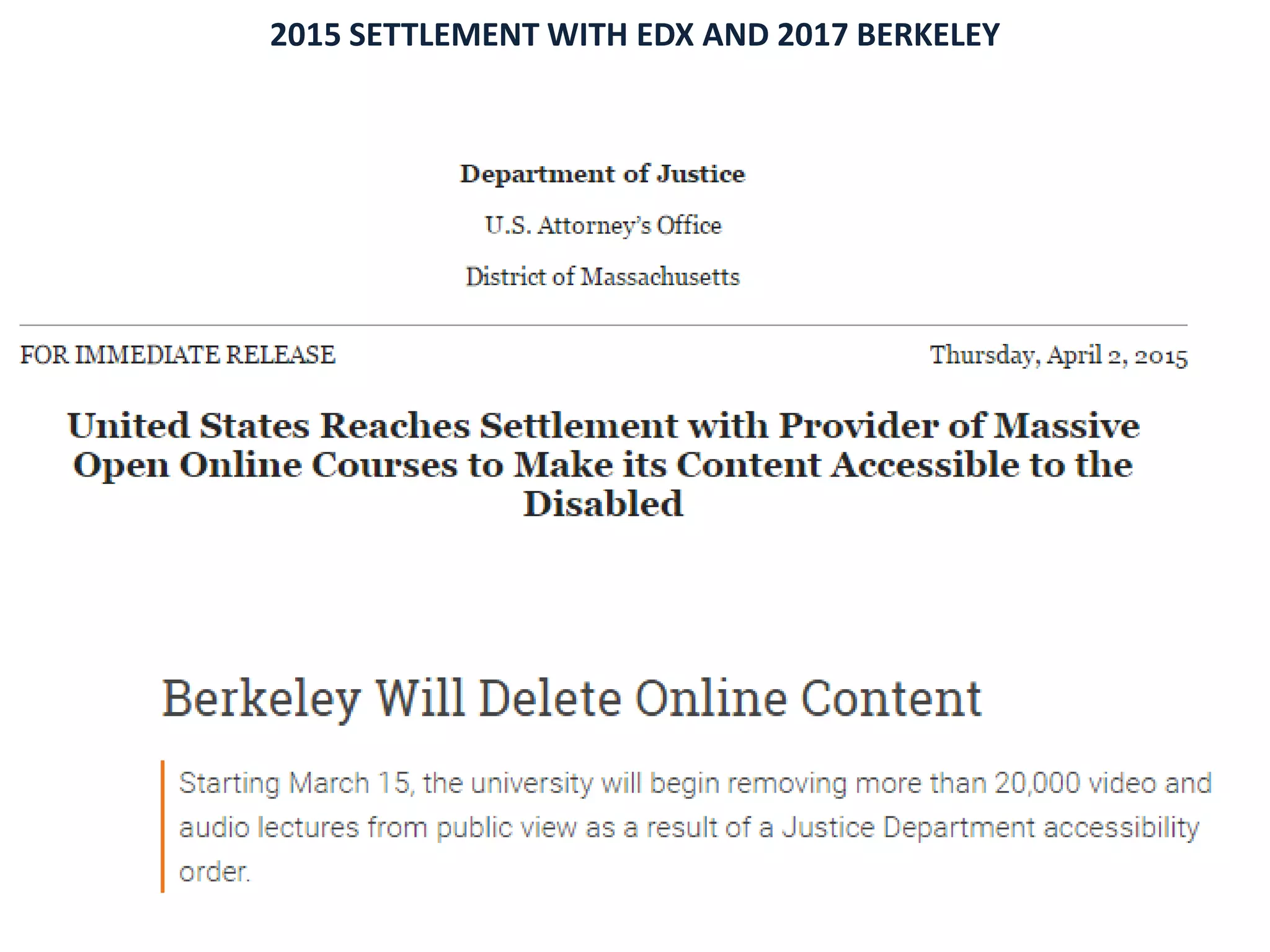
2015 SETTLEMENT WITH EDX AND 2017 BERKELEY
• MOOC Learning, benefits such as:
• Openness
• Low cost
• Ubiquity (Time, place and pace)
• Acquiring knowledge
• Social learning: Connectivism
• Achieving new competences
• Develop professionally
INTRODUCTION AND RELATED WORK
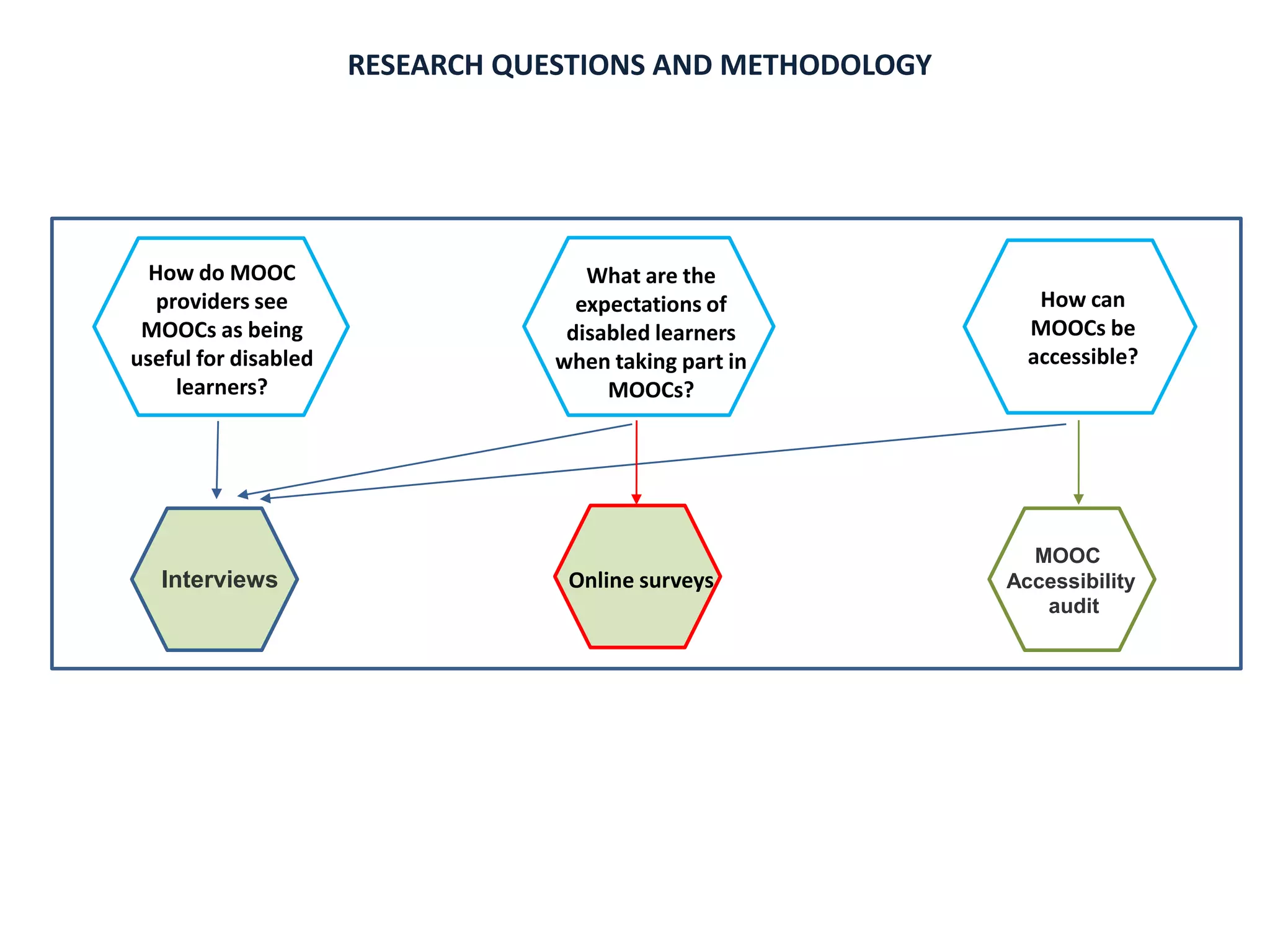
Interviews Online surveys
MOOC
Accessibility
audit
How do MOOC
providers see
MOOCs as being
useful for disabled
learners?
What are the
expectations of
disabled learners
when taking part in
MOOCs?
How can
MOOCs be
accessible?
RESEARCH QUESTIONS AND METHODOLOGY
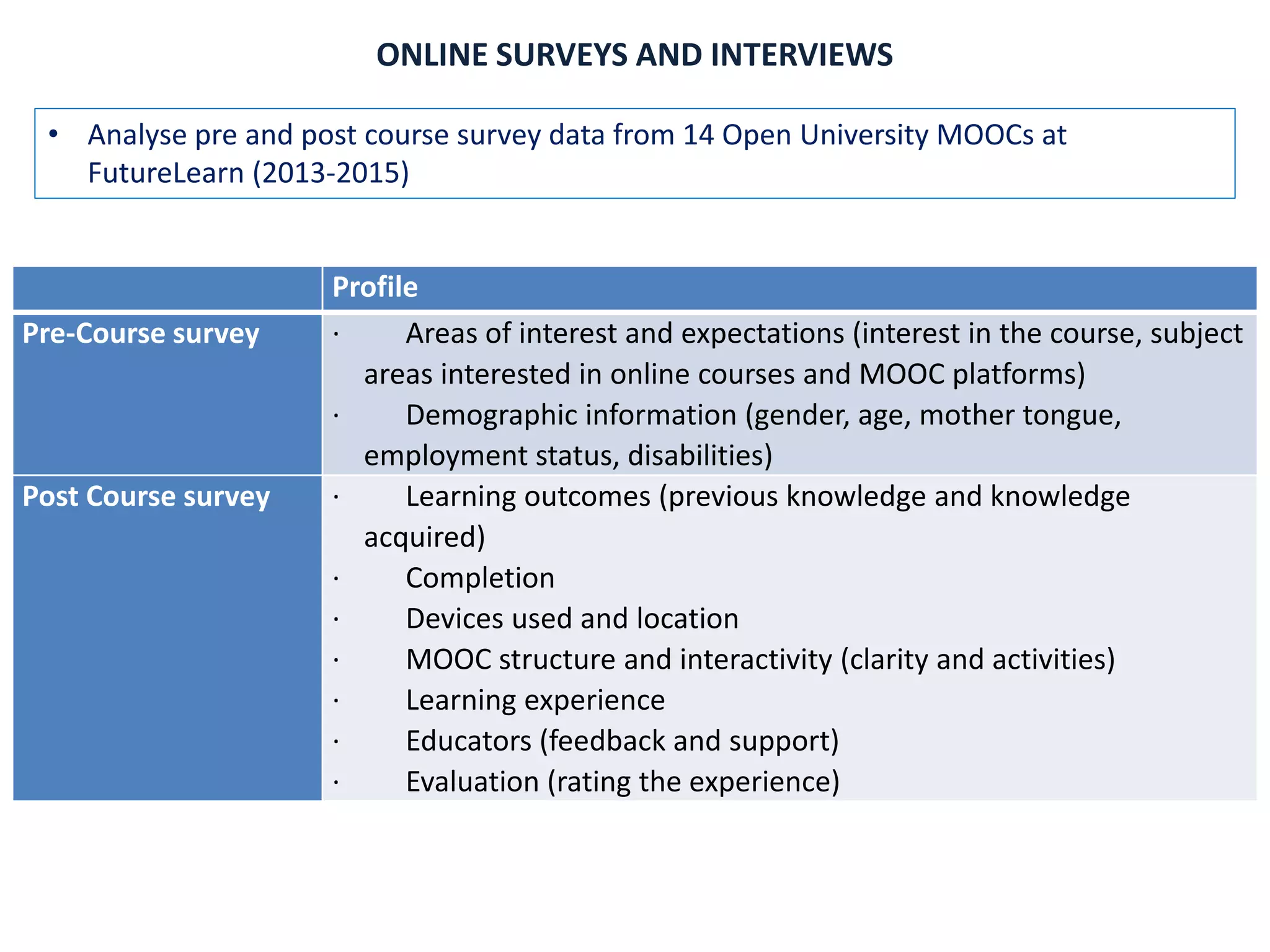
ONLINE SURVEYS AND INTERVIEWS
Profile
Pre-Course survey · Areas of interest and expectations (interest in the course, subject
areas interested in online courses and MOOC platforms)
· Demographic information (gender, age, mother tongue,
employment status, disabilities)
Post Course survey · Learning outcomes (previous knowledge and knowledge
acquired)
· Completion
· Devices used and location
· MOOC structure and interactivity (clarity and activities)
· Learning experience
· Educators (feedback and support)
· Evaluation (rating the experience)
• Analyse pre and post course survey data from 14 Open University MOOCs at
FutureLearn (2013-2015)
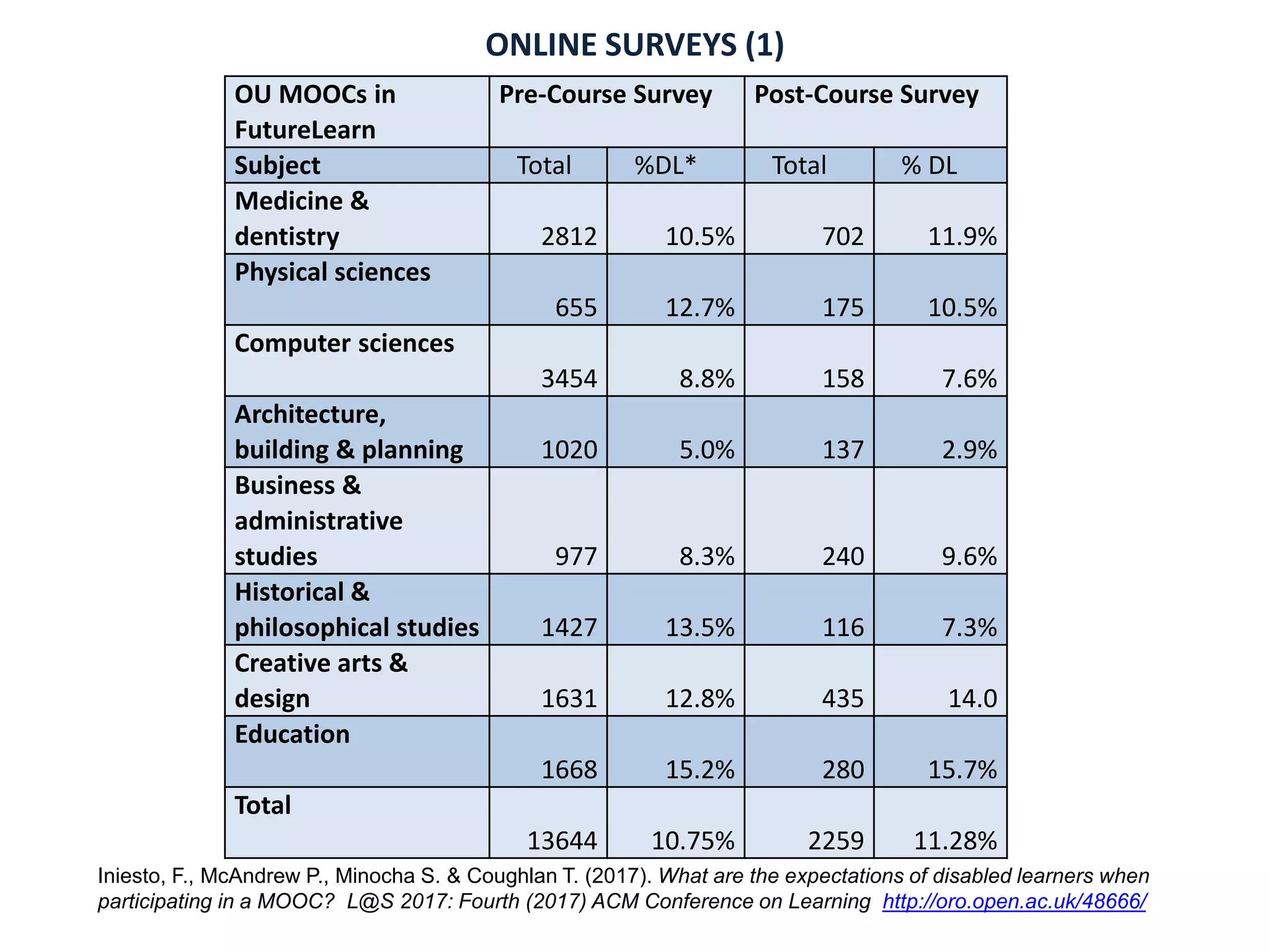
ONLINE SURVEYS (1)
Iniesto, F., McAndrew P., Minocha S. & Coughlan T. (2017). What are the expectations of disabled learners when
participating in a MOOC? L@S 2017: Fourth (2017) ACM Conference on Learning http://oro.open.ac.uk/48666/
OU MOOCs in
FutureLearn
Pre-Course Survey Post-Course Survey
Subject Total %DL* Total % DL
Medicine &
dentistry 2812 10.5% 702 11.9%
Physical sciences
655 12.7% 175 10.5%
Computer sciences
3454 8.8% 158 7.6%
Architecture,
building & planning 1020 5.0% 137 2.9%
Business &
administrative
studies 977 8.3% 240 9.6%
Historical &
philosophical studies 1427 13.5% 116 7.3%
Creative arts &
design 1631 12.8% 435 14.0
Education
1668 15.2% 280 15.7%
Total
13644 10.75% 2259 11.28%
ONLINE SURVEYS (2)
ONLINE SURVEYS (3)
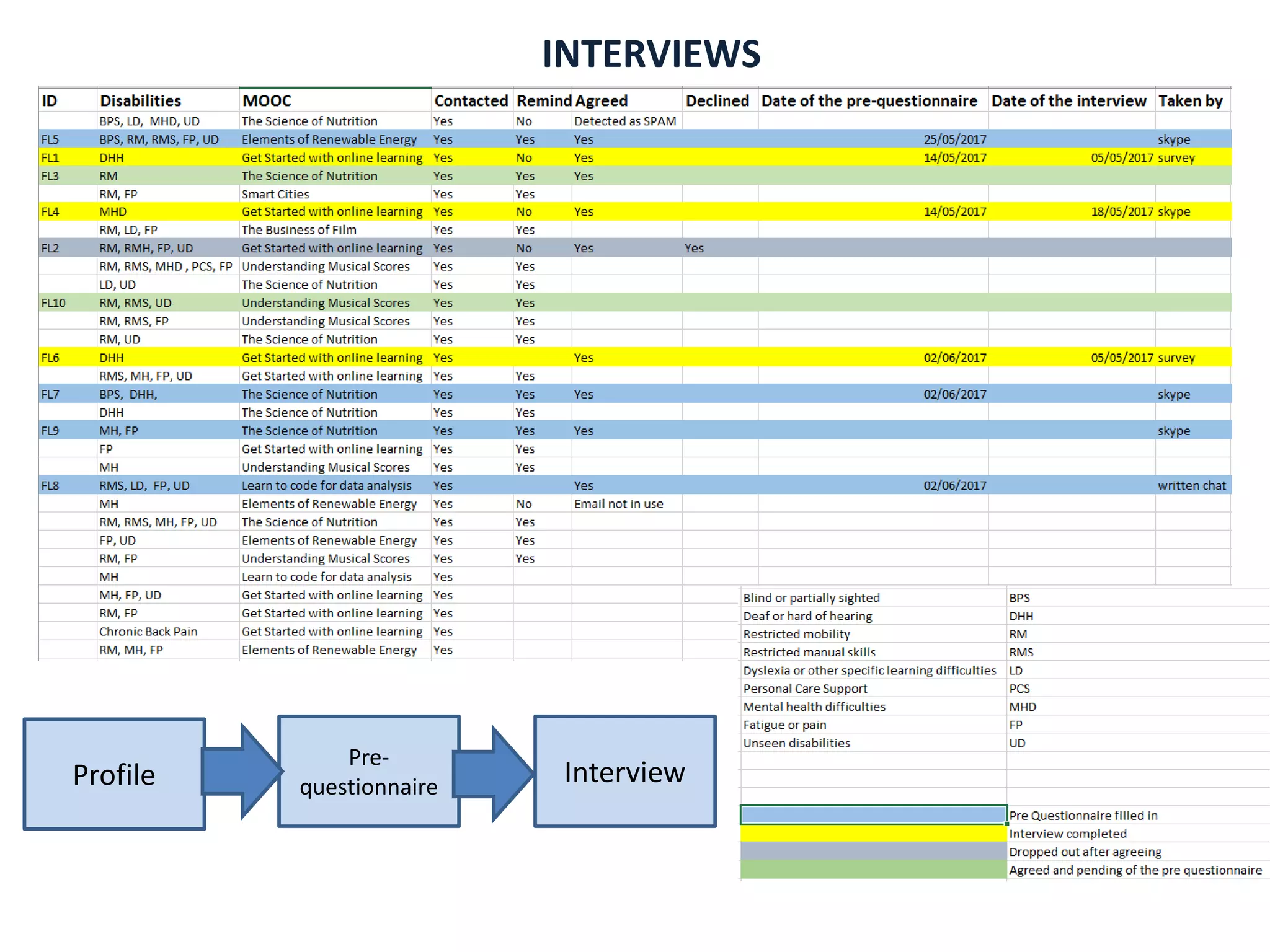
INTERVIEWS
Profile
Pre-
questionnaire
Interview
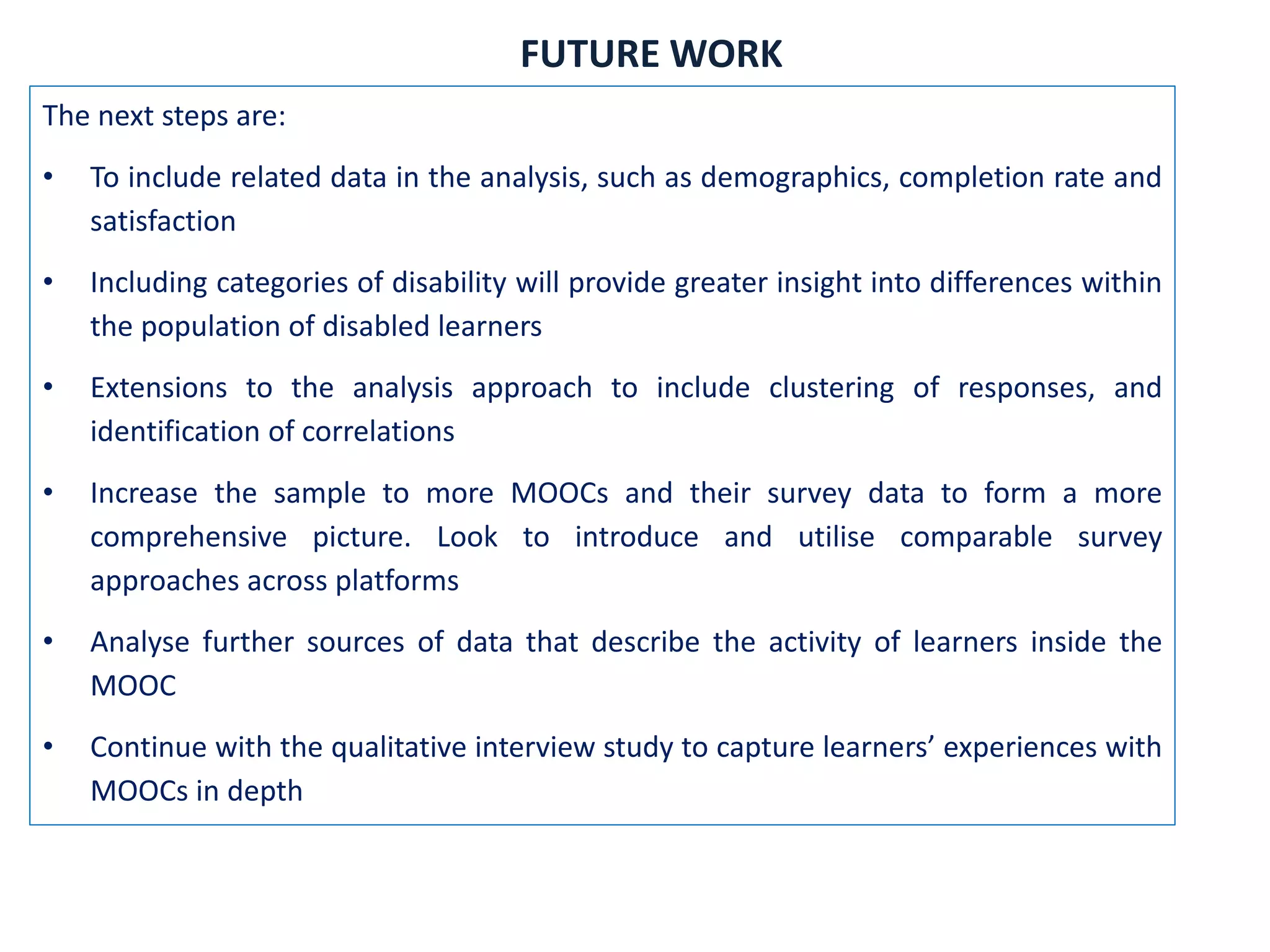
The next steps are:
• To include related data in the analysis, such as demographics, completion rate and
satisfaction
• Including categories of disability will provide greater insight into differences within
the population of disabled learners
• Extensions to the analysis approach to include clustering of responses, and
identification of correlations
• Increase the sample to more MOOCs and their survey data to form a more
comprehensive picture. Look to introduce and utilise comparable survey
approaches across platforms
• Analyse further sources of data that describe the activity of learners inside the
MOOC
• Continue with the qualitative interview study to capture learners’ experiences with
MOOCs in depth
FUTURE WORK
What are the expectations of disabled learners
when participating in MOOCs
Francisco Iniesto, Patrick McAndrew, Shailey Minocha and Tim Coughlan
The Open University
francisco.iniesto@open.ac.uk

What are the expectations of disabled learners when participating in MOOCs?

  • 1.
    The 38th annualCALRG conference 14th – 16th June 2017 What are the expectations of disabled learners when participating in MOOCs Francisco Iniesto, Patrick McAndrew, Shailey Minocha and Tim Coughlan The Open University
  • 2.
    2015 SETTLEMENT WITHEDX AND 2017 BERKELEY
  • 3.
    • MOOC Learning,benefits such as: • Openness • Low cost • Ubiquity (Time, place and pace) • Acquiring knowledge • Social learning: Connectivism • Achieving new competences • Develop professionally INTRODUCTION AND RELATED WORK
  • 4.
    Interviews Online surveys MOOC Accessibility audit Howdo MOOC providers see MOOCs as being useful for disabled learners? What are the expectations of disabled learners when taking part in MOOCs? How can MOOCs be accessible? RESEARCH QUESTIONS AND METHODOLOGY
  • 5.
    ONLINE SURVEYS ANDINTERVIEWS Profile Pre-Course survey · Areas of interest and expectations (interest in the course, subject areas interested in online courses and MOOC platforms) · Demographic information (gender, age, mother tongue, employment status, disabilities) Post Course survey · Learning outcomes (previous knowledge and knowledge acquired) · Completion · Devices used and location · MOOC structure and interactivity (clarity and activities) · Learning experience · Educators (feedback and support) · Evaluation (rating the experience) • Analyse pre and post course survey data from 14 Open University MOOCs at FutureLearn (2013-2015)
  • 6.
    ONLINE SURVEYS (1) Iniesto,F., McAndrew P., Minocha S. & Coughlan T. (2017). What are the expectations of disabled learners when participating in a MOOC? L@S 2017: Fourth (2017) ACM Conference on Learning http://oro.open.ac.uk/48666/ OU MOOCs in FutureLearn Pre-Course Survey Post-Course Survey Subject Total %DL* Total % DL Medicine & dentistry 2812 10.5% 702 11.9% Physical sciences 655 12.7% 175 10.5% Computer sciences 3454 8.8% 158 7.6% Architecture, building & planning 1020 5.0% 137 2.9% Business & administrative studies 977 8.3% 240 9.6% Historical & philosophical studies 1427 13.5% 116 7.3% Creative arts & design 1631 12.8% 435 14.0 Education 1668 15.2% 280 15.7% Total 13644 10.75% 2259 11.28%
  • 7.
  • 8.
  • 9.
  • 10.
    The next stepsare: • To include related data in the analysis, such as demographics, completion rate and satisfaction • Including categories of disability will provide greater insight into differences within the population of disabled learners • Extensions to the analysis approach to include clustering of responses, and identification of correlations • Increase the sample to more MOOCs and their survey data to form a more comprehensive picture. Look to introduce and utilise comparable survey approaches across platforms • Analyse further sources of data that describe the activity of learners inside the MOOC • Continue with the qualitative interview study to capture learners’ experiences with MOOCs in depth FUTURE WORK
  • 11.
    What are theexpectations of disabled learners when participating in MOOCs Francisco Iniesto, Patrick McAndrew, Shailey Minocha and Tim Coughlan The Open University francisco.iniesto@open.ac.uk

Editor's Notes

  • #2 Introduction, Phd Research Student at the OU, Institute of Educational Technology, Leverhulme Open World Learning and GO-GN MOOCs and accessibility, overview of my research Project, achievements, results and work to be done
  • #3 Accessibility and MOOCs The settlement requires edX to provide accurate captioning for the deaf, oral navigation signals for the blind, and programing changes so those with dexterity disabilities can navigate content without struggling with a hand-operated mouse. MOOCs have the potential to increase access to high-quality education for people facing income, distance, and other barriers, but only if they are truly open to everyone.  This landmark agreement is far-reaching in ensuring that individuals with disabilities will have an equal opportunity to independently and conveniently access quality higher education online the university will begin removing the more than 20,000 audio and video files from those platforms -- a process that will take three to five months -- and require users sign in with University of California credentials to view or listen to them.
  • #4 This educational paradigm has not developed with an inherent capacity to attend to the needs of all students This poses a serious problem to its foundation principles of being open to all Lack of support for disabled students in open learning : Poor compliance of platforms and contents with web accessibility standards Lack of information about accessibility preferences of students Barriers of e-commerce or biometric techniques Accessibility barriers of third party software and social networks
  • #5 RQ3. How can MOOCs be accessible? RQ3 a. What is the current state of accessibility of MOOCs? RQ3 b. Which aspects of accessibility in MOOCs could be improved and adapted? Qualitative approach tend to use very small samples and just one group of disabilities such as vision impairment Quantitative methods tend to focus on just one platform The heuristic evaluations do not usually include user-based approaches being just technical reports Research questions and methods to be used
  • #6  Pre (41406 – 4481) Post (8870 - 1055 )
  • #7 Subset of eight MOOCs and the first three questions related with this profile: Interest in the MOOC from response to ‘Why are you interested in studying this course? Subject areas of interest from response to ‘Which of the following subject areas are you interested in?’ Previous experience with online courses from response to ‘What sort of online course have you taken?
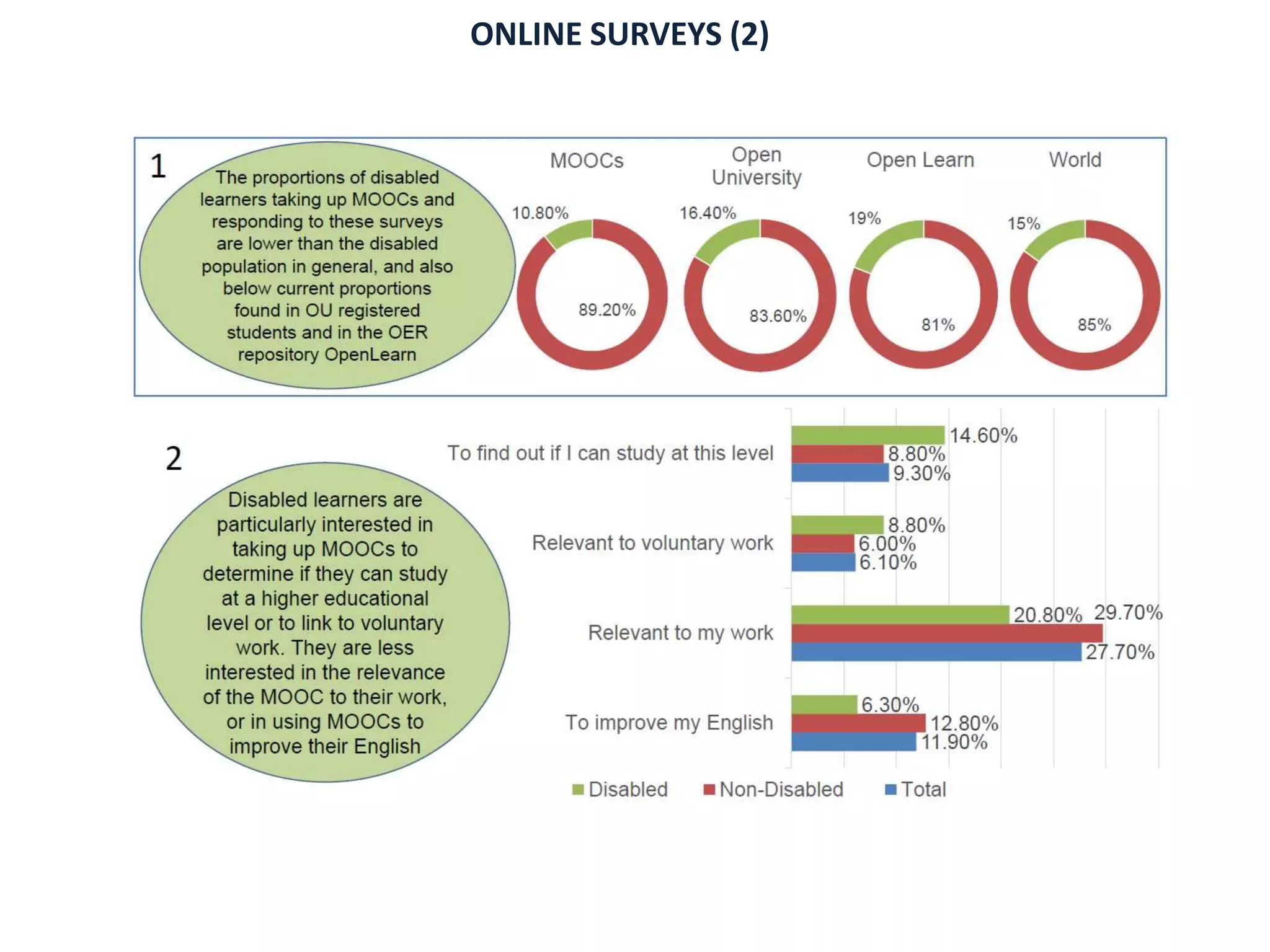
  • #8  The proportions of disabled learners taking part in MOOCs and responding to these surveys are lower than the disabled population in In comparison with other learners, disabled learners are particularly interested in taking up MOOCs to determine if they can study at a higher educational level and to link to voluntary work. They are less interested in the relevance of the MOOC to their work, or in using MOOCs to improve their English.
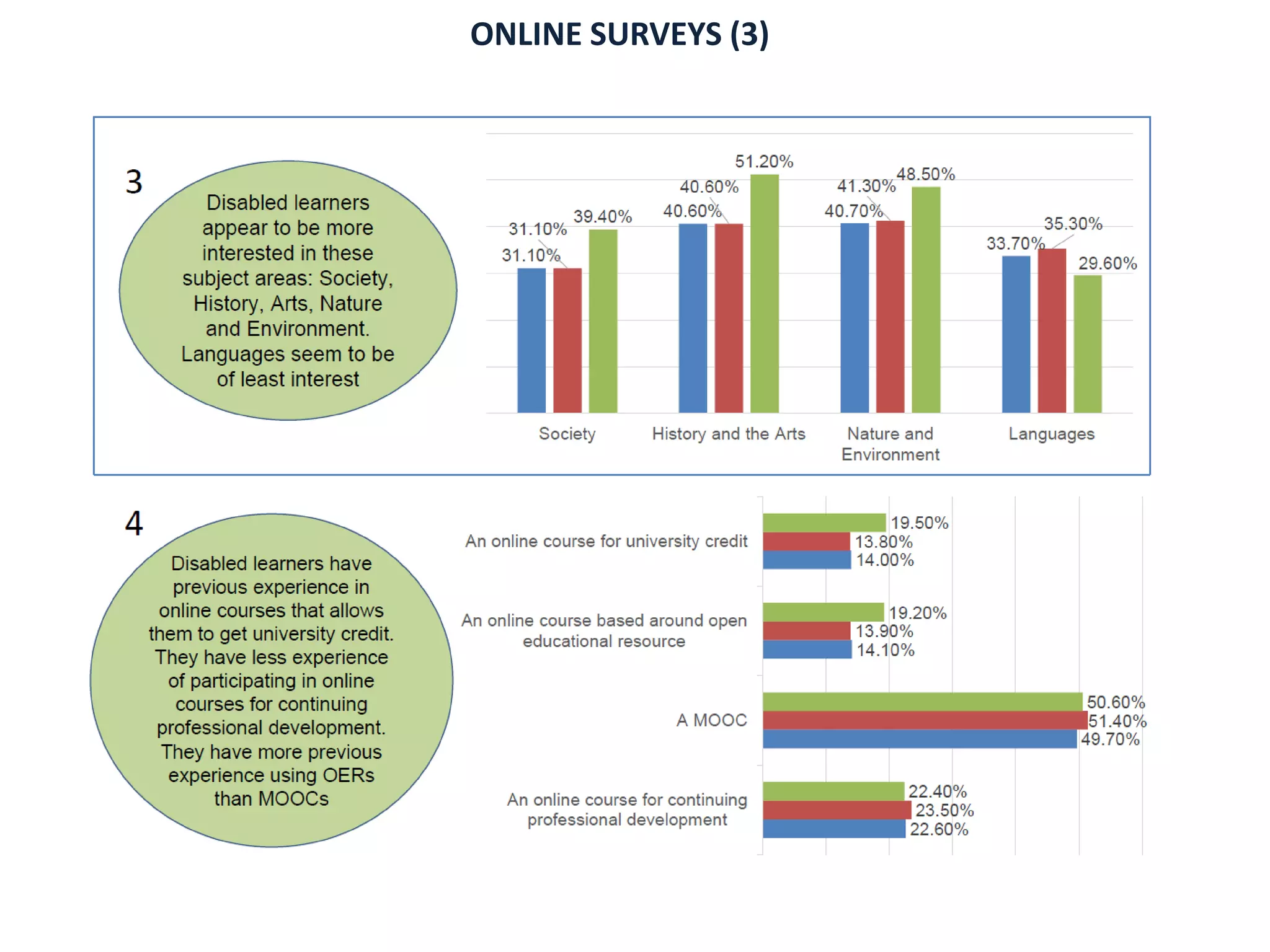
  • #9 Based on this initial analysis, disabled learners appear to be more interested in these subject areas: Society, History and Arts and Nature and Environment. Languages seem to be of least interest. Finally, disabled learners have previous experience in online courses that allows them to get university credit, which is related to their interest in studying at a higher educational level. They have less experience of participating in online courses for continuing professional development.
  • #10 Interviews, Pilot study: 8 MOOCs from 2015 Pre-course disabled responded favourably to being interviewed: 746 Post-course disabled responded favourably to being interviewed: 112 Pre and Post common learners: 56 Learners who do not declare disabilities 6 Interviews conducted at the moment 2 more are scheduled