


Understanding patterns in 
OER Impact: the role of 
mapping and curation 
Dr. Rob Farrow 
The Open University
Structure 
OER Research Hub 
Collaborative Research 
Evidence Model 
Mapping and Curation 
Preview of Project Results 
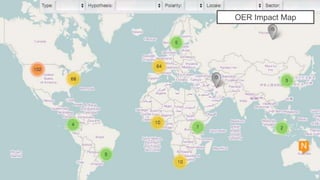
OER Impact Map
#oerrhub 
@philosopher1978
OER Research Hub 
• Research project at The Open University (UK) 
• Funded by William & Flora Hewlett Foundation for two years 
• Tasked with building the most comprehensive picture of OER impact 
• Organised by eleven research hypotheses 
• Collaboration model works across different educational sectors 
• Global reach but with a USA focus 
• Openness in practice: methods, data, dissemination 
oerresearchhub.org 
#oerrhub
Rationale 
• Consolidatory phase for OER movement after years of investment and piloting 
• The need for an evidence base: advocacy, strategy, policymaking 
• Lack of robust evidence for OER impact 
• The evidence ‘problem’ in OER impact research 
• Isolated ‘pockets of innovation’ 
• No agreement over best methods for impact comparison 
• Compare diverse experiences to assess the influence of ‘open’ 
• Mixed methods data from experimental + non-experimental research
Collaboration 
Developing an ecology of sharing
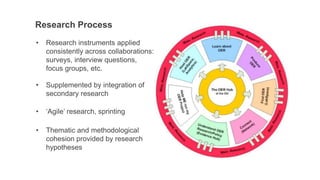
Research Process 
• Research instruments applied 
consistently across collaborations: 
surveys, interview questions, 
focus groups, etc. 
• Supplemented by integration of 
secondary research 
• ‘Agile’ research, sprinting 
• Thematic and methodological 
cohesion provided by research 
hypotheses
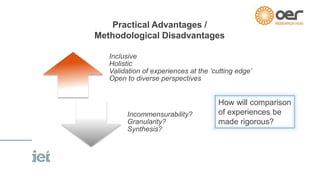
Practical Advantages / 
Methodological Disadvantages 
Inclusive 
Holistic 
Validation of experiences at the ‘cutting edge’ 
Open to diverse perspectives 
Incommensurability? 
Granularity? 
Synthesis? 
How will comparison 
of experiences be 
made rigorous?
Hypotheses 
Key claims about open education
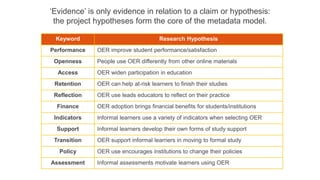
‘Evidence’ is only evidence in relation to a claim or hypothesis: 
the project hypotheses form the core of the metadata model. 
Keyword Research Hypothesis 
Performance OER improve student performance/satisfaction 
Openness People use OER differently from other online materials 
Access OER widen participation in education 
Retention OER can help at-risk learners to finish their studies 
Reflection OER use leads educators to reflect on their practice 
Finance OER adoption brings financial benefits for students/institutions 
Indicators Informal learners use a variety of indicators when selecting OER 
Support Informal learners develop their own forms of study support 
Transition OER support informal learners in moving to formal study 
Policy OER use encourages institutions to change their policies 
Assessment Informal assessments motivate learners using OER
Evidence Model 
Design for information architecture
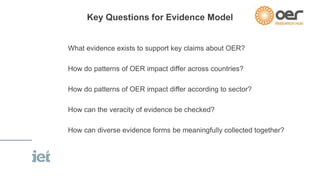
Key Questions for Evidence Model 
What evidence exists to support key claims about OER? 
How do patterns of OER impact differ across countries? 
How do patterns of OER impact differ according to sector? 
How can the veracity of evidence be checked? 
How can diverse evidence forms be meaningfully collected together?
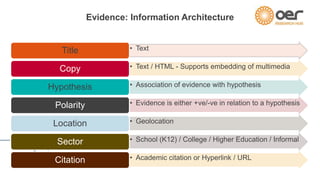
Evidence: Information Architecture 
Title • Text 
Copy • Text / HTML - Supports embedding of multimedia 
Hypothesis • Association of evidence with hypothesis 
Polarity • Evidence is either +ve/-ve in relation to a hypothesis 
Location • Geolocation 
Sector • School (K12) / College / Higher Education / Informal 
Citation • Academic citation or Hyperlink / URL
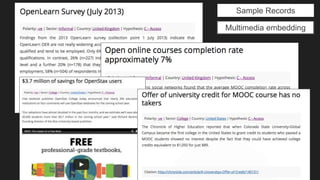
Sample Records 
Multimedia embedding
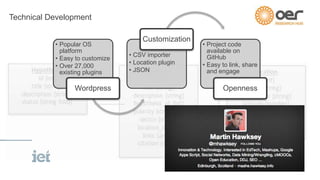
• Popular OS 
platform 
• Easy to customize 
• Over 27,000 
existing plugins 
Wordpress 
Customization 
• CSV importer 
• Location plugin 
• JSON 
• Project code 
available on 
GitHub 
• Easy to link, share 
and engage 
Openness 
Technical Development
Synthesis 
Mapping and curation
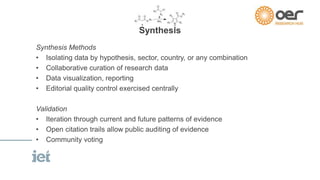
Synthesis 
Synthesis Methods 
• Isolating data by hypothesis, sector, country, or any combination 
• Collaborative curation of research data 
• Data visualization, reporting 
• Editorial quality control exercised centrally 
Validation 
• Iteration through current and future patterns of evidence 
• Open citation trails allow public auditing of evidence 
• Community voting
in service of The Open University
OER Impact Map 
oermap.org
OER Impact Map: Maps 
oermap.org 
• Country Summary Map - evidence nodes organized by country 
• OER Project Map - OER initiatives and projects around the world 
• OER Evidence Map - all impact evidence is categorized according to the OER 
Research Hub hypotheses 
• OER Policy Map is the single largest curated collection of OER policies 
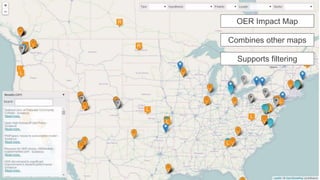
• OER Impact Map aggregates the other maps 
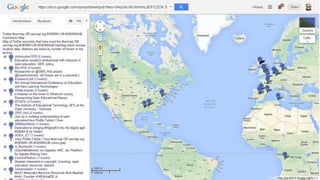
• Tweetmaps show a geographical summary of tweets for a particular Twitter 
hashtag. E.g. #oermap for outreach; #oerrhub for tracking project activity. 
• Collection of maps by others
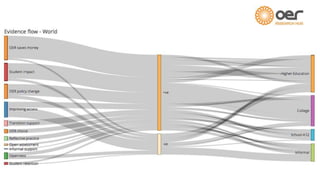
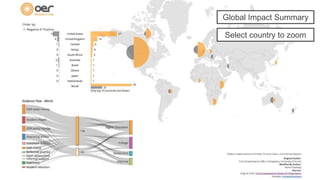
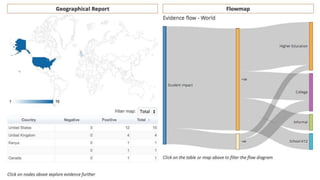
Global Impact Summary 
Select country to zoom
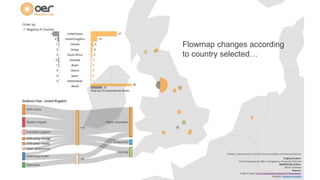
Flowmap changes according 
to country selected… 
in service of The Open University
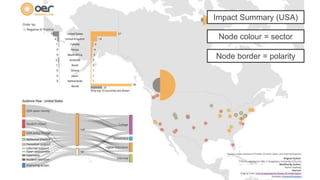
Impact Summary (USA) 
Node colour = sector 
Node border = polarity
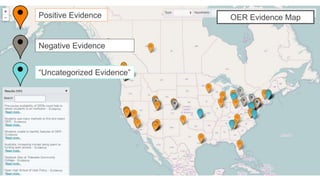
Positive Evidence 
Negative Evidence 
“Uncategorized Evidence” 
OER Evidence Map
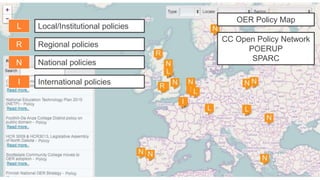
OER Policy Map 
L 
R 
N 
I 
Local/Institutional policies 
Regional policies 
National policies 
International policies 
CC Open Policy Network 
POERUP 
SPARC
in service of The Open University 
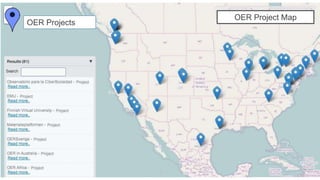
OER Projects 
OER Project Map
in service of The Open University 
OER Impact Map
in service of The Open University 
OER Impact Map 
Combines other maps 
Supports filtering
tweetmap 
tiny.cc/oermap 
#oermap
in service of The Open University
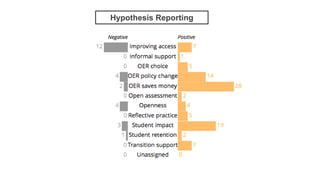
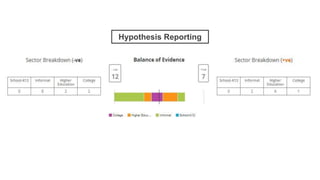
Hypothesis Reporting
in service of The Open University
Mapping & Curation: Summary 
• A collaborative approach to OER impact research is recommended 
• Mapping and curation are effective tools for building a collective understanding of 
a problem and building an evidence base 
• Open methods for researching openness: openly licensed instruments; remix 
and reuse data; working openly; sharing 
• Takeaway message: the whole is greater than the sum of the parts
OER Research Hub 
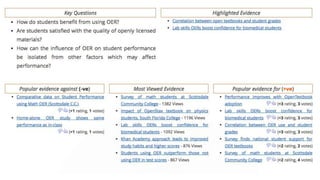
Preview of consolidated survey 
results
OER impact on Student Performance: 
• More than 1/3 of educators agree (or strongly agree) that OER increase 
student satisfaction with learning 
• a higher percentage of formal students (55.7%) agree (or strongly 
agree) 
• OER benefits for formal learners: increased interest in subjects taught 
(60.1%, n=398); increased experimentation with new ways of learning’ 
(49.4%, n=327); gaining confidence (48.6%, n=322).
The importance of open licensing: 
• Comparatively high level of adaptation amongst all types of users 
• Two thirds of educators (67.5%) consider open licensing important and 
are familiar with Creative Commons logo (55.7%) 
• But only 12.4% of educators create resources and publish them on a 
Creative Commons license 
• This is, however, consistent with the fact that only 26.8% (n=215) of 
educators are concerned with knowing whether they have permission to 
use or change a resource.
OER and access to education: 
• A majority of informal OER users already educated to degree 
level 
• However, some learners are using OER as a replacement 
for formal education to which they might not otherwise have 
access. 
• 88.4% of all learner respondents (n= 3761) indicated that the 
opportunity to study at no cost was significant, and many 
formal students use OER as replacement for higher education 
• Data from OpenLearn suggests that that OER increase 
access to education for informal learners with disabilities
OER impact on educators & reflective practice 
• Broader range of teaching practices 
• More reflection on method 
• More comparison with other teachers 
• More collaboration 
• Use OER for inspiration 
• Broadening coverage of curriculum 
• Bringing in multiple perspectives on topics
Financial savings: 
• Strong evidence that open textbooks save money 
• Almost 75% of educators believe that OER saves students money 
• Just under 80% of students believe they are saving money 
Indirect benefits for institutions: 
• Making college affordable encourages students to continue to study 
• Savings made through digitization and reuse
OER Impact Map: Next Steps 
• Adding qualitative data analysis to evidence base 
• Increasing the evidence base through desk research 
• Using the map as a storytelling tool 
• Refinement of user interface 
• A badging system to reward contributors and commenters 
• New hypotheses, new contributors, (hopefully) community uptake 
• School of Open course on open research; Open Data; CC-BY research tools 
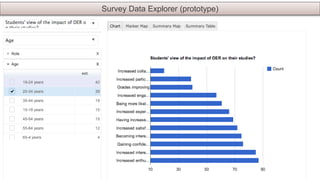
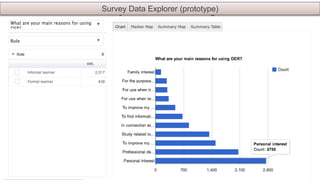
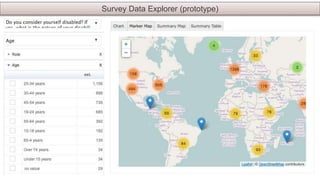
• Survey data ‘exploration tool’
Survey Data Explorer (prototype) 
in service of The Open University
Survey Data Explorer (prototype) 
in service of The Open University
Survey Data Explorer (prototype) 
in service of The Open University
Mapping & Curation: Reflection 
• Would mapping & curation be useful in your own practice? 
• What would you map & why? 
• How would you categorize your data to make it meaningful for others? 
• What would you omit from the map to make it more effective? 
• What would your map look like? Even a very basic attempt to produce a map 
can help identify the most relevant data 
• Dissemination: mapping also helps focus on visual communication and 
conveying message 
• Cartographic pedagogies: we use this for research, but it could also be used for 
teaching as an artifact shared between learners
Join us in building understanding 
of open education 
School of Open 
course on 
#openresearch 
(Sep 2014) 
Take our general 
OER impact survey 
Contribute to OER 
Impact Map
Thanks for listening! 
oerresearchhub.org 
oermap.org 
rob.farrow@open.ac.uk 
@philosopher1978

Mapping & Curation in OER Impact Research #altc

  • 1.
    Understanding patterns in OER Impact: the role of mapping and curation Dr. Rob Farrow The Open University
  • 2.
    Structure OER ResearchHub Collaborative Research Evidence Model Mapping and Curation Preview of Project Results OER Impact Map
  • 3.
  • 4.
    OER Research Hub • Research project at The Open University (UK) • Funded by William & Flora Hewlett Foundation for two years • Tasked with building the most comprehensive picture of OER impact • Organised by eleven research hypotheses • Collaboration model works across different educational sectors • Global reach but with a USA focus • Openness in practice: methods, data, dissemination oerresearchhub.org #oerrhub
  • 5.
    Rationale • Consolidatoryphase for OER movement after years of investment and piloting • The need for an evidence base: advocacy, strategy, policymaking • Lack of robust evidence for OER impact • The evidence ‘problem’ in OER impact research • Isolated ‘pockets of innovation’ • No agreement over best methods for impact comparison • Compare diverse experiences to assess the influence of ‘open’ • Mixed methods data from experimental + non-experimental research
  • 6.
    Collaboration Developing anecology of sharing
  • 8.
    Research Process •Research instruments applied consistently across collaborations: surveys, interview questions, focus groups, etc. • Supplemented by integration of secondary research • ‘Agile’ research, sprinting • Thematic and methodological cohesion provided by research hypotheses
  • 9.
    Practical Advantages / Methodological Disadvantages Inclusive Holistic Validation of experiences at the ‘cutting edge’ Open to diverse perspectives Incommensurability? Granularity? Synthesis? How will comparison of experiences be made rigorous?
  • 10.
    Hypotheses Key claimsabout open education
  • 11.
    ‘Evidence’ is onlyevidence in relation to a claim or hypothesis: the project hypotheses form the core of the metadata model. Keyword Research Hypothesis Performance OER improve student performance/satisfaction Openness People use OER differently from other online materials Access OER widen participation in education Retention OER can help at-risk learners to finish their studies Reflection OER use leads educators to reflect on their practice Finance OER adoption brings financial benefits for students/institutions Indicators Informal learners use a variety of indicators when selecting OER Support Informal learners develop their own forms of study support Transition OER support informal learners in moving to formal study Policy OER use encourages institutions to change their policies Assessment Informal assessments motivate learners using OER
  • 12.
    Evidence Model Designfor information architecture
  • 13.
    Key Questions forEvidence Model What evidence exists to support key claims about OER? How do patterns of OER impact differ across countries? How do patterns of OER impact differ according to sector? How can the veracity of evidence be checked? How can diverse evidence forms be meaningfully collected together?
  • 14.
    Evidence: Information Architecture Title • Text Copy • Text / HTML - Supports embedding of multimedia Hypothesis • Association of evidence with hypothesis Polarity • Evidence is either +ve/-ve in relation to a hypothesis Location • Geolocation Sector • School (K12) / College / Higher Education / Informal Citation • Academic citation or Hyperlink / URL
  • 15.
  • 16.
    • Popular OS platform • Easy to customize • Over 27,000 existing plugins Wordpress Customization • CSV importer • Location plugin • JSON • Project code available on GitHub • Easy to link, share and engage Openness Technical Development
  • 17.
  • 18.
    Synthesis Synthesis Methods • Isolating data by hypothesis, sector, country, or any combination • Collaborative curation of research data • Data visualization, reporting • Editorial quality control exercised centrally Validation • Iteration through current and future patterns of evidence • Open citation trails allow public auditing of evidence • Community voting
  • 19.
    in service ofThe Open University
  • 20.
    OER Impact Map oermap.org
  • 21.
    OER Impact Map:Maps oermap.org • Country Summary Map - evidence nodes organized by country • OER Project Map - OER initiatives and projects around the world • OER Evidence Map - all impact evidence is categorized according to the OER Research Hub hypotheses • OER Policy Map is the single largest curated collection of OER policies • OER Impact Map aggregates the other maps • Tweetmaps show a geographical summary of tweets for a particular Twitter hashtag. E.g. #oermap for outreach; #oerrhub for tracking project activity. • Collection of maps by others
  • 22.
    Global Impact Summary Select country to zoom
  • 23.
    Flowmap changes according to country selected… in service of The Open University
  • 24.
    Impact Summary (USA) Node colour = sector Node border = polarity
  • 25.
    Positive Evidence NegativeEvidence “Uncategorized Evidence” OER Evidence Map
  • 26.
    OER Policy Map L R N I Local/Institutional policies Regional policies National policies International policies CC Open Policy Network POERUP SPARC
  • 27.
    in service ofThe Open University OER Projects OER Project Map
  • 28.
    in service ofThe Open University OER Impact Map
  • 29.
    in service ofThe Open University OER Impact Map Combines other maps Supports filtering
  • 30.
  • 31.
    in service ofThe Open University
  • 32.
  • 33.
  • 34.
    in service ofThe Open University
  • 35.
    in service ofThe Open University
  • 36.
    Mapping & Curation:Summary • A collaborative approach to OER impact research is recommended • Mapping and curation are effective tools for building a collective understanding of a problem and building an evidence base • Open methods for researching openness: openly licensed instruments; remix and reuse data; working openly; sharing • Takeaway message: the whole is greater than the sum of the parts
  • 37.
    OER Research Hub Preview of consolidated survey results
  • 38.
    OER impact onStudent Performance: • More than 1/3 of educators agree (or strongly agree) that OER increase student satisfaction with learning • a higher percentage of formal students (55.7%) agree (or strongly agree) • OER benefits for formal learners: increased interest in subjects taught (60.1%, n=398); increased experimentation with new ways of learning’ (49.4%, n=327); gaining confidence (48.6%, n=322).
  • 39.
    The importance ofopen licensing: • Comparatively high level of adaptation amongst all types of users • Two thirds of educators (67.5%) consider open licensing important and are familiar with Creative Commons logo (55.7%) • But only 12.4% of educators create resources and publish them on a Creative Commons license • This is, however, consistent with the fact that only 26.8% (n=215) of educators are concerned with knowing whether they have permission to use or change a resource.
  • 40.
    OER and accessto education: • A majority of informal OER users already educated to degree level • However, some learners are using OER as a replacement for formal education to which they might not otherwise have access. • 88.4% of all learner respondents (n= 3761) indicated that the opportunity to study at no cost was significant, and many formal students use OER as replacement for higher education • Data from OpenLearn suggests that that OER increase access to education for informal learners with disabilities
  • 41.
    OER impact oneducators & reflective practice • Broader range of teaching practices • More reflection on method • More comparison with other teachers • More collaboration • Use OER for inspiration • Broadening coverage of curriculum • Bringing in multiple perspectives on topics
  • 42.
    Financial savings: •Strong evidence that open textbooks save money • Almost 75% of educators believe that OER saves students money • Just under 80% of students believe they are saving money Indirect benefits for institutions: • Making college affordable encourages students to continue to study • Savings made through digitization and reuse
  • 43.
    OER Impact Map:Next Steps • Adding qualitative data analysis to evidence base • Increasing the evidence base through desk research • Using the map as a storytelling tool • Refinement of user interface • A badging system to reward contributors and commenters • New hypotheses, new contributors, (hopefully) community uptake • School of Open course on open research; Open Data; CC-BY research tools • Survey data ‘exploration tool’
  • 44.
    Survey Data Explorer(prototype) in service of The Open University
  • 45.
    Survey Data Explorer(prototype) in service of The Open University
  • 46.
    Survey Data Explorer(prototype) in service of The Open University
  • 47.
    Mapping & Curation:Reflection • Would mapping & curation be useful in your own practice? • What would you map & why? • How would you categorize your data to make it meaningful for others? • What would you omit from the map to make it more effective? • What would your map look like? Even a very basic attempt to produce a map can help identify the most relevant data • Dissemination: mapping also helps focus on visual communication and conveying message • Cartographic pedagogies: we use this for research, but it could also be used for teaching as an artifact shared between learners
  • 48.
    Join us inbuilding understanding of open education School of Open course on #openresearch (Sep 2014) Take our general OER impact survey Contribute to OER Impact Map
  • 49.
    Thanks for listening! oerresearchhub.org oermap.org rob.farrow@open.ac.uk @philosopher1978