
The Impact of Open
Textbooks in the USA &
South Africa: When? Why?
How? (Webinar: 05/28/14)
Dr. Beck Pitt
The Open University
Megan Beckett
Siyavula
Daniel Williamson
OpenStax College
• OER Research Hub project and Impact Map
• Siyavula and OpenStax College Open Textbooks
• Methodology: Educator Sample Groups
• OER Behaviours
• OpenStax College: Impact
• Siyavula: Impact
• Educator Perspectives
• Summary/Next Steps
Overview
http://oerresearchhub.org
#oerrhub @OER_Hub
Background
• 2-year research project based at The Open University (UK)
• Funded by William & Flora Hewlett Foundation
• Aiming to build the most comprehensive picture of OER impact
• Eleven research hypotheses
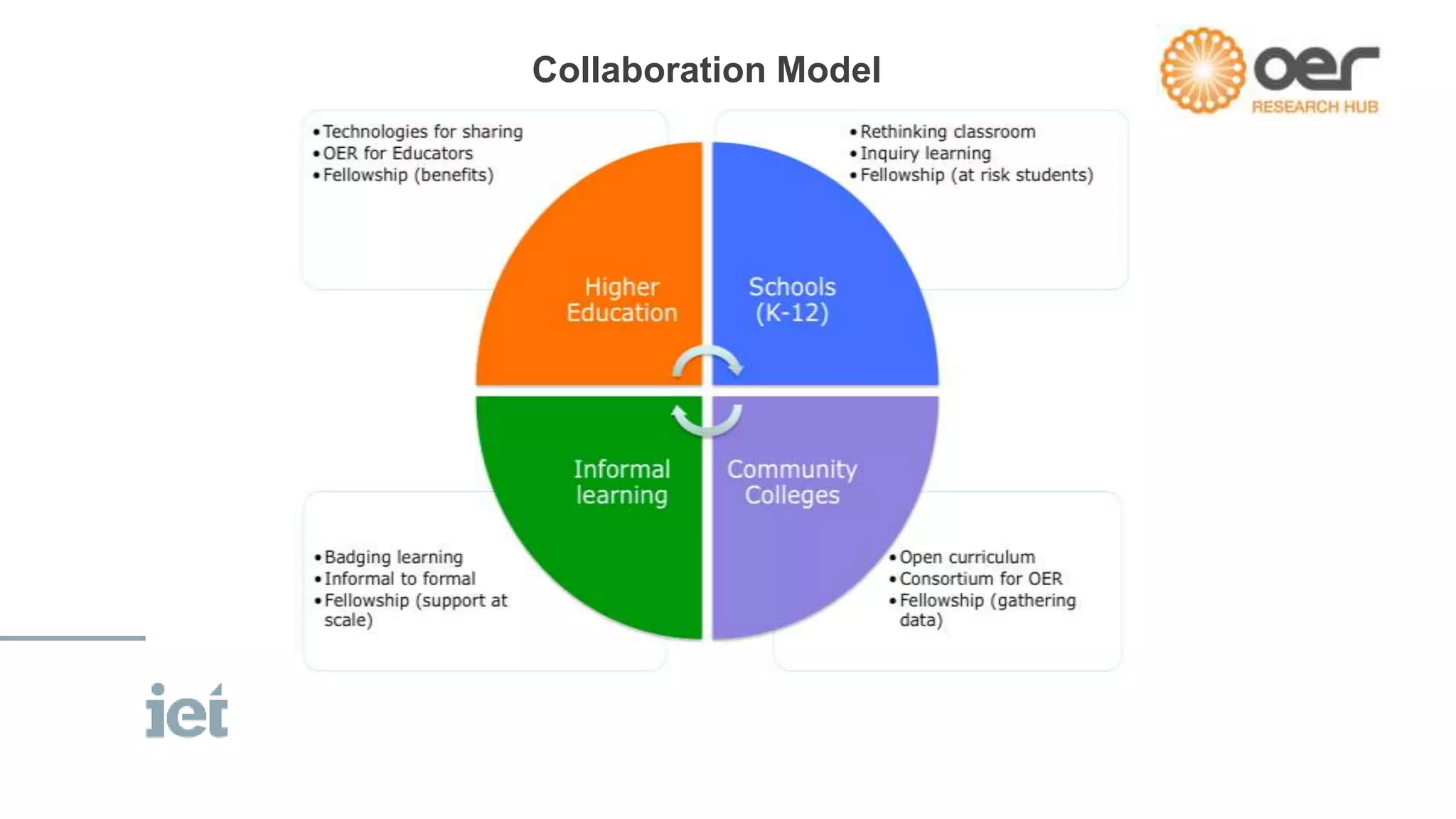
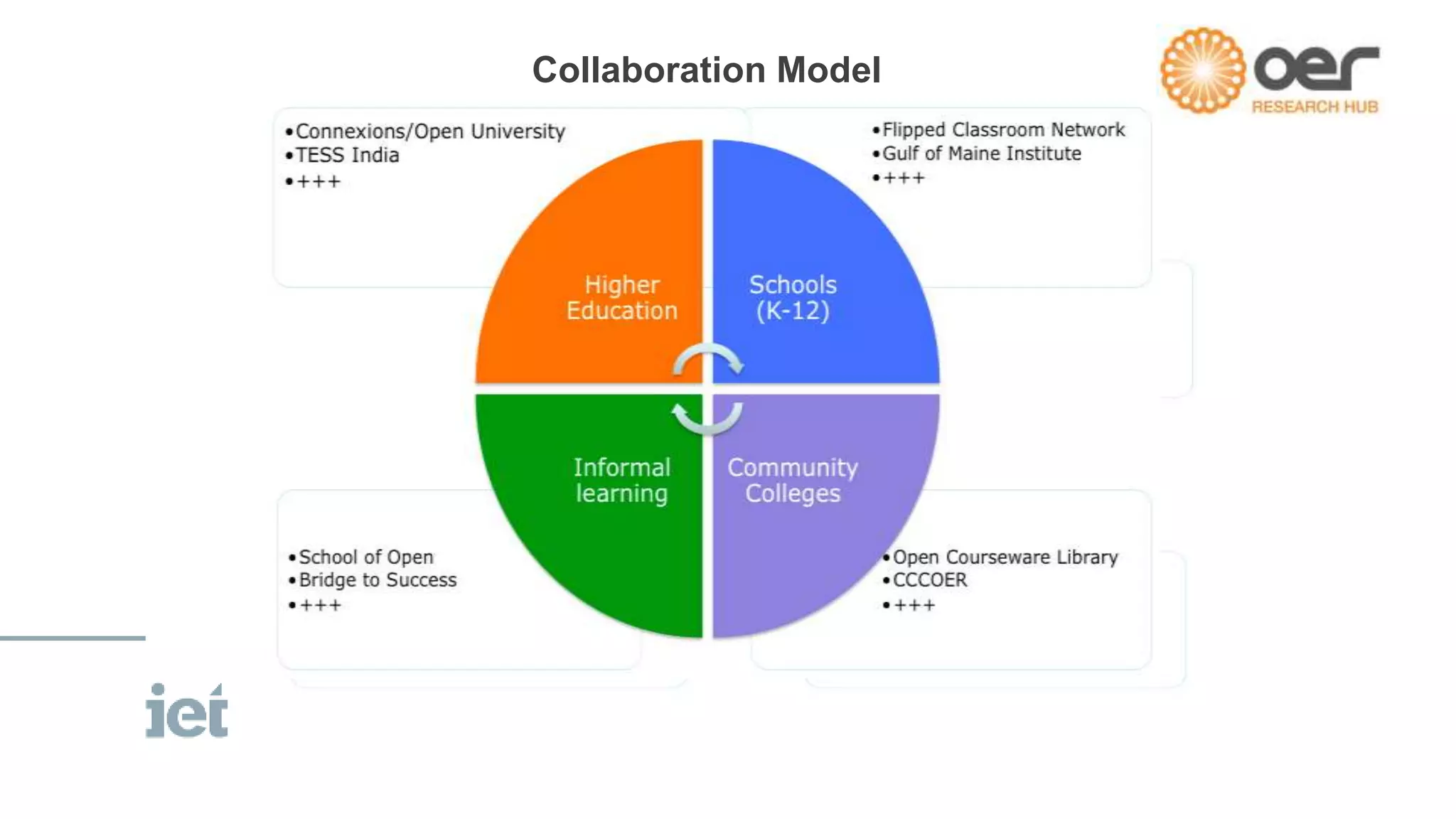
• Collaboration model across different educational sectors
• Global reach but with a USA focus
• Fellowship Scheme
• Practicing openness: CC-BY licensed research instruments / SOO Course /
Impact Map
OER Research Hub
oerresearchhub.org
#oerrhub @OER_Hub
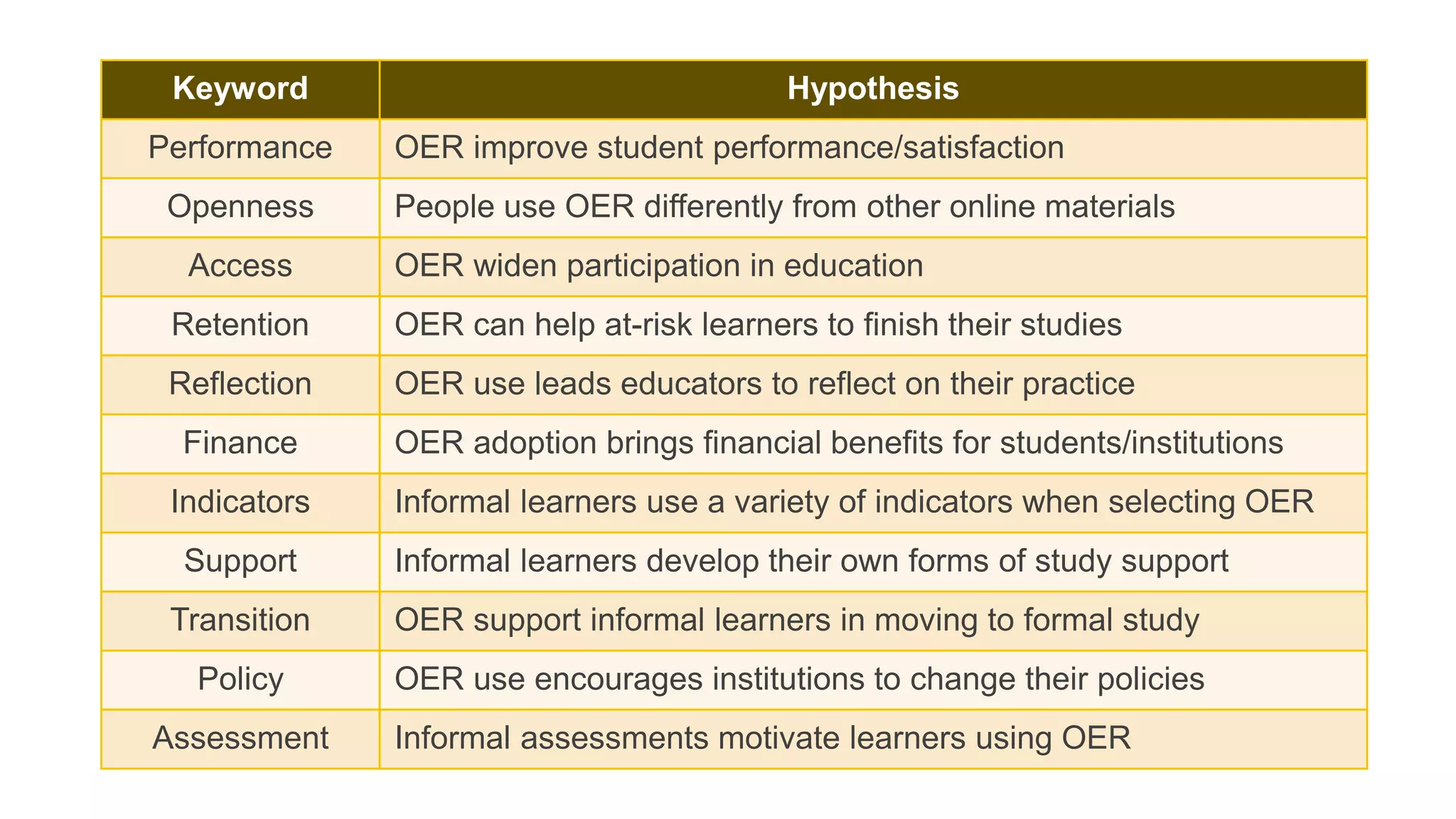
Keyword Hypothesis
Performance OER improve student performance/satisfaction
Openness People use OER differently from other online materials
Access OER widen participation in education
Retention OER can help at-risk learners to finish their studies
Reflection OER use leads educators to reflect on their practice
Finance OER adoption brings financial benefits for students/institutions
Indicators Informal learners use a variety of indicators when selecting OER
Support Informal learners develop their own forms of study support
Transition OER support informal learners in moving to formal study
Policy OER use encourages institutions to change their policies
Assessment Informal assessments motivate learners using OER
Collaboration Model
Collaboration Model
Collaboration Model
Collaboration Model
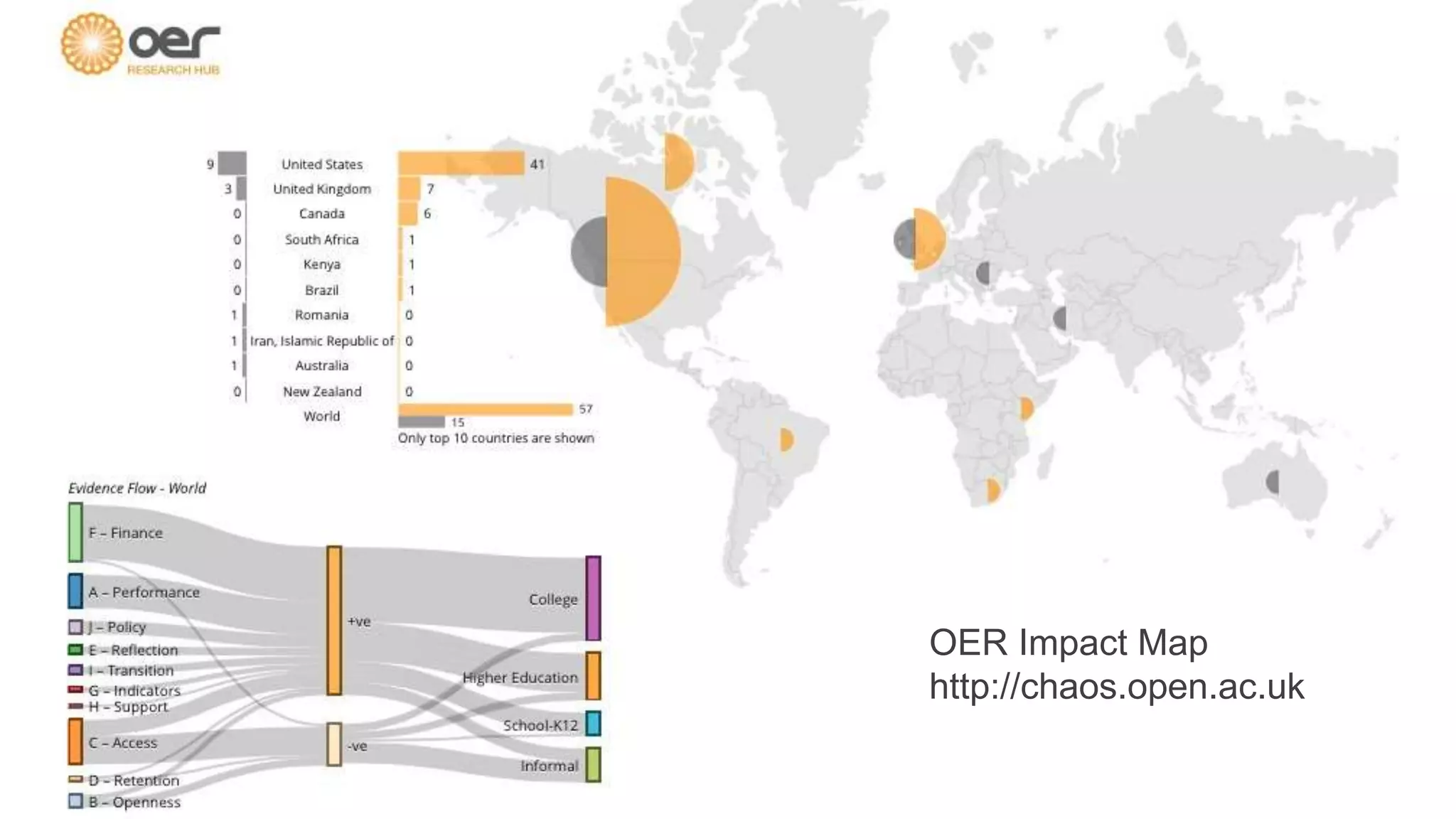
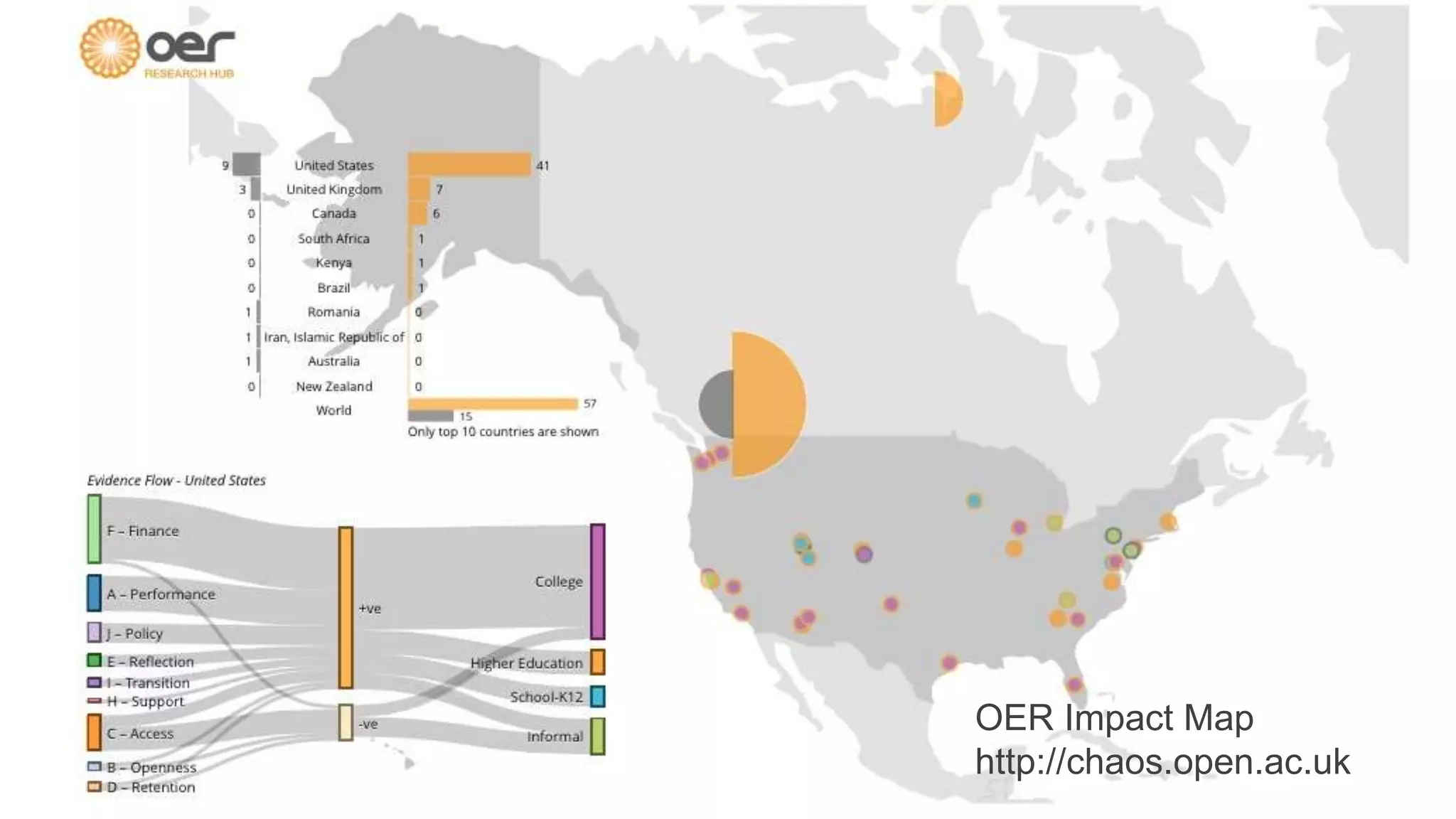
OER Impact Map
OER Impact Map
http://chaos.open.ac.uk
OER Impact Map
http://chaos.open.ac.uk
Open Textbook Overview
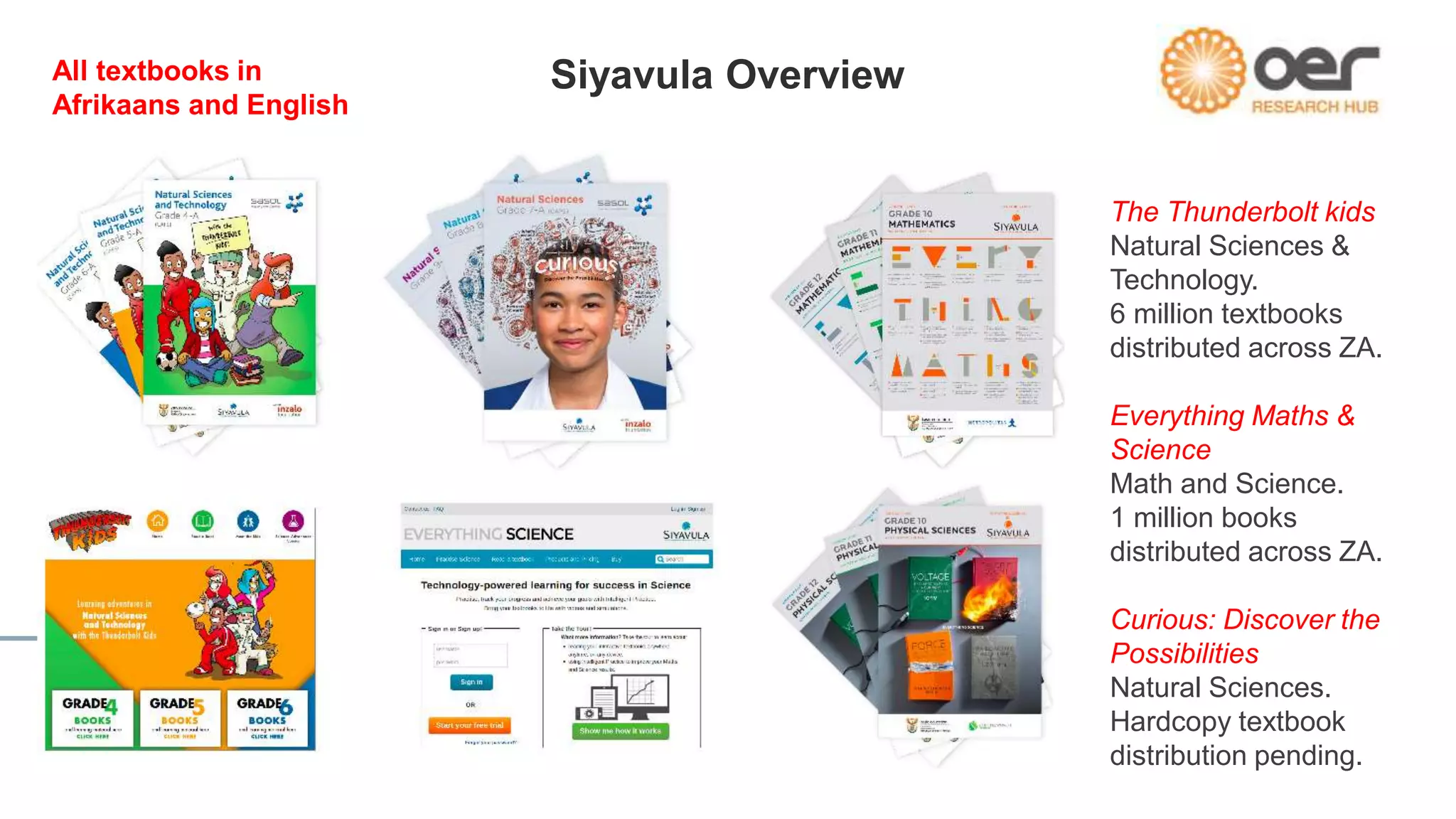
Siyavula OverviewAll textbooks in
Afrikaans and English
The Thunderbolt kids
Natural Sciences &
Technology.
6 million textbooks
distributed across ZA.
Everything Maths &
Science
Math and Science.
1 million books
distributed across ZA.
Curious: Discover the
Possibilities
Natural Sciences.
Hardcopy textbook
distribution pending.
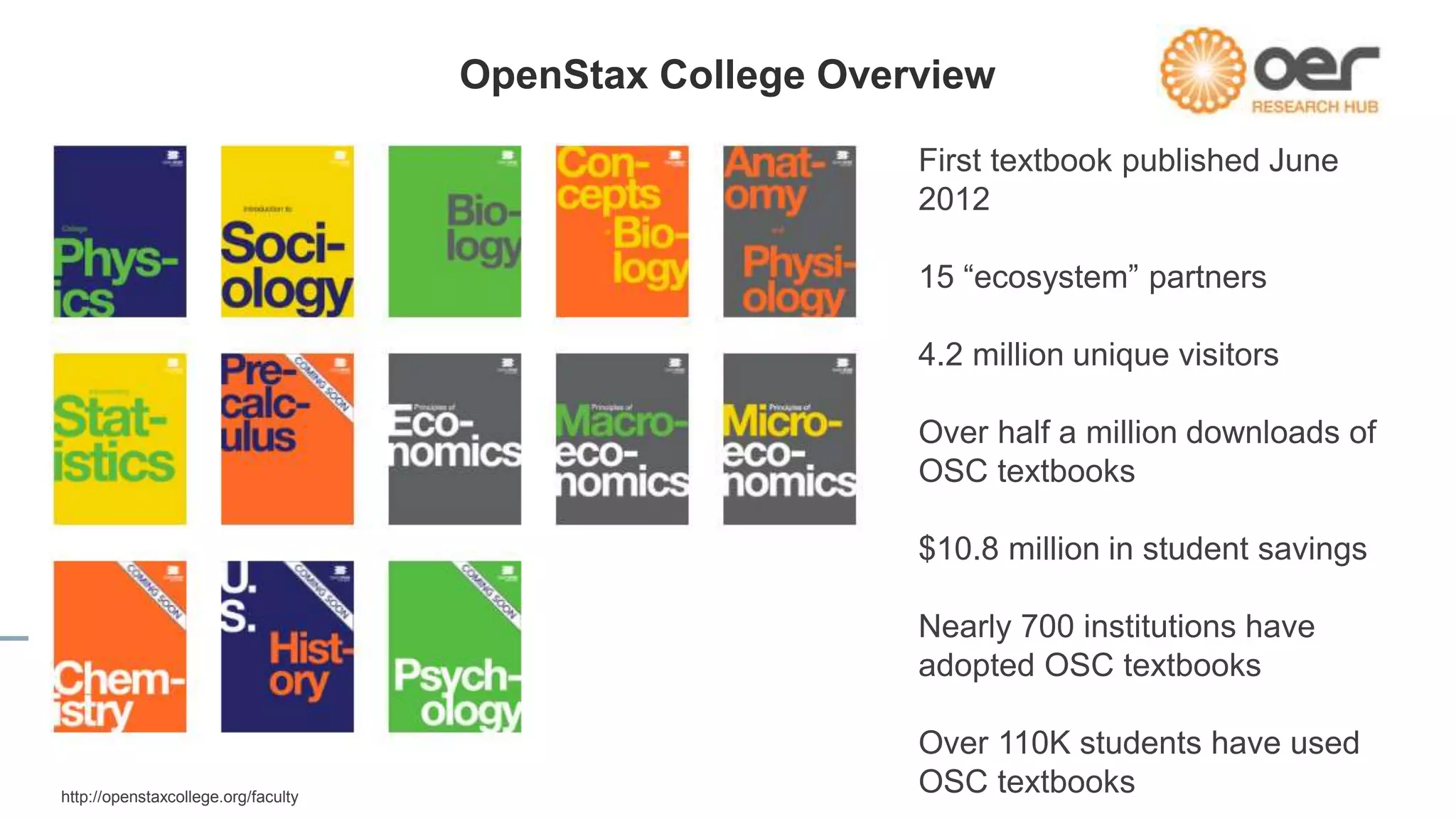
OpenStax College Overview
http://openstaxcollege.org/faculty
First textbook published June
2012
15 “ecosystem” partners
4.2 million unique visitors
Over half a million downloads of
OSC textbooks
$10.8 million in student savings
Nearly 700 institutions have
adopted OSC textbooks
Over 110K students have used
OSC textbooks
Methodology
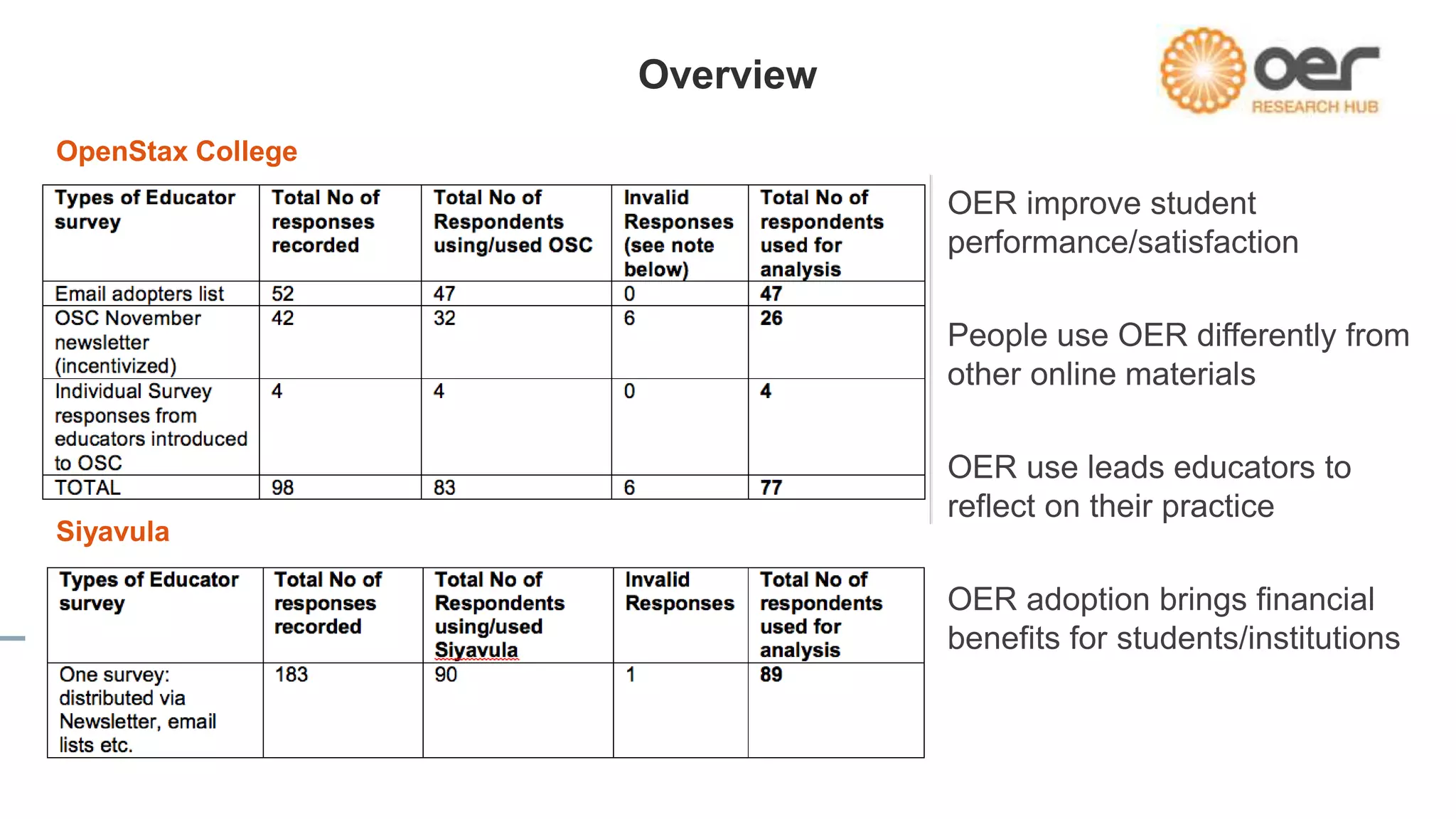
Overview
OpenStax College
Siyavula
OER improve student
performance/satisfaction
People use OER differently from
other online materials
OER use leads educators to
reflect on their practice
OER adoption brings financial
benefits for students/institutions
Educator Surveys: Sample
Educator Sample: OpenStax College
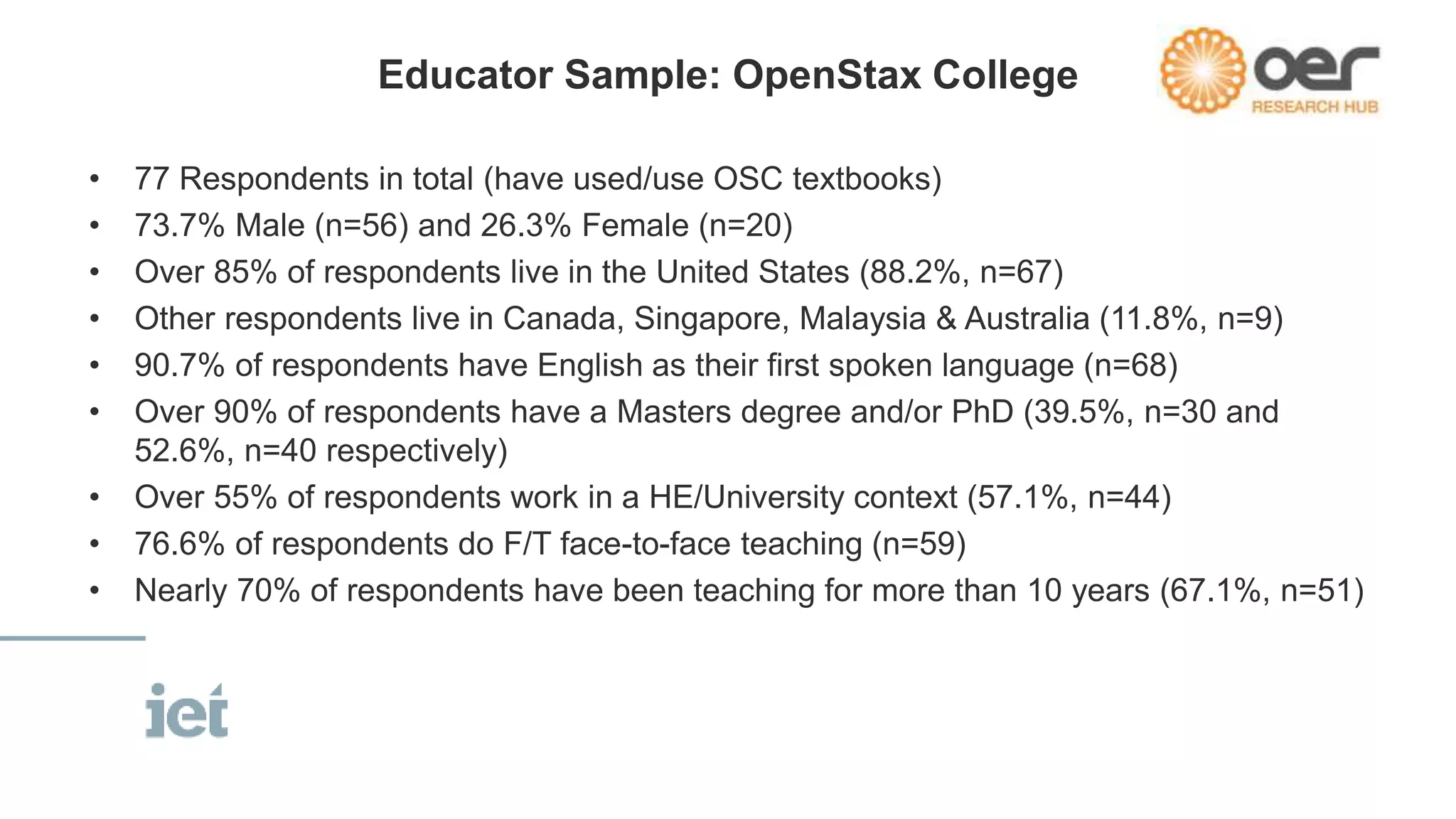
• 77 Respondents in total (have used/use OSC textbooks)
• 73.7% Male (n=56) and 26.3% Female (n=20)
• Over 85% of respondents live in the United States (88.2%, n=67)
• Other respondents live in Canada, Singapore, Malaysia & Australia (11.8%, n=9)
• 90.7% of respondents have English as their first spoken language (n=68)
• Over 90% of respondents have a Masters degree and/or PhD (39.5%, n=30 and
52.6%, n=40 respectively)
• Over 55% of respondents work in a HE/University context (57.1%, n=44)
• 76.6% of respondents do F/T face-to-face teaching (n=59)
• Nearly 70% of respondents have been teaching for more than 10 years (67.1%, n=51)
Educator Sample: Siyavula
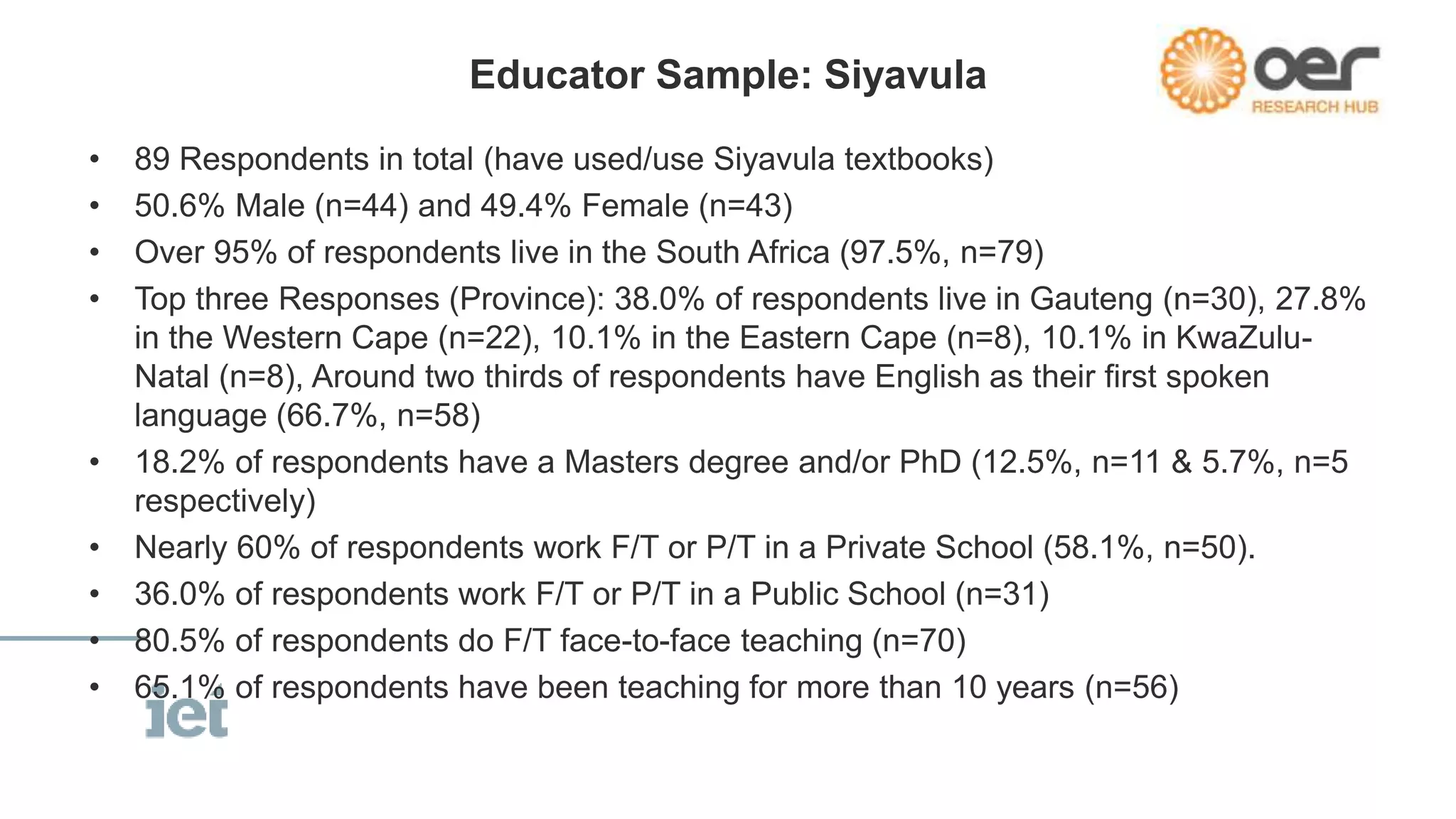
• 89 Respondents in total (have used/use Siyavula textbooks)
• 50.6% Male (n=44) and 49.4% Female (n=43)
• Over 95% of respondents live in the South Africa (97.5%, n=79)
• Top three Responses (Province): 38.0% of respondents live in Gauteng (n=30), 27.8%
in the Western Cape (n=22), 10.1% in the Eastern Cape (n=8), 10.1% in KwaZulu-
Natal (n=8), Around two thirds of respondents have English as their first spoken
language (66.7%, n=58)
• 18.2% of respondents have a Masters degree and/or PhD (12.5%, n=11 & 5.7%, n=5
respectively)
• Nearly 60% of respondents work F/T or P/T in a Private School (58.1%, n=50).
• 36.0% of respondents work F/T or P/T in a Public School (n=31)
• 80.5% of respondents do F/T face-to-face teaching (n=70)
• 65.1% of respondents have been teaching for more than 10 years (n=56)
OER Behaviours
The use and creation of Open Educational
Resources: Siyavula & OpenStax College
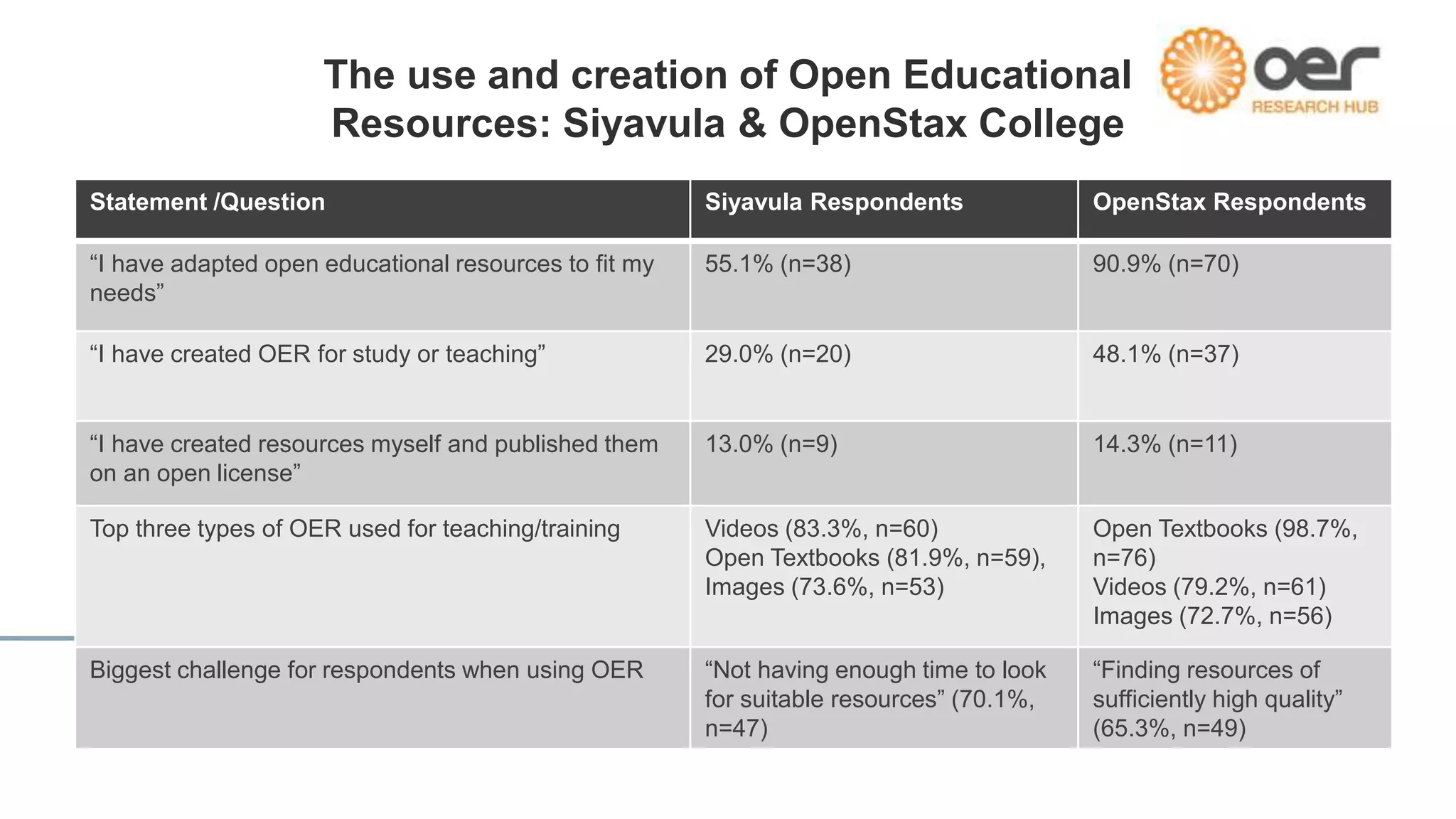
Statement /Question Siyavula Respondents OpenStax Respondents
“I have adapted open educational resources to fit my
needs”
55.1% (n=38) 90.9% (n=70)
“I have created OER for study or teaching” 29.0% (n=20) 48.1% (n=37)
“I have created resources myself and published them
on an open license”
13.0% (n=9) 14.3% (n=11)
Top three types of OER used for teaching/training Videos (83.3%, n=60)
Open Textbooks (81.9%, n=59),
Images (73.6%, n=53)
Open Textbooks (98.7%,
n=76)
Videos (79.2%, n=61)
Images (72.7%, n=56)
Biggest challenge for respondents when using OER “Not having enough time to look
for suitable resources” (70.1%,
n=47)
“Finding resources of
sufficiently high quality”
(65.3%, n=49)
OpenStax College Textbooks: Impact
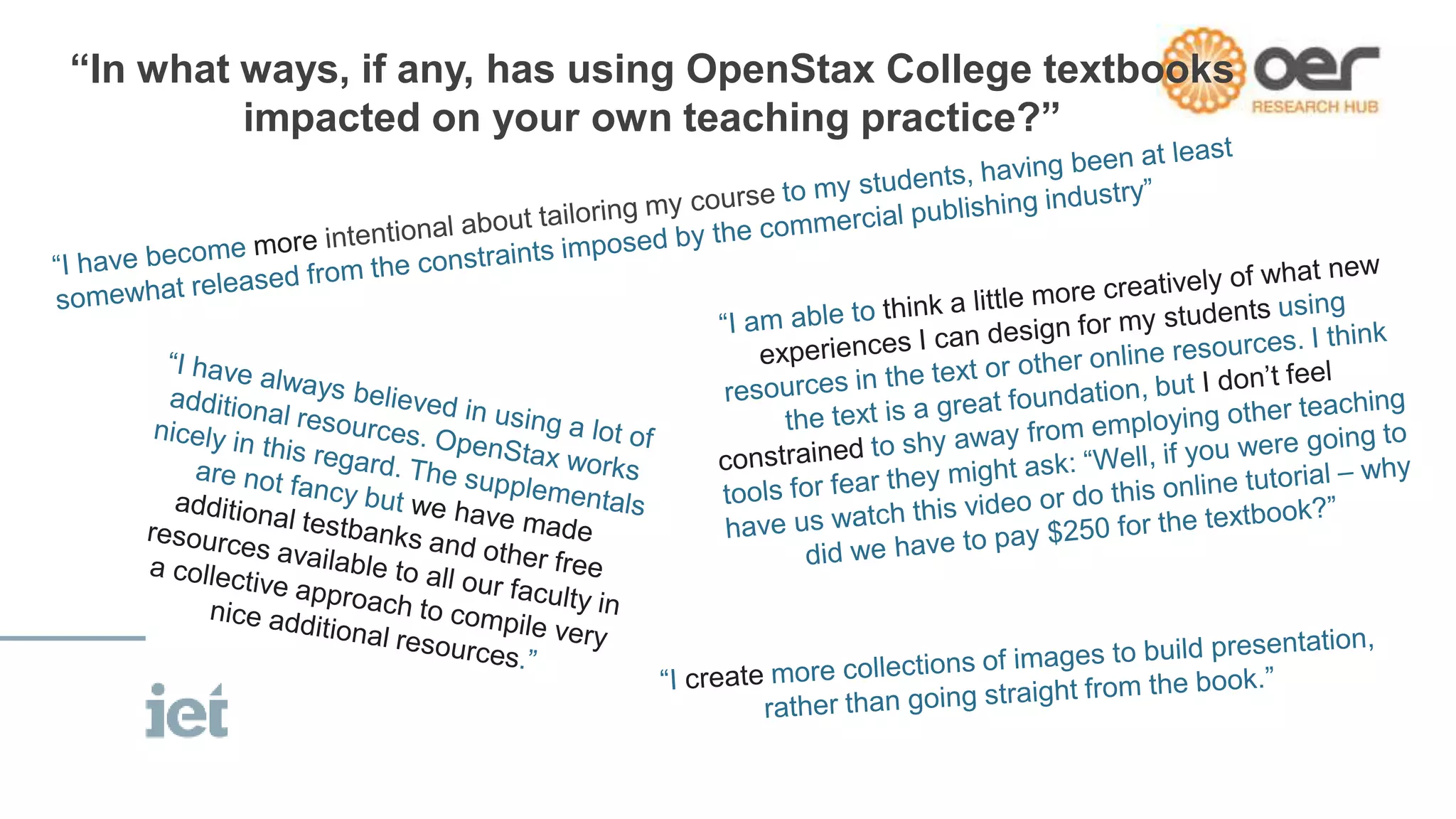
“In what ways, if any, has using OpenStax College textbooks
impacted on your own teaching practice?”
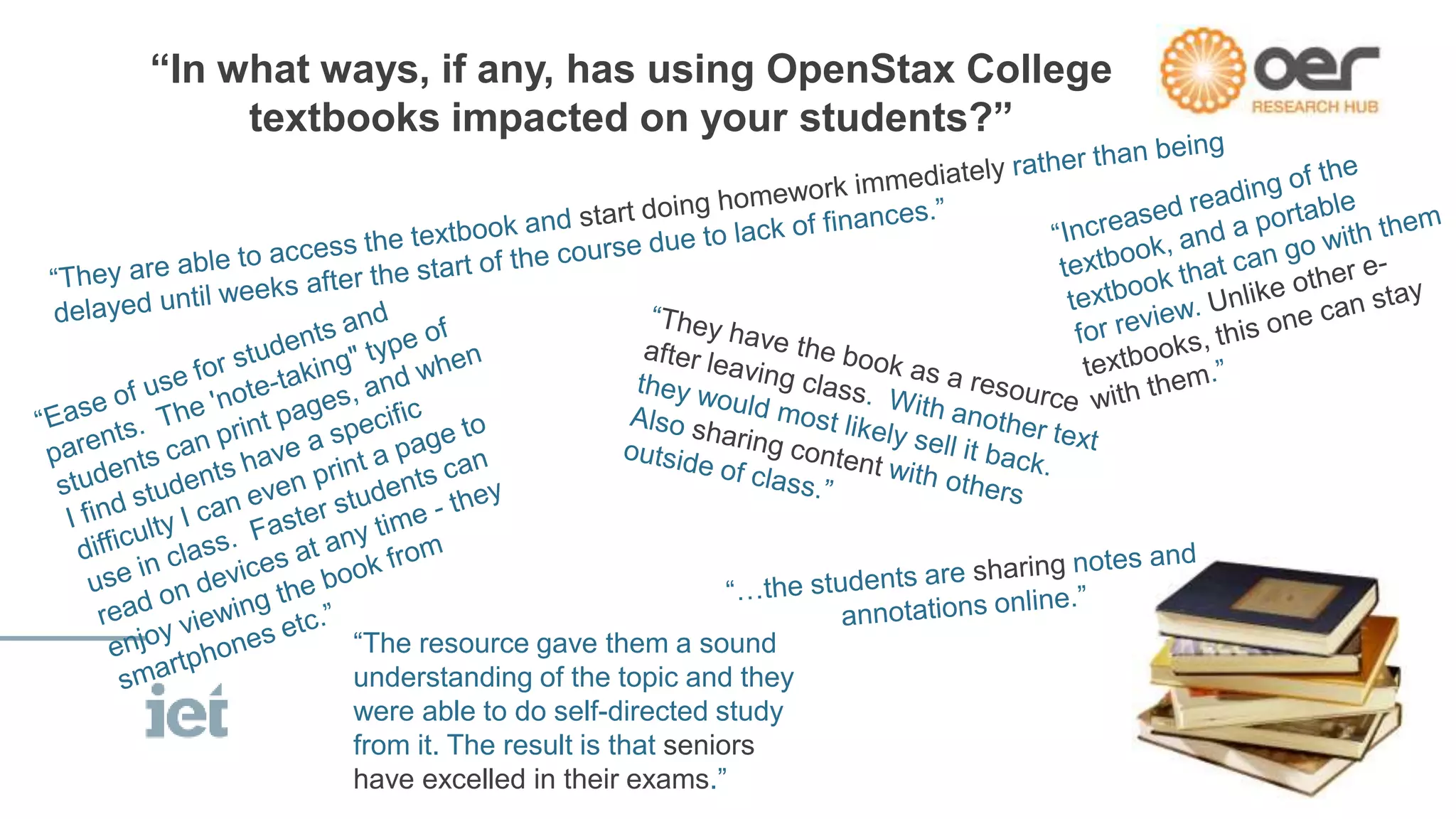
“In what ways, if any, has using OpenStax College
textbooks impacted on your students?”
“The resource gave them a sound
understanding of the topic and they
were able to do self-directed study
from it. The result is that seniors
have excelled in their exams.”
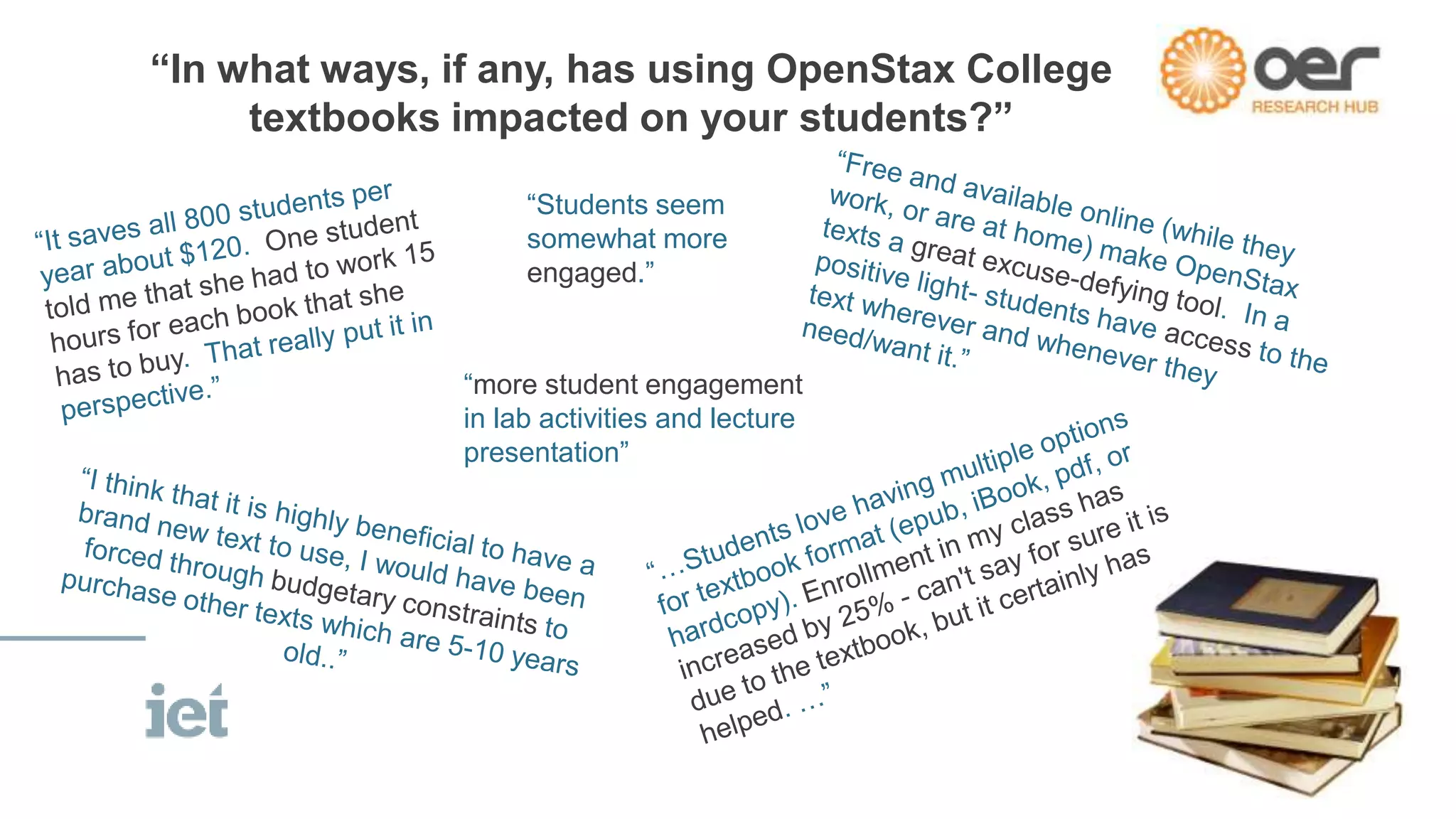
“In what ways, if any, has using OpenStax College
textbooks impacted on your students?”
“more student engagement
in lab activities and lecture
presentation”
“Students seem
somewhat more
engaged.”
Siyavula Textbooks: Impact
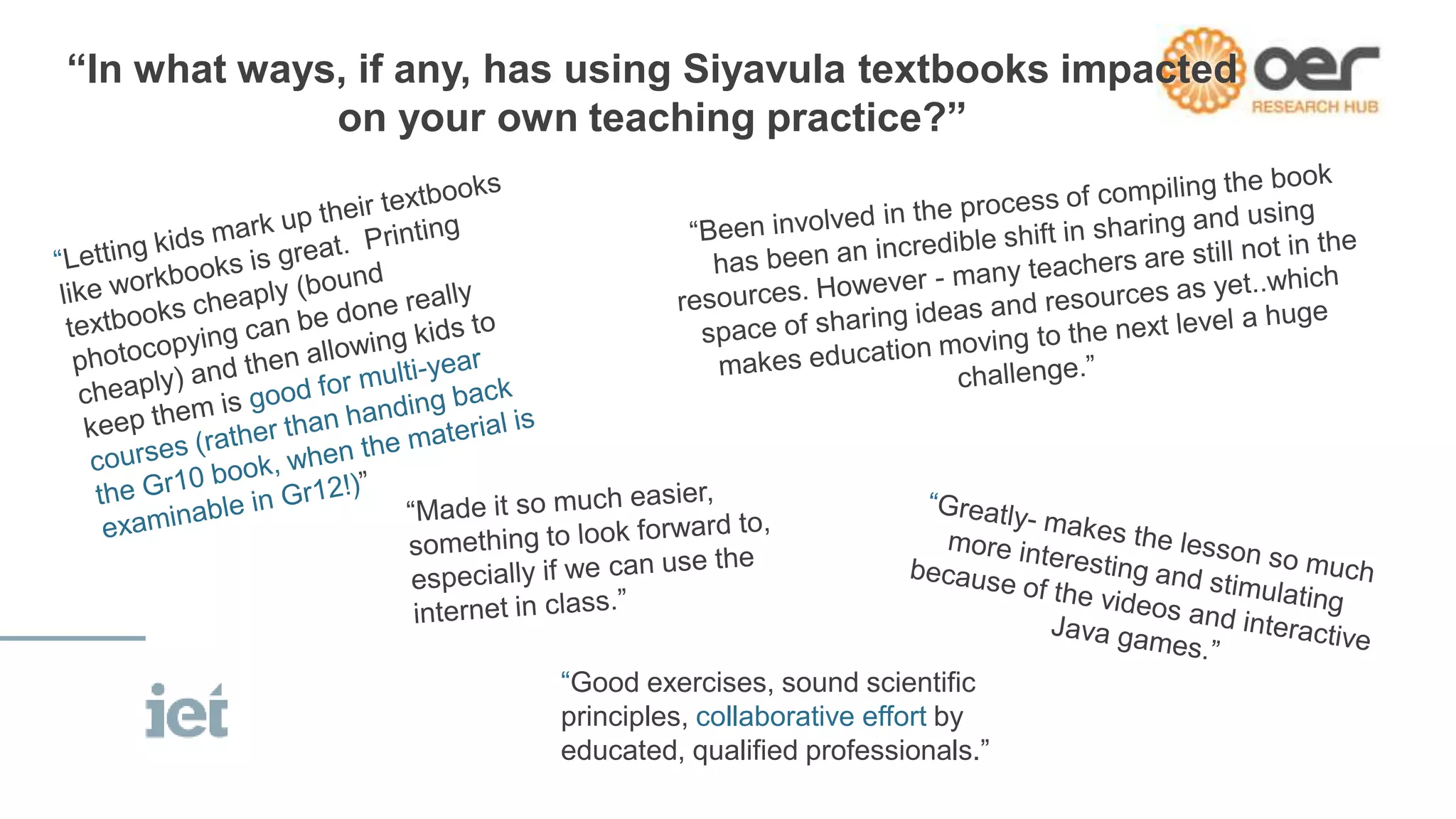
“In what ways, if any, has using Siyavula textbooks impacted
on your own teaching practice?”
“Good exercises, sound scientific
principles, collaborative effort by
educated, qualified professionals.”
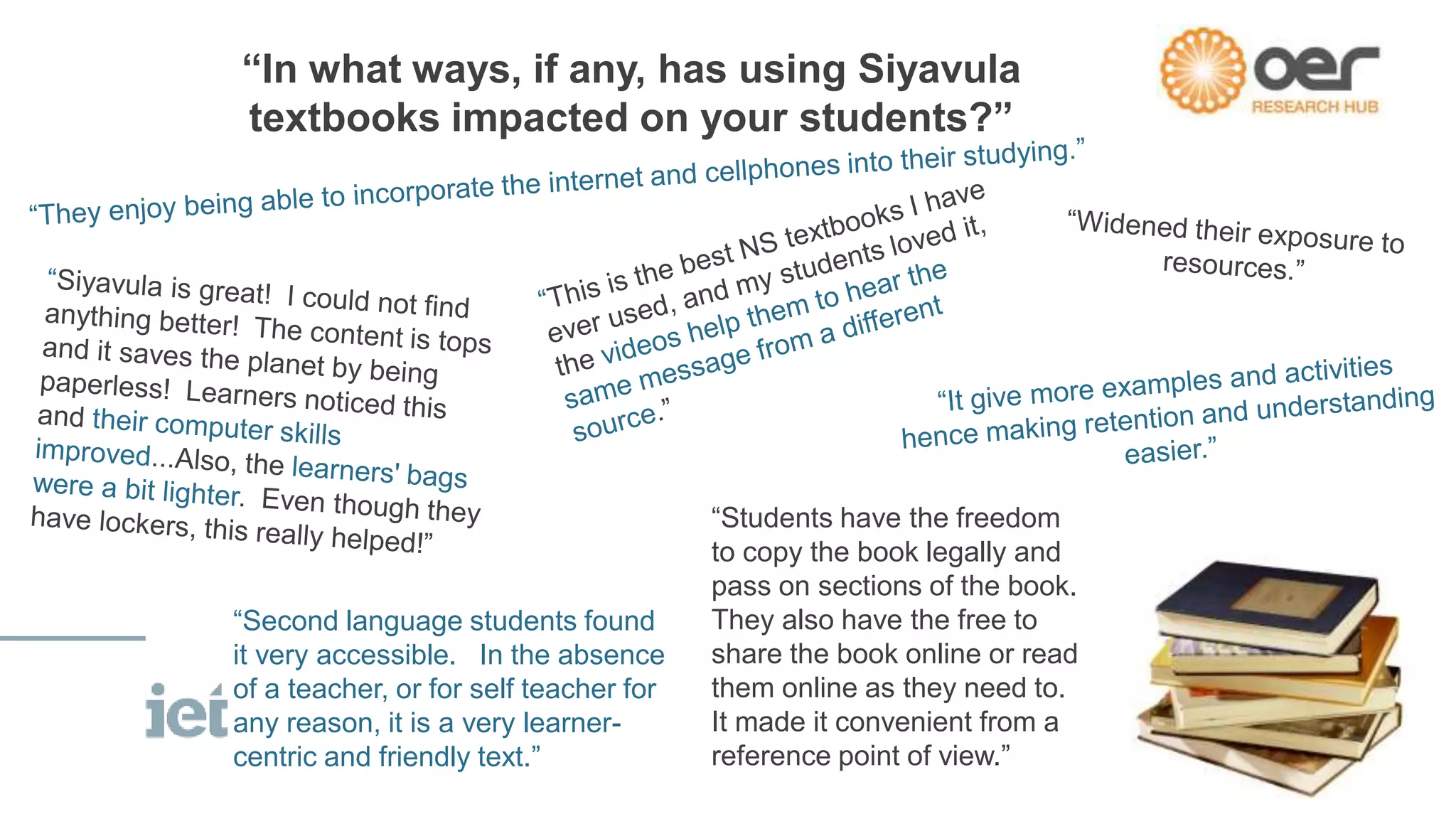
“In what ways, if any, has using Siyavula
textbooks impacted on your students?”
“Second language students found
it very accessible. In the absence
of a teacher, or for self teacher for
any reason, it is a very learner-
centric and friendly text.”
“Students have the freedom
to copy the book legally and
pass on sections of the book.
They also have the free to
share the book online or read
them online as they need to.
It made it convenient from a
reference point of view.”
Educator Perspectives: Siyavula &
OpenStax College
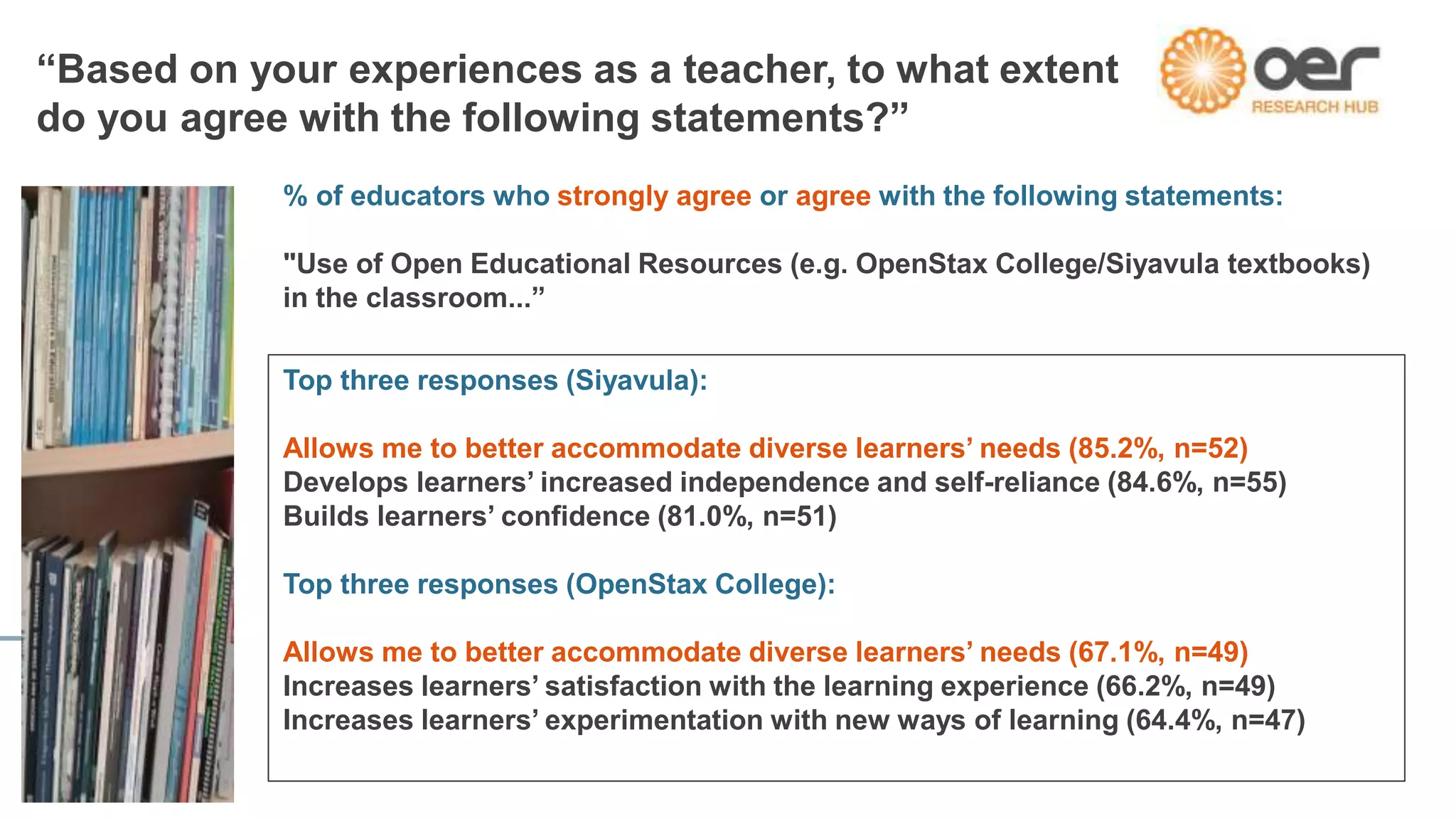
“Based on your experiences as a teacher, to what extent
do you agree with the following statements?”
% of educators who strongly agree or agree with the following statements:
"Use of Open Educational Resources (e.g. OpenStax College/Siyavula textbooks)
in the classroom...”
Top three responses (Siyavula):
Allows me to better accommodate diverse learners’ needs (85.2%, n=52)
Develops learners’ increased independence and self-reliance (84.6%, n=55)
Builds learners’ confidence (81.0%, n=51)
Top three responses (OpenStax College):
Allows me to better accommodate diverse learners’ needs (67.1%, n=49)
Increases learners’ satisfaction with the learning experience (66.2%, n=49)
Increases learners’ experimentation with new ways of learning (64.4%, n=47)
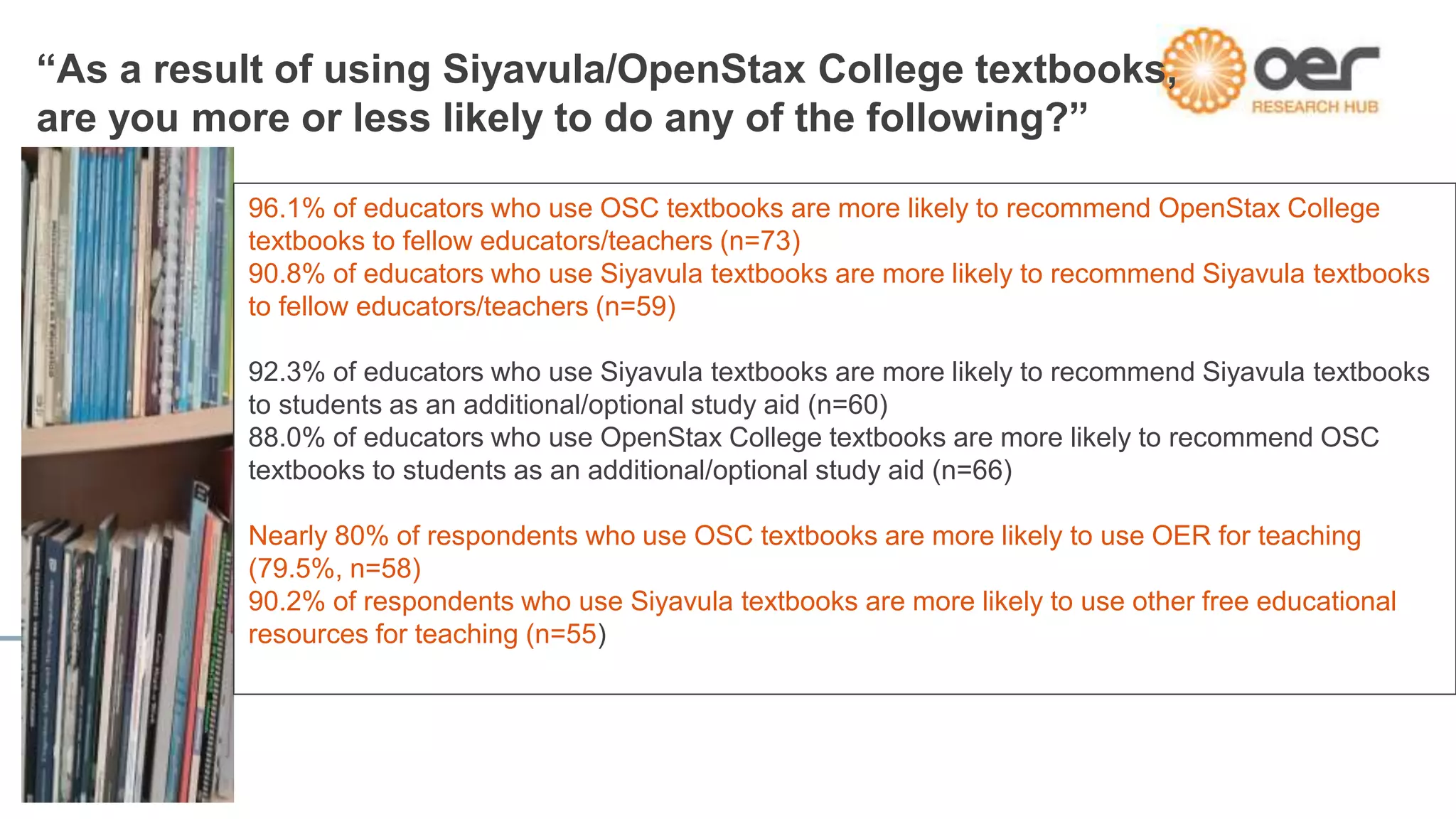
“As a result of using Siyavula/OpenStax College textbooks,
are you more or less likely to do any of the following?”
96.1% of educators who use OSC textbooks are more likely to recommend OpenStax College
textbooks to fellow educators/teachers (n=73)
90.8% of educators who use Siyavula textbooks are more likely to recommend Siyavula textbooks
to fellow educators/teachers (n=59)
92.3% of educators who use Siyavula textbooks are more likely to recommend Siyavula textbooks
to students as an additional/optional study aid (n=60)
88.0% of educators who use OpenStax College textbooks are more likely to recommend OSC
textbooks to students as an additional/optional study aid (n=66)
Nearly 80% of respondents who use OSC textbooks are more likely to use OER for teaching
(79.5%, n=58)
90.2% of respondents who use Siyavula textbooks are more likely to use other free educational
resources for teaching (n=55)
Summary and Next Steps
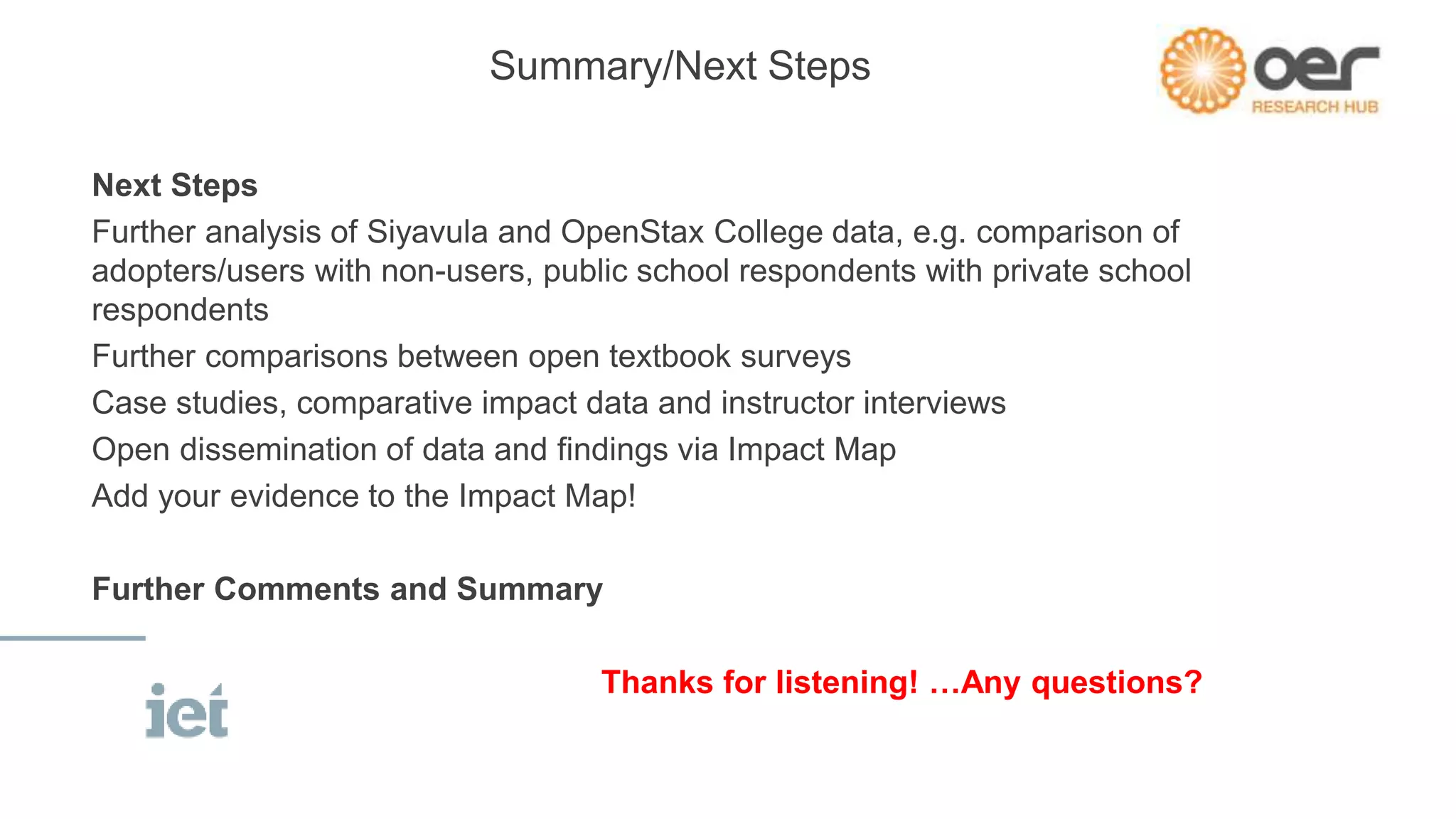
Summary/Next Steps
Next Steps
Further analysis of Siyavula and OpenStax College data, e.g. comparison of
adopters/users with non-users, public school respondents with private school
respondents
Further comparisons between open textbook surveys
Case studies, comparative impact data and instructor interviews
Open dissemination of data and findings via Impact Map
Add your evidence to the Impact Map!
Further Comments and Summary
Thanks for listening! …Any questions?
Thanks for listening!
http://oerresearchhub.org
http://oermap.org
http://openstaxcollege.org
http://www.siyavula.com
Twitter: @BeckPitt, @new_edu,
@MeganBeckett2
in service of The Open University

The Impact of Open Textbooks in the USA and South Africa: When? Why? How?

  • 1.
    The Impact ofOpen Textbooks in the USA & South Africa: When? Why? How? (Webinar: 05/28/14) Dr. Beck Pitt The Open University Megan Beckett Siyavula Daniel Williamson OpenStax College
  • 2.
    • OER ResearchHub project and Impact Map • Siyavula and OpenStax College Open Textbooks • Methodology: Educator Sample Groups • OER Behaviours • OpenStax College: Impact • Siyavula: Impact • Educator Perspectives • Summary/Next Steps Overview http://oerresearchhub.org #oerrhub @OER_Hub
  • 3.
  • 4.
    • 2-year researchproject based at The Open University (UK) • Funded by William & Flora Hewlett Foundation • Aiming to build the most comprehensive picture of OER impact • Eleven research hypotheses • Collaboration model across different educational sectors • Global reach but with a USA focus • Fellowship Scheme • Practicing openness: CC-BY licensed research instruments / SOO Course / Impact Map OER Research Hub oerresearchhub.org #oerrhub @OER_Hub
  • 5.
    Keyword Hypothesis Performance OERimprove student performance/satisfaction Openness People use OER differently from other online materials Access OER widen participation in education Retention OER can help at-risk learners to finish their studies Reflection OER use leads educators to reflect on their practice Finance OER adoption brings financial benefits for students/institutions Indicators Informal learners use a variety of indicators when selecting OER Support Informal learners develop their own forms of study support Transition OER support informal learners in moving to formal study Policy OER use encourages institutions to change their policies Assessment Informal assessments motivate learners using OER
  • 6.
  • 7.
  • 9.
  • 10.
  • 11.
  • 12.
  • 13.
    Siyavula OverviewAll textbooksin Afrikaans and English The Thunderbolt kids Natural Sciences & Technology. 6 million textbooks distributed across ZA. Everything Maths & Science Math and Science. 1 million books distributed across ZA. Curious: Discover the Possibilities Natural Sciences. Hardcopy textbook distribution pending.
  • 14.
    OpenStax College Overview http://openstaxcollege.org/faculty Firsttextbook published June 2012 15 “ecosystem” partners 4.2 million unique visitors Over half a million downloads of OSC textbooks $10.8 million in student savings Nearly 700 institutions have adopted OSC textbooks Over 110K students have used OSC textbooks
  • 15.
  • 16.
    Overview OpenStax College Siyavula OER improvestudent performance/satisfaction People use OER differently from other online materials OER use leads educators to reflect on their practice OER adoption brings financial benefits for students/institutions
  • 17.
  • 18.
    Educator Sample: OpenStaxCollege • 77 Respondents in total (have used/use OSC textbooks) • 73.7% Male (n=56) and 26.3% Female (n=20) • Over 85% of respondents live in the United States (88.2%, n=67) • Other respondents live in Canada, Singapore, Malaysia & Australia (11.8%, n=9) • 90.7% of respondents have English as their first spoken language (n=68) • Over 90% of respondents have a Masters degree and/or PhD (39.5%, n=30 and 52.6%, n=40 respectively) • Over 55% of respondents work in a HE/University context (57.1%, n=44) • 76.6% of respondents do F/T face-to-face teaching (n=59) • Nearly 70% of respondents have been teaching for more than 10 years (67.1%, n=51)
  • 19.
    Educator Sample: Siyavula •89 Respondents in total (have used/use Siyavula textbooks) • 50.6% Male (n=44) and 49.4% Female (n=43) • Over 95% of respondents live in the South Africa (97.5%, n=79) • Top three Responses (Province): 38.0% of respondents live in Gauteng (n=30), 27.8% in the Western Cape (n=22), 10.1% in the Eastern Cape (n=8), 10.1% in KwaZulu- Natal (n=8), Around two thirds of respondents have English as their first spoken language (66.7%, n=58) • 18.2% of respondents have a Masters degree and/or PhD (12.5%, n=11 & 5.7%, n=5 respectively) • Nearly 60% of respondents work F/T or P/T in a Private School (58.1%, n=50). • 36.0% of respondents work F/T or P/T in a Public School (n=31) • 80.5% of respondents do F/T face-to-face teaching (n=70) • 65.1% of respondents have been teaching for more than 10 years (n=56)
  • 20.
  • 21.
    The use andcreation of Open Educational Resources: Siyavula & OpenStax College Statement /Question Siyavula Respondents OpenStax Respondents “I have adapted open educational resources to fit my needs” 55.1% (n=38) 90.9% (n=70) “I have created OER for study or teaching” 29.0% (n=20) 48.1% (n=37) “I have created resources myself and published them on an open license” 13.0% (n=9) 14.3% (n=11) Top three types of OER used for teaching/training Videos (83.3%, n=60) Open Textbooks (81.9%, n=59), Images (73.6%, n=53) Open Textbooks (98.7%, n=76) Videos (79.2%, n=61) Images (72.7%, n=56) Biggest challenge for respondents when using OER “Not having enough time to look for suitable resources” (70.1%, n=47) “Finding resources of sufficiently high quality” (65.3%, n=49)
  • 22.
  • 23.
    “In what ways,if any, has using OpenStax College textbooks impacted on your own teaching practice?”
  • 24.
    “In what ways,if any, has using OpenStax College textbooks impacted on your students?” “The resource gave them a sound understanding of the topic and they were able to do self-directed study from it. The result is that seniors have excelled in their exams.”
  • 25.
    “In what ways,if any, has using OpenStax College textbooks impacted on your students?” “more student engagement in lab activities and lecture presentation” “Students seem somewhat more engaged.”
  • 26.
  • 27.
    “In what ways,if any, has using Siyavula textbooks impacted on your own teaching practice?” “Good exercises, sound scientific principles, collaborative effort by educated, qualified professionals.”
  • 28.
    “In what ways,if any, has using Siyavula textbooks impacted on your students?” “Second language students found it very accessible. In the absence of a teacher, or for self teacher for any reason, it is a very learner- centric and friendly text.” “Students have the freedom to copy the book legally and pass on sections of the book. They also have the free to share the book online or read them online as they need to. It made it convenient from a reference point of view.”
  • 29.
  • 30.
    “Based on yourexperiences as a teacher, to what extent do you agree with the following statements?” % of educators who strongly agree or agree with the following statements: "Use of Open Educational Resources (e.g. OpenStax College/Siyavula textbooks) in the classroom...” Top three responses (Siyavula): Allows me to better accommodate diverse learners’ needs (85.2%, n=52) Develops learners’ increased independence and self-reliance (84.6%, n=55) Builds learners’ confidence (81.0%, n=51) Top three responses (OpenStax College): Allows me to better accommodate diverse learners’ needs (67.1%, n=49) Increases learners’ satisfaction with the learning experience (66.2%, n=49) Increases learners’ experimentation with new ways of learning (64.4%, n=47)
  • 31.
    “As a resultof using Siyavula/OpenStax College textbooks, are you more or less likely to do any of the following?” 96.1% of educators who use OSC textbooks are more likely to recommend OpenStax College textbooks to fellow educators/teachers (n=73) 90.8% of educators who use Siyavula textbooks are more likely to recommend Siyavula textbooks to fellow educators/teachers (n=59) 92.3% of educators who use Siyavula textbooks are more likely to recommend Siyavula textbooks to students as an additional/optional study aid (n=60) 88.0% of educators who use OpenStax College textbooks are more likely to recommend OSC textbooks to students as an additional/optional study aid (n=66) Nearly 80% of respondents who use OSC textbooks are more likely to use OER for teaching (79.5%, n=58) 90.2% of respondents who use Siyavula textbooks are more likely to use other free educational resources for teaching (n=55)
  • 32.
  • 33.
    Summary/Next Steps Next Steps Furtheranalysis of Siyavula and OpenStax College data, e.g. comparison of adopters/users with non-users, public school respondents with private school respondents Further comparisons between open textbook surveys Case studies, comparative impact data and instructor interviews Open dissemination of data and findings via Impact Map Add your evidence to the Impact Map! Further Comments and Summary Thanks for listening! …Any questions?
  • 34.
  • 35.
    in service ofThe Open University