Correlation part 1 Relationship between variables...
We are covering... Idea of  correlation Plotting  scatter diagrams Describing the  pattern  of points Drawing  line of best fit  and using the LOBF to make predictions Finding the difference between  interpolation  and  extrapolation
Activity 1: Read the following slides... Look for holes in the arguments Can you state what the fallacies might be? Are they valid and false? Or just invalid?
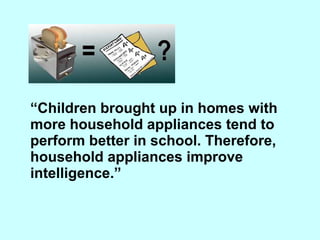
“ Children brought up in homes with more household appliances tend to perform better in school. Therefore, household appliances improve intelligence.”
“ Teens involved in violent crimes tend to play violent video games. Therefore, playing violent video games causes teenagers to get involved in criminal behaviour.” http://btr.michaelkwan.com/2009/01/10/correlation-does-not-imply-causation/
Correlation  does not  imply causation...
...but the existence of a correlation can flag something worth investigating...
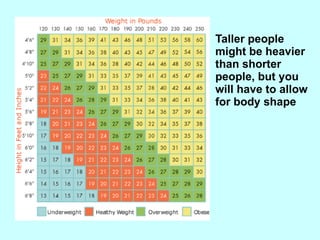
Taller people might be heavier than shorter people, but you will have to allow for body shape
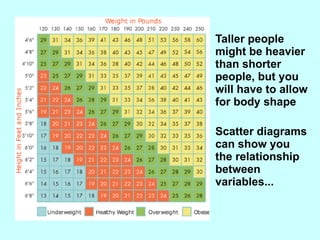
Taller people might be heavier than shorter people, but you will have to allow for body shape Scatter diagrams can show you the relationship between variables...
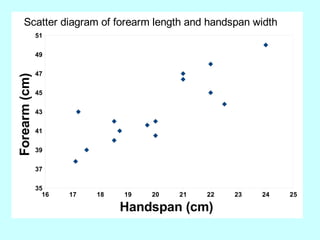
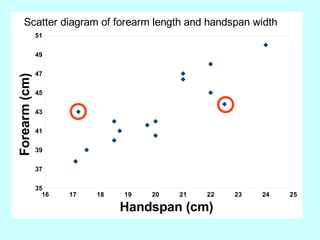
Scatter diagram Another chart – X Y plot in MS Excel
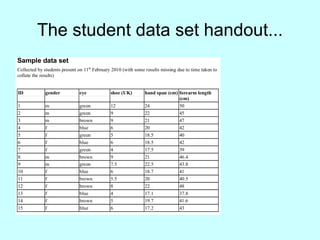
The student data set handout...
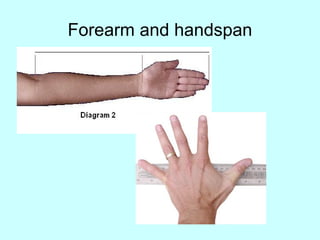
Forearm and handspan
 
 
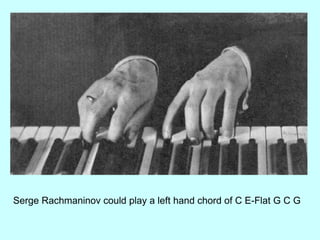
Serge Rachmaninov could play a left hand chord of C E-Flat G C G
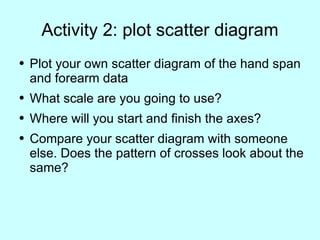
Activity 2: plot scatter diagram Plot your own scatter diagram of the hand span and forearm data What scale are you going to use? Where will you start and finish the axes? Compare your scatter diagram with someone else. Does the pattern of crosses look about the same?
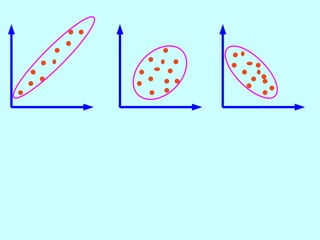
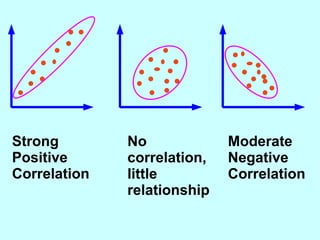
Describing the pattern Words and ellipses
 
 
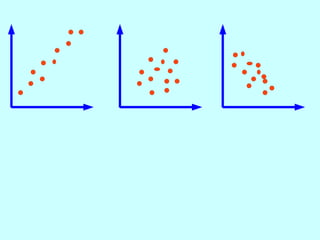
Strong Positive Correlation No correlation, little relationship Moderate Negative Correlation
Homework Q1 Plot a scatter diagram of Handspan vs Shoe Size from this data set Describe the pattern using the vocabulary developed on the last slide Do you think that the relationship between shoe size and hand span might be stronger than the relationship between hand span and fore arm length? What basis have you for your opinion?
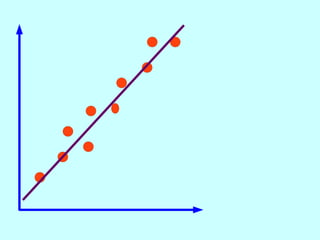
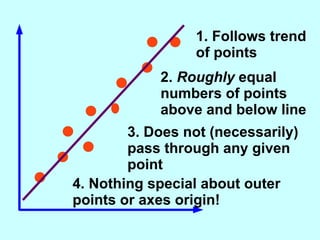
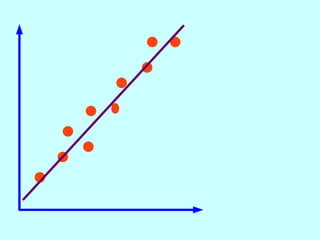
Line of best fit Only for medium to strong correlations...
 
 
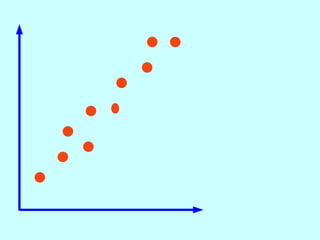
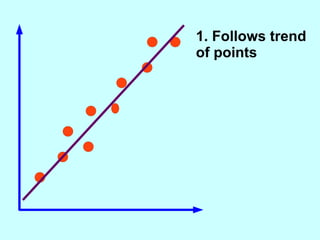
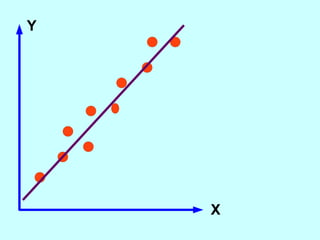
1. Follows trend of points
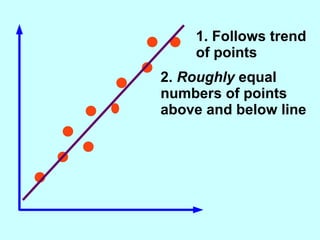
1. Follows trend of points 2.  Roughly  equal numbers of points above and below line
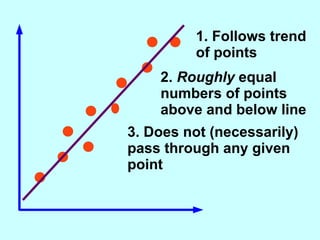
1. Follows trend of points 2.  Roughly  equal numbers of points above and below line 3. Does not (necessarily) pass through any given point
1. Follows trend of points 2.  Roughly  equal numbers of points above and below line 3. Does not (necessarily) pass through any given point 4. Nothing special about outer points or axes origin!
 
 
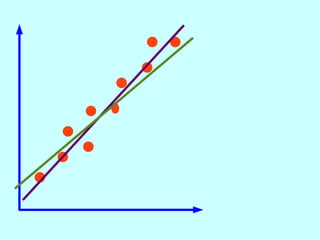
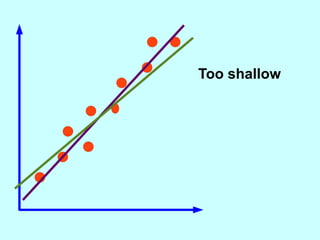
Too shallow
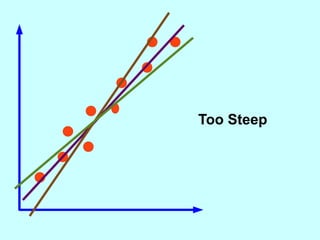
Too Steep
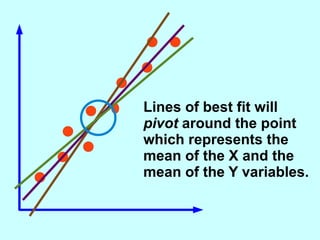
Lines of best fit will  pivot  around the point which represents the mean of the X and the mean of the Y variables.
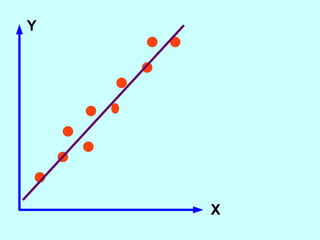
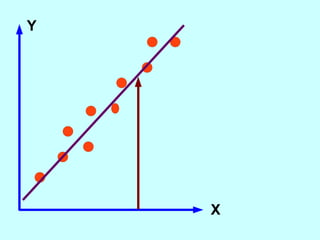
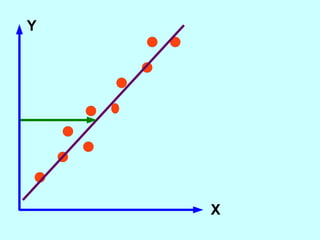
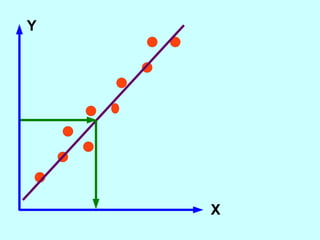
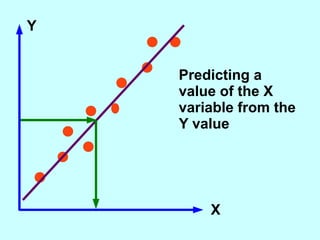
Using LOBF to make predictions Drawing lines on the graph
Y X
Y X
Y X
Y X Predicting a value of the X variable from the Y value
Y X
Y X
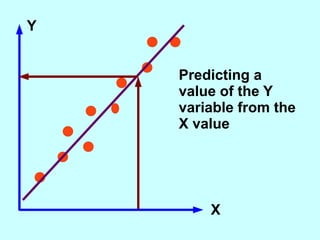
Y X Predicting a value of the Y variable from the X value
Activity 3: Draw LOBF Take your plot of the forearm and handspan length and draw a line of best fit on the graph Compare your LOBF with someone else. Is yours shallow or steep or somewhere in the middle? Use your graph to predict the forearm length of someone with a hand span of 20.5 cm Use your graph to predict the hand span of someone whose forearm is 48cm long How do the results compare with others? Which prediction varies more?
Interpolation and extrapolation Safe data processing
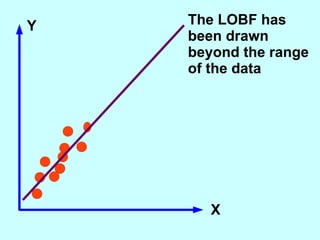
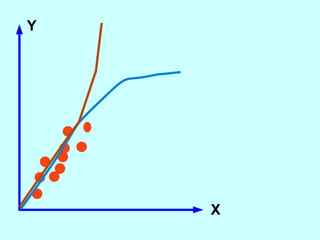
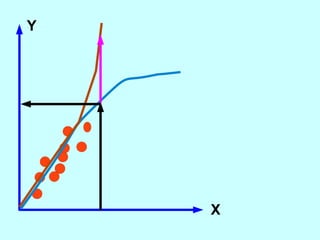
Y X The LOBF has been drawn beyond the range of the data
Y X
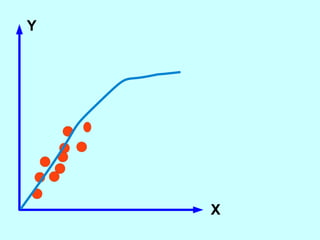
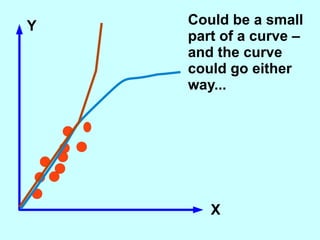
Y X Could be a small part of a curve – and the curve could go either way...
Y X
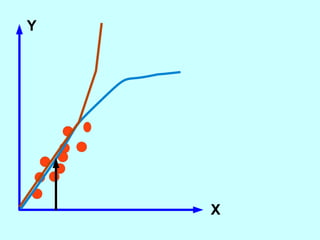
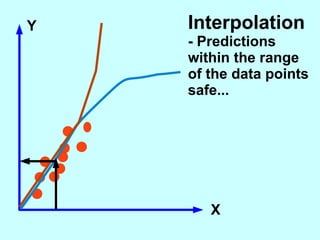
Y X Interpolation - Predictions within the range of the data points safe...
Y X
Y X
Y X
Y X
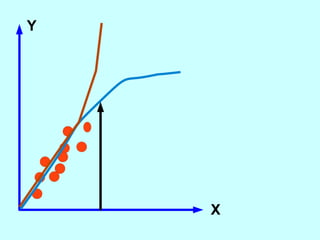
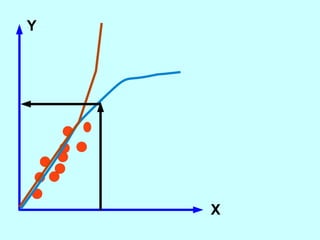
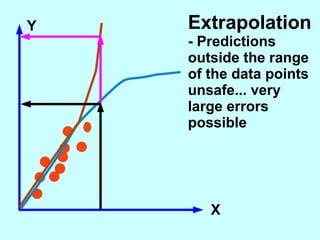
Y X Extrapolation - Predictions outside the range of the data points unsafe... very large errors possible
Homework Q2 Draw a LOBF on your shoe size and hand span scatter diagram Use your LOBF to predict the hand span of someone with a shoe size of 7 ½ Use the LOBF to predict the shoe size of someone with a hand span of 24.5 cm Which prediction is the most reliable. Write a sentence to two explaining your answer

Scatter diagrams and correlation

  • 1.
    Correlation part 1Relationship between variables...
  • 2.
    We are covering...Idea of correlation Plotting scatter diagrams Describing the pattern of points Drawing line of best fit and using the LOBF to make predictions Finding the difference between interpolation and extrapolation
  • 3.
    Activity 1: Readthe following slides... Look for holes in the arguments Can you state what the fallacies might be? Are they valid and false? Or just invalid?
  • 4.
    “ Children broughtup in homes with more household appliances tend to perform better in school. Therefore, household appliances improve intelligence.”
  • 5.
    “ Teens involvedin violent crimes tend to play violent video games. Therefore, playing violent video games causes teenagers to get involved in criminal behaviour.” http://btr.michaelkwan.com/2009/01/10/correlation-does-not-imply-causation/
  • 6.
    Correlation doesnot imply causation...
  • 7.
    ...but the existenceof a correlation can flag something worth investigating...
  • 8.
    Taller people mightbe heavier than shorter people, but you will have to allow for body shape
  • 9.
    Taller people mightbe heavier than shorter people, but you will have to allow for body shape Scatter diagrams can show you the relationship between variables...
  • 10.
    Scatter diagram Anotherchart – X Y plot in MS Excel
  • 11.
    The student dataset handout...
  • 12.
  • 13.
  • 14.
  • 15.
    Serge Rachmaninov couldplay a left hand chord of C E-Flat G C G
  • 16.
    Activity 2: plotscatter diagram Plot your own scatter diagram of the hand span and forearm data What scale are you going to use? Where will you start and finish the axes? Compare your scatter diagram with someone else. Does the pattern of crosses look about the same?
  • 17.
    Describing the patternWords and ellipses
  • 18.
  • 19.
  • 20.
    Strong Positive CorrelationNo correlation, little relationship Moderate Negative Correlation
  • 21.
    Homework Q1 Plota scatter diagram of Handspan vs Shoe Size from this data set Describe the pattern using the vocabulary developed on the last slide Do you think that the relationship between shoe size and hand span might be stronger than the relationship between hand span and fore arm length? What basis have you for your opinion?
  • 22.
    Line of bestfit Only for medium to strong correlations...
  • 23.
  • 24.
  • 25.
  • 26.
    1. Follows trendof points 2. Roughly equal numbers of points above and below line
  • 27.
    1. Follows trendof points 2. Roughly equal numbers of points above and below line 3. Does not (necessarily) pass through any given point
  • 28.
    1. Follows trendof points 2. Roughly equal numbers of points above and below line 3. Does not (necessarily) pass through any given point 4. Nothing special about outer points or axes origin!
  • 29.
  • 30.
  • 31.
  • 32.
  • 33.
    Lines of bestfit will pivot around the point which represents the mean of the X and the mean of the Y variables.
  • 34.
    Using LOBF tomake predictions Drawing lines on the graph
  • 35.
  • 36.
  • 37.
  • 38.
    Y X Predictinga value of the X variable from the Y value
  • 39.
  • 40.
  • 41.
    Y X Predictinga value of the Y variable from the X value
  • 42.
    Activity 3: DrawLOBF Take your plot of the forearm and handspan length and draw a line of best fit on the graph Compare your LOBF with someone else. Is yours shallow or steep or somewhere in the middle? Use your graph to predict the forearm length of someone with a hand span of 20.5 cm Use your graph to predict the hand span of someone whose forearm is 48cm long How do the results compare with others? Which prediction varies more?
  • 43.
    Interpolation and extrapolationSafe data processing
  • 44.
    Y X TheLOBF has been drawn beyond the range of the data
  • 45.
  • 46.
    Y X Couldbe a small part of a curve – and the curve could go either way...
  • 47.
  • 48.
    Y X Interpolation- Predictions within the range of the data points safe...
  • 49.
  • 50.
  • 51.
  • 52.
  • 53.
    Y X Extrapolation- Predictions outside the range of the data points unsafe... very large errors possible
  • 54.
    Homework Q2 Drawa LOBF on your shoe size and hand span scatter diagram Use your LOBF to predict the hand span of someone with a shoe size of 7 ½ Use the LOBF to predict the shoe size of someone with a hand span of 24.5 cm Which prediction is the most reliable. Write a sentence to two explaining your answer

Editor's Notes

  • #5 Underlying variable fallacy
  • #6 Reverse implication fallacy
  • #10 Have you spotted it? This thing is UPSIDE DOWN. The height axis is goes the wrong way!