Course 3
Scatter Plots
Scatter plots are the graphs that present the
relationship between two variables in a data-set.
It represents data points on a two dimensional plane.
The independent variable or attribute is plotted on the
X-axis, while the dependent variable is plotted on the Y-
axis. These plots are often called scatter
graphs or scatter diagrams.
Course 3
When to use a scatter plot?
Scatter plots are used in either of the following
situations.
When we have paired numerical data
When there are multiple values of the dependent
variable for a unique value of an independent variable
In determining the relationship between variables in
some scenarios, such as identifying potential root
causes of problems, checking whether two products
that appear to be related both occur with the exact
cause and so on.
Course 3
Scatter Plots
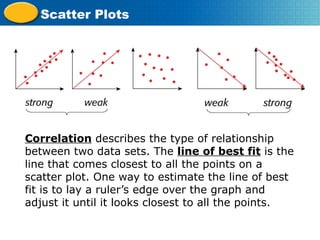
Correlation describes the type of relationship
between two data sets. The line of best fit is the
line that comes closest to all the points on a
scatter plot. One way to estimate the line of best
fit is to lay a ruler’s edge over the graph and
adjust it until it looks closest to all the points.
Course 3
Scatter Plots
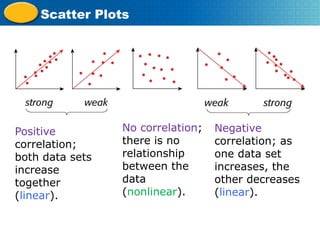
Positive
correlation;
both data sets
increase
together
(linear).
Negative
correlation; as
one data set
increases, the
other decreases
(linear).
No correlation;
there is no
relationship
between the
data
(nonlinear).
Use the given data to make a scatter plot of
the weight and height of each member of a
basketball team.
Additional Example 1: Making a Scatter Plot of a
Data Set
Course 3
Scatter Plots
The points on the scatter plot are
(71, 170), (68, 160), (70, 175),
(73, 180), and (74, 190).
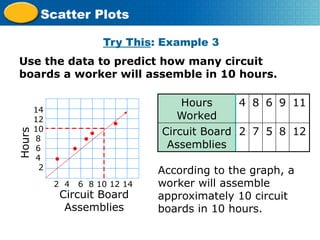
Use the data to predict how many circuit
boards a worker will assemble in 10 hours.
Try This: Example 3
Course 3
Scatter Plots
According to the graph, a
worker will assemble
approximately 10 circuit
boards in 10 hours.
Hours
Worked
4 8 6 9 11
Circuit Board
Assemblies
2 7 5 8 12
14
12
10
8
6
4
2
2 4 6 8 10 12 14
Hours
Circuit Board
Assemblies

scatter plots and visualization concept.pptx

  • 1.
    Course 3 Scatter Plots Scatterplots are the graphs that present the relationship between two variables in a data-set. It represents data points on a two dimensional plane. The independent variable or attribute is plotted on the X-axis, while the dependent variable is plotted on the Y- axis. These plots are often called scatter graphs or scatter diagrams.
  • 2.
    Course 3 When touse a scatter plot? Scatter plots are used in either of the following situations. When we have paired numerical data When there are multiple values of the dependent variable for a unique value of an independent variable In determining the relationship between variables in some scenarios, such as identifying potential root causes of problems, checking whether two products that appear to be related both occur with the exact cause and so on.
  • 3.
    Course 3 Scatter Plots Correlationdescribes the type of relationship between two data sets. The line of best fit is the line that comes closest to all the points on a scatter plot. One way to estimate the line of best fit is to lay a ruler’s edge over the graph and adjust it until it looks closest to all the points.
  • 4.
    Course 3 Scatter Plots Positive correlation; bothdata sets increase together (linear). Negative correlation; as one data set increases, the other decreases (linear). No correlation; there is no relationship between the data (nonlinear).
  • 5.
    Use the givendata to make a scatter plot of the weight and height of each member of a basketball team. Additional Example 1: Making a Scatter Plot of a Data Set Course 3 Scatter Plots The points on the scatter plot are (71, 170), (68, 160), (70, 175), (73, 180), and (74, 190).
  • 6.
    Use the datato predict how many circuit boards a worker will assemble in 10 hours. Try This: Example 3 Course 3 Scatter Plots According to the graph, a worker will assemble approximately 10 circuit boards in 10 hours. Hours Worked 4 8 6 9 11 Circuit Board Assemblies 2 7 5 8 12 14 12 10 8 6 4 2 2 4 6 8 10 12 14 Hours Circuit Board Assemblies