Data:
Frequency Tables and Line
          Plots
Vocabulary
Data - information, often given in the form
of numbers or categories.
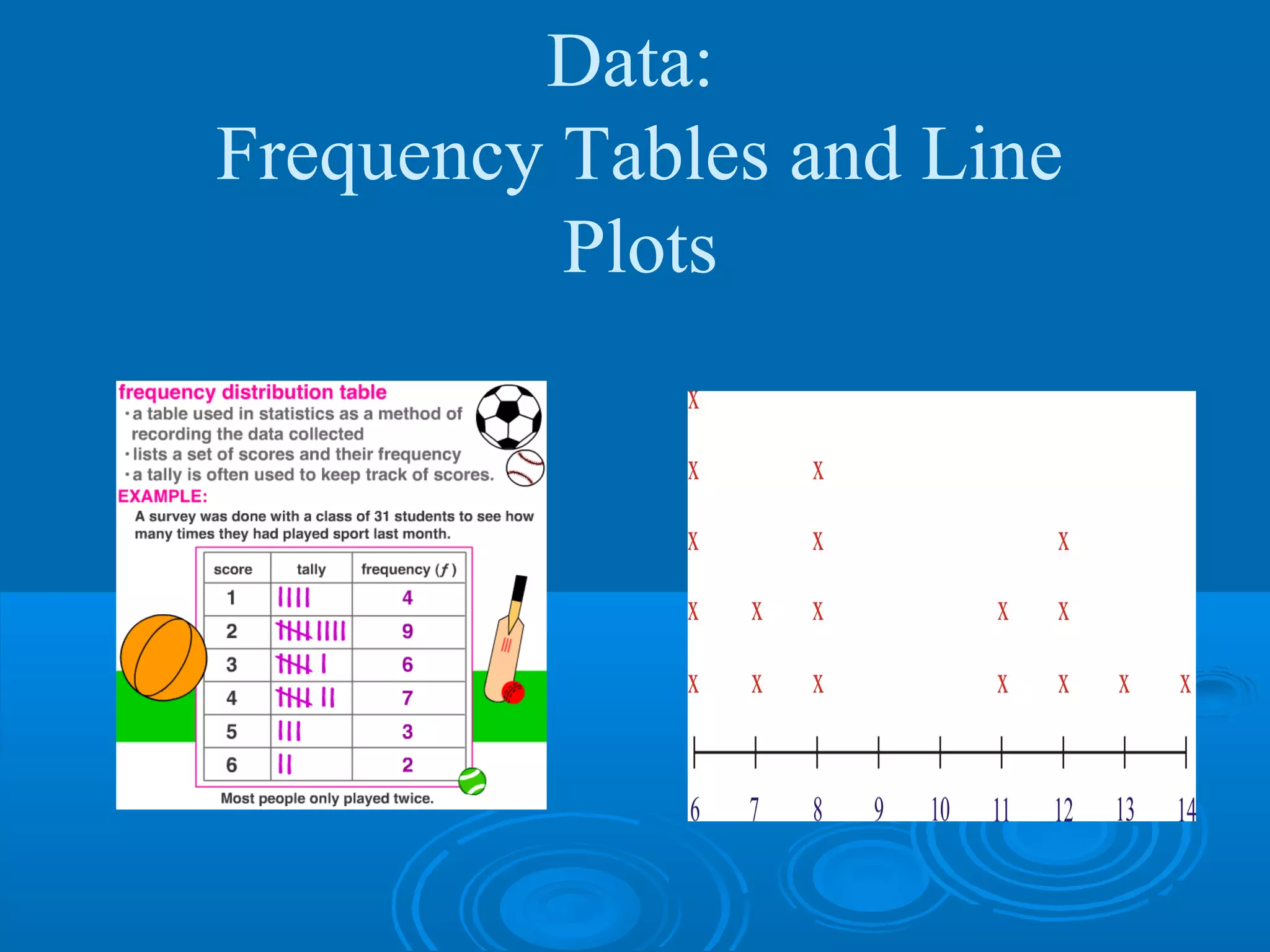
Frequency Table – a table that displays
the number of times each item or category
occurs in a data set.
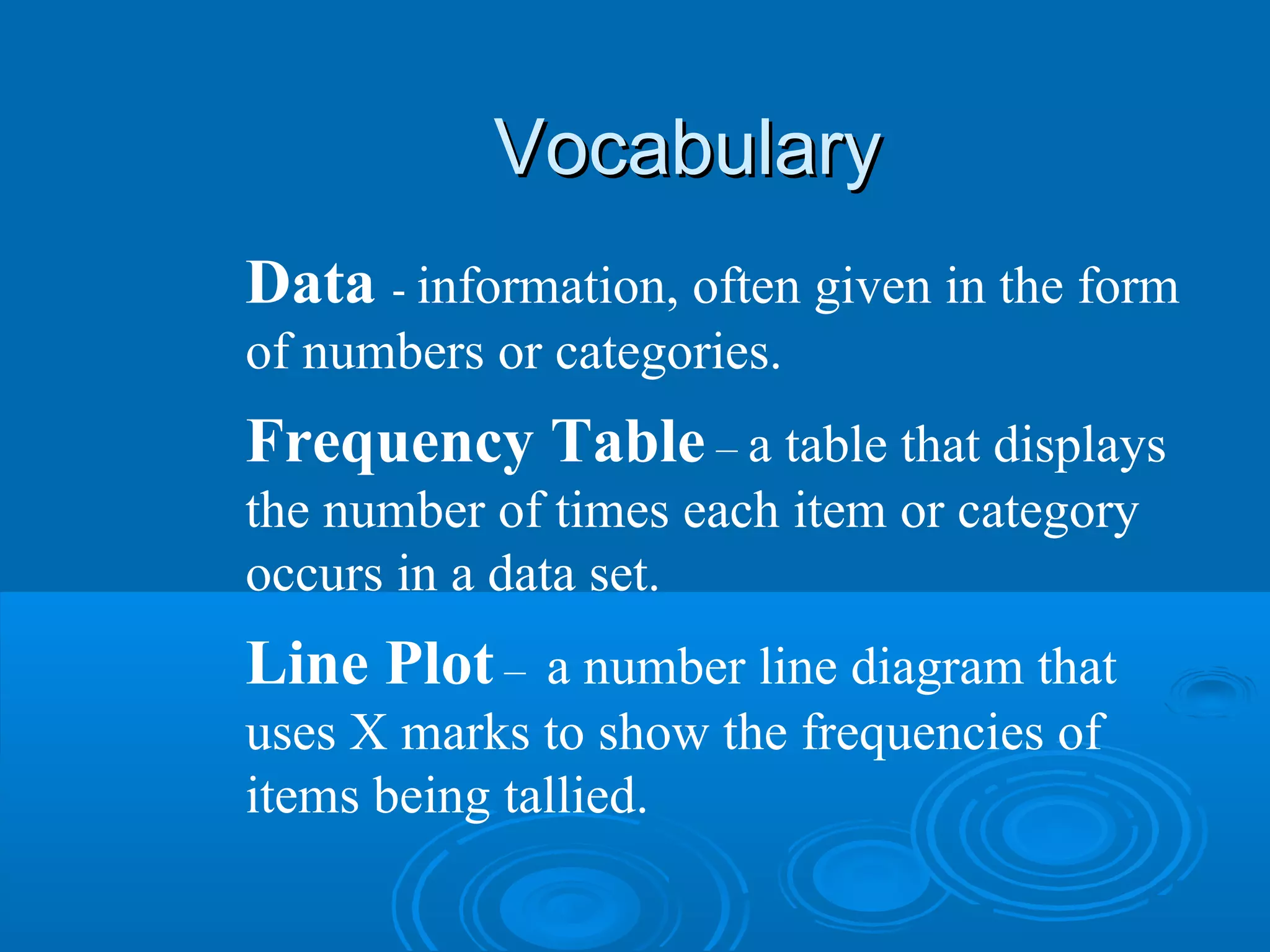
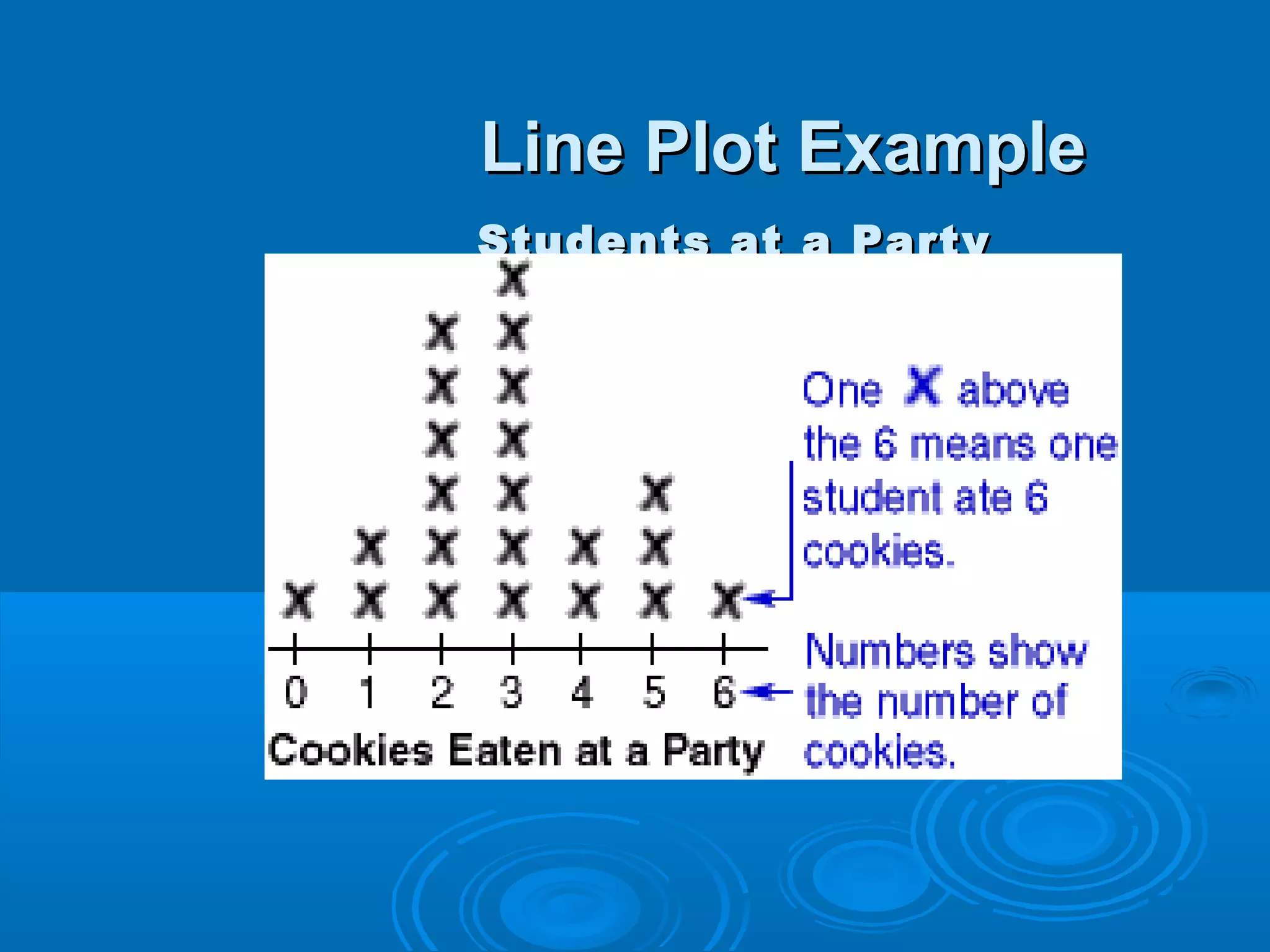
Line Plot – a number line diagram that
uses X marks to show the frequencies of
items being tallied.
Line Plot Example
Students at a Party
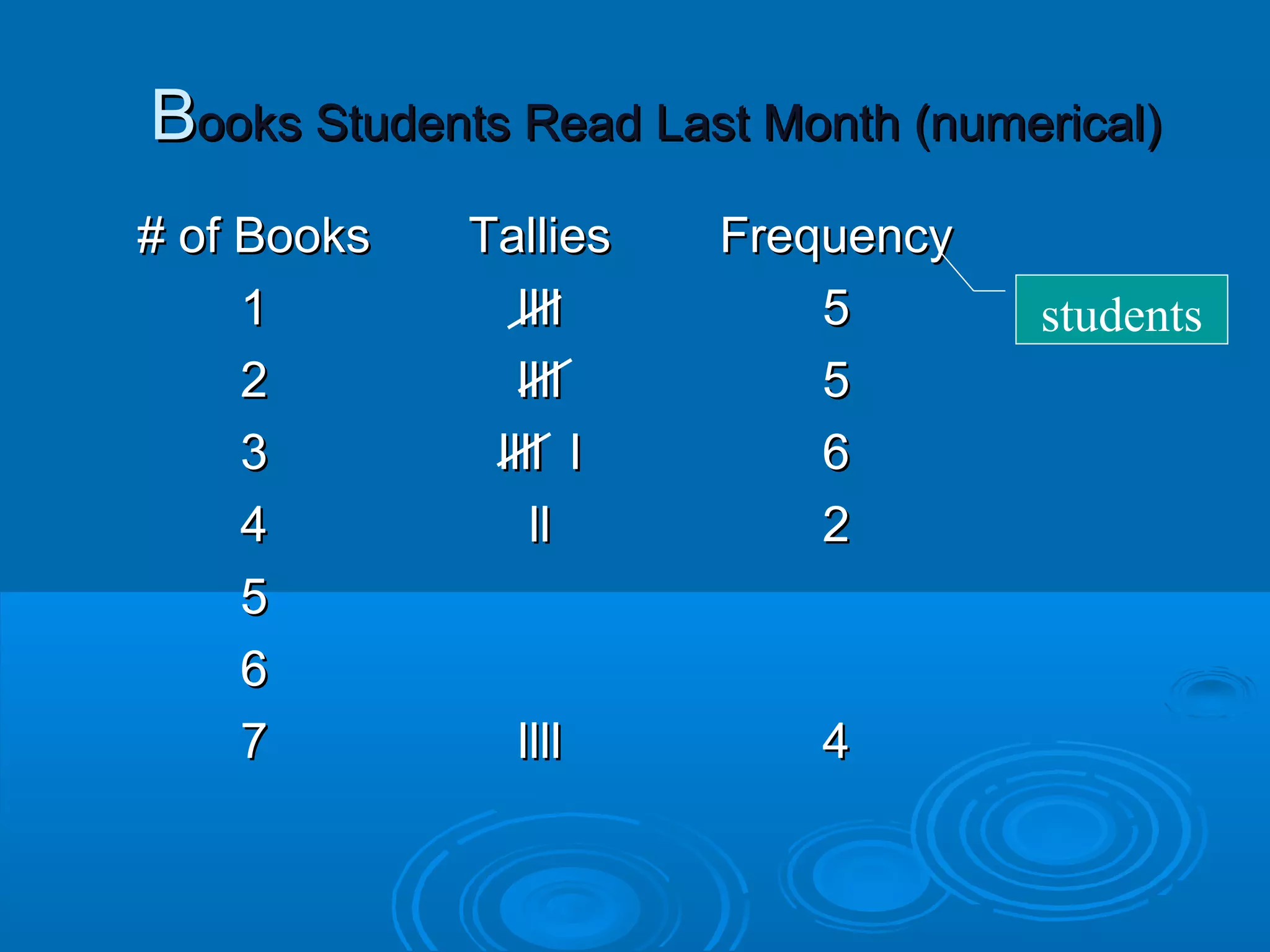
Books Students Read Last Month (numerical)
# of Books   Tallies   Frequency
     1          llll       5        students
     2          llll       5
     3        llll l       6
     4           ll        2
     5
     6
     7         llll        4
Making a Line Plot
Is a visual of the frequency distribution.
Line plots are NOT used for categorical
data.
Draw a number line whose scale starts
at or before the minimum data value
and stops at or after the maximum data
value. Use a consistent increment.
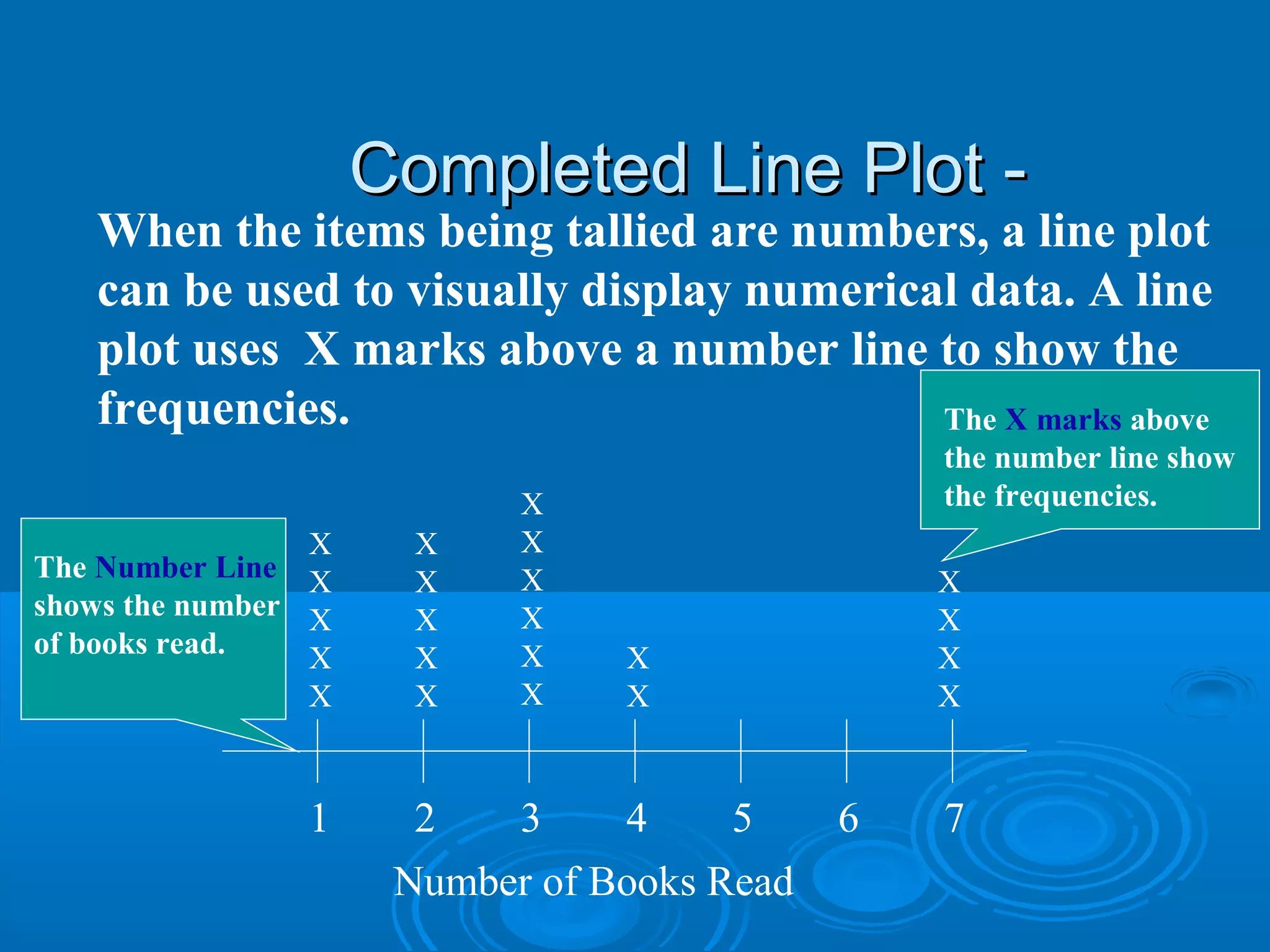
Completed Line Plot -
   When the items being tallied are numbers, a line plot
   can be used to visually display numerical data. A line
   plot uses X marks above a number line to show the
   frequencies.                            The X marks above
                                                 the number line show
                            X                    the frequencies.
                 X     X    X
The Number Line X      X    X                    X
shows the number X     X    X                    X
of books read.   X     X    X    X               X
                 X     X    X    X               X


                1      2   3     4     5     6   7
                      Number of Books Read
Making a Frequency Table
Categorical data: data that can
 be placed into categories.
Categorical question: What is
 your favorite color?
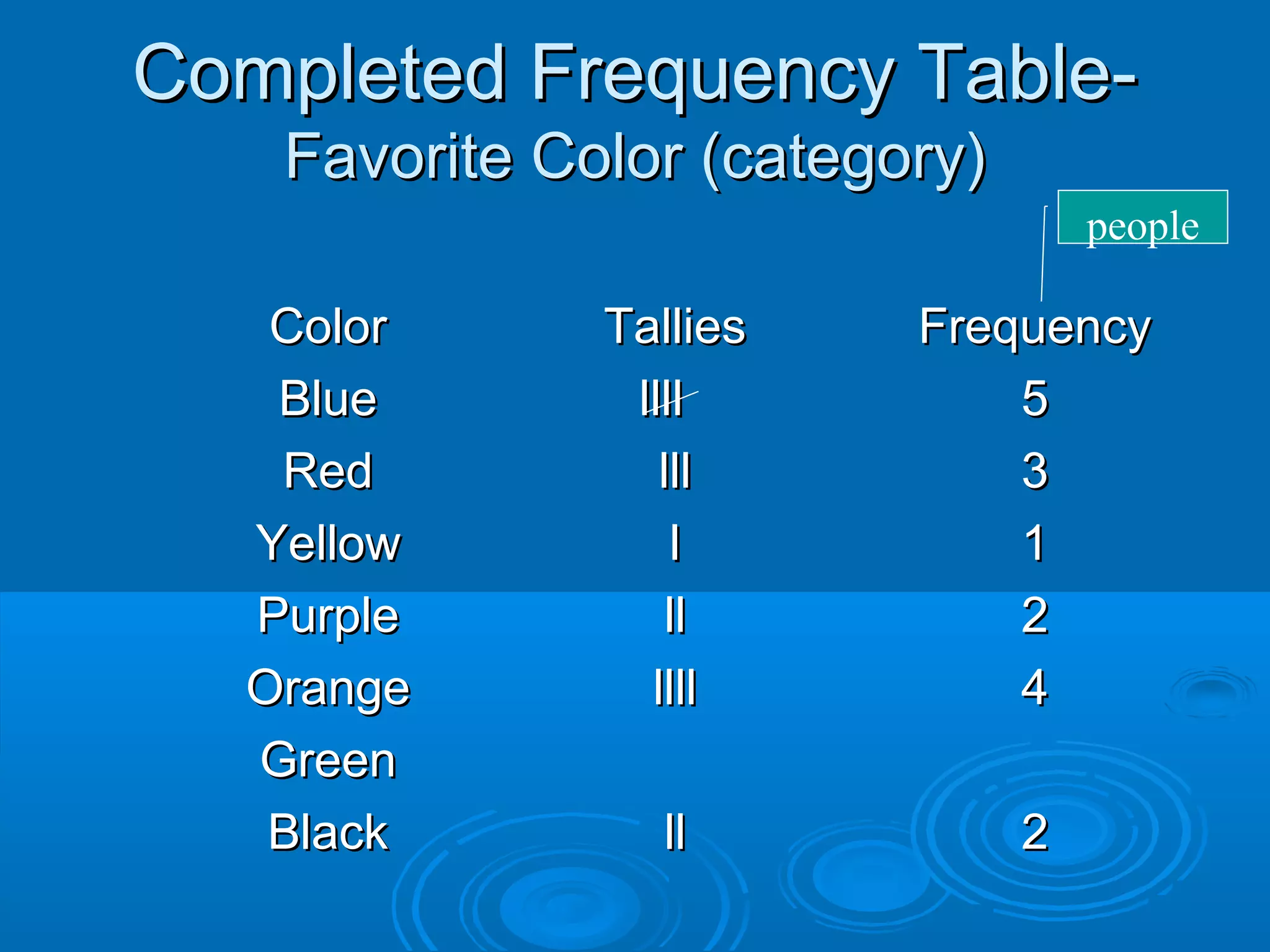
Completed Frequency Table-
   Favorite Color (category)
                                   people

   Color      Tallies    Frequency
   Blue        llll          5
   Red           lll         3
  Yellow           l         1
  Purple          ll         2
  Orange        llll         4
  Green
   Black        ll             2
Variability in Data Distributions
 Outliers-Unusually high or low values in
  a distribution.

  Clusters-An group of data values with
  higher frequency than surrounding
  values.
 Gaps-Areas in the scale where there is a

  lack of data values.
Analyze the Data
 Now look at the Frequency
Tables and the Line Plots from
your notes to see if you can
identify any outliers, clusters or
gaps.

Frequency tables and line plots

  • 1.
  • 2.
    Vocabulary Data - information,often given in the form of numbers or categories. Frequency Table – a table that displays the number of times each item or category occurs in a data set. Line Plot – a number line diagram that uses X marks to show the frequencies of items being tallied.
  • 3.
  • 4.
    Books Students ReadLast Month (numerical) # of Books Tallies Frequency 1 llll 5 students 2 llll 5 3 llll l 6 4 ll 2 5 6 7 llll 4
  • 5.
    Making a LinePlot Is a visual of the frequency distribution. Line plots are NOT used for categorical data. Draw a number line whose scale starts at or before the minimum data value and stops at or after the maximum data value. Use a consistent increment.
  • 6.
    Completed Line Plot- When the items being tallied are numbers, a line plot can be used to visually display numerical data. A line plot uses X marks above a number line to show the frequencies. The X marks above the number line show X the frequencies. X X X The Number Line X X X X shows the number X X X X of books read. X X X X X X X X X X 1 2 3 4 5 6 7 Number of Books Read
  • 7.
    Making a FrequencyTable Categorical data: data that can be placed into categories. Categorical question: What is your favorite color?
  • 8.
    Completed Frequency Table- Favorite Color (category) people Color Tallies Frequency Blue llll 5 Red lll 3 Yellow l 1 Purple ll 2 Orange llll 4 Green Black ll 2
  • 9.
    Variability in DataDistributions  Outliers-Unusually high or low values in a distribution.  Clusters-An group of data values with higher frequency than surrounding values.  Gaps-Areas in the scale where there is a lack of data values.
  • 10.
    Analyze the Data Now look at the Frequency Tables and the Line Plots from your notes to see if you can identify any outliers, clusters or gaps.