Probability & Chance
• If you listen to weather forecasts you could
  hear expressions like these:

• ‘There is a strong likelihood of rain
  tomorrow’.

• ‘In the afternoon there is a possibility of
  thunder’.

• ‘The rain will probably clear towards
  evening’.

• Weather forecasts are made by studying
  charts and weather data to tell us how
• Probability uses numbers to tell us
  how likely something is to happen.

• The probability or chance of
  something happening can be
  described by using words such as

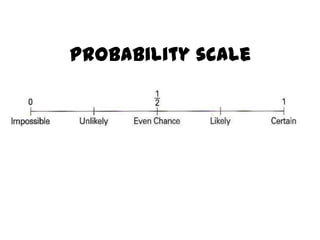
• Impossible, Unlikely, Even, Chance,
  Likely or Certain
• An event which is certain to happen
  has a probability of 1.

• An event which cannot happen has a
  probability of 0.

• All other probabilities will be a
  number greater than 0 and less than 1.

• The more likely an event is to happen,
  the closer the probability is to 1
Probability scale
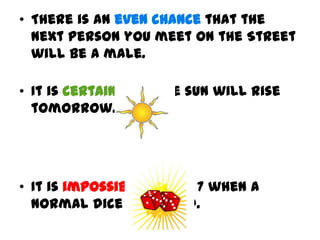
• There is an even chance that the
  next person you meet on the Street
  will be a male.

• It is certain that the sun will rise
  tomorrow.


• It is impossible to get 7 when a
  normal dice is rolled.
Events and outcomes
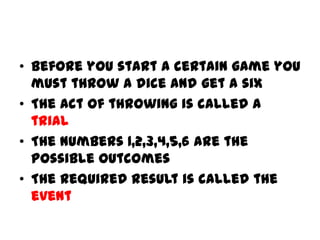
• Before you start a certain game you
  must throw a dice and get a six
• The act of throwing is called a
  trial
• The numbers 1,2,3,4,5,6 are the
  possible outcomes
• The required result is called the
  event
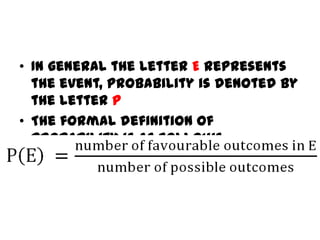
• In general the letter E represents
  the event, probability is denoted by
  the letter P
• The formal definition of
  probability is as follows
• The probability of any event cannot
  be less than 0 or greater than 1
• The probability of a certainty is 1
• An impossibility is 0
Example 1
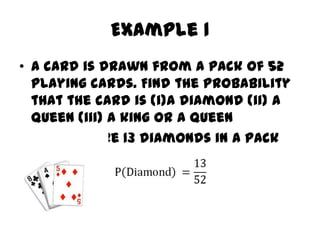
• A card is drawn from a pack of 52
  playing cards. Find the probability
  that the card is (i)a diamond (ii) a
  queen (iii) a king or a queen
• (i)There are 13 diamonds in a pack
  therefore
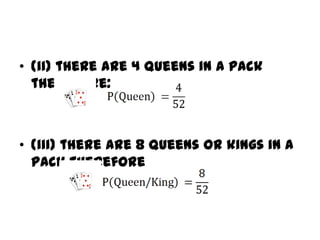
• (ii) there are 4 queens in a pack
  therefore:


• (iii) there are 8 queens or kings in a
  pack therefore
Roulette
                                                                                         ODD                  EVEN

                                 2   2                                                    1          11        21
                             2           1
                         6       6   3       1
                             0                                                            2          12        22
                 1                           6   5
                                                                                          3          13        23
                 2
             1                                       4
                                                                                          4          14        24
             7
     1                                                       2                            5          15        25
     9                                                       2
 1                                                               8                        6          16        26
 4                                                                                        7          17        27
2                                                                2
8                                                                                         8          18        28
                                                                 9
1                                                                1                        9          19        29
0                                                                1
                                                                                          10         20        30
    3                                                        2
    0                                                                                   1 to 10   11 to 20   21 to 30
         9                                               2                               RED                 BLACK
                                                         7
                 7                               1
                     2                           8
                                             1
                     1       3
                                 2   2
                                         1
                                         3
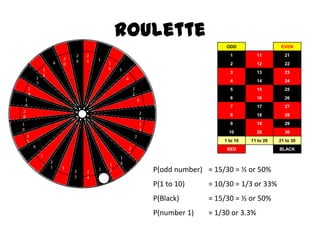
                                             5                       P(odd number) = 15/30 = ½ or 50%
                                 5   4
                                                                     P(1 to 10)     = 10/30 = 1/3 or 33%
                                                                     P(Black)       = 15/30 = ½ or 50%
                                                                     P(number 1)    = 1/30 or 3.3%
Probability of an event not
        occurring
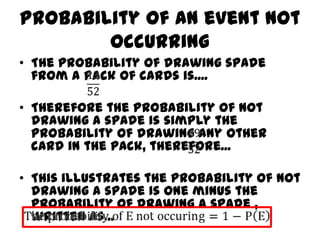
• The probability of drawing spade
  from a pack of cards is....
• Therefore the probability of not
  drawing a spade is simply the
  probability of drawing any other
  card in the pack, therefore...

• This illustrates the probability of not
  drawing a spade is one minus the
  probability of drawing a spade ,
  written as...
Two events –the use of
       sample space
• When two coins are tossed the set
  of possible outcomes is as follows
• There could be two heads
• There could be a head and a tail
• There could be a tail and a head
• Or there could be two tails
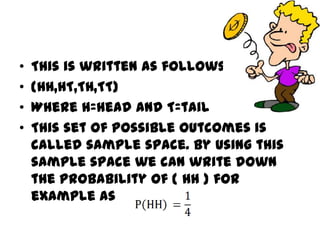
•   This is written as follows:
•   {HH,HT,TH,TT}
•   Where H=head and T=tail
•   This set of possible outcomes is
    called sample space. By using this
    sample space we can write down
    the probability of { HH } for
    example as
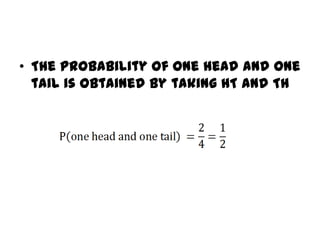
• The probability of one head and one
  tail is obtained by taking HT and TH
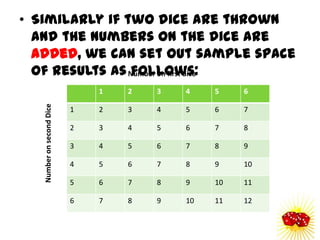
• Similarly if two dice are thrown
  and the numbers on the dice are
  added, we can set out sample space
  of results as Number on first dice
                 follows:
                               1   2   3   4    5    6
   Number on second Dice


                           1   2   3   4   5    6    7

                           2   3   4   5   6    7    8

                           3   4   5   6   7    8    9

                           4   5   6   7   8    9    10

                           5   6   7   8   9    10   11

                           6   7   8   9   10   11   12
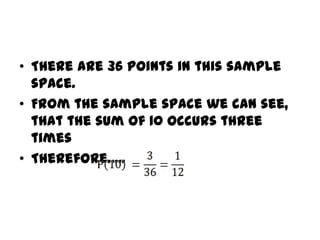
• There are 36 points in this sample
  space.
• From the sample space we can see,
  that the sum of 10 occurs three
  times
• Therefore.....
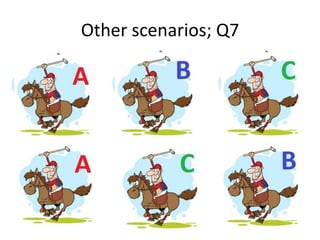
Other scenarios; Q7
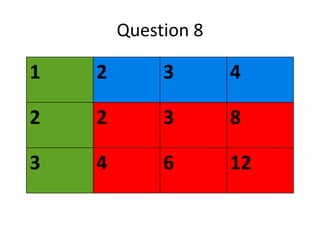
Question 8

1   2        3       4

2   2        3       8

3   4        6       12
Experimental probability
What is Probability?

• Probability is a number from 0 to 1 that tells
  you how likely something is to happen.
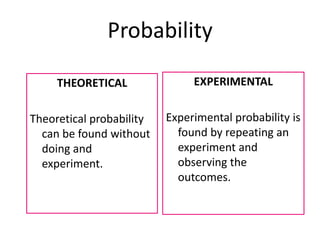
• Probability can be either theoretical or
  experimental.
Probability

     THEORETICAL               EXPERIMENTAL

Theoretical probability   Experimental probability is
  can be found without      found by repeating an
  doing and                 experiment and
  experiment.               observing the
                            outcomes.
THEORETICAL PROBABILITY

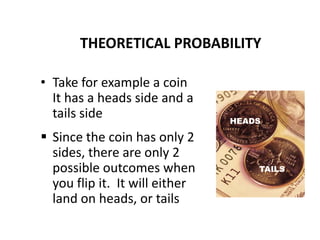
• Take for example a coin
  It has a heads side and a
  tails side                    HEADS

 Since the coin has only 2
  sides, there are only 2
  possible outcomes when            TAILS
  you flip it. It will either
  land on heads, or tails
THEORETICAL PROBABILITY

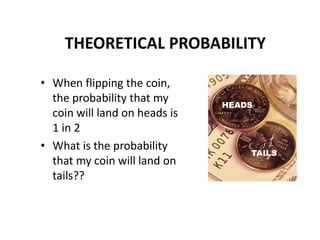
• When flipping the coin,
  the probability that my      HEADS
  coin will land on heads is
  1 in 2
• What is the probability
                                   TAILS
  that my coin will land on
  tails??
Theoretical Probability

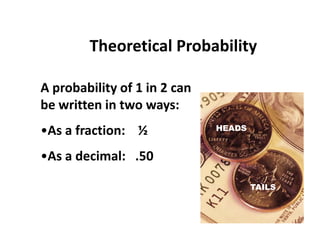
A probability of 1 in 2 can
be written in two ways:
•As a fraction: ½             HEADS


•As a decimal: .50

                                      TAILS
Theoretical probability

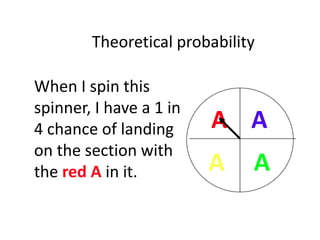
When I spin this
spinner, I have a 1 in
4 chance of landing      A A
on the section with
the red A in it.         A    A
Theoretical Probability
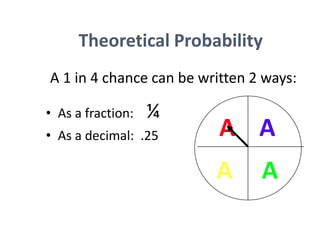
A 1 in 4 chance can be written 2 ways:

• As a fraction:   ¼
• As a decimal: .25       A A
                         A      A
Theoretical Probability
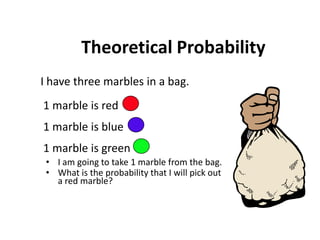
I have three marbles in a bag.
1 marble is red
1 marble is blue
1 marble is green
 • I am going to take 1 marble from the bag.
 • What is the probability that I will pick out
   a red marble?
Theoretical Probability
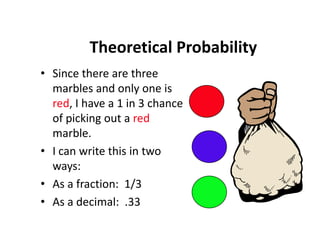
• Since there are three
  marbles and only one is
  red, I have a 1 in 3 chance
  of picking out a red
  marble.
• I can write this in two
  ways:
• As a fraction: 1/3
• As a decimal: .33
Experimental Probability

Experimental probability is found
by repeating an experiment and
observing the outcomes.
Experimental Probability

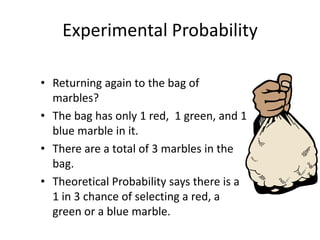
• Returning again to the bag of
  marbles?
• The bag has only 1 red, 1 green, and 1
  blue marble in it.
• There are a total of 3 marbles in the
  bag.
• Theoretical Probability says there is a
  1 in 3 chance of selecting a red, a
  green or a blue marble.
Experimental Probability
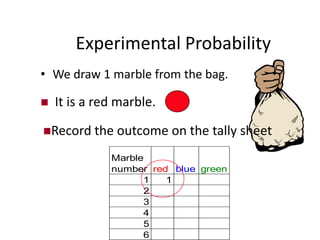
• We draw 1 marble from the bag.

   It is a red marble.

Record the outcome       on the tally sheet
              Marble
              number red blue green
                    1   1
                    2
                    3
                    4
                    5
                    6
Experimental Probability

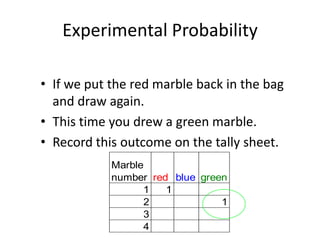
• If we put the red marble back in the bag
  and draw again.
• This time you drew a green marble.
• Record this outcome on the tally sheet.
            Marble
            number red blue green
                  1   1
                  2             1
                  3
                  4
Experimental Probability
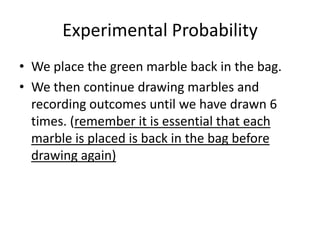
• We place the green marble back in the bag.
• We then continue drawing marbles and
  recording outcomes until we have drawn 6
  times. (remember it is essential that each
  marble is placed is back in the bag before
  drawing again)
Experimental Probability

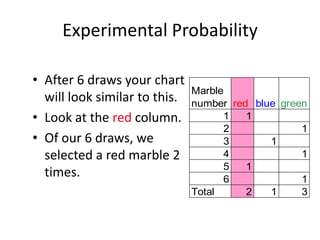
• After 6 draws your chart
                               Marble
  will look similar to this.   number red blue green
• Look at the red column.            1   1
                                     2             1
• Of our 6 draws, we                 3       1
  selected a red marble 2            4             1
                                     5   1
  times.                             6             1
                               Total     2   1     3
Experimental Probability

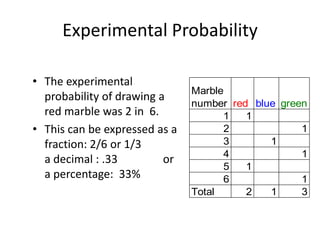
• The experimental
                               Marble
  probability of drawing a
                               number red blue green
  red marble was 2 in 6.             1   1
• This can be expressed as a         2             1
  fraction: 2/6 or 1/3               3       1
                                     4             1
  a decimal : .33         or
                                     5   1
  a percentage: 33%                  6             1
                               Total     2   1     3
Experimental Probability

                   Marble
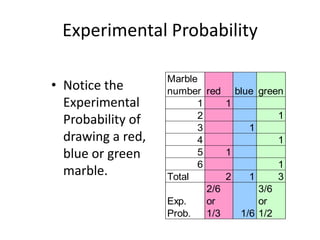
• Notice the       number red blue green
  Experimental           1     1
                         2               1
  Probability of
                         3         1
  drawing a red,         4               1
  blue or green          5     1
                         6               1
  marble.          Total       2   1     3
                           2/6       3/6
                   Exp.    or        or
                   Prob.   1/3   1/6 1/2
Comparing Experimental and
       Theoretical Probability
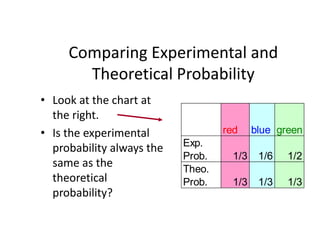
• Look at the chart at
  the right.
• Is the experimental              red     blue green
                           Exp.
  probability always the
                           Prob.     1/3    1/6   1/2
  same as the              Theo.
  theoretical              Prob.     1/3    1/3   1/3
  probability?
Comparing Experimental and
       Theoretical Probability
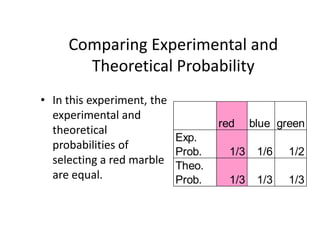
• In this experiment, the
  experimental and
                                    red     blue green
  theoretical
                            Exp.
  probabilities of
                            Prob.     1/3    1/6   1/2
  selecting a red marble    Theo.
  are equal.                Prob.     1/3    1/3   1/3
Comparing Experimental and
         Theoretical Probability
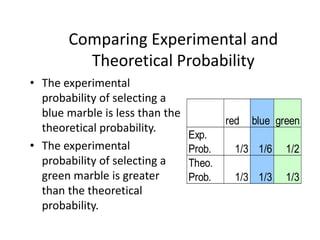
• The experimental
  probability of selecting a
  blue marble is less than the
                                         red   blue green
  theoretical probability.
                                 Exp.
• The experimental               Prob.     1/3 1/6    1/2
  probability of selecting a     Theo.
  green marble is greater        Prob.     1/3 1/3    1/3
  than the theoretical
  probability.
Probability Review

Probability is a number from 0 to 1 that tells
you how likely something is to happen.
   There are 2 types of probability:
• Theoretical (can be found without doing an
  experiment)
• Experimental (can be found by repeating an
  experiment and recording outcomes.)
Questions 4.4
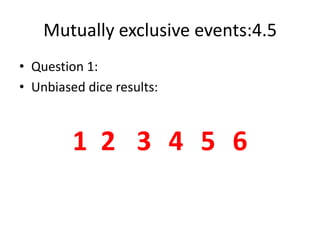
Mutually exclusive events:4.5
• Question 1:
• Unbiased dice results:


         1 2 3 4 5 6
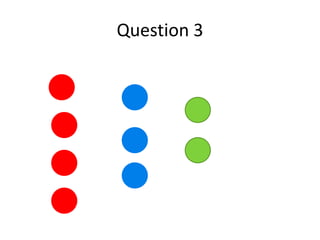
Question 3
Question 4

Probability & chance

  • 1.
  • 2.
    • If youlisten to weather forecasts you could hear expressions like these: • ‘There is a strong likelihood of rain tomorrow’. • ‘In the afternoon there is a possibility of thunder’. • ‘The rain will probably clear towards evening’. • Weather forecasts are made by studying charts and weather data to tell us how
  • 3.
    • Probability usesnumbers to tell us how likely something is to happen. • The probability or chance of something happening can be described by using words such as • Impossible, Unlikely, Even, Chance, Likely or Certain
  • 4.
    • An eventwhich is certain to happen has a probability of 1. • An event which cannot happen has a probability of 0. • All other probabilities will be a number greater than 0 and less than 1. • The more likely an event is to happen, the closer the probability is to 1
  • 5.
  • 6.
    • There isan even chance that the next person you meet on the Street will be a male. • It is certain that the sun will rise tomorrow. • It is impossible to get 7 when a normal dice is rolled.
  • 7.
  • 8.
    • Before youstart a certain game you must throw a dice and get a six • The act of throwing is called a trial • The numbers 1,2,3,4,5,6 are the possible outcomes • The required result is called the event
  • 9.
    • In generalthe letter E represents the event, probability is denoted by the letter P • The formal definition of probability is as follows
  • 10.
    • The probabilityof any event cannot be less than 0 or greater than 1 • The probability of a certainty is 1 • An impossibility is 0
  • 11.
    Example 1 • Acard is drawn from a pack of 52 playing cards. Find the probability that the card is (i)a diamond (ii) a queen (iii) a king or a queen • (i)There are 13 diamonds in a pack therefore
  • 12.
    • (ii) thereare 4 queens in a pack therefore: • (iii) there are 8 queens or kings in a pack therefore
  • 13.
    Roulette ODD EVEN 2 2 1 11 21 2 1 6 6 3 1 0 2 12 22 1 6 5 3 13 23 2 1 4 4 14 24 7 1 2 5 15 25 9 2 1 8 6 16 26 4 7 17 27 2 2 8 8 18 28 9 1 1 9 19 29 0 1 10 20 30 3 2 0 1 to 10 11 to 20 21 to 30 9 2 RED BLACK 7 7 1 2 8 1 1 3 2 2 1 3 5 P(odd number) = 15/30 = ½ or 50% 5 4 P(1 to 10) = 10/30 = 1/3 or 33% P(Black) = 15/30 = ½ or 50% P(number 1) = 1/30 or 3.3%
  • 14.
    Probability of anevent not occurring • The probability of drawing spade from a pack of cards is.... • Therefore the probability of not drawing a spade is simply the probability of drawing any other card in the pack, therefore... • This illustrates the probability of not drawing a spade is one minus the probability of drawing a spade , written as...
  • 15.
    Two events –theuse of sample space • When two coins are tossed the set of possible outcomes is as follows • There could be two heads • There could be a head and a tail • There could be a tail and a head • Or there could be two tails
  • 16.
    This is written as follows: • {HH,HT,TH,TT} • Where H=head and T=tail • This set of possible outcomes is called sample space. By using this sample space we can write down the probability of { HH } for example as
  • 17.
    • The probabilityof one head and one tail is obtained by taking HT and TH
  • 18.
    • Similarly iftwo dice are thrown and the numbers on the dice are added, we can set out sample space of results as Number on first dice follows: 1 2 3 4 5 6 Number on second Dice 1 2 3 4 5 6 7 2 3 4 5 6 7 8 3 4 5 6 7 8 9 4 5 6 7 8 9 10 5 6 7 8 9 10 11 6 7 8 9 10 11 12
  • 19.
    • There are36 points in this sample space. • From the sample space we can see, that the sum of 10 occurs three times • Therefore.....
  • 20.
  • 23.
    Question 8 1 2 3 4 2 2 3 8 3 4 6 12
  • 24.
  • 25.
    What is Probability? •Probability is a number from 0 to 1 that tells you how likely something is to happen. • Probability can be either theoretical or experimental.
  • 26.
    Probability THEORETICAL EXPERIMENTAL Theoretical probability Experimental probability is can be found without found by repeating an doing and experiment and experiment. observing the outcomes.
  • 27.
    THEORETICAL PROBABILITY • Takefor example a coin It has a heads side and a tails side HEADS  Since the coin has only 2 sides, there are only 2 possible outcomes when TAILS you flip it. It will either land on heads, or tails
  • 28.
    THEORETICAL PROBABILITY • Whenflipping the coin, the probability that my HEADS coin will land on heads is 1 in 2 • What is the probability TAILS that my coin will land on tails??
  • 29.
    Theoretical Probability A probabilityof 1 in 2 can be written in two ways: •As a fraction: ½ HEADS •As a decimal: .50 TAILS
  • 30.
    Theoretical probability When Ispin this spinner, I have a 1 in 4 chance of landing A A on the section with the red A in it. A A
  • 31.
    Theoretical Probability A 1in 4 chance can be written 2 ways: • As a fraction: ¼ • As a decimal: .25 A A A A
  • 32.
    Theoretical Probability I havethree marbles in a bag. 1 marble is red 1 marble is blue 1 marble is green • I am going to take 1 marble from the bag. • What is the probability that I will pick out a red marble?
  • 33.
    Theoretical Probability • Sincethere are three marbles and only one is red, I have a 1 in 3 chance of picking out a red marble. • I can write this in two ways: • As a fraction: 1/3 • As a decimal: .33
  • 34.
    Experimental Probability Experimental probabilityis found by repeating an experiment and observing the outcomes.
  • 35.
    Experimental Probability • Returningagain to the bag of marbles? • The bag has only 1 red, 1 green, and 1 blue marble in it. • There are a total of 3 marbles in the bag. • Theoretical Probability says there is a 1 in 3 chance of selecting a red, a green or a blue marble.
  • 36.
    Experimental Probability • Wedraw 1 marble from the bag.  It is a red marble. Record the outcome on the tally sheet Marble number red blue green 1 1 2 3 4 5 6
  • 37.
    Experimental Probability • Ifwe put the red marble back in the bag and draw again. • This time you drew a green marble. • Record this outcome on the tally sheet. Marble number red blue green 1 1 2 1 3 4
  • 38.
    Experimental Probability • Weplace the green marble back in the bag. • We then continue drawing marbles and recording outcomes until we have drawn 6 times. (remember it is essential that each marble is placed is back in the bag before drawing again)
  • 39.
    Experimental Probability • After6 draws your chart Marble will look similar to this. number red blue green • Look at the red column. 1 1 2 1 • Of our 6 draws, we 3 1 selected a red marble 2 4 1 5 1 times. 6 1 Total 2 1 3
  • 40.
    Experimental Probability • Theexperimental Marble probability of drawing a number red blue green red marble was 2 in 6. 1 1 • This can be expressed as a 2 1 fraction: 2/6 or 1/3 3 1 4 1 a decimal : .33 or 5 1 a percentage: 33% 6 1 Total 2 1 3
  • 41.
    Experimental Probability Marble • Notice the number red blue green Experimental 1 1 2 1 Probability of 3 1 drawing a red, 4 1 blue or green 5 1 6 1 marble. Total 2 1 3 2/6 3/6 Exp. or or Prob. 1/3 1/6 1/2
  • 42.
    Comparing Experimental and Theoretical Probability • Look at the chart at the right. • Is the experimental red blue green Exp. probability always the Prob. 1/3 1/6 1/2 same as the Theo. theoretical Prob. 1/3 1/3 1/3 probability?
  • 43.
    Comparing Experimental and Theoretical Probability • In this experiment, the experimental and red blue green theoretical Exp. probabilities of Prob. 1/3 1/6 1/2 selecting a red marble Theo. are equal. Prob. 1/3 1/3 1/3
  • 44.
    Comparing Experimental and Theoretical Probability • The experimental probability of selecting a blue marble is less than the red blue green theoretical probability. Exp. • The experimental Prob. 1/3 1/6 1/2 probability of selecting a Theo. green marble is greater Prob. 1/3 1/3 1/3 than the theoretical probability.
  • 45.
    Probability Review Probability isa number from 0 to 1 that tells you how likely something is to happen. There are 2 types of probability: • Theoretical (can be found without doing an experiment) • Experimental (can be found by repeating an experiment and recording outcomes.)
  • 46.
  • 47.
    Mutually exclusive events:4.5 •Question 1: • Unbiased dice results: 1 2 3 4 5 6
  • 48.
  • 49.