Scales
• Dimension of an object on drawing and on real object are not always same
• For the ease of reading and handling of the drawing of an object
• Dimension of large object is reduced
• Similarly small objects are drawn enlarged
• This reduction or enlargement creates a scale of that ratio
• Representative Factor (RF)
L w
L
• Suppose 2 Km is shown by 20 cm on the drawing
• Scale 1:10000
• RF = 1/10000
• Scale recommended by BIS (Bureau of Indian Standards)
• Full scale
1:1
• Reduced scale
1:2
1:5
1:10
1:50
1:100
1:200
1:1000
1:2000
1:5000
• Enlarged scale
50:1
20:1
10:1
5:1
2:1
• For constructing a scale, one must know
• RF of the scale
• The unit it is to represent
• Max length required to be measured
Length of scale (L) = RF X Max length required to be measured
• Types of scale
• Plain scale
• Diagonal scale
• Vernier scale
• Isometric scale
• Scale of chords
• Comparative scale
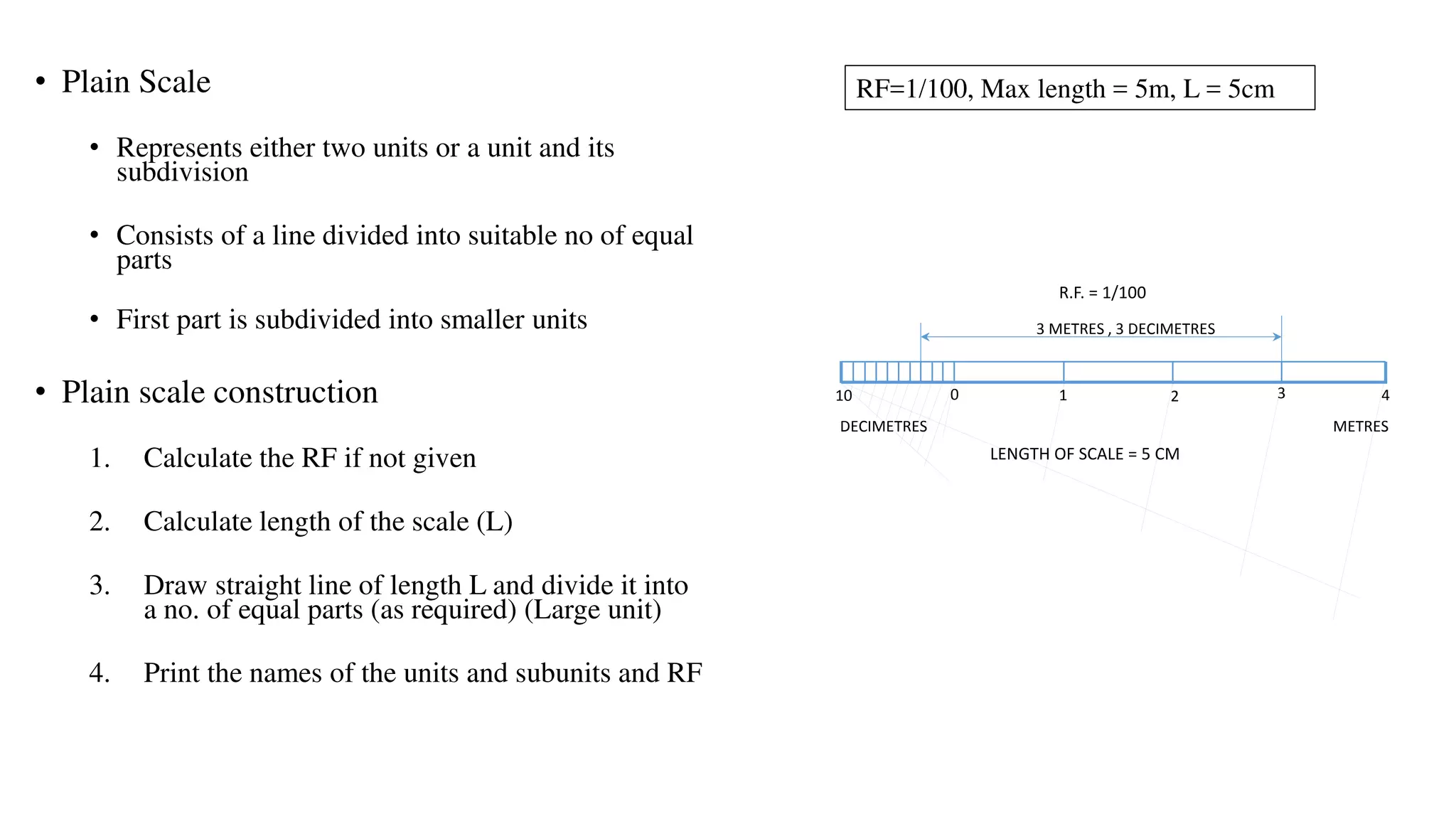
• Plain Scale
• Represents either two units or a unit and its
subdivision
• Consists of a line divided into suitable no of equal
parts
• First part is subdivided into smaller units
• Plain scale construction
1. Calculate the RF if not given
2. Calculate length of the scale (L)
3. Draw straight line of length L and divide it into
a no. of equal parts (as required) (Large unit)
4. Print the names of the units and subunits and RF
RF=1/100, Max length = 5m, L = 5cm
0 1 2 3 410
METRESDECIMETRES
R.F. = 1/100
LENGTH OF SCALE = 5 CM
3 METRES , 3 DECIMETRES
• Diagonal Scale
• Represents three units or a unit and its fraction upto second
place of decimal
• Consists of a line divided into suitable no of equal part
• First part is divided into smallest part by diagonals
• Principle of diagonal division
• To divide AB into 5 equal parts
• Draw BC perpendicular to AB
• Divide BC into 5 equal parts
• Draw line AC
• Draw lines 1- ’ , - ’ , - ’ ……
• From similar triangles
• 1- ’=AB/
• 2- ’= *AB/
A B
C
1’
’
’
’
2
3
4
Q 11: Construct a scale of R.F. 3:200 showing metres, decimetres and centimetres. The
scale should measure upto 6 metres. Show a distance of 4.37 metres.
L = 3/200*6 meters = 9 centimeters
0 1 2 3 4 510
0
10
DECIMETRES
CENTIMETRES
METRES
R. F. = 3/200
LENGTH OF SCALE = 9 CM
4.37 METRES
• Roulettes
• Curves generated by a fixed point on a curve rolling over another curve
without slipping
• Generating and directing curve
• Cycloid, Epicycloid, Hypocycloid and involute
• Important application in profile of gear teeth
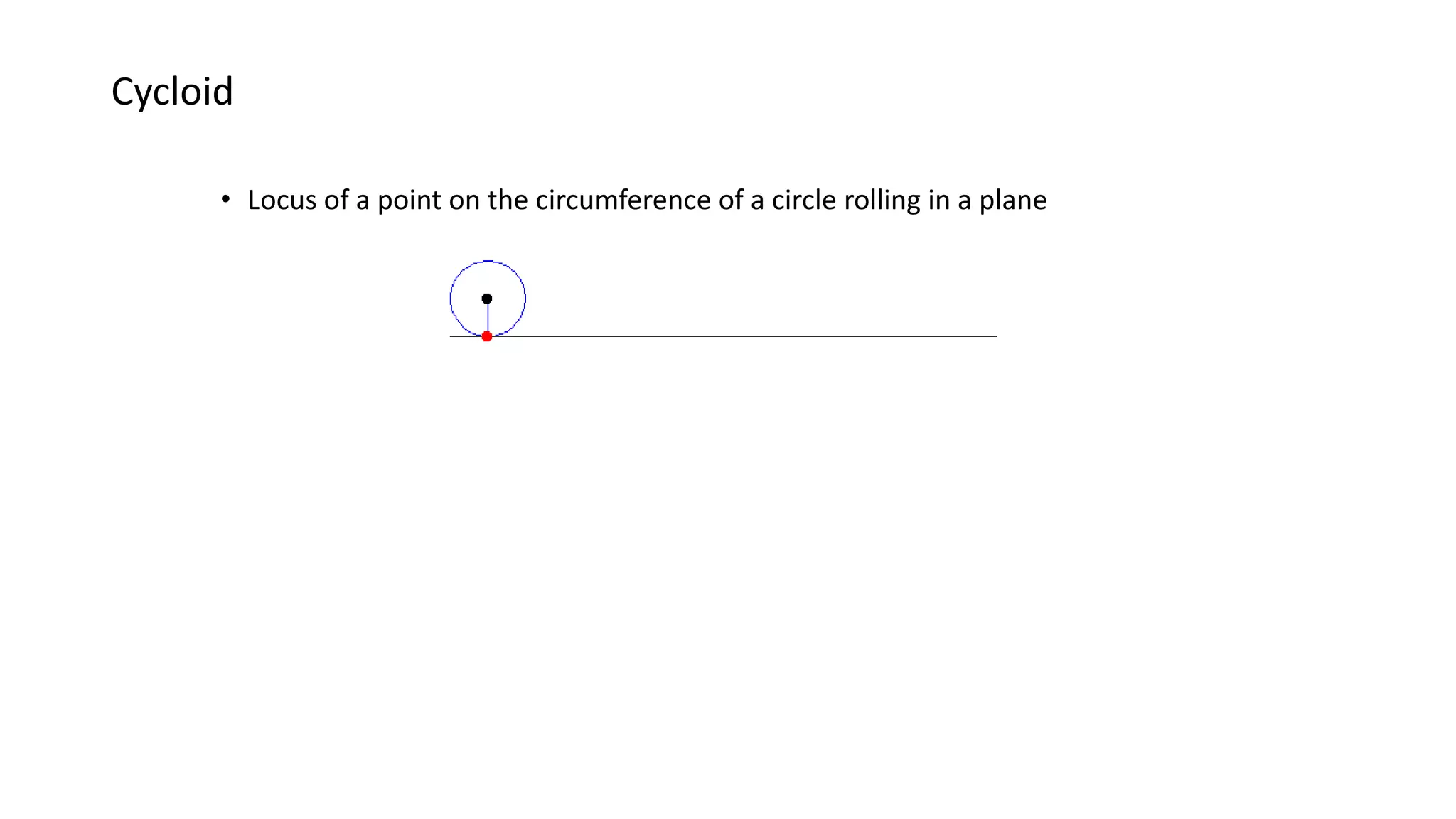
Cycloid
• Locus of a point on the circumference of a circle rolling in a plane
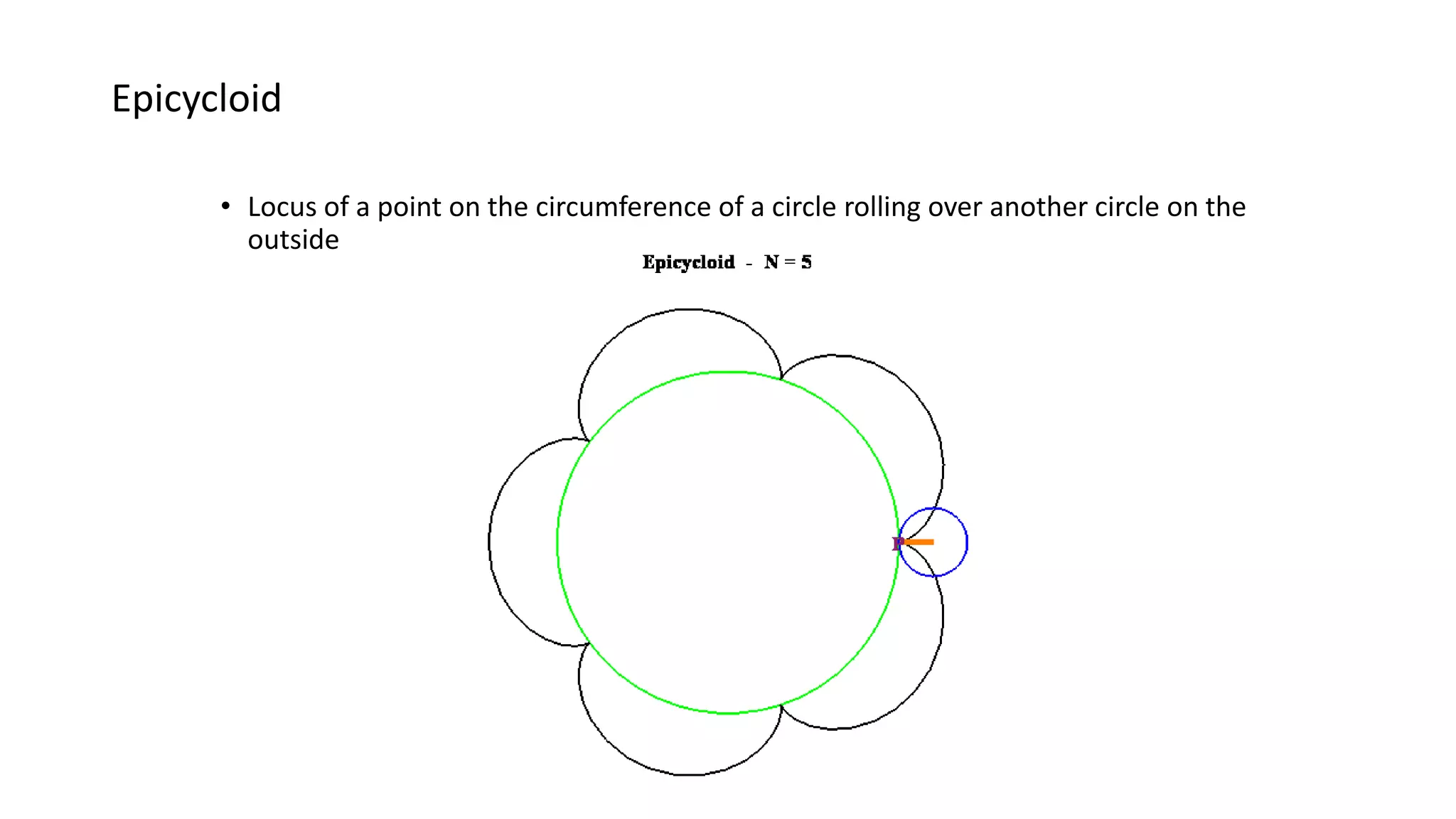
Epicycloid
• Locus of a point on the circumference of a circle rolling over another circle on the
outside
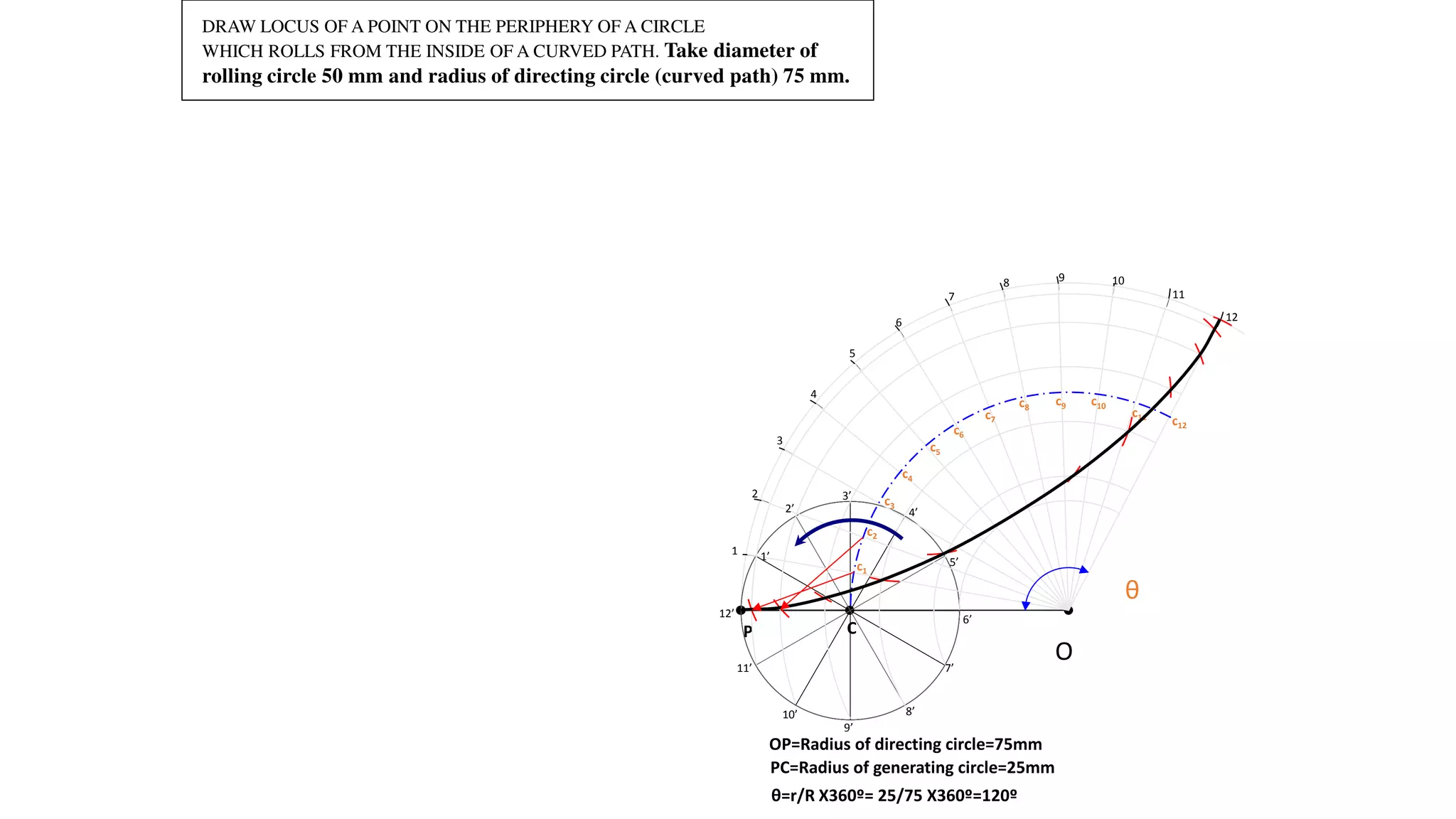
Hypocycloid
• Locus of a point on the circumference of a circle rolling over another circle on the inside
P
C1 C2 C3 C4 C5 C6 C7 C8 C9 C10 C11 C12
p1
p2
p3
p4
p5
p6
p7
p8
D
CYCLOIDDraw locus of a point on the periphery of a circle which rolls on straight line path. Take circle
diameter as 50 mm. Draw normal and tangent on the curve at a point 40 mm above the
directing line.
p9
p10
p11
p121
2
3
5
4
6
7
8
9
10
11
12
O
P
OP=Radius of directing circle=75mm
C
PC=Radius of generating circle=25mm
θ
θ=r/R X360º= 25/75 X360º=120º
1
2
3
4
5
6
7
8 9 10
11
12
’
’’’
’
’
’
’
’
’
’
’
c1
c2
c3
c4
c5
c6
c7
c8
c9 c10
c11
c12
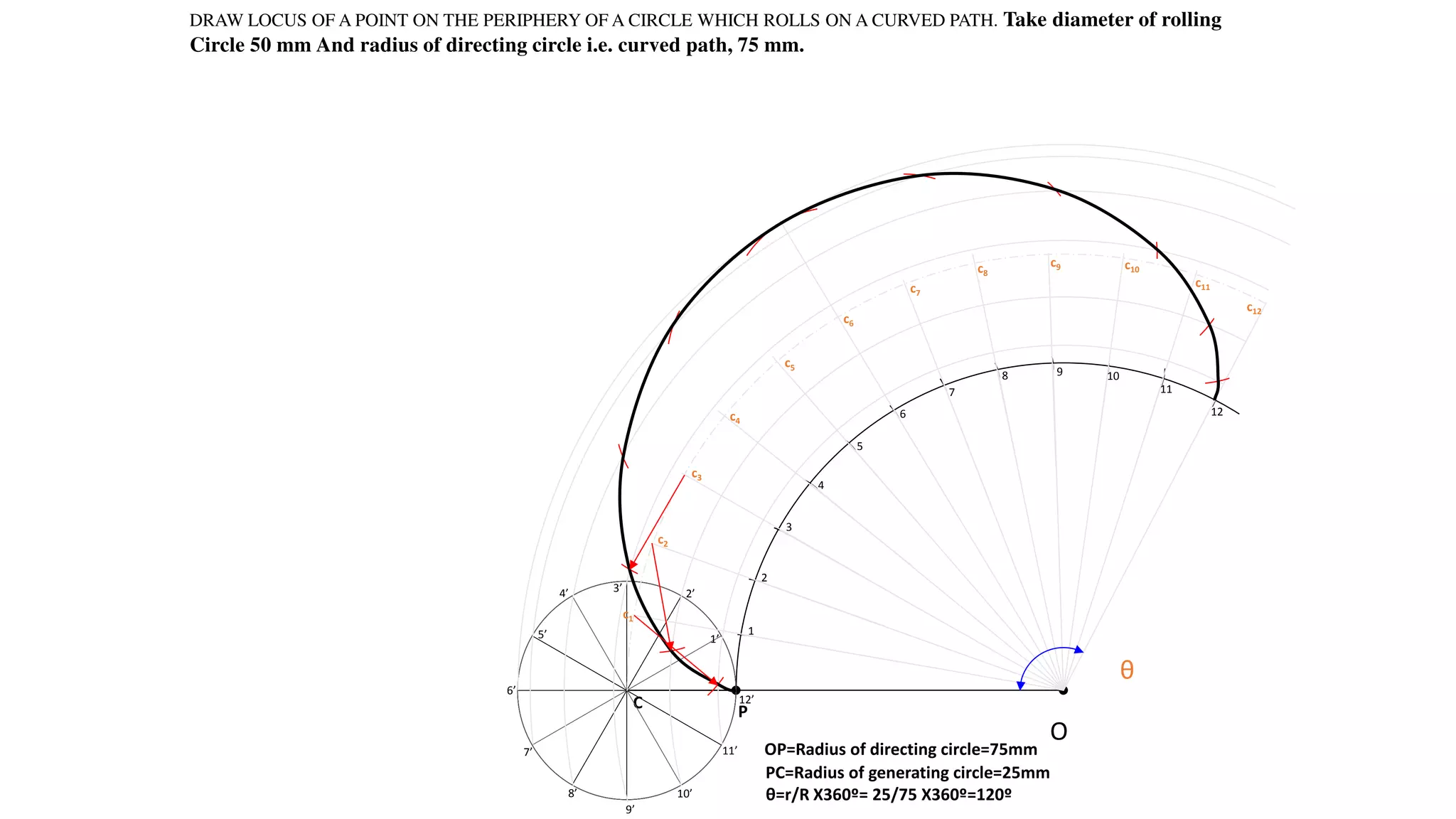
DRAW LOCUS OF A POINT ON THE PERIPHERY OF A CIRCLE WHICH ROLLS ON A CURVED PATH. Take diameter of rolling
Circle 50 mm And radius of directing circle i.e. curved path, 75 mm.
O
P
OP=Radius of directing circle=75mm
C
PC=Radius of generating circle=25mm
θ
θ=r/R X360º= 25/75 X360º=120º
1
2
3
4
5
6
7
8 9 10
11
12
c2
c1
c3
c4
c5
c6
c7
c8
c9 c10
c11
c12
’
’
’
’
’
’
’
’
’
’
’
’
DRAW LOCUS OF A POINT ON THE PERIPHERY OF A CIRCLE
WHICH ROLLS FROM THE INSIDE OF A CURVED PATH. Take diameter of
rolling circle 50 mm and radius of directing circle (curved path) 75 mm.
Draw involute of a square of 25 mm sides
25 100
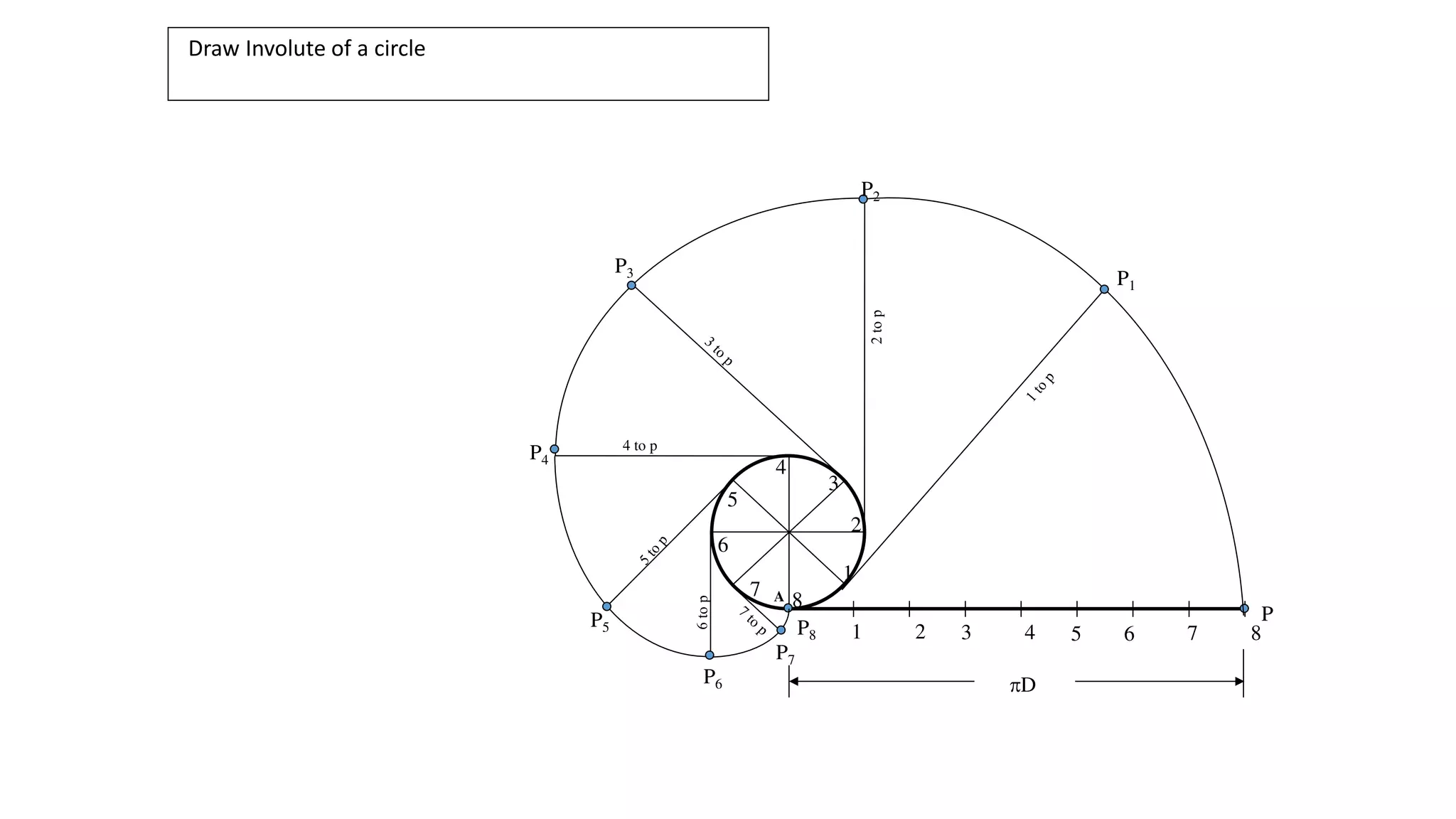
Involute: A spiral curve traced by a point on a chord unwinding from around a polygon or a circle
Draw Involute of a circle
1 2 3 4 5 6 7 8
P
P8
1
2
3
4
5
6
7
8
P3
P4
4 to p
P5
P7
P6
P2
P1
D
A

Scales-engineering drawing b.tech

  • 1.
  • 2.
    • Dimension ofan object on drawing and on real object are not always same • For the ease of reading and handling of the drawing of an object • Dimension of large object is reduced • Similarly small objects are drawn enlarged • This reduction or enlargement creates a scale of that ratio • Representative Factor (RF) L w L • Suppose 2 Km is shown by 20 cm on the drawing • Scale 1:10000 • RF = 1/10000
  • 3.
    • Scale recommendedby BIS (Bureau of Indian Standards) • Full scale 1:1 • Reduced scale 1:2 1:5 1:10 1:50 1:100 1:200 1:1000 1:2000 1:5000 • Enlarged scale 50:1 20:1 10:1 5:1 2:1
  • 4.
    • For constructinga scale, one must know • RF of the scale • The unit it is to represent • Max length required to be measured Length of scale (L) = RF X Max length required to be measured • Types of scale • Plain scale • Diagonal scale • Vernier scale • Isometric scale • Scale of chords • Comparative scale
  • 5.
    • Plain Scale •Represents either two units or a unit and its subdivision • Consists of a line divided into suitable no of equal parts • First part is subdivided into smaller units • Plain scale construction 1. Calculate the RF if not given 2. Calculate length of the scale (L) 3. Draw straight line of length L and divide it into a no. of equal parts (as required) (Large unit) 4. Print the names of the units and subunits and RF RF=1/100, Max length = 5m, L = 5cm 0 1 2 3 410 METRESDECIMETRES R.F. = 1/100 LENGTH OF SCALE = 5 CM 3 METRES , 3 DECIMETRES
  • 6.
    • Diagonal Scale •Represents three units or a unit and its fraction upto second place of decimal • Consists of a line divided into suitable no of equal part • First part is divided into smallest part by diagonals • Principle of diagonal division • To divide AB into 5 equal parts • Draw BC perpendicular to AB • Divide BC into 5 equal parts • Draw line AC • Draw lines 1- ’ , - ’ , - ’ …… • From similar triangles • 1- ’=AB/ • 2- ’= *AB/ A B C 1’ ’ ’ ’ 2 3 4
  • 7.
    Q 11: Constructa scale of R.F. 3:200 showing metres, decimetres and centimetres. The scale should measure upto 6 metres. Show a distance of 4.37 metres. L = 3/200*6 meters = 9 centimeters 0 1 2 3 4 510 0 10 DECIMETRES CENTIMETRES METRES R. F. = 3/200 LENGTH OF SCALE = 9 CM 4.37 METRES
  • 8.
    • Roulettes • Curvesgenerated by a fixed point on a curve rolling over another curve without slipping • Generating and directing curve • Cycloid, Epicycloid, Hypocycloid and involute • Important application in profile of gear teeth
  • 9.
    Cycloid • Locus ofa point on the circumference of a circle rolling in a plane
  • 10.
    Epicycloid • Locus ofa point on the circumference of a circle rolling over another circle on the outside
  • 11.
    Hypocycloid • Locus ofa point on the circumference of a circle rolling over another circle on the inside
  • 12.
    P C1 C2 C3C4 C5 C6 C7 C8 C9 C10 C11 C12 p1 p2 p3 p4 p5 p6 p7 p8 D CYCLOIDDraw locus of a point on the periphery of a circle which rolls on straight line path. Take circle diameter as 50 mm. Draw normal and tangent on the curve at a point 40 mm above the directing line. p9 p10 p11 p121 2 3 5 4 6 7 8 9 10 11 12
  • 13.
    O P OP=Radius of directingcircle=75mm C PC=Radius of generating circle=25mm θ θ=r/R X360º= 25/75 X360º=120º 1 2 3 4 5 6 7 8 9 10 11 12 ’ ’’’ ’ ’ ’ ’ ’ ’ ’ ’ c1 c2 c3 c4 c5 c6 c7 c8 c9 c10 c11 c12 DRAW LOCUS OF A POINT ON THE PERIPHERY OF A CIRCLE WHICH ROLLS ON A CURVED PATH. Take diameter of rolling Circle 50 mm And radius of directing circle i.e. curved path, 75 mm.
  • 14.
    O P OP=Radius of directingcircle=75mm C PC=Radius of generating circle=25mm θ θ=r/R X360º= 25/75 X360º=120º 1 2 3 4 5 6 7 8 9 10 11 12 c2 c1 c3 c4 c5 c6 c7 c8 c9 c10 c11 c12 ’ ’ ’ ’ ’ ’ ’ ’ ’ ’ ’ ’ DRAW LOCUS OF A POINT ON THE PERIPHERY OF A CIRCLE WHICH ROLLS FROM THE INSIDE OF A CURVED PATH. Take diameter of rolling circle 50 mm and radius of directing circle (curved path) 75 mm.
  • 15.
    Draw involute ofa square of 25 mm sides 25 100 Involute: A spiral curve traced by a point on a chord unwinding from around a polygon or a circle
  • 16.
    Draw Involute ofa circle 1 2 3 4 5 6 7 8 P P8 1 2 3 4 5 6 7 8 P3 P4 4 to p P5 P7 P6 P2 P1 D A