The document contains advice from Dr. APJ Abdul Kalam about achieving success. It states that to shine brightly like the sun, one must be willing to burn brightly by working hard. It then quotes Abraham Lincoln saying that to accomplish a big task, it is important to properly prepare in advance.

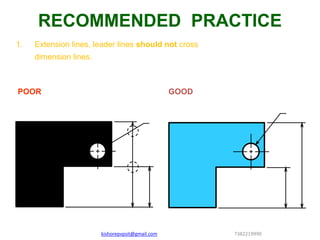
1. Extension lines,leader lines should not cross
dimension lines.
POOR GOOD
RECOMMENDED PRACTICE
kishorepvpsit@gmail.com 7382219990
4.
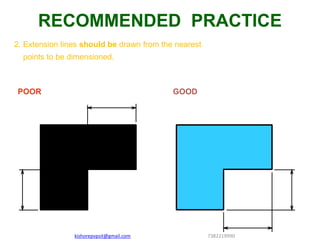
2. Extension linesshould be drawn from the nearest
points to be dimensioned.
POOR GOOD
RECOMMENDED PRACTICE
kishorepvpsit@gmail.com 7382219990
5.
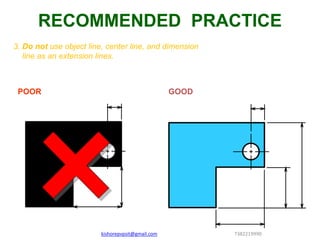
3. Do notuse object line, center line, and dimension
line as an extension lines.
POOR GOOD
RECOMMENDED PRACTICE
kishorepvpsit@gmail.com 7382219990
6.
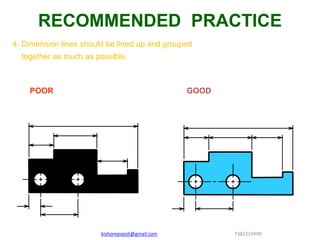
4. Dimension linesshould be lined up and grouped
together as much as possible.
POOR GOOD
RECOMMENDED PRACTICE
kishorepvpsit@gmail.com 7382219990
7.
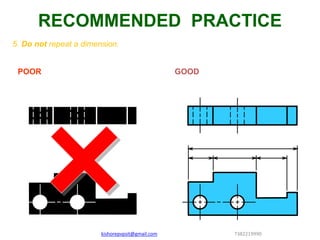
5. Do notrepeat a dimension.
POOR GOOD
RECOMMENDED PRACTICE
kishorepvpsit@gmail.com 7382219990
8.
Arrowheads and dimensionline positioning
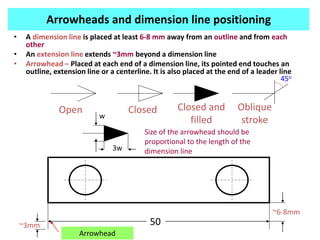
• A dimension line is placed at least 6-8 mm away from an outline and from each
other
• An extension line extends ~3mm beyond a dimension line
• Arrowhead – Placed at each end of a dimension line, its pointed end touches an
outline, extension line or a centerline. It is also placed at the end of a leader line
~3mm 50
Arrowhead
45o
Open Closed Closed and
filled
Oblique
strokew
3w
Size of the arrowhead should be
proportional to the length of the
dimension line
~6-8mm
FOR FULL SIZESCALE
R.F.=1 OR ( 1:1 )
MEANS DRAWING
& OBJECT ARE OF
SAME SIZE.
Other RFs are described
as
1:10, 1:100,
1:1000, 1:1,00,000
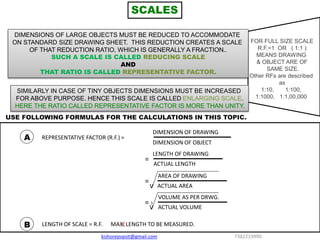
SCALES
DIMENSIONS OF LARGE OBJECTS MUST BE REDUCED TO ACCOMMODATE
ON STANDARD SIZE DRAWING SHEET. THIS REDUCTION CREATES A SCALE
OF THAT REDUCTION RATIO, WHICH IS GENERALLY A FRACTION..
SUCH A SCALE IS CALLED REDUCING SCALE
AND
THAT RATIO IS CALLED REPRESENTATIVE FACTOR.
SIMILARLY IN CASE OF TINY OBJECTS DIMENSIONS MUST BE INCREASED
FOR ABOVE PURPOSE. HENCE THIS SCALE IS CALLED ENLARGING SCALE.
HERE THE RATIO CALLED REPRESENTATIVE FACTOR IS MORE THAN UNITY.
REPRESENTATIVE FACTOR (R.F.) =
=
=
=
A
USE FOLLOWING FORMULAS FOR THE CALCULATIONS IN THIS TOPIC.
B LENGTH OF SCALE = R.F. MAX. LENGTH TO BE MEASURED.X
DIMENSION OF DRAWING
DIMENSION OF OBJECT
LENGTH OF DRAWING
ACTUAL LENGTH
AREA OF DRAWING
ACTUAL AREA
VOLUME AS PER DRWG.
ACTUAL VOLUME
V
V
3
kishorepvpsit@gmail.com 7382219990
11.
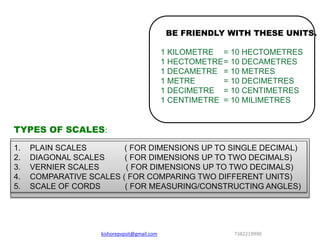
1. PLAIN SCALES( FOR DIMENSIONS UP TO SINGLE DECIMAL)
2. DIAGONAL SCALES ( FOR DIMENSIONS UP TO TWO DECIMALS)
3. VERNIER SCALES ( FOR DIMENSIONS UP TO TWO DECIMALS)
4. COMPARATIVE SCALES ( FOR COMPARING TWO DIFFERENT UNITS)
5. SCALE OF CORDS ( FOR MEASURING/CONSTRUCTING ANGLES)
TYPES OF SCALES:
= 10 HECTOMETRES
= 10 DECAMETRES
= 10 METRES
= 10 DECIMETRES
= 10 CENTIMETRES
= 10 MILIMETRES
1 KILOMETRE
1 HECTOMETRE
1 DECAMETRE
1 METRE
1 DECIMETRE
1 CENTIMETRE
BE FRIENDLY WITH THESE UNITS.
kishorepvpsit@gmail.com 7382219990
12.
0 1 23 4 510
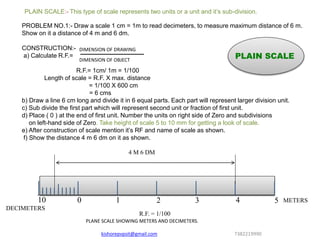
PLAIN SCALE:- This type of scale represents two units or a unit and it’s sub-division.
METERS
DECIMETERS
R.F. = 1/100
4 M 6 DM
PLANE SCALE SHOWING METERS AND DECIMETERS.
PROBLEM NO.1:- Draw a scale 1 cm = 1m to read decimeters, to measure maximum distance of 6 m.
Show on it a distance of 4 m and 6 dm.
CONSTRUCTION:-
a) Calculate R.F.=
R.F.= 1cm/ 1m = 1/100
Length of scale = R.F. X max. distance
= 1/100 X 600 cm
= 6 cms
b) Draw a line 6 cm long and divide it in 6 equal parts. Each part will represent larger division unit.
c) Sub divide the first part which will represent second unit or fraction of first unit.
d) Place ( 0 ) at the end of first unit. Number the units on right side of Zero and subdivisions
on left-hand side of Zero. Take height of scale 5 to 10 mm for getting a look of scale.
e) After construction of scale mention it’s RF and name of scale as shown.
f) Show the distance 4 m 6 dm on it as shown.
DIMENSION OF DRAWING
DIMENSION OF OBJECT
PLAIN SCALE
kishorepvpsit@gmail.com 7382219990
13.
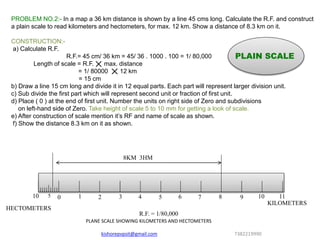
PROBLEM NO.2:- Ina map a 36 km distance is shown by a line 45 cms long. Calculate the R.F. and construct
a plain scale to read kilometers and hectometers, for max. 12 km. Show a distance of 8.3 km on it.
CONSTRUCTION:-
a) Calculate R.F.
R.F.= 45 cm/ 36 km = 45/ 36 . 1000 . 100 = 1/ 80,000
Length of scale = R.F. max. distance
= 1/ 80000 12 km
= 15 cm
b) Draw a line 15 cm long and divide it in 12 equal parts. Each part will represent larger division unit.
c) Sub divide the first part which will represent second unit or fraction of first unit.
d) Place ( 0 ) at the end of first unit. Number the units on right side of Zero and subdivisions
on left-hand side of Zero. Take height of scale 5 to 10 mm for getting a look of scale.
e) After construction of scale mention it’s RF and name of scale as shown.
f) Show the distance 8.3 km on it as shown.
KILOMETERS
HECTOMETERS
8KM 3HM
R.F. = 1/80,000
PLANE SCALE SHOWING KILOMETERS AND HECTOMETERS
0 1 2 3 4 5 6 7 8 9 10 1110 5
PLAIN SCALE
kishorepvpsit@gmail.com 7382219990
14.
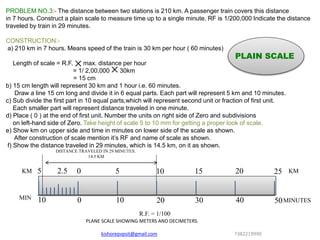
PROBLEM NO.3:- Thedistance between two stations is 210 km. A passenger train covers this distance
in 7 hours. Construct a plain scale to measure time up to a single minute. RF is 1/200,000 Indicate the distance
traveled by train in 29 minutes.
CONSTRUCTION:-
a) 210 km in 7 hours. Means speed of the train is 30 km per hour ( 60 minutes)
Length of scale = R.F. max. distance per hour
= 1/ 2,00,000 30km
= 15 cm
b) 15 cm length will represent 30 km and 1 hour i.e. 60 minutes.
Draw a line 15 cm long and divide it in 6 equal parts. Each part will represent 5 km and 10 minutes.
c) Sub divide the first part in 10 equal parts,which will represent second unit or fraction of first unit.
Each smaller part will represent distance traveled in one minute.
d) Place ( 0 ) at the end of first unit. Number the units on right side of Zero and subdivisions
on left-hand side of Zero. Take height of scale 5 to 10 mm for getting a proper look of scale.
e) Show km on upper side and time in minutes on lower side of the scale as shown.
After construction of scale mention it’s RF and name of scale as shown.
f) Show the distance traveled in 29 minutes, which is 14.5 km, on it as shown.
0 10 20 30 40 5010 MINUTESMIN
R.F. = 1/100
PLANE SCALE SHOWING METERS AND DECIMETERS.
KMKM 0 5 10 15 20 255 2.5
DISTANCE TRAVELED IN 29 MINUTES.
14.5 KM
PLAIN SCALE
kishorepvpsit@gmail.com 7382219990
15.
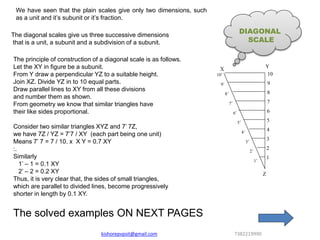
We have seenthat the plain scales give only two dimensions, such
as a unit and it’s subunit or it’s fraction.
1
2
3
4
5
6
7
8
9
10
X Y
Z
The principle of construction of a diagonal scale is as follows.
Let the XY in figure be a subunit.
From Y draw a perpendicular YZ to a suitable height.
Join XZ. Divide YZ in to 10 equal parts.
Draw parallel lines to XY from all these divisions
and number them as shown.
From geometry we know that similar triangles have
their like sides proportional.
Consider two similar triangles XYZ and 7’ 7Z,
we have 7Z / YZ = 7’7 / XY (each part being one unit)
Means 7’ 7 = 7 / 10. x X Y = 0.7 XY
:.
Similarly
1’ – 1 = 0.1 XY
2’ – 2 = 0.2 XY
Thus, it is very clear that, the sides of small triangles,
which are parallel to divided lines, become progressively
shorter in length by 0.1 XY.
The solved examples ON NEXT PAGES
The diagonal scales give us three successive dimensions
that is a unit, a subunit and a subdivision of a subunit.
DIAGONAL
SCALE
kishorepvpsit@gmail.com 7382219990
16.
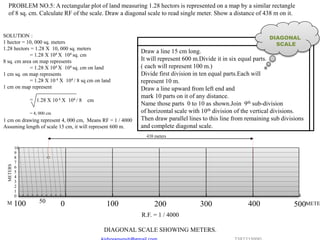
PROBLEM NO.5: Arectangular plot of land measuring 1.28 hectors is represented on a map by a similar rectangle
of 8 sq. cm. Calculate RF of the scale. Draw a diagonal scale to read single meter. Show a distance of 438 m on it.
Draw a line 15 cm long.
It will represent 600 m.Divide it in six equal parts.
( each will represent 100 m.)
Divide first division in ten equal parts.Each will
represent 10 m.
Draw a line upward from left end and
mark 10 parts on it of any distance.
Name those parts 0 to 10 as shown.Join 9th sub-division
of horizontal scale with 10th division of the vertical divisions.
Then draw parallel lines to this line from remaining sub divisions
and complete diagonal scale.
DIAGONAL
SCALE
SOLUTION :
1 hector = 10, 000 sq. meters
1.28 hectors = 1.28 X 10, 000 sq. meters
= 1.28 X 104 X 104 sq. cm
8 sq. cm area on map represents
= 1.28 X 104 X 104 sq. cm on land
1 cm sq. on map represents
= 1.28 X 10 4 X 10⁴ / 8 sq cm on land
1 cm on map represent
= 1.28 X 10 4 X 10⁴ / 8 cm
= 4, 000 cm
1 cm on drawing represent 4, 000 cm, Means RF = 1 / 4000
Assuming length of scale 15 cm, it will represent 600 m.
0 100 200 300 400 500100 50
10
9
8
7
6
5
4
3
2
1
0
METE
METERS
M
438 meters
R.F. = 1 / 4000
DIAGONAL SCALE SHOWING METERS.
17.
10
9
8
7
6
5
4
3
2
1
0
CENTIMETRES
MM
CM
R.F. = 1/ 2.5
DIAGONAL SCALE SHOWING CENTIMETERS.
0 5 10 155 4 3 2 1
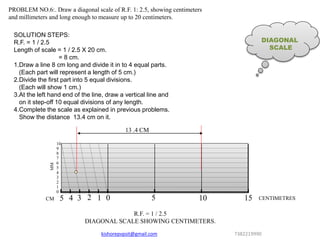
PROBLEM NO.6:. Draw a diagonal scale of R.F. 1: 2.5, showing centimeters
and millimeters and long enough to measure up to 20 centimeters.
SOLUTION STEPS:
R.F. = 1 / 2.5
Length of scale = 1 / 2.5 X 20 cm.
= 8 cm.
1.Draw a line 8 cm long and divide it in to 4 equal parts.
(Each part will represent a length of 5 cm.)
2.Divide the first part into 5 equal divisions.
(Each will show 1 cm.)
3.At the left hand end of the line, draw a vertical line and
on it step-off 10 equal divisions of any length.
4.Complete the scale as explained in previous problems.
Show the distance 13.4 cm on it.
13 .4 CM
DIAGONAL
SCALE
kishorepvpsit@gmail.com 7382219990
18.
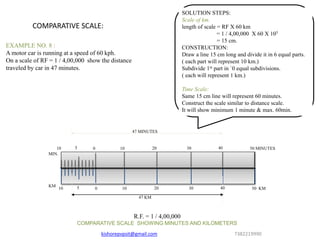
COMPARATIVE SCALE:
EXAMPLE NO.8 :
A motor car is running at a speed of 60 kph.
On a scale of RF = 1 / 4,00,000 show the distance
traveled by car in 47 minutes.
SOLUTION STEPS:
Scale of km.
length of scale = RF X 60 km
= 1 / 4,00,000 X 60 X 105
= 15 cm.
CONSTRUCTION:
Draw a line 15 cm long and divide it in 6 equal parts.
( each part will represent 10 km.)
Subdivide 1st part in `0 equal subdivisions.
( each will represent 1 km.)
Time Scale:
Same 15 cm line will represent 60 minutes.
Construct the scale similar to distance scale.
It will show minimum 1 minute & max. 60min.
10 100 20 305 50 KM40
10 100 20 305 50 MINUTES40
MIN.
KM
47 MINUTES
47 KM
R.F. = 1 / 4,00,000
COMPARATIVE SCALE SHOWING MINUTES AND KILOMETERS
kishorepvpsit@gmail.com 7382219990
19.
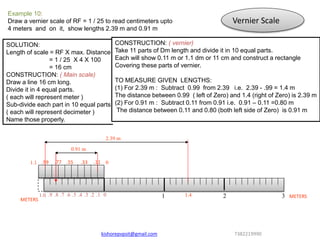
Example 10:
Draw avernier scale of RF = 1 / 25 to read centimeters upto
4 meters and on it, show lengths 2.39 m and 0.91 m
.9 .8 .7 .6 .5 .4 .3 .2 .1
.99 .77 .55 .33 .11 01.1
0 1 2 31.0
SOLUTION:
Length of scale = RF X max. Distance
= 1 / 25 X 4 X 100
= 16 cm
CONSTRUCTION: ( Main scale)
Draw a line 16 cm long.
Divide it in 4 equal parts.
( each will represent meter )
Sub-divide each part in 10 equal parts.
( each will represent decimeter )
Name those properly.
CONSTRUCTION: ( vernier)
Take 11 parts of Dm length and divide it in 10 equal parts.
Each will show 0.11 m or 1.1 dm or 11 cm and construct a rectangle
Covering these parts of vernier.
TO MEASURE GIVEN LENGTHS:
(1) For 2.39 m : Subtract 0.99 from 2.39 i.e. 2.39 - .99 = 1.4 m
The distance between 0.99 ( left of Zero) and 1.4 (right of Zero) is 2.39 m
(2) For 0.91 m : Subtract 0.11 from 0.91 i.e. 0.91 – 0.11 =0.80 m
The distance between 0.11 and 0.80 (both left side of Zero) is 0.91 m
1.4
2.39 m
0.91 m
METERS
METERS
Vernier Scale
kishorepvpsit@gmail.com 7382219990
20.
GIVE ME SIXHOURS TO
CHOP DOWN A TREE AND I
WILL SPEND THE FIRST FOUR
SHARPENING THE AXE.
- Abraham lincoln.