Projection of Solids
DEVELOPMENT OF SURFACES
Polyhedra
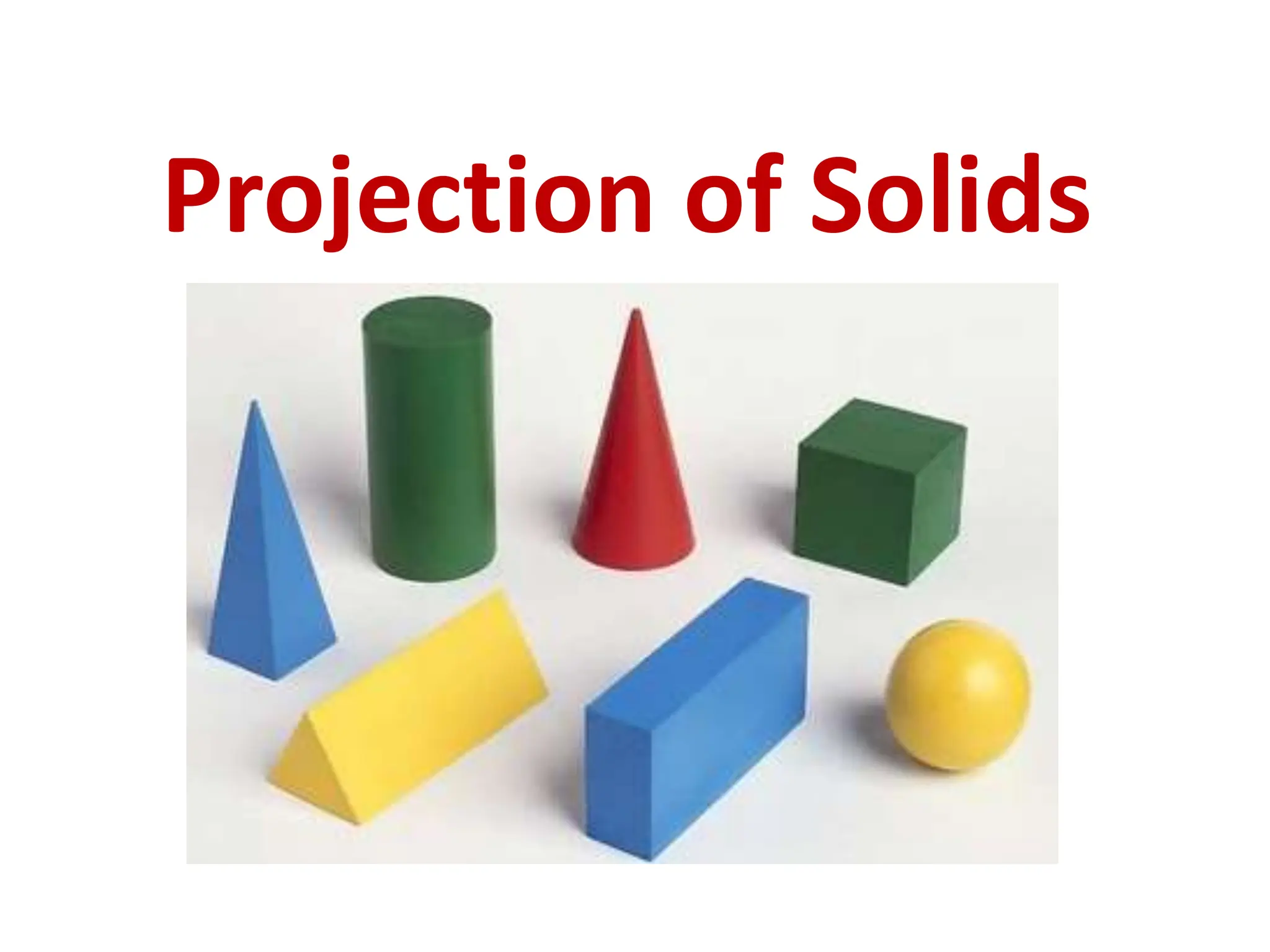
Tetrahedron Cube Octahedron Dodecahedron Icosahedron Prism Pyramid
Hexahedron
Solids of
Revolution
Cylinder Cone Sphere
Special
Oblique
Cylinder Cone Frustum Truncated
Pyramid Cone
Pyramid Cone
(12) (20)
Rectangular
Parallelepiped
SOLIDS
Draw the Projections of a TRIANGULAR PRISM , base 40 mm side and Axis 50
mm long , resting on one of its bases on the H.P. with a vertical face
perpendicular to the V.P.
Draw the projections of a PENTAGONAL PYRAMID, base 30 mm edge and
axis 50 mm long, having its base on the H.P. and an edge of the base parallel
to the V.P. Also draw its side view.
Draw the projections of (i) a CYLINDER, base 40 mm diameter and axis 50 mm long,
and (ii) a CONE, base 40 mm diameter and axis 50 mm long, resting on the H.P. on
their respective bases.
A CUBE of 50 mm long edges is resting on the H.P. with vertical faces equally
inclined to the V.P. Draw its projections.
45⁰
Draw the projections of a HEXAGONAL PYRAMID, base 30 mm side
and axis 60 mm long, having its base on the H.P. and one the edges
of the base inclined at 45⁰ to the V.P.
A TETRAHEDRON of 5 cm long edges is resting on the H.P. on one of its
faces, with an edge of that face parallel to the V.P. Draw its projections
and measure the distance of its apex from the ground
All the four faces of the tetrahedron are equal equilateral triangles of 5
cm side
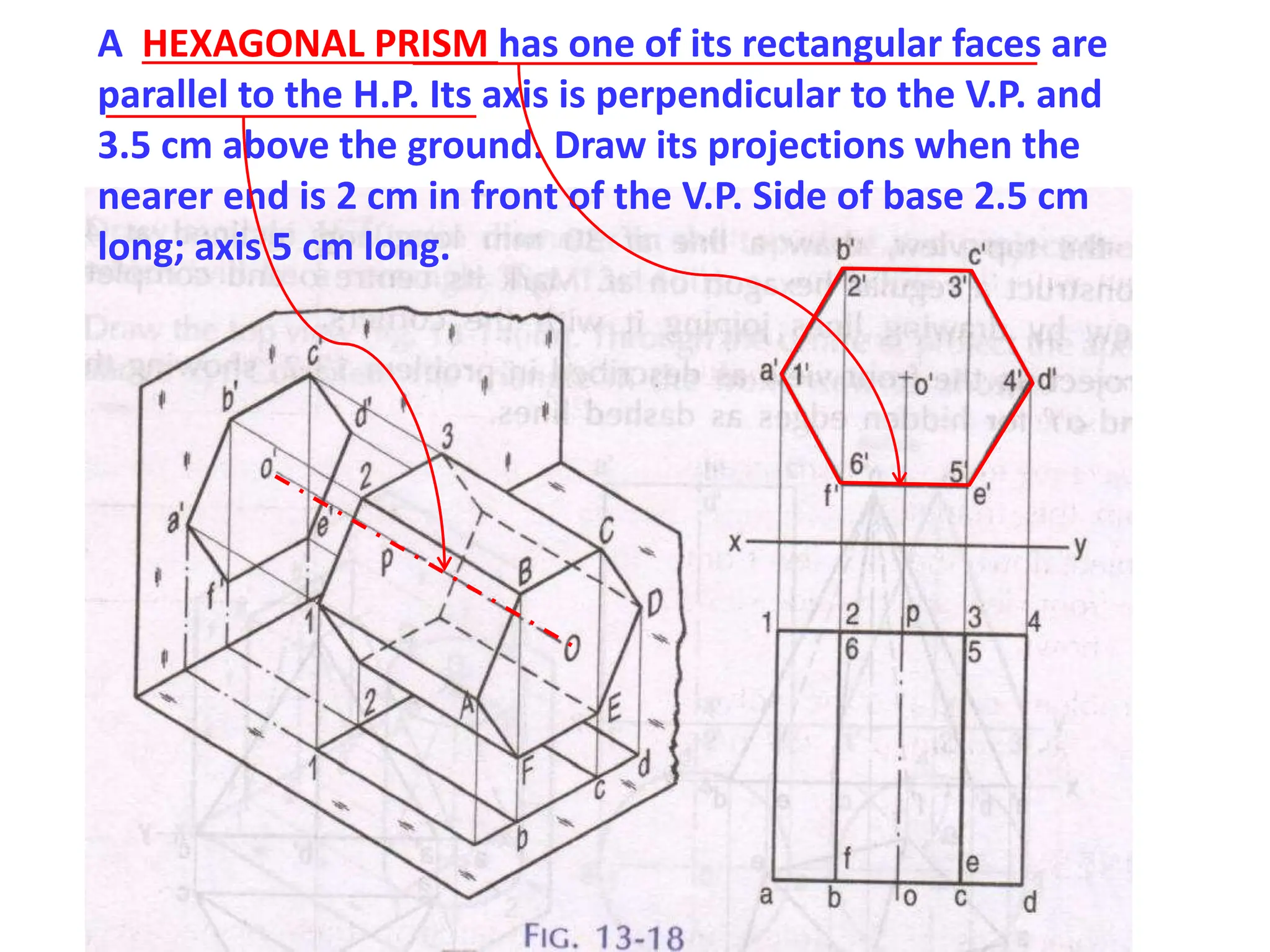
A HEXAGONAL PRISM has one of its rectangular faces are
parallel to the H.P. Its axis is perpendicular to the V.P. and
3.5 cm above the ground. Draw its projections when the
nearer end is 2 cm in front of the V.P. Side of base 2.5 cm
long; axis 5 cm long.
A SQUARE PYRAMID, base 40 mm side and axis 65 mm long,has its base in the V.P. One
edge of the base is inclined at 30⁰ to the H.P. and a corner contained by that edge is on
the H.P. Draw its projections.
A TRIANGULAR PRISM, base 40 mm side and height 65
mm is resting on the H.P. on one of its rectangular faces
with the axis parallel to the V.P. Draw its projections.
Y1
X 1
Draw the projections of a PENTAGONAL PRISM, base 25 mm
side and 50 mm long, resting on one of its rectangular faces
on the H.P., with the axis inclined at 45⁰ to the V.P.
2
1
3
4
5
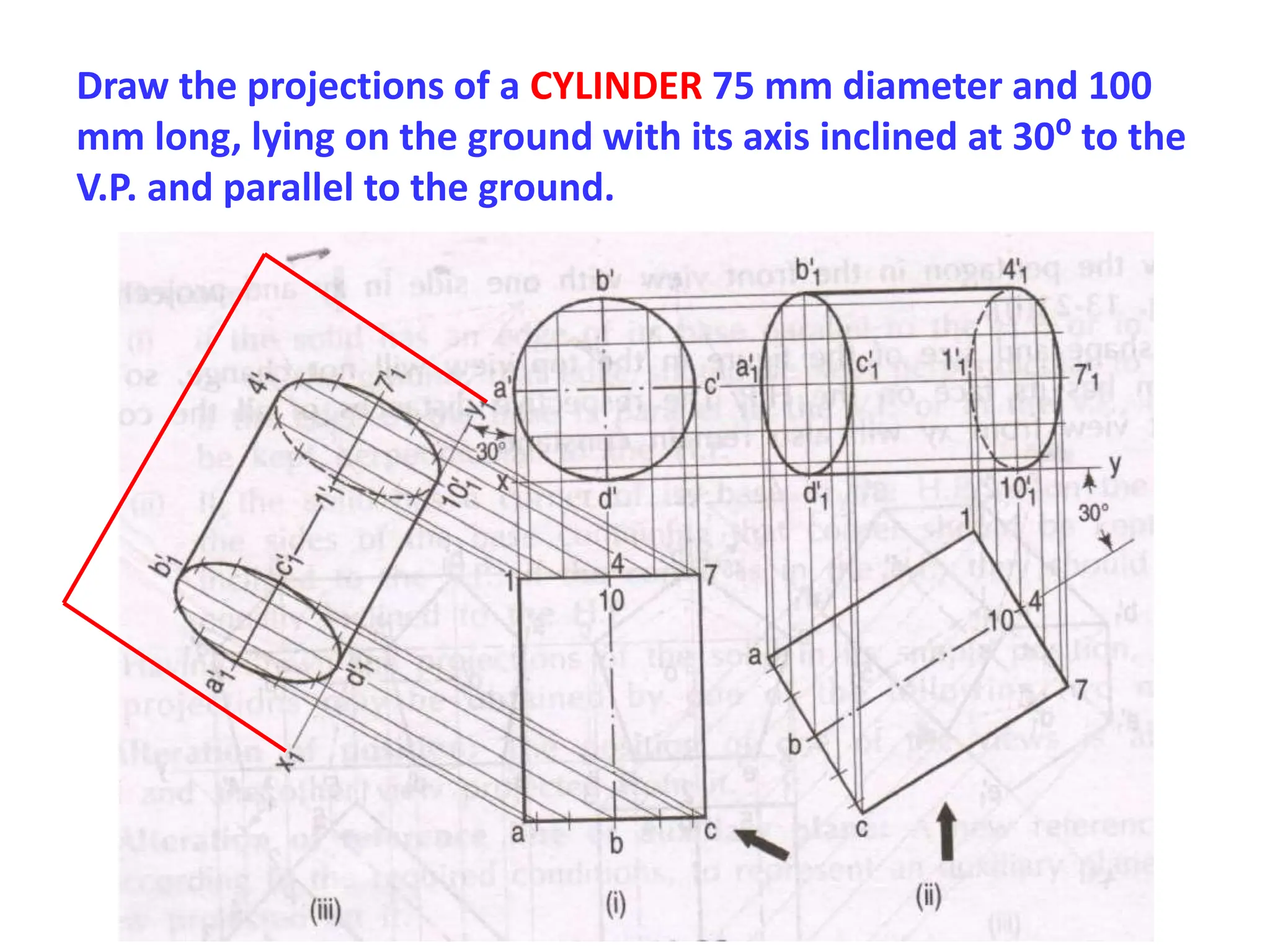
Draw the projections of a CYLINDER 75 mm diameter and 100
mm long, lying on the ground with its axis inclined at 30⁰ to the
V.P. and parallel to the ground.
A HEXAGONAL PYRAMID, base 25 mm side and axis 50 mm long,
has an edge of its base on the ground. Its axis is inclined at 30⁰ to
the ground and parallel to the V.P. Draw its projections.
Draw the projections of a CONE, base 75 mm diameter
and axis 100 mm long, lying on the H.P. on one of its
generations with the axis parallel to the V.P.
A SQUARE PRISM, base 40 mm side and height 65 mm, has its
axis inclined at 45⁰ to the H.P. and has an edge of its base, on
the H.P. and inclined at 30⁰ to the V.P. Draw its projections.
Method 1
A PENTAGONAL PYRAMID, base 25 mm side and axis 50 mm long has one of its
triangular faces in the V.P. and the edge of the base contained by that face makes
an angles of 30⁰ with the H.P. Draw its projections.
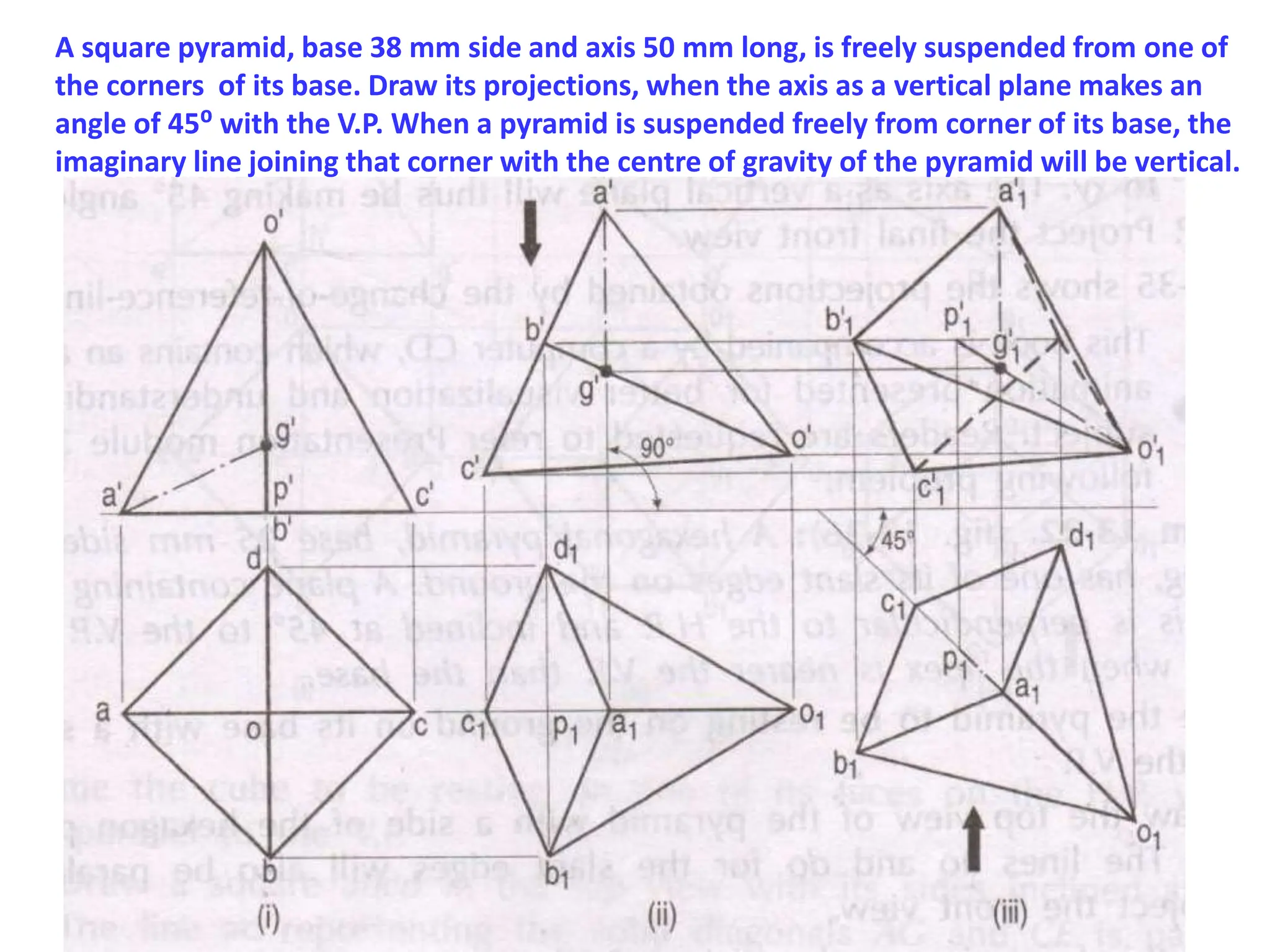
A square pyramid, base 38 mm side and axis 50 mm long, is freely suspended from one of
the corners of its base. Draw its projections, when the axis as a vertical plane makes an
angle of 45⁰ with the V.P. When a pyramid is suspended freely from corner of its base, the
imaginary line joining that corner with the centre of gravity of the pyramid will be vertical.
A hexagonal pyramid, base 25mm side and axis 55mm long, has one of its slant
edges on the ground. A plane containing that edge and the axis is perpendicular to
the H.P. and inclined at 45⁰ to the V.P. Draw its projections when the apex is
nearer the V.P. than the base.
Draw the projections of a cube of 25 mm long edges resting on the H.P.
on one of its corners with a solid diagonal perpendicular to the V.P.
A triangular prism, base 40 mm side and axis 50 mm long, is lying on the H.P.
on one of its rectangular faces with the axis perpendicular to the V.P. A cone,
base 40 mm diameter and axis 50 mm long, is resting on the H.P. and is leaning
centrally on a face of the prism, with its axis parallel to the V.P. Draw the
projections of the solids and project another front view on a reference line
making 60⁰ angle with xy
A pentagonal prism is resting on one of the corners of its base on the H.P. The longer edge
containing that corner is inclined at 45⁰ to the H.P. The axis of the prism makes an angle of
30⁰ to the V.P. Draw the projections of the solid.
Also, draw the projections of the solid when the top view of axis is inclined at 30⁰ to xy.
Take the side of base 45 mm and height 70 mm
A square prism, with the side of its base 40mm and axis 70 mm long
on one of its base edges on the H.P. in such a way that this base
edges makes an angle of 45⁰ with the V.P. and the axis is inclined at
30⁰ to the H.P. Draw the projections of the solid using the “auxiliary
plane method”
A hexagonal prism, with the side of the hexagon 30 mm and height of 70 mm is
resting on the H.P. on one of the edges of its hexagonal base in such a way that, the
edge is at 60⁰ to the V.P. and the base is at 30⁰ to the H.P. Draw to scale 1:1, the
view from the front and the view from the top.
A rectangular pentagonal prism lies with its axis inclined at 60⁰ to the H.P. and
30⁰ to the V.P. The prism is 60 mm long and has a face width of 25 mm. The
nearest corner is 10 mm away from the H.P. Draw the projections of the solid.
A square pyramid of 50 mm side of base and 50 mm length of axis is resting
on one of its triangular faces on the H.P. having a slant edge containing that
face parallel to the V.P. Draw the projections of the pyramid.
A rectangular pentagonal pyramid, base 30 mm side and height 80 mm rests
on one edge of its base on the ground so that the highest point in the base is
30 mm above the ground. Draw its projection when the axis is parallel to the
V.P.
A rectangular pentagonal pyramid with the sides of its base 30 mm and height
80 mm rests on an edge of the base. The base is tilted until its apex is 50 mm
above the level of the edge of the base on which it rests. Draw the projection
of the apex of the pyramid points towards V.P.
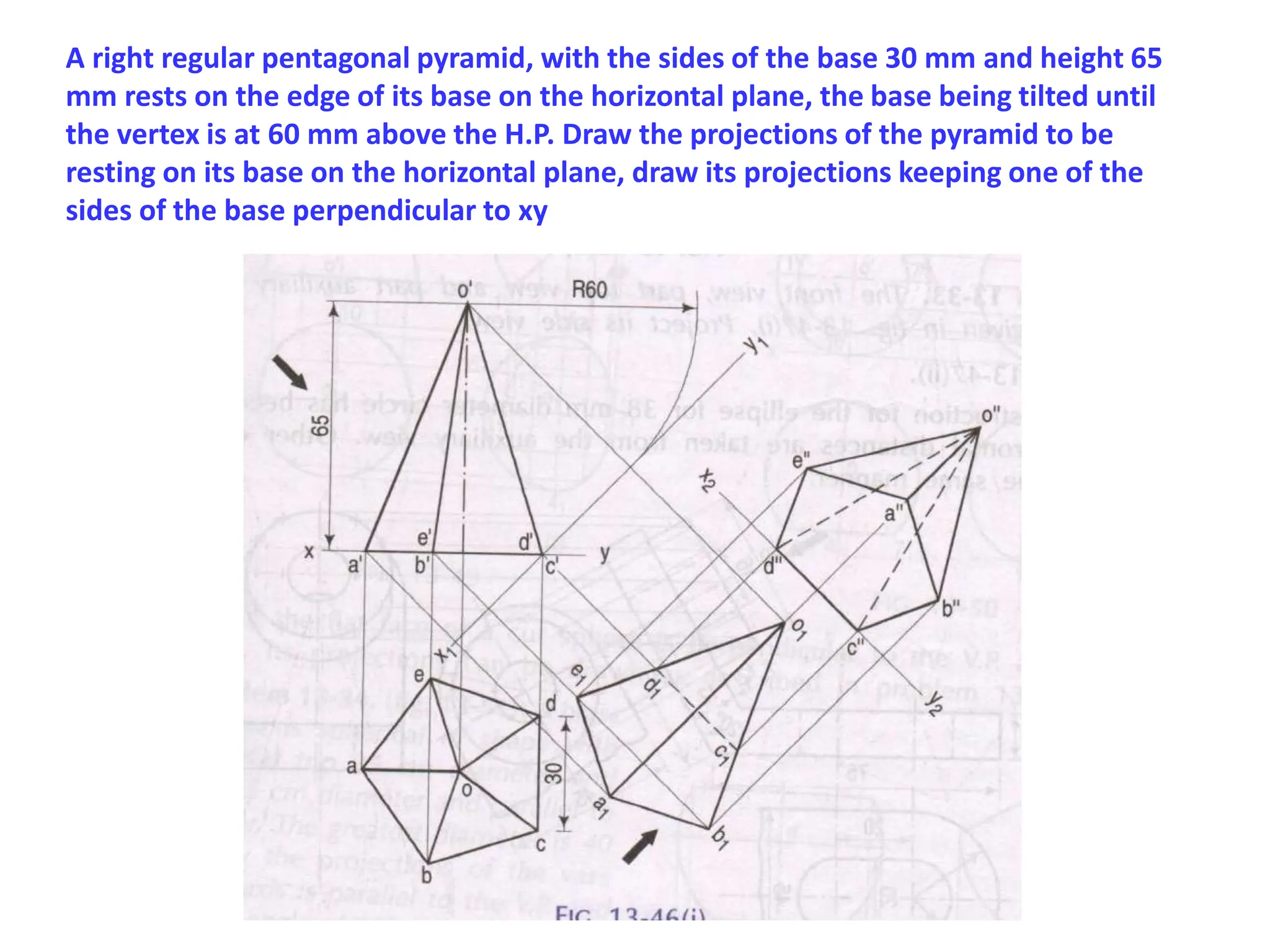
A right regular pentagonal pyramid, with the sides of the base 30 mm and height 65
mm rests on the edge of its base on the horizontal plane, the base being tilted until
the vertex is at 60 mm above the H.P. Draw the projections of the pyramid to be
resting on its base on the horizontal plane, draw its projections keeping one of the
sides of the base perpendicular to xy
670528617-04-Projection-of-Solids presentationpptx

670528617-04-Projection-of-Solids presentationpptx

  • 1.
  • 2.
    DEVELOPMENT OF SURFACES Polyhedra TetrahedronCube Octahedron Dodecahedron Icosahedron Prism Pyramid Hexahedron Solids of Revolution Cylinder Cone Sphere Special Oblique Cylinder Cone Frustum Truncated Pyramid Cone Pyramid Cone (12) (20) Rectangular Parallelepiped SOLIDS
  • 3.
    Draw the Projectionsof a TRIANGULAR PRISM , base 40 mm side and Axis 50 mm long , resting on one of its bases on the H.P. with a vertical face perpendicular to the V.P.
  • 4.
    Draw the projectionsof a PENTAGONAL PYRAMID, base 30 mm edge and axis 50 mm long, having its base on the H.P. and an edge of the base parallel to the V.P. Also draw its side view.
  • 5.
    Draw the projectionsof (i) a CYLINDER, base 40 mm diameter and axis 50 mm long, and (ii) a CONE, base 40 mm diameter and axis 50 mm long, resting on the H.P. on their respective bases.
  • 6.
    A CUBE of50 mm long edges is resting on the H.P. with vertical faces equally inclined to the V.P. Draw its projections. 45⁰
  • 7.
    Draw the projectionsof a HEXAGONAL PYRAMID, base 30 mm side and axis 60 mm long, having its base on the H.P. and one the edges of the base inclined at 45⁰ to the V.P.
  • 8.
    A TETRAHEDRON of5 cm long edges is resting on the H.P. on one of its faces, with an edge of that face parallel to the V.P. Draw its projections and measure the distance of its apex from the ground All the four faces of the tetrahedron are equal equilateral triangles of 5 cm side
  • 9.
    A HEXAGONAL PRISMhas one of its rectangular faces are parallel to the H.P. Its axis is perpendicular to the V.P. and 3.5 cm above the ground. Draw its projections when the nearer end is 2 cm in front of the V.P. Side of base 2.5 cm long; axis 5 cm long.
  • 10.
    A SQUARE PYRAMID,base 40 mm side and axis 65 mm long,has its base in the V.P. One edge of the base is inclined at 30⁰ to the H.P. and a corner contained by that edge is on the H.P. Draw its projections.
  • 11.
    A TRIANGULAR PRISM,base 40 mm side and height 65 mm is resting on the H.P. on one of its rectangular faces with the axis parallel to the V.P. Draw its projections. Y1 X 1
  • 12.
    Draw the projectionsof a PENTAGONAL PRISM, base 25 mm side and 50 mm long, resting on one of its rectangular faces on the H.P., with the axis inclined at 45⁰ to the V.P. 2 1 3 4 5
  • 13.
    Draw the projectionsof a CYLINDER 75 mm diameter and 100 mm long, lying on the ground with its axis inclined at 30⁰ to the V.P. and parallel to the ground.
  • 14.
    A HEXAGONAL PYRAMID,base 25 mm side and axis 50 mm long, has an edge of its base on the ground. Its axis is inclined at 30⁰ to the ground and parallel to the V.P. Draw its projections.
  • 15.
    Draw the projectionsof a CONE, base 75 mm diameter and axis 100 mm long, lying on the H.P. on one of its generations with the axis parallel to the V.P.
  • 16.
    A SQUARE PRISM,base 40 mm side and height 65 mm, has its axis inclined at 45⁰ to the H.P. and has an edge of its base, on the H.P. and inclined at 30⁰ to the V.P. Draw its projections. Method 1
  • 17.
    A PENTAGONAL PYRAMID,base 25 mm side and axis 50 mm long has one of its triangular faces in the V.P. and the edge of the base contained by that face makes an angles of 30⁰ with the H.P. Draw its projections.
  • 18.
    A square pyramid,base 38 mm side and axis 50 mm long, is freely suspended from one of the corners of its base. Draw its projections, when the axis as a vertical plane makes an angle of 45⁰ with the V.P. When a pyramid is suspended freely from corner of its base, the imaginary line joining that corner with the centre of gravity of the pyramid will be vertical.
  • 20.
    A hexagonal pyramid,base 25mm side and axis 55mm long, has one of its slant edges on the ground. A plane containing that edge and the axis is perpendicular to the H.P. and inclined at 45⁰ to the V.P. Draw its projections when the apex is nearer the V.P. than the base.
  • 22.
    Draw the projectionsof a cube of 25 mm long edges resting on the H.P. on one of its corners with a solid diagonal perpendicular to the V.P.
  • 23.
    A triangular prism,base 40 mm side and axis 50 mm long, is lying on the H.P. on one of its rectangular faces with the axis perpendicular to the V.P. A cone, base 40 mm diameter and axis 50 mm long, is resting on the H.P. and is leaning centrally on a face of the prism, with its axis parallel to the V.P. Draw the projections of the solids and project another front view on a reference line making 60⁰ angle with xy
  • 24.
    A pentagonal prismis resting on one of the corners of its base on the H.P. The longer edge containing that corner is inclined at 45⁰ to the H.P. The axis of the prism makes an angle of 30⁰ to the V.P. Draw the projections of the solid. Also, draw the projections of the solid when the top view of axis is inclined at 30⁰ to xy. Take the side of base 45 mm and height 70 mm
  • 26.
    A square prism,with the side of its base 40mm and axis 70 mm long on one of its base edges on the H.P. in such a way that this base edges makes an angle of 45⁰ with the V.P. and the axis is inclined at 30⁰ to the H.P. Draw the projections of the solid using the “auxiliary plane method”
  • 27.
    A hexagonal prism,with the side of the hexagon 30 mm and height of 70 mm is resting on the H.P. on one of the edges of its hexagonal base in such a way that, the edge is at 60⁰ to the V.P. and the base is at 30⁰ to the H.P. Draw to scale 1:1, the view from the front and the view from the top.
  • 28.
    A rectangular pentagonalprism lies with its axis inclined at 60⁰ to the H.P. and 30⁰ to the V.P. The prism is 60 mm long and has a face width of 25 mm. The nearest corner is 10 mm away from the H.P. Draw the projections of the solid.
  • 29.
    A square pyramidof 50 mm side of base and 50 mm length of axis is resting on one of its triangular faces on the H.P. having a slant edge containing that face parallel to the V.P. Draw the projections of the pyramid.
  • 30.
    A rectangular pentagonalpyramid, base 30 mm side and height 80 mm rests on one edge of its base on the ground so that the highest point in the base is 30 mm above the ground. Draw its projection when the axis is parallel to the V.P.
  • 31.
    A rectangular pentagonalpyramid with the sides of its base 30 mm and height 80 mm rests on an edge of the base. The base is tilted until its apex is 50 mm above the level of the edge of the base on which it rests. Draw the projection of the apex of the pyramid points towards V.P.
  • 32.
    A right regularpentagonal pyramid, with the sides of the base 30 mm and height 65 mm rests on the edge of its base on the horizontal plane, the base being tilted until the vertex is at 60 mm above the H.P. Draw the projections of the pyramid to be resting on its base on the horizontal plane, draw its projections keeping one of the sides of the base perpendicular to xy