Engineering
Graphics
Course No. ME 193
Orthographic Projections
of
Machine Parts
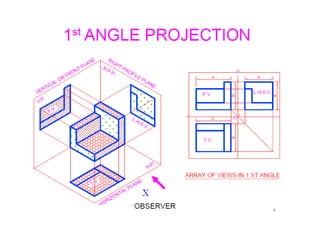
• A method of producing a number of separate two-
dimensional inter-related views.
• These views are drawn mutually at right angle to each
other.
• It is used to represent solid objects by two dimensional
views, as many as are necessary to give all the
information needed, clearly and accurately.
• Depending on the positioning of the object, there are
two forms of orthographic projection:
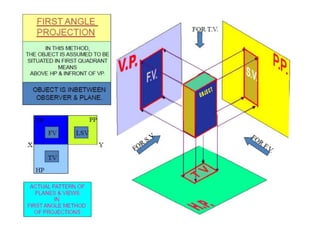
(i) First angle orthographic projection
(ii) Third angle orthographic projection
Definition
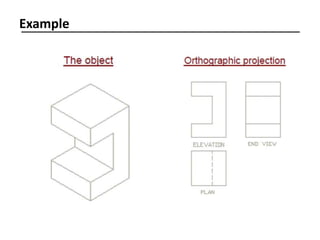
Example
• A point or line is said to be projected
orthographically if the projector is normal to the
plane. Therefore the word orthographic stands for
drawing at right angle.
• Solids consist of points linked by lines. Using a system
of parallel projectors from their boundaries, the lines
(or points) may be projected orthographically on to
any planes.
The principle
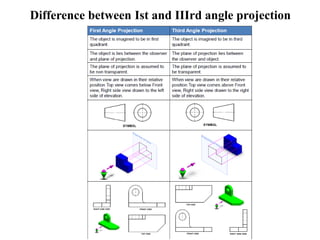
Difference between Ist and IIIrd angle projection
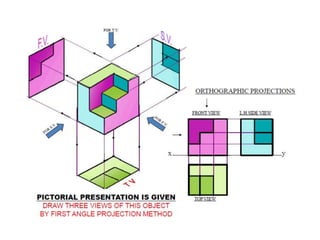
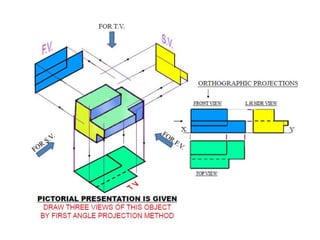
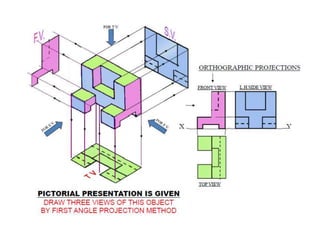
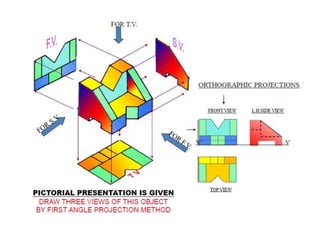
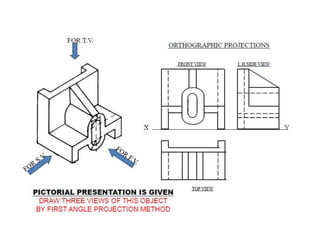
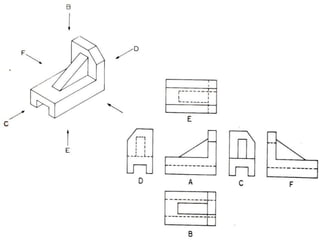
Machine parts orthographic projections

Machine parts orthographic projections

  • 1.
    Engineering Graphics Course No. ME193 Orthographic Projections of Machine Parts
  • 2.
    • A methodof producing a number of separate two- dimensional inter-related views. • These views are drawn mutually at right angle to each other. • It is used to represent solid objects by two dimensional views, as many as are necessary to give all the information needed, clearly and accurately. • Depending on the positioning of the object, there are two forms of orthographic projection: (i) First angle orthographic projection (ii) Third angle orthographic projection Definition
  • 3.
  • 4.
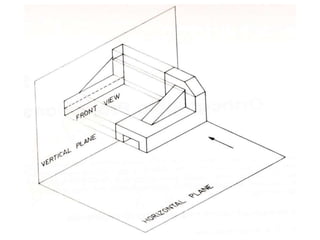
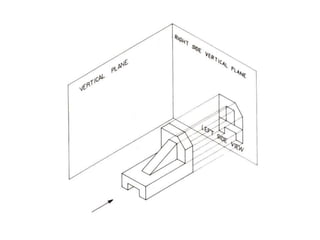
    • A pointor line is said to be projected orthographically if the projector is normal to the plane. Therefore the word orthographic stands for drawing at right angle. • Solids consist of points linked by lines. Using a system of parallel projectors from their boundaries, the lines (or points) may be projected orthographically on to any planes. The principle
  • 7.
    Difference between Istand IIIrd angle projection

Editor's Notes

  • #5 A point or line is said to be projected orthographically if the projector is normal to the plane. Therefore the word orthographic stands for drawing at right angle. Solids consist of points linked by lines. Using a system of parallel projectors from their boundaries, the lines (or points) may be projected orthographically on to any planes. The figures below illustrate how a solid object is projected on to a vertical plane and a horizontal plane, the projectors are being normal to the planes and parallel to each other In practice, orthographic projection uses two principal planes: a vertical plane and a horizontal plane. These two planes intersect each other and produce four quadrants or angles.