Lettering in Engineering Drawing
Lettering is used to provide easy to read and understand
information to supplement a drawing in the form of notes
and annotations.
Thus, it must be written with:
Legibility – shape & space between letters and words.
Uniformity – size & line thickness.
Lettering is an essential element in both traditional drawing
and Computer Aided Design (CAD) drawing
Types of Lettering
The two types of lettering are:
1. Double Stroke Lettering. 2. Single Stroke Lettering.
1. Double Stroke Lettering
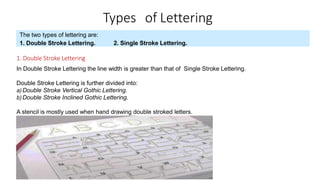
In Double Stroke Lettering the line width is greater than that of Single Stroke Lettering.
Double Stroke Lettering is further divided into:
a)Double Stroke Vertical Gothic Lettering.
b)Double Stroke Inclined Gothic Lettering.
A stencil is mostly used when hand drawing double stroked letters.
2. Single Stroke Lettering
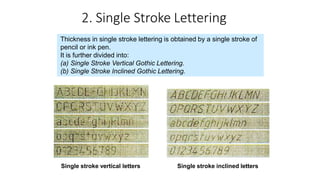
Thickness in single stroke lettering is obtained by a single stroke of
pencil or ink pen.
It is further divided into:
(a) Single Stroke Vertical Gothic Lettering.
(b) Single Stroke Inclined Gothic Lettering.
Single stroke vertical letters Single stroke inclined letters
Conventions for Lettering
•
•
•
•
•
•
Use all CAPITAL LETTERS.
Use even pressure to draw precise, clean lines.
Use one stroke per line.
Horizontal Stroke are drawn left to right.
Vertical Strokes are drawn downward.
Curved strokes are drawn top to bottom in one continuous stroke on
each side.
Use kerning to eliminate excessive space between letters. –
[kerning refers to adjusting the space between characters, especially by
placing two characters closer together than normal. Kerning makes certain
combinations of letters, such as WA, MW, TA, and VA, look better.]
•
Conventions for Lettering (cont.)
•
•
•
•
•
•
•
•
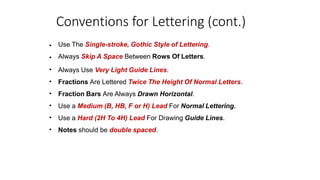
Use The Single-stroke, Gothic Style of Lettering.
Always Skip A Space Between Rows Of Letters.
Always Use Very Light Guide Lines.
Fractions Are Lettered Twice The Height Of Normal Letters.
Fraction Bars Are Always Drawn Horizontal.
Use a Medium (B, HB, F or H) Lead For Normal Lettering.
Use a Hard (2H To 4H) Lead For Drawing Guide Lines.
Notes should be double spaced.
Application of Lettering
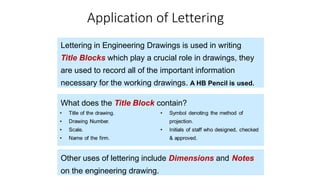
Lettering in Engineering Drawings is used in writing
Title Blocks which play a crucial role in drawings, they
are used to record all of the important information
necessary for the working drawings. A HB Pencil is used.
What does the Title Block contain?
Other uses of lettering include Dimensions and Notes
on the engineering drawing.
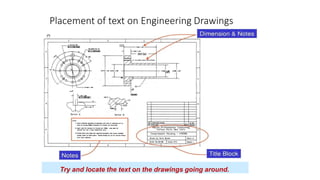
Placement of text on Engineering Drawings
Try and locate the text on the drawings going around.
Guidelines
Extremely light horizontal lines that are necessary to regulate
the height of letters.
In addition, light vertical or inclined guidelines are needed to
keep the letters uniformly vertical or inclined.
Guidelines are absolutely essential for good lettering.
Guidelines are drawn using Hard (2H to 4H) Lead Pencils with
light pressure. HB grade conical end pencils are used for
lettering.
Procedure for Lettering
•
•
•
Thin horizontal guide lines are drawn first at a distance ‘h’ apart.
Lettering Technique: Horizontal lines of the letters are drawn from
left to right. Vertical, inclined and curved lines are drawn from top to
bottom.
After lettering has been completed, the guidelines are not erased.
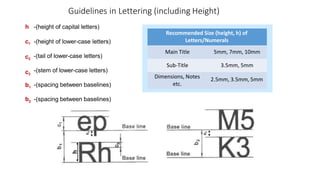
Guidelines in Lettering (including Height)
b1
h -(height of capital letters)
c1 -(height of lower-case letters)
c2
-(tail of lower-case letters)
c3
-(stem of lower-case letters)
-(spacing between baselines)
Recommended Size (height, h) of
Letters/Numerals
Main Title 5mm, 7mm, 10mm
Sub-Title 3.5mm, 5mm
Dimensions, Notes 2.5mm, 3.5mm, 5mm
etc.
h
c2
c2
b2
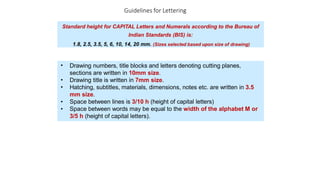
Guidelines for Lettering
•
•
•
•
•
Drawing numbers, title blocks and letters denoting cutting planes,
sections are written in 10mm size.
Drawing title is written in 7mm size.
Hatching, subtitles, materials, dimensions, notes etc. are written in 3.5
mm size.
Space between lines is 3/10 h (height of capital letters)
Space between words may be equal to the width of the alphabet M or
3/5 h (height of capital letters).
Standard height for CAPITAL Letters and Numerals according to the Bureau of
Indian Standards (BIS) is:
1.8, 2.5, 3.5, 5, 6, 10, 14, 20 mm. (Sizes selected based upon size of drawing)
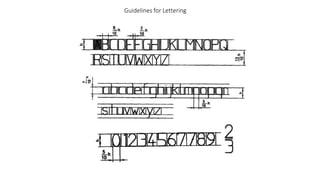
Guidelines for Lettering
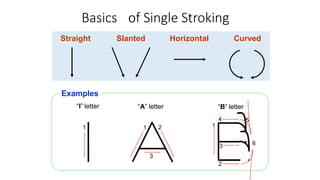
Basics of Single Stroking
Straight Slanted Horizontal Curved
1 1 2
3
“I” letter “A” letter
2
3
4
1
5
6
“B” letter
Examples
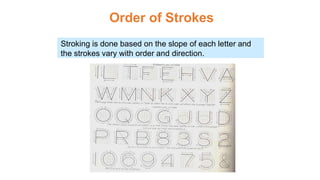
Order of Strokes
Stroking is done based on the slope of each letter and
the strokes vary with order and direction.
Various Single Stroking
Groups
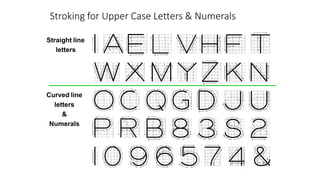
Stroking for Upper Case Letters & Numerals
Straight line
letters
Curved line
letters
&
Numerals
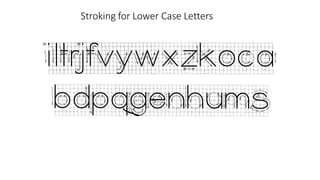
Stroking for Lower Case Letters
Stroking Groups
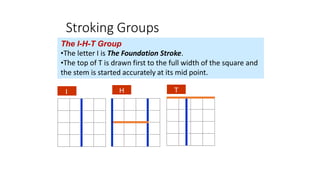
The I-H-T Group
•The letter I is The Foundation Stroke.
•The top of T is drawn first to the full width of the square and
the stem is started accurately at its mid point.
I H T
Stroking Groups
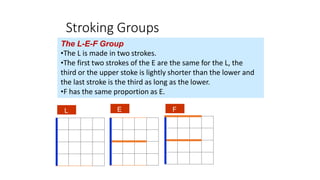
The L-E-F Group
•The L is made in two strokes.
•The first two strokes of the E are the same for the L, the
third or the upper stoke is lightly shorter than the lower and
the last stroke is the third as long as the lower.
•F has the same proportion as E.
L E F
Stroking Groups
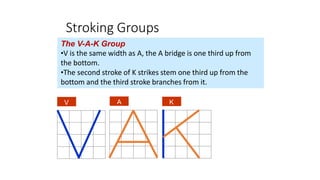
The V-A-K Group
•V is the same width as A, the A bridge is one third up from
the bottom.
•The second stroke of K strikes stem one third up from the
bottom and the third stroke branches from it.
V A K
Stroking Groups
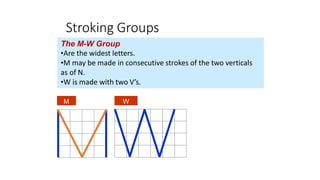
The M-W Group
•Are the widest letters.
•M may be made in consecutive strokes of the two verticals
as of N.
•W is made with two V’s.
M W
Stroking Groups
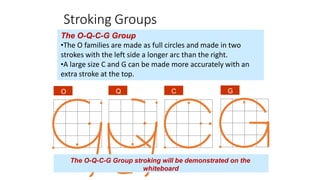
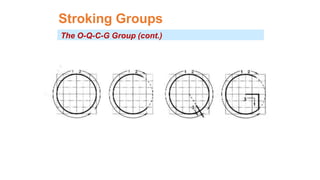
The O-Q-C-G Group
•The O families are made as full circles and made in two
strokes with the left side a longer arc than the right.
•A large size C and G can be made more accurately with an
extra stroke at the top.
O Q C G
The O-Q-C-G Group stroking will be demonstrated on the
whiteboard
Stroking Groups
The O-Q-C-G Group (cont.)
Stroking Groups
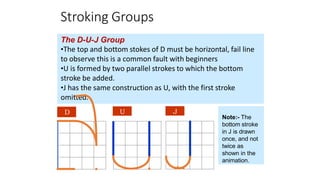
The D-U-J Group
•The top and bottom stokes of D must be horizontal, fail line
to observe this is a common fault with beginners
•U is formed by two parallel strokes to which the bottom
stroke be added.
•J has the same construction as U, with the first stroke
omitted.
D U J
Note:- The
bottom stroke
in J is drawn
once, and not
twice as
shown in the
animation.
Stroking Groups
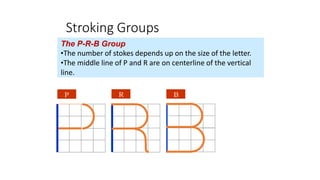
The P-R-B Group
•The number of stokes depends up on the size of the letter.
•The middle line of P and R are on centerline of the vertical
line.
P R B
Stroking Groups
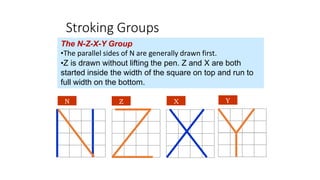
The N-Z-X-Y Group
•The parallel sides of N are generally drawn first.
•Z is drawn without lifting the pen. Z and X are both
started inside the width of the square on top and run to
full width on the bottom.
N Z X Y
Other Stroking Groups
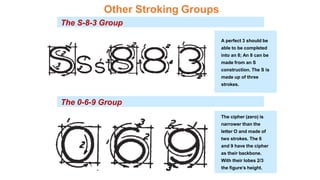
The S-8-3 Group
The 0-6-9 Group
A perfect 3 should be
able to be completed
into an 8; An 8 can be
made from an S
construction. The S is
made up of three
strokes.
The cipher (zero) is
narrower than the
letter O and made of
two strokes. The 6
and 9 have the cipher
as their backbone.
With their lobes 2/3
the figure’s height.
Other Stroking Groups
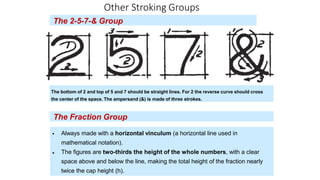
The 2-5-7-& Group
The Fraction Group
•
•
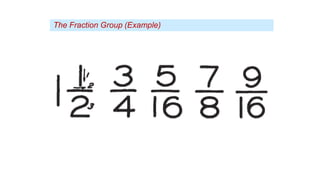
Always made with a horizontal vinculum (a horizontal line used in
mathematical notation).
The figures are two-thirds the height of the whole numbers, with a clear
space above and below the line, making the total height of the fraction nearly
twice the cap height (h).
The bottom of 2 and top of 5 and 7 should be straight lines. For 2 the reverse curve should cross
the center of the space. The ampersand (&) is made of three strokes.
The Fraction Group (Example)
Spacing
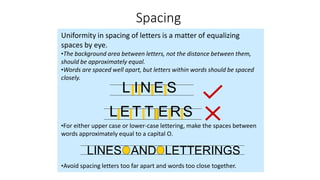
Uniformity in spacing of letters is a matter of equalizing
spaces by eye.
•The background area between letters, not the distance between them,
should be approximately equal.
•Words are spaced well apart, but letters within words should be spaced
closely.
•For either upper case or lower-case lettering, make the spaces between
words approximately equal to a capital O.
LINES AND LETTERINGS
•Avoid spacing letters too far apart and words too close together.
L IN E S
L E T T ERS
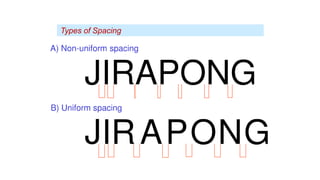
Types of Spacing
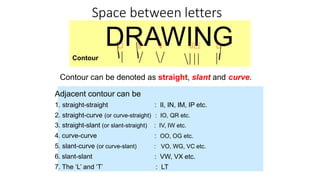
Space between letters
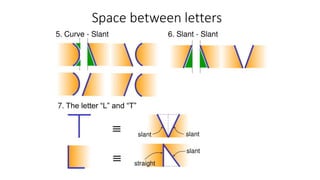
DRAWING
Contour
Contour can be denoted as straight, slant and curve.
Adjacent contour can be
1. straight-straight : II, IN, IM, IP etc.
2. straight-curve (or curve-straight) : IO, QR etc.
3. straight-slant (or slant-straight)
4. curve-curve
5. slant-curve (or curve-slant)
6. slant-slant
7. The ‘L’ and ‘T’
: IV, IW etc.
: OO, OG etc.
: VO, WG, VC etc.
: VW, VX etc.
: LT
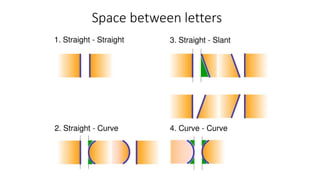
Space between letters
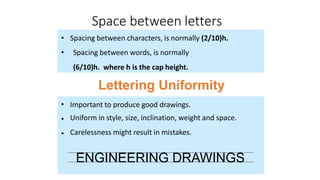
Lettering Uniformity
Important to produce good drawings.•
•
•
Uniform in style, size, inclination, weight and space.
Carelessness might result in mistakes.
ENGINEERING DRAWINGS
Space between letters
• Spacing between characters, is normally (2/10)h.
• Spacing between words, is normally
(6/10)h. where h is the cap height.
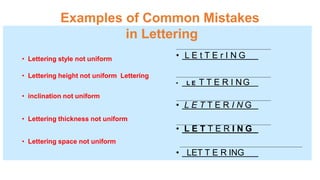
Examples of Common Mistakes
in Lettering
• Lettering style not uniform
• Lettering height not uniform Lettering
• inclination not uniform
• Lettering thickness not uniform
• Lettering space not uniform
• L E t T E r I N G
• L E T T E R I NG
• L E T T E R I N G
• L E T T E R I N G
• LET T E R ING
In Class EXERCISES:
- Refer handouts given
Thank you…

Lettering technique

  • 2.
    Lettering in EngineeringDrawing Lettering is used to provide easy to read and understand information to supplement a drawing in the form of notes and annotations. Thus, it must be written with: Legibility – shape & space between letters and words. Uniformity – size & line thickness. Lettering is an essential element in both traditional drawing and Computer Aided Design (CAD) drawing
  • 3.
    Types of Lettering Thetwo types of lettering are: 1. Double Stroke Lettering. 2. Single Stroke Lettering. 1. Double Stroke Lettering In Double Stroke Lettering the line width is greater than that of Single Stroke Lettering. Double Stroke Lettering is further divided into: a)Double Stroke Vertical Gothic Lettering. b)Double Stroke Inclined Gothic Lettering. A stencil is mostly used when hand drawing double stroked letters.
  • 4.
    2. Single StrokeLettering Thickness in single stroke lettering is obtained by a single stroke of pencil or ink pen. It is further divided into: (a) Single Stroke Vertical Gothic Lettering. (b) Single Stroke Inclined Gothic Lettering. Single stroke vertical letters Single stroke inclined letters
  • 5.
    Conventions for Lettering • • • • • • Useall CAPITAL LETTERS. Use even pressure to draw precise, clean lines. Use one stroke per line. Horizontal Stroke are drawn left to right. Vertical Strokes are drawn downward. Curved strokes are drawn top to bottom in one continuous stroke on each side. Use kerning to eliminate excessive space between letters. – [kerning refers to adjusting the space between characters, especially by placing two characters closer together than normal. Kerning makes certain combinations of letters, such as WA, MW, TA, and VA, look better.] •
  • 6.
    Conventions for Lettering(cont.) • • • • • • • • Use The Single-stroke, Gothic Style of Lettering. Always Skip A Space Between Rows Of Letters. Always Use Very Light Guide Lines. Fractions Are Lettered Twice The Height Of Normal Letters. Fraction Bars Are Always Drawn Horizontal. Use a Medium (B, HB, F or H) Lead For Normal Lettering. Use a Hard (2H To 4H) Lead For Drawing Guide Lines. Notes should be double spaced.
  • 7.
    Application of Lettering Letteringin Engineering Drawings is used in writing Title Blocks which play a crucial role in drawings, they are used to record all of the important information necessary for the working drawings. A HB Pencil is used. What does the Title Block contain? Other uses of lettering include Dimensions and Notes on the engineering drawing.
  • 8.
    Placement of texton Engineering Drawings Try and locate the text on the drawings going around.
  • 9.
    Guidelines Extremely light horizontallines that are necessary to regulate the height of letters. In addition, light vertical or inclined guidelines are needed to keep the letters uniformly vertical or inclined. Guidelines are absolutely essential for good lettering. Guidelines are drawn using Hard (2H to 4H) Lead Pencils with light pressure. HB grade conical end pencils are used for lettering. Procedure for Lettering • • • Thin horizontal guide lines are drawn first at a distance ‘h’ apart. Lettering Technique: Horizontal lines of the letters are drawn from left to right. Vertical, inclined and curved lines are drawn from top to bottom. After lettering has been completed, the guidelines are not erased.
  • 10.
    Guidelines in Lettering(including Height) b1 h -(height of capital letters) c1 -(height of lower-case letters) c2 -(tail of lower-case letters) c3 -(stem of lower-case letters) -(spacing between baselines) -(spacing between baselines) Recommended Size (height, h) of Letters/Numerals Main Title 5mm, 7mm, 10mm Sub-Title 3.5mm, 5mm Dimensions, Notes 2.5mm, 3.5mm, 5mm etc. h c2 c2 b2
  • 11.
    Guidelines for Lettering • • • • • Drawingnumbers, title blocks and letters denoting cutting planes, sections are written in 10mm size. Drawing title is written in 7mm size. Hatching, subtitles, materials, dimensions, notes etc. are written in 3.5 mm size. Space between lines is 3/10 h (height of capital letters) Space between words may be equal to the width of the alphabet M or 3/5 h (height of capital letters). Standard height for CAPITAL Letters and Numerals according to the Bureau of Indian Standards (BIS) is: 1.8, 2.5, 3.5, 5, 6, 10, 14, 20 mm. (Sizes selected based upon size of drawing)
  • 12.
  • 13.
    Basics of SingleStroking Straight Slanted Horizontal Curved 1 1 2 3 “I” letter “A” letter 2 3 4 1 5 6 “B” letter Examples
  • 14.
    Order of Strokes Strokingis done based on the slope of each letter and the strokes vary with order and direction.
  • 15.
  • 16.
    Stroking for UpperCase Letters & Numerals Straight line letters Curved line letters & Numerals
  • 17.
    Stroking for LowerCase Letters
  • 18.
    Stroking Groups The I-H-TGroup •The letter I is The Foundation Stroke. •The top of T is drawn first to the full width of the square and the stem is started accurately at its mid point. I H T
  • 19.
    Stroking Groups The L-E-FGroup •The L is made in two strokes. •The first two strokes of the E are the same for the L, the third or the upper stoke is lightly shorter than the lower and the last stroke is the third as long as the lower. •F has the same proportion as E. L E F
  • 20.
    Stroking Groups The V-A-KGroup •V is the same width as A, the A bridge is one third up from the bottom. •The second stroke of K strikes stem one third up from the bottom and the third stroke branches from it. V A K
  • 21.
    Stroking Groups The M-WGroup •Are the widest letters. •M may be made in consecutive strokes of the two verticals as of N. •W is made with two V’s. M W
  • 22.
    Stroking Groups The O-Q-C-GGroup •The O families are made as full circles and made in two strokes with the left side a longer arc than the right. •A large size C and G can be made more accurately with an extra stroke at the top. O Q C G The O-Q-C-G Group stroking will be demonstrated on the whiteboard
  • 23.
  • 24.
    Stroking Groups The D-U-JGroup •The top and bottom stokes of D must be horizontal, fail line to observe this is a common fault with beginners •U is formed by two parallel strokes to which the bottom stroke be added. •J has the same construction as U, with the first stroke omitted. D U J Note:- The bottom stroke in J is drawn once, and not twice as shown in the animation.
  • 25.
    Stroking Groups The P-R-BGroup •The number of stokes depends up on the size of the letter. •The middle line of P and R are on centerline of the vertical line. P R B
  • 26.
    Stroking Groups The N-Z-X-YGroup •The parallel sides of N are generally drawn first. •Z is drawn without lifting the pen. Z and X are both started inside the width of the square on top and run to full width on the bottom. N Z X Y
  • 27.
    Other Stroking Groups TheS-8-3 Group The 0-6-9 Group A perfect 3 should be able to be completed into an 8; An 8 can be made from an S construction. The S is made up of three strokes. The cipher (zero) is narrower than the letter O and made of two strokes. The 6 and 9 have the cipher as their backbone. With their lobes 2/3 the figure’s height.
  • 28.
    Other Stroking Groups The2-5-7-& Group The Fraction Group • • Always made with a horizontal vinculum (a horizontal line used in mathematical notation). The figures are two-thirds the height of the whole numbers, with a clear space above and below the line, making the total height of the fraction nearly twice the cap height (h). The bottom of 2 and top of 5 and 7 should be straight lines. For 2 the reverse curve should cross the center of the space. The ampersand (&) is made of three strokes.
  • 29.
  • 30.
    Spacing Uniformity in spacingof letters is a matter of equalizing spaces by eye. •The background area between letters, not the distance between them, should be approximately equal. •Words are spaced well apart, but letters within words should be spaced closely. •For either upper case or lower-case lettering, make the spaces between words approximately equal to a capital O. LINES AND LETTERINGS •Avoid spacing letters too far apart and words too close together. L IN E S L E T T ERS
  • 31.
  • 32.
    Space between letters DRAWING Contour Contourcan be denoted as straight, slant and curve. Adjacent contour can be 1. straight-straight : II, IN, IM, IP etc. 2. straight-curve (or curve-straight) : IO, QR etc. 3. straight-slant (or slant-straight) 4. curve-curve 5. slant-curve (or curve-slant) 6. slant-slant 7. The ‘L’ and ‘T’ : IV, IW etc. : OO, OG etc. : VO, WG, VC etc. : VW, VX etc. : LT
  • 33.
  • 34.
  • 35.
    Lettering Uniformity Important toproduce good drawings.• • • Uniform in style, size, inclination, weight and space. Carelessness might result in mistakes. ENGINEERING DRAWINGS Space between letters • Spacing between characters, is normally (2/10)h. • Spacing between words, is normally (6/10)h. where h is the cap height.
  • 36.
    Examples of CommonMistakes in Lettering • Lettering style not uniform • Lettering height not uniform Lettering • inclination not uniform • Lettering thickness not uniform • Lettering space not uniform • L E t T E r I N G • L E T T E R I NG • L E T T E R I N G • L E T T E R I N G • LET T E R ING
  • 37.
    In Class EXERCISES: -Refer handouts given Thank you…